

Key Takeaways
- Modern trading platforms combine broker APIs, market data APIs, algo trading tools, portfolio management, and investor dashboards within one connected ecosystem.
- APIs enable real-time data exchange, order execution, account synchronization, payments, KYC workflows, and integration with third-party financial services.
- Algo tools and investor dashboards help users automate strategies, monitor portfolios, analyze market activity, track performance, and make faster investment decisions.
API & Algo Signals
- Trading APIs can connect live market data, order management systems, broker infrastructure, portfolio records, payment services, and external analytics tools.
- Algo trading tools may support strategy creation, rule-based orders, backtesting, alerts, execution triggers, risk limits, and automated portfolio workflows.
- Secure authentication, API rate limits, WebSockets, audit logs, risk controls, monitoring, and fail-safe mechanisms are essential for reliable automated trading operations.
Investor Dashboard Insights
- Investor dashboards bring holdings, positions, watchlists, profit and loss, asset allocation, order history, market alerts, and performance analytics into one interface.
- Personalized charts, portfolio insights, transaction reports, strategy performance, and real-time notifications can improve visibility and ongoing investor engagement.
- Miracuves develops customizable trading platforms with APIs, algo tools, investor dashboards, market data, order management, portfolio analytics, risk controls, security, and admin management.
Modern trading platforms are no longer just apps where users place buy and sell orders. They are connected fintech ecosystems where APIs move data, algorithmic tools help users act on strategies, and investor dashboards turn complex market activity into clear decisions.
For founders, this distinction matters. A trading product can look polished on the surface but still fail operationally if the API layer is unstable, the order flow is unclear, the dashboard does not explain portfolio performance, or the admin team cannot trace activity when something goes wrong.
That is why modern trading platform development should be planned as a connected architecture, not a collection of screens. APIs, algo tools, investor dashboards, compliance-ready workflows, and admin controls all need to support each other from the beginning.
Miracuves helps fintech founders build source-code-owned and white-label trading platform foundations where the user experience, backend workflows, API connections, dashboards, and operational controls are planned together instead of being added later as disconnected modules.
Why APIs Are the Backbone of Modern Trading Platforms
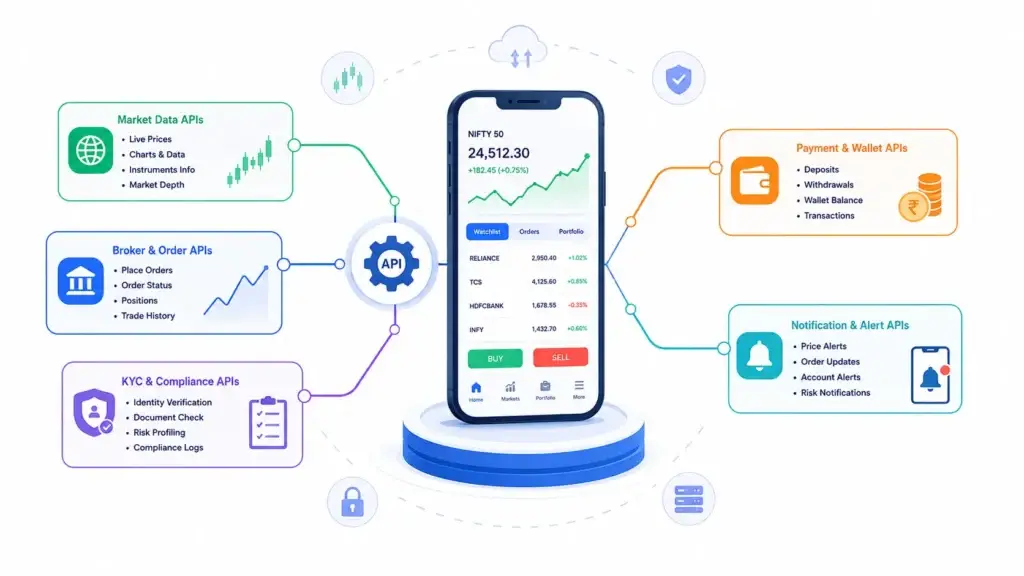
APIs are the connection layer of a trading platform. They allow the app to communicate with market data providers, brokerage systems, payment gateways, KYC providers, analytics tools, notification systems, and internal admin modules. Founders exploring broader finance and investment app solutions should treat APIs as the foundation that connects trading, investing, wallet, reporting, and admin workflows.
Without APIs, a trading platform becomes static. Users may see screens, but the product cannot respond properly to live prices, portfolio changes, order updates, payment activity, or verification events.
For founders who want to go deeper into the integration layer, Miracuves’ guide on fintech API integration best practices explains how connected systems, admin visibility, and integration status tracking help fintech platforms operate more reliably.
In real trading products, APIs usually support five major functions.
Market Data APIs
Market data APIs bring price feeds, instrument details, charts, historical data, market depth, and watchlist updates into the platform. For investors, this is the engagement layer. They open the app to check what is moving, compare instruments, review trends, and decide what action to take.
If market data is slow, incomplete, or poorly formatted, the user loses confidence quickly. This is why the market data layer needs caching, WebSocket delivery, fallback handling, and clean formatting for charts and dashboards.
Broker and Order APIs
Broker APIs connect the platform to trading accounts, order placement, order status, positions, margin details, and trade history. Interactive Brokers, for example, describes its APIs as supporting trading, account management, reporting, real-time account data, historical market data, and algorithmic trading workflows.
For founders, the broker API layer is one of the most sensitive parts of the build. It affects execution clarity, account syncing, user trust, and operational support. If an order fails, the platform should show a clear status, record the event, and give the support or admin team enough context to investigate.
KYC and Compliance APIs
Trading platforms often require user verification, identity checks, document review, risk categorisation, and compliance reporting support. These workflows may vary by country, brokerage model, and asset class.
The right API architecture helps connect KYC providers, AML workflow tools, audit logs, and admin review screens. This does not guarantee legal compliance by itself. Final compliance depends on jurisdiction, licensing, legal review, integrations, and operating model.
Payment and Wallet APIs
A trading product may need deposits, withdrawals, payment gateway integrations, bank account linking, wallet balances, transaction history, and settlement records.
Payment APIs must be designed carefully because user money movement needs accuracy, traceability, reconciliation, and secure access control. For founders, this is not just a feature decision. It is a trust decision.
Notification and Alert APIs
Trading users expect instant communication. They want alerts for price movement, order status, deposits, withdrawals, portfolio changes, margin notices, and account activity.
Notifications should not be treated as simple push messages. They should be connected to event rules, user preferences, audit logs, and risk workflows.
How Algorithmic Tools Fit Into the Trading Experience
Algorithmic tools help users automate or support trading decisions based on rules, signals, market conditions, or strategy logic. This may include price alerts, conditional orders, strategy templates, backtesting, signal engines, portfolio rebalancing rules, or advanced automated execution.
Alpaca positions its APIs around allowing developers and businesses to trade algorithms, build apps, and embed investing into services. This shows how modern trading infrastructure is increasingly developer-friendly and automation-ready.
But algorithmic tools should not be added casually. In trading products, automation increases both product value and operational risk. A poorly tested automation workflow can create wrong orders, user confusion, excessive exposure, or support problems.
A safer algorithmic trading layer should include:
| Algo Tool Layer | What It Does | Why It Matters |
|---|---|---|
| Strategy Builder | Lets users define trading rules or conditions | Helps users act with structure instead of impulse |
| Backtesting | Tests strategies on historical data | Reduces blind deployment of untested ideas |
| Paper Trading | Simulates trading without real funds | Helps users learn before live execution |
| Risk Limits | Sets exposure, order size, stop-loss, and frequency limits | Protects users and platform operators |
| Admin Approval | Allows review of certain strategy types | Supports operational oversight |
| Audit Logs | Records strategy changes, triggers, and order events | Helps with traceability and dispute handling |
| Kill Switch | Stops abnormal strategy behaviour | Reduces damage during unexpected conditions |
FINRA’s guidance on algorithmic trading supervision focuses on areas such as risk assessment, software development, testing, trading systems, and compliance. SEC Rule 15c3-5 also requires brokers with market access to maintain risk management controls and supervisory procedures designed to manage financial and regulatory risks.
The founder takeaway is simple: algorithmic tools should be useful, but they must also be controllable.
Why Investor Dashboards Are More Than Visual Reports
An investor dashboard is the decision layer of a trading platform. It turns data into clarity.
Users do not want to search through multiple screens to understand what happened. They want one place to view holdings, profit and loss, buying power, watchlists, alerts, transactions, deposits, withdrawals, order history, and performance trends.
For readers who want a deeper breakdown of user-facing modules, admin controls, portfolio views, watchlists, order history, and trading workflows, the trading platform features page explains the core modules needed in a stock trading product.
A strong investor dashboard should answer practical user questions:
- What do I own?
- How is my portfolio performing?
- What changed today?
- Which orders are pending, completed, rejected, or cancelled?
- What is my available balance?
- Where is my risk concentrated?
- What action should I consider next?
This is especially important for first-time investors. A dashboard that only shows numbers can feel intimidating. A dashboard that explains activity clearly can improve trust, retention, and product engagement.
How APIs, Algo Tools, and Dashboards Work Together
The real value appears when these three layers are connected.
A market data API sends live price updates. The algorithmic tool checks whether a rule has been triggered. The broker API sends or updates the order. The investor dashboard reflects the order status, portfolio impact, and account activity. The admin dashboard records the event for monitoring, support, and audit purposes.
This is the difference between a trading app and a trading platform.
| Workflow | API Role | Algo Tool Role | Dashboard Role |
| Price Movement | Streams live or delayed market data | Checks trigger conditions | Shows alerts and chart changes |
| Order Placement | Sends order to broker or exchange system | Applies rules and limits | Shows status and execution updates |
| Portfolio Tracking | Syncs holdings, balances, and trade history | Supports rebalancing logic | Displays P&L, allocation, and exposure |
| Risk Monitoring | Pulls margin, exposure, and order data | Enforces limits or warnings | Shows risk signals and account health |
| Admin Oversight | Connects logs, reports, and user activity | Flags abnormal behaviour | Helps operators investigate issues |
For founders, this is where product planning becomes important. If APIs, algorithmic workflows, and dashboards are planned separately, the product can become expensive to maintain. If they are planned together, the platform becomes easier to scale, debug, and improve.
Core Architecture Layers Founders Should Plan Early
A modern trading platform usually needs multiple layers working together. Readers who want the complete build-side view can explore how to build a modern stock trading app, including planning, modules, backend workflows, and launch considerations. This blog focuses specifically on how the API, algorithmic, dashboard, and admin layers should work together.
User App Layer
This is where users register, complete verification, view markets, place orders, track portfolios, manage funds, and review dashboard insights.
The user app should feel simple, but the backend behind it should be strong. Every tap may trigger multiple systems: authentication, market data, portfolio sync, order validation, broker communication, notifications, and logs.
API Gateway Layer
The API gateway controls how frontend apps, internal services, third-party providers, and admin tools communicate.
Miracuves’ API development service references REST, GraphQL, and WebSocket architecture, along with gateway, authentication, monitoring, and rate-limiting workflows.
For trading platforms, this layer is critical because it helps manage speed, security, access control, traffic volume, and integration reliability.
Market Data Layer
The market data layer handles live prices, delayed prices, historical charts, instrument metadata, and watchlists.
It should support formatting, caching, streaming, and fallback logic. If the platform relies on one unstable data path, user experience can break during active market hours.
Order and Broker Layer
This layer manages account syncing, order placement, order updates, rejected orders, cancellation requests, trade confirmations, and portfolio updates.
The goal is not only to send orders. The goal is to make the full trading journey traceable and understandable.
Algorithmic Logic Layer
This layer handles rule-based strategies, alerts, backtesting, simulation, risk checks, and automation triggers.
It should be designed with limits from day one. Founders should avoid launching advanced automation features without clear testing, monitoring, and admin controls.
Dashboard and Analytics Layer
This layer turns platform activity into user and operator visibility.
For users, it shows portfolio performance, holdings, P&L, alerts, order history, and reports. For admins, it shows KYC status, user activity, broker health, risk events, system performance, revenue, and support signals.
Admin and Compliance-Ready Layer
The admin layer is where the business operates. It should help the platform operator manage users, roles, KYC reviews, trading controls, fees, reports, audit logs, payment activity, and support workflows.
This is often the layer founders underestimate. A trading product without admin control becomes difficult to manage once real users, real funds, and real support requests enter the system.
Founder Decision Signals
Speed
If your target users need live market movement, order updates, and instant alerts, API and WebSocket planning should happen before UI polish.
Control
If the platform includes algorithmic tools, the admin layer should include logs, limits, approvals, and emergency controls.
Trust
If users will deposit funds or connect trading accounts, dashboards must show clear balances, orders, portfolio status, and transaction history.
Scalability
If you plan to add more asset classes, brokers, or analytics modules later, the API layer should be modular from the beginning.
Features That Make Investor Dashboards More Useful
A dashboard should not overwhelm users. It should organise information around decisions.
Useful dashboard modules may include:
- Portfolio overview
- Holdings breakdown
- Real-time or delayed P&L
- Watchlists
- Market movers
- Order history
- Transaction history
- Deposits and withdrawals
- Price alerts
- Risk exposure
- Asset allocation
- Performance over time
- Tax or statement exports where applicable
- Education prompts for beginner users
The best dashboards help users understand what happened, what changed, and what needs attention.
For example, instead of only showing “Order Rejected,” the dashboard should explain whether the rejection happened because of insufficient balance, market closure, instrument restrictions, expired order type, broker-side failure, or risk rule violation.
That level of clarity reduces support load and increases user trust.
Monetization Models for API-Driven Trading Platforms
A trading platform should not wait until launch to define revenue logic. Monetization affects product scope, dashboard design, admin reporting, and payment workflows.
Common monetization models include:
| Revenue Model | How It Works | Product Impact |
| Brokerage or Commission | Platform earns per executed trade | Needs accurate order and fee reporting |
| Spread-Based Earnings | Platform earns from buy/sell price differences where legally allowed | Requires transparent pricing logic |
| Premium Analytics | Users pay for advanced charts, signals, or dashboards | Needs subscription management |
| API Access Fees | Developers or partners pay for API usage | Requires API keys, rate limits, and usage tracking |
| Advisory or Research Plans | Users pay for insights or model portfolios | Needs content, alerts, and compliance review |
| White-Label Licensing | Platform is licensed to brokers or financial brands | Needs multi-brand configuration and admin control |
| Referral Partnerships | Platform earns from partner financial products | Needs tracking, attribution, and reporting |
Founders should choose monetization before finalising feature scope. A free dashboard, a paid analytics layer, and an API-access product all need different backend logic. If monetization is the main planning question, the stock trading app business model page explains how a Zerodha-style platform can structure revenue around brokerage logic, subscriptions, premium tools, and platform operations.
Security and Compliance-Ready Workflows Should Start Early
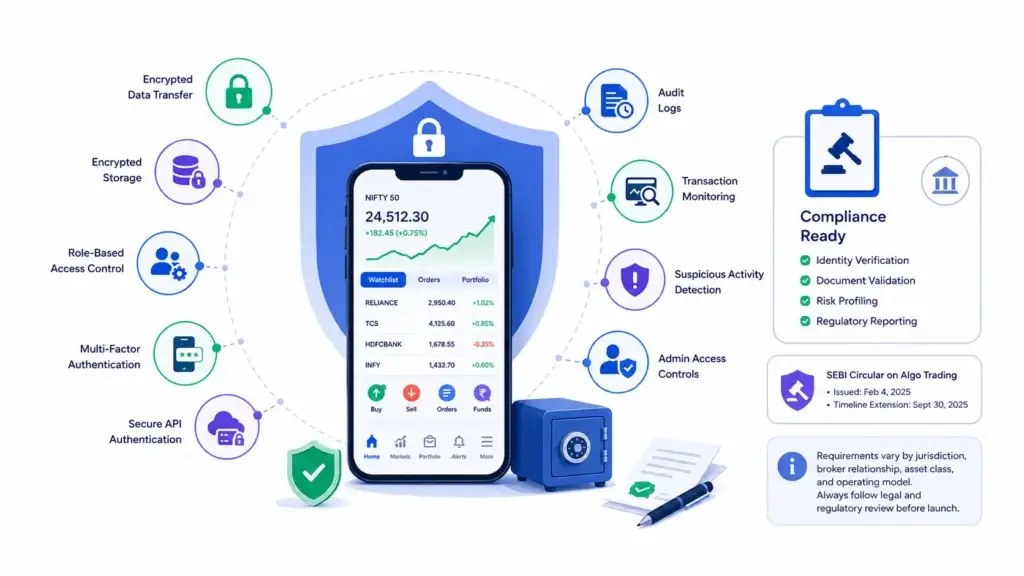
Trading platforms handle sensitive user data, identity documents, financial activity, order history, and account information. Security should be part of the product foundation, not a final checklist.
Important security layers include encrypted data transfer, encrypted storage, role-based access control, multi-factor authentication, secure API authentication, audit logs, transaction monitoring, suspicious activity flags, and admin access controls.
For India-focused algo workflows, SEBI issued a circular on safer participation of retail investors in algorithmic trading on February 4, 2025, and later issued a timeline extension on September 30, 2025.
The practical point for founders is not to treat regulation as a blog paragraph. Requirements can vary by jurisdiction, broker relationship, asset class, and operating model. A trading platform should be built with compliance-ready workflows, but legal and regulatory review must still happen before launch.
Common Mistakes Founders Should Avoid
Building the Dashboard Before Planning the Data Flow
A beautiful dashboard is useless if the underlying data is slow, mismatched, or incomplete. Before designing charts and cards, founders should confirm where each number comes from, how often it updates, and what happens when an API fails.
Adding Algo Tools Without Risk Controls
Algorithmic features can make a platform more attractive, but they also increase operational complexity. Strategy builders, automation triggers, and signal tools should include limits, logs, testing, and monitoring.
Depending on One API Provider Without Fallback Logic
Trading platforms rely heavily on third-party systems. Market data, broker APIs, KYC tools, and payment gateways can face downtime or latency. The platform should handle errors clearly and avoid leaving users confused.
Ignoring the Admin Dashboard
The user app gets attention because it is visible. The admin dashboard runs the business. Without admin visibility, the operator cannot manage KYC, support, risk, payments, user activity, broker status, or reports properly.
Treating Compliance as a Marketing Claim
Founders should avoid saying a platform is fully compliant everywhere unless that claim is verified. Better language is compliance-ready foundation, supports compliance workflows, or can be configured for jurisdiction-specific requirements.
How Miracuves Helps Founders Build Trading Platform Foundations
Miracuves helps founders build trading and investment platform foundations with user apps, API-driven backend workflows, admin dashboards, portfolio modules, security controls, and source-code ownership.
For founders exploring broader fintech product scope, the Miracuves finance and investment app solutions page is the strongest internal next step. It connects this blog to trading, investment, portfolio, and fintech platform development.
For API-heavy builds, founders can also review Miracuves’ API development service, especially when the platform needs REST, GraphQL, WebSocket, gateway, authentication, rate limiting, and monitoring workflows.
If the goal is to understand the wider product scope, Miracuves’ existing modern trading platform guide can support this blog by covering features, pricing factors, and tech stack planning in more detail.
Final Thoughts
Modern trading platforms succeed when speed, intelligence, and trust work together.
APIs keep data moving between market feeds, broker systems, payments, alerts, and admin workflows. Algorithmic tools help users act with more structure. Investor dashboards turn trading activity into clear portfolio insights, while admin systems give platform operators the control they need to manage risk, users, and operations.
For founders, the real decision is not simply whether to add more trading features. It is whether the product foundation can handle live market activity, user growth, operational issues, security expectations, and future expansion. That is why working with a trading platform development company can help align API integrations, dashboard design, admin controls, and launch planning from the beginning.
When APIs, algo tools, and investor dashboards are connected properly, the platform becomes more than a trading interface. It becomes a scalable fintech product foundation built for users, operators, and long-term growth.
FAQs
What is trading platform API integration?
Trading platform API integration connects the app with external and internal systems such as market data providers, broker APIs, payment gateways, KYC providers, notification tools, analytics systems, and admin dashboards.
Why are APIs important in trading platforms?
APIs help trading platforms fetch market data, sync accounts, place orders, update portfolios, verify users, send alerts, and manage reporting. Without a strong API layer, the platform may struggle with speed, accuracy, and scalability.
What are algorithmic trading tools?
Algorithmic trading tools help users create, test, or automate trading actions based on predefined rules, market signals, price movement, portfolio conditions, or strategy logic.
Should every trading platform include algorithmic trading?
No. Not every trading platform needs algorithmic trading in the first release. Founders should add algo tools only when the target users need them and when the platform has proper risk limits, testing, logs, and admin oversight.
What should an investor dashboard include?
An investor dashboard should include portfolio value, holdings, profit and loss, order history, watchlists, alerts, transaction history, account balance, asset allocation, and performance insights.
How do APIs and dashboards work together?
APIs bring data into the platform, while dashboards organise that data for users and admins. For example, a broker API may update order status, and the dashboard shows whether the order is pending, completed, rejected, or cancelled.
What makes a trading platform scalable?
A scalable trading platform usually has modular APIs, reliable market data handling, secure authentication, clear order workflows, admin controls, monitoring, audit logs, and infrastructure that can support more users, asset classes, and integrations.
Can Miracuves help build a trading platform?
Yes. Miracuves helps founders build white-label and custom trading platform foundations with API-driven architecture, investor dashboards, admin workflows, security controls, and source-code ownership.
Miracuves is an independent software development company. We are not affiliated with, connected to, sponsored by, or endorsed by any company or product named in this article.
Terms such as “X Clone” are used descriptively. It is how the software industry refers to building a platform with functionality comparable to a known service, and how clients search for it.
The entire design and codebase of our products is built by our own team. Our products contain no code, design, graphics, or content originating from any third-party website or applications.
All third-party names and marks referenced in this article are the property of their respective owners, referenced solely to identify the services discussed.