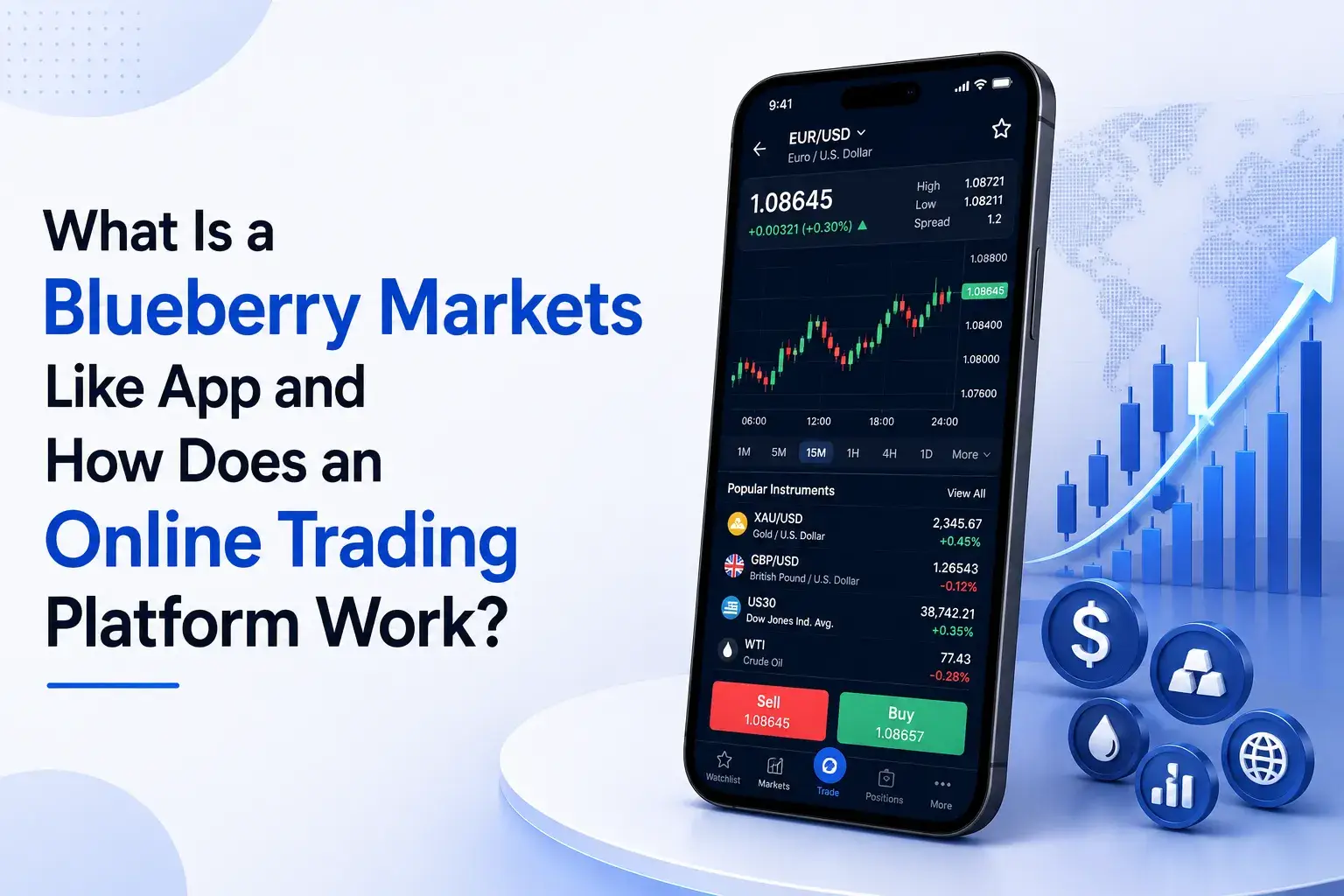
A Blueberry Markets like app is an online trading platform inspired by broker-style products that let users access financial markets through web and mobile interfaces. These platforms usually combine account onboarding, KYC verification, deposits, withdrawals, real-time market data, charts, trading tools, order placement, portfolio tracking, trade history, risk controls, and admin dashboards.
But a serious online trading platform is not just a beautiful app screen with buy and sell buttons.
Behind every trade, there are multiple layers working together: user verification, account funding, live pricing feeds, liquidity connections, margin rules, order execution, transaction records, risk monitoring, notifications, reporting, and compliance workflows. For a founder, understanding these layers is more important than simply copying the user interface of an existing broker.
Blueberry Markets currently positions itself around access to platforms such as MetaTrader 4, MetaTrader 5, TradingView, Blueberry X, and WebTrader, with trading across forex, commodities, indices, and crypto CFDs. This gives founders a useful product reference: modern trading platforms compete on speed, trust, platform access, market coverage, education, execution experience, and account management.
Miracuves helps founders and fintech businesses build ready-made, white-label, and custom app solutions with source code, branded design, admin control, and scalable backend workflows. For trading products, the real goal is not to copy a broker brand. The goal is to build a secure, compliant, user-friendly trading platform foundation aligned with the target market and regulatory requirements.
Key Takeaways
- A Blueberry Markets like app is an online broker-style trading platform that connects users to financial markets through web and mobile trading interfaces.
- An online trading platform works through multiple layers: onboarding, KYC, deposits, market data, charts, order execution, margin rules, risk controls, withdrawals, and admin reporting.
- The frontend trading screen is only one part of the product. The broker back office, liquidity setup, compliance workflows, payment controls, and risk systems are equally important.
- Trading platforms require careful legal, financial, and technical planning because rules differ by jurisdiction, asset class, and business model.
- Miracuves helps founders move from idea to launch faster with ready-made, white-label, and custom fintech app solutions.
What Is a Blueberry Markets Like App?
A Blueberry Markets like app is a trading platform that allows users to open accounts, access market instruments, analyze price movements, place trades, manage positions, and track trading performance.
Depending on the business model, the platform may support:
- Forex trading
- CFD trading
- Commodities
- Indices
- Crypto CFDs
- Shares or stock CFDs
- Demo trading accounts
- Copy trading
- Web trading
- Mobile trading
- MetaTrader or third-party platform integration
- Proprietary trading interface
- TradingView-style charting
- Broker CRM and admin dashboards
The important point is this: a Blueberry Markets-like app is not only a user app. It is a broker operating system.
The user sees charts, account balance, market prices, open positions, profit/loss, and order buttons. The platform owner needs much more: KYC controls, deposit approval, withdrawal processing, user segmentation, leverage rules, risk monitoring, payment records, support tickets, reporting, and compliance-ready workflows.
How Does an Online Trading Platform Work?
An online trading platform works by connecting traders, brokers, market data providers, liquidity providers, payment systems, compliance workflows, and admin teams into one digital ecosystem.
Here is the simplified flow:
- A user signs up and submits identity details.
- The platform verifies the user through KYC and risk checks.
- The user funds the account through a payment method.
- The platform displays live or near-real-time market prices.
- The user studies charts, indicators, spreads, and market movement.
- The user places an order.
- The order is routed for execution based on the broker’s infrastructure.
- The platform updates the user’s open position, margin, equity, and trade history.
- Risk systems monitor exposure, margin levels, and suspicious activity.
- The user can close trades, request withdrawals, and review performance.
- Admin teams monitor users, payments, trades, support, risk, reports, and compliance records.
This is why trading platform development requires deeper planning than many normal fintech apps. A wallet app moves money. A trading platform moves money, market risk, user identity, financial data, and real-time execution logic together.
Read more- Blueberry Markets Clone Script Features and Pricing: Build a Modern Trading Platform in 2026
Key Components of a Blueberry Markets Like App
Core Modules of a Blueberry Markets Like Trading Platform
| Module | What It Does | Founder Impact |
|---|---|---|
| User App | Allows traders to register, verify accounts, deposit funds, view charts, place orders, and track positions. | Creates the trading experience users judge first. |
| WebTrader | Lets users trade through a browser without downloading desktop software. | Improves accessibility for users who prefer browser-based trading. |
| Admin Dashboard | Helps the platform operator manage users, accounts, KYC, transactions, risk rules, support, and reports. | Gives the business control over operations without depending on developers for every action. |
| KYC/AML Workflows | Verifies user identity, screens documents, and supports compliance workflows. | Builds trust and prepares the platform for regulated-market requirements. |
| Market Data Integration | Feeds prices, charts, spreads, historical data, and instrument details into the platform. | Determines how accurate and useful the trading experience feels. |
| Order Management | Handles market orders, pending orders, stop-loss, take-profit, position updates, and trade history. | Controls the core trading workflow. |
| Risk Engine | Monitors margin, leverage, exposure, liquidation rules, suspicious behavior, and trading limits. | Protects the platform from operational and financial risk. |
| Payment Layer | Supports deposits, withdrawals, payment gateway integration, transaction status, and audit records. | Directly affects user trust, cash flow, and support workload. |
The User Journey Inside an Online Trading Platform
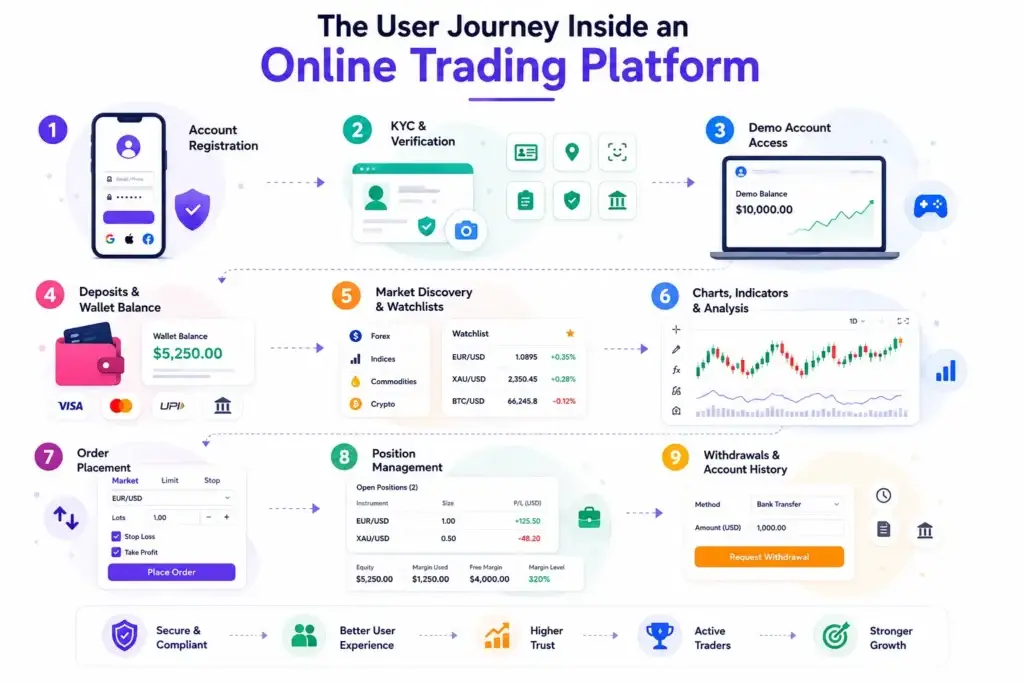
A trader’s journey may look simple, but each step requires careful product design.
1. Account Registration
The user creates an account using email, phone number, password, social login, or broker-specific onboarding. The platform should collect only necessary information at the right stage. Too many fields too early can reduce signups. Too little information can create compliance and support issues later.
2. KYC and Verification
Trading platforms usually require identity verification before users can deposit, trade, or withdraw. KYC workflows may include:
- Government ID upload
- Address verification
- Selfie or liveness check
- Sanctions screening
- Risk questionnaire
- Trading experience questions
- Source-of-funds declaration
- Region-based eligibility checks
This is not only a regulatory process. It is also a trust layer. A serious trading platform should make KYC clear, secure, and easy to complete.
3. Demo Account Access
Many broker-style platforms offer demo accounts so users can practice trading without using real funds. Blueberry’s WebTrader content also explains demo account usage with virtual funds before moving to live markets.
For founders, demo accounts can reduce user anxiety and improve education. New traders can explore charts, test order placement, and understand platform mechanics before funding a live account.
4. Deposits and Wallet Balance
Once verified, users deposit funds. The platform should support secure payment gateway integration, payment status tracking, deposit history, failed payment handling, and admin reconciliation.
For a global trading product, payment complexity can increase quickly. Different regions may need different gateways, banking partners, currency support, settlement rules, and withdrawal workflows.
5. Market Discovery and Watchlists
Users need a clean way to discover instruments. This may include:
- Forex pairs
- Commodities
- Indices
- Crypto instruments
- Most traded instruments
- Favorites
- Watchlists
- Search filters
- Price alerts
- Market news
- Volatility indicators
The watchlist is not a small feature. It becomes the user’s daily entry point into the trading platform.
6. Charts, Indicators, and Market Analysis
Trading platforms compete heavily on chart quality. Users expect candlestick charts, line charts, timeframes, indicators, drawing tools, volume views, price alerts, and historical data.
Blueberry promotes access to MetaTrader, TradingView, and other trading platforms, showing how important professional charting and trading tools are in the broker experience.
For founders, the decision is whether to integrate third-party charting tools or build proprietary charting interfaces. Third-party tools can reduce complexity, while custom charting can offer deeper brand control.
7. Order Placement
The order placement screen is where product trust is tested.
Users may need:
- Market orders
- Limit orders
- Stop orders
- Stop-loss
- Take-profit
- Lot size or quantity input
- Margin preview
- Estimated fees
- Spread visibility
- Confirmation screen
- Trade execution status
The platform should not make risky actions confusing. Clear order confirmation, warnings, and risk labels are important.
8. Position Management
After execution, users need to manage open trades.
The platform should show:
- Open positions
- Entry price
- Current price
- Profit/loss
- Margin used
- Free margin
- Equity
- Swap or overnight charges if applicable
- Stop-loss and take-profit levels
- Close trade option
- Trade history
For active traders, position management must be fast, accurate, and reliable.
9. Withdrawals and Account History
Withdrawals are one of the biggest trust moments in online trading. A platform may look polished, but users judge credibility by how clearly deposits, profits, losses, fees, and withdrawals are handled.
Important withdrawal features include:
- Withdrawal request form
- Bank or payment method selection
- Withdrawal status tracking
- Admin approval workflow
- Fraud monitoring
- Compliance review
- Transaction history
- User notifications
- Audit logs
What Happens Behind the Scenes When a User Places a Trade?
When a user taps “Buy” or “Sell,” several things happen in the background.
The platform checks whether the user is eligible to trade, whether the account is verified, whether there is enough margin, whether the instrument is available, whether the market is open, and whether the order meets the broker’s rules. Then it sends the order through the trading infrastructure for execution.
Depending on the platform model, execution may involve:
- Broker system
- Liquidity provider
- Trading bridge
- Order management system
- MetaTrader server
- Risk engine
- Internal matching logic
- External venue or exchange connection
The user only sees the final result: trade opened, trade rejected, order pending, or execution failed. But the business must monitor every step.
That is why online trading platform development needs strong backend architecture. A slow or unreliable execution flow can create user frustration, financial exposure, and regulatory risk.
Read more- Why Fintech Startups Choose a Blueberry Markets Clone Over Building a Trading Platform From Scratch
Blueberry Markets Like App vs Stock Trading App vs Crypto Exchange
A Blueberry Markets-like app may look similar to other trading platforms, but the business logic can be very different.
| Platform Type | Core Product Logic | Common Assets | Key Complexity |
|---|---|---|---|
| Blueberry Markets Like Broker App | Broker-style trading access with forex, CFDs, market data, margin, and platform integrations. | Forex, commodities, indices, crypto CFDs, stock CFDs depending on jurisdiction. | KYC, leverage, margin, execution, liquidity, risk controls, broker compliance. |
| Stock Trading App | Lets users buy and sell listed securities through brokerage or exchange connections. | Stocks, ETFs, options, fractional shares. | Brokerage licensing, exchange integration, custody, settlement, market data. |
| Crypto Exchange | Lets users buy, sell, swap, deposit, and withdraw digital assets. | Crypto spot pairs, tokens, stablecoins, sometimes derivatives. | Wallet security, liquidity, order books, custody, withdrawal controls, blockchain monitoring. |
| Investment App | Helps users invest in portfolios, mutual funds, robo-advisory, or wealth products. | Funds, portfolios, ETFs, savings products. | Suitability, portfolio logic, advisory rules, reporting, recurring investments. |
For founders, this distinction matters. A trading app is not one universal product. The architecture depends on the asset class, jurisdiction, risk model, and regulatory pathway.
Essential Features of a Blueberry Markets Like App
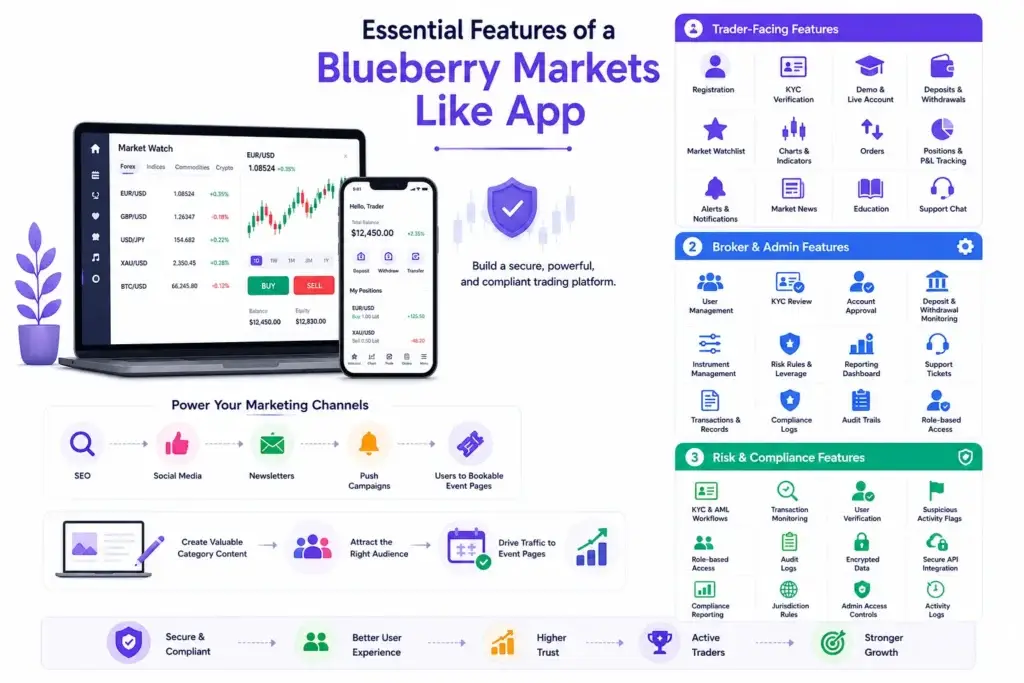
A founder planning to build a Blueberry Markets-like trading platform should think in terms of product layers, not only app screens.
Trader-Facing Features
The trader app should include:
- User registration and login
- KYC verification
- Demo account
- Live account
- Deposits and withdrawals
- Multi-currency wallet or balance view
- Market watchlist
- Real-time or near-real-time price data
- Trading charts
- Technical indicators
- Buy and sell order placement
- Stop-loss and take-profit
- Open positions
- Order history
- Profit/loss tracking
- Notifications and alerts
- Market news
- Education resources
- Support chat or ticketing
Broker and Admin Features
The admin side should include:
- User management
- KYC review
- Account approval
- Deposit monitoring
- Withdrawal approval
- Transaction records
- Instrument management
- Spread or fee settings where applicable
- Risk rules
- Leverage controls
- User segmentation
- Support tickets
- Reporting dashboard
- Compliance logs
- Audit trails
- Role-based admin access
Risk and Compliance Features
A fintech trading platform should support:
- KYC workflows
- AML workflow support
- Transaction monitoring
- User verification
- Suspicious activity flags
- Role-based access control
- Audit logs
- Encrypted data transfer
- Encrypted data storage
- Secure API integration
- Admin access controls
- Activity logs
- Compliance-ready reporting
- Jurisdiction-specific onboarding rules
Final compliance depends on the target country, legal structure, licenses, payment partners, brokerage model, and regulatory review. A platform can support compliance workflows, but no app should claim automatic approval in every market.
How Does a Trading Platform Make Money?
A Blueberry Markets-like app can generate revenue in different ways depending on the broker model and jurisdiction.
| Revenue Model | How It Works | Founder Consideration |
| Spread Revenue | The platform earns from the difference between buy and sell prices. | Requires transparent pricing and strong liquidity setup. |
| Commission | Traders pay a fee per trade or per lot. | Works well for active traders who value tighter spreads. |
| Swap or Overnight Fees | Fees may apply when leveraged positions stay open overnight. | Must be clearly disclosed to users. |
| Premium Accounts | Users pay for lower spreads, advanced tools, or account benefits. | Works when the platform offers real value beyond basic trading. |
| Education and Signals | The platform monetizes courses, webinars, analytics, or research tools. | Must avoid misleading investment promises. |
| Copy Trading Fees | Users pay to follow or copy selected traders. | Requires strong risk disclosures and performance transparency. |
| API or Institutional Access | Advanced users or partners pay for API access, reporting, or broker tools. | Better suited for mature platforms. |
The safest founder mindset is to build trust before monetization. Traders are sensitive to unclear fees, withdrawal delays, order execution issues, and hidden costs.
Why Security and Compliance Matter More Than UI
A trading platform handles identity data, financial transactions, market exposure, user balances, and sensitive trade records. A poor UI can be improved later. Weak security or unclear compliance can damage the business early.
Important security layers include:
- Encrypted data transfer
- Encrypted data storage
- Two-factor authentication
- Biometric login
- Role-based admin access
- Secure payment gateway integration
- Tokenized payments where applicable
- API rate limiting
- Device and session monitoring
- Audit logs
- Admin activity history
- Withdrawal controls
- Suspicious activity flags
- Transaction monitoring
- Backup and disaster recovery
- Secure cloud infrastructure
Broker-style platforms should also show clear risk disclosures. Blueberry’s own website warns that CFD trading involves significant risk of loss and may not be suitable for all investors. This is a useful reminder for founders: risk communication is part of the product experience, not just a legal footer.
Founder Decision Signals
Regulation
If your platform involves real-money trading, decide the target jurisdiction, license pathway, KYC rules, and restricted markets before development begins.
Execution
If users will place live trades, prioritize market data, order routing, liquidity setup, margin logic, and backend reliability over cosmetic features.
Trust
If users deposit and withdraw funds, build transparent transaction records, support workflows, security controls, and clear risk disclosures from day one.
Scalability
If the platform targets active traders, prepare for high traffic during market volatility, fast price updates, and real-time notification loads.
Ready-Made vs Custom Development for a Trading Platform
Founders usually compare two paths: build from scratch or start with a ready-made foundation.
A Custom development gives full control, but it also requires more time for discovery, architecture, user flows, backend logic, integrations, QA, compliance review, and testing.
A ready-made fintech foundation can reduce development time if the required modules already exist. But for trading platforms, founders should still review the code quality, security model, API flexibility, KYC integrations, payment workflows, admin control, and regulatory adaptability.
| Build Option | Best For | Advantage | Caution |
| Ready-Made Trading App Foundation | Founders who want faster validation with known trading workflows. | Saves time on standard modules such as onboarding, dashboard, wallet, admin, and notifications. | Must be reviewed for security, scalability, and compliance fit. |
| White-Label Broker Platform | Brokers or fintech businesses that want branded trading access. | Faster branding, app launch, and operational setup. | Still requires legal, liquidity, payment, and jurisdiction planning. |
| Custom Trading Platform | Businesses with unique execution logic, proprietary UI, or special integrations. | Maximum flexibility and product differentiation. | Higher planning, development, testing, and compliance workload. |
| Hybrid Approach | Founders who want a faster base with custom fintech workflows. | Balances speed and customization. | Requires clear scoping to avoid unnecessary complexity. |
Miracuves can support both ready-made and custom fintech app development depending on the product scope. For founders exploring trading, investment, or brokerage-style platforms, the finance and investment app development category is the strongest starting point.
What Technology Stack Does an Online Trading Platform Need?
The right stack depends on the asset class, trading model, liquidity provider, third-party APIs, region, and scale target. A typical architecture may include:
- Mobile app for iOS and Android
- Web trading dashboard
- Admin dashboard
- Backend API layer
- Market data integration
- Payment gateway integration
- KYC provider integration
- Notification engine
- Order management layer
- Trading platform bridge
- Risk management engine
- Reporting database
- Analytics dashboard
- Customer support system
- Cloud hosting and monitoring
- Security and logging infrastructure
For real-time features, platforms may use WebSockets or similar event-driven systems to update prices, balances, positions, and notifications quickly.
For fintech products, backend architecture matters more than visual speed. A trading app can fail if the charts look good but deposits, orders, withdrawals, or reports break under pressure.
Mistakes Founders Should Avoid
Starting With UI Before Compliance
A trading platform cannot be planned like a normal app. Jurisdiction, licensing, KYC, AML, restricted markets, risk disclosures, and payment rules should be considered before product design is finalized.
Underestimating the Broker Back Office
Users see charts and trades, but the business runs through admin dashboards, transaction records, risk controls, support tools, audit logs, and reporting workflows.
Ignoring Withdrawal Trust
Users may tolerate small UI issues, but unclear withdrawals, delayed payment updates, or weak support can damage platform credibility quickly.
Promising Trading Outcomes
A platform can provide tools, education, and market access, but it should not promise profits, guaranteed returns, or risk-free trading.
How Miracuves Helps Build Trading and Fintech Platforms
Founders planning a broker-style trading product can also explore Miracuves’ fintech app development services to build secure finance workflows, trading dashboards, payment integrations, KYC flows, and scalable admin control.
Miracuves helps founders, startups, agencies, and fintech businesses launch digital products faster using ready-made, white-label, and custom app development models.
For a Blueberry Markets-like platform, Miracuves can help structure the product foundation around:
- User onboarding
- KYC workflows
- Wallet and account flows
- Trading dashboard
- Watchlists
- Market data integration
- Portfolio and trade history
- Admin dashboard
- Payment gateway integration
- Secure API architecture
- Role-based access controls
- Reporting workflows
- Source-code ownership where applicable
- Custom branding
- Future customization planning
Final Thoughts: A Trading Platform Is a Trust-Driven Product
A Blueberry Markets-like app is more than a fintech interface. It is a trust-driven platform where users share personal information, deposit funds, place live trades, request withdrawals, and rely on financial tools to make important decisions.
For this reason, founders must look beyond visual design and basic trading features. The Blueberry Markets complete product experience includes identity verification, secure payment processing, real-time market data, efficient order execution, risk management controls, administrative workflows, transparent reporting, compliance-ready processes, and responsive customer support.
Successful trading platforms do not grow simply by offering more markets or financial instruments. They earn user loyalty by providing a secure, transparent, reliable, and professionally managed trading environment.
Before beginning development, founders should clearly define the trading model, understand the applicable regulatory requirements, select the right development approach, and create a scalable technical foundation. Building trust into every part of the platform from the beginning is essential for long-term user confidence and sustainable growth.
FAQs
1. What is a Blueberry Markets like app?
A Blueberry Markets like app is an online broker-style trading platform that lets users create accounts, verify identity, deposit funds, view market data, analyze charts, place trades, manage positions, and withdraw funds. It may support forex, CFDs, commodities, indices, crypto CFDs, or other financial instruments depending on the business model and jurisdiction.
2. How does an online trading platform work?
An online trading platform works by connecting users to market data, trading tools, account balances, order execution systems, payment gateways, risk controls, and admin dashboards. When users place trades, the backend checks eligibility, margin, market availability, and execution rules before updating the account and trade records.
3. What features should a Blueberry Markets clone app include?
A Blueberry Markets clone app should include user registration, KYC verification, demo accounts, deposits, withdrawals, watchlists, real-time market data, trading charts, order placement, open positions, trade history, notifications, risk alerts, admin dashboard, payment workflows, audit logs, and compliance-ready reporting.
4. Is it legal to build a trading platform like Blueberry Markets?
Building trading software is different from operating a regulated trading business. The legal requirements depend on the jurisdiction, financial products, brokerage model, payment flows, user location, and licensing structure. Founders should get legal and regulatory advice before launching.
5. How does a trading platform make money?
A trading platform may earn through spreads, commissions, premium accounts, overnight fees, education tools, copy trading fees, API access, or institutional services. The revenue model must be transparent and aligned with local financial regulations.
6. What is the difference between a trading app and a broker platform?
A trading app is the user-facing interface where traders view charts and place orders. A broker platform includes the deeper business layer: KYC, deposits, withdrawals, liquidity, order execution, risk controls, CRM, admin dashboard, support workflows, audit logs, and regulatory reporting.
7. Can Miracuves build a Blueberry Markets-like trading platform?
Miracuves can help founders build ready-made, white-label, and custom fintech app solutions with branded interfaces, admin dashboards, secure workflows, source-code ownership where applicable, and integration-ready architecture. Final scope depends on trading model, jurisdiction, compliance needs, and selected modules.
8. How much does it cost to build a Blueberry Markets-like app?
The cost depends on features, trading modules, market data integrations, KYC provider, payment gateways, admin dashboard depth, security layers, broker integrations, compliance workflows, and customization requirements. Ask Miracuves for the latest quote based on your selected scope.
Miracuves is an independent software development company. We are not affiliated with, connected to, sponsored by, or endorsed by any company or product named in this article.
Terms such as “X Clone” are used descriptively. It is how the software industry refers to building a platform with functionality comparable to a known service, and how clients search for it.
The entire design and codebase of our products is built by our own team. Our products contain no code, design, graphics, or content originating from any third-party website or applications.
All third-party names and marks referenced in this article are the property of their respective owners, referenced solely to identify the services discussed.