

























Key Takeaways
- Brokerage Client Onboarding should connect registration, KYC, AML review, wallet setup, deposit confirmation, account provisioning, trading access, withdrawals, and audit reporting.
- Registration should create the client record, but trading access should remain separate until verification and eligibility checks are complete.
- KYC workflows need document collection, status tracking, resubmission requests, risk review, decision history, and operator notes.
- A trader should be marked as funded only after the deposit is verified, reconciled, and connected to the correct wallet and account state.
- Funded account activation should remain a controlled state with clear permissions, account rules, risk settings, and approval history.
Onboarding Signals
- If traders drop during KYC, improve status messages, document guidance, and resubmission workflows before adding more acquisition traffic.
- AML and risk review should support approval, rejection, escalation, additional-information requests, and complete audit trails.
- Wallets should track pending and confirmed deposits, withdrawals, transfers, fees, adjustments, reversals, and reconciliation records.
- Account provisioning should apply the correct currency, leverage, instruments, limits, fee model, and trading environment.
- Compliance, finance, support, and partner teams should use role-based admin permissions instead of sharing one unrestricted dashboard.
Real Insights
- Brokerage onboarding is a client lifecycle system, not simply a signup form followed by a trading dashboard.
- Crediting funds before payment confirmation creates reconciliation, fraud, and account-state risks.
- Clear account statuses help traders and internal teams understand whether a client is registered, verified, funded, restricted, or trading-enabled.
- Withdrawal screening is as important as deposit handling because payouts require balance, identity, risk, and destination checks.
- The strongest journey is: register → submit KYC → review risk → create wallet → verify deposit → provision account → activate trading → monitor activity → review withdrawals → maintain audit records.
A trader sees onboarding as a simple journey: sign up, verify identity, add funds, open an account, and start trading.
For a Digital brokerage platform, that journey is much more controlled.
Before a trader reaches a funded account, the platform must verify identity, collect documents, screen risk, approve account eligibility, connect payment rails, credit the wallet, provision the trading account, apply account rules, and record every important decision for compliance and audit review.
This is why modern Brokerage Client Onboarding are not just login dashboards. They are client lifecycle systems that connect onboarding, KYC, AML workflows, funding, account activation, wallet operations, trading access, withdrawals, support, and back-office reporting.
This guide explains how the trader journey works from KYC to funded account, what founders should plan before launching, and why operational control matters as much as the trading interface itself.
Why the Trader Journey Matters in Digital Brokerage Platforms
A brokerage portal manages money, identity, market access, risk, and operational evidence. That makes the onboarding journey very different from a normal consumer app signup.
A basic app can activate a user after email verification. A brokerage platform cannot treat account creation the same way. The platform needs to know who the trader is, where they are located, whether they meet eligibility requirements, which account type they selected, whether risk checks are complete, and whether the funding source is valid.
The trader journey should answer questions such as:
- Has the user completed identity verification?
- Are the required documents approved?
- Does the user match the allowed market or jurisdiction?
- Has AML or sanctions screening been completed?
- Has the bank, card, wallet, or payment method been verified?
- Has the trading wallet received confirmed funds?
- Which account type should be activated?
- Are leverage, limits, account currency, and risk rules configured?
- Is the trader allowed to deposit, trade, withdraw, or request payout?
For founders, this journey matters because every weak step creates business risk. A confusing KYC flow reduces activation. Weak funding logic creates reconciliation issues. Poor account status visibility increases support tickets. Missing audit logs make compliance review harder.
A strong trader journey makes the brokerage easier to operate, easier to review, and easier to scale.
The Complete Journey From Signup to Funded Account
A modern brokerage portal usually moves the trader through a structured sequence.
Trader Journey Stages in a Digital Brokerage Platform
| Journey Stage | What Happens | Business Value |
|---|---|---|
| Registration | The trader creates a profile with basic contact, location, and account details. | Starts the client record and gives the platform a base identity to verify. |
| KYC Submission | The trader uploads identity, address, tax, source-of-funds, or business documents where required. | Creates the verification package needed before account access is granted. |
| Risk Review | The platform or operator reviews risk score, document quality, screening results, and eligibility. | Helps compliance teams approve, reject, or request more information. |
| Wallet Setup | The platform creates the funding wallet, account currency, and transaction ledger. | Connects money movement with client identity and account rules. |
| Deposit Confirmation | Payment gateway, bank transfer, wallet, or alternative rails confirm successful funding. | Prevents accounts from being activated against unverified or failed deposits. |
| Account Provisioning | The system creates or links the trader’s live, demo, evaluation, or funded account. | Turns verified onboarding into usable platform access. |
| Trading Access | The trader receives access to the appropriate dashboard, terminal connection, or account workspace. | Activates the revenue journey while keeping controls in place. |
| Monitoring and Withdrawal Control | The platform tracks activity, flags risk, reviews withdrawals, and records decisions. | Supports trust, fraud prevention, payout control, and operational transparency. |
Stage 1: Registration and Client Record Creation
The journey begins when a trader creates an account.
This first step should be simple enough to reduce friction but structured enough to create a reliable client record. The platform may collect name, email, phone number, country, preferred account type, password, referral source, partner code, and consent acknowledgements.
The important point is that registration should not automatically equal trading access.
A brokerage portal should separate account creation from account activation. A user may be registered but not verified. They may be verified but not funded. They may be funded but not yet assigned the correct trading account. They may have a live account but still be restricted from withdrawals until screening is complete.
Common account statuses include:
- registered
- email verified
- KYC pending
- KYC under review
- KYC approved
- more information required
- rejected
- wallet created
- deposit pending
- funded
- trading enabled
- withdrawal restricted
- suspended
These statuses help the client, support team, compliance team, and finance team understand exactly where the trader is in the journey.
Stage 2: KYC Submission and Document Collection
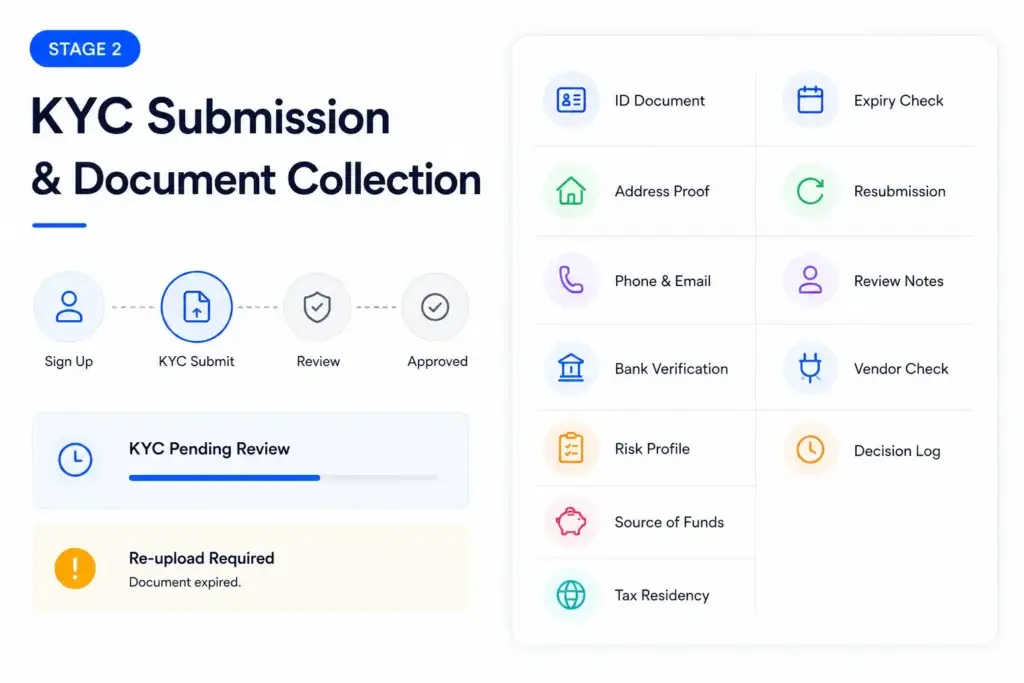
KYC is one of the most important workflows in a brokerage portal.
Many founders think of KYC as a file upload screen. In practice, it is a structured verification process that can include identity documents, proof of address, tax information, bank details, source-of-funds declarations, suitability questions, business verification, beneficial ownership information, and jurisdiction-specific disclosures.
A strong KYC module should support:
- identity document upload
- address verification
- phone and email verification
- bank account verification
- risk questionnaire
- source-of-funds declaration
- tax residency details
- document expiry tracking
- resubmission requests
- manual review notes
- automated vendor integration
- decision history
The trader should see clear progress messages. “Your KYC is pending review” is better than silence. “Please re-upload proof of address because the document is expired” is better than a generic rejection.
The operator dashboard should be even more detailed. Compliance teams need to know what was submitted, when it was submitted, who reviewed it, what decision was made, and what evidence supports that decision.
Stage 3: AML Screening and Risk-Based Review
A brokerage account is not activated only because documents were uploaded.
The platform should also support AML screening, sanctions checks, politically exposed person checks where relevant, risk scoring, and ongoing monitoring workflows based on the market and operating model.
This does not mean the software guarantees legal compliance. Final compliance depends on the jurisdiction, licence, legal review, vendor integrations, internal policies, and operating procedures. But the platform should give operators the workflow foundation needed to collect evidence, review risk, and document decisions.
Risk review may include:
- country risk
- document mismatch
- duplicate profiles
- unusual IP or device signals
- high-risk payment source
- mismatched funding name
- previous rejected accounts
- failed screening results
- account type requested
- expected trading behavior
- withdrawal destination risk
A practical Digital brokerage platform should let operators approve, reject, escalate, or request more information from one compliance queue. Every decision should leave an audit trail.
This matters because the compliance team should not work from spreadsheets, email attachments, and disconnected chat messages. The platform should keep the review process inside the same system that controls funding and account access.
Stage 4: Wallet Creation and Funding Readiness
Once the trader reaches a suitable verification stage, the platform can prepare the funding wallet.
The wallet is not just a displayed balance. It is the financial ledger that records deposits, withdrawals, internal transfers, currency conversions, fees, adjustments, reversals, and account-level funding status.
A brokerage wallet should track:
- available balance
- pending deposits
- confirmed deposits
- failed deposits
- withdrawals in review
- approved withdrawals
- rejected withdrawals
- internal transfers
- bonus credits where applicable
- currency conversion history
- transaction fees
- adjustment notes
- audit logs
Funding readiness also depends on payment rails. A platform may support card payments, bank transfers, e-wallets, local payment methods, crypto rails where allowed, or manual deposit references depending on the business model and jurisdiction.
Founders should also understand the wider brokerage portal feature breakdown, especially where KYC queues, wallet ledgers, deposit workflows, withdrawal screening, and account operations connect.
Stage 5: Deposit Confirmation and Reconciliation
A trader should not be treated as funded simply because they clicked “deposit.”
The platform should wait for confirmed payment status from the payment provider, bank, gateway, or finance team. This confirmation may come through a webhook, manual review, bank reference, admin approval, or payment processor update.
A reliable deposit workflow should check:
- payment status
- client identity
- payment method ownership
- transaction reference
- amount received
- currency
- fees
- gateway response
- duplicate payment attempts
- chargeback or reversal risk
- reconciliation status
Reconciliation is the difference between showing a balance and trusting that balance. The finance team should be able to match platform records with gateway statements, bank accounts, processor reports, and withdrawal obligations.
This is where founders should review digital brokerage development cost factors, because live payment rails, KYC vendors, liquidity arrangements, market data contracts, and jurisdiction-specific reporting can affect the real launch scope beyond the software base.
Stage 6: Account Type Selection and Provisioning
After identity and funding are in place, the platform can provision the appropriate account.
Not every trader needs the same setup. A brokerage may offer demo accounts, standard live accounts, professional accounts, evaluation accounts, funded accounts, Islamic accounts, multi-currency accounts, or account types based on leverage, spread, commission, deposit size, or jurisdiction.
Provisioning should define:
- account type
- base currency
- leverage rules
- minimum funding level
- maximum exposure limits
- allowed instruments
- trading environment
- platform connection
- account group
- fee model
- commission structure
- reporting visibility
For forex and CFD-style brokerage portals, trading execution may sit in a separate terminal or external trading infrastructure. In that model, the client portal manages onboarding, identity, wallet, funding, account status, reports, partner attribution, and operational controls around the trading environment.
That distinction is important. The client portal is the relationship, compliance, funding, and back-office layer. The trading terminal or connected execution system is where orders may be placed and managed after integration.
Stage 7: Funded Account Activation
A funded account should activate only when the platform has enough evidence to trust the client and the balance.
That usually means the trader has passed the required verification checks, completed agreements, funded the wallet or passed an evaluation route, and received the correct account configuration.
A funded account also connects to the wider brokerage business model, because deposits, account types, spreads, commissions, partner payouts, subscriptions, and withdrawal rules all influence revenue operations.
Funded account activation should not be a single manual switch without context. The admin should see:
- KYC status
- screening status
- funding status
- account type
- payment references
- agreement acceptance
- risk notes
- previous account history
- partner or referral attribution
- account limits
- activation timestamp
- operator who approved activation
For prop-style workflows, the funded journey may include evaluation purchase, challenge rules, drawdown monitoring, target tracking, breach detection, funded progression, agreement signing, payout setup, and withdrawal review.
For traditional brokerage workflows, the funded journey may focus more on deposit confirmation, live account provisioning, platform access, risk controls, transaction history, and withdrawal permissions.
In both cases, the principle is the same: a funded account is not just a balance. It is a controlled account state.
Stage 8: Dashboard Access and Trader Communication
Once the account is active, the trader needs a dashboard that makes the next step obvious.
A well-designed trader dashboard should show:
- account verification status
- wallet balance
- account type
- funded status
- trading account credentials or connection status
- deposit and withdrawal options
- open requests
- documents and agreements
- trading reports
- account performance
- support access
- notifications
- risk or restriction messages
The trader should not need to contact support to understand basic account state. If KYC is pending, the dashboard should say that. If a deposit is being reconciled, the dashboard should show it. If a withdrawal is under review, the trader should see the reason or expected next step where appropriate.
Clear communication reduces support workload and improves trust. In brokerage, confusion around money creates immediate anxiety. The portal should make account status visible and understandable.
Stage 9: Withdrawal Screening and Payout Control
Funding is only one side of the journey. Withdrawals are where operational discipline becomes even more important.
A platform should not allow every withdrawal request to pass automatically without checks. The system may need to verify available balance, account status, KYC validity, trading restrictions, bonus conditions, payout rules, bank account ownership, risk flags, chargeback exposure, and internal approval requirements.
Withdrawal workflows should include:
- withdrawal request submission
- available balance check
- account status check
- payout method verification
- review queue
- risk flag detection
- approval or rejection notes
- finance processing status
- trader notification
- audit log
- reconciliation after payout
For funded-trader or evaluation models, payout control can also include profit split rules, drawdown validation, breach review, invoice or agreement checks, and payout schedule management.
This is where the platform protects both the trader experience and the operator’s capital.
Stage 10: Back-Office Reporting and Audit Trails
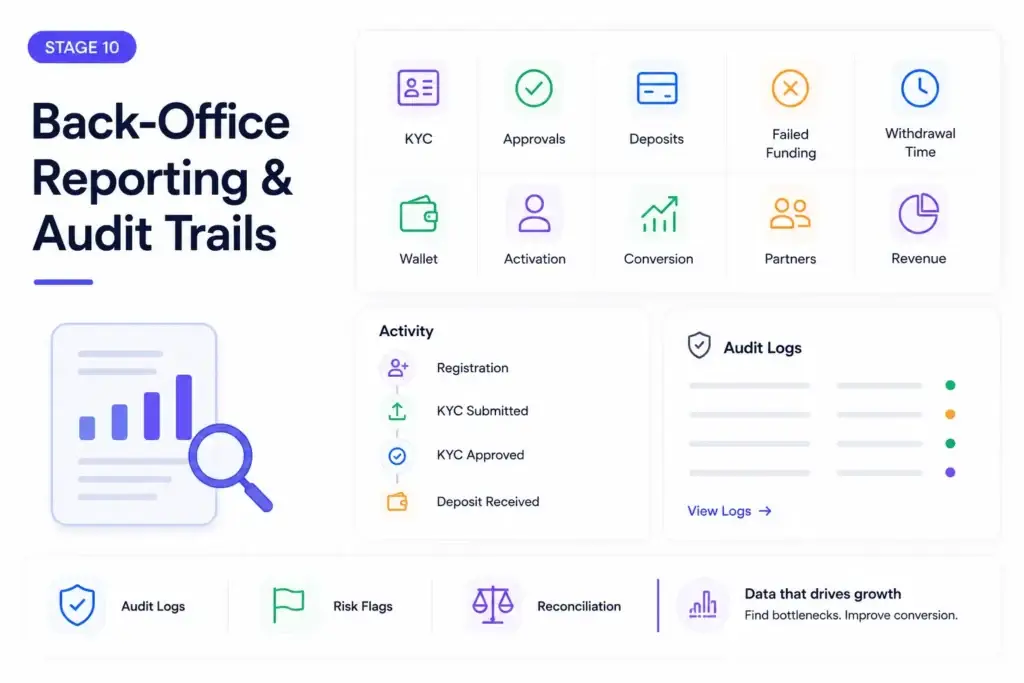
A brokerage portal must help the operating team understand what happened across the trader lifecycle.
The back office should show every important event: registration, document submission, KYC decision, deposit attempt, wallet credit, internal transfer, account creation, funded status change, withdrawal request, payout approval, support interaction, and admin action.
Useful reports include:
- KYC queue performance
- approval and rejection reasons
- deposits by method
- failed funding attempts
- withdrawal review times
- wallet balance history
- account activation rate
- funded account conversion
- partner attribution
- revenue by account type
- risk flags
- audit logs
- finance reconciliation records
For founders, this reporting is not optional. It helps teams detect bottlenecks, reduce failed onboarding, improve funding conversion, and prepare evidence for compliance or partner review.
Trader Journey State Map
| Trader State | Trigger | Next Possible State | Operational Risk to Control |
|---|---|---|---|
| Registered | User creates a profile | KYC pending | Fake or duplicate accounts entering the funnel |
| KYC Submitted | User uploads required information | Approved, rejected, or more information required | Poor document quality or incomplete evidence |
| Verified | Compliance review approves the client | Funding ready | Trading access granted without correct restrictions |
| Deposit Pending | User starts a funding transaction | Funded, failed, or under review | Balance shown before payment is confirmed |
| Funded | Deposit or payout route is verified | Trading enabled | Funding mismatch, failed reconciliation, or payment reversal |
| Trading Enabled | Account is provisioned and access is granted | Active, restricted, suspended, or withdrawal eligible | Incorrect leverage, account group, or access rules |
| Withdrawal Review | Trader requests a payout or withdrawal | Approved, rejected, or escalated | Fraud, chargeback exposure, or policy breach |
Admin Consoles Needed to Manage the Trader Journey
A brokerage portal needs role-based access because different teams touch different parts of the lifecycle.
The support team should not have the same permissions as finance. Finance should not edit risk rules without authorization. A partner manager should not approve withdrawals. A compliance officer should be able to review KYC decisions without exposing unnecessary operational tools.
Important admin areas include:
- client management
- KYC review queue
- AML and risk flags
- funding and deposits
- wallet ledger
- withdrawal review
- account provisioning
- partner and IB attribution
- prop challenge management
- support tickets
- document management
- notifications
- audit logs
- reports and reconciliation
If you are comparing technical teams, choose a brokerage platform development partner that understands KYC queues, wallet funding, payment reconciliation, trading account provisioning, withdrawal screening, partner economics, and role-scoped admin control.
Founder Decision Signals
Activation
If traders drop off during KYC, the portal needs clearer status messages, fewer unnecessary steps, and better resubmission workflows.
Risk
If accounts can be funded before identity and payment status are trusted, the operator may face fraud, reversals, or compliance gaps.
Operations
If compliance, finance, support, and partner teams share one generic dashboard, the platform will become harder to operate safely.
Scale
If every account activation or withdrawal needs developer involvement, growth will increase operational pressure instead of reducing it.
Common Mistakes Founders Should Avoid
Treating KYC as a basic upload form
KYC should include verification status, review queues, risk flags, resubmission logic, decision notes, vendor integrations, and audit records.
Crediting funds before confirmation
A trader should not see confirmed buying power or funded status until the deposit is verified and reconciled with the payment provider or finance workflow.
Mixing support, finance, and compliance permissions
Brokerage operations need role-based access controls so only the right team can approve KYC, adjust wallets, review withdrawals, or change account rules.
Ignoring withdrawal screening
Withdrawals and payouts should pass through balance checks, risk review, account status validation, and audit logging before finance processes the request.
How Miracuves Helps Founders Build Brokerage Portals With a Complete Trader Journey
Miracuves helps fintech founders build brokerage portals where onboarding, KYC, wallet funding, account provisioning, admin review, partner economics, withdrawal workflows, and reporting work as one connected system.
For founders planning a forex, CFD, prop trading, or multi-asset brokerage operation, a Digital brokerage platform can provide a ready-made foundation for client lifecycle management, funding workflows, role-based operations, admin control, and source-code ownership.
You can also explore Miracuves’ finance and investment app solutions or review the investment platform solutions category if your model includes brokerage, wealth, funds, forex, CFDs, or trading operations.
For broader mobile-first fintech builds, Miracuves also offers custom mobile app development services for businesses that need tailored onboarding, wallet, dashboard, or compliance workflows.
The goal is not to copy another brokerage brand. The stronger decision is to build a client portal that controls the trader journey properly from verification to funded account access.
Final Thoughts: Funded Account Access Is a Controlled State, Not a Signup Step
A Digital brokerage platform succeeds when the trader journey is clear, controlled, and auditable.
Registration starts the relationship. KYC verifies the trader. AML workflows support risk review. Funding confirms that money movement is real. Account provisioning applies the right trading rules. The dashboard communicates status. Withdrawal screening protects the operator after activation.
The visible trading experience may get the attention, but the client portal determines whether the brokerage can operate safely.
Founders who plan this journey properly can reduce onboarding confusion, improve funding conversion, support compliance workflows, and give their teams the control needed to scale beyond the first cohort of traders.
FAQs
What is a Digital brokerage platform?
A Digital brokerage platform is a fintech system that helps traders or investors complete onboarding, KYC, funding, account setup, trading access, reporting, and account management through a web or mobile portal.
Why is KYC important before activating a trading account?
KYC helps the operator verify identity, collect required documents, review account eligibility, assess risk, and support compliance workflows before trading or funded account access is enabled.
When should a trader be marked as funded?
A trader should be marked as funded only after the platform verifies deposit confirmation, reconciles the transaction, updates the wallet ledger, and connects the balance to the correct account state.
What is the difference between a registered account and a funded account?
A registered account means the user has created a profile. A funded account means the user has completed required checks and has verified funds or account access according to the platform’s rules.
Why do brokerage platforms need withdrawal screening?
Withdrawal screening helps operators review available balance, payment method ownership, account status, risk flags, chargeback exposure, and payout rules before money leaves the platform.
What admin tools are needed for a brokerage client portal?
A brokerage client portal needs admin tools for KYC review, client management, wallets, deposits, withdrawals, account provisioning, partner attribution, support, audit logs, compliance review, and reporting.
Can Miracuves help build a brokerage portal with KYC and funding workflows?
Yes. Miracuves helps founders build source-code-owned brokerage portals with onboarding, KYC workflows, wallet funding, admin dashboards, partner management, withdrawal review, reporting, and faster deployment support.
Does brokerage software guarantee regulatory compliance?
No. Software can provide a compliance-ready foundation and workflow controls, but final compliance depends on jurisdiction, licence, legal review, vendor integrations, internal policies, and operating model.
Miracuves is an independent software development company. We are not affiliated with, connected to, sponsored by, or endorsed by any company or product named in this article.
Terms such as “X Clone” are used descriptively. It is how the software industry refers to building a platform with functionality comparable to a known service, and how clients search for it.
The entire design and codebase of our products is built by our own team. Our products contain no code, design, graphics, or content originating from any third-party website or applications.
All third-party names and marks referenced in this article are the property of their respective owners, referenced solely to identify the services discussed.