

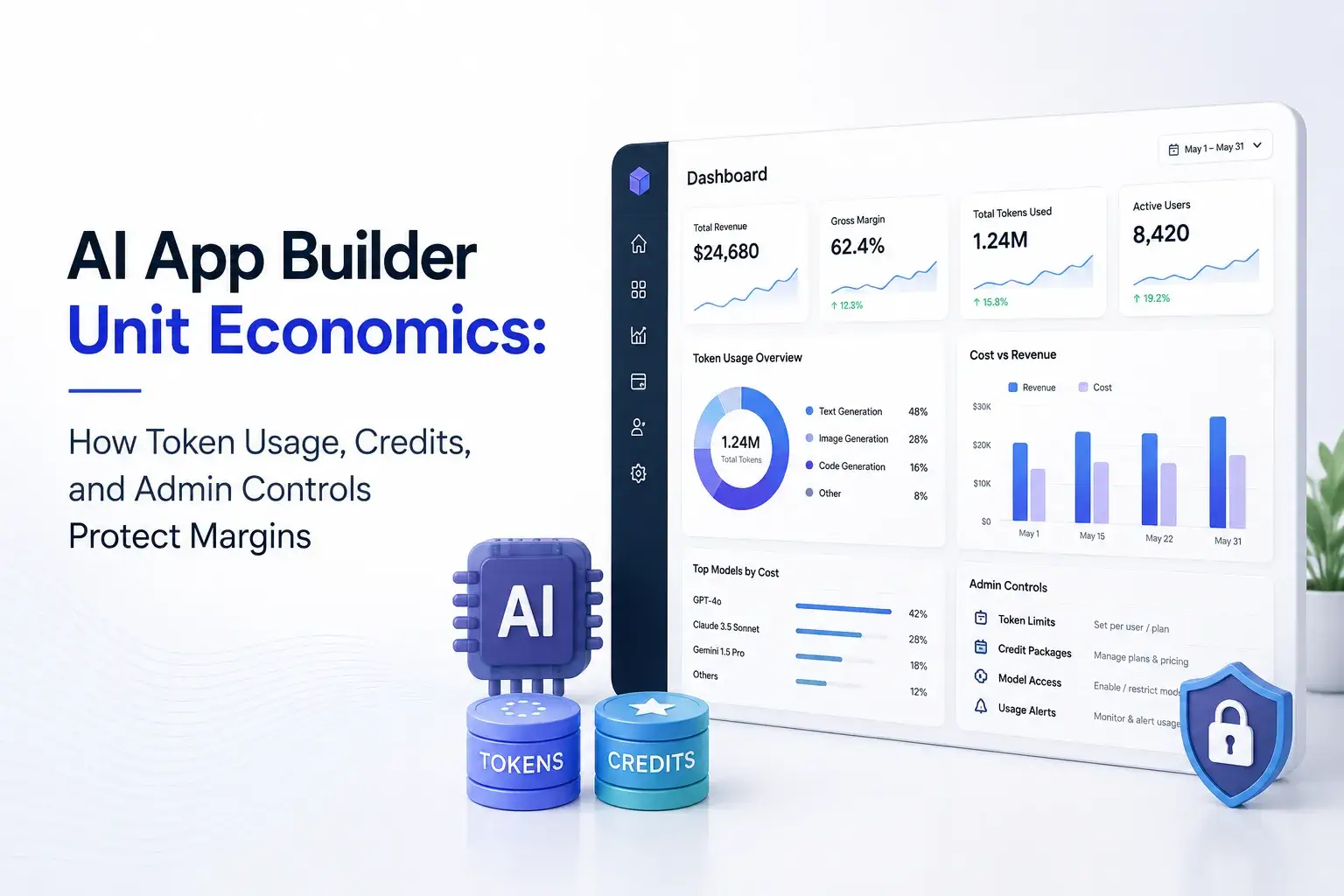
AI app builders look simple from the outside. A user types an idea, the system generates code, the project runs in the browser, and the user keeps improving it through prompts. For the customer, the value is speed. For the platform operator, the challenge is economics.
Every prompt, project scan, code revision, debugging loop, file sync, model call, preview session, and deployment workflow can create operating cost. That means an AI app builder is not only a software product. It is a usage-driven infrastructure business where revenue must be designed carefully around consumption.
This is where unit economics matter.
A founder can have strong signups, active users, and impressive product demos, but still lose money if heavy users consume more AI resources than they pay for. The goal is not only to monetize access. The goal is to connect pricing, usage, admin control, and infrastructure decisions so the platform can grow without margin leakage.
Miracuves helps founders think through this layer before launch, especially when they are planning AI app builder platforms, prompt-to-app tools, developer automation products, or white-label AI software businesses.
Key Takeaways
- AI app builder unit economics decide whether usage growth becomes profitable revenue or uncontrolled infrastructure cost.
- Token usage, model calls, project size, file syncing, debugging loops, and deployment workflows all influence operating cost.
- Credit-based pricing helps founders connect customer usage with actual AI consumption.
- Hybrid pricing usually works better than flat unlimited pricing because it combines predictable subscriptions with usage control.
- Admin dashboards should track usage, cost, plan limits, abuse signals, and upgrade opportunities from day one.
Why Unit Economics Matter More in AI App Builders Than Normal SaaS
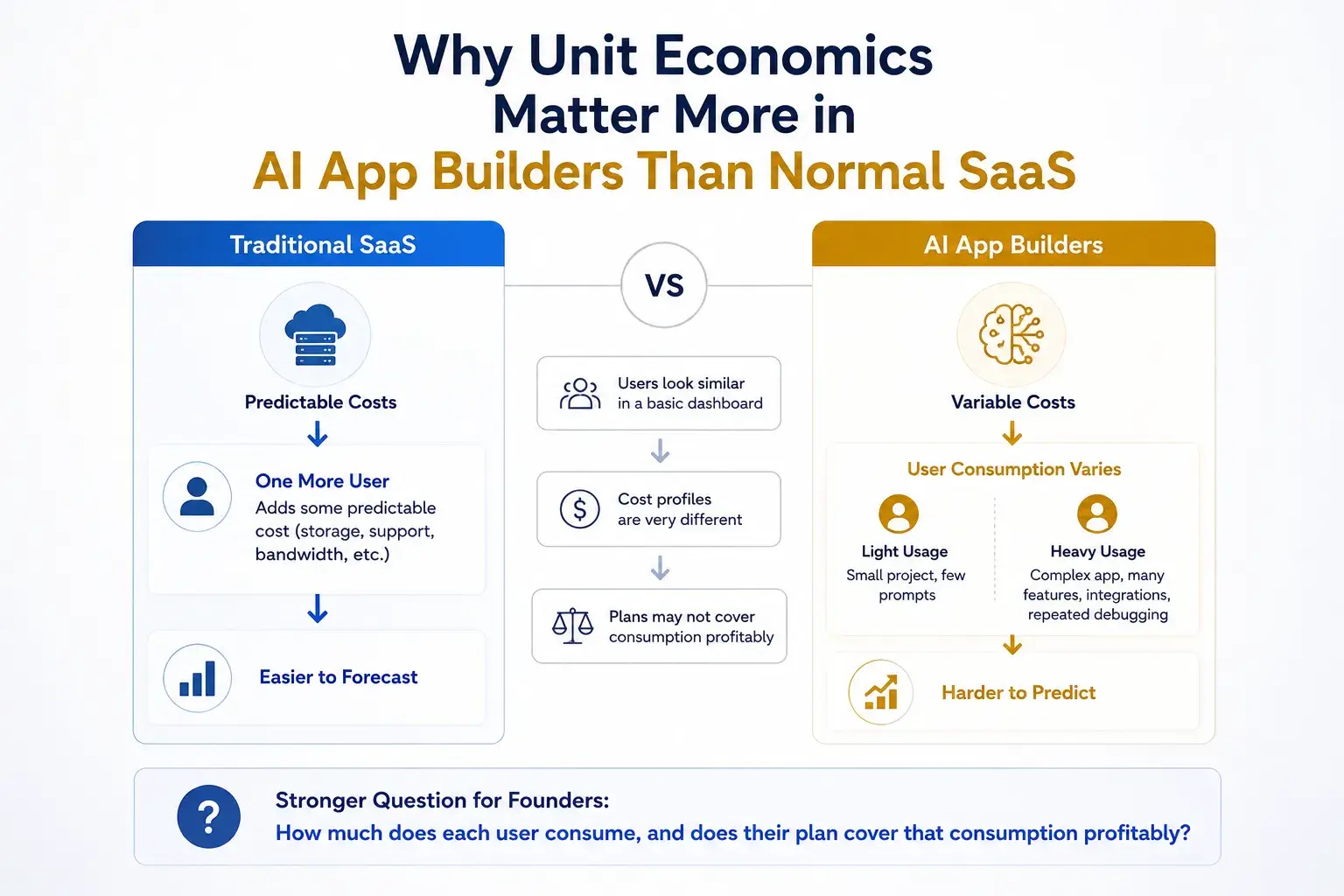
A traditional SaaS product often has predictable costs. Once the platform is built, one more user may add some database, storage, support, or bandwidth cost, but usage is usually easier to forecast.
AI app builders are different.
The cost of serving one user can vary dramatically. One user may generate a small landing page in a few prompts. Another may build a multi-page SaaS product with authentication, dashboard logic, database flows, integrations, deployment steps, and repeated debugging. Both users may appear similar in a basic subscription dashboard, but their cost profiles are not the same.
This is why founders should avoid thinking only in terms of monthly plans. The stronger question is:
How much does each user consume, and does their plan cover that consumption profitably?
If the product does not answer that question, pricing becomes guesswork.
The Main Cost Drivers Behind AI App Builder Platforms
An AI app builder has multiple cost layers. Some are visible to the founder during development. Others only become painful after users start building larger projects.
The most important cost drivers usually include:
- AI model usage
- Prompt and response processing
- Project file reading
- Multi-file code generation
- Repeated debugging cycles
- Context syncing
- Database and storage usage
- Live preview environments
- Deployment workflows
- Authentication and API integrations
- Team collaboration activity
- Support and onboarding
The important point is that not all product activity has the same cost. A simple UI edit is not equal to a multi-file backend refactor. A landing page is not equal to a full workflow product. A first-time prompt is not equal to a long project context with many files.
Founders need pricing and admin logic that can detect these differences.
Why Flat Unlimited Pricing Can Damage Margins
Unlimited pricing looks attractive in marketing because it is simple for users to understand. But in AI-heavy products, unlimited usage can become risky.
If users pay one fixed fee and can generate unlimited projects, run unlimited prompts, and sync unlimited files, the platform may attract exactly the users who consume the most resources. That can create a situation where your most active users are also your least profitable users.
This does not mean unlimited plans should never exist. It means they need careful controls.
A safer unlimited-style plan may still include:
- Fair-use limits
- Speed throttling after heavy usage
- Model access restrictions
- Project size limits
- Paid add-ons for premium models
- Enterprise-level custom agreements
- Admin alerts for abnormal consumption
For early founders, the key lesson is simple: do not offer unlimited AI usage before you can measure usage properly.
Credit-Based Pricing: The Practical Middle Layer
Credit-based pricing gives founders a way to connect AI usage with monetization.
Instead of letting every user consume unlimited resources, the platform assigns credits based on the user’s plan. Each AI action consumes credits depending on cost intensity. Simple tasks may consume fewer credits, while advanced generation, larger context windows, premium model usage, or complex debugging may consume more.
This helps the founder create a clearer relationship between:
- What the user does
- What the platform pays to support that action
- What the user is charged
- When the user should upgrade or buy more credits
The strongest credit systems are easy for users to understand but detailed enough for operators to manage internally.
Subscription vs Credits vs Hybrid Pricing
Most AI app builder businesses should not rely on one pricing model alone. A subscription gives predictable revenue, while credits protect the business from variable usage.
AI App Builder Pricing Model Comparison
| Pricing Model | How It Works | Business Strength | Founder Risk |
|---|---|---|---|
| Flat Subscription | Users pay a fixed monthly or yearly fee for access. | Simple to explain and easy to sell. | Heavy users may consume more AI resources than they pay for. |
| Pure Credit Pricing | Users buy credits and spend them on AI actions. | Closely connects revenue with usage. | May feel complicated for beginners. |
| Hybrid Pricing | Users pay a subscription that includes monthly credits, with paid top-ups available. | Balances predictable revenue with cost protection. | Requires strong billing, tracking, and admin logic. |
| Team Pricing | Companies pay for multiple users, shared credits, roles, and collaboration. | Improves account value and B2B adoption. | Needs workspace permissions and usage allocation. |
| Enterprise Pricing | Larger buyers pay for governance, support, security controls, and custom usage rules. | Creates higher-value contracts. | Requires procurement, onboarding, and reliability expectations. |
For many founders, hybrid pricing is the strongest starting point. It gives users a clear plan while giving the business a way to control usage and sell more capacity when users become more active.
What Founders Should Track Inside the Admin Dashboard
The admin dashboard is not only a backend control panel. In an AI app builder business, it is the margin protection layer.
A strong admin system should help the operator understand which users, plans, features, and workflows are profitable. Without that visibility, the founder may keep acquiring users without realizing that certain usage patterns are quietly draining margin.
Important metrics include:
- Active users by plan
- Credit usage by user
- Credit usage by project
- Credit usage by feature
- Model usage by provider
- Cost per generation
- Cost per debugging session
- Average credits consumed per project
- Failed generation rate
- Upgrade triggers
- Top-up purchases
- Abuse or bot-like usage
- Team-level consumption
- Enterprise account activity
- Churn by plan
- Revenue by segment
This data helps the founder answer practical business questions.
Which users are ready to upgrade? Which plan is underpriced? Which feature consumes the most resources? Which model is too expensive for basic tasks? Which customer segment has the best lifetime value?
Without this visibility, the business may scale traffic but not profit.
Founder Decision Signals
Speed
Launch speed matters, but founders should not launch without usage tracking. A fast launch is stronger when credit logic, plan limits, and admin visibility are already built into the platform.
Cost
AI usage cost can rise quickly when users build larger projects. Founders should connect plan pricing with actual resource consumption instead of relying only on fixed subscriptions.
Scalability
Scaling an AI app builder is not only about servers. It is about model routing, fair-use rules, project-size handling, usage analytics, and predictable billing logic.
Market Fit
Different audiences use AI builders differently. Students, indie makers, agencies, and enterprise teams may need different limits, workflows, credit pools, and upgrade paths.
Model Routing: A Hidden Lever for Better Margins
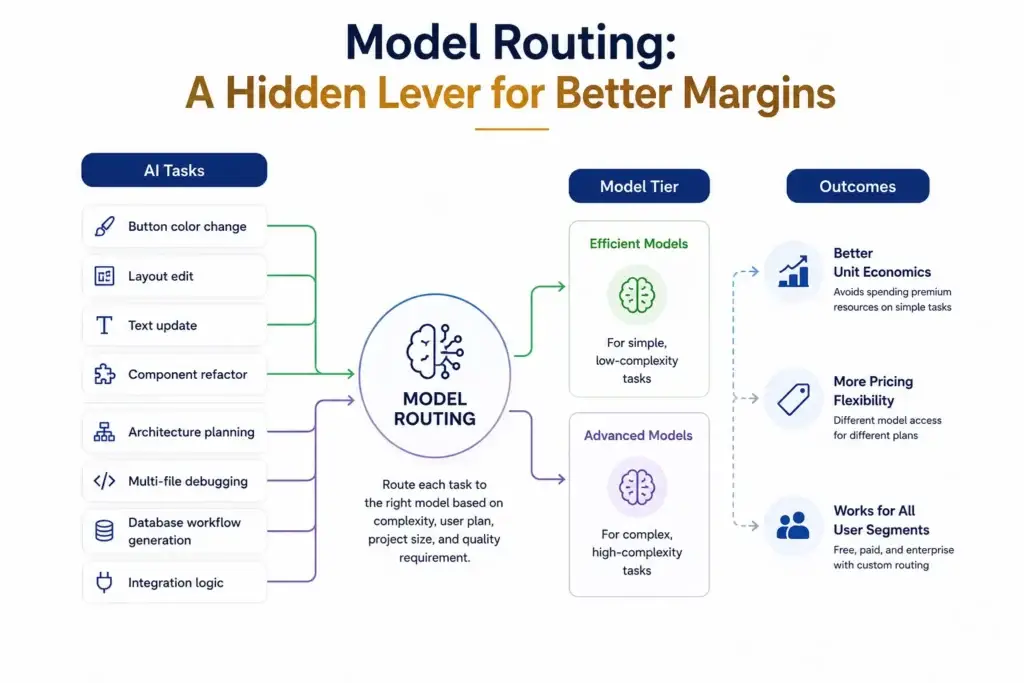
Not every AI task needs the same model.
A simple button color change, layout edit, text update, or component refactor may not need the most advanced model available. More complex tasks such as architecture planning, multi-file debugging, database workflow generation, or integration logic may need a stronger model.
Model routing helps the platform send each task to the right model based on complexity, user plan, project size, and quality requirement.
This can improve unit economics because the platform avoids spending premium AI resources on low-complexity actions. It also gives the founder more pricing flexibility. Free users may receive access to basic model workflows, paid users may unlock better models, and enterprise customers may receive custom routing rules.
How Credit Packages Create Expansion Revenue
Credit packages are useful because they let users keep building without forcing them into a higher subscription tier immediately.
For example, a solo founder may be happy on a Pro plan most months. During a product sprint, that founder may consume more credits while building new pages, fixing workflows, or preparing a demo. Instead of upgrading permanently, they can buy a credit top-up.
This creates expansion revenue without making the pricing feel restrictive.
Credit packages can be designed around:
- One-time top-ups
- Monthly add-on credits
- Team credit pools
- Premium model credits
- Deployment credits
- Debugging credits
- Enterprise usage commitments
The key is to make credits feel like productive capacity, not a penalty. Users should understand that they are paying for more building power, not being blocked artificially.
Why Team Accounts Improve Unit Economics
Solo users are useful for adoption, but teams often create better commercial value.
Agencies, product studios, startup teams, internal innovation groups, and enterprise departments may need shared workspaces, permission controls, billing visibility, project history, and multiple members working under one account.
This creates opportunities for:
- Per-seat pricing
- Shared credit pools
- Role-based permissions
- Team analytics
- Private templates
- Branded workspaces
- Admin approval flows
- Enterprise onboarding
Team accounts also improve retention because projects, workflows, and collaboration history become part of the organization’s operating process.
For founders, this matters because the strongest AI app builder businesses may not only sell to individual builders. They may sell to teams that need repeatable, governed, and branded software creation workflows.
Enterprise Controls That Support Higher-Value Contracts
Enterprise buyers do not only care about generation quality. They care about control.
Before a larger company adopts an AI app builder, it may ask questions about access, data handling, audit logs, user roles, provider settings, billing visibility, private deployment, and support.
Useful enterprise controls include:
- Role-based access control
- SSO support
- Audit logs
- Admin approval workflows
- Private project settings
- Custom usage limits
- Team-level credit pools
- Model access restrictions
- Data retention controls
- Secure API integration
- Activity logs
- Priority support workflows
These controls allow a founder to create a pricing tier that is based on trust and governance, not only higher token limits.
Mistakes Founders Should Avoid
Launching without usage analytics
If the admin dashboard cannot show usage by user, plan, feature, and model, pricing decisions become reactive. Founders need cost visibility before scale, not after margins start shrinking.
Selling unlimited AI too early
Unlimited usage can attract power users before the business has fair-use rules, routing logic, and plan controls. This can turn active users into margin risk.
Using one model for every task
Routing all tasks through the same high-cost model may increase quality in some areas but waste budget on simple actions. Model routing gives founders better control.
Ignoring team and enterprise workflows
Individual users may validate demand, but teams and enterprises often create stronger account value. Without permissions, shared credits, and governance, the platform may remain stuck at low-ticket pricing.
What a Margin-Aware AI App Builder Should Include
A strong platform foundation should make monetization measurable from the beginning.
Important modules include:
Margin-Aware AI App Builder Modules
| Module | Business Value | Founder Impact |
|---|---|---|
| Credit Wallet | Tracks available and consumed usage credits. | Connects AI consumption with monetization. |
| Plan Management | Controls limits, features, credits, and upgrade rules. | Helps founders test pricing without rebuilding billing logic. |
| Usage Analytics | Shows consumption by user, team, project, feature, and model. | Improves pricing decisions and margin visibility. |
| Model Routing | Routes tasks to suitable models based on cost and complexity. | Reduces unnecessary AI spend. |
| Fair-Use Controls | Prevents uncontrolled usage from free or low-tier plans. | Protects infrastructure and supports sustainable growth. |
| Team Workspaces | Enables collaboration, shared projects, and account-level billing. | Moves the product toward higher-value B2B revenue. |
| Enterprise Governance | Adds roles, logs, permissions, custom limits, and security controls. | Supports larger business customers and custom contracts. |
How Miracuves Helps Founders Build AI App Builder Platforms Faster
Building an AI app builder from zero can become complex quickly. The founder has to think about the prompt interface, code generation flow, model provider strategy, project workspaces, preview experience, billing, usage limits, admin controls, deployment options, security, and support workflows.
Miracuves helps founders move faster with ready-made and white-label app foundations that can be shaped around branding, source-code ownership, admin control, and monetization-ready workflows.
For founders exploring this category, a white-label AI app builder solution from Miracuves can provide a faster starting point than building every module from the ground up. The important decision is not to copy another product blindly. The stronger decision is to launch with a product foundation that gives you control over usage, pricing, workflows, and long-term customization.
You can also explore Miracuves’ generative AI app development services if your product requires custom AI workflows, automation logic, or model integration beyond the launch-ready foundation.
Final Thoughts: AI App Builder Growth Needs Cost Control, Not Just More Users
The biggest mistake founders make with AI products is assuming user growth automatically means business growth.
In AI app builders, growth becomes valuable only when pricing, credits, model usage, admin visibility, and infrastructure cost are designed together. Otherwise, the platform can attract active users while quietly losing margin.
The stronger approach is to think like an operator from day one. Track usage. Price around consumption. Route models intelligently. Set fair-use rules. Build team and enterprise workflows. Give the admin dashboard enough visibility to make pricing decisions based on real behavior.
An AI app builder can become a strong software business when the founder does not treat monetization as a checkout page. It must be part of the product architecture.
FAQs
What are AI app builder unit economics?
AI app builder unit economics show how much it costs to serve each user, project, prompt, model call, or generated workflow compared with the revenue earned from that usage. They help founders understand whether growth is profitable.
Why is token usage important in AI SaaS pricing?
Token usage matters because AI systems create variable costs. A user who builds complex projects may consume more model resources than a user who builds simple pages. Pricing should reflect that difference.
Is credit-based pricing better than subscriptions?
Credit-based pricing is useful for controlling usage, while subscriptions are useful for predictable revenue. Many AI app builder platforms benefit from a hybrid model that includes monthly credits with paid top-ups.
What should an AI app builder admin dashboard track?
The admin dashboard should track usage by user, project, plan, team, feature, and model. It should also show credit consumption, upgrade triggers, abuse signals, failed generations, and revenue by customer segment.
Why can unlimited AI usage hurt margins?
Unlimited AI usage can attract heavy users who consume more resources than their subscription covers. Without fair-use rules, model routing, and usage analytics, unlimited plans can become expensive to operate.
How do team accounts improve AI app builder revenue?
Team accounts allow founders to charge for multiple users, shared credits, permissions, collaboration, private projects, and account-level controls. This can increase account value and improve retention.
What is model routing in an AI app builder?
Model routing means sending different tasks to different AI models based on complexity, cost, quality requirement, or user plan. It helps reduce unnecessary AI spend while preserving product quality.
Miracuves is an independent software development company. We are not affiliated with, connected to, sponsored by, or endorsed by any company or product named in this article.
Terms such as “X Clone” are used descriptively. It is how the software industry refers to building a platform with functionality comparable to a known service, and how clients search for it.
The entire design and codebase of our products is built by our own team. Our products contain no code, design, graphics, or content originating from any third-party website or applications.
All third-party names and marks referenced in this article are the property of their respective owners, referenced solely to identify the services discussed.