
Key Takeaways
- A new ticketing platform needs both event organizers and ticket buyers, because organizer supply creates inventory while buyer demand makes the marketplace valuable.
- Organizer acquisition should focus on easy event setup, ticket management, payments, analytics, promotion tools, transparent pricing, and reliable settlement.
- Buyer growth depends on relevant event discovery, simple booking, trusted payments, clear pricing, personalized recommendations, reminders, offers, and a smooth entry experience.
Organizer Acquisition Signals
- Platforms can attract organizers through direct outreach, partnerships, onboarding support, early-adopter incentives, event migration assistance, and tools that simplify listing and ticket operations.
- Organizer dashboards should support event creation, venue setup, seat inventory, ticket tiers, promo codes, sales tracking, attendee management, refunds, payouts, and entry reporting.
- Teams should monitor organizer sign-ups, first-event publishing, active listings, ticket inventory, repeat organizers, event conversion, payout reliability, and organizer retention.
Ticket Buyer Growth Insights
- Buyer acquisition can use search visibility, social campaigns, organizer audiences, referral programs, local event discovery, email marketing, notifications, and category-based promotions.
- Track event views, search-to-booking conversion, cart abandonment, payment completion, repeat purchases, referral activity, event-category preferences, and retention to improve buyer growth.
- Miracuves develops customizable ticketing platforms with organizer onboarding, event discovery, seat booking, payments, digital tickets, promotions, analytics, entry validation, and admin controls.
Launching a new ticketing platform is not only a technology decision. It is a marketplace-building challenge.
A ticketing platform needs two groups to trust it at the same time. Organizers need confidence that the platform can help them sell tickets, manage entries, receive payments, and understand their audience. Ticket buyers need confidence that the platform has relevant events, clear pricing, smooth booking, secure payments, timely reminders, and reliable entry access.
This is where many founders struggle. They start by promoting the app to buyers before they have enough event inventory. Or they onboard organizers without giving them the visibility, tools, and support required to sell consistently. In both cases, growth becomes uneven.
A strong ticketing platform growth strategy should connect organizer acquisition, buyer demand, event discovery, conversion, retention, and operational trust into one system. The goal is not just to get app installs. The goal is to create a repeatable loop where better supply attracts more buyers, more buyers attract better organizers, and better event performance strengthens the platform.
For founders planning to launch faster, Miracuves can help with a launch-ready entertainment ticketing platform foundation that supports organizer workflows, ticket booking, admin control, and faster deployment in 6 days.
Why Ticketing Platform Growth Depends on Both Supply and Demand
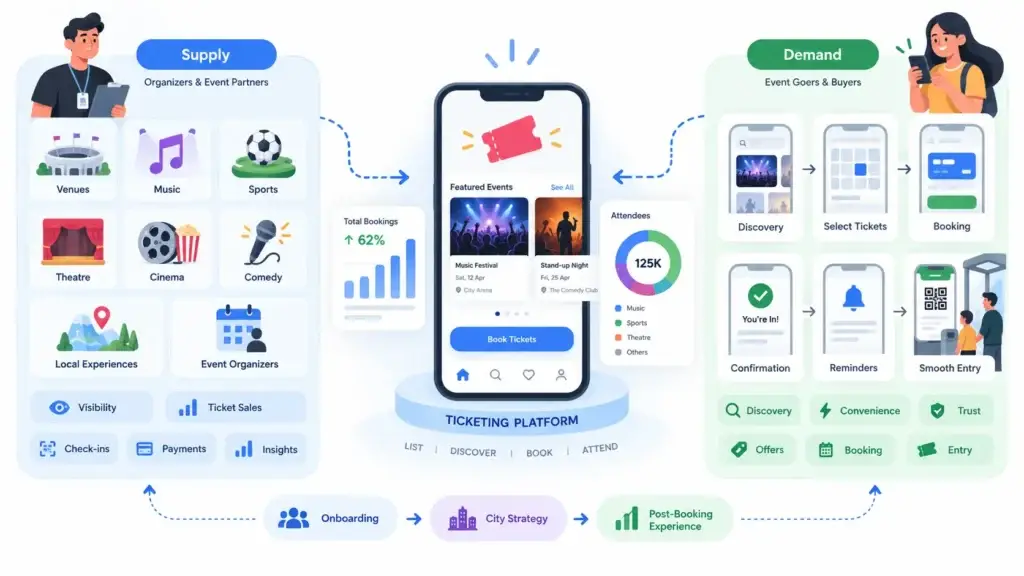
A ticketing platform is a two-sided marketplace. On one side, there are event organizers, venue partners, activity hosts, cinema operators, sports promoters, comedy clubs, theatre groups, music venues, and local experience creators. On the other side, there are ticket buyers looking for something worth attending.
The platform becomes valuable only when both sides see a clear reason to participate.
For organizers, the value is simple: more visibility, easier ticket selling, smoother check-ins, reliable payments, promotional support, and audience insights. For buyers, the value is discovery, convenience, trust, offers, seat or ticket selection, booking confirmation, reminders, and a smooth entry experience.
If the platform has buyers but weak event inventory, users will leave because there is not enough to browse. If the platform has organizers but no buyer demand, partners will stop listing because the platform does not produce results.
That is why a new ticketing marketplace should not treat marketing as a separate activity. Growth should be built into the product, onboarding, city strategy, event pages, analytics, and post-booking experience. Before planning acquisition campaigns, founders should understand how an online ticketing ecosystem connects event discovery, ticket selection, payments, confirmations, entry validation, refunds, and reporting.
Start With a Sharp Launch Wedge Instead of Targeting Everyone
A common mistake in ticketing platform growth is trying to launch across too many event categories at once. Movies, concerts, plays, sports, workshops, nightlife, college events, local experiences, and family activities all have different buyer behavior.
A sharper launch wedge gives the platform a better chance to build momentum.
For example, a founder may start with:
- Comedy and live performance events in one city
- College festivals and youth events
- Local music gigs and nightlife events
- Independent theatre and cultural shows
- Weekend family activities
- Sports facility bookings and local tournaments
- Corporate events and paid workshops
The best launch wedge is not always the largest category. It is the category where supply can be onboarded faster, buyers are easier to reach, and repeat discovery can happen often.
A focused launch also improves SEO. Instead of publishing generic event pages, the platform can create city-level and category-level landing pages such as “live music events in [city],” “stand-up comedy shows near me,” “weekend activities for families,” or “paid workshops in [city].”
This makes the platform more useful for buyers and easier to pitch to organizers.
How to Attract Event Organizers to a New Ticketing Platform
Event organizers do not join a platform only because it exists. They join when they believe the platform can reduce friction or increase ticket sales.
Your organizer acquisition strategy should answer one core question: “Why should an organizer trust this platform with their event?”
Build a Clear Organizer Value Proposition
A weak pitch says, “List your event on our platform.”
A stronger pitch says, “We help you create a professional event page, sell tickets online, manage payments, check attendees in with QR codes, and understand which campaigns drive bookings.”
The second pitch works better because it speaks to organizer outcomes.
Organizer-facing benefits should include:
- Easy event listing
- Multiple ticket types
- Early-bird pricing
- Group ticket setup
- Coupon and offer management
- Real-time sales tracking
- Attendee list management
- QR-based entry validation
- Payout visibility
- Refund and cancellation workflows
- Campaign performance insights
- Featured event placement options
Organizers want fewer manual tasks and better sales visibility. A platform that gives them both becomes easier to sell. Founders who want to plan the core modules in more detail can review this ticketing platform feature breakdown before finalizing organizer dashboards, buyer booking flows, QR validation, payments, and admin controls.
Offer Assisted Onboarding for Early Partners
In the early stage, self-serve onboarding may not be enough. New organizers may hesitate if they have to set up their own event pages, pricing, banners, descriptions, ticket rules, tax details, and payout information without help.
Assisted onboarding can remove that friction.
For the first set of organizers, founders can offer:
- Event page setup support
- Banner and copy formatting
- Ticket tier configuration
- Payment and payout guidance
- QR check-in instructions
- Promotional calendar planning
- Launch partner visibility
- Manual quality review before publishing
This does not need to stay fully manual forever. The early goal is to learn what organizers struggle with, convert those steps into platform features, and make future onboarding smoother.
Use Local Partnerships to Build Supply Density
Ticketing platforms grow faster when users see enough relevant events in one place. That means supply density matters.
Instead of onboarding random organizers across many cities, focus on building depth in one city, neighborhood, category, or audience segment.
Potential supply partners include:
- Independent venues
- Cultural centers
- Comedy clubs
- Local theatres
- Music studios
- Sports academies
- Workshop hosts
- Community groups
- College committees
- Tourism activity providers
- Corporate event planners
A concentrated supply strategy helps the platform become known for a specific type of event. Once that category works, founders can expand into adjacent categories.
Give Organizers Data They Cannot Easily Get Elsewhere
Many event organizers sell through scattered channels such as social posts, messaging groups, offline contacts, and manual payments. They may know how many tickets they sold, but they may not clearly know which channel performed best, where buyers dropped off, or which audience segment converted fastest.
A platform can become more valuable by showing organizer-level analytics such as:
- Event page views
- Ticket sales by date
- Conversion rate
- Traffic sources
- Coupon usage
- Buyer location
- Repeat buyer rate
- Failed payment attempts
- Check-in count
- Refund requests
When organizers can see what works, they are more likely to return for the next event.
Organizer Acquisition Levers and Business Value
| Organizer Need | Platform Feature | Business Value |
|---|---|---|
| Sell tickets without manual follow-up | Online event pages and ticket checkout | Reduces friction and makes the organizer more likely to list future events. |
| Handle multiple ticket categories | Ticket tiers, early-bird pricing, group tickets, and coupons | Gives organizers more control over revenue strategy. |
| Manage entry smoothly | QR check-in and attendee list tools | Improves event-day operations and buyer trust. |
| Understand marketing performance | Organizer analytics dashboard | Helps organizers see which campaigns and channels drive bookings. |
| Trust platform payments | Payout tracking and transaction history | Builds confidence and reduces operational disputes. |
How to Attract Ticket Buyers When the Platform Is New
Ticket buyers behave differently from organizers. They do not care how advanced the backend is. They care whether the platform helps them find something interesting, book quickly, pay safely, and enter the event without confusion.
A new platform should focus on reducing buyer uncertainty.
Turn Every Event Page Into a Conversion Page
Many new ticketing platforms treat event pages like simple listings. That is not enough.
A strong event page should answer buyer questions before they hesitate:
- What is the event about?
- Who is performing, hosting, or organizing it?
- Where is it happening?
- What date and time does it start?
- What ticket types are available?
- What is included in each ticket?
- Are there age, entry, seating, or ID rules?
- What is the refund or cancellation policy?
- How will the buyer receive the ticket?
- What happens at entry?
An event page should not only display information. It should build confidence.
The stronger the event page, the easier it becomes to run search campaigns, social campaigns, influencer promotions, email campaigns, and referral programs because every campaign has a clear destination.
Build City-Level and Category-Level Discovery
Most buyers search by location, interest, and timing. They may not know which organizer they want. They only know they want something to do this weekend, tonight, or during a festival period.
That makes discovery pages important.
A new ticketing platform should create useful pages around:
- Events in a specific city
- Weekend events
- Today’s events
- Comedy shows
- Music events
- Theatre performances
- Kids and family activities
- Workshops and learning events
- Sports events
- Festival events
- Date-night experiences
- Student events
These pages can support organic discovery, paid campaign landing pages, and app navigation. They also help organizers understand how their events will be discovered beyond direct links.
Use Local Creators, Communities, and Micro-Influencers
Ticket buying is often social. People attend events with friends, colleagues, family members, or communities. This makes local creators and community partners useful during the early stage.
Instead of only running broad ads, founders can work with:
- City-based lifestyle creators
- College ambassadors
- Local artists
- Event photographers
- Community group admins
- Food and nightlife pages
- Parenting communities
- Fitness and sports communities
- Culture and theatre groups
The goal is not just exposure. The goal is relevance. A creator with a smaller but highly local audience may produce better buyer intent than a broad campaign with weak targeting.
Reduce First-Booking Friction
A first-time buyer has no history with your platform. They may worry about ticket validity, payment safety, refund clarity, event details, or entry issues.
To increase first bookings, the platform should make the process feel safe and simple.
Useful first-booking trust builders include:
- Clear ticket confirmation
- Transparent fees
- Multiple payment options
- Refund and cancellation information
- Organizer verification
- Event reminders
- QR ticket access
- Customer support visibility
- Reviews or ratings where relevant
- Secure checkout messaging
The first booking is more than a transaction. It is the buyer’s first trust test. A smooth buyer experience depends on the complete ticket booking journey, from event discovery and seat selection to payment confirmation, QR ticket access, and venue check-in.
Create a Growth Loop Between Organizers and Buyers
The strongest ticketing platforms do not grow through isolated campaigns. They grow through loops.
A loop means one action creates the next action. For example, when an organizer lists an event, the platform creates a searchable event page. That page attracts buyers. Buyer activity creates data. Data helps the organizer improve promotion. Better event performance encourages the organizer to list again. More events bring more buyers back.
This is the foundation of marketplace growth.
| Growth Loop Stage | What Happens | Founder Focus |
|---|---|---|
| Supply acquisition | Organizers list events on the platform | Make onboarding fast, assisted, and outcome-driven |
| Discovery | Buyers find events through search, social, referrals, or app browsing | Improve event pages, local SEO, and category navigation |
| Conversion | Buyers select tickets, pay, and receive confirmation | Reduce checkout friction and build trust |
| Event operation | Attendees check in and organizers manage entry | Support QR validation, attendee lists, and support workflows |
| Data feedback | Organizers review performance and buyer behavior | Provide analytics, sales reports, and campaign insights |
| Repeat listing | Organizers return for future events | Improve payouts, visibility, and partner support |
| Repeat booking | Buyers receive relevant recommendations | Use reminders, personalization, loyalty, and category follows |
When this loop works, growth becomes less dependent on one-time advertising.
Product Features That Make Acquisition Easier
Marketing cannot fix a weak product foundation. If organizers cannot publish events easily, if buyers struggle at checkout, or if the admin team cannot manage listings and disputes, acquisition becomes expensive.
A new ticketing platform should include features that support both growth and operations.
| Feature | Why It Helps Organizers | Why It Helps Ticket Buyers |
|---|---|---|
| Organizer dashboard | Gives control over listings, pricing, sales, and check-ins | Improves event accuracy and reliability |
| Event page builder | Makes publishing faster | Gives buyers complete event information |
| Ticket tiers and coupons | Supports pricing experiments and promotions | Helps buyers choose the right ticket option |
| QR ticketing | Reduces manual entry issues | Creates a smoother entry experience |
| Payment gateway integration | Supports online collection and payout tracking | Enables faster and more convenient checkout |
| Admin approval controls | Maintains listing quality | Reduces low-quality or unclear events |
| Push, SMS, email, or messaging reminders | Helps organizers reduce no-shows | Keeps buyers informed before the event |
| Analytics dashboard | Shows campaign and sales performance | Improves future event recommendations |
This is why founders should think about marketing before development is complete. The platform should be built to support campaigns, partner onboarding, buyer conversion, and repeat engagement from the beginning.
Founder Decision Signals
Supply Readiness
If organizers need manual help for every listing, growth will slow. The platform should simplify event creation, ticket setup, check-in, and payout tracking.
Demand Quality
Traffic alone is not enough. Buyers should reach event pages with clear intent, understand the offer quickly, and complete checkout without confusion.
Operational Control
The admin team needs visibility into listings, payments, disputes, refunds, campaigns, and partner activity to prevent small issues from becoming growth blockers.
Repeat Behavior
The platform becomes stronger when organizers list again and buyers return for new events based on interests, location, and timing.
A Practical 90-Day Growth Plan for a New Ticketing Platform
A new ticketing platform should not try to scale everything immediately. The first 90 days should prove that the marketplace can attract supply, generate buyer demand, and create repeat activity.
Days 1–30: Build Organizer Supply
The first month should focus on acquiring enough quality events to make the platform useful.
Founder actions:
- Select one launch city, category, or event segment
- Build a list of target organizers and venues
- Offer assisted onboarding for early partners
- Create high-quality event pages for launch partners
- Provide promotional templates and event-page guidance
- Set up payout and check-in workflows clearly
- Launch with a small but credible event inventory
Success signals:
- Organizers understand the platform value
- Event pages look professional
- Buyers have enough listings to browse
- Early partners are willing to promote their own event links
Days 31–60: Build Buyer Demand
Once supply exists, the second month should focus on attracting relevant buyers.
Founder actions:
- Create city and category discovery pages
- Run event-specific paid campaigns
- Partner with local creators and communities
- Launch referral codes for groups and students
- Promote early-bird and limited-seat offers
- Use social proof from verified organizers
- Track event page visits and checkout behavior
Success signals:
- Event page traffic increases
- First-time bookings start growing
- Campaigns show which audience segments convert
- Buyers begin browsing more than one event
Days 61–90: Improve Retention and Repeat Listings
The third month should convert early activity into repeat behavior.
Founder actions:
- Add category follows and city alerts
- Send reminders for upcoming events
- Create abandoned booking recovery flows
- Share sales reports with organizers
- Improve low-performing event pages
- Test loyalty, wallet credits, or group offers
- Re-engage buyers after events with similar recommendations
Success signals:
- Organizers list more than one event
- Buyers return for new events
- Checkout completion improves
- Referral and repeat booking channels begin contributing
A 90-day plan does not need to prove every long-term feature. It should prove that the platform can create a working marketplace loop.
How Organizers and Buyers Should Be Measured Differently
A ticketing platform should not use one dashboard for every growth question. Organizer growth and buyer growth need different metrics.
| Growth Area | Metrics to Track | Why It Matters |
|---|---|---|
| Organizer acquisition | New organizers, active organizers, listed events, repeat listings | Shows whether the supply side is growing |
| Event quality | Complete event pages, approved listings, category coverage, city coverage | Shows whether buyers have useful inventory |
| Buyer discovery | Organic visits, campaign clicks, app opens, category views | Shows whether buyers are finding events |
| Buyer conversion | Ticket selection rate, checkout completion, payment success | Shows whether demand turns into bookings |
| Organizer success | Ticket sales, payout completion, check-in usage, campaign performance | Shows whether partners are getting value |
| Retention | Repeat bookings, saved events, category follows, notification engagement | Shows whether users return without heavy ad spend |
| Trust | Refund requests, failed payments, support tickets, event disputes | Shows whether operational quality supports growth |
Founders should review these metrics weekly during the launch stage. The numbers will show whether the growth problem is supply, discovery, pricing, checkout, trust, or retention.
Monetization Should Support Growth, Not Block It
A new ticketing platform needs revenue, but early monetization should not make the platform unattractive to organizers or buyers.
Common monetization options include:
- Commission per ticket
- Convenience fee
- Featured event placement
- Organizer subscription plans
- Sponsored banners
- Promotional campaign packages
- Premium analytics for organizers
- Group booking fees
- Loyalty or membership plans
The right model depends on the platform’s category, audience, pricing power, and organizer maturity. Founders comparing commissions, convenience fees, featured listings, subscriptions, and premium visibility can use this event ticketing business model guide to understand how revenue streams connect with organizer value and buyer trust.
For early-stage platforms, the smartest approach is often to keep onboarding simple, prove sales value, and introduce advanced monetization once organizers can see measurable benefits.
For buyers, pricing transparency matters. Hidden charges or unclear checkout fees can reduce trust. If convenience fees are used, they should be visible before payment.
Trust and Safety Are Growth Features
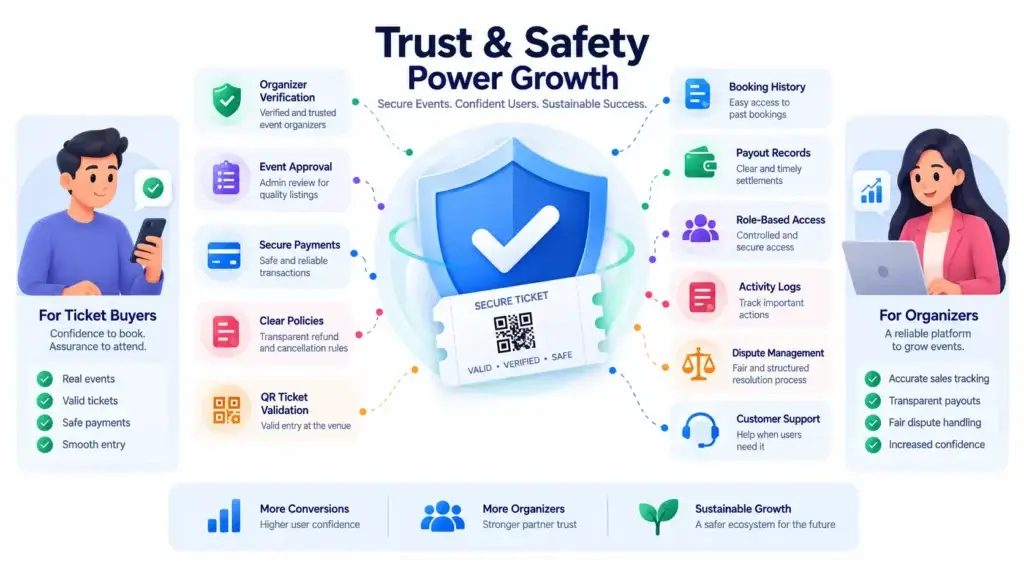
Trust is not only a legal or operational matter. It directly affects conversion.
Ticket buyers need to trust that the event is real, the ticket is valid, the payment is safe, and the entry process will work. Organizers need to trust that sales are tracked correctly, payouts are handled clearly, and customer disputes are managed fairly.
Important trust layers include:
- Organizer verification
- Admin approval for event listings
- Secure payment gateway integration
- Clear refund and cancellation policies
- QR ticket validation
- Booking history
- Payout records
- Role-based access control
- Activity logs
- Dispute management workflows
- Customer support visibility
A platform that handles trust well can reduce buyer hesitation and increase organizer confidence.
Why the Technology Foundation Matters for Marketing
Marketing becomes harder when the platform does not support the growth strategy. Founders still deciding between a ready-made foundation and a custom build can review this pre-built vs custom ticketing platform comparison before finalizing their launch approach.
For example, a founder may want to run city-level campaigns, but the app may not support location-based landing pages. An organizer may want early-bird pricing, but the backend may not support ticket tiers. A buyer may abandon checkout because payment errors or unclear fees create friction. An admin team may struggle because refunds, approvals, and event quality checks are scattered.
That is why product architecture matters from the beginning. Budget planning should also account for event listing workflows, payment processing, ticket inventory, notifications, infrastructure spikes, organizer onboarding, and admin operations. Founders can review this ticketing platform development cost guide to understand what usually affects the final build scope.
A growth-ready ticketing platform should include:
- Buyer-facing event discovery
- Organizer listing and sales tools
- Admin controls for approvals and operations
- Ticket inventory management
- Secure payment workflows
- QR entry validation
- Campaign and coupon tools
- Notification workflows
- Analytics for platform operators and organizers
- Scalable backend logic for future categories and cities
For founders who do not want to build every workflow from zero, choosing the right ticketing platform development partner matters because the product must support organizer onboarding, buyer discovery, secure payments, QR validation, admin controls, and future category expansion. Miracuves offers a ready-made event booking app foundation with white-label branding, source-code ownership, admin control, and 6-day solution delivery where the launch scope matches the ready-made product.
Final Thoughts: Build the Marketplace Loop Before Scaling the Campaigns
A new ticketing platform grows when organizers and buyers both see value.
Organizers need a platform that helps them sell, manage, track, and improve event performance. Buyers need a platform that helps them discover relevant experiences, book without friction, pay securely, and attend with confidence.
The strongest growth strategy is not a single campaign. It is a connected marketplace loop: acquire quality supply, make events discoverable, convert buyers smoothly, support event operations, share performance insights, and encourage repeat activity on both sides.
Miracuves helps founders launch faster with ready-made and white-label ticketing app solutions built for branding, admin control, source-code ownership, and market validation. If your goal is to test a ticketing business without waiting months for the first product release, a launch-ready platform foundation can help you move faster and learn from the market sooner.
FAQs
How can a new ticketing platform attract event organizers?
A new ticketing platform can attract organizers by offering easy event listing, assisted onboarding, ticket tier setup, QR check-in, payout visibility, campaign support, sales analytics, and featured placement for early partners. The pitch should focus on helping organizers sell more tickets and reduce operational work.
How can a ticketing platform attract ticket buyers in the early stage?
A ticketing platform can attract buyers through city-level discovery pages, event-specific landing pages, local creator partnerships, referral campaigns, paid search, social promotion, clear event details, secure checkout, and timely reminders. The first goal is to make discovery and booking feel trustworthy.
Should a ticketing platform onboard organizers first or attract buyers first?
Most new platforms should build a strong base of organizers and event inventory first. Without relevant events, buyer campaigns may produce poor retention. Once the platform has enough quality listings, demand generation becomes more effective.
What is the best launch strategy for an event ticketing marketplace?
The best launch strategy is to start with a focused city, event category, or audience segment. This helps the platform build supply density, create relevant discovery pages, run targeted campaigns, and understand buyer behavior before expanding into more categories.
What features help organizers sell more tickets?
Useful organizer features include event page creation, ticket tiers, coupon codes, early-bird pricing, group booking options, sales analytics, QR check-in, attendee lists, campaign tracking, payout records, and promotional tools.
What metrics should a ticketing platform track after launch?
A ticketing platform should track active organizers, listed events, repeat listings, event page views, ticket selection rate, checkout completion, payment success rate, repeat bookings, refund requests, referral usage, and organizer retention.
How does technology affect ticketing platform growth?
Technology affects growth because organizer onboarding, event discovery, payment success, ticket inventory, QR validation, notifications, refunds, and analytics all influence acquisition and retention. A weak platform foundation can increase marketing cost and reduce trust.
Can Miracuves help launch a ticketing platform quickly?
Yes. Miracuves provides ready-made and white-label ticketing app solutions designed for faster launch, source-code ownership, admin control, organizer workflows, and buyer booking flows. For suitable ready-made scopes, Miracuves highlights 6-day solution delivery.
Miracuves is an independent software development company. We are not affiliated with, connected to, sponsored by, or endorsed by any company or product named in this article.
Terms such as “X Clone” are used descriptively. It is how the software industry refers to building a platform with functionality comparable to a known service, and how clients search for it.
The entire design and codebase of our products is built by our own team. Our products contain no code, design, graphics, or content originating from any third-party website or applications.
All third-party names and marks referenced in this article are the property of their respective owners, referenced solely to identify the services discussed.