

Key Takeaways
- A short-term rental marketplaceconnects hosts, guests, property listings, availability, reservations, payments, and communication within one digital platform.
- Hosts manage properties, pricing, calendars, booking rules, and guest communication, while guests use search, filters, maps, reviews, and availability to find suitable stays.
- Successful reservation workflows depend on accurate listings, real-time calendar updates, secure payments, booking confirmations, cancellations, and clear host-guest communication.
Marketplace Workflow Signals
- Hosts onboard, create property listings, upload photos, add amenities, set nightly rates, define availability, configure booking policies, and manage incoming reservations.
- Guests search by destination, dates, price, property type, amenities, ratings, and availability before reviewing listing details and sending or confirming a booking.
- Messaging, notifications, identity checks, reviews, payment status, cancellation rules, and check-in information keep both sides connected throughout the booking journey.
Reservation & Operations Insights
- Reservation management should synchronize calendars, prevent double bookings, track booking status, manage modifications, and support refunds or cancellations when required.
- Marketplace operators need visibility into users, listings, reservations, commissions, payments, payouts, disputes, reviews, and overall platform performance.
- Miracuves develops customizable short-term rental marketplaces with host management, guest booking flows, property listings, calendars, reservations, payments, messaging, reviews, analytics, and admin controls.
A short-term rental marketplace is not just a website with property photos. The real product is the connection system behind the scenes. It has to connect hosts who own or manage properties, guests who want to book stays, listings that describe available spaces, and reservations that turn interest into confirmed bookings.
For founders, this distinction matters. A rental marketplace can look simple from the outside, but the backend logic is what decides whether the platform can prevent double bookings, handle payments, manage cancellations, support host operations, and build trust with guests.
That is why a short-term rental marketplace should be planned as a complete booking ecosystem, not only as a property listing directory. If you are exploring this category, a short-term rental marketplace solution can help you understand how ready-made rental platforms structure guest, host, booking, calendar, and admin workflows.
What Is a Short-Term Rental Marketplace?
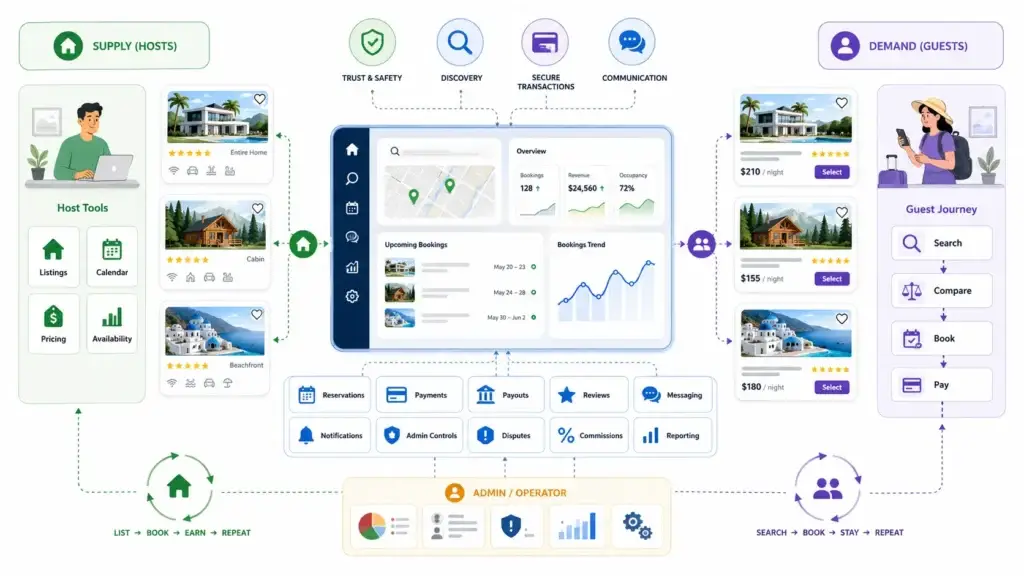
A short-term rental marketplace is a digital platform where property owners, managers, or local hosts list spaces for temporary stays, and guests search, compare, book, and pay for those stays through the platform.
The platform does not usually own the properties. Its role is to organize trust, discovery, transactions, and communication between both sides.
A strong rental marketplace usually includes:
- Guest search and booking experience
- Host listing and calendar tools
- Property detail pages
- Availability and pricing logic
- Reservation management
- Payment and payout workflows
- Reviews and ratings
- Messaging and notifications
- Admin controls for disputes, users, commissions, and reporting
This is why short-term rental marketplaces are often called two-sided platforms. One side brings supply, and the other side brings demand. The platform becomes valuable when it helps both sides complete bookings safely and repeatedly.
For a broader view of how these platforms fit into listings-based products, founders can explore Miracuves’ listings marketplace solutions.
The Four Core Parts of a Rental Marketplace
Every short-term rental marketplace depends on four connected parts: hosts, guests, listings, and reservations.
| Core Part | What It Means | Why It Matters |
|---|---|---|
| Hosts | People or businesses offering properties | They create supply for the marketplace |
| Guests | Travelers or renters looking for stays | They create demand and booking revenue |
| Listings | Property pages with details, price, rules, photos, and availability | They turn host inventory into searchable options |
| Reservations | Confirmed or requested bookings between guests and hosts | They create transactions, payouts, reviews, and platform revenue |
If one part fails, the marketplace loses trust. For example, if listings are attractive but calendars are inaccurate, guests may book unavailable dates. If hosts receive bookings but payout rules are unclear, they may stop using the platform. If guests cannot compare total prices clearly, they may abandon checkout.
A founder should think of these four parts as connected workflows, not separate features.
How Guests Move Through a Short-Term Rental Marketplace
The guest journey usually begins with intent. A guest wants a place to stay in a certain location for specific dates, with a budget, group size, and comfort expectation.
A well-built guest flow connects multiple steps.
First, the guest searches by destination, date, number of guests, property type, price range, amenities, and location. Then the marketplace shows relevant listings based on availability, rules, and ranking logic. After that, the guest compares photos, reviews, cancellation policies, total price, house rules, and host details.
Once the guest finds a suitable property, the platform moves them into a reservation flow. Depending on the business model, the booking may be instant or request-based.
In an instant booking flow, the reservation is confirmed quickly when the guest pays and the listing is available. In a request-based flow, the host reviews the booking request before accepting or declining it. Both models can work, but they serve different marketplace strategies.
Instant booking improves speed and convenience. Request-based booking gives hosts more control. A founder choosing between both should consider supply quality, host trust, market maturity, and guest expectations.
How Hosts Use the Marketplace
Hosts are not just users who upload photos. They are supply partners. The marketplace must make it easy for them to create, manage, price, and protect their listings.
A practical host flow includes:
- Host registration and verification
- Property creation
- Photo and description upload
- Amenity and house rule setup
- Location and map details
- Availability calendar control
- Nightly, weekly, seasonal, or custom pricing
- Minimum and maximum stay rules
- Booking request management
- Guest messaging
- Earnings and payout tracking
- Review management
The host dashboard is important because it reduces operational friction. If a host cannot easily block unavailable dates, update pricing, respond to guest questions, or track reservations, the marketplace becomes difficult to trust. This is why strong host tools, pricing, and payout controls should be planned as part of the platform’s core feature layer, not added later.
For founders, host experience is a growth lever. Better host tools can increase supply quality, reduce support tickets, and encourage hosts to keep their inventory active.
How Listings Become Bookable Inventory
A listing is more than a property profile. It is the digital version of the inventory a host wants to monetize.
To become bookable, a listing needs structured information. This includes the property type, room count, guest capacity, photos, location, amenities, check-in rules, cancellation rules, pricing, availability, and host terms.
The marketplace then uses this information to decide when and where the listing should appear.
For example, if a guest searches for a two-bedroom apartment in Mumbai from October 10 to October 14, the platform must check whether each listing matches the location, dates, capacity, pricing, and rules. Listings that do not match should not appear as bookable options.
This sounds simple, but it requires strong data logic. A weak listing system may show unavailable properties, incorrect prices, outdated amenities, or unclear rules. These issues can damage trust quickly.
A strong listing system should help guests make decisions and help hosts avoid manual coordination.
How Reservations Connect Hosts and Guests
Reservations are the bridge between interest and transaction.
When a guest starts a booking, the platform must connect the selected listing, guest profile, host profile, dates, pricing, taxes or fees, cancellation rules, payment method, and confirmation status.
A reservation may pass through several states:
| Reservation State | Meaning | Platform Role |
| Inquiry | Guest asks a question before booking | Enable messaging and host response |
| Booking request | Guest requests selected dates | Notify host and hold booking context |
| Accepted | Host approves the request | Move guest toward payment or confirmation |
| Confirmed | Booking is approved and paid | Lock dates and send confirmation |
| Cancelled | Guest or host cancels | Apply cancellation and refund rules |
| Completed | Stay is finished | Trigger review and payout workflows |
| Disputed | Issue occurs before, during, or after stay | Give admin a clear resolution workflow |
The reservation system must prevent two guests from booking the same property for the same dates. It must also handle payment success, payment failure, host decline, guest cancellation, host cancellation, refunds, and review triggers.
This is where many rental marketplace ideas become operationally complex. A booking page alone is not enough. Founders need the reservation engine to handle real-life edge cases such as calendar conflicts, payment failure, host decline, guest cancellation, and booking-status updates. For a deeper technical view, this short-term rental booking system guide explains how these workflows support a rental platform’s backend logic.
How Payments and Payouts Fit Into the Marketplace
Payments in short-term rental marketplaces involve more than collecting money from guests.
The platform may need to manage guest charges, host payouts, service fees, commissions, refunds, security deposits, coupons, taxes, and cancellation penalties. The exact structure depends on the business model and the target market.
A common payment flow looks like this:
- Guest enters payment details.
- Platform calculates stay price, cleaning fees, service fees, and any taxes or charges.
- Guest confirms payment.
- Reservation is created or confirmed.
- Host is notified.
- Platform tracks the commission or service fee.
- Host payout is released based on the payout policy.
- Refund or dispute rules apply if the booking is cancelled or challenged.
For founders, payment logic should be designed carefully from the beginning. Unclear payout rules can frustrate hosts. Confusing guest charges can reduce conversion. Poor refund workflows can create support pressure. This is also where the rental marketplace business model becomes important because commissions, service fees, host payouts, cancellation charges, and premium listing options directly affect platform revenue.
A rental marketplace should make money movement transparent for all sides.
Why Reviews and Trust Signals Matter
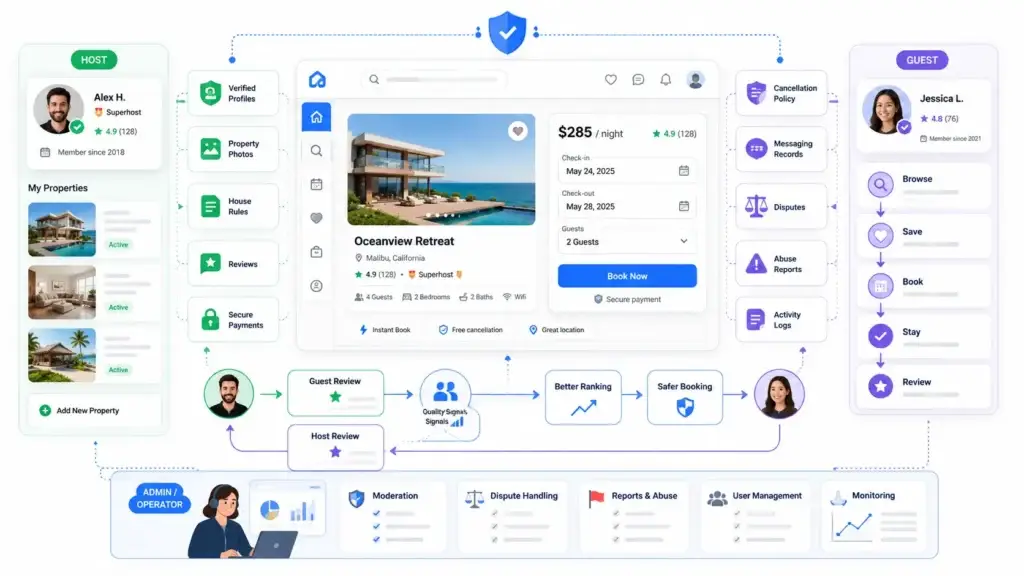
Short-term rental marketplaces rely on trust because guests are booking spaces they have not physically inspected, and hosts are welcoming people they may not know.
Trust is built through several layers:
- Verified profiles
- Accurate property photos
- Clear house rules
- Guest and host reviews
- Secure payment handling
- Cancellation transparency
- Messaging records
- Admin dispute workflows
- Abuse reporting
- Activity logs
Reviews are especially important because they create a feedback loop. Guests use reviews to evaluate the property and host. Hosts use guest history to feel more confident about accepting bookings. The platform uses review signals to improve ranking, moderation, and quality control.
For marketplace founders, trust should not be treated as a later feature. It is part of the product foundation. A strong short-stay rental app security guide can help founders think through verification, secure payments, abuse reporting, review moderation, and admin controls before the platform starts scaling.
The Admin Layer: Where the Marketplace Operator Controls the Business
The admin dashboard is where the platform operator manages the business.
Guests and hosts see the marketplace from their side, but the admin sees the entire operating layer. This includes users, hosts, listings, reservations, payments, commissions, cancellations, disputes, reviews, reports, and platform settings.
A useful admin layer should help the operator:
- Approve or reject listings
- Manage users and hosts
- View booking activity
- Track payment and payout status
- Configure commissions
- Review disputes and cancellations
- Monitor suspicious activity
- Manage content and reviews
- Control categories, amenities, and locations
- View marketplace performance reports
Without admin control, the founder becomes dependent on manual support or developer intervention for every small change. That slows operations and makes scaling difficult.
This is one reason many founders compare custom development with a ready-made marketplace foundation. A source-code-owned solution from Miracuves can help founders start with core marketplace workflows already structured, while still allowing room for branding, customization, and operational control.
Founder Decision Signals
Supply
Do you already have access to hosts, property managers, local operators, or niche inventory? Marketplace growth becomes easier when supply is not an afterthought.
Trust
Can guests confidently book without manual reassurance? Verification, reviews, clear rules, and payment safety directly affect conversion.
Booking Logic
Can the platform handle availability, cancellations, refunds, and double-booking prevention? Reservation accuracy is central to marketplace credibility.
Control
Can the operator manage listings, commissions, users, disputes, and reports from one dashboard? Admin control decides how smoothly the business can scale.
Short-Term Rental Marketplace Workflow Example
Here is a simple example of how the full system connects.
A host creates a listing for a two-bedroom apartment. They upload photos, add amenities, define guest capacity, set nightly pricing, block unavailable dates, and choose whether bookings are instant or request-based.
A guest searches for a stay in the same location for four nights. The marketplace checks the guest’s dates, group size, filters, and budget. If the apartment matches, it appears in search results.
The guest opens the listing, reviews photos, reads house rules, checks the total price, and sends a booking request. The host receives a notification, reviews the guest profile, and accepts the request.
The guest completes payment. The platform confirms the reservation, blocks the dates on the host calendar, sends confirmation details to both sides, and records the transaction in the admin dashboard.
After the stay, the guest and host leave reviews. The platform updates trust signals and makes the data available for reporting.
This is the marketplace connection layer in action.
Common Mistakes Founders Should Avoid
Building Listings Without Booking Logic
A property directory is not the same as a rental marketplace. If users can only browse but cannot request, confirm, pay, cancel, or review bookings, the product is incomplete.
Ignoring Calendar Accuracy
Calendar errors create one of the fastest trust failures in rental marketplaces. Double bookings, outdated availability, and manual date management can damage both guest and host confidence.
Treating Hosts Like Passive Users
Hosts need tools, support, and visibility. If the host dashboard is weak, the marketplace may struggle to keep good inventory active.
Making Pricing Too Confusing
Guests should understand what they are paying before checkout. Hosts should understand what they will receive after commissions and fees.
Delaying Admin Controls
Disputes, cancellations, payment failures, listing abuse, and review issues will happen. Founders need admin workflows before problems become manual chaos.
How Miracuves Helps Founders Launch Rental Marketplace Platforms Faster
Building a short-term rental marketplace from zero means designing guest apps, host tools, listing management, availability calendars, booking logic, payments, reviews, notifications, and admin controls.
For many founders, the smarter first step is not to rebuild every module from scratch. It is to start with a launch-ready foundation and customize the business model, branding, user experience, and market-specific workflows. This is why many startups compare a ready-made rental platform over custom development before committing to a longer build cycle.
Miracuves helps founders launch ready-made and white-label marketplace platforms with source-code ownership, admin dashboards, branded design, and faster deployment. For rental-focused ideas, founders can explore a ready-made vacation rental platform or compare related models through the broader rental marketplace solution category.
Final Thoughts
A short-term rental marketplace succeeds when the platform connects every participant and action clearly. Hosts need control over listings, pricing, availability, reservations, and payouts. Guests need fast discovery, transparent booking, secure payments, and reliable communication. The operator needs admin control over trust, payments, disputes, commissions, and marketplace quality.
The listing page may attract attention, but the reservation system creates the business.
For founders, the real question is not only “Can we build a rental app?” The stronger question is “Can we build a connected marketplace where hosts, guests, listings, and reservations work together without operational friction?”
That is the foundation worth getting right. For founders who want to move from planning to launch faster, Miracuves helps build ready-made, white-label rental marketplace platforms with guest booking flows, host tools, admin control, and source-code ownership.
FAQs
What is a short-term rental marketplace?
A short-term rental marketplace is a platform where hosts list properties for temporary stays and guests search, book, pay, and review those stays through the platform. It connects listings, availability, reservations, payments, communication, and admin control.
How do hosts and guests connect in a rental marketplace?
Hosts create listings with property details, pricing, rules, and availability. Guests search for matching properties, compare options, request or confirm bookings, and communicate with hosts through the platform.
What makes a listing bookable?
A listing becomes bookable when it has complete property details, accurate availability, pricing rules, guest capacity, house rules, cancellation terms, and a reservation workflow connected to the booking engine.
How does reservation management work in a short-term rental platform?
Reservation management tracks booking states such as inquiry, request, accepted, confirmed, cancelled, completed, or disputed. It connects guest intent, host approval, payment status, calendar availability, and admin visibility.
Why is calendar accuracy important in rental marketplaces?
Calendar accuracy prevents double bookings and avoids showing unavailable properties to guests. If availability is wrong, both guest trust and host confidence can drop quickly.
What does the admin dashboard control in a rental marketplace?
The admin dashboard helps the marketplace operator manage users, hosts, listings, reservations, commissions, payments, disputes, reviews, reports, and platform settings from one control layer.
Should founders build a short-term rental marketplace from scratch?
Custom development can work when the business needs highly specific workflows. However, many founders choose a ready-made marketplace foundation to launch faster, validate demand, and customize after real market feedback.
How can Miracuves help with rental marketplace development?
Miracuves helps founders launch ready-made and white-label rental marketplace platforms with source code, guest and host workflows, booking logic, admin dashboards, branding support, and faster deployment.
Miracuves is an independent software development company. We are not affiliated with, connected to, sponsored by, or endorsed by any company or product named in this article.
Terms such as “X Clone” are used descriptively. It is how the software industry refers to building a platform with functionality comparable to a known service, and how clients search for it.
The entire design and codebase of our products is built by our own team. Our products contain no code, design, graphics, or content originating from any third-party website or applications.
All third-party names and marks referenced in this article are the property of their respective owners, referenced solely to identify the services discussed.