Key Takeaways
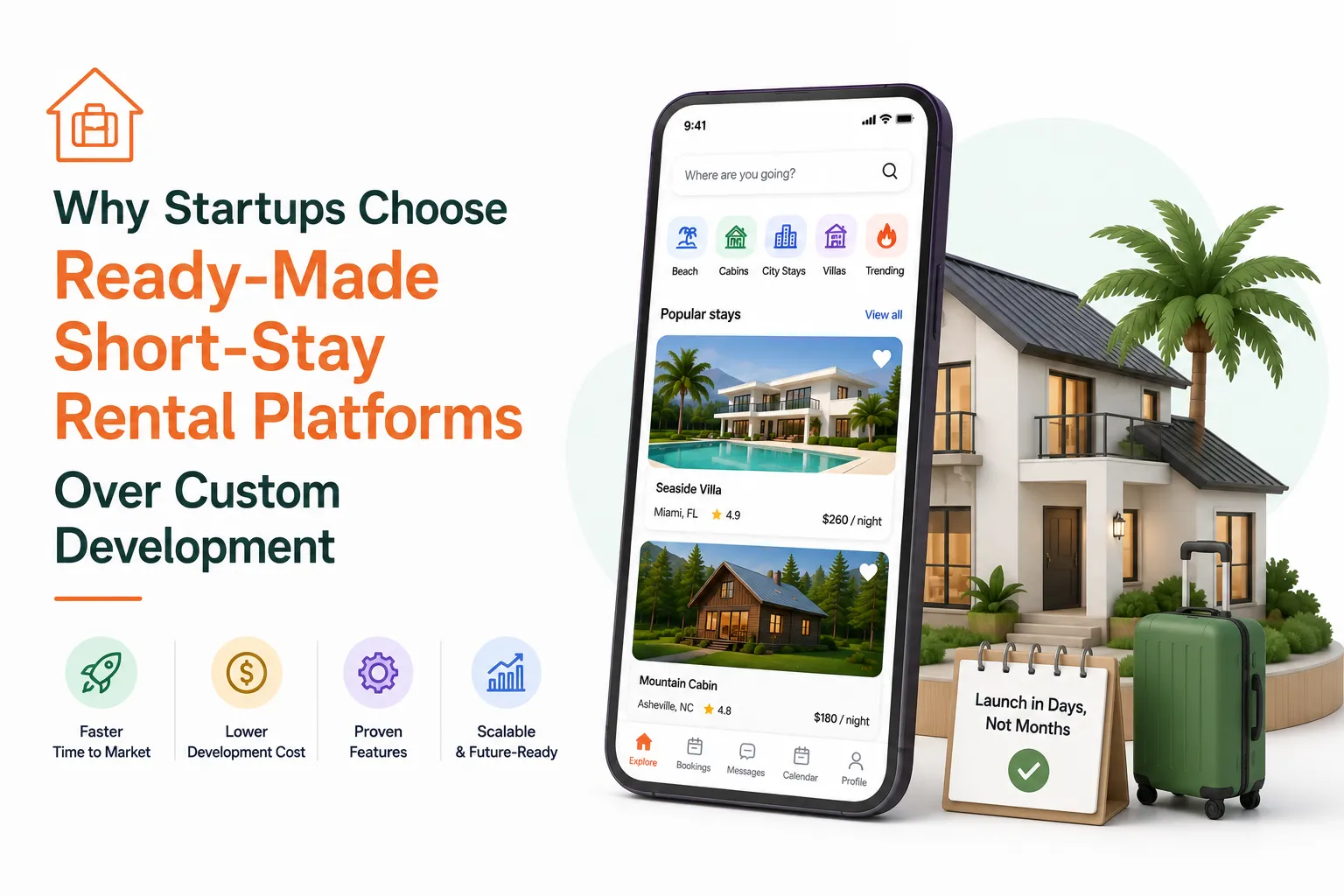
- A ready-made short-stay rental platform gives startups access to proven modules for listings, search, booking, calendars, payments, payouts, reviews, and host management.
- Compared with custom development, a ready-made foundation can reduce initial development complexity and let founders focus more on niche positioning, user acquisition, and marketplace validation.
- Source-code access, customization flexibility, integrations, scalable architecture, and admin control are important when choosing a platform that can evolve beyond the first launch.
Ready-Made Platform Signals
- Prebuilt guest, host, booking, payment, messaging, review, and admin workflows reduce the need to recreate standard rental marketplace functionality from scratch.
- Founders can customize branding, property types, commission rules, booking policies, payment gateways, maps, verification, notifications, and niche-specific workflows.
- A modular platform also makes it easier to add dynamic pricing, loyalty, analytics, channel integrations, automation, and advanced host tools as marketplace demand grows.
Founder Decision Insights
- Startups should compare development effort, customization needs, source-code ownership, scalability, security, integrations, maintenance, and long-term platform control before selecting a development path.
- Custom development may suit highly specialized products, while ready-made rental software can be practical when the core marketplace workflows are already well understood.
- Miracuves develops customizable short-stay rental platforms with property listings, booking workflows, host management, payments, payouts, reviews, integrations, analytics, and admin controls.
Building a rental marketplace sounds simple at the idea stage. A founder imagines hosts uploading properties, guests searching by location, bookings flowing through the platform, and the business earning commission from every successful stay.
The difficult part appears once development begins.
A short-stay rental platform is not only a listing website. It needs host onboarding, guest discovery, availability calendars, booking rules, payments, payouts, reviews, dispute workflows, notifications, admin controls, and security layers working together. When every module is built from zero, the first market version can take longer, cost more, and create more operational risk than expected.
That is why many startups now compare custom development with a ready-made short-stay rental platform before making a build decision. The goal is not to avoid customization. The goal is to avoid spending the first few months rebuilding basic marketplace infrastructure before the business has even tested demand.
What Startups Are Really Comparing
Most founders do not compare ready-made and custom development because they dislike custom software. They compare both because they are trying to protect time, budget, and market timing.
Because pricing depends on modules, integrations, branding, payment setup, platform complexity, and customization depth, founders should review rental platform development cost factors before choosing between a ready-made foundation and a fully custom build.
A custom build starts with discovery, architecture, UI planning, backend development, frontend development, mobile development, QA, bug fixing, deployment, and post-launch fixes. This route can make sense when the business model is highly unusual or when the company already has a validated market and dedicated technical leadership.
A ready-made platform starts from a different position. The foundation already includes the common marketplace flows. The founder can then focus on branding, business rules, payment setup, launch geography, host onboarding, and the features that make the platform different.
For a startup, that difference matters. Early traction usually depends less on having every possible custom feature and more on whether the platform can get hosts, process bookings, accept payments, and give the operator enough control to manage the marketplace.
Why Custom Development Can Slow Early Market Validation
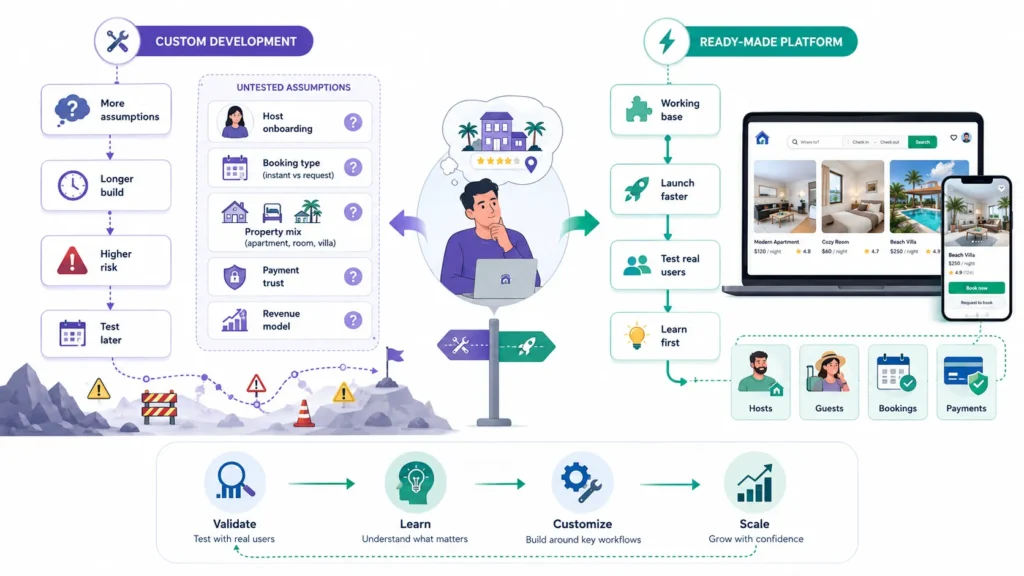
Custom development often looks attractive because it promises complete control. The problem is that early-stage founders do not always know which features deserve that control yet.
Before launch, many assumptions are still untested:
- Will hosts list their properties without personal onboarding?
- Will guests prefer instant booking or request-based booking?
- Will the market respond better to apartments, rooms, serviced stays, villas, or mixed inventory?
- Which payment method will users trust?
- Should the platform charge commission, host plans, featured listings, booking fees, or a mix of revenue streams?
When a startup builds everything from zero, it can spend heavily on assumptions before real users confirm them. A ready-made rental platform helps reduce that risk by giving the founder a working base for market testing.
This does not mean the product should stay generic. It means the founder can customize after understanding which workflows actually influence host supply, guest trust, and booking conversion.
What a Ready-Made Short-Stay Rental Platform Includes
A good ready-made short-stay rental platform should include the operational foundation of a two-sided rental marketplace.
For guests, the platform should support search, filters, listing pages, booking flow, availability checks, secure checkout, reviews, and communication.
For hosts, it should support listing creation, photo uploads, availability management, pricing rules, booking requests, earnings visibility, payout requests, and profile management.
For the platform operator, it should include admin controls for users, hosts, listings, bookings, commissions, payments, disputes, refunds, content, reports, and settings.
The value is not simply that these modules exist. The value is that they are already connected. A booking should affect availability. A payment should affect commission. A completed stay should affect payout. A review should connect to the correct guest and host. An admin action should reflect across the marketplace.
That connected foundation is what saves founders from rebuilding the same operational logic repeatedly.
For founders comparing different rental marketplace models, Miracuves’ white-label rental and property app solutions give a broader view of how short-stay, property listing, property management, vehicle rental, and asset rental platforms can be structured under one rental ecosystem.
For a deeper breakdown of host dashboards, guest booking flows, listing controls, pricing rules, payout workflows, and admin tools, founders can review the core rental marketplace features before finalizing their launch scope.
Ready-Made vs Custom Development: Founder Decision Table
| Decision Area | Custom Development | Ready-Made Rental Platform |
|---|---|---|
| Launch speed | Slower because architecture, flows, and modules start from zero | Faster because core marketplace workflows already exist |
| Budget control | Harder to estimate if scope keeps expanding | Easier to plan because the foundation is already defined |
| Early validation | Delayed until enough modules are built and tested | Faster because founders can test host and guest demand earlier |
| Customization | Maximum flexibility from day one | Strong flexibility after the base platform is configured |
| Technical risk | Higher if the team has not built rental marketplace logic before | Lower when common booking, listing, payment, and admin flows are already structured |
| Best use case | Unique models, funded teams, complex long-term builds | Startups that need faster launch, brand control, and practical market testing |
Why Speed Matters in Rental Marketplace Startups
Speed is not only about launching earlier. It is about learning earlier.
A rental marketplace has two sides to validate: supply and demand. Founders need to know whether hosts will list inventory and whether guests will complete bookings. This cannot be fully answered inside a product document, prototype, or investor deck.
A live platform gives better signals:
- Hosts either complete onboarding or drop off.
- Guests either search and book or abandon.
- Payment methods either build trust or create friction.
- Admin workflows either make operations manageable or create daily bottlenecks.
- Support requests either reveal missing features or expose unclear user flows.
Once the first version is live, a focused rental marketplace marketing strategy helps founders test host acquisition, guest demand, local positioning, booking conversion, and early retention more systematically.
A ready-made platform helps founders reach these signals faster. Instead of waiting for every module to be designed and developed from scratch, the team can launch a branded first market version, observe real behavior, and improve with clearer priorities.
The Host Side Decides Marketplace Health
Many rental marketplace founders focus heavily on the guest experience. That makes sense because guests create bookings. But the host side often decides whether the platform has enough inventory to survive.
Hosts need more than a signup form. They need control over listings, dates, pricing, rules, photos, communication, booking status, and payouts. If hosts cannot manage their inventory easily, they will either leave the platform or continue depending on manual channels.
For startups, the host dashboard should answer practical questions:
- Can hosts add and edit listings without support help?
- Can they manage availability clearly?
- Can they set seasonal prices or special rules?
- Can they track booking requests and completed stays?
- Can they see earnings and payout status?
- Can the operator approve, suspend, or verify hosts when needed?
A ready-made short-stay rental platform gives founders a working host-side base instead of treating host tools as an afterthought.
Guest Experience Still Needs Trust, Not Just Design
Attractive screens help, but rental bookings depend on trust.
Guests want to know whether the listing is real, whether the price is clear, whether the dates are available, whether payment is safe, and whether they have a clear record of the booking. A platform that looks good but fails on booking reliability will struggle to build repeat usage.
Founders should also plan rental app security and trust controls early because payment safety, account protection, listing verification, booking records, and dispute workflows directly affect marketplace confidence.
The guest flow should be simple:
- Search by location and dates.
- Compare listings with clear photos and details.
- Check availability before booking.
- Review pricing, fees, and policies.
- Pay securely.
- Receive booking confirmation.
- Leave a review after the stay.
A ready-made rental booking platform gives startups these core flows early, so design improvements and local market refinements can happen on top of a working transaction system.
Admin Control Is Where Founders Avoid Operational Chaos
A rental marketplace becomes difficult to manage when the admin panel is weak.
Founders need visibility across the business. They should be able to manage users, hosts, listings, bookings, payments, commissions, disputes, reviews, content, and reports from one control layer. Without this, every small issue turns into a developer request or manual workaround.
Strong admin control helps the operator answer questions such as:
- Which listings are pending approval?
- Which hosts are waiting for payout?
- Which bookings failed or were cancelled?
- Which users need support?
- Which markets or property types are performing better?
- Which commission rules need adjustment?
This is one of the biggest reasons startups choose ready-made platforms over custom development. The admin foundation already exists, so the founder can manage operations while the product continues improving.
Where Customization Should Actually Happen
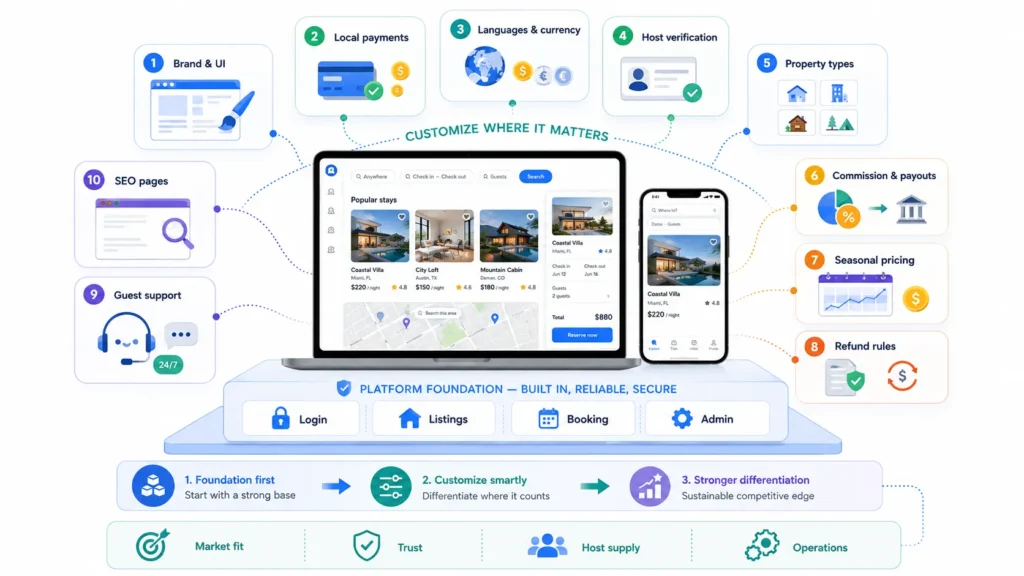
Choosing a ready-made platform does not mean launching a copy of another business. The smarter approach is to use the ready-made foundation for common infrastructure and customize the areas that shape market differentiation.
For a short-stay rental startup, useful customization areas may include:
- Brand identity and user interface.
- Local payment gateways.
- Regional languages and currencies.
- Host verification workflows.
- Property types and listing categories.
- Commission rules and payout policies.
- Seasonal pricing logic.
- Cancellation and refund rules.
- Guest support workflows.
- Marketing pages and SEO structure.
This is where founders should spend strategic energy. Rebuilding standard login, listing, booking, and admin modules from zero rarely creates differentiation. Local market fit, trust, host supply, and operational clarity usually matter more.
Before finalizing commissions, host subscriptions, featured placements, service fees, or booking charges, founders should map the rental marketplace business model clearly so monetization does not become an afterthought after launch.
When Custom Development Still Makes Sense
A custom build can still be the right choice in some cases.
If the platform has a highly unique booking model, unusual inventory logic, enterprise integrations, complex compliance requirements, or a funded technical team ready for a longer build, custom development may be appropriate.
It can also make sense when a business already has strong traction and needs a deeply specialized platform that cannot be supported by an existing foundation.
If the project requires deeper technical planning, third-party integrations, advanced booking rules, or a longer custom build, founders should understand how to choose the right rental marketplace development partner before committing to a team.
The decision is not “ready-made is always better” or “custom is always better.” The decision depends on the founder’s stage.
For early-stage startups, the priority is usually speed, validation, cost control, and operational readiness. For mature businesses, the priority may shift toward deeper custom workflows, advanced integrations, and long-term platform architecture.
Founder Decision Signals
Choose ready-made when speed matters
If your main goal is to launch, onboard hosts, test bookings, and validate demand faster, a ready-made rental marketplace foundation is usually more practical.
Choose custom when the model is unusual
If your business logic is not close to a standard host-guest booking marketplace, a custom build may give you more flexibility.
Choose ready-made when budget needs control
If you want to avoid open-ended discovery, architecture, and module development costs, a defined platform base can reduce uncertainty.
Choose custom when you already have traction
If your marketplace already has users, revenue, and clear workflow requirements, deeper custom development can be easier to justify.
How Miracuves Helps Founders Launch Smarter
Miracuves helps founders build ready-made and white-label app solutions with source-code ownership, admin dashboards, branded user experiences, and faster deployment.
For short-stay rental marketplace founders, the advantage is focus. Instead of spending the early build cycle recreating basic booking logic, founders can start with a structured platform foundation and focus on the business layer: host acquisition, guest trust, local pricing, payment preferences, and launch-market positioning.
Founders who want to see the implementation layer can explore Miracuves’ short-stay rental marketplace solution after understanding whether a ready-made foundation fits their launch strategy. This keeps the blog focused on founder education while the product page handles demo, features, pricing, and direct conversion.
For broader planning, founders can also read the short-term rental platform development guide and the rental app security guide to understand trust, safety, payment, and operational risks before launch.
Mistakes Startups Should Avoid
Building every feature before testing demand
A long feature list can feel productive, but it may delay real validation. Startups should first prove that hosts will list and guests will book. Extra features should follow real usage patterns.
Treating the platform as a simple directory
A rental marketplace is not just a list of properties. It needs booking logic, payment flow, availability checks, host management, guest communication, and admin oversight.
Ignoring host retention
Guest demand matters, but hosts create the supply. If hosts cannot manage listings, prices, calendars, and payouts easily, the marketplace becomes fragile.
Underestimating admin operations
Many founders focus on the app and forget the operator dashboard. Without strong admin control, disputes, approvals, refunds, payouts, and support become difficult to manage.
Customizing before clarifying the business model
Customization should support strategy. Founders should first decide how the platform will earn: commission, host subscriptions, featured listings, booking fees, service charges, or mixed revenue streams.
Final Thoughts
Startups choose ready-made short-stay rental platforms over custom development because they need a faster and more controlled way to validate the market.
Custom development is useful when the business has unusual requirements or mature workflows. But for many early-stage rental marketplace founders, the biggest risk is not a lack of custom code. The bigger risk is spending too much time and budget before learning whether hosts, guests, pricing, and operations actually work in the target market.
A ready-made platform gives founders a practical starting point. It supports the core marketplace flows, reduces development uncertainty, and leaves room for meaningful customization where it matters most. For founders who want to move from planning to launch with stronger control, Miracuves helps create ready-made and white-label rental marketplace foundations that can be adapted around brand, admin workflows, and business model needs.
The better startup decision is not always the longest build. It is the build that helps the founder launch, learn, and improve with real market feedback.
FAQs
What is a ready-made short-stay rental platform?
A ready-made short-stay rental platform is a pre-built marketplace foundation for hosts, guests, bookings, payments, payouts, listings, and admin management. It allows founders to launch faster and customize the platform for their brand, market, and business model.
Is a ready-made rental platform better than custom development?
It depends on the founder’s stage. A ready-made platform is usually better for startups that need faster launch, budget control, and early market validation. Custom development may be better for businesses with unusual workflows, complex integrations, or already validated demand.
Can a ready-made vacation rental marketplace be customized?
Yes. A ready-made vacation rental marketplace can be customized with branding, local payment gateways, languages, currencies, property categories, commission rules, host verification, pricing logic, and market-specific workflows.
What features should a rental marketplace startup launch with first?
A startup should launch with host onboarding, property listings, guest search, availability calendar, booking flow, secure payments, payout management, reviews, notifications, and admin controls. Advanced features can be added after real market feedback.
Why do startups avoid building rental platforms from scratch?
Many startups avoid building from scratch because it can delay validation and increase technical uncertainty. A ready-made platform helps founders focus on host acquisition, guest trust, monetization, and operations instead of rebuilding common marketplace modules.
Does a ready-made platform limit future scalability?
Not necessarily. Scalability depends on code quality, architecture, hosting, database structure, integrations, and ongoing development. A source-code-owned platform gives founders more flexibility to customize, optimize, and extend the product over time.
How should this blog link to the money page?
This blog should use semantic anchors such as “short-stay rental marketplace solution,” “ready-made rental marketplace platform,” or “launch-ready rental marketplace foundation.” It should avoid repeated exact-match product anchors that compete with the money page.
Miracuves is an independent software development company. We are not affiliated with, connected to, sponsored by, or endorsed by any company or product named in this article.
Terms such as “X Clone” are used descriptively. It is how the software industry refers to building a platform with functionality comparable to a known service, and how clients search for it.
The entire design and codebase of our products is built by our own team. Our products contain no code, design, graphics, or content originating from any third-party website or applications.
All third-party names and marks referenced in this article are the property of their respective owners, referenced solely to identify the services discussed.