


Key Takeaways
What You’ll Learn
- TransferNow operates on a freemium model that allows users to send files without mandatory registration.
- Paid plans provide higher transfer limits, storage capacity, and advanced features.
- The platform serves individuals, teams, and businesses with scalable pricing tiers.
- File transfer simplicity and speed drive user adoption and retention.
- The model focuses on converting free users into long-term paying customers.
Stats That Matter
- Free transfers come with limits on file size and availability duration.
- Premium plans increase transfer limits and storage capacity.
- Team plans include collaboration and branding features.
- Cloud-based systems support scalable and secure file delivery.
- APIs enable automation and integration with other business tools.
Real Insights
- Freemium access lowers entry barriers and drives large-scale adoption.
- Subscription upgrades are driven by higher usage needs.
- Business features create additional revenue opportunities.
- API integrations expand the platform into broader ecosystems.
- A balanced mix of simplicity, performance, and monetization supports long-term growth.
In a world flooded with digital content, fast, secure, and user-friendly file exchange is essential for productivity. The Business Model of TransferNow emerged from recognizing this gap early — building a lightweight, privacy-focused alternative to giants like WeTransfer and Dropbox. It offers instant file delivery without login barriers and ensures GDPR-compliant security.
What started as a freemium tool for sending large files has evolved into a scalable SaaS ecosystem powering individuals, business teams, and enterprise clients through custom branded portals and collaboration workflows. By 2026, business model of TransferNow clone stands as a textbook case of how simplicity and trust can scale into multi-million-dollar recurring revenue — a lesson modern founders cannot ignore.
For entrepreneurs building cloud, SaaS, or content-delivery apps, the Business Model of TransferNow demonstrates how to transform a simple utility service into a profitable subscription engine — something Miracuves helps founders replicate through white-label super-app and SaaS platform architecture.
How the TransferNow Business Model Works
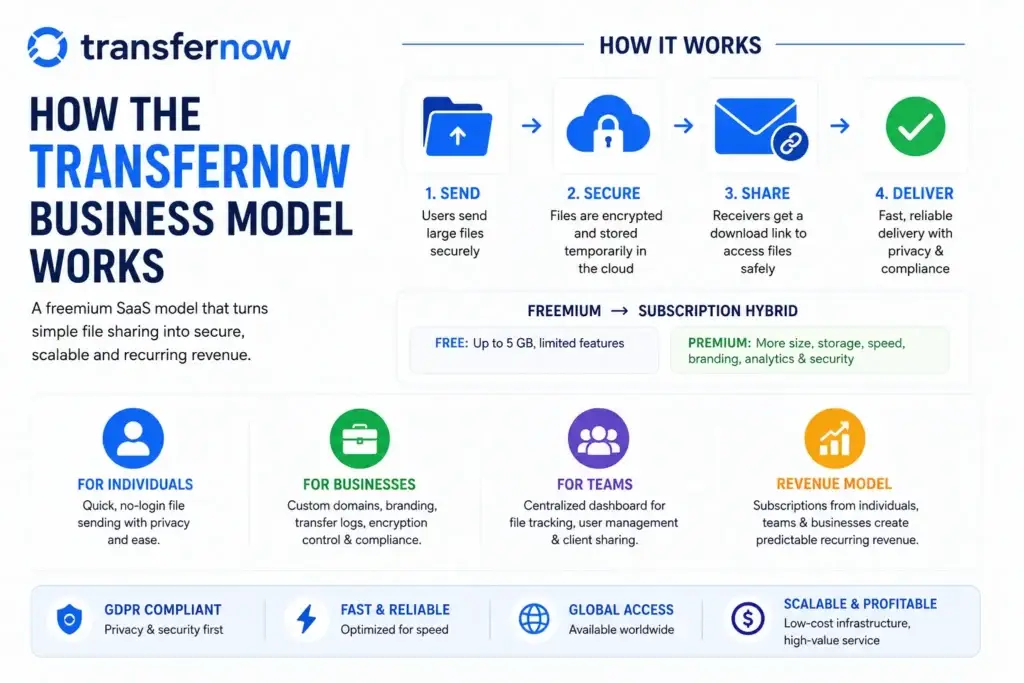
TransferNow operates on a freemium SaaS model blending accessibility, privacy, and scalability — balancing free utility for casual users with premium subscriptions for professionals and businesses. Its model thrives on the principle of “send now, upgrade later,” turning high-volume usage into predictable recurring revenue.
Core Framework Overview
At its core, TransferNow connects users needing to send large files with secure cloud infrastructure that ensures reliability, speed, and compliance.
Unlike file storage apps (Dropbox, Google Drive), TransferNow focuses exclusively on temporary, secure delivery, optimizing bandwidth and simplicity over long-term hosting.
Type of Model
- Freemium → Subscription Hybrid
- Free tier: Send files up to 5 GB, limited download window.
- Premium tier: Larger file limits, permanent storage, faster speeds, custom branding, and password protection.
- B2C + B2B SaaS Fusion
- Individuals use it for personal sharing.
- Businesses use branded portals and teams for professional transfers.
Value Proposition
- For Individuals:
Quick, no-login file sending with privacy and ease. - For Businesses:
Custom domains, analytics, encryption control, and transfer logs for regulatory compliance. - For Teams:
Centralized dashboard for file tracking and recurring client sharing.
Stakeholders
- End Users (Free & Paid): Use platform to send large files quickly.
- Business Clients: Subscribe to premium plans for compliance and branding.
- Partners & API Clients: Integrate TransferNow’s delivery engine into apps or enterprise portals.
- TransferNow Itself: Manages servers, security, uptime, and customer support to maintain ecosystem balance.
Evolution of the Model
- 2013–2017: Basic freemium sharing tool with limited file size.
- 2018–2020: Launch of premium “Pro” and “Team” tiers with analytics.
- 2021–2023: Introduction of TransferNow Business, offering multi-user admin control and branding options.
- 2024–2025: Integrations with cloud drives (OneDrive, Google Drive) and advanced API usage for enterprises.
Why It Works Today
- Privacy & Compliance Demand: GDPR-first design attracts EU businesses wary of US-based data processors.
- Speed & UX Simplicity: Zero-login and clean UI create viral adoption loops.
- Work-from-anywhere Economy: Remote teams need fast, secure delivery tools.
- Scalable Infrastructure: Optimized storage lifecycle reduces operational costs.
- Balanced Monetization: Clear distinction between free and paid value ensures conversion.
Read more : What is TransferNow App and How Does It Work?
Target Market & Customer Segmentation Strategy
TransferNow’s success lies in its ability to serve distinct yet complementary user segments — from casual individuals to enterprise teams — all unified by one need: reliable, secure, and effortless file transfer
Primary Customer Segments
| Segment | Description | Core Need | Monetization Path |
| Individual Users | Freelancers, designers, students, photographers | Fast and free file delivery up to 5 GB | Freemium → Upsell to Pro for larger limits and extra security |
| Professional Users | Agencies, creators, and small businesses | Branding, password protection, analytics | Subscription (Pro/Team plans) |
| Enterprise Clients | Corporates, media houses, software teams | Multi-user management, API integration, compliance | TransferNow Business (custom pricing) |
| API Partners | Developers embedding TransferNow into SaaS apps | File transfer infrastructure-as-a-service | API usage fees |
Customer Journey
- Discovery:
Users find TransferNow via organic search (“send large files free”), social referrals, or comparison sites. - Adoption:
Quick onboarding — no sign-up required to test file sending. - Engagement:
First transfer builds trust through speed and simplicity. - Conversion:
Users hit the free limit → prompted to upgrade for larger files or longer retention. - Retention:
Pro users stay due to reliability, customization, and team features. - Advocacy:
Businesses recommend it internally, expanding team accounts and creating network effects.
Acquisition Channels
- Organic SEO: TransferNow ranks for high-intent keywords like “send files online,” “share large files,” etc.
- Referral Marketing: Each shared link acts as a micro-promotion for the brand.
- Email Remarketing: Nurtures free users approaching their transfer limits.
- Partnership Integrations: Cloud storage tie-ins and corporate onboarding programs.
Customer Retention & Lifetime Value Optimization
- Subscription renewals driven by team usage expansion.
- Annual plans with 20–30% discounts encourage long-term commitment.
- Business tier offers API integrations — increasing switching costs.
- Regular feature updates (e.g., encryption logs, branded portals) enhance perceived value.
Read more : Business Model of TransferNow : Complete Strategy Breakdown 2026
Revenue Streams and Monetization Design
TransferNow’s monetization architecture is a perfect example of how a free utility can evolve into a sustainable subscription-driven SaaS engine.
By 2026, the company generates steady recurring revenue through layered plans, business integrations, and value-added services — all while maintaining a freemium acquisition funnel.
Primary Revenue Stream 1 – Subscriptions (~85 % of total revenue)
Mechanism:
TransferNow uses a tiered subscription system designed around file size limits, retention time, and customization.
Pricing Model
| Plan | Target User | File Size Limit | Key Benefits | Price |
| Free | Casual users | 5 GB | No login, 7-day retention, ads | $0 |
| Premium | Professionals | 50 GB | No ads, faster transfers, encryption | $8.99 / month |
| Team | Small businesses | 200 GB | Multiple users, dashboard, analytics | $14.99 / month |
| Business | Enterprises | Custom | Branding, API, compliance tools | From $29 / month (custom pricing) |
Growth Trajectory:
- Conversion rate: ~4–6 % from free to paid.
- ARPU rising 10 % YoY as enterprise adoption grows.
- Long-term retention above 80 % among team and business plans.
Secondary Revenue Streams
- API & Integration Fees (~7 %)
- Enterprises integrating TransferNow’s API for secure file workflows pay per-usage or annual licenses.
- Adds B2B scalability and stickiness.
- Advertising on Free Tier (~4 %)
- Contextual, brand-safe ads displayed to non-logged-in users.
- Creates passive monetization without compromising UX.
- Affiliate & Partner Programs (~2 %)
- Cloud storage or productivity tools offering co-marketing with referral payouts.
- Expands visibility and reduces acquisition cost.
- Custom Branding Services (~2 %)
- White-label or co-branded portals for agencies and corporates wanting branded file-delivery pages.
- White-label or co-branded portals for agencies and corporates wanting branded file-delivery pages.
Monetization Design Philosophy
TransferNow’s model thrives on value-segmented progression — users start free, hit a limitation, and upgrade for convenience, security, or professionalism.
This ensures monetization is natural, not forced.
Its tier-based architecture interlinks across all segments:
- Cross-selling: Team plan upsells to Business API.
- Upselling: Free → Premium → Team path via usage triggers.
- Psychological Anchoring: Affordable monthly entry with annual discounts nudging longer retention.
Together, these mechanisms form a self-reinforcing revenue flywheel — high usage brings upgrades, upgrades fund better performance, which in turn attracts more users.
Read more : TransferNow Revenue Model: How TransferNow Makes Money in 2026
Operational Model & Key Activities
TransferNow’s operational backbone is built on efficiency, automation, and privacy compliance.
Its ability to serve millions of transfers daily — without friction — relies on a tightly coordinated blend of cloud infrastructure, lean engineering, and responsive customer support.
Core Operations
- Cloud Infrastructure Management
Uses distributed storage nodes across Europe to comply with GDPR and reduce latency.
Cloud redundancy ensures near-zero downtime even during high-traffic periods. - Platform Development & Maintenance
Agile development cycles with weekly updates focusing on performance optimization, encryption upgrades, and UX refinements. - Data Security & Compliance
End-to-end encryption (AES-256), SSL transfer layers, and automated expiration of files after retention windows.
Regular audits ensure ISO 27001 and GDPR adherence — a major trust driver in EU markets. - Customer Support & Success
Automated ticketing plus live chat for premium users.
Knowledge base and tutorials enhance self-service efficiency. - Marketing & Growth
SEO-optimized content, referral incentives, and B2B outreach via integration partnerships.
Campaigns emphasize privacy, ease, and European data sovereignty.
Resource Allocation
| Function | Estimated Share of Operating Budget | Key Focus |
| Technology & Infrastructure | 40 % | Server uptime, storage scalability, AI-driven optimization |
| Marketing & Acquisition | 25 % | SEO, paid media, partnerships |
| Human Resources & Operations | 15 % | Engineering talent, support teams |
| R&D & Innovation | 10 % | New features (API, encryption tech, AI-based delivery optimization) |
| Administration & Compliance | 10 % | Legal, finance, data privacy management |
Regional Expansion & Localization
- Primary data centers in France, Germany, and the Netherlands to ensure EU compliance.
- Localization in 12+ languages, capturing markets in Europe, Latin America, and parts of Asia.
- Exploring partnerships with local ISPs and telecom providers to integrate “Send via TransferNow” tools.
Operational Strengths
- Automation-first infrastructure keeps costs low relative to traffic volume.
- Privacy-centric differentiation attracts enterprise customers wary of US-based cloud processors.
- Lean workforce (~80 employees) operating globally through remote-first structure reduces overhead.
- Predictable scalability — bandwidth can be expanded on demand through elastic storage partnerships.
Strategic Partnerships & Ecosystem Development
TransferNow’s ecosystem has expanded well beyond file transfer — it now thrives on strategic alliances that amplify performance, security, and reach.
By aligning with cloud providers, compliance partners, and tech integrators, TransferNow builds a defensible ecosystem moat around its freemium core.
Collaboration Philosophy
TransferNow believes in “partnering for trust and scalability.”
Instead of building every component in-house, the company collaborates with specialists for storage, security, and marketing infrastructure.
This partnership-first strategy minimizes capital expenditure while maximizing reliability and innovation speed.
Key Partnership Types
- Technology & API Partners
- Collaborates with AWS Europe, OVHCloud, and Scaleway for distributed storage and bandwidth optimization.
- Integrations with productivity tools (e.g., Slack, Trello, Google Workspace) through its RESTful API.
- Security audits supported by certified cybersecurity firms for penetration testing and compliance assurance.
- Payment & Billing Alliances
- Uses Stripe and Paddle for seamless international billing and currency conversion.
- Localized payment gateways in EU, LATAM, and Asia enhance conversion rates for small businesses.
- Marketing & Distribution Partners
- Co-marketing with privacy-oriented software (like ProtonMail, Brave Browser) to tap into overlapping user bases.
- Affiliate partnerships with SaaS marketplaces and tech blogs.
- Referral API allows white-label partners to embed TransferNow inside their ecosystems.
- Regulatory & Expansion Alliances
- Works closely with EU Data Protection Agencies for GDPR transparency.
- Partners with telecom and ISP firms in emerging markets to reduce latency and expand network reach.
- Collaboration with education and research institutions for secure academic data transfer.
Ecosystem Strategy Insight
TransferNow’s partnerships extend its utility beyond simple file transfer — they embed it into a broader data movement ecosystem:
- Network effects: Each integration creates new exposure channels.
- Trust ecosystem: Compliance partners add brand legitimacy in enterprise procurement.
- Monetization: API partners drive recurring B2B income while reducing churn.
- Competitive moat: Tech and compliance partnerships make replication by competitors difficult and costly.
Growth Strategy & Scaling Mechanisms
TransferNow’s growth journey from a niche European file-sharing tool to a global SaaS platform is rooted in simplicity, privacy trust, and scalable cloud economics.
By 2026, its growth strategy combines organic virality, premium upsells, and regional expansion — all supported by a lean operational model and automated infrastructure.
Core Growth Engines
- Organic Virality & Referral Loops
- Every shared file acts as an advertisement — recipients see TransferNow’s interface and often become new users.
- Smart triggers encourage free users to “upgrade to Premium” after hitting file or speed limits.
- Built-in “Send Again” prompts and branded download pages multiply exposure.
- Paid Acquisition & Partnerships
- Runs targeted Google and YouTube ads focused on phrases like “send large files securely.”
- Co-marketing with privacy-focused tech brands (Proton, NordVPN) increases credibility and conversion among privacy-conscious audiences.
- New Product Lines & Feature Extensions
- Introduced TransferNow Business and API services for enterprise adoption.
- Exploring AI-powered optimization for file compression and upload speeds.
- Rolling out smart link analytics (open rates, download geography) to attract marketers and media firms.
- Geographic Expansion Models
- Core base: Europe (France, Germany, Spain).
- Growth regions: North America, LATAM, and Southeast Asia.
- Tailored local pages and payment options fuel regional trust.
- Partnerships with telecoms in LATAM to reduce upload latency.
Scaling Challenges & Solutions
| Challenge | Description | TransferNow’s Solution |
| Server Load & Speed | Traffic spikes during global work hours cause slow transfers | Elastic scaling with multi-region CDN and smart caching |
| Competition | Rivals like WeTransfer, Smash, and SendAnywhere offer similar features | Differentiation via GDPR compliance, better uptime, and flexible pricing |
| Monetization Saturation | Limited upsell potential beyond Premium users | Introduced Business tier + API monetization |
| Regulatory Complexity | Data residency rules vary by country | Multi-region hosting compliant with EU, UK, and US privacy standards |
| Customer Retention | Free users churn quickly | Automated upgrade triggers and retention-based pricing discounts |
Results by 2026
- Over 25 million active users and 120+ million transfers per month.
- Year-over-year revenue growth: +18 %.
- Conversion rate (Free → Paid): ~5.4 % average, boosted by SMB adoption.
- Strongest growth in emerging markets adopting EU privacy standards.
Lessons for Entrepreneurs & Implementation
TransferNow’s trajectory offers timeless lessons for founders building SaaS, cloud, or utility-driven platforms.
Its rise from a small French startup to a globally trusted brand illustrates how focus, trust, and lean scalability can outperform aggressive spending and marketing.
Key Factors Behind TransferNow’s Success
- User-Centric Simplicity
- The platform never overcomplicated its interface — it removed every barrier between the user and the goal: sending a file fast.
- Entrepreneurs should design around one core action, then scale horizontally only after mastery.
- Freemium Funnel Done Right
- Instead of limiting essential functionality, TransferNow lets free users experience the full product — then converts them when limits feel natural.
- Smart upsell timing and usage-triggered upgrades can outperform traditional paywalls.
- Privacy as a Business Differentiator
- In an era where user data is currency, TransferNow built brand equity around not monetizing data.
- Founders should recognize that trust = long-term revenue in modern digital ecosystems.
- Operational Efficiency
- A lean, automation-first infrastructure keeps costs low, allowing TransferNow to stay profitable without massive venture capital.
- Lesson: “Build light, scale smart.”
- Strategic Ecosystem Thinking
- By partnering with cloud, API, and compliance providers instead of competing with them, TransferNow turned potential threats into allies.
- By partnering with cloud, API, and compliance providers instead of competing with them, TransferNow turned potential threats into allies.
Replicable Principles for Startups
- Begin with a narrow, high-utility niche (e.g., file transfers, payments, bookings).
- Build trust-first marketing — privacy, compliance, transparency.
- Use freemium entry models to grow volume fast, but make premium value irresistible.
- Optimize customer lifecycle analytics — understand when and why users upgrade.
- Localize early — regional trust is more scalable than global awareness at the start.
Common Mistakes to Avoid
- Overbuilding features that dilute core utility.
- Using invasive ads that degrade user trust.
- Expanding before infrastructure can handle spikes.
- Ignoring data protection standards — especially if operating in regulated markets.
Conclusion :
TransferNow’s story proves that you don’t need to reinvent technology to build a billion-dollar idea — you just need to perfect the experience.
By focusing on what truly matters to users — speed, simplicity, and trust — it transformed a basic utility into a scalable, defensible SaaS powerhouse.
The company’s success shows that clarity beats complexity: clear pricing, clean UX, transparent privacy, and consistent reliability.
In 2026’s platform economy, users reward products that respect their time and data — and TransferNow mastered both.
For entrepreneurs, the deeper lesson is this:
“The future of digital platforms isn’t just innovation — it’s invisible innovation.”
Apps that feel effortless, secure, and dependable will dominate the next decade of cloud software.
As founders look ahead to 2026 and beyond, TransferNow’s model stands as proof that trust, automation, and value simplicity will remain the pillars of sustainable growth — values Miracuves builds into every white-label platform it delivers. Contact us .
FAQs
1. What type of business model does TransferNow use?
TransferNow operates on a freemium subscription-based SaaS model. It offers free file transfers with limits and premium plans for users who need larger uploads, longer retention, and advanced features like encryption, analytics, and branding.
2. How does TransferNow’s model create value?
It creates value by providing fast, secure, and privacy-compliant file sharing without the need for accounts or complex onboarding. Businesses and teams gain efficiency and compliance peace of mind through TransferNow’s enterprise-grade tools and GDPR-first approach.
3. What are the key success factors behind TransferNow?
A frictionless user experience, GDPR-compliant hosting, and a smart freemium funnel drive growth. Low-cost cloud scaling and strong API partnerships sustain profitability.
4. How scalable is TransferNow’s business model?
Highly scalable — its cloud-native setup enables elastic bandwidth and storage expansion while recurring subscriptions ensure stable monthly revenue.
5. What are the biggest challenges TransferNow faces?
Competing with large players, managing bandwidth costs, maintaining global compliance, and converting free users into loyal subscribers.
6. How can entrepreneurs adapt this model for their region?
By launching localized, white-label file-transfer apps through Miracuves with secure encryption, flexible monetization, and region-specific branding.
7. What are alternatives to TransferNow’s model?
Ad-based or one-time-purchase models exist but lack TransferNow’s viral freemium scalability and predictable subscription revenue.
Miracuves is an independent software development company. We are not affiliated with, connected to, sponsored by, or endorsed by any company or product named in this article.
Terms such as “X Clone” are used descriptively. It is how the software industry refers to building a platform with functionality comparable to a known service, and how clients search for it.
The entire design and codebase of our products is built by our own team. Our products contain no code, design, graphics, or content originating from any third-party website or applications.
All third-party names and marks referenced in this article are the property of their respective owners, referenced solely to identify the services discussed.