Key Takeaways
- A Thumbtack clone script helps launch a local service marketplace.
- Customer, provider, and admin flows must work together.
- Booking, quote requests, payments, and reviews are core features.
- Pricing depends on features, apps, integrations, and customization.
- A strong script reduces launch time and development risk.
Feature Signals
- Customers need search, filters, quotes, booking, and payments.
- Providers need profiles, leads, schedules, pricing, and earnings.
- Admins need control over users, services, disputes, and commissions.
- Reviews and verification help build marketplace trust.
- Notifications keep customers and providers updated.
Real Insights
- A service marketplace needs trust before scale.
- Weak lead logic can reduce provider engagement.
- Clear pricing helps customers book faster.
- Dispute handling protects both users and providers.
- Miracuves builds Thumbtack Clone apps with service booking workflows.
A Thumbtack clone script helps founders launch a local services marketplace where customers can find, compare, book, and pay professionals across categories such as cleaning, plumbing, home repair, wellness, tutoring, pet care, and handyman services.
But choosing the right Thumbtack clone software is not only about buying a ready-made app. The real decision is whether the platform gives you the right booking flow, provider onboarding, quote management, admin control, payment setup, source-code ownership, and flexibility to grow beyond one city or one service category.
That is why this guide compares the most important Thumbtack clone script features, pricing factors, marketplace workflows, monetization models, and vendor-selection criteria. We will also explain where Miracuves fits as a ready-made, white-label Thumbtack Clone App option for founders who want faster launch, source-code ownership, and a cost-efficient route to market.
What Is a Thumbtack Clone Script?
A Thumbtack clone script is ready-made software that helps you launch a local services marketplace similar to Thumbtack. It connects customers who need services with professionals who can provide them.
For example, a customer may need a plumber, cleaner, tutor, electrician, photographer, pet groomer, or home repair expert. Instead of searching manually, the customer can open the app, choose a service, share their requirement, compare available providers, receive quotes, book the right professional, pay online, and leave a review.
For service providers, the platform gives them a place to create a profile, list their services, receive job requests, send quotes, manage bookings, communicate with customers, and track earnings.
For the business owner, the script includes an admin dashboard to manage users, providers, service categories, bookings, payments, commissions, reviews, disputes, and overall marketplace performance.
In simple terms, a Thumbtack clone script gives founders a ready-made foundation to launch a service marketplace faster instead of building customer apps, provider apps, booking flows, payment systems, and admin controls from zero.
Miracuves helps founders launch a white-label Thumbtack Clone App with source code, PHP/Laravel backend, Flutter apps, admin control, and faster deployment for local service marketplace businesses.
How a Thumbtack Clone Script Works: Customer, Provider, and Admin Flow
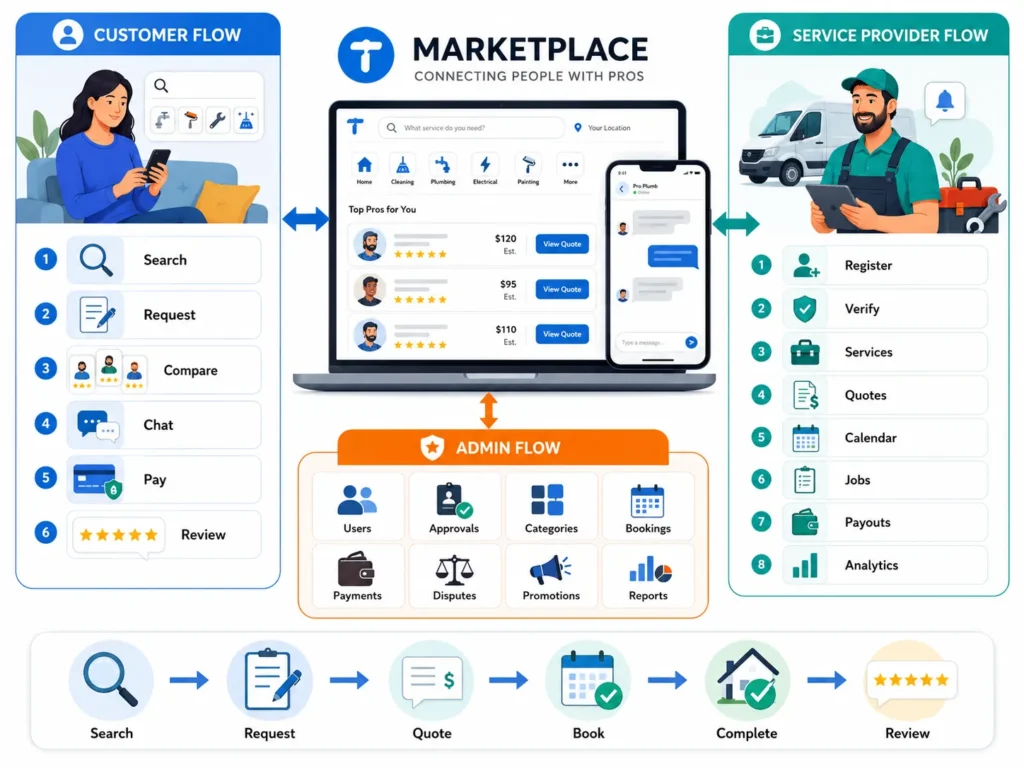
A strong Thumbtack clone script is not just a directory of local service providers. It is a three-sided marketplace system where customers, service professionals, and the platform admin each need a smooth workflow.
Customer Flow
The customer journey usually starts with service discovery. A user searches for a service, selects a category, enters location details, answers requirement-based questions, and submits a booking or quote request.
A strong Thumbtack-like app should allow customers to:
- Search services by category, location, rating, availability, and price range
- Submit custom job requirements
- Receive quotes or offers from providers
- Compare provider profiles, reviews, portfolios, and pricing
- Chat or call before booking
- Pay securely through the platform
- Track booking status
- Leave ratings and reviews after service completion
This flow matters because users do not only want a list of providers. They want confidence before hiring someone for a real-world service.
Service Provider Flow
The provider side is where marketplace supply is created. A service professional should be able to register, verify their profile, add skills, define service areas, manage availability, receive leads, submit quotes, accept bookings, complete jobs, and track earnings.
A provider app or panel should include:
- Profile creation and document verification
- Service category and pricing setup
- Job request alerts
- Quote or bidding tools
- Booking calendar
- Chat or call support
- Payout history
- Customer review management
- Performance analytics
This is where many generic scripts become weak. If providers cannot manage leads, pricing, availability, and payouts easily, they may stop using the platform.
Admin Flow
The admin dashboard is the control layer of the entire marketplace. It helps the platform owner manage users, providers, categories, commissions, bookings, payments, disputes, reviews, promotions, and reports.
A strong admin panel should support:
- Customer and provider management
- Provider approval and verification
- Service category management
- Booking and quote monitoring
- Commission and fee settings
- Payment and payout tracking
- Refund and dispute handling
- Promo code and marketing controls
- Revenue analytics
- Role-based admin access
For founders, this matters because the admin dashboard decides whether the business can scale operationally without depending on developers for every small change.
Why Launch a Thumbtack Clone in 2026?
Local service marketplaces are becoming more practical for founders because customers now expect faster access to trusted professionals for home, personal, repair, wellness, event, and business services. Instead of calling multiple providers manually, users prefer a platform where they can compare profiles, check reviews, request quotes, book services, and pay securely in one place.
For founders, a Thumbtack-style marketplace creates an opportunity to organize fragmented local service demand. Many cities still have skilled professionals who depend on referrals, WhatsApp groups, local ads, or offline networks to get customers. A digital marketplace can help these providers become more discoverable while giving customers a more reliable booking experience.
A Thumbtack clone script also helps reduce launch risk. Instead of building customer apps, provider workflows, quote requests, payment systems, reviews, and admin controls from scratch, founders can start with a ready-made foundation and customize it for a specific niche or region.
This model works well for categories such as:
- Home cleaning and maintenance
- Plumbing and electrical services
- Beauty and wellness bookings
- Pet care and grooming
- Photography and event services
- Tutors and trainers
- Handyman and repair services
- Local business services
The real advantage is not just launching another service app. It is building a marketplace where customers can find trusted providers, providers can receive quality leads, and the platform owner can earn through commissions, subscriptions, lead fees, featured listings, or service charges.
For founders who want to validate a local services marketplace faster, a ready-made Thumbtack clone app can be a more practical route than waiting months for a fully custom build.
Read More ; Reasons startup choose our Thumbtack clone over custom development
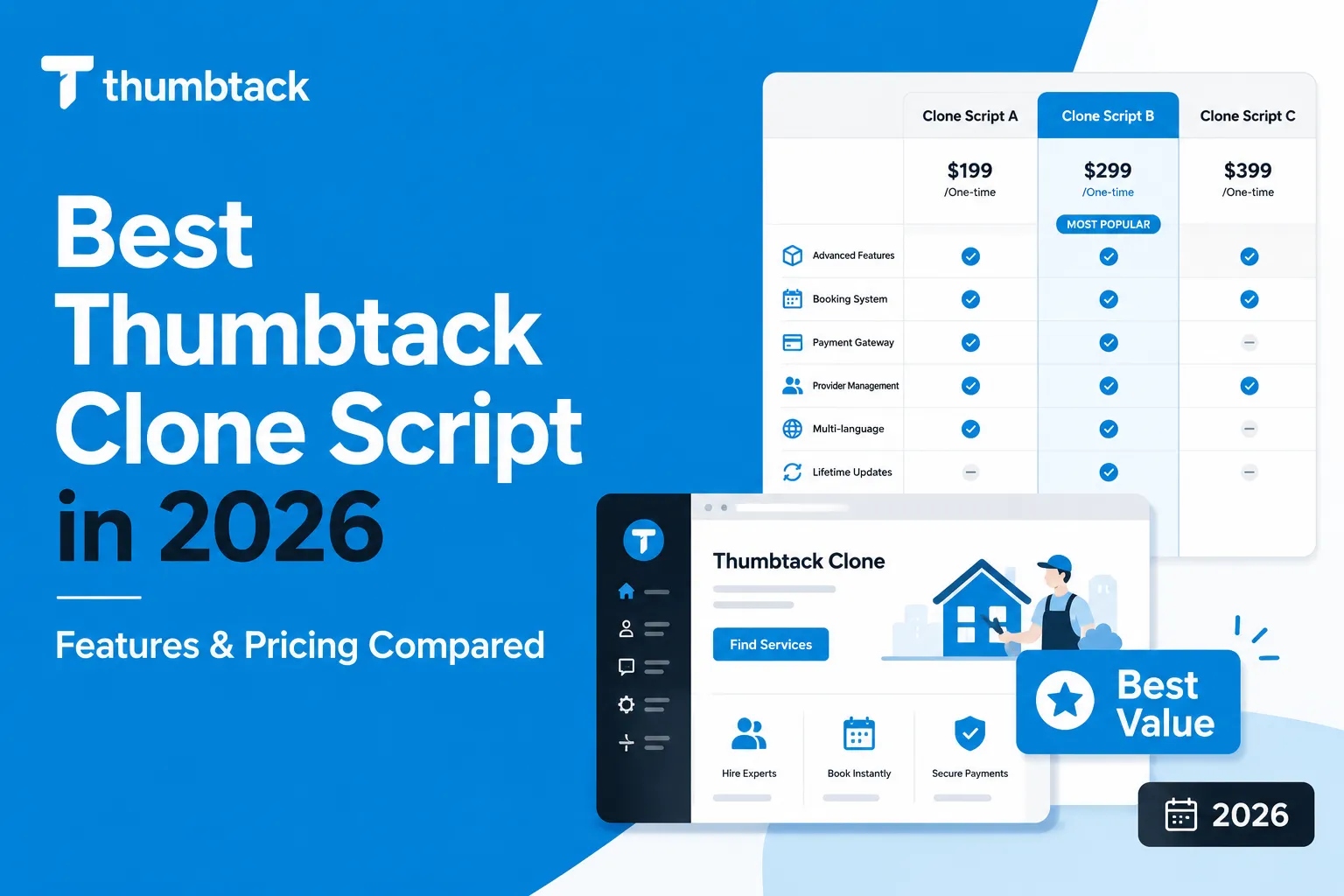
Best Thumbtack Clone Scripts Compared in 2026
Founders should compare Thumbtack clone scripts based on launch speed, source code ownership, admin control, customization, pricing clarity, and marketplace workflows.
| Provider | Best For | Key Strength | Pricing Visibility | Limitation |
|---|---|---|---|---|
| Miracuves Thumbtack Clone | Founders who want fast launch with ownership | Source code, white-label branding, admin dashboard, PHP/Laravel + Flutter apps, 6-day launch positioning | Public starting price available | Final scope depends on customizations |
| Appscrip Service Genie | Buyers comparing service marketplace workflows | Strong scheduling, job posting, and service booking flow | Quote/demo based | Pricing is less transparent |
| Osiz Thumbtack Clone Script | Businesses needing custom marketplace development | Provider management, analytics, booking, and customization support | Quote-based | More custom-development focused |
| Yo!Gigs Thumbtack Clone | Founders comparing white-label home service software | Bidding, booking calendar, categories, and source code flexibility | One-time cost positioning mentioned | Exact scope may require inquiry |
| SoftwareSuggest Listing | Buyers checking software alternatives | Useful for quick product discovery and comparison | Get-quote model | Limited marketplace workflow depth |
Competitors show that Google is rewarding pages that go beyond basic definitions. Appscrip covers scheduling and budget-based job posting, Osiz covers booking, provider management, payment integration, analytics, and customization, and Yo!Gigs explains bidding, booking calendar, custom categories, source code, and one-time payment positioning.
Read More:Reasons startup choose our Thumbtack clone over custom development
Why Miracuves Is a Stronger Thumbtack Clone Script Choice
Miracuves is a strong choice for founders who want a Thumbtack-style marketplace without building every module from zero. Instead of starting with a blank development roadmap, founders can begin with a ready-made foundation and customize the product around their niche, brand, service categories, pricing model, and launch market.
The key advantage is control. A Thumbtack clone business needs more than attractive screens. It needs customer workflows, provider workflows, booking logic, quote handling, payments, admin controls, monetization settings, and service category management. Miracuves supports this with a white-label, source-code-owned approach that gives founders more flexibility after launch.
Miracuves’ Thumbtack Clone App is positioned with:
- Full source code ownership
- PHP/Laravel backend
- Flutter-based mobile apps
- Admin dashboard
- Customer and provider workflows
- Quote request and booking flow
- White-label branding
- One-time pricing
- 6-day launch positioning
- Deployment support
- Customization flexibility
- Monetization-ready marketplace structure
For founders, this reduces early execution risk. You can launch faster, test real demand, onboard providers, validate service categories, and improve the platform based on market feedback instead of spending months building the basic marketplace foundation.
Thumbtack Clone Script Pricing: What Affects the Cost?
Thumbtack clone script pricing depends on what the founder actually wants to launch. A simple services marketplace with customer booking, provider profiles, payments, and admin control will cost less than a multi-city platform with real-time chat, video consultation, complex commission rules, custom provider verification, and advanced analytics.
The biggest cost factors include:
| Cost Factor | Why It Matters |
|---|---|
| Number of apps | A full platform may need a customer app, provider app, web panel, and admin panel. |
| Booking model | Instant booking is simpler; quote-based bidding needs request forms, provider proposals, and comparison logic. |
| Payment system | Cards, wallets, UPI, COD, payout flows, refunds, and commissions affect integration scope. |
| Provider verification | Document checks, manual approvals, background-check workflows, and profile moderation add operational depth. |
| Location features | Map search, geo-fencing, service radius, live tracking, and city expansion affect backend complexity. |
| Communication tools | Chat, call, video consultation, and notifications require additional workflows and integrations. |
| Multi-city support | Expanding across regions needs category, pricing, provider, and commission controls by location. |
| Custom branding | UI changes, app icons, color systems, landing pages, and marketplace positioning affect design scope. |
| Third-party APIs | Payment gateways, SMS, email, maps, analytics, CRM, and verification APIs can change the final budget. |
| Deployment and publishing | Server setup, app store publishing, domain setup, and testing affect launch readiness. |
Read More : Ultimate Service Booking Apps: Build Smarter Thumbtack Clone
Global Cost of Development for a Thumbtack Clone App
Thumbtack-Like Service Marketplace Development — Market Price by Tech Stack
The tech stack affects booking speed, provider management, quote requests, search filters, and payment flow in a Thumbtack-like service marketplace. PHP/Laravel works well for cost-effective service marketplace launches, Node.js/React.js supports faster real-time booking and quote workflows, while Go microservices suit large service platforms with high traffic, multi-city operations, and advanced provider matching.
PHP/Laravel is often the most practical choice for launching a Thumbtack clone quickly and affordably. Node.js/Python fits better when real-time quote flows and data-heavy marketplace activity become more important, while Go microservices are better suited for enterprise-scale service marketplaces with higher concurrency and more complex infrastructure needs.
These values reflect global development cost estimates. Final pricing varies based on customer and provider apps, service categories, booking flow, quote/bidding system, location search, payments, payouts, reviews, admin controls, and platform complexity.
Miracuves Thumbtack-Like App Solution Cost and Tech Stack
Miracuves Pricing for a Thumbtack-Like App Solution developed in PHP/Laravel with Flutter Apps for $2,799 USD (One-Time Price) in just 6 days
Get a fully developed, deployment-ready platform modeled after Thumbtack. Built on a reliable PHP/Laravel backend with Flutter mobile apps, this complete solution helps you launch and scale a local services marketplace quickly and efficiently.
- Core Workflows: Service discovery, provider matching, quote requests, bookings, and customer-provider communication.
- Built-in Operations: Pricing logic, commission setup, lead management, and payment flow handling.
- Management Hub: Centralized admin panel to manage customers, service providers, job requests, transactions, and platform activity.
- Launch-Ready: Fully prepared for your branding, configuration, and immediate go-to-market execution.
Why is it so affordable?
Most modern service marketplaces are built using complex architectures like Node.js or microservices. While powerful, these approaches require large engineering teams, longer timelines, and significantly higher development costs.
We took a smarter and more practical approach:
- You Aren’t Paying for Ground-Up Development: Our marketplace engine is already developed, tested, and ready to deploy. You skip months of development time and avoid the high costs of building from scratch.
- The Power of PHP / Laravel: Built on one of the most trusted and widely used frameworks globally, this solution keeps upfront costs low while ensuring long-term flexibility. With a large developer ecosystem, it becomes easier and more cost-effective to maintain, scale, and customize your platform.
- Built for Practical Growth: You get a strong, market-ready services marketplace with essential features like provider discovery, booking workflows, and lead management—without the complexity and expense of enterprise-level builds.
You get a scalable, production-ready platform without paying inflated development costs.
Note: This cost is for the solution, re-branding, deployment, and source code only.
Thumbtack Clone Script vs Custom Development
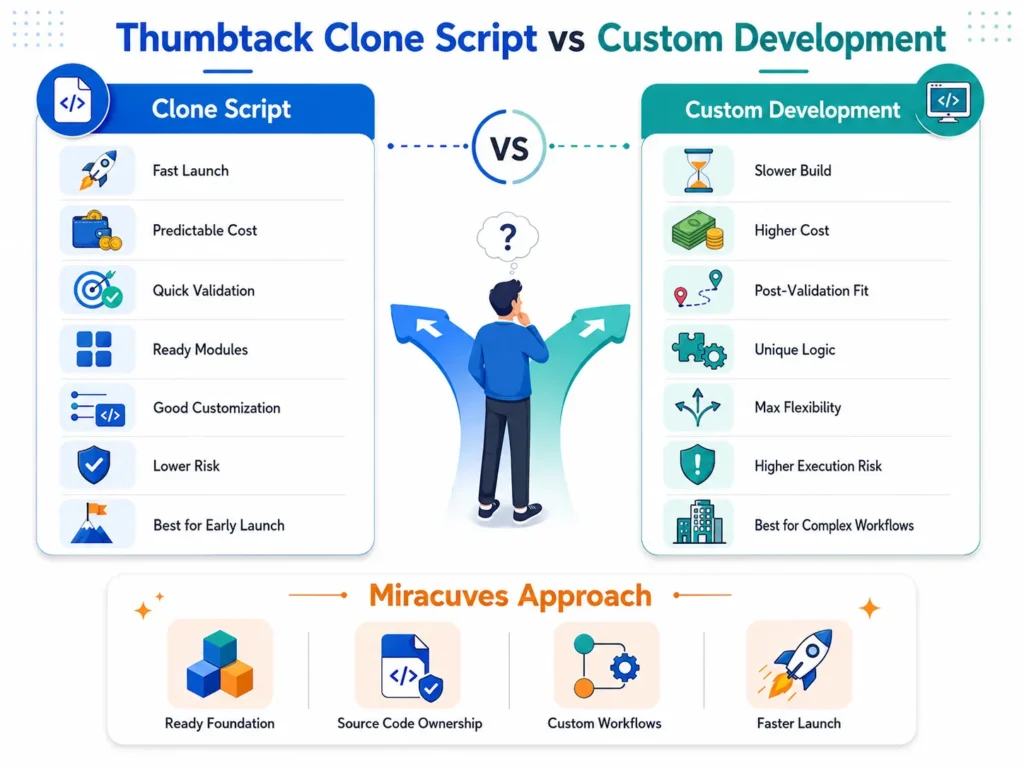
A founder usually has two options: buy a ready-made Thumbtack clone script or build a fully custom service marketplace from scratch. Neither option is automatically better. The right choice depends on speed, budget, product uniqueness, and validation stage.
| Decision Factor | Thumbtack Clone Script | Custom Development |
|---|---|---|
| Launch speed | Faster because core workflows are already built | Slower because discovery, design, development, and testing start from zero |
| Cost control | More predictable when pricing is clear | Usually higher and more variable |
| Market validation | Better for testing demand quickly | Better after a validated business model needs deep custom logic |
| Feature foundation | Includes common marketplace modules | Built exactly around unique requirements |
| Customization | Good when source code is included | Highest flexibility |
| Operational risk | Lower if the script already includes admin, booking, payments, and provider flows | Higher if the team underestimates marketplace complexity |
| Best for | Founders launching fast with proven workflows | Businesses with complex enterprise workflows or highly unique logic |
Miracuves sits between both approaches. Founders can start with a ready-made Thumbtack clone foundation, customize it for their market, own the source code, and avoid being locked into a rigid template. This is especially useful for service marketplaces where speed, provider onboarding, local demand validation, and admin control matter from day one.
Monetization Models That Work in 2026
When launching a Thumbtack clone, your revenue model matters just as much as your features. Here are popular strategies:
1. Commission per Booking
Take a small cut (say 10–15%) from each transaction. Works well at scale but requires trust and secure payment processing.
2. Subscription for Providers
Allow professionals to pay monthly to unlock leads or reduce commission fees. This ensures predictable revenue and attracts serious service providers.
3. Featured Listings & Promotions
Give top-rated or paying users the chance to appear higher in search or as “Verified Professionals.”
4. Service Bundles
Offer packaged deals (e.g., “Moving Day Package: Cleaner + Mover + Repairman”) to increase basket size and platform stickiness.
Read More : Try the Future of Local Services Free: Build with Our Thumbtack Clone
Trust, Verification, and Marketplace Safety Features Every Thumbtack Clone Must Include
Trust is not optional in a local services marketplace. Customers may invite providers into their homes, offices, events, or personal spaces. Providers also need protection from fake leads, payment disputes, and unfair reviews.
A serious Thumbtack clone app should include:
| Trust Feature | Business Value |
|---|---|
| Provider verification | Helps reduce fake or low-quality provider profiles. |
| Document checks | Useful for regulated or skill-sensitive service categories. |
| Ratings and reviews | Gives customers confidence before booking. |
| Dispute management | Helps admins resolve booking, refund, and service quality issues. |
| Secure payments | Keeps transactions inside the platform and improves trust. |
| Refund rules | Creates clarity for cancellations and failed service delivery. |
| Admin moderation | Helps control abusive content, fake reviews, and suspicious profiles. |
| Fraud detection signals | Supports safer marketplace operations. |
| Role-based access | Protects admin controls and sensitive platform data. |
| Service quality monitoring | Helps identify underperforming providers and improve retention. |
For founders, these features are not just technical add-ons. They protect marketplace reputation, reduce operational friction, and make customers more comfortable booking through the platform.
Mistakes to Avoid Before Launching a Thumbtack Clone App
Choosing a Script Without Source Code Ownership
A low-cost clone script can become expensive if you cannot modify the source code later. Source-code ownership gives founders more control over branding, workflows, integrations, and future product changes.
Ignoring Provider Experience
Many founders focus only on customer features. But if providers cannot manage leads, quotes, bookings, calendars, payouts, and profiles easily, the marketplace will struggle to build supply.
Launching Too Many Service Categories at Once
A Thumbtack-style marketplace can support many categories, but early-stage founders should start with focused verticals or cities. This helps improve provider quality, customer trust, and marketing efficiency.
Weak Admin Controls
Without a strong admin dashboard, the founder cannot manage commissions, disputes, providers, refunds, categories, and revenue properly. Admin control is what turns the app from a booking interface into a real marketplace business.
Treating Trust as a Later Feature
Verification, reviews, dispute handling, and secure payments should be part of the launch foundation. Waiting too long to add trust workflows can damage customer confidence early.
What Founders Should Check Before Launching a Thumbtack Clone App
Launching a Thumbtack clone app can be a strong marketplace opportunity, but founders should evaluate a few operational risks before going live.
Keep the interface simple:
Customers should be able to search, request, compare, book, pay, and review without confusion. A crowded interface can reduce bookings and make the app harder to use.
Build trust from day one:
Local service marketplaces depend on trust. Add provider verification, ratings, reviews, secure payments, dispute handling, and clear cancellation rules so customers feel confident hiring through the platform.
Make provider onboarding easy:
Service professionals may not be comfortable with complex dashboards. The provider flow should make it easy to create a profile, list services, manage availability, receive job requests, send quotes, and track payouts.
Stabilize one market before expanding:
Launching across too many cities or service categories too early can create quality-control issues. Validate one city, niche, or service category first, improve the workflow, and then expand with stronger operational control.
Final Recommendation: Choose the Script That Gives You Speed, Control, and Marketplace Depth
The best Thumbtack clone script is not simply the one with the longest feature list. It is the one that helps you launch a real local services marketplace with customer booking, provider onboarding, quote management, payment flows, admin control, monetization, and trust workflows already planned.
For founders who want to validate a Thumbtack-like marketplace quickly, a ready-made script can be a smarter first step than a long custom build. It reduces the time spent on basic marketplace modules and lets the founder focus on service categories, provider acquisition, local marketing, and customer trust.
Miracuves is a strong option for founders who want a white-label Thumbtack Clone App with source code, PHP/Laravel backend, Flutter apps, admin control, one-time pricing, and faster launch support. The goal is not to copy Thumbtack blindly. The goal is to use a proven service marketplace model, customize it for your niche, and build a launch-ready platform with room to scale.
FAQs
Still have questions about Thumbtack clone scripts? Let’s clear them up.
What is a Thumbtack clone script?
A Thumbtack clone script is ready-made marketplace software that helps founders launch a platform where customers can find, compare, book, and pay local service providers. It usually includes customer apps, provider apps, booking flows, quote requests, payments, reviews, and an admin dashboard.
How much does a Thumbtack clone script cost in 2026?
The cost depends on features, app platforms, provider workflows, booking logic, payment integrations, customization, and launch scope. Some vendors provide quote-based pricing, while Miracuves shows a clear starting price for its Thumbtack-like platform.
How much does the Miracuves Thumbtack Clone cost?
Miracuves positions its Thumbtack Clone with a $2,799 starting price, PHP/Laravel backend, Flutter apps, and 6-day launch positioning. Final pricing depends on branding, integrations, selected modules, localization, and customization requirements.
How long does it take to launch a Thumbtack-like app?
A ready-made Thumbtack clone script can launch faster than a fully custom build because the core workflows are already prepared. Miracuves positions its Thumbtack-like platform with a 6-day launch timeline depending on scope and setup requirements.
What features are included in a Thumbtack clone app?
A strong Thumbtack clone app should include customer registration, service search, quote requests, provider profiles, booking management, secure payments, reviews, notifications, provider dashboard, admin panel, commission settings, dispute handling, and analytics.
Can I customize the Thumbtack clone source code?
Yes. Customization helps founders change service categories, branding, booking flows, payment methods, provider verification, commission models, and marketplace rules. Miracuves’ source-code-owned approach gives founders more flexibility after launch.
How does a Thumbtack clone make money?
A Thumbtack-like marketplace can make money through booking commissions, provider subscriptions, featured listings, lead fees, service bundles, advertising, cancellation fees, and premium provider tools. The best model depends on the service category and local market behavior.
What is the difference between a Thumbtack clone script and custom development?
A Thumbtack clone script starts with a ready-made foundation, which helps reduce launch time and cost. Custom development starts from zero and is better for highly unique workflows or enterprise-level requirements. Miracuves combines a ready-made foundation with customization and source-code ownership.
Related Articles
Miracuves is an independent software development company. We are not affiliated with, connected to, sponsored by, or endorsed by any company or product named in this article.
Terms such as “X Clone” are used descriptively. It is how the software industry refers to building a platform with functionality comparable to a known service, and how clients search for it.
The entire design and codebase of our products is built by our own team. Our products contain no code, design, graphics, or content originating from any third-party website or applications.
All third-party names and marks referenced in this article are the property of their respective owners, referenced solely to identify the services discussed.