


For years, dating apps treated abundance as the product.
More profiles meant more swipes. More swipes meant more sessions. More sessions created more opportunities to display boosts, subscriptions, and premium visibility features.
But the mechanics that increase browsing do not automatically increase meaningful connections.
When users face an apparently endless stream of profiles, each individual choice becomes easier to dismiss. Matches accumulate with little commitment. Conversations begin without clear intent. Users return to browsing before giving existing connections enough attention to develop.
This is the central product problem behind swipe fatigue.
It is also why major dating platforms are reconsidering their discovery models. Bumble has announced plans to move away from its signature swipe interaction, while Tinder is investing in AI-assisted recommendations intended to reduce fatigue and improve match relevance. The broader direction is clear: any modern dating platform like app tinder must begin optimizing for better decisions rather than simply offering more decisions.
In the anonymized regional dating-app deployment examined in this case study, the product team tested a more restrictive model.
Instead of allowing users to browse continuously, the platform presented each eligible user with only three AI-curated matches per day.
According to the internal deployment result provided for this case study, that change contributed to a 41% increase in chat-to-first-date conversion during the measured comparison period.
The Swipe-Fatigue Problem: When More Choice Produces Less Intent
A swipe-based feed makes every profile appear replaceable.
A user can reject one candidate knowing another will appear immediately. Even after matching, the discovery loop remains available. Rather than investing in a conversation, the user can continue searching for a person who appears slightly more attractive, interesting or compatible.
This creates several product problems.
First, matches become low-cost actions. A person can express interest without seriously intending to communicate.
Second, conversation attention becomes fragmented. Users may hold several simultaneous chats while continuing to generate more matches.
Third, the product trains people to evaluate profiles quickly using incomplete information. Photos and short prompts dominate, while values, communication preferences and relationship goals receive less attention.
Fourth, low-quality interactions increase fatigue. Users can spend considerable time browsing while feeling that the app is producing little genuine progress.
A 2025 survey reported by Forbes Health found substantial dating-app burnout among younger users, while industry reporting throughout 2026 has documented major platforms using AI, curated discovery and safety tools to improve the experience.
For founders, the lesson is not that swiping must disappear from every app. It is that swipe volume should never be confused with matchmaking performance.
Read More: What is Tinder App and How Does It Work?
The Product Hypothesis: Replace Unlimited Browsing With Three Curated Matches
The deployment began with a simple product hypothesis:
If users receive fewer but more relevant recommendations, they will give each recommendation more attention and pursue promising conversations more intentionally.
The platform therefore disabled continuous profile browsing for the test cohort.
Each user received up to three match recommendations during a daily delivery window. The recommendations were generated from the currently eligible candidate pool and ranked according to several layers:
- Declared relationship intent
- Location and distance rules
- Age and preference compatibility
- Shared interests
- Lifestyle compatibility
- Profile completeness
- Recent activity
- Previous matching behaviour
- Safety and trust signals
- Recommendation diversity
Users could accept or decline each recommendation. However, declining all three did not unlock an unlimited feed. The next recommendation cycle began the following day.
This restriction was essential.
A platform cannot test scarcity while quietly allowing users to bypass it through another discovery screen. The constraint must be applied consistently across the mobile interface, APIs and backend recommendation service.
Read More: Tinder App Marketing Strategy
Engineering the Anti-Swipe AI Routing Protocol
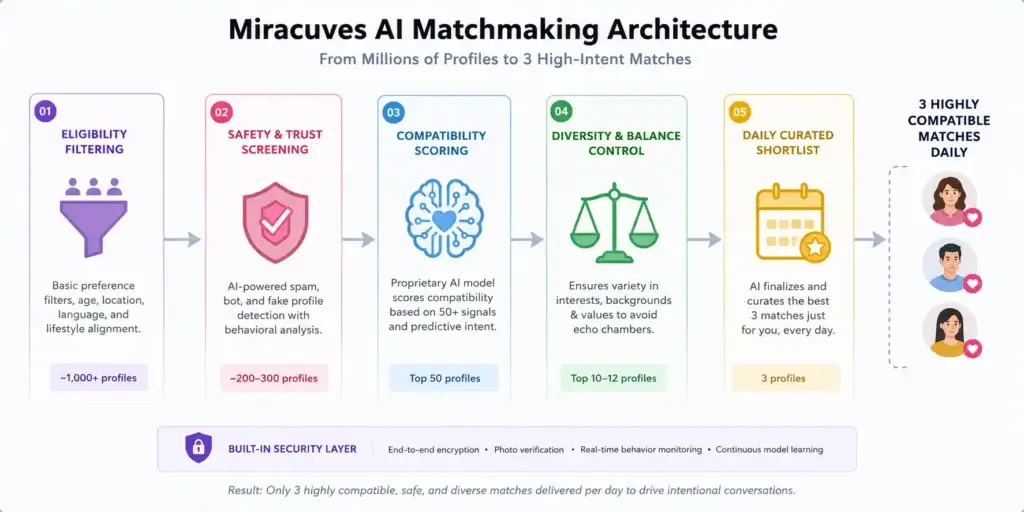
The recommendation engine was not designed to ask, “Which three profiles are most popular?”
It was designed to answer a more useful question:
Which three eligible people create the strongest combination of mutual compatibility, safety, availability and likelihood of conversation?
That distinction matters.
A ranking system based mainly on profile popularity can repeatedly send attention to a small percentage of users. This creates unequal match distribution, reduces liquidity for the wider community and can make the product feel ineffective for most participants.
The deployed routing flow used five conceptual layers.
1. Candidate Eligibility Filtering
Before compatibility scoring began, the system removed candidates who failed hard constraints.
These included:
- Age or preference mismatch
- Distance outside the selected radius
- Incompatible relationship goals
- Blocked or previously reported accounts
- Users already shown too recently
- Inactive profiles
- Accounts undergoing moderation
- Profiles without required verification
- Existing matches or prior declined recommendations
This step prevented the AI model from wasting ranking capacity on candidates who should never have entered the recommendation pool.
2. Safety and Trust Scoring
Dating products carry unusually high trust requirements because online conversations can lead to private, offline meetings.
Candidate eligibility therefore included operational trust signals such as:
- Email and phone verification
- Photo or selfie verification
- Duplicate-image detection
- Suspicious login patterns
- Rapid mass-messaging behaviour
- Repeated blocks or reports
- Profile-text moderation
- Scam-language indicators
- Location inconsistency
- Account age and activity quality
AI can assist with risk detection, but it should not be treated as an infallible judge. High-risk events should enter a moderation queue, and users should retain clear reporting, blocking and appeal pathways.
Current dating platforms are investing in AI for both matchmaking and safety. Grindr, for example, has tested AI recommendations while expanding age and identity checks in response to safety concerns.
3. Compatibility Ranking
After filtering, the engine calculated compatibility using declared and behavioural signals.
Declared signals included:
- Relationship objective
- Family plans
- Religion or cultural preferences where voluntarily provided
- Lifestyle
- Communication style
- Interests
- Location flexibility
- Education or career preferences
- Smoking and drinking preferences
- Availability for dating
Behavioural signals could include:
- Which profile elements receive attention
- Which recommendations result in conversations
- Typical response time
- Conversation continuation
- Match acceptance patterns
- Feedback after a match
- Date-confirmation events
Sensitive data should only be processed with clear consent, appropriate access controls and a defined retention policy. A matchmaking model should not quietly infer deeply personal characteristics merely because doing so might improve short-term prediction.
4. Diversity and Repetition Control
The three highest raw scores were not automatically delivered.
A recommendation set can become repetitive even when each individual candidate has a high compatibility score. For example, all three might share almost identical traits, locations or profile styles.
The routing layer therefore applied set-level controls designed to produce a balanced daily selection.
These controls could include:
- Avoiding repeated occupational or interest clusters
- Preventing the same profile archetype from dominating
- Rotating candidates from different nearby areas
- Limiting repeated exposure
- Protecting new verified users from being invisible
- Balancing compatibility with discovery
- Preventing a small group of popular profiles from receiving all impressions
The goal was not artificial variety for its own sake. It was to avoid producing three recommendations that effectively represented the same choice.
5. Daily Match Allocation
Once the set was approved, the platform created three time-bound recommendation records.
Each record included:
- Recommending user ID
- Candidate user ID
- Compatibility version
- Ranking explanation code
- Delivery timestamp
- Expiry timestamp
- Accept or decline state
- Mutual-match state
- Conversation activation state
- Safety eligibility state
The system also recorded why a recommendation was generated. The user-facing explanation could remain simple—such as “You share similar relationship goals”—while the backend retained a more detailed decision log for testing and model evaluation.
Anti-Swipe Matchmaking Architecture
| Architecture Layer | Primary Function | Founder Impact |
|---|---|---|
| Eligibility engine | Removes incompatible, inactive or unsafe candidates | Prevents poor recommendations before ranking begins |
| Compatibility model | Scores relationship intent, preferences and behavioural fit | Improves relevance without exposing the full user pool |
| Trust layer | Uses verification, moderation and risk signals | Protects user confidence and platform reputation |
| Diversity controller | Prevents repetitive recommendation sets | Creates discovery without restoring endless browsing |
| Daily allocation service | Delivers and expires the three recommendations | Enforces the product’s scarcity rule consistently |
| Outcome analytics | Tracks chats, replies and date-confirmation events | Measures meaningful progress rather than vanity engagement |
Read More : How AI Is Revolutionizing Matchmaking in Service Marketplaces
The 41% Conversion Increase: What the Deployment Actually Measured
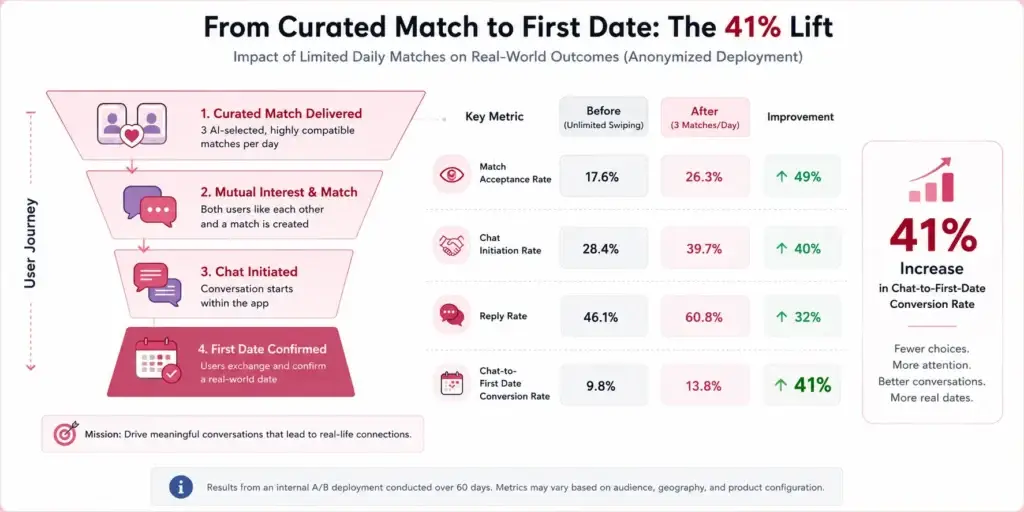
The product team did not use swipes as the primary success metric.
It compared the percentage of activated conversations that progressed to a first-date confirmation event within the platform’s defined attribution window.
The case-study result supplied to Miracuves showed a 41% relative improvement in chat-to-first-date conversion after the restricted model was introduced.
That wording is important.
A relative increase does not mean that 41% of all chats produced dates. For illustration, a conversion rate rising from 10% to 14.1% would represent a 41% relative increase. The approved case study should disclose the baseline and resulting rates whenever client confidentiality permits.
The result should also be interpreted alongside other metrics:
| Metric | Why It Matters |
|---|---|
| Recommendation acceptance rate | Shows whether the three selections feel relevant |
| Mutual-match rate | Measures reciprocal interest |
| First-message rate | Tests whether matches create enough intent to act |
| Reply rate | Separates initiated chats from genuine conversations |
| Conversation depth | Indicates whether exchanges continue |
| Date-confirmation rate | Connects digital matching with an offline outcome |
| Report or block rate | Reveals whether relevance is compromising safety |
| Seven-day retention | Shows whether restriction improves or harms return behaviour |
| Subscription conversion | Tests whether the model supports sustainable monetization |
The reported lift should not be attributed automatically to scarcity alone if the release also included profile redesign, verification changes, notifications or a revised onboarding questionnaire.
A strong case study separates the intervention from surrounding product changes wherever the data allows.
Read More: How the World’s Top Dating App Makes Money
Why Scarcity Encouraged More Intentional Conversations
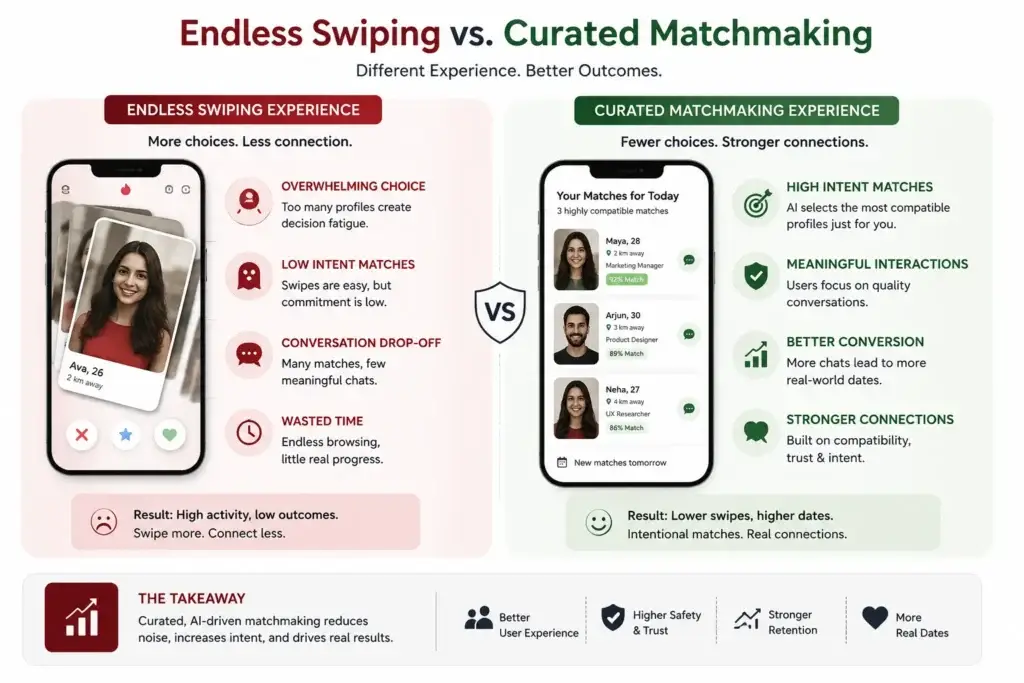
The three-match ceiling influenced behaviour in four ways.
Each Recommendation Carried More Attention
When another profile is not available immediately, the current option becomes less disposable.
Users are more likely to read prompts, review shared interests and consider compatibility before making a decision.
Matches Became More Meaningful Events
Under unlimited discovery, a match can feel like one item in a growing queue.
Under restricted discovery, a match represents one of a small number of daily opportunities. That does not manufacture compatibility, but it can increase the attention given to a compatible person.
Conversation Competition Declined
A user managing three relevant introductions has more capacity to participate than a user holding dozens of low-intent matches.
This can improve response speed and reduce the number of conversations that expire after a generic opening.
The Product Promise Became Clearer
The app was no longer promising endless entertainment. It was promising a manageable set of considered introductions.
That positioning attracted users who valued intentional matchmaking more than continuous browsing.
Founder Decision Signals
Outcome
Use restricted discovery when the primary promise is meaningful introductions, serious relationships or community compatibility.
Liquidity
Confirm that each location and preference segment contains enough active, verified users to generate three credible recommendations.
Trust
Do not send a highly ranked candidate when verification, moderation or fraud signals indicate elevated risk.
Monetization
Sell better control, insight and service—not unlimited low-quality exposure that undermines the product promise.
The Metrics Dating-App Founders Should Measure Instead of Swipe Volume
Swipe volume is easy to measure. It is also easy to misinterpret.
A user may swipe hundreds of times because the app is entertaining, because recommendations are poor or because they have not found anyone worth contacting.
Founders building an AI-powered dating platform should construct a measurement hierarchy that connects product activity to user outcomes.
Discovery-quality metrics
- Eligible candidates per active user
- Recommendation acceptance
- Mutual-match rate
- Repeated-profile frequency
- Distribution of profile exposure
- Recommendation diversity
Conversation-quality metrics
- First-message rate
- Reply rate
- Time to reply
- Messages per activated conversation
- Conversation survival after 24 or 72 hours
- Safety reports generated from matches
Outcome metrics
- Phone or video interaction opt-in
- Date-intent selection
- Date scheduling
- Confirmed first dates
- Second-date indications where voluntarily supplied
- Match closure reason
- User satisfaction after an introduction
The closer a metric sits to the user’s real objective, the more strategically valuable it becomes.
Read More: Business Model of Tinder : Key Features & Strategy
Safety Must Be Part of the Matching Engine
A high compatibility score cannot compensate for an unsafe account.
Dating apps should treat safety as a prerequisite for distribution, not as a separate page in the settings menu.
A scalable matchmaking foundation can include:
- Phone and email verification
- Selfie or liveness checks
- Profile-image moderation
- Duplicate-account detection
- Age-gating
- User blocking and reporting
- Suspicious-message detection
- Role-based moderator access
- Audit logs
- Device and login-risk signals
- Secure data transfer and storage
- Permission-based administrative dashboards
AI can help prioritize suspicious activity and identify patterns that human moderators may miss. However, automated systems can also make incorrect decisions. High-impact actions should include review pathways, documented thresholds and appropriate human oversight.
Final privacy, identity-verification and platform-safety obligations depend on the target jurisdiction, operating model and legal advice.
Read More: White-label Tinder App Security Explained
Monetizing a Dating App Without Reintroducing Infinite Choice
A three-match model creates a monetization challenge.
The platform should not restrict choice in the free experience and then sell unlimited swiping as the premium product. That would undermine the central promise.
More aligned revenue streams include:
Advanced preference controls
Subscribers can specify additional compatibility criteria without being given an unlimited feed.
Match explanation insights
Premium users can receive clearer explanations of shared values, interests or communication patterns.
Human-assisted matchmaking
High-value plans can include profile reviews, concierge introductions or community moderation.
Identity and profile enhancement
The platform can offer optional verification, professional profile guidance or enhanced introduction prompts.
Event and community access
Niche dating products can monetize curated events, interest groups or facilitated introductions.
Second-look functionality
Users may review a recently declined recommendation without opening unrestricted browsing.
Travel or location modes
Subscribers can prepare for introductions in a future destination while maintaining the daily recommendation structure.
The principle is simple: premium features should improve decision quality or service depth, not restore the behaviour the product was designed to prevent.
When the Three-Match Model Works—and When It Does Not
Restrictive discovery is not automatically appropriate for every dating business.
It is strongest when:
- Users are seeking serious relationships
- The platform serves a defined community
- Profiles contain meaningful compatibility data
- User identity and intent can be verified
- The local user pool has adequate liquidity
- The brand can credibly promise curation
- The recommendation model receives useful feedback
It may struggle when:
- The platform has very few active users in a location
- Users primarily seek spontaneous nearby interactions
- Profiles contain little information beyond photos
- The recommendation model has insufficient cold-start data
- The app does not explain why recommendations are relevant
- Users cannot adjust inaccurate preferences
- Safety and moderation controls are weak
For a new platform, the daily ceiling can be dynamic rather than universal.
A dense metropolitan segment might support three recommendations per day. A smaller community may require weekly batches, wider distance controls or carefully managed waitlists.
Mistakes Dating-App Founders Should Avoid
Limiting matches without improving relevance
Scarcity magnifies recommendation quality. Three weak matches feel worse than an unlimited feed because the user has no credible alternative.
Optimizing only for acceptance
A model can generate attractive recommendations that never produce healthy conversations. Ranking should be evaluated against downstream outcomes.
Ignoring cold-start users
New users have limited behavioural history. Onboarding questions, declared intent and safe exploration logic are needed before personalization matures.
Treating AI as a substitute for human interaction
AI should help users find and evaluate compatible people. It should not impersonate users or manufacture conversations that become inauthentic offline.
Publishing a conversion lift without methodology
Case-study metrics need a defined baseline, cohort, attribution window and measurement event. Without them, the headline creates more risk than authority.
How Miracuves Can Support a High-Intent Dating Platform
A differentiated dating product requires more than changing the swipe screen.
The restriction must connect to:
- User onboarding
- Preference management
- Candidate eligibility
- Recommendation ranking
- Safety workflows
- Daily allocation
- Messaging activation
- Notifications
- Subscriptions
- Moderation
- Analytics
- Administrative controls
Miracuves helps founders adapt a white-label dating-app foundation around their matchmaking model, community rules, branding and monetization strategy.
Rather than launching another generic browsing experience, a founder can configure the product around controlled introductions, verified profiles, AI-assisted recommendations and measurable conversation outcomes.
A launch-ready foundation can also reduce the need to rebuild standard modules such as authentication, profiles, messaging, payments, moderation and admin control before testing the differentiated matching logic.
Final Thoughts: A Dating App Should Create Decisions, Not Delay Them
The swipe became successful because it made dating-app discovery simple, fast, and habit-forming.
However, those same strengths can also become weaknesses.
When users encounter an endless stream of alternatives, each individual match may receive less attention. A dating-like platform can generate substantial browsing activity without producing the meaningful conversations and real-world dates users originally joined to find.
The deployment examined in this case study took the opposite approach. It restricted discovery, increased the perceived importance of each recommendation, and measured success through chat-to-first-date conversion rather than swipe volume alone.
The reported 41% improvement should be interpreted within the verified scope of that specific deployment—not as a guaranteed outcome for every audience, market, or product configuration.
Still, the broader product lesson remains valuable: strategically reducing choice can encourage users to pay greater attention to the connections already presented to them.
A dating platform does not need to maximize the number of people each user sees. It needs to improve the probability that the right people notice, trust, and respond to one another.
For founders entering the online dating market, the opportunity is not to build another endless swipe feed. It is to design a more intentional matchmaking experience that prioritizes relevance, safety, conversation quality, and genuine outcomes.
Planning to build a high-intent dating platform with curated matching and scalable technology? Contact Miracuves to discuss your product requirements and launch strategy.
FAQs
What is an anti-swipe dating app?
An anti-swipe dating app limits or replaces continuous profile browsing. It may deliver a small number of curated recommendations based on compatibility, relationship intent, location, activity and safety signals.
Why would a dating app limit users to three matches per day?
A daily limit can encourage users to pay more attention to each recommendation, reduce conversation overload and make matches feel less disposable. The number three is a product variable, not a universal rule, and should be tested against user liquidity and outcomes.
Does limiting matches reduce user engagement?
It may reduce swipes or total browsing time while improving higher-value engagement such as profile reading, first messages, replies and scheduled dates. Founders should decide which type of engagement supports the product promise.
How does AI matchmaking work in a dating app?
An AI-assisted matchmaking engine filters eligible users and ranks candidates using declared preferences, relationship goals, location, interests, activity, compatibility signals and safe behavioural feedback. Human oversight remains important for moderation, fairness and high-impact safety decisions.
Can Miracuves build a Hinge-style dating clone?
Miracuves can help founders create a white-label dating platform with profiles, prompts, matching, messaging, subscriptions, verification, moderation and admin controls. The final product should be customized around the founder’s target community rather than copying another company’s protected branding or proprietary design.
What safety features should a matchmaking app include?
Important layers include phone and email verification, age controls, profile moderation, blocking, reporting, suspicious-behaviour detection, secure data handling, role-based admin access and audit logs. Requirements vary by jurisdiction and business model.
How can a curated dating app make money?
Revenue can come from advanced preferences, profile services, verification, concierge matchmaking, community events, second-look features, travel modes and subscriptions. Monetization should enhance the curated experience rather than undermine it with unlimited low-quality discovery.
Is the 41% conversion increase guaranteed for other dating apps?
No. It is an internal result supplied for the anonymized deployment described in this draft. Outcomes depend on user density, recommendation quality, onboarding, safety, community intent, product changes and measurement methodology.
Miracuves is an independent software development company. We are not affiliated with, connected to, sponsored by, or endorsed by any company or product named in this article.
Terms such as “X Clone” are used descriptively. It is how the software industry refers to building a platform with functionality comparable to a known service, and how clients search for it.
The entire design and codebase of our products is built by our own team. Our products contain no code, design, graphics, or content originating from any third-party website or applications.
All third-party names and marks referenced in this article are the property of their respective owners, referenced solely to identify the services discussed.