

For years, social-network growth has been associated with one idea: more users create more value. More profiles mean more possible connections. More content means more engagement. More industries mean a larger addressable market.
That logic works for platforms whose advantage comes from enormous scale. It is much less convincing for a founder, industry association, professional body, talent community, alumni organization, or specialist business trying to create a new professional network today.
A focused professional network does not need to become the place where every professional spends time. It needs to become the place where a particular group of professionals gets something valuable that broad social networks cannot organize as precisely: trusted relationships, verified expertise, specialized opportunities, relevant discussions, industry knowledge, referrals, hiring access, collaboration, or private community participation.
This changes the growth equation completely. Instead of asking how many people can join, the better question becomes: how much value can the right members create for one another?
That is why niche professional networking platforms can sometimes create more practical business value than broader networks with dramatically larger audiences. The advantage comes not from scale alone, but from relevance, trust, context, concentration, and purpose.
Key Takeaways
- Niche professional networking platforms compete through relevance and trust rather than total audience size.
- A smaller network can create significant value when the right people, expertise, opportunities, and workflows are concentrated inside it.
- Verification, controlled access, industry-specific profiles, specialized discovery, and focused communities can improve signal quality.
- The most defensible networks usually solve an industry problem beyond generic posting and connection requests.
- Monetization becomes stronger when the network serves a clearly identifiable professional outcome such as hiring, referrals, knowledge, certification, events, or deal discovery.
- A walled-garden model can work particularly well when membership quality is more important than maximum reach.
Broad Reach and High Value Are Not the Same Thing
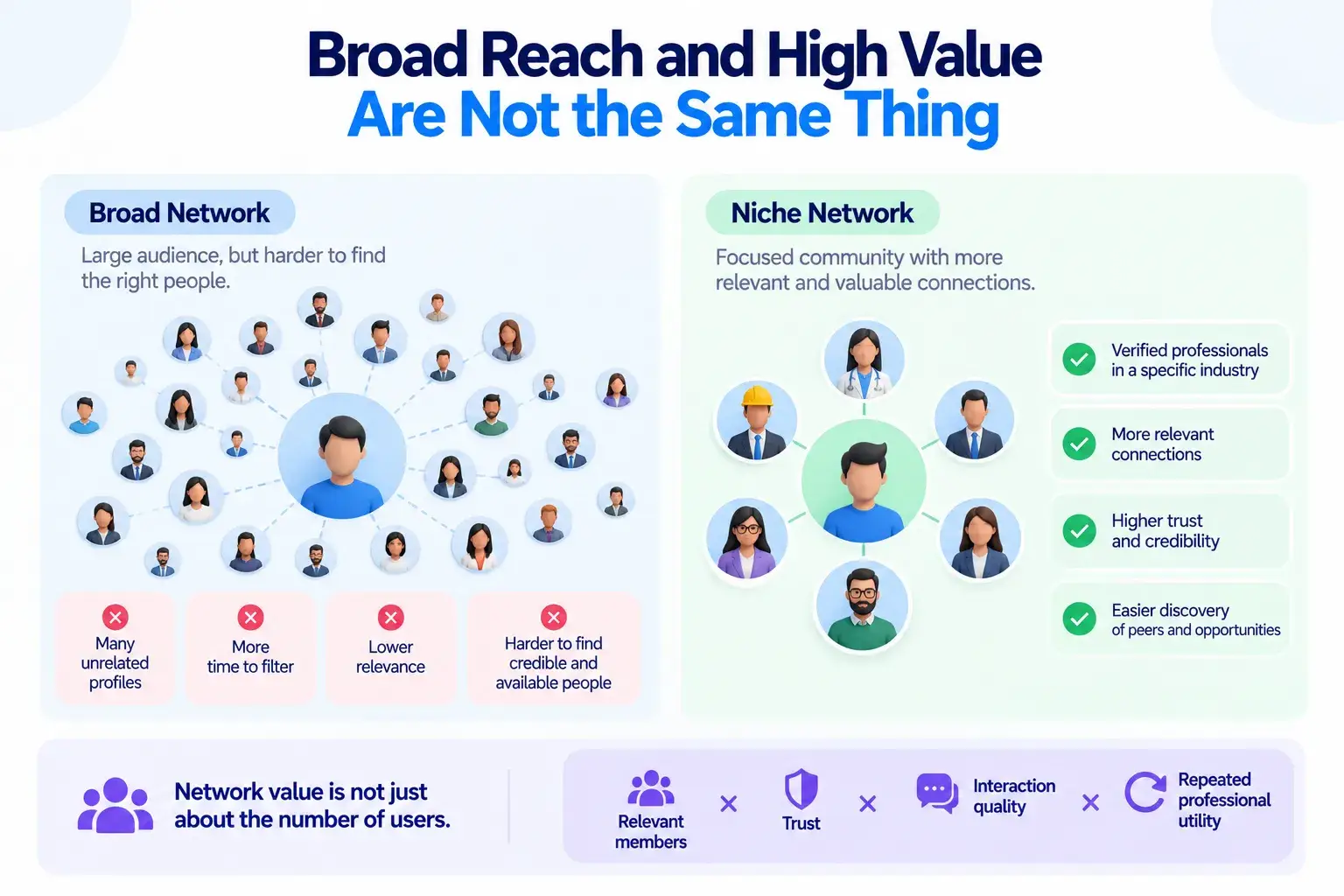
The first mistake founders make when evaluating professional-network opportunities is assuming that audience size and network value are interchangeable.
They are not.
A broad network may provide enormous reach while still creating weak relevance for a particular interaction. A specialist procurement executive, medical professional, compliance consultant, engineer, recruiter, investor, or association member may technically be able to find thousands of people on a general platform. The difficult part is identifying which people are credible, relevant, available, qualified, and useful for the specific problem they are trying to solve.
A niche network reverses the problem. It intentionally limits the universe of people so that membership itself creates context.
If a community contains only verified professionals from one industry, the member does not need to filter through unrelated profiles before discovering peers. If every company inside a supplier network belongs to a particular value chain, vendor discovery becomes more useful. If an alumni network already knows institutions, graduation years, industries, and locations, professional discovery can start with information that a broad platform may treat as secondary.
For a niche platform, the value of the network is therefore not simply:
number of users × number of possible connections.
A more useful model is:
relevant members × trust × interaction quality × repeated professional utility.
That is a very different product strategy.
Why Relevance Can Matter More Than Network Size
Imagine two professional communities.
The first contains millions of people from hundreds of professions. The second contains 8,000 members from one specialized industry.
At first glance, the larger network seems overwhelmingly more valuable. But suppose the smaller platform contains the majority of the region’s certified specialists, employers hiring those specialists, approved vendors, training organizations, industry events, and private discussions about regulatory changes.
For someone working in that field, those 8,000 members may create more day-to-day utility than millions of unrelated connections.
This is the central strategic advantage of niche networking: the platform can optimize for relevance instead of maximum reach.
Relevance changes almost every part of the experience. Search results become more meaningful. Recommendations can use sector-specific data. Discussions require less introductory context. Events target real member interests. Hiring filters become more precise. Member directories become operational tools instead of static profile lists.
The network becomes useful not because everybody is inside it, but because the people who matter to a specific professional problem are inside it.
Niche Networks Can Build Greater Trust Density
Professional networking is fundamentally different from entertainment-oriented social interaction. A professional connection may lead to a job, referral, contract, supplier relationship, investment conversation, partnership, credential, speaking opportunity, or access to sensitive industry knowledge.
That makes trust more valuable.
Broad networks typically reduce friction to participation because scale is important. A niche network can make the opposite decision. It can deliberately introduce verification, approvals, invitations, membership criteria, organization checks, certifications, professional references, or moderator review.
These gates reduce the theoretical size of the audience, but they can increase what might be called trust density: the percentage of interactions in which members have a reasonable basis for believing the other person belongs in the community.
For some platforms, that trust layer is the product.
A private healthcare community may care about verified professional qualifications. A trade association may want to restrict certain discussions to active members. A supplier community may verify companies before giving access to buyer requests. A professional education network may connect course credentials directly to member profiles.
The important principle is that verification should match the risk and purpose of the network. Not every niche platform needs heavy admission rules. But when credibility affects the quality of transactions, stronger identity and membership controls can become a meaningful competitive advantage.
Founders considering this model should also treat moderation, account controls, abuse reporting, permission-based access, activity records, and privacy-conscious data handling as part of the trust architecture rather than optional features. For a deeper examination of that layer, Miracuves’ guide to professional networking platform safety and trust controls provides useful supporting context.
Context Makes Discovery More Useful
Discovery is one of the hardest problems in a large social network because the platform has to infer what relevance means across enormous numbers of professions, industries, roles, geographies, goals, and interests.
A niche platform begins with a stronger prior assumption: members already share something professionally meaningful.
That allows search and recommendation logic to become more specific.
- A medical community can filter expertise by specialization, institution, credential, research area, or practice type.
- A construction network can organize members by trade, licence, project type, region, equipment capability, or subcontracting need.
- An investment network can categorize opportunities by thesis, sector, geography, stage, ticket size, or member role.
- An alumni platform can connect people by institution, cohort, employer, city, career transition, mentorship interest, or hiring need.
- A specialist talent platform can prioritize role-specific skills, certifications, availability, experience, and hiring intent.
The difference is subtle but commercially important. Broad networks often start with identity and then ask the user to search. Focused networks can understand the professional context first and organize discovery around it.
That reduces what users really dislike about networking: spending time filtering weak opportunities.
Specialized Workflows Can Turn a Community Into Infrastructure
A niche networking platform becomes significantly more valuable when it stops behaving like a smaller social feed and begins supporting actual industry workflows.
This is where many community ideas either become defensible businesses or remain informal discussion spaces.
The strongest niche platforms usually connect networking to something members already need to do.
| Professional Need | Possible Network Workflow | Why It Creates Value |
|---|---|---|
| Hiring | Verified talent profiles, specialized filters, private jobs, referrals | Reduces irrelevant candidate discovery |
| Knowledge | Expert groups, private discussions, industry updates, resource libraries | Concentrates useful sector knowledge |
| Business development | Member directories, introductions, supplier discovery, referral tracking | Connects networking directly to revenue opportunities |
| Credentials | Verification, certification status, learning records, badges | Improves professional trust and discovery |
| Events | Member events, workshops, roundtables, private sessions | Creates repeated community engagement |
| Mentorship | Role-based matching, goals, experience levels, introductions | Makes professional development actionable |
| Industry opportunities | Projects, deals, tenders, partnerships, referrals | Creates reasons to return beyond content consumption |
For talent-focused communities, for example, a generic jobs section may be less valuable than search designed around the exact way employers in that niche evaluate candidates. Founders exploring this path can also review how advanced professional job-search workflows can support more precise candidate discovery.
This is an important distinction. The goal is not to add more features simply because large networks have them. The goal is to build workflows that increase the value of membership.
A Smaller Network Can Produce Higher-Value Connections
Consumer social platforms frequently optimize around engagement volume: views, reactions, shares, comments, session time, and content consumption.
A professional niche network may need a very different success model.
One relevant introduction can be more valuable than hundreds of passive impressions. One successful hire may justify months of membership. One supplier relationship can produce recurring commercial value. One trusted referral may matter more than a large follower count.
This means founders should be careful about importing consumer social metrics into professional-community strategy.
A community with moderate daily posting but strong introductions, event participation, qualified job applications, useful conversations, repeat referrals, and high membership renewal may have healthier economics than a noisy platform generating large quantities of low-intent engagement.
For niche networks, better metrics may include:
- relevant connection acceptance rate;
- qualified introductions per active member;
- member-to-member messages that lead to follow-up interaction;
- jobs receiving suitable applications;
- referrals or opportunities generated;
- event participation;
- expert contribution rates;
- member renewal or retention;
- search-to-contact conversion;
- verified profile completion;
- repeat participation in groups or specialist communities.
The strategic lesson is simple: measure useful professional outcomes, not only social activity.
Focused Communities Can Create Stronger Member Identity
People participate differently when a platform reflects an identity they consider professionally important.
A general network may describe somebody as an engineer. A specialized engineering community can represent discipline, certification, project history, equipment expertise, regulatory knowledge, region, sector, technical publications, and professional interests.
That richer identity layer improves more than profiles.
It improves search. It improves recommendations. It improves hiring. It improves introductions. It gives members a reason to maintain their profile because the information is directly useful inside the community.
This is one reason vertical communities can become difficult to replace. Their data model gradually begins reflecting how the industry itself works.
A broad network needs generic fields that work reasonably well for everybody. A focused network can build the exact professional vocabulary its members already use.
Why Walled-Garden Networks Can Work Without Becoming Isolated
The phrase “walled garden” can create the wrong impression. It does not necessarily mean a completely hidden platform where nobody outside the community can see anything.
For professional networking, it is better understood as selective openness.
Different parts of the platform can have different access rules. Public company pages may help discovery. Professional profiles may expose limited information publicly. Member discussions may remain private. Opportunities may be restricted to verified users. Premium research may require a subscription. Sensitive communities may require additional approval.
This layered model gives the operator control over where openness creates growth and where exclusivity creates value.
For example, a trade organization may want its public articles indexed by search engines while keeping member conversations private. An alumni platform may make member achievements visible publicly while restricting contact details to verified alumni. An industry marketplace may allow suppliers to have public profiles while giving qualified buyers access to deeper commercial information.
The wall therefore should not exist simply to exclude people. It should protect the part of the experience whose value depends on trust, membership, privacy, or professional qualification.
Niche Positioning Can Make Monetization More Logical
Broad networks often need enormous scale before certain revenue models become meaningful. Niche communities can sometimes monetize earlier because they know exactly who receives value and what that value is.
An industry association may already charge membership dues. A professional education community can connect networking with courses and certification. A specialist recruitment network may charge employers for talent access. A vendor ecosystem may monetize qualified listings or sponsorships. An executive community may sell premium membership and events.
The strongest revenue model usually emerges from an existing professional transaction rather than from inserting advertising into a social feed.
| Network Type | Primary Member Value | Potential Monetization Logic |
|---|---|---|
| Industry association | Access, credibility, knowledge, events | Memberships, events, sponsorships |
| Specialist talent community | Hiring and career opportunities | Recruiter access, job posting, premium search |
| Alumni network | Mentorship, relationships, opportunities | Institutional licensing, events, premium services |
| Professional learning community | Credentials and knowledge | Courses, certifications, subscriptions |
| Supplier or trade network | Buyer access, referrals, industry visibility | Listings, memberships, sponsorships, lead access |
| Executive community | Private peer relationships | Memberships, roundtables, advisory access |
Founders evaluating revenue architecture can explore additional professional networking business-model options, but the important strategic rule is to connect monetization directly to a benefit the niche already values.
The Defensibility Comes From the Network’s Context, Not Just Its Code
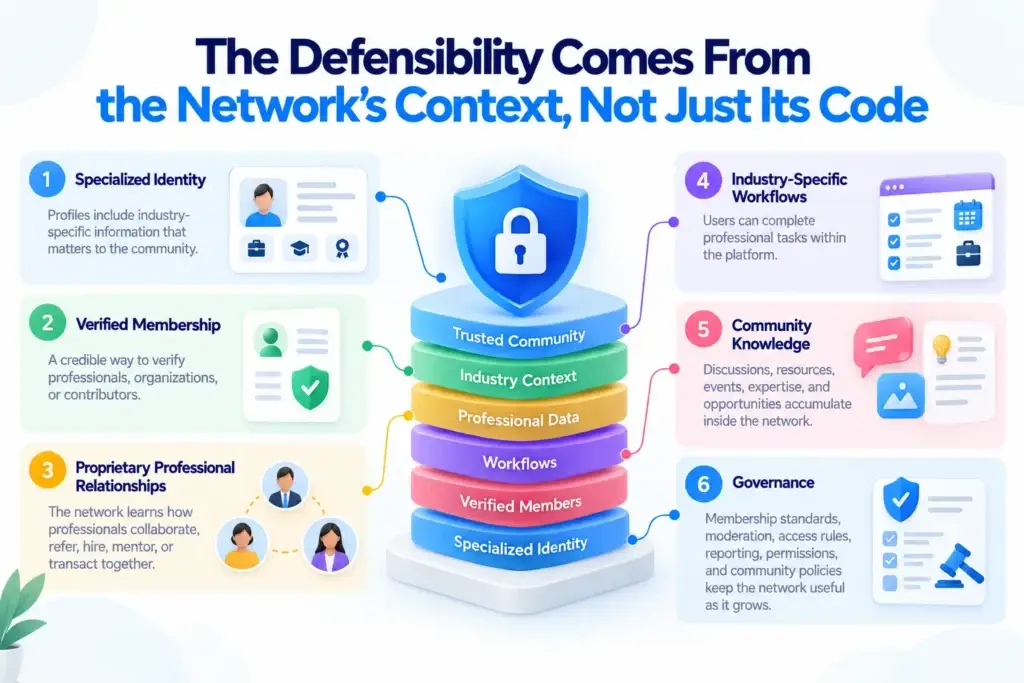
Profiles, feeds, messaging, groups, notifications, directories, and job listings are valuable building blocks, but they are not automatically a defensible business.
The defensibility of a niche network usually develops through several layers working together.
1. Specialized Identity
The profile represents information that matters inside the industry rather than only generic job history.
2. Verified Membership
The platform has a credible way to distinguish qualified members, organizations, or contributors where verification matters.
3. Proprietary Professional Relationships
The network learns which professionals collaborate, refer, hire, mentor, transact, or participate together.
4. Industry-Specific Workflows
Users can complete professional tasks that would otherwise require several disconnected tools or informal channels.
5. Community Knowledge
Discussions, resources, events, expertise, opportunities, and shared history accumulate inside the network.
6. Governance
Membership standards, moderation, access rules, reporting, permissions, and community policies keep the network useful as it grows.
These layers compound over time. A new entrant can reproduce interface components. It is much harder to reproduce years of verified member relationships, community reputation, professional context, historical interactions, industry-specific data, and trusted governance.
What Features Matter Most Depends on the Niche’s Value Loop
Founders often begin by creating a long feature checklist. That is usually the wrong starting point.
Start with the network’s value loop.
Ask what causes a member to join, what causes them to receive value, and what causes them to return.
For a talent community, the loop might be verified profile → employer discovery → relevant opportunity → application → career outcome.
For an association, it might be membership → expert community → useful discussion → event or resource → renewed membership.
For a supplier network, it might be verification → searchable capabilities → buyer discovery → introduction → commercial relationship.
Once that loop is clear, the feature roadmap becomes easier to prioritize.
A networking platform may eventually require profiles, relationships, search, messaging, feeds, groups, moderation, notifications, analytics, administration, events, jobs, company pages, or paid access. But not every niche needs every module to have equal priority. Miracuves maintains a more detailed professional networking feature breakdown for founders who reach the product-planning stage.
The Best Starting Audience Often Already Exists Somewhere Else
The hardest part of a networking business is rarely writing the first line of code. It is creating enough useful participation that new members experience value.
This is why niche networks become much more attractive when the founder already has access to a community.
That community could exist as an industry association, conference audience, newsletter, certification program, training organization, membership club, alumni body, professional directory, recruiting database, regional business group, specialist marketplace, or offline network.
The software then does not have to invent the community from zero. Its job is to make relationships inside an existing ecosystem more discoverable, persistent, searchable, useful, and monetizable.
This creates a much healthier starting position than launching an empty network and hoping professionals arrive simply because profiles and messaging exist.
Founders should therefore evaluate distribution before development.
- Where do the first 500 relevant members come from?
- Why would they complete a profile?
- Who creates the first useful content or opportunities?
- What professional problem gives members a reason to return?
- What makes invitations valuable rather than annoying?
- What does the platform provide that existing group chats, directories, newsletters, or events cannot provide efficiently?
Those questions are more important than trying to recreate every function available on a broad social network.
Founder Decision Signals: When a Niche Professional Network Makes Sense
Trust
The community benefits when members, credentials, organizations, or professional roles can be verified.
Economic Value
A successful introduction, hire, referral, deal, certification, or membership outcome has enough value to support monetization.
Repeat Utility
Members have ongoing reasons to return for people, knowledge, opportunities, events, collaboration, or professional development.
Distribution
The founder or operator can reach an existing community instead of depending entirely on cold user acquisition.
A niche network becomes particularly interesting when several of these signals overlap.
| Decision Factor | Strong Signal | Weak Signal |
|---|---|---|
| Professional identity | The niche requires specialized credentials, experience, or roles | Generic profiles provide enough context |
| Trust | Members care strongly about who gains access | Identity quality has little effect on interaction |
| Opportunity value | Connections can lead to meaningful commercial or career outcomes | Interactions are primarily casual |
| Existing community | A reachable professional audience already exists | The platform must create both product and audience from zero |
| Repeat need | Knowledge, hiring, referrals, deals, learning, or events recur | The platform solves a one-time need |
| Specialized workflow | The industry needs tools broad networks do not prioritize | Generic posts and messaging solve the problem adequately |
Who Can Benefit From a Niche Professional Networking Platform?
The opportunity is broader than startup founders building standalone social apps.
Organizations that already coordinate professional relationships may have an even stronger starting position.
- Industry associations can extend member value beyond annual events and newsletters.
- Certification organizations can connect verified credentials with professional identity and opportunity discovery.
- Alumni bodies can support mentorship, hiring, fundraising, introductions, and community events.
- Recruitment communities can combine talent identity, opportunities, referrals, and employer access.
- Training providers can connect learning achievements with peer networking and professional opportunities.
- Trade networks can bring suppliers, buyers, experts, and industry knowledge into a controlled ecosystem.
- Professional event operators can convert temporary event relationships into year-round communities.
- Regional business groups can support introductions, referrals, local opportunities, and member services.
- Enterprise ecosystems can create structured networks for partners, vendors, alumni, specialists, or customers.
The common thread is not industry type. It is the existence of a group whose relationships become more useful when identity, access, discovery, and communication are organized around shared professional context.
Mistakes That Reduce the Value of Niche Networks
Mistakes Founders Should Avoid
Defining the Audience Too Broadly
“Professionals” is not a niche. A useful starting community usually shares an industry, professional problem, qualification, business model, location, career path, or recurring workflow.
Copying a Broad Network Feature for Feature
The goal is not to reproduce every possible social function. Build the smallest set of interactions that makes the chosen professional community meaningfully more useful.
Assuming Signups Equal Network Value
Member count means little when members cannot discover relevant people, opportunities, knowledge, or professional outcomes.
Ignoring Governance
Verification, moderation, permissions, reporting, membership policies, and admin control influence trust as strongly as the front-end experience.
Launching Without a Community Seed
An empty network has no value loop. Before launch, founders should know where the first credible members, contributors, employers, experts, or organizations will come from.
Choosing Monetization Before Understanding Member Value
Pricing works better when it is attached to a real professional outcome such as hiring access, trusted membership, learning, events, visibility, referrals, or deal discovery.
How to Validate a Niche Network Before Trying to Scale It
The strongest validation is not asking potential users whether they would join another professional network.
Most people will say they are interested in better networking. That does not prove they will change behavior.
Validate the underlying professional problem instead.
- Identify a high-value professional interaction. Hiring, referrals, vendor discovery, mentorship, credentialing, collaboration, private knowledge, or deal access are stronger starting points than generic networking.
- Find where the interaction happens today. It may already occur through events, messaging groups, spreadsheets, email introductions, directories, professional bodies, or informal referrals.
- Understand the friction. Is discovery difficult? Is identity unreliable? Is information fragmented? Are opportunities invisible? Is the community hard to moderate?
- Define the membership boundary. Decide who should be inside the network and why that boundary makes participation more useful.
- Choose one repeatable value loop. Members need a reason to return after profile creation.
- Test willingness to participate. Measure whether real professionals will complete profiles, make introductions, share opportunities, attend sessions, or contribute expertise.
- Test willingness to pay only after value is visible. Determine whether members, employers, sponsors, institutions, or service providers are the logical payer.
This approach keeps founders focused on proving the network’s economics and behavior before chasing audience scale.
Build the Niche Layer Instead of Rebuilding Commodity Networking Technology
Once the opportunity is validated, founders face another decision: how much of the underlying networking infrastructure actually needs to be created from zero?
Standard modules such as profiles, connection logic, messaging, groups, feeds, notifications, admin controls, moderation, company pages, and job workflows require considerable integration work, but they are not normally the part that makes a niche community strategically unique.
The differentiation is more likely to come from the niche layer: specialized profile fields, verification rules, member categories, discovery logic, permissions, private communities, industry workflows, monetization, data structures, governance, branding, and the way different professional roles interact.
For founders who prefer to concentrate investment on those differentiating layers, Miracuves offers a white-label professional networking platform that can provide the underlying product foundation while the business is adapted around a specific professional community.
For ready-made deployments, Miracuves positions its standard professional-networking solution around a six-day launch process. That can be useful when speed matters, but the strategic work still remains with the founder: defining who the network is for, what members trust it for, what interaction creates value, and which niche-specific workflows deserve customization.
The objective should never be to launch generic networking software quickly. It should be to use speed to reach the market sooner with a network that already has a clear reason to exist.
Final Thoughts: Network Depth Can Be More Valuable Than Network Breadth
A niche professional network should not be judged by whether it can become larger than an established broad social network.
That is usually the wrong contest.
The better question is whether the platform can become significantly more useful for one defined professional community.
If members can find more relevant people, trust identities more easily, access specialized opportunities, exchange higher-value knowledge, participate in industry workflows, and build relationships inside a community designed around their professional reality, a smaller network can create substantial value.
That is the strategic logic behind niche and walled-garden professional networks. Their advantage is not that they exclude everyone else. Their advantage is that they can organize one professional ecosystem with far greater precision.
For founders, associations, institutions, and community operators, this shifts the ambition from “build a huge social network” to something much more actionable: build the most useful network for a specific group whose relationships are already valuable.
FAQs
What is a niche professional networking platform?
A niche professional networking platform is a digital network built for a defined professional community, industry, association, role, credential group, or business ecosystem. Instead of maximizing total audience size, it organizes profiles, relationships, knowledge, opportunities, and communication around a specific professional context.
Why can a niche professional network create more value than a broad social network?
A niche network can concentrate relevant members, trusted identities, specialized information, and industry-specific opportunities. This can reduce discovery noise and make each connection, referral, job, discussion, or professional interaction more useful even when the total member base is smaller.
Does a niche professional network need to be invite-only?
No. Controlled access can take several forms, including invitations, organization approval, professional verification, certifications, paid membership, email-domain validation, or open registration with restricted member areas. The right access model depends on how important trust and exclusivity are to the community.
What types of organizations can launch a niche professional network?
Industry associations, alumni organizations, training providers, certification bodies, recruitment communities, professional event operators, trade groups, regional business organizations, enterprise ecosystems, and startup founders can all use niche professional networking models when they serve a clearly defined community.
How can niche professional networking platforms make money?
Potential revenue models include memberships, employer or recruiter access, job listings, premium professional search, events, training, certifications, sponsorships, vendor listings, premium visibility, institutional licensing, and other services tied directly to the community’s professional value.
What should founders validate before building a niche professional network?
Founders should validate the target member group, the professional problem being solved, where the first community will come from, the repeatable value loop, the level of verification required, the specialized workflows members need, and who has a credible reason to pay for the platform.
Can a smaller professional network still become a strong business?
Yes, when member relationships have meaningful economic or professional value. A smaller network can support subscriptions, hiring, referrals, events, education, sponsorships, or other revenue streams when users receive outcomes valuable enough to justify repeat participation and payment.
Miracuves is an independent software development company. We are not affiliated with, connected to, sponsored by, or endorsed by any company or product named in this article.
Terms such as “X Clone” are used descriptively. It is how the software industry refers to building a platform with functionality comparable to a known service, and how clients search for it.
The entire design and codebase of our products is built by our own team. Our products contain no code, design, graphics, or content originating from any third-party website or applications.
All third-party names and marks referenced in this article are the property of their respective owners, referenced solely to identify the services discussed.