Key Takeaways
- Microblogging Platform Settings should let operators manage branding, policies, moderation, media limits, monetization, notifications, roles, and regional controls without redevelopment.
- Runtime controls reduce developer dependency for routine operational changes after launch.
- Branding, upload rules, moderation states, verification plans, ad settings, and policy links should be configurable from the admin dashboard.
- Sensitive settings need role-based permissions, audit logs, and rollback options to reduce operational risk.
- Structural changes such as authentication, database schema, encryption, APIs, and infrastructure should still require proper development review.
Runtime Control Signals
- If routine logo, policy, pricing, or upload-rule changes require developer tickets, more controls should move into runtime configuration.
- Moderation settings should support report categories, review states, takedown reasons, escalation labels, suspension rules, and audit notes.
- Media controls should help operators adjust file types, upload size, post limits, video duration, and moderation requirements.
- Monetization controls should allow business teams to test verification plans, subscriptions, ad rules, and promotional settings without rebuilding the product.
- Multi-community and regional expansion becomes easier when branding, policies, language defaults, support details, and operating rules can vary without creating separate code forks.
Real Insights
- Runtime configuration is what turns a social product from a fixed application into an operable platform.
- Hardcoding policies and commercial settings slows experimentation because every small adjustment becomes an engineering task.
- Runtime flexibility without permissions creates risk, while role-scoped access gives teams speed with accountability.
- Audit logs should record who changed a setting, the previous value, the new value, and when the change occurred.
- The strongest approach is: configure operational settings → restrict access by role → record every sensitive change → allow rollback → keep structural architecture under engineering control.
A social app does not stay the same after launch.
The brand may need a new logo. The community rules may change. Upload limits may need adjustment. Moderation rules may become stricter. Verification pricing may shift. Ad settings may need testing. A new market may require different content policies, privacy messaging, or onboarding controls.
For a Microblogging Platform, these changes should not always require redevelopment.
Runtime controls allow platform operators to manage branding, policies, monetization settings, moderation rules, media limits, and user-facing configurations from the admin dashboard instead of waiting for developers to edit code, run migrations, rebuild the app, or redeploy the system.
This guide explains how runtime controls work, why they matter for founders, and what settings a modern Microblogging Platform Settings product should manage without turning every operational change into a development sprint.
What Runtime Controls Mean in a Microblogging Platform
Runtime controls are settings that operators can change while the platform is live.
Instead of asking developers to modify code for every small change, the platform stores certain rules and values as configurable settings. The application reads these settings while running and applies them across the user app, admin panel, creator tools, moderation workflows, and monetization flows.
For example, a platform operator may want to change:
- platform name
- logo and favicon
- tagline
- allowed media file types
- upload size limits
- number of images per post
- reply policy defaults
- verification plan pricing
- ad campaign approval rules
- report triage statuses
- blocked IP settings
- community policy links
- email provider settings
- payment gateway settings
- user role permissions
Without runtime controls, even basic operational updates can become slow. The team may need to create a development ticket, wait for code changes, test the change, deploy the change, and monitor whether anything broke.
For founders, this creates unnecessary delay.
A Microblogging Platform is a living community product. Policies, branding, commercial rules, and moderation needs change after real users arrive. The platform should give operators enough control to adapt without breaking the product foundation.
Why Runtime Settings Matter After Launch
The biggest mistake founders make is assuming the first version of their social platform will be operationally perfect.
In reality, the first few weeks after launch reveal what the community actually needs. Users may post more media than expected. Spam may appear in direct messages. Certain words may need closer moderation. A verification plan may need a pricing update. The brand may need different onboarding copy after early feedback. Advertisers may need creative review before campaigns go live.
Once the platform is stable, founders can use a clear microblogging platform growth strategy to improve onboarding, retention, community activity, creator participation, and monetization experiments.
If every one of these changes requires redevelopment, the product becomes slower than the community it is trying to serve.
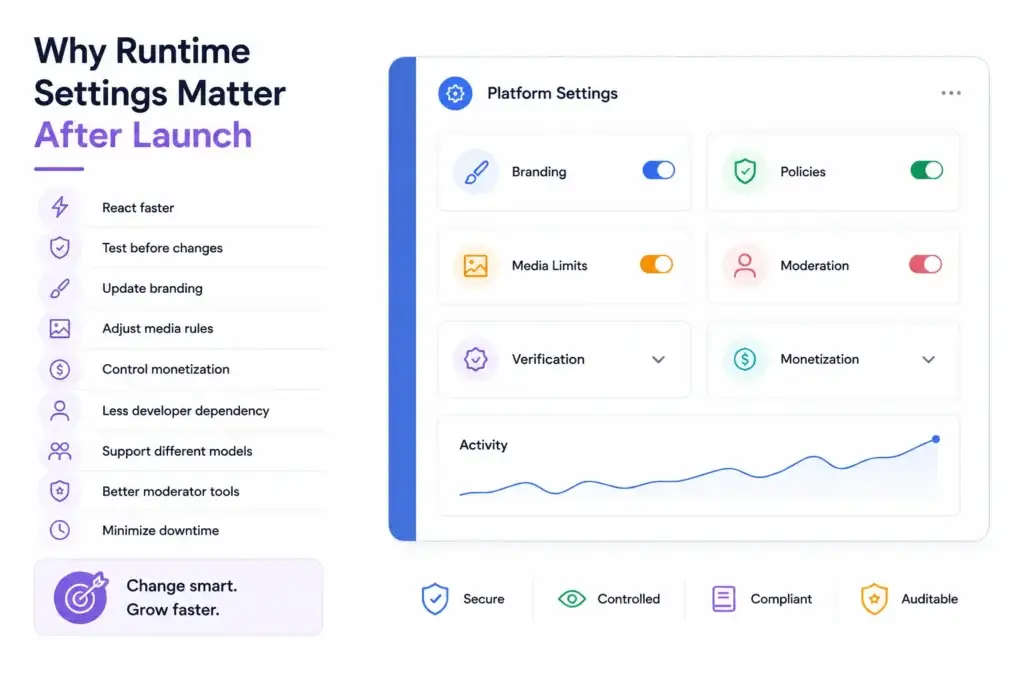
Runtime controls help founders:
- react faster to user behavior
- test policies before making permanent changes
- update brand identity without rebuilding the app
- adjust media rules as infrastructure costs change
- control monetization settings from the admin panel
- reduce dependency on developers for routine operations
- support different community models from one codebase
- give moderators clearer tools and workflows
- reduce avoidable downtime during small updates
This does not mean everything should be editable from the dashboard. It means the right operational levers should be configurable, while deeper architecture and security changes remain controlled by development teams.
Runtime Branding Controls: Updating Identity Without Rebuilding
Branding is usually the first layer founders think about.
A white-label social product should not feel like a borrowed template. It should carry the operator’s name, logo, colors, favicon, domain, tagline, email identity, support identity, and user-facing copy.
Runtime branding controls may include:
- platform name
- brand tagline
- logo
- favicon
- app icon references
- email sender name
- support contact
- footer text
- policy page links
- landing page copy blocks
- theme color values
- onboarding headline
- default meta title and description
For a founder, this is more than visual control. Branding affects trust. A professional community, creator network, regional discussion platform, or media-owned audience product needs a consistent identity across login, feed, profile, notifications, emails, admin messages, and public pages.
If small branding changes require redevelopment, every campaign becomes slower. If branding is runtime-configurable, the operator can refresh market positioning, test user-facing language, and update visual identity with less operational friction.
Runtime branding is especially useful for agencies, media brands, creator communities, and regional operators that may run similar product foundations under different audience identities.
Policy Controls: Turning Community Rules Into Platform Behavior
A microblogging product is not only a feed. It is a governed conversation environment.
Community rules should not live only in a static policy page. The platform should translate important policies into product behavior, moderation workflows, and admin controls.
Policy-related runtime settings may include:
- allowed content types
- upload restrictions
- report categories
- default visibility rules
- reply control options
- message request behavior
- account suspension reasons
- content takedown reasons
- verification eligibility rules
- ad campaign review requirements
- user reporting limits
- blocked words or phrases
- age-gating rules where relevant
- appeal workflow settings
- automated flagging thresholds
For example, a platform serving a professional membership community may need stricter identity and verification controls. A creator-led community may need stronger abuse reporting, message request filtering, and monetization policy enforcement. A regional public conversation app may need local language moderation, spam rules, and legal escalation workflows.
The stronger approach is to make policy settings visible to operators, not buried in code.
This helps the platform adapt to real community behavior while keeping governance decisions documented.
Media and Upload Controls: Managing Infrastructure Cost and User Behavior
Media settings are easy to underestimate.
A text-first platform may still allow profile images, post images, videos, GIFs, polls, link previews, voice clips, or documents depending on the product direction. Every media decision affects storage, bandwidth, moderation workload, content quality, and infrastructure cost.
Runtime media controls may include:
- allowed file types
- maximum upload size
- maximum media count per post
- profile image size limits
- banner image limits
- video duration limits
- image compression rules
- moderation review requirements
- upload cooldowns
- blocked file formats
- media visibility rules
- link preview controls
This matters because early assumptions often change. A founder may launch with generous upload limits to encourage adoption, then tighten rules if storage costs rise or abuse increases. Another founder may begin as a text-first network and later enable richer media for creator monetization.
Media policy should be adjustable without requiring a full rebuild.
A practical Microblogging Platform should let operators set upload rules based on community needs, infrastructure budget, moderation capacity, and user experience.
Moderation Settings: Moving From Manual Reaction to Governed Workflows
Moderation is where runtime control becomes business-critical.
A growing community will produce reports, spam, harassment, impersonation attempts, fake accounts, low-quality posts, and policy edge cases. If the admin panel only gives a flat list of reports, moderators quickly lose context.
Runtime moderation controls can help operators define how reports move through the system.
Useful moderation controls include:
- report categories
- report priority rules
- pending, reviewed, resolved, dismissed states
- takedown reasons
- account warning templates
- suspension durations
- IP block duration
- comment or reply restrictions
- repeat offender thresholds
- manual review queues
- moderator assignment rules
- escalation labels
- appeal options
- audit notes
The key is that moderation should be a workflow, not a database cleanup exercise.
A moderator should be able to review a report, understand the content, inspect user history, apply a decision, record the reason, and leave a visible audit trail. Admins should also know which policies are causing the most reports and whether rule changes are reducing abuse.
Runtime controls help founders adjust the governance model as the community grows.
Monetization Controls: Changing Commercial Rules Without a Sprint
Microblogging platforms can monetize through several models.
Some rely on ads. Some sell verification tiers. Some offer premium profiles. Some support creator subscriptions, promoted posts, sponsored trends, private communities, or brand campaigns.
Runtime monetization settings should also support the wider microblogging platform business model, including verification plans, promoted posts, subscriptions, creator tools, ad controls, and payout workflows.
Monetization settings should not be hardcoded into the product.
Useful runtime monetization controls include:
- verification plan names
- subscription prices
- plan benefits
- ad campaign minimum spend
- sponsored post rules
- promoted trend pricing
- creator revenue share
- payout thresholds
- payment gateway settings
- campaign approval rules
- refund policy links
- invoice settings
- ad review states
- discount or promotional logic
Founders rarely know the perfect monetization model before launch. Runtime controls allow the operator to test commercial packaging without rebuilding the product each time.
This also helps the team separate strategy from engineering. The business team can adjust pricing or packaging from the admin panel, while developers focus on core product stability, scalability, and new feature development.
Platform Settings Operators Should Control From the Admin Panel
A practical runtime settings layer usually includes several groups of controls.
A strong admin layer should connect with the wider microblogging platform feature breakdown, especially where branding controls, media rules, moderation settings, verification plans, and role-based permissions work together.
Runtime Control Areas in a Microblogging Platform
| Control Area | Examples | Founder Impact |
|---|---|---|
| Branding | Platform name, logo, favicon, tagline, support identity, email sender name. | Allows brand updates without rebuilding the app. |
| Media Policy | File types, upload limits, media count, video duration, image rules. | Helps manage storage cost, user behavior, and moderation workload. |
| Community Policy | Report categories, reply controls, suspension reasons, appeal settings. | Turns community rules into operational workflows. |
| Moderation | Report triage, takedown reasons, IP blocks, escalation labels, review queues. | Helps moderators manage safety issues without developer support. |
| Monetization | Verification plans, ad settings, creator revenue share, gateway settings. | Lets operators test revenue models faster. |
| Access and Roles | Admin roles, moderator permissions, creator tools, team access controls. | Protects sensitive actions from being handled by the wrong user. |
| Notifications | Email templates, push triggers, moderation notices, onboarding reminders. | Improves communication without changing app code for every message. |
| Regional Controls | Language defaults, policy links, local support details, market-specific settings. | Supports regional expansion from one product foundation. |
Why Role-Based Access Matters for Runtime Controls
Runtime settings are powerful. That also makes them risky.
Not every team member should be able to change upload limits, payment settings, moderation policies, verification pricing, or gateway configuration. A support agent may need to view user reports, but not change platform-wide policy. A moderator may need to remove content, but not edit payment settings. A marketing manager may need to update campaign copy, but not change security rules.
Role-based access control helps separate responsibilities.
Typical admin roles may include:
- super admin
- platform admin
- moderator
- support agent
- content reviewer
- ad reviewer
- finance admin
- creator manager
- analytics viewer
Each role should have clear permissions. High-risk changes should also have audit logs and, in some cases, approval workflows.
Runtime control without permissions creates operational risk. Runtime control with role separation creates operational speed without losing accountability.
Audit Logs and Rollback: The Safety Net Behind Every Setting Change
When a live setting changes, the platform should record what happened.
Audit logs help operators answer:
- Who changed the setting?
- What was changed?
- What was the old value?
- What is the new value?
- When did the change happen?
- Was approval required?
- Did the change affect users immediately?
- Can the change be reversed?
This is important for moderation, payments, branding, ad settings, upload limits, and account restrictions.
Rollback is also useful. If a media upload rule accidentally blocks valid posts, the admin should be able to restore the previous setting quickly. If a policy change creates unexpected user complaints, the team should understand what changed and when.
A runtime settings layer should make operations faster, but not invisible.
What Should Not Be Runtime-Controlled
Runtime flexibility is useful, but founders should avoid making every part of the product editable from the dashboard.
Founders should also review social platform development cost factors, because runtime settings, moderation workflows, media limits, admin roles, and monetization modules can affect the final launch scope.
Some changes should still require development review, testing, and deployment.
Examples include:
- database schema changes
- authentication architecture
- encryption logic
- payment security changes
- major feed ranking changes
- large-scale infrastructure changes
- core permission system changes
- API contract changes
- sensitive compliance workflows
- deep moderation automation rules
- data retention architecture
- migration-heavy feature changes
The rule is simple: operational settings can be runtime-controlled, but structural changes should be engineered properly.
Founders should not confuse configurability with unlimited flexibility. A strong platform gives operators the right levers while protecting the system from unsafe changes.
Runtime Controls and Multi-Community Expansion
Runtime settings become especially useful when a platform is used for different community models.
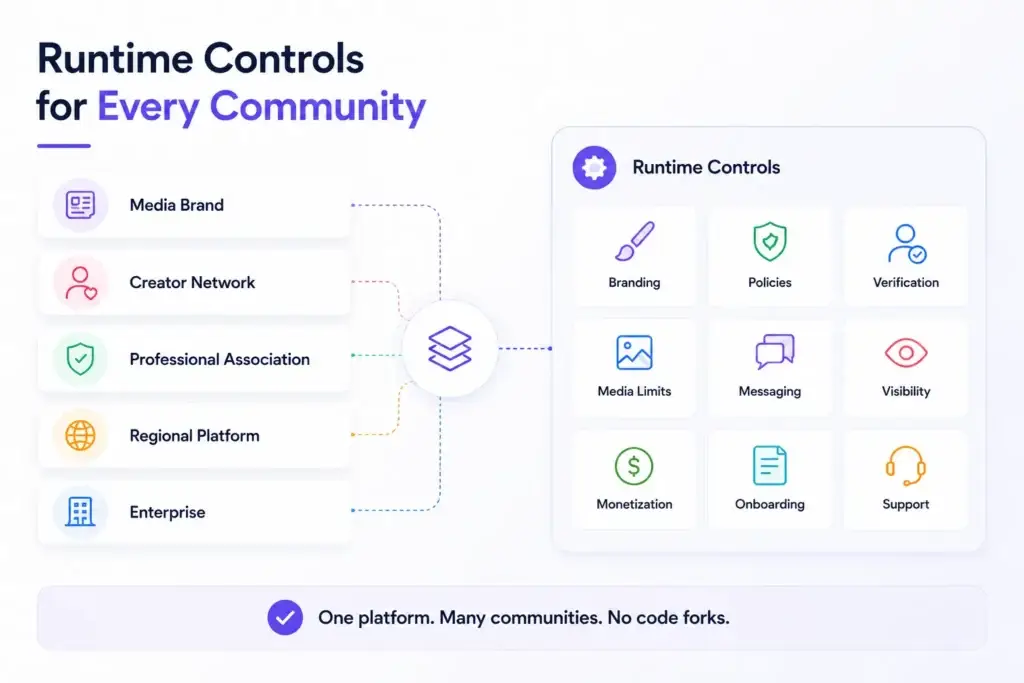
A media brand may use microblogging to build discussion around articles. A creator network may use it for fan engagement and monetization. A professional association may use it for verified member conversations. A regional platform may use it for local language discourse. An enterprise may use it for internal updates and partner communities.
Each use case may require different:
- branding
- moderation policy
- verification rules
- media limits
- messaging behavior
- public visibility
- monetization settings
- onboarding copy
- support workflows
Runtime controls allow one strong product foundation to support different operating models without creating separate code forks for every community.
This is important for founders because code forks become expensive over time. Every fork needs separate maintenance, testing, updates, and bug fixes. Runtime configuration helps the business adapt without multiplying engineering burden.
Founder Decision Signals
Speed
If your team needs a developer for every logo, upload rule, policy label, or pricing change, runtime controls should be part of your platform plan.
Governance
If your community is open to public posting, moderation states, report categories, takedown reasons, and audit logs are operational necessities.
Monetization
If you plan to test verification, ads, promoted posts, or creator revenue models, pricing and approval rules should be configurable from the admin panel.
Scale
If your roadmap includes multiple communities or regional versions, runtime settings reduce the need to maintain separate product forks.
Common Mistakes Founders Should Avoid
Hardcoding branding and policy settings
Branding, upload rules, report categories, verification plans, and policy links often change after launch. Hardcoding them turns routine operations into development work.
Giving every admin full access
Runtime controls need role-based permissions. Moderators, support teams, finance users, and super admins should not all control the same sensitive settings.
Skipping audit logs for setting changes
If a policy, payment, media, or moderation setting changes, the platform should record who changed it, when it changed, and what the previous value was.
Making structural architecture changes from the dashboard
Runtime configuration is not a replacement for proper engineering. Database, security, API, and infrastructure changes still need development review and testing.
How Miracuves Helps Founders Build Runtime-Controlled Social Platforms
Miracuves helps founders build social platforms where branding, moderation, trust workflows, media rules, monetization settings, and admin controls are part of the product foundation.
For founders planning a text-first social product, owned community, creator network, media discussion layer, regional conversation app, or professional member network, a Microblogging Platform can provide a launch-ready base with white-label branding, runtime configuration, moderation workflows, role-based admin control, and source-code ownership.
You can also explore Miracuves’ social network app solutions or review our social media app development services if your roadmap needs custom community workflows, creator tools, or governance controls.
The goal is not to copy another social network. The stronger decision is to build a platform foundation that your team can operate, govern, and adapt after launch.
If you are comparing technical teams, choose a social platform development partner that understands runtime branding, policy settings, moderation workflows, monetization controls, admin roles, and source-code ownership.
Final Thoughts: Runtime Control Is What Makes a Social Platform Operable
A Microblogging Platform is not finished on launch day.
The real test begins when users arrive, posts increase, reports appear, creators ask for monetization, advertisers need approval, policies change, and the brand learns what the market actually responds to.
Runtime controls help founders manage that reality.
Branding, policies, media limits, moderation workflows, verification plans, ad settings, and admin permissions should not require redevelopment every time the business needs to adjust. At the same time, sensitive structural changes should still be engineered carefully.
The best platform foundation gives founders both speed and control: fast enough to adapt, structured enough to govern, and stable enough to grow.
FAQs
What are runtime controls in a Microblogging Platform?
Runtime controls are admin-managed settings that can be changed while the platform is live. They may include branding, media rules, moderation workflows, policy links, verification plans, ad settings, notification templates, and platform configuration.
Why are runtime settings important for a microblogging app?
Runtime settings help operators adapt after launch without waiting for every change to become a development task. This is useful for community policies, branding updates, upload limits, monetization tests, and moderation workflows.
What branding settings should a social platform support?
A social platform should support configurable platform name, logo, favicon, tagline, email sender identity, support details, policy links, theme values, and selected onboarding copy.
Can moderation rules be managed without redevelopment?
Yes, many moderation workflows can be managed through admin settings, including report categories, review states, takedown reasons, suspension durations, IP blocking, escalation labels, and audit notes.
Should payment and ad settings be runtime-configurable?
Some commercial settings can be runtime-configurable, such as verification plan names, pricing, ad approval rules, campaign limits, and payout thresholds. Sensitive payment security changes should still be handled carefully with proper technical review.
What should not be changed through runtime settings?
Core security logic, database schema, authentication architecture, encryption, major feed-ranking logic, API contracts, and infrastructure-level changes should not be treated as casual admin settings. These usually require development review and testing.
Why do runtime settings need audit logs?
Audit logs show who changed a setting, what changed, when it changed, and what the previous value was. This helps with accountability, moderation review, policy disputes, payment configuration, and operational governance.
Can Miracuves help build a runtime-controlled microblogging platform?
Yes. Miracuves helps founders build white-label social platforms with runtime branding, moderation workflows, media policy controls, monetization settings, admin dashboards, source-code ownership, and faster launch support.
Miracuves is an independent software development company. We are not affiliated with, connected to, sponsored by, or endorsed by any company or product named in this article.
Terms such as “X Clone” are used descriptively. It is how the software industry refers to building a platform with functionality comparable to a known service, and how clients search for it.
The entire design and codebase of our products is built by our own team. Our products contain no code, design, graphics, or content originating from any third-party website or applications.
All third-party names and marks referenced in this article are the property of their respective owners, referenced solely to identify the services discussed.