

Key Takeaways
- A real estate crowdfunding platform architecture should connect investor onboarding, eligibility, properties, SPVs, share classes, subscriptions, payments, ownership, financial ledgers, distributions, reporting, and exits.
- Investor verification and eligibility should be structured records with review history, classifications, limits, evidence, and expiry information rather than a simple verified status.
- Subscriptions, payment settlement, share allocation, and ownership should remain separate states so an investment request or payment cannot incorrectly create ownership.
- A double-entry financial ledger should track deposits, investments, fees, rental income, expenses, distributions, refunds, withdrawals, FX, and secondary-market transactions.
- Distribution and exit workflows should preserve historical ownership, support approvals and reconciliation, and provide enough records to explain investor statements and financial outcomes.
Architecture Signals
- The core model should maintain separate but connected records for properties, SPVs, offerings, share classes, subscriptions, allocations, holdings, certificates, distributions, transfers, and exits.
- Ownership should be represented through durable allocation and transfer events so historical positions can be reconstructed.
- Wallet balances should derive from financial transactions and should not be used as the ownership register.
- Rental distributions should account for income, expenses, fees, reserves, withholding, eligible holdings, record dates, approvals, and payment status.
- Payment callbacks, funding, allocations, withdrawals, distributions, transfers, and other sensitive financial actions should use idempotency, permissions, validation, and audit records.
Real Insights
- A property listing does not prove investor ownership; the platform must connect the investment structure, settled funds, allocation event, and ownership register.
- A payment gateway callback should never directly create ownership because external payment events can be duplicated, delayed, retried, or reversed.
- Reports and investor statements should be generated from operational records rather than maintained separately in spreadsheets.
- Secondary-market functionality requires more than listings; eligibility, funding, settlement, ownership transfer, and historical records must work together.
- The strongest architecture path is: onboard investor → verify eligibility → structure property and SPV → create subscription → confirm funding → allocate shares → record ownership → track property income → calculate distributions → manage transfers or exits → reconcile and preserve the complete investment history.
A Real Estate Crowdfunding Platform can look deceptively simple from the investor side.
An investor opens a property page, reviews projected returns, enters an investment amount, completes verification, sends funds, and later receives distributions.
Behind that journey is a much more demanding operating system.
The platform must know who the investor is, whether they are eligible to invest, which legal entity owns the property, which share class they subscribed to, whether payment actually settled, how many units were allocated, who currently owns those units, how rental income should be distributed, and what should appear on the investor’s statement.
That is why good fractional real estate investment architecture starts with ownership and money records—not property cards.
Why Property Listings Are Only the Frontend
A polished property catalogue can explain location, valuation, rental yield, investment minimums, photographs, documents, and projections.
But none of those records proves that an investor owns anything.
The operational architecture begins after someone clicks Invest.
The system needs to coordinate:
- Investor identity
- Eligibility and verification
- Property entity
- Share class
- Subscription order
- Payment
- Allocation
- Ownership record
- Wallet or cash ledger
- Rental distributions
- Fees and withholding
- Statements
- Exit or transfer history
- Audit evidence
These records must remain connected throughout the full investment lifecycle.
If they are maintained in disconnected spreadsheets and manual reports, the platform becomes harder to reconcile as investors, properties, currencies, and transactions grow.
Architecture Layer 1: Investor Onboarding and Eligibility
Investor onboarding should do more than create an account.
Before allowing someone to subscribe to an investment, the platform may need to understand who that person is and whether the selected product is available to them.
The exact requirements depend on jurisdiction, legal structure, investor classification, and operating model, but the platform architecture may need to support:
- Identity information
- Address records
- Identity-document workflow
- KYC status
- Investor classification
- Accreditation status where applicable
- Suitability or appropriateness checks where required
- Country restrictions
- Investment limits
- Tax information
- Bank or payout details
- Compliance notes
- Review status
- Document expiry
- Manual-review history
The important architectural principle is that eligibility should become structured data.
A simple field such as verified = yes is often not enough.
Operators may need to understand why an investor was approved, what evidence was reviewed, when that decision occurred, who approved it, and whether the approval remains valid.
Architecture Layer 2: Property SPVs and Share Classes
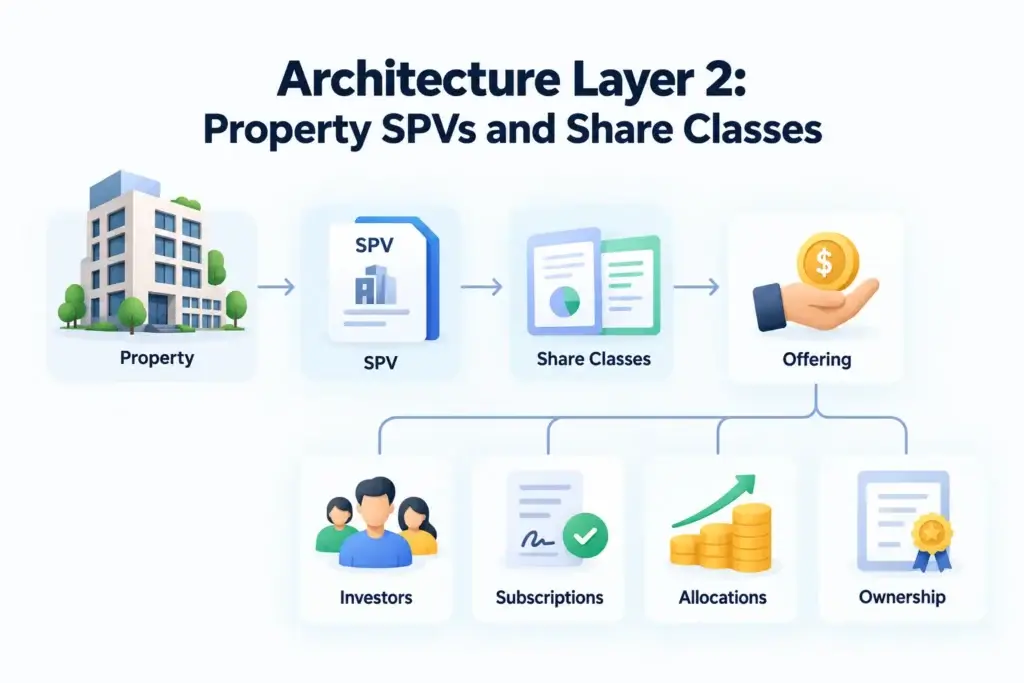
The next important layer is the legal connection between property and investor.
A fractional property model may use a special-purpose vehicle, or SPV, for a specific asset. Instead of placing investor ownership directly against a building record, the platform can represent the investment through interests or shares associated with the entity holding the property.
The system therefore needs more than a property table.
A stronger data model may include:
- Property
- SPV
- Share class
- Offering
- Subscription
- Allocation
- Investor holding
- Ownership history
- Certificate
- Distribution entitlement
- Transfer
- Exit event
These should be related but separate records.
For a deeper explanation of property-level legal structures, investor allocations, and ownership logic, this guide on how SPVs work in real estate investing explains how SPVs connect properties, share classes, investors, and distribution rights.
Why the SPV Should Be Its Own Entity
Keeping the SPV separate from the property makes the architecture more flexible.
One property may have:
- Multiple share classes
- Different investor groups
- Different distribution rights
- Different voting rules
- Different fee arrangements
- Different exit conditions
If everything is stored directly against the property record, future changes become difficult to model.
The legal structure should therefore have its own lifecycle rather than being treated as property metadata.
Architecture Layer 3: Subscription Is Not the Same as Ownership
One of the most important distinctions in investment architecture is the difference between an order and an allocation.
An investor may submit a subscription for ₹100,000 or $10,000.
That does not automatically mean they own that value of shares.
The transaction may still need:
- Eligibility confirmation
- Subscription validation
- Payment initiation
- Payment settlement
- Compliance review
- Allocation calculation
- Share issuance
- Ownership-register update
- Certificate generation
- Investor confirmation
Keeping these states separate makes the system much easier to audit.
A typical investment status model might include:
- Draft
- Submitted
- Awaiting verification
- Awaiting payment
- Payment pending
- Payment settled
- Under review
- Approved
- Allocated
- Rejected
- Canceled
- Refunded
Ownership should normally be created by the allocation event, not merely because an investor pressed a button or initiated a payment.
Architecture Layer 4: The Ownership Register
The ownership register answers one critical question:
Who owns what right now, and how did that ownership change over time?
That sounds simple until transfers, partial exits, secondary trades, inheritance, corrections, redemptions, or property sales begin occurring.
The architecture should preserve ownership history rather than repeatedly overwriting a current balance.
Useful records may include:
- Investor
- SPV
- Share class
- Number of units
- Allocation source
- Effective date
- Certificate reference
- Transfer reference
- Exit reference
- Current status
Historical records are equally important.
Founders planning ownership records, investor allocation flows, ledgers, reporting, and operator controls can also review the property investment platform features needed to support these workflows in one system
If an investor owned 1,000 units in January, sold 250 in March, and redeemed another 250 in September, the platform should be able to reconstruct each state.
If secondary transfers or investor liquidity may become part of the roadmap, a white-label investment trading platform can provide additional context around transaction workflows, order handling, and investor-facing trading experiences.
This is why append-oriented ownership records are usually safer than relying only on one editable balance field.
Architecture Layer 5: Double-Entry Financial Ledger
Ownership and money should not be treated as the same thing.
The ownership register answers:
Who owns the investment?
The financial ledger answers:
Where did the money move?
A robust investment platform may need ledger entries for:
- Investor deposits
- Subscription settlement
- Wallet transfers
- Platform fees
- Property funding
- Rental income
- Property expenses
- Management fees
- Distribution payments
- Tax withholding
- Refunds
- Withdrawals
- FX conversion
- Secondary-market settlement
A double-entry model provides stronger reconciliation because every transaction has balanced financial effects.
For example, an investor deposit should not simply increase a stored wallet balance. It should create balanced entries between relevant accounts.
Balances can then be derived from ledger activity.
That makes it easier to investigate inconsistencies because every change should point back to a transaction.
Payment Architecture: Never Treat a Gateway Callback as Ownership
External payments create one of the easiest places for financial systems to break.
A payment provider may:
- Send the same callback more than once
- Retry after a timeout
- Return success late
- Reverse a transaction
- Produce an asynchronous settlement result
- Send events out of order
If every callback creates a new investment allocation, the same payment could accidentally produce duplicate ownership.
The platform therefore needs idempotent payment processing.
In simple terms, the same external transaction should not be capable of creating the same financial effect twice.
A safer flow is:
- Create subscription.
- Generate payment intent.
- Store external payment reference.
- Receive payment event.
- Verify authenticity.
- Check whether event was already processed.
- Record ledger transaction.
- Mark payment settled.
- Trigger allocation once.
- Store processing evidence.
This is less visible than the investor dashboard, but far more important.
Architecture Layer 6: Rental Income and Distribution Runs
Once properties begin generating income, the platform has to determine which investors are entitled to receive what amount.
A distribution engine may need to consider:
- Distribution period
- Rental income
- Property expenses
- Platform or management fees
- Tax withholding
- Eligible share class
- Record date
- Investor ownership on that date
- Distribution-per-unit calculation
- Currency
- Investor payout status
The architecture should store the distribution as a batch rather than directly changing every investor balance without explanation.
A useful lifecycle might be:
Draft → Calculated → Reviewed → Approved → Posted → Paid → Reconciled
This creates room for maker-checker control.
Founders should also connect distribution architecture with the broader fractional investment business model, including platform fees, recurring management revenue, distribution charges, transaction fees, and exit-related monetization.
One operator may prepare the batch, while another approves it before money moves.
Distribution Entitlement Should Be Reproducible
An operator should be able to answer:
- Which investors were included?
- How many units did each investor own?
- Which record date was used?
- What gross rental income was received?
- Which expenses were deducted?
- Which fees were charged?
- What withholding applied?
- What was the investor’s net distribution?
If the platform cannot reproduce that calculation later, reporting becomes difficult.
Investor Wallet vs Bank Balance
A platform wallet should be treated as an accounting representation, not assumed to be money physically held inside the software.
The application may show an investor:
- Available balance
- Pending balance
- Invested capital
- Distribution income
- Withdrawal request
- Refund credit
But each figure should derive from underlying transactions and the platform’s actual payment or banking setup.
This distinction becomes increasingly important when the platform supports:
- Multiple currencies
- Deposit methods
- Withdrawals
- Refunds
- Reinvestment
- Distribution credits
- FX conversions
The UI balance should be the output of accounting logic, not the source of truth.
Reporting Architecture: Reports Should Come From Records, Not Spreadsheets
Investors expect clear records throughout the holding period.
Useful reports may include:
- Portfolio summary
- Property holdings
- Subscription history
- Allocation history
- Distribution history
- Transaction statement
- Wallet activity
- Fee statement
- Tax summary
- Ownership certificate
- Exit proceeds
- Secondary-market activity
Operators need deeper reports:
- Capital raised by property
- Investor count
- Outstanding subscriptions
- Distribution batches
- Fee revenue
- Payment reconciliation
- Withdrawals
- Compliance status
- Investor-class exposure
- Property performance
- FX activity
- Audit history
The most important architectural rule is that these reports should derive from the same operational data that drives the platform.
A separate spreadsheet-based reporting process can create contradictions between what the investor sees and what finance believes happened.
Audit Logs and Maker-Checker Controls
Financial platforms need to know not only what changed, but who changed it.
High-risk operator actions may include:
- Approving investor verification
- Changing investor classification
- Approving a withdrawal
- Editing bank details
- Posting a distribution
- Approving a refund
- Changing fee rules
- Modifying marketplace eligibility
- Changing ownership records
- Approving a property for investment
These actions should generate durable audit records.
Some actions should also require maker-checker approval.
This means the person preparing the transaction cannot be the only person approving it.
Founder Decision Signals
Ownership Model
If investors are acquiring interests in specific properties, define SPVs, share classes, allocations, certificates, and ownership history before designing the marketplace UI.
Money Movement
If deposits, withdrawals, fees, distributions, refunds, or FX are involved, use a real ledger architecture rather than editable balance fields.
Distribution Complexity
If rental income will be distributed periodically, define record dates, entitlement calculations, fees, withholding, approvals, and reconciliation early.
Operational Evidence
If finance, compliance, auditors, or investors may question a transaction later, every sensitive action should leave enough evidence to reconstruct what happened.
Common Architecture Mistakes Founders Should Avoid
Treating a Subscription as Ownership
An investment request, settled payment, allocation, and ownership record are different events. Keeping them separate improves reconciliation and auditability.
Using Only One Editable Investor Balance
Deposits, investments, fees, distributions, withdrawals, refunds, and FX should create traceable financial entries rather than silently changing a balance.
Keeping the Cap Table Outside the Platform
If ownership lives in spreadsheets while transactions happen inside the application, the operating record can drift from the legal and financial record.
Building Reports After Launch
Statements, certificates, tax summaries, reconciliation, and distribution reports should influence the data model from the beginning.
Architecture Checklist Before Launch
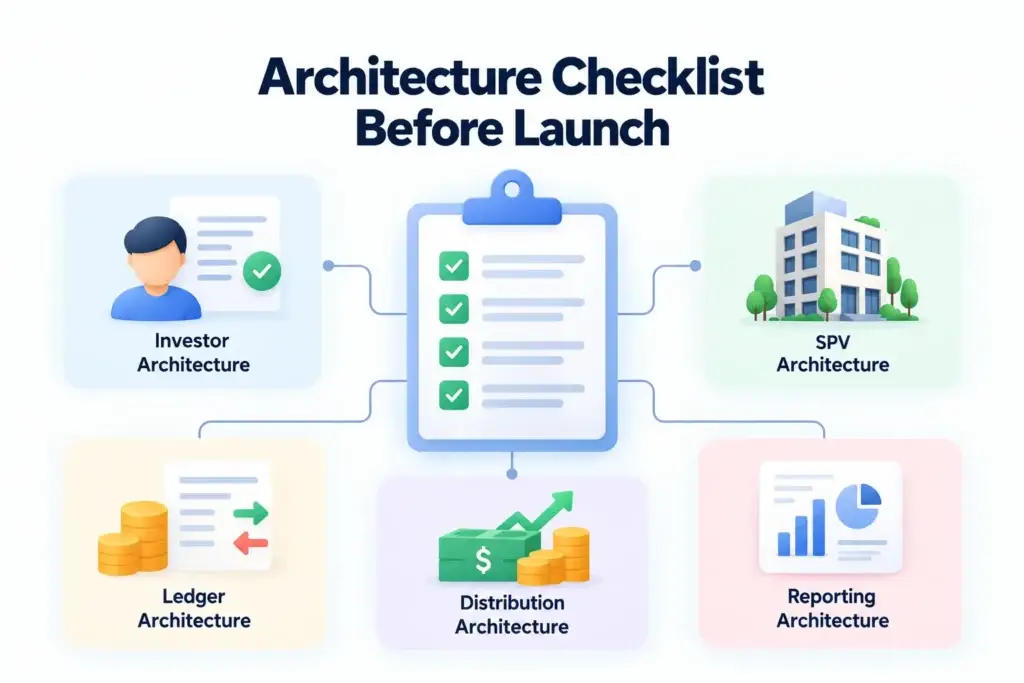
Before real investor activity begins, founders should confirm:
Investor architecture
- Identity and eligibility records are structured.
- Investor classifications are stored separately from user profiles.
- Review history can be audited.
- Investment limits can be enforced.
- Expired verification can be detected.
SPV architecture
- Every investable property can reference the correct SPV.
- Share classes are explicit.
- Offering terms are versioned.
- Ownership records connect back to allocation events.
- Historical ownership can be reconstructed.
Ledger architecture
- Financial transactions use balanced entries.
- Wallet balances derive from ledger activity.
- External payment events are idempotent.
- Refunds create reversing or related entries.
- Reconciliation can tie processor activity to platform records.
Distribution architecture
- Property income and expenses are recorded.
- Eligible holdings are determined using a clear record date.
- Entitlements can be recalculated.
- Approval workflow is documented.
- Investor statements explain gross, deductions, and net distribution.
Reporting architecture
- Investor statements derive from operational data.
- Ownership certificates reference actual holdings.
- Finance reports reconcile with ledger entries.
- Audit logs record high-risk actions.
- Historical records are preserved.
Founders who have already mapped onboarding, SPVs, payments, ledgers, distributions, and reporting can next review property investment platform development cost to understand how scope, integrations, compliance workflows, and production requirements can influence budget planning.
How a Launch-Ready Foundation Changes the Build Decision
Building a property investment product from zero is not mainly a frontend challenge.
The heavier work is ownership logic, financial accounting, investor eligibility, payment idempotency, distribution processing, operator approvals, and reporting.
For founders who want to evaluate an existing foundation rather than recreate every layer, Miracuves‘ fractional property investment platform already centers its product architecture on property SPVs, ownership records, ledger-backed transactions, investor workflows, distributions, operator controls, and reporting.
If development-team evaluation is part of the decision, this guide on choosing a property investment development partner explains what founders should assess around architecture, integrations, source ownership, security, and delivery capability.
Where the ready-made scope matches the business model, Miracuves positions deployment at 6 days, while jurisdiction-specific hardening, live providers, legal structure, and compliance configuration still need to match the operator’s actual market.
Final Thoughts
The architecture of a fractional property investment product should begin with one question:
Can the platform prove who owns what, where the money moved, and why every number on an investor statement exists?
If the answer depends on manually reconciling separate spreadsheets, payment dashboards, ownership files, and investor reports, the system will become harder to operate as it grows.
Founders exploring adjacent investment models can also review Miracuves’ investment platform solutions to compare related product structures before finalizing the roadmap.
A stronger architecture connects investor onboarding, eligibility, SPVs, subscriptions, payments, allocations, ownership, ledgers, distributions, and reporting through one consistent domain model.
The investor interface can remain simple.
The records underneath it cannot.
FAQs
What is an SPV in fractional real estate investing?
An SPV is a separate legal entity commonly used to hold a specific asset or investment structure. Platform architecture can connect the SPV with share classes, offerings, subscriptions, investor allocations, and ownership records.
Why does a property investment platform need a double-entry ledger?
A double-entry ledger creates balanced records for deposits, subscriptions, fees, distributions, refunds, withdrawals, and other financial movements. This improves reconciliation and makes transaction history easier to audit.
What is the difference between an investment subscription and an allocation?
A subscription is an investor’s request or order to participate. An allocation records the investment interest actually issued after required payment, eligibility, and approval conditions are satisfied.
Why should the ownership register be separate from the wallet ledger?
A double-entry ledger creates balanced records for deposits, subscriptions, fees, distributions, refunds, withdrawals, and other financial movements. This improves reconciliation and makes transaction history easier to audit.
How should rental distributions be processed?
A structured distribution workflow should identify the income period, eligible investors, units held on the record date, expenses, fees, withholding, gross entitlement, net entitlement, approvals, payment, and reconciliation.
What reporting should investors receive?
Depending on the operating model, investors may need portfolio summaries, transaction statements, allocation history, distribution history, ownership certificates, tax records, wallet activity, and exit records.
What is payment idempotency?
Payment idempotency prevents the same external transaction or callback from creating the same financial effect more than once. It is especially important when payment providers retry webhooks.
Can Miracuves provide a launch-ready fractional property investment system?
Miracuves offers a white-label property investment platform with SPV-oriented ownership workflows, ledger-backed transactions, investor and operator surfaces, distributions, reporting, and source-code ownership. Its stated ready-made deployment timeline is 6 days when the existing scope fits the rollout requirement.
Miracuves is an independent software development company. We are not affiliated with, connected to, sponsored by, or endorsed by any company or product named in this article.
Terms such as “X Clone” are used descriptively. It is how the software industry refers to building a platform with functionality comparable to a known service, and how clients search for it.
The entire design and codebase of our products is built by our own team. Our products contain no code, design, graphics, or content originating from any third-party website or applications.
All third-party names and marks referenced in this article are the property of their respective owners, referenced solely to identify the services discussed.