
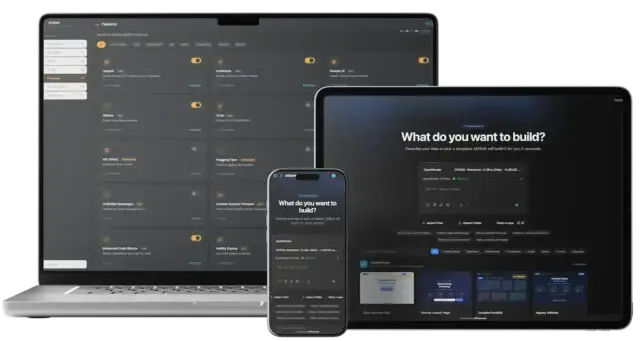
Fundrise Clone App - White-Label Real Estate Crowdfunding & Fractional Investment Platform
A real estate crowdfunding platform built as one operating system rather than a portal bolted onto a spreadsheet. Investors subscribe to shares in a specific asset held in its own SPV, receive rental distributions and resell on a secondary market. Operators underwrite, approve and settle from the same data model.
Three audiences, one platform. A 77-model domain serves an investor web and mobile experience, a full operator console, and a partner portal where developers submit deal pipeline, across 229 API routes with a double-entry ledger underneath.
Go Live in 6 Days with SPV-NativeLedger-BackedMulti-CurrencyLiquidity-ReadyWhite-LabelAudit-Traceable
⚡ Platform at a Glance
1
SPV Per Property
share classes and an append-only owner register
2
Ways to Exit
secondary market listings or scheduled windows
60+
Property Fields
identity, projections, economics and regulatory data
10
Document Suite
including the security handbook and VAPT review
The Operator Console Is the Product
Underwriting, investment committee review, tenancy and rent roll, distribution batching, KYC queues and a full helpdesk. Most platforms in this category leave this half-built.
Hardened Around Your Deployment
The demo runs on sandbox providers and demo defaults. Your build is delivered hardened to your stack: real credentials, signed webhooks and enforced role permissions.
🚀 Ready to launch your own real estate investment platform?




Live in Action
Fundrise Clone Demo - Investor, Operator & Partner Consoles
Don’t just take our word for it. Open the Miracuves Fundrise Clone yourself. Every role has a working login and no setup is required. Follow a funded property from the investor portfolio into the operator console and on to the finance workspace where its distribution is reviewed. A fourth login, compliance@demo.com on the same password, opens the KYC and approval queues if you want to see the maker-checker chain from both sides. The demo instance is seeded and read-only, so you can open every screen but write actions are restricted.
INVESTOR EXPERIENCE
Fundrise Clone - Invest, Hold & Exit
The investor surface. Browse and compare properties, run the calculator, complete KYC, subscribe to shares, hold the certificate, collect distributions and resell on the secondary market.
-
Open the web app in your browser
-
Login with the demo credentials below
-
Explore: Properties, Portfolio, Wallet, Marketplace
-
Try: investor@demo.com | Demo1234!
OPERATOR CONSOLE
Pipeline, Properties, Operations & Exits
The operator surface. Property pipeline and underwriting, investment committee review, tenancy and rent roll, maintenance, marketplace moderation, exit windows, audit and reports.
-
Open the admin console in your browser
-
Login with the demo credentials below
-
Explore: Pipeline, Properties, Operations, Exits
-
Try: admin@demo.com | Demo1234!
FINANCE CONSOLE
Distributions, Withdrawals & the Ledger
The money surface, and the one worth opening if you only open one. Read a distribution batch line by line as gross, tax, fee and net, see the withdrawal approval queue that needs a second actor, and trace the balanced ledger entries behind both.
-
Open the finance console in your browser
-
Login with the demo credentials below
-
Explore: Distributions, Withdrawals, Ledger, Fees
-
Try: finance@demo.com | Demo1234!
PARTNER PORTAL
Developer Pipeline & Deal Tracking
The supply side. A developer sees their properties moving through pre-listing, almost-funded and active, with target capital, committed capital, investor counts, yields and due-diligence status on each one.
-
Sign in, then open /partners/dashboard
-
Use the investor demo login below
-
Explore: Pipeline, Deal Cards, Due Diligence
-
Try: investor@demo.com | Demo1234!
Watch It Work
Fundrise Clone Video Demo: Subscribe, Allocate, Distribute & Exit
A walkthrough of the platform as an operator sees it, rather than a feature reel. It opens on a property in the catalogue with its SPV and share class visible, follows an investor through KYC, the subscription agreement and an order, and shows the order sitting payment-pending until settlement confirms it, creates the allocation, appends ownership and issues the certificate. It then moves to the operator console for the part that matters commercially: a distribution batch aggregating rent and expenses into gross, tax, fee and net lines, passing compliance review and finance approval, and executing into balanced ledger entries with statements attached. The secondary market is shown from both sides, a listing with its investment memo and an exit window with its eligibility checks. If a specific flow matters more than the tour, ask and we will open it live with data in it.
Every Screen Mapped
Fundrise Clone App Flows - Investor, Operator, Partner & Mobile Screens
The interface across the surfaces that matter: property catalogue with comparison and calculator, property detail carrying SPV and share class, valuation history and due-diligence documents, the onboarding and KYC path, the order and subscription agreement flow, the portfolio with holdings, certificates and performance analytics, the multi-currency wallet, the secondary marketplace with its investment memo, and the operator console across its thirty-odd workspaces.

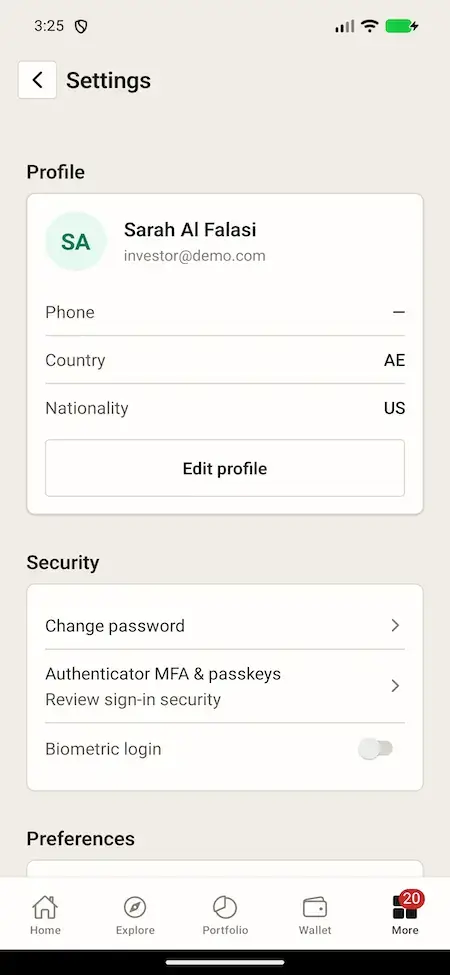
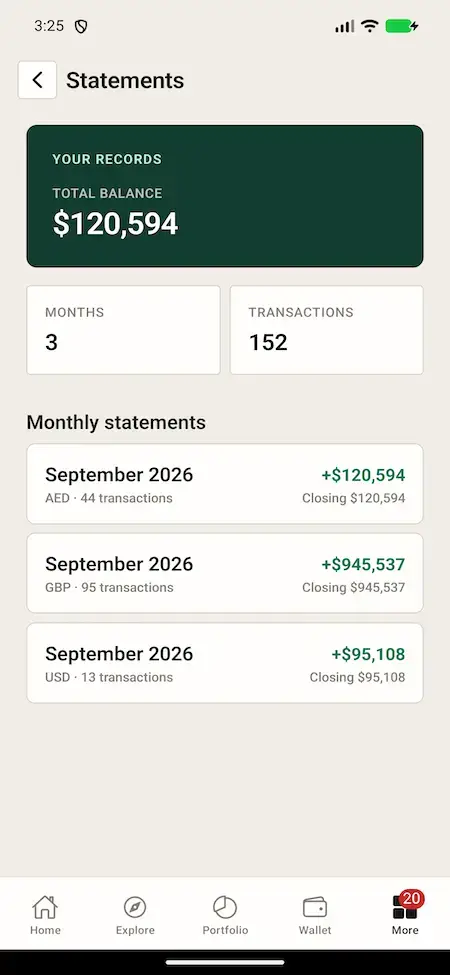
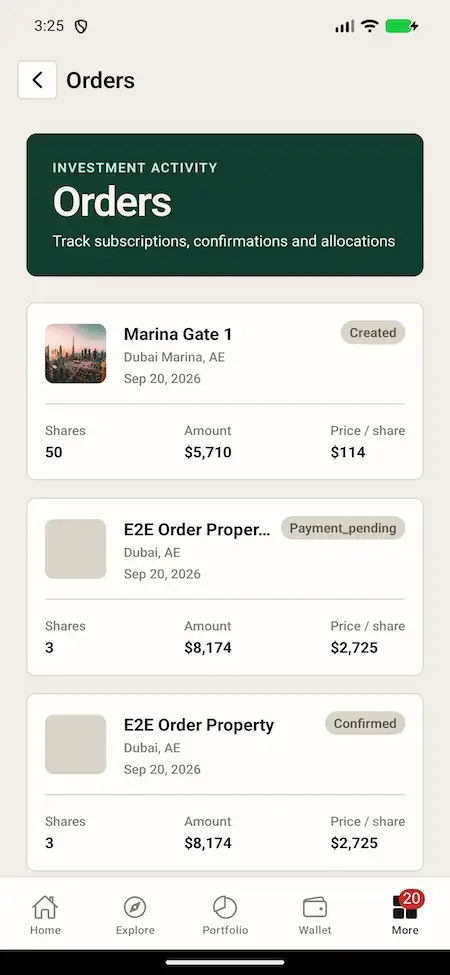
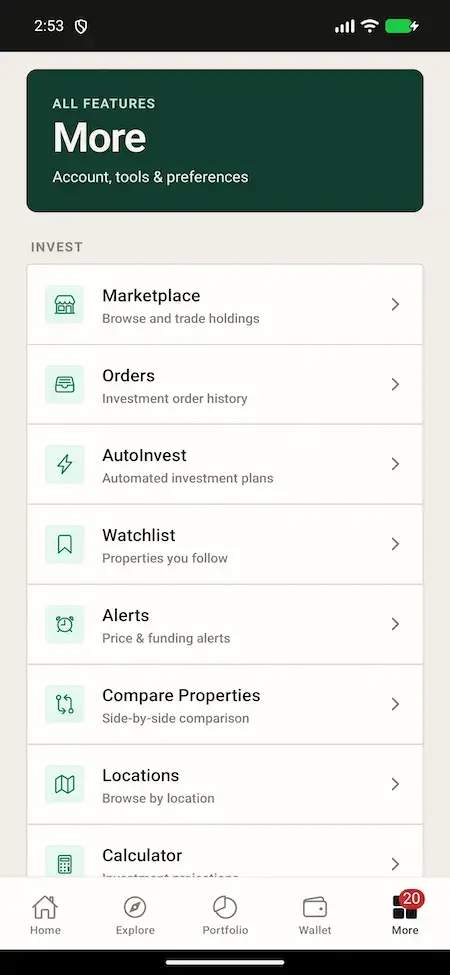
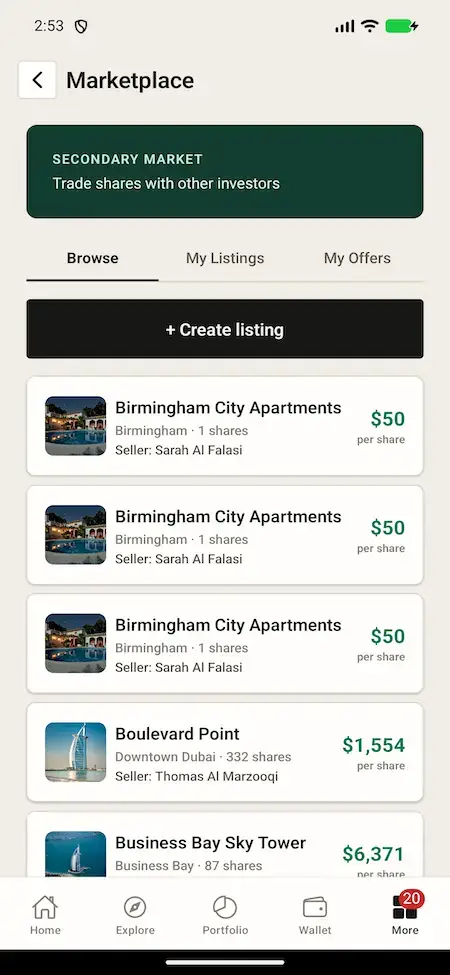
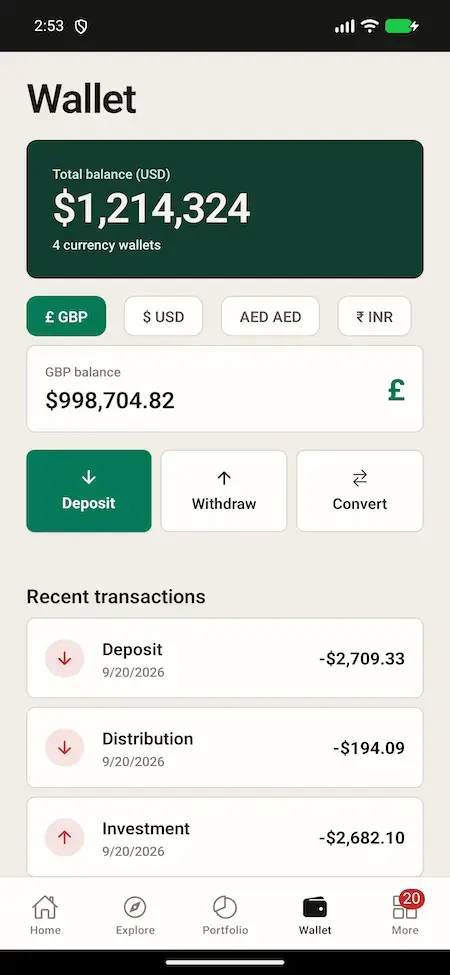
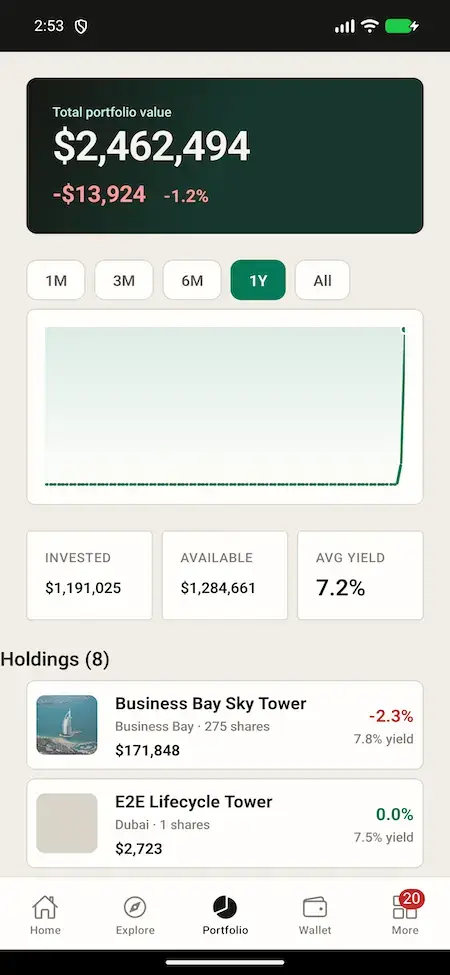
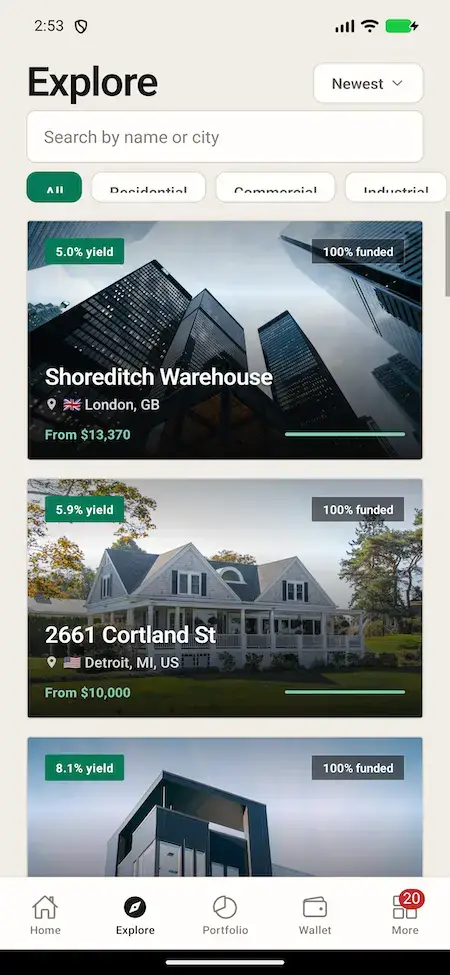
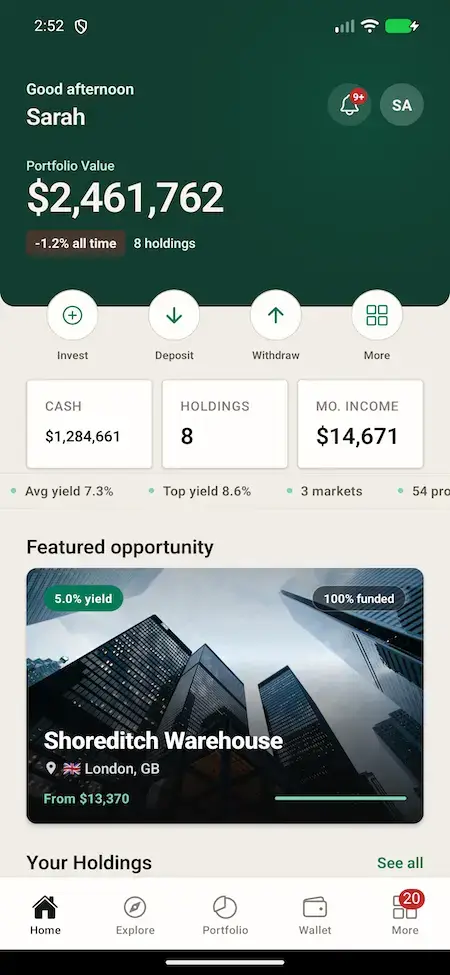
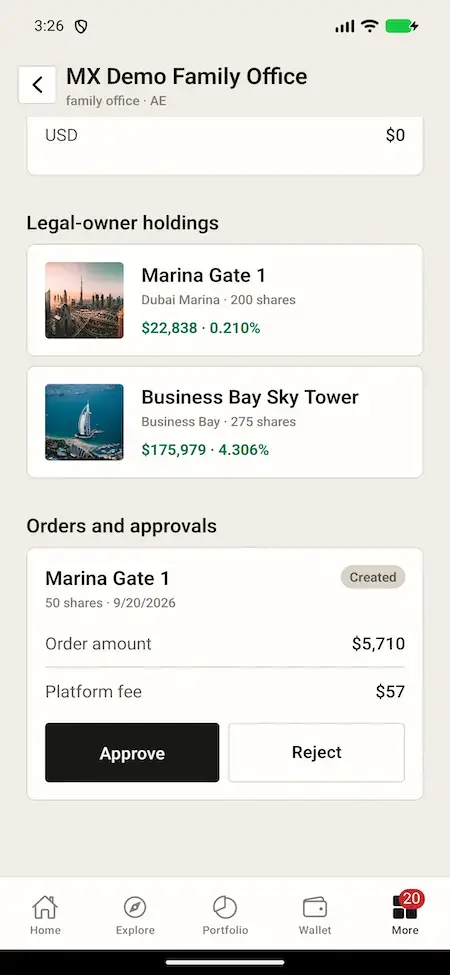
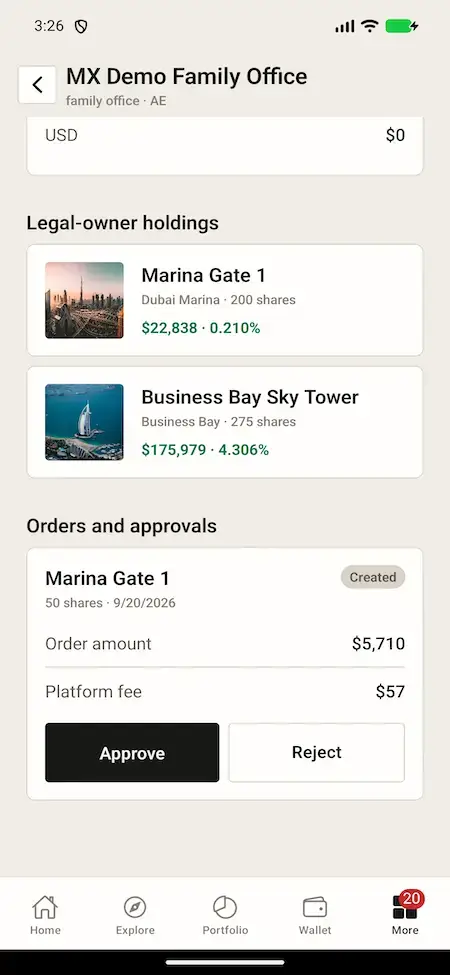
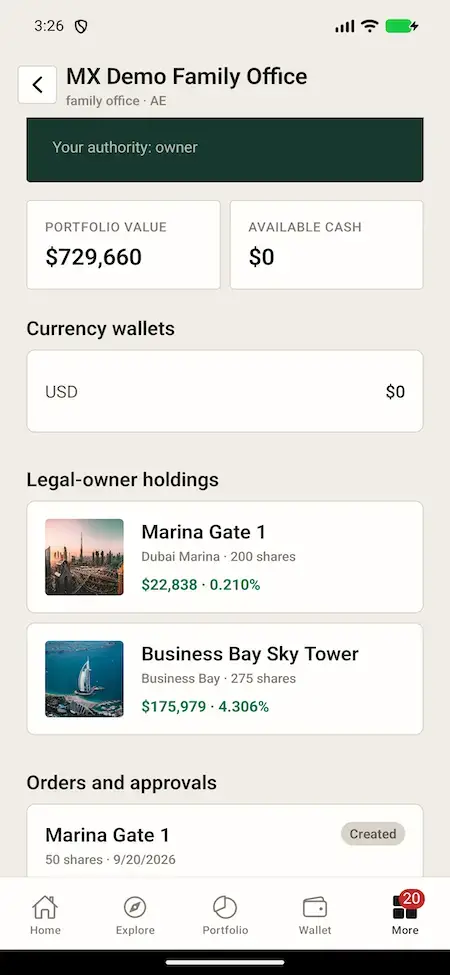
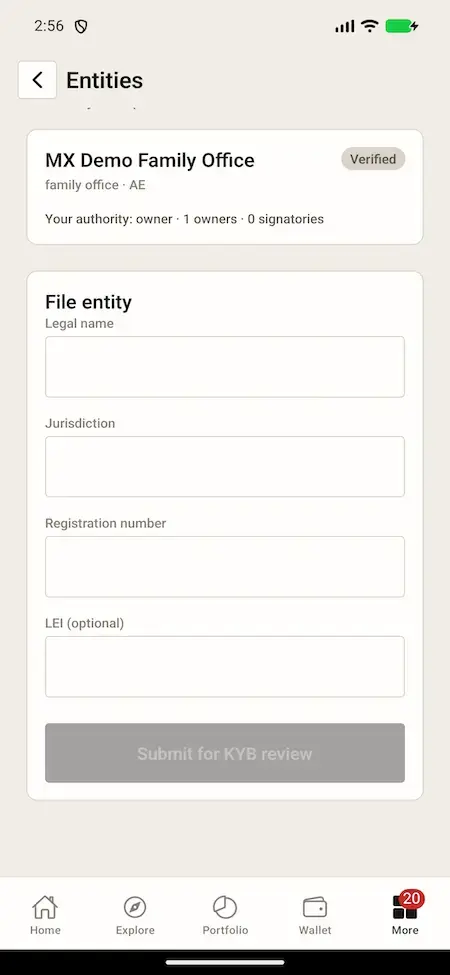
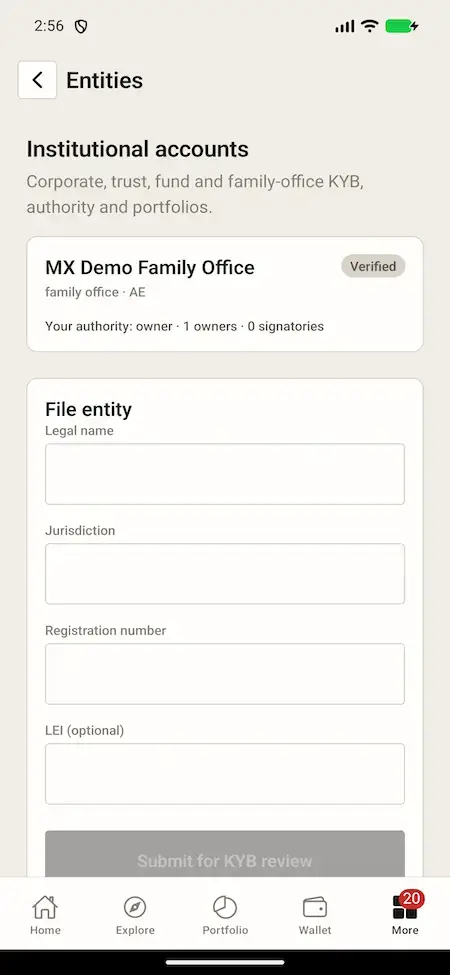
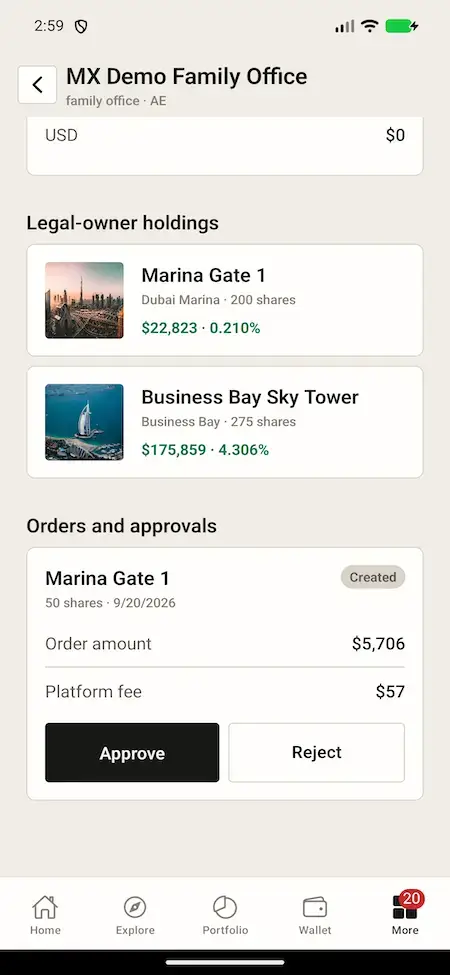
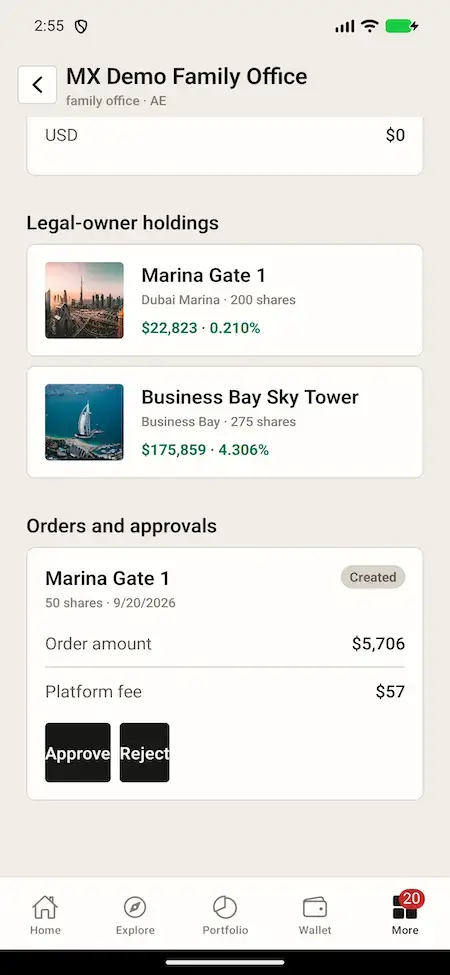
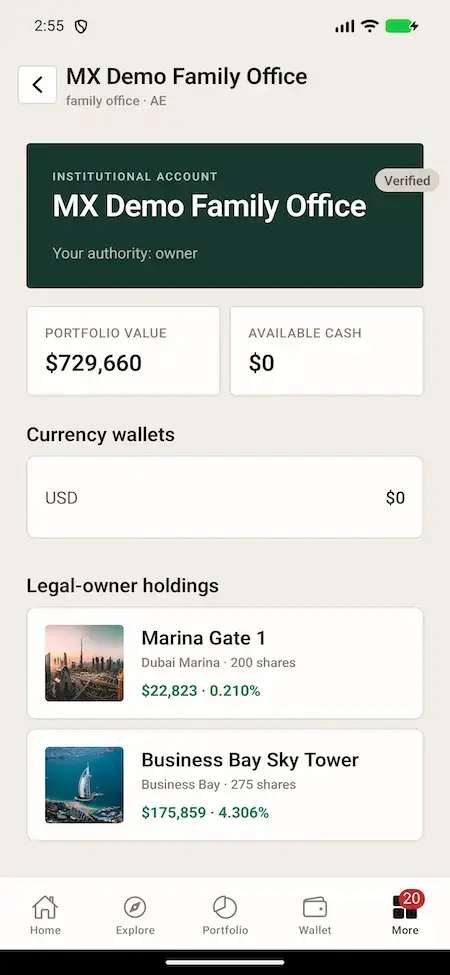
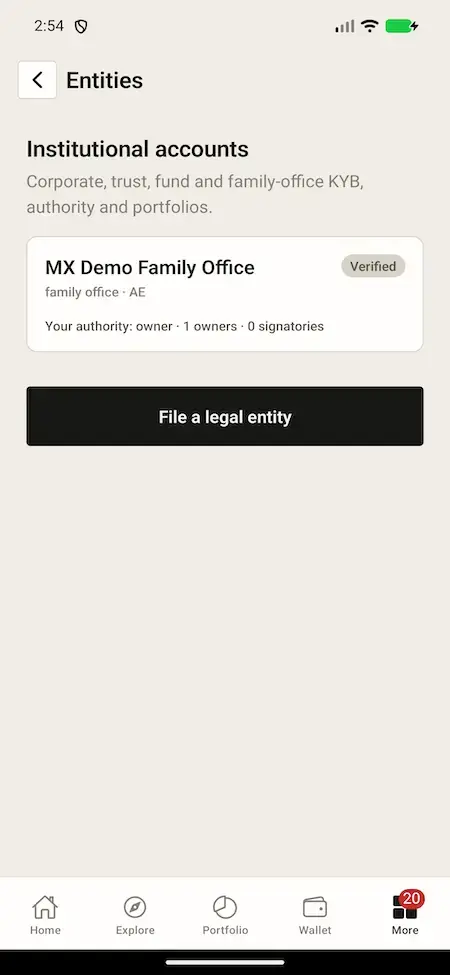
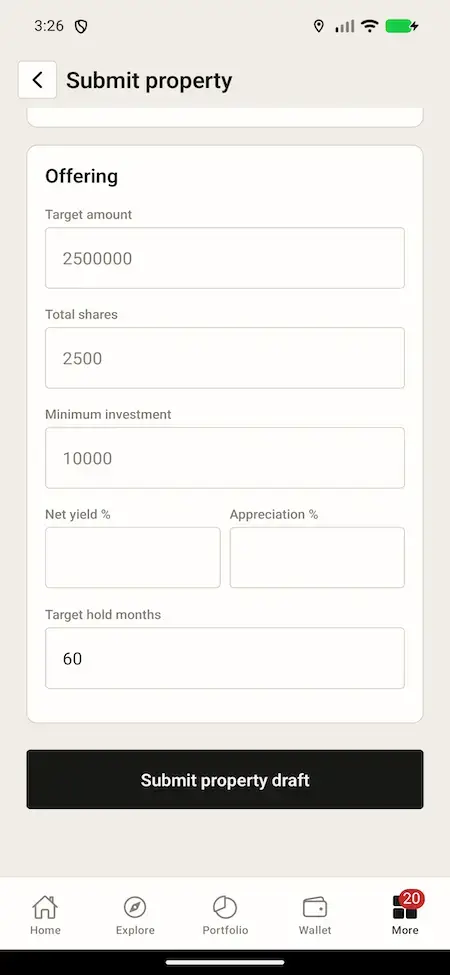
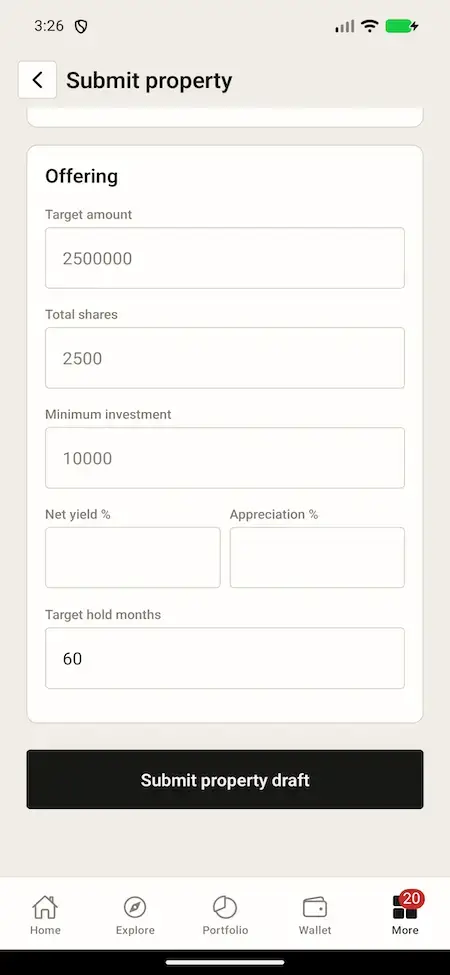
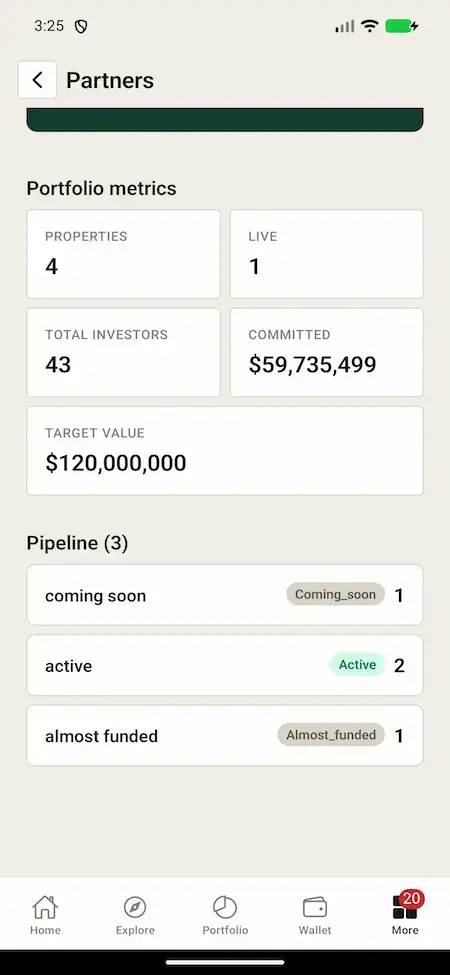
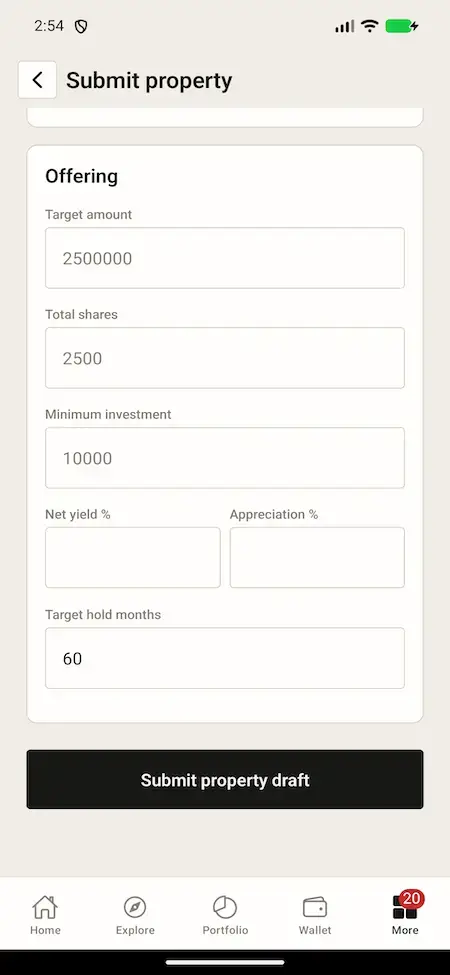
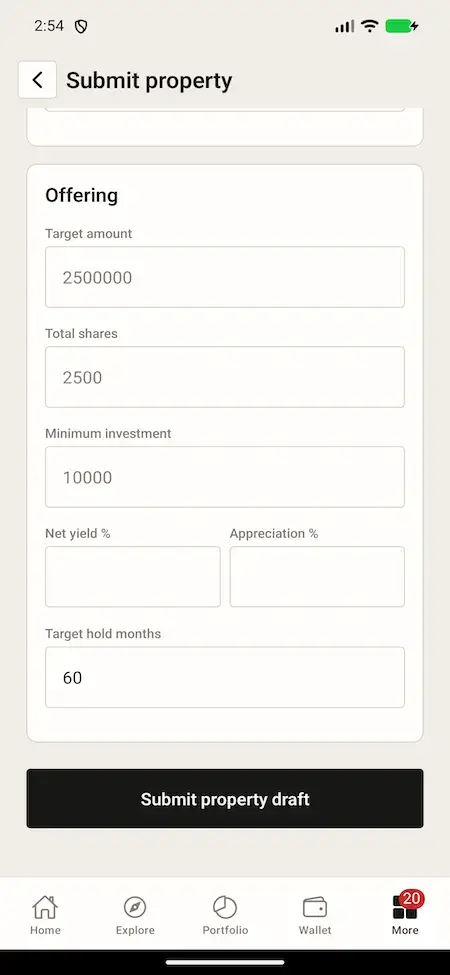
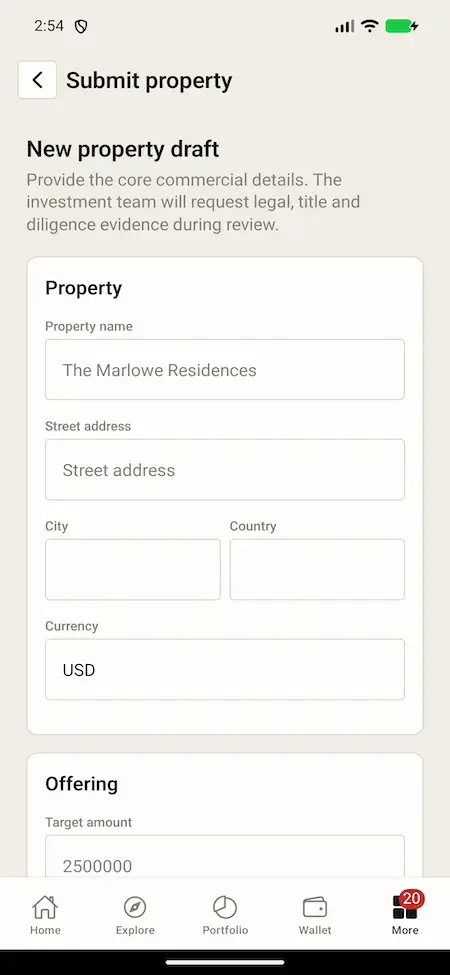
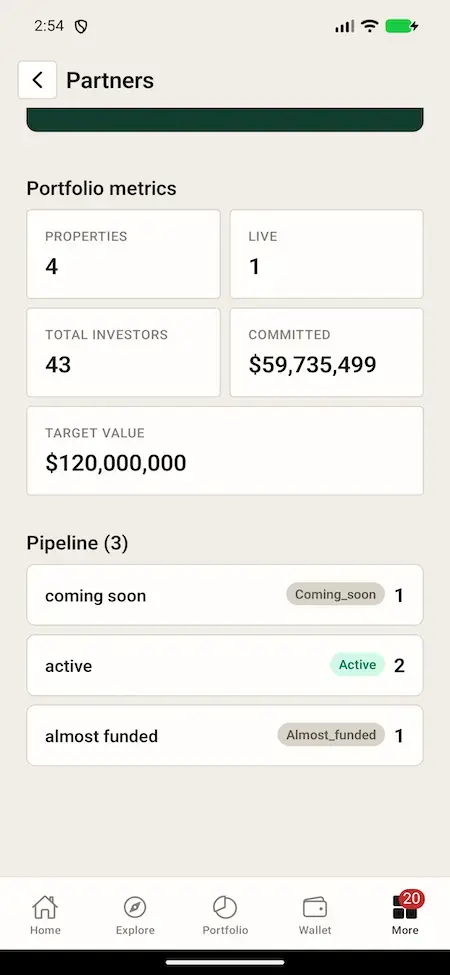
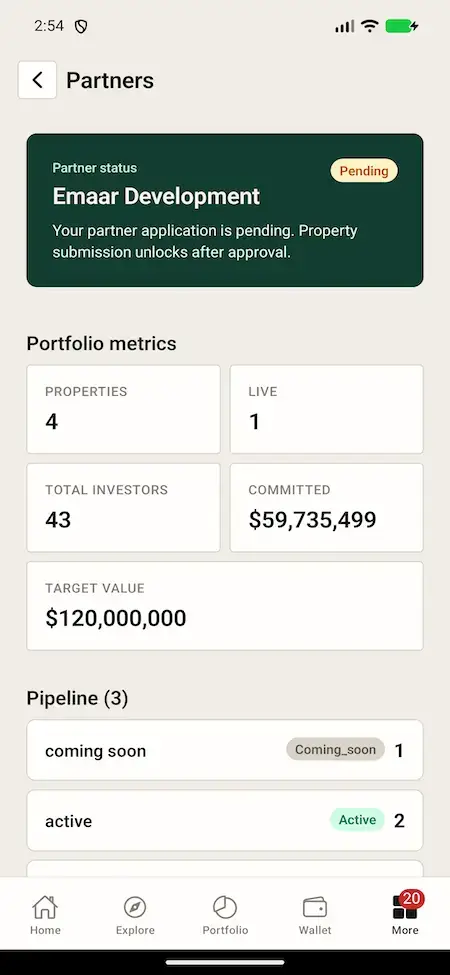
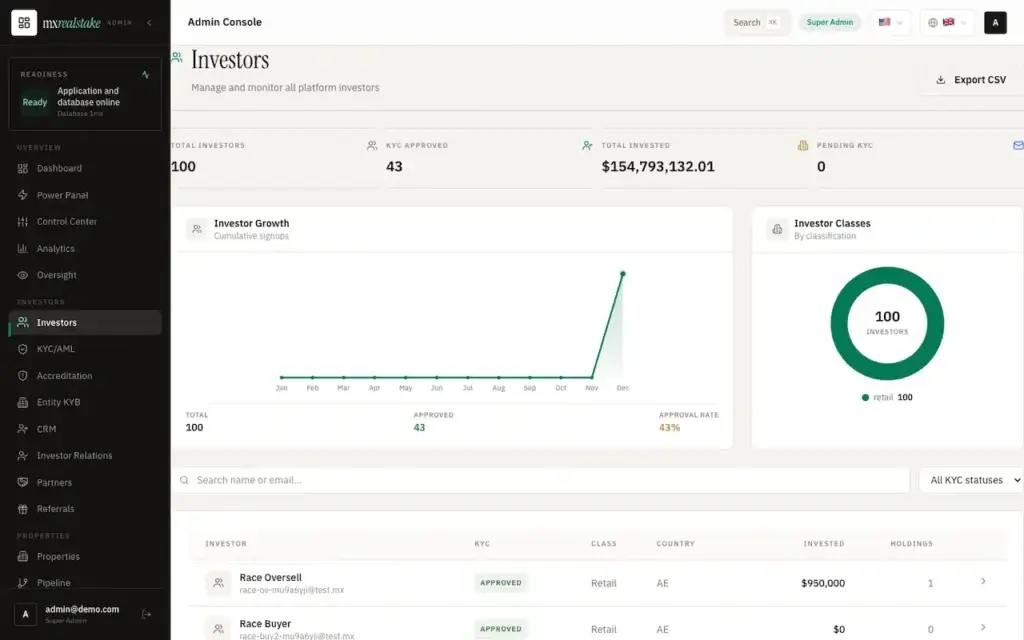
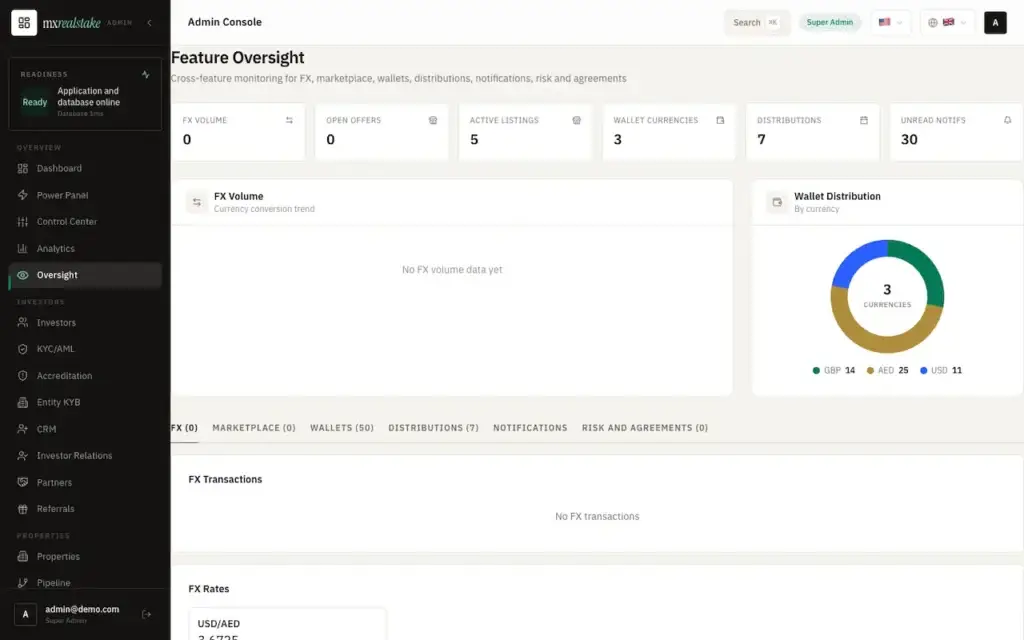
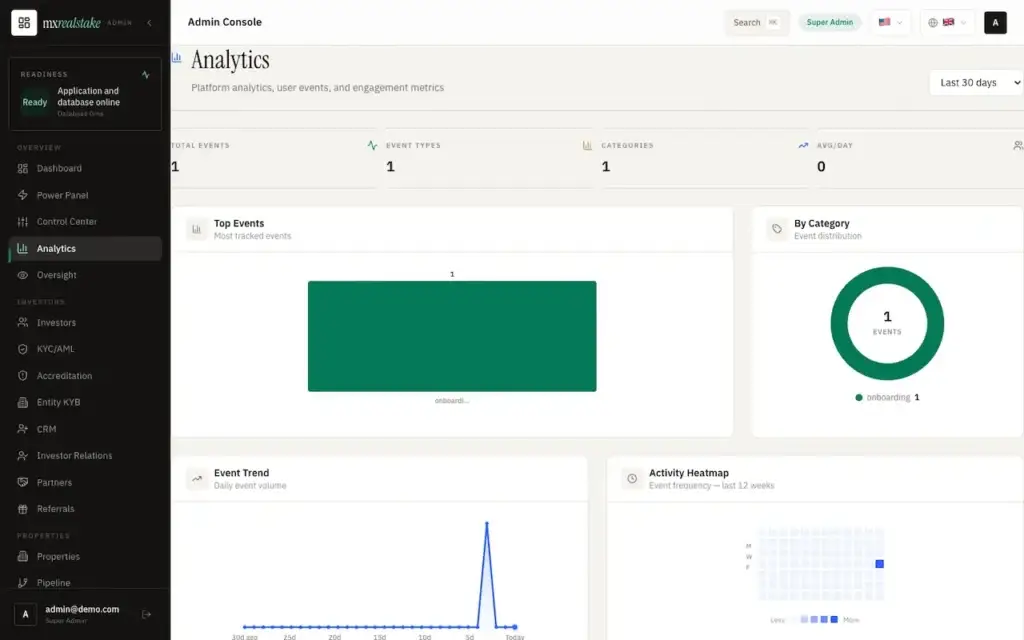
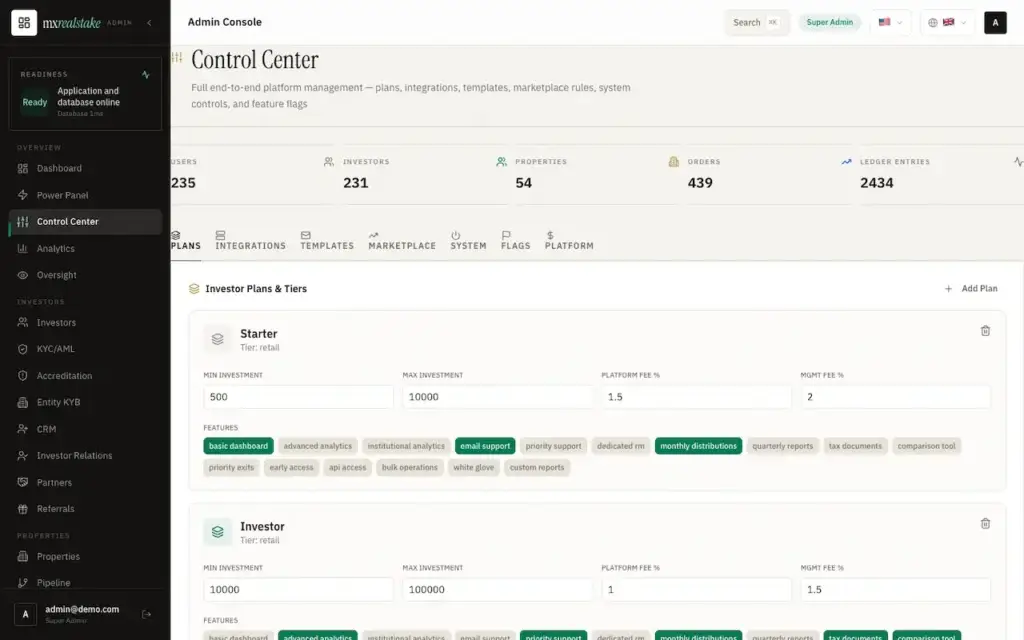
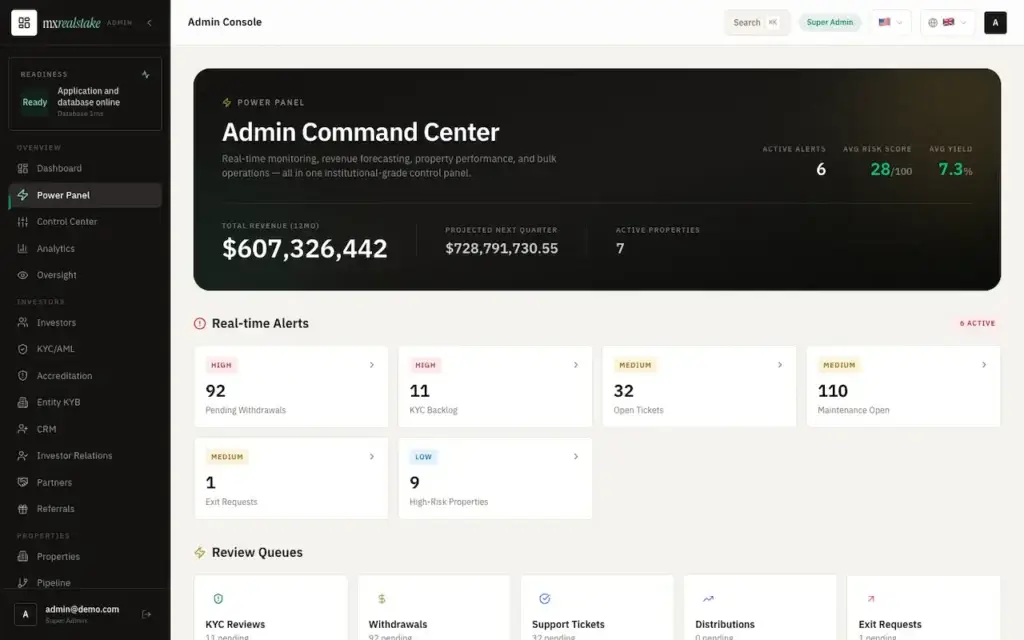
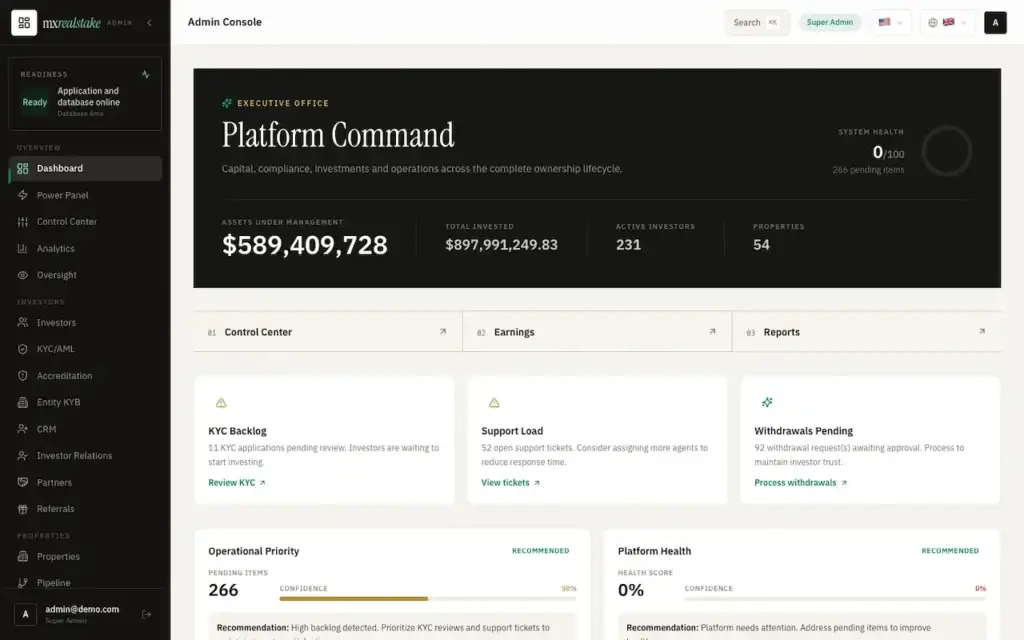
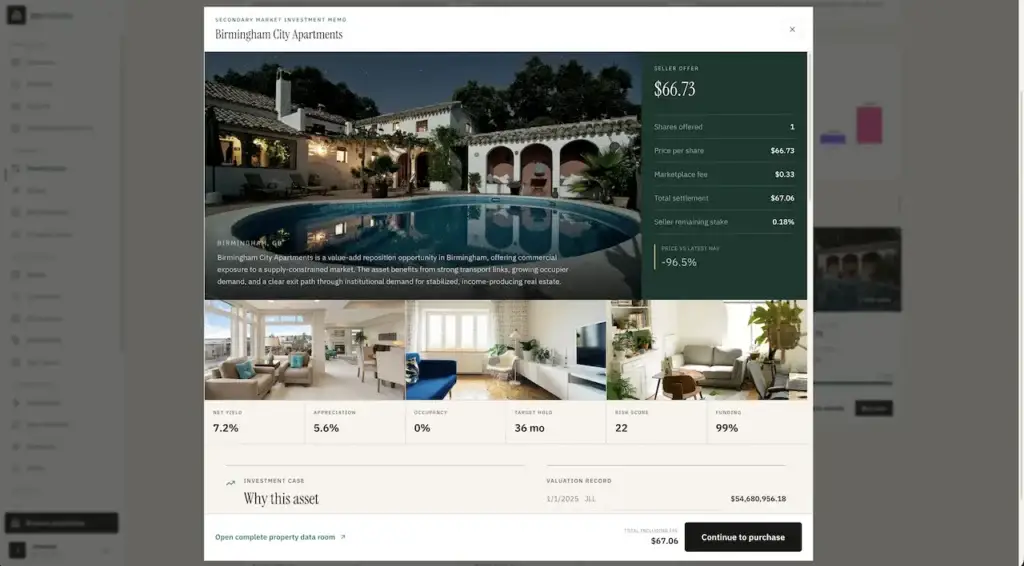
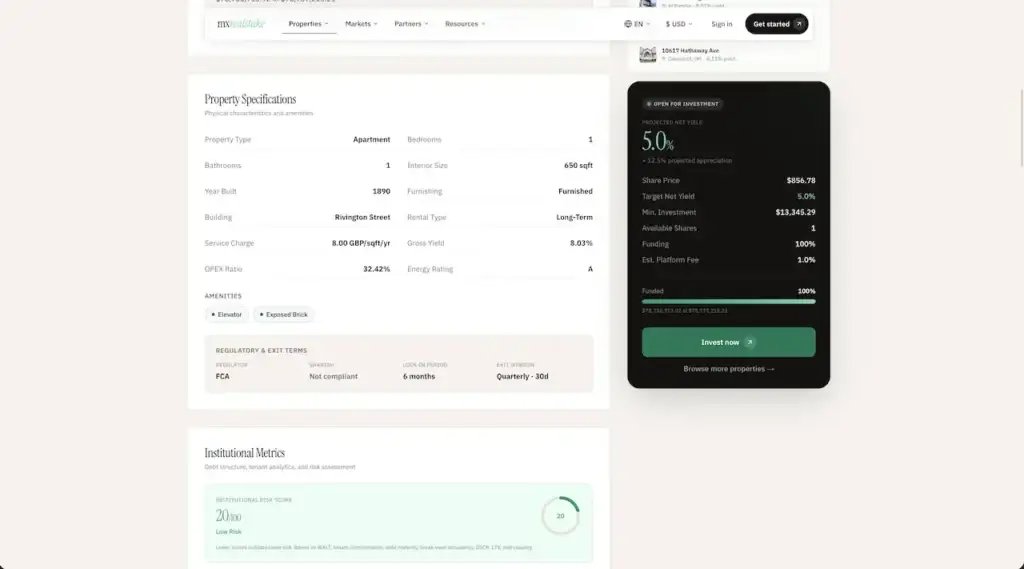
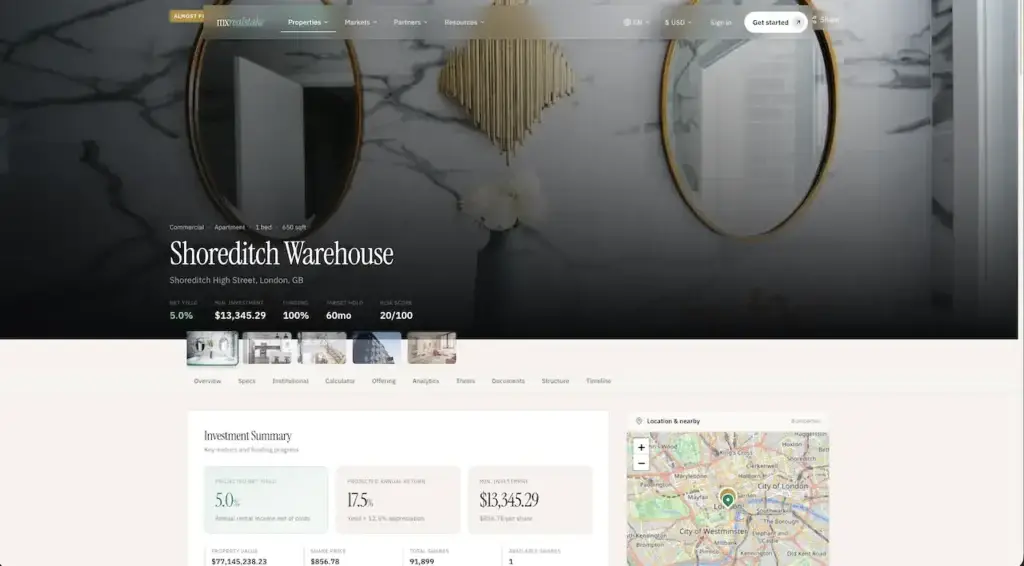
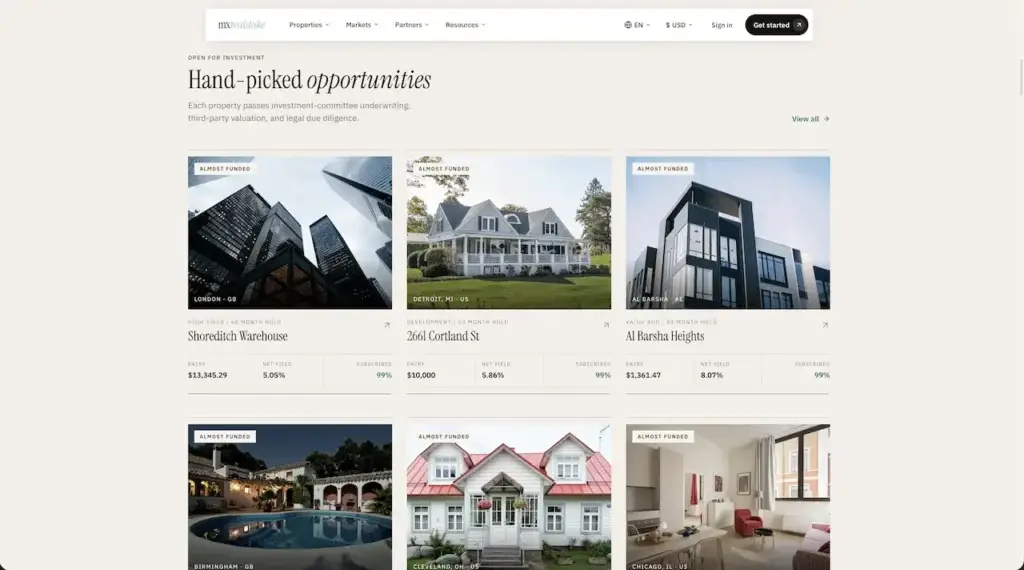
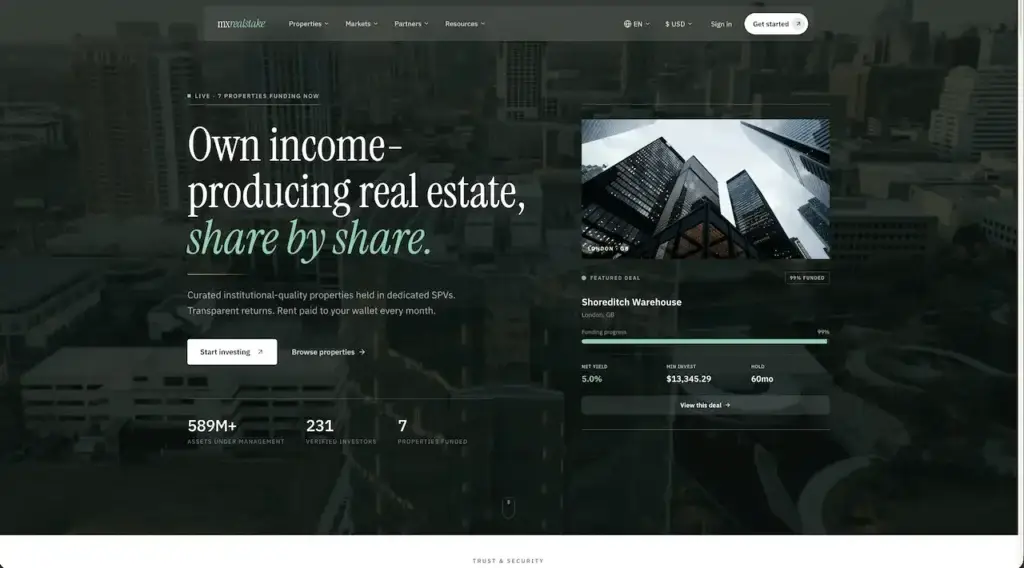
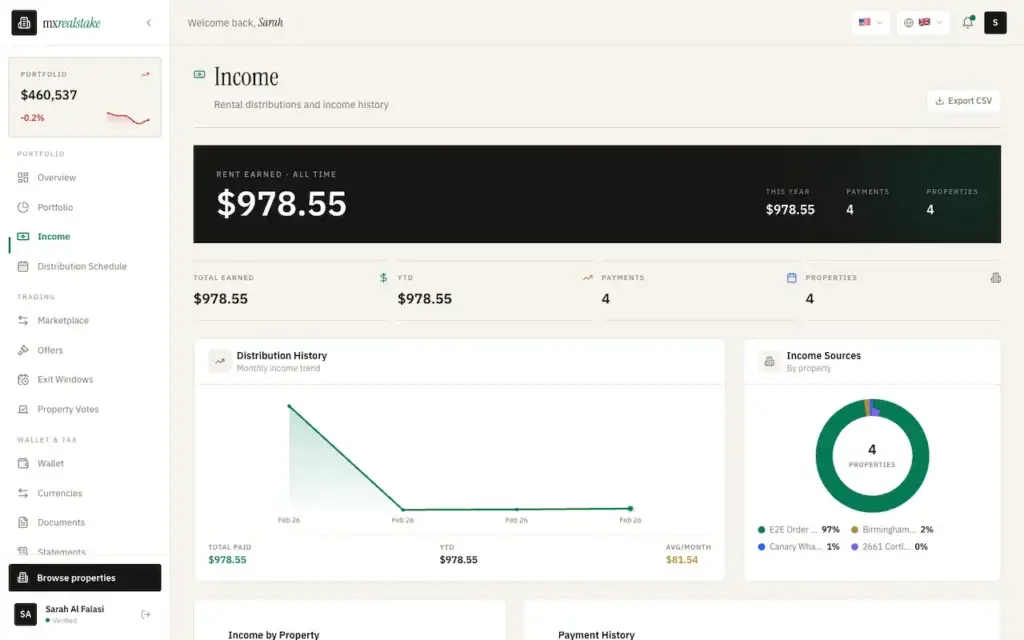
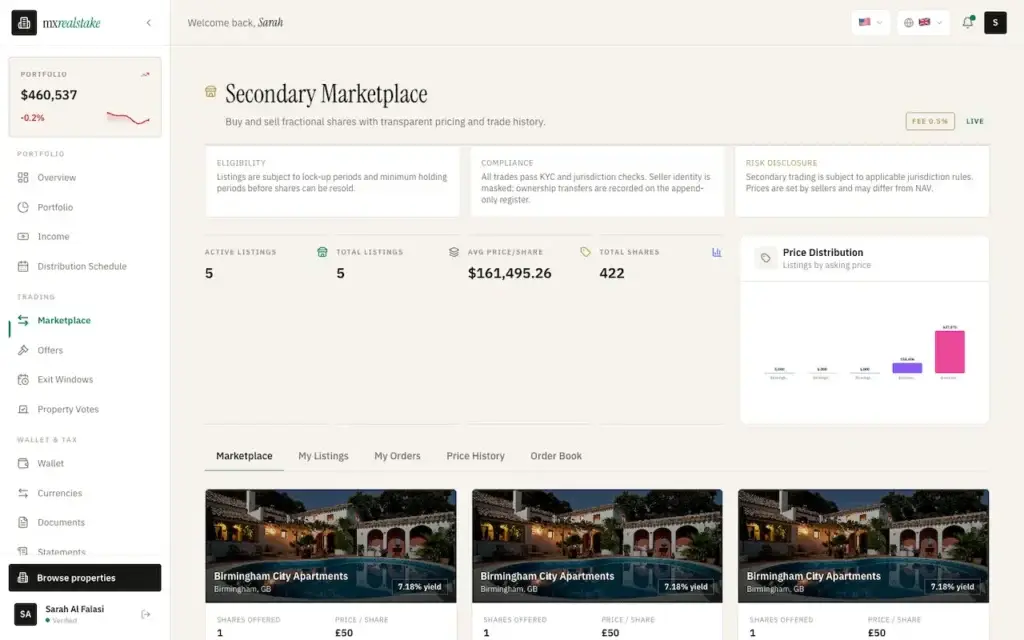
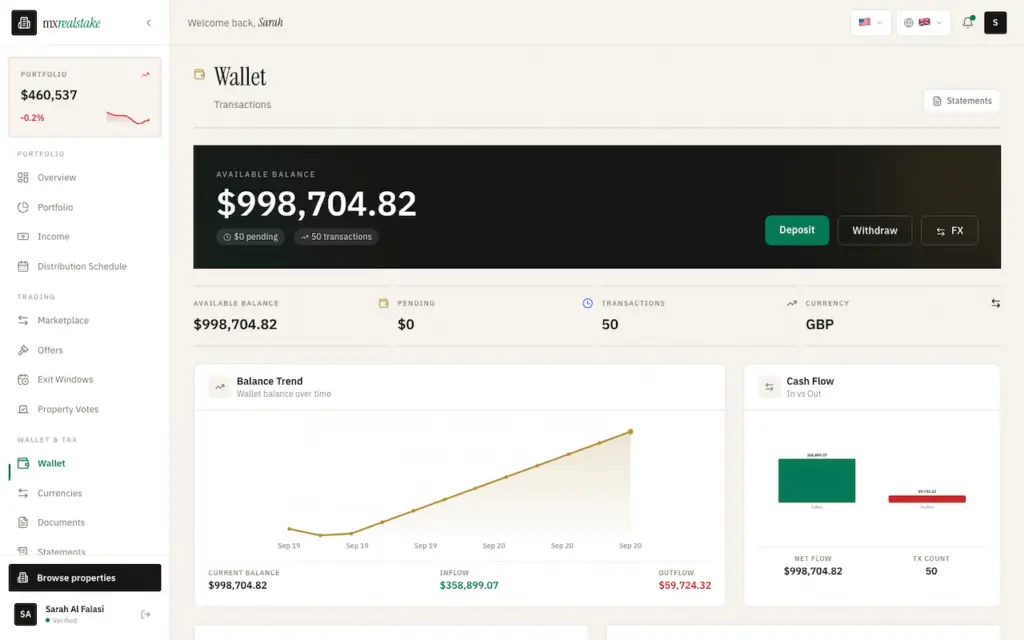
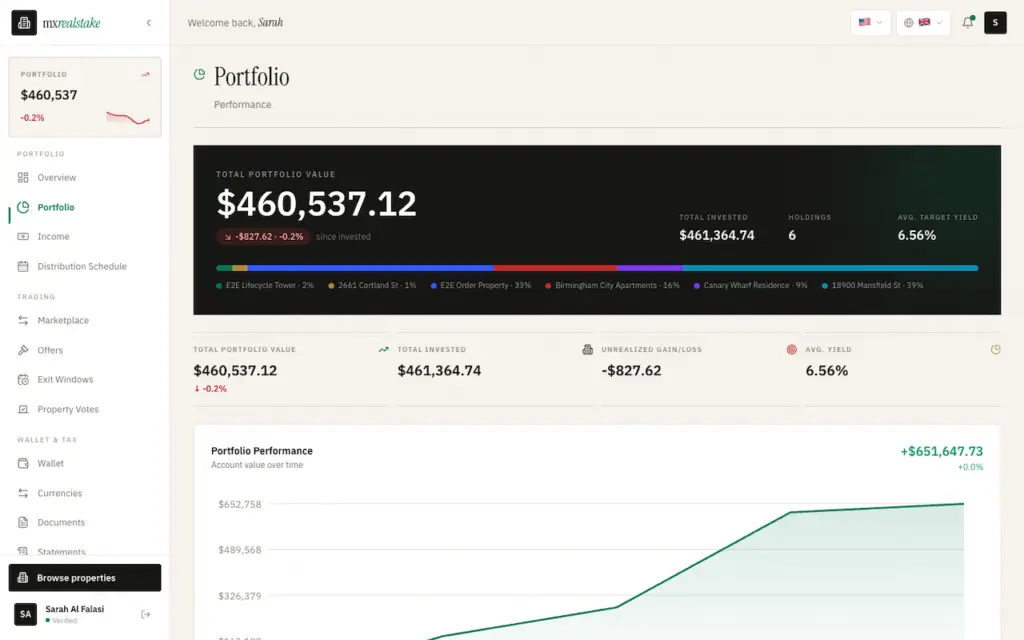
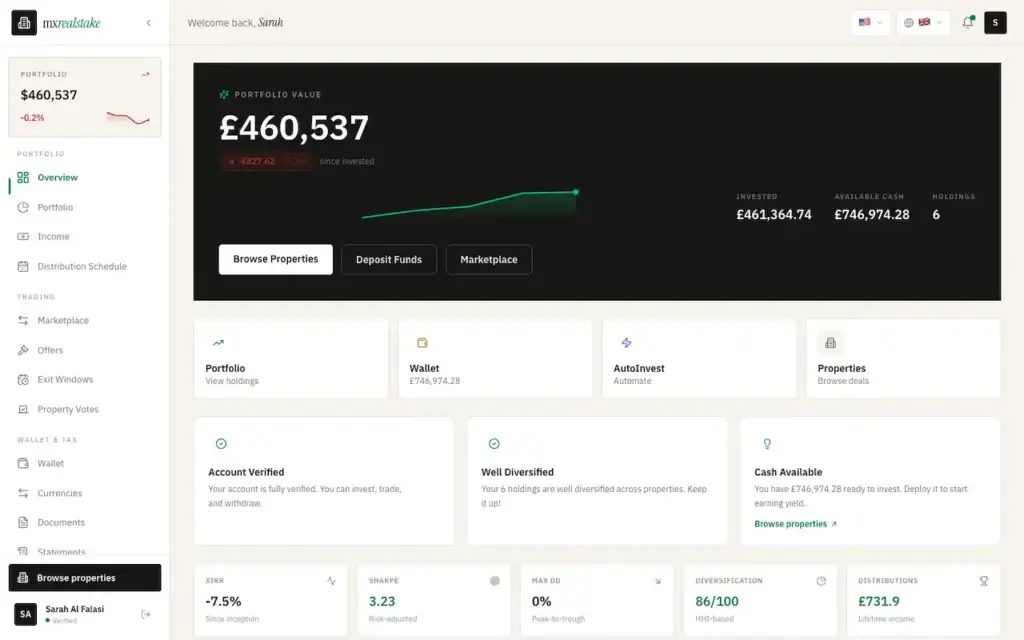
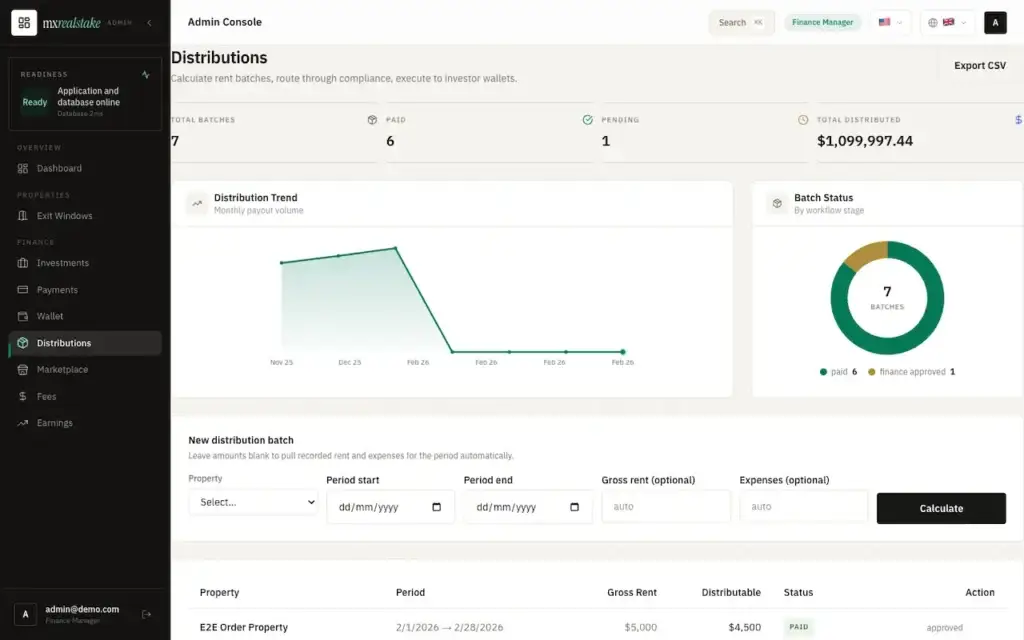
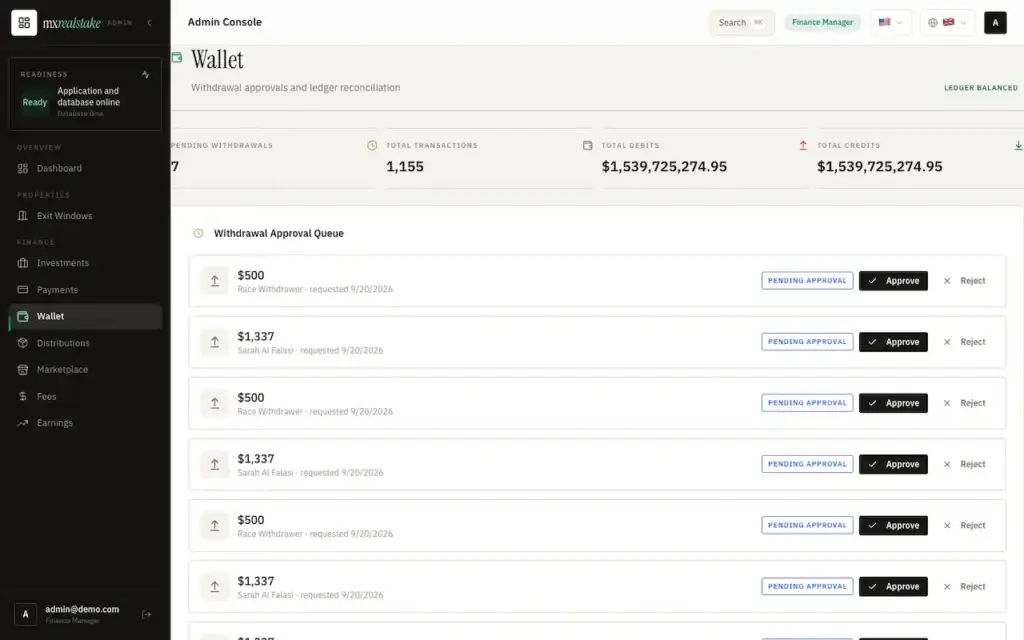
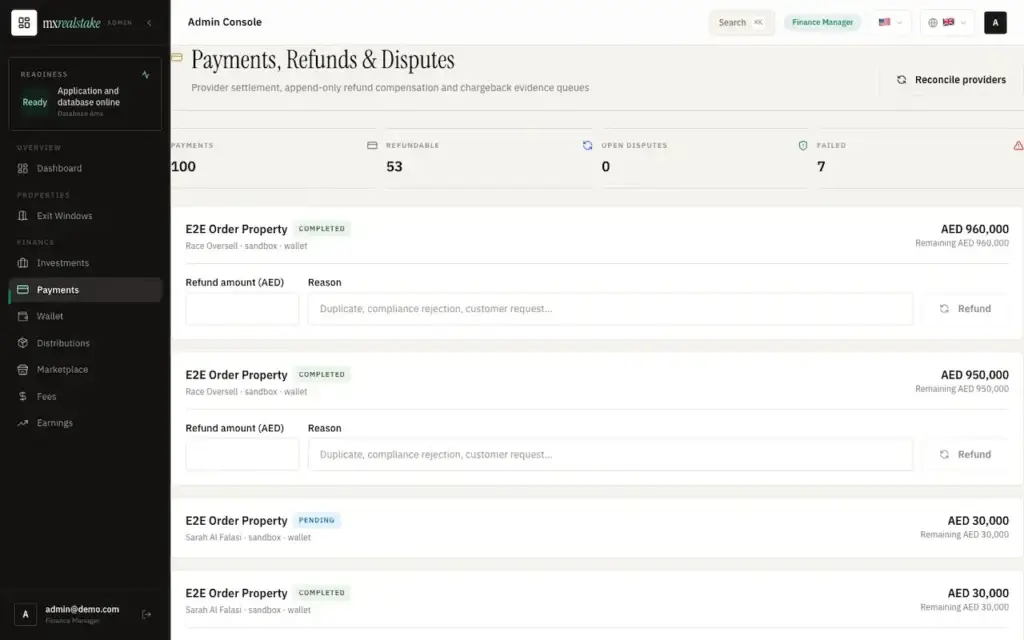
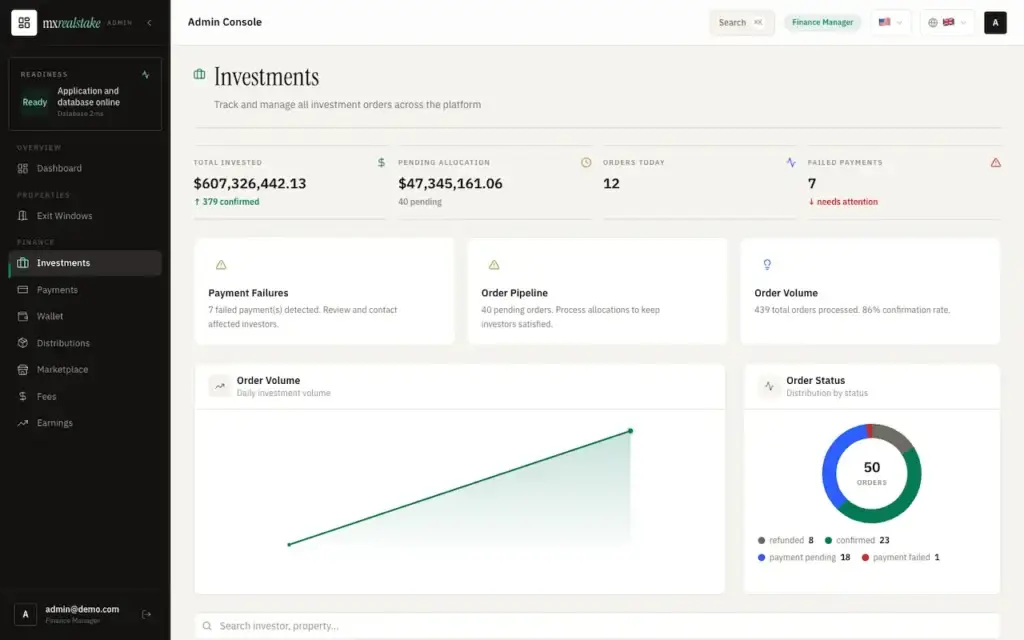
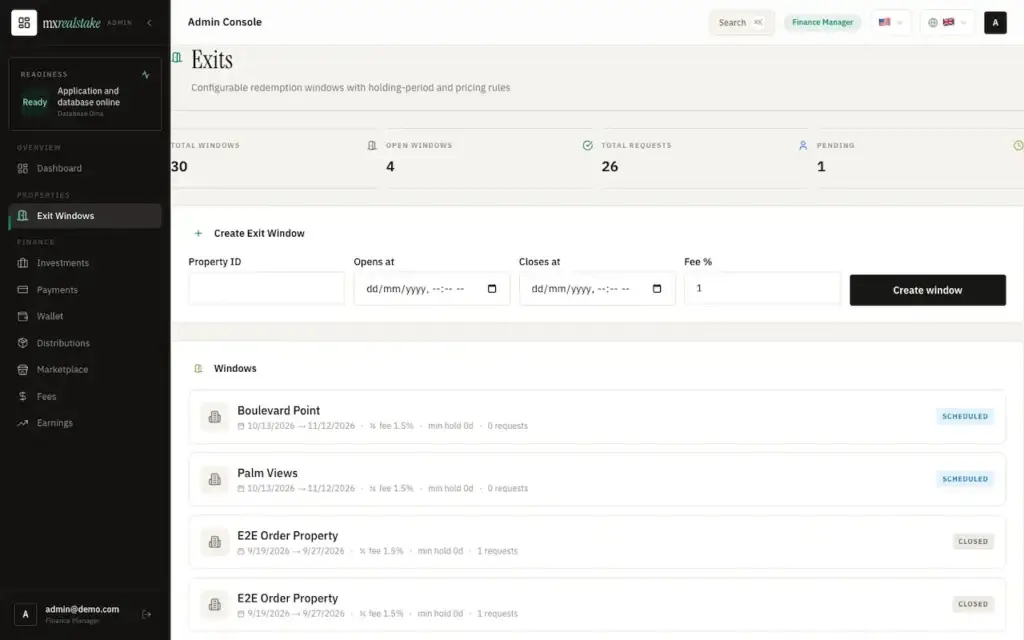
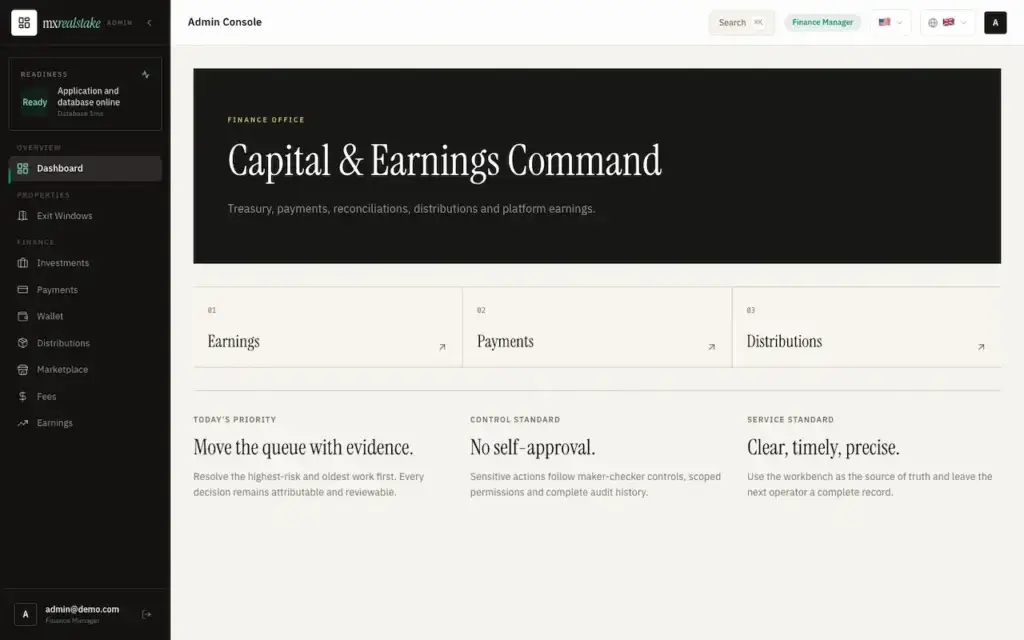
Follow an investor from a first property view through KYC, an order and a distribution, an operator from a partner submission through underwriting and investment committee review to a funded property, and a compliance officer from a KYC case to an approved accreditation. Web carries the full experience and the Expo mobile app covers the investor journey with broad API parity. Want a guided walkthrough of a specific flow? Book a call and we will open the surface you care about with live data in it.
Straight Answers
Fundrise Clone Deployment References - What the Platform Actually Does
There is no fractional real-estate deployment in the Miracuves portfolio yet, so rather than dress this platform in borrowed proof, the statements below are properties of the build, each demonstrable in the live demo above.
Illustrative Scenario
Fundrise Clone Modelled Reference - Fractional Real Estate Deployment
A modelled reference deployment showing how the Miracuves Fundrise Clone is configured for a multi-jurisdiction fractional property operator. This is not a client engagement and the figures are properties of the platform rather than results reported by a customer.
Multi-Jurisdiction
Fractional Real Estate Operator
How this platform is configured for an operator raising retail capital into property SPVs, where the ledger has to reconcile and the regulator will eventually ask for the beneficial-owner list.
- Cap tables kept in spreadsheets that no auditor can follow
- Distributions calculated by hand across multiple files and reconciled by hope
- Investors locked in with no way out until the asset is sold
- A double-entry ledger where every money movement posts to an account
- An append-only ownership register that answers the beneficial-owner question
- A secondary market so liquidity does not depend on a whole-asset sale
- Property-level SPVs and share classes, not a pooled blind fund
- Distribution batching with compliance and finance approval before execution
- Eight locales including Arabic with full right-to-left layout
- Underwriting, investment committee review and a partner deal pipeline
- Configured for UAE, US and UK with AED, USD and GBP
This is a modelled reference deployment, not a client engagement. Every capability listed above ships in the base build and is demonstrable in the live demo. The figures are properties of the platform, not results reported by a customer.
The Basics
What Is a Fundrise Clone App?
A Fundrise Clone is a ready-made real estate crowdfunding platform. Investors put small amounts into property they could not buy outright, receive rental income and eventually a share of the sale. The platform handles the parts that make this category genuinely hard: holding ownership in a register an auditor can follow, moving money through a ledger that reconciles, and proving to a regulator who owns what.
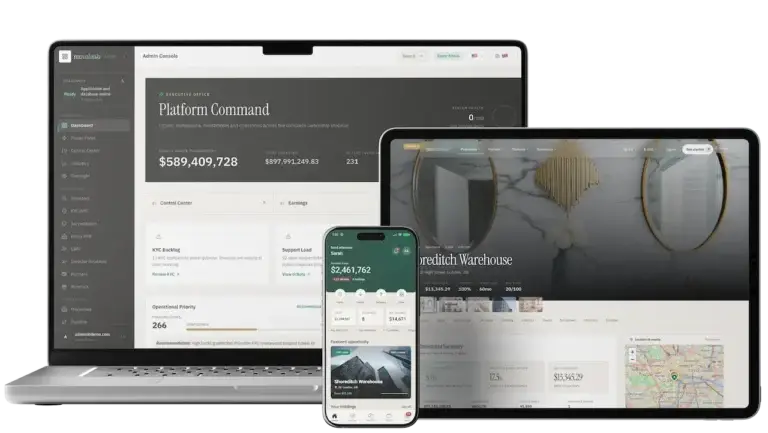
Not a Listing Site
A property portal shows you buildings. This settles subscriptions, issues ownership, pays distributions and reconciles a ledger. The listing page is the smallest part of the system.
Not a Fund Administrator
You own the whole stack rather than renting fund administration. The SPV, share class, ownership register and ledger are yours, on standard PostgreSQL, with no per-investor fee to a third party.
Not a Demo Dressed as a Product
The platform is fully built and fully documented, down to an ERD, an API collection and a security review. What a demo instance runs on sandbox settings, your deployment runs on your own providers, hardened during delivery.
Built for Web, Mobile & Operators
What Is a Real Estate Crowdfunding Script?
The difficulty is never the property listing page. It is the cap table, the distribution run, the KYC file and the beneficial-owner question. Those are the parts already built here.
-
Property-level SPVs with share classes
-
Double-entry ledger with derived balances
-
Secondary market and scheduled exit windows
-
KYC, accreditation and investor-class gating
-
Operator console with maker-checker approvals
Where this build differs from Fundrise itself is the structure. Fundrise pools investors into funds. This platform gives investors shares in a specific property held in its own SPV, with a share class, a certificate and a secondary market to sell into. That is closer to how Stake, Arrived and Property Partner operate, and it is the more flexible base to launch from.
Everything Included
Fundrise Clone Features - Investing, Ledger, Liquidity, Compliance & Operations
Every capability below is built and demonstrable in the live demo. The documentation labels 127 capabilities as available, 39 as configuration required and 30 as integration required, and where a feature needs a third-party account, a deployment decision or pre-launch hardening, that is stated against the feature rather than implied away.
Property-Level SPVs
Each asset sits in its own vehicle with share classes, so investors buy into a named property rather than a blind pool, and the legal structure is visible on the detail page.
- Property catalogue, detail, comparison up to four
- Investment calculator with local projections
- Location-led discovery by country and city
- Track record, academy content and CMS pages
Append-Only Ownership Register
Ownership is appended, never overwritten, which is what lets you answer a beneficial-owner request without reconstructing history from three systems.
- Email and passkey login with database-backed sessions
- TOTP multi-factor with backup codes
- WebAuthn passkey registration and authentication
- Device registration and push token association
Double-Entry Ledger
Integer minor units, balanced entries on every movement, derived balances and compensating corrections, so distributions and wallets reconcile against the bank.
- Case-based KYC with Sumsub and Onfido seams
- Accreditation submission, review, expiry and history
- Risk questionnaire and suitability profile
- Investor class: retail, accredited, professional, institutional
Order Flow With Idempotency
Subscription orders carry idempotency keys and emit outbox events, so a retried request cannot create a second allocation.
- SPV and share-class presentation on every property
- Valuation history with methodology and valuer
- Due-diligence document association
- Underwriting with bear, base and bull scenarios
Distribution Batching
Rent and expenses aggregate into gross, tax, fee and net lines, pass compliance and finance approval by different actors, then settle through the ledger with statements.
- Subscription agreement signing and evidence
- Order flow with idempotency keys
- Allocation, ownership append and certificate issue
- Operator-configurable minimums and eligibility gates
Secondary Marketplace
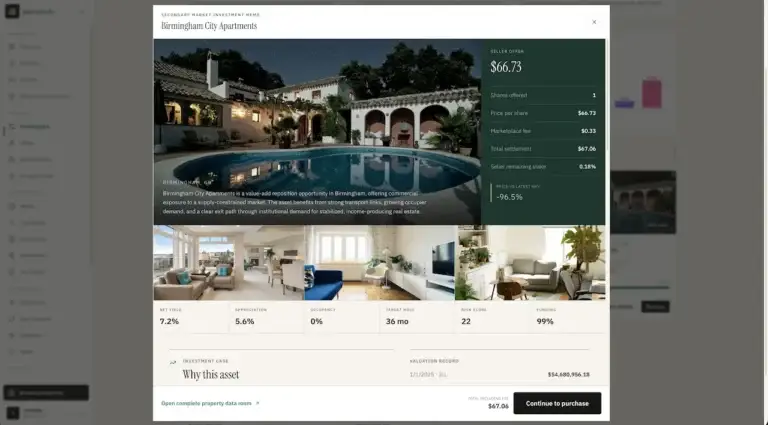
Listings, negotiated offers and atomic ownership transfer, gated behind an investment memo showing premium or discount to latest NAV before checkout.
- Multi-currency wallets with ledger-derived balances
- FX quote and conversion with bounded rate cache
- Deposit and withdrawal workflows
- Plaid bank verification seam
Exit Windows
Operator-scheduled redemption windows with pricing method, fees, holding-period checks and settlement that credits proceeds and burns ownership.
- Distribution batching with gross, tax, fee and net lines
- Compliance review then finance approval then execution
- Tax withholding data path and statements
- Balanced ledger settlement with investor notification
Sale Governance
Whole-property sale proposals with one vote per investor, weighted by shares, kept separate from marketplace trading.
- Secondary marketplace with listings and offers
- Investment memo required before checkout
- Scheduled exit windows with eligibility checks
- Whole-property sale proposals with weighted voting
Underwriting & IC Review
Assumptions with bear, base and bull outputs, then an independent investment committee decision recorded as its own evidence.
- AutoInvest and rent reinvest plans
- Watchlists and price alerts
- Referral codes, rewards and sharing
- Goal planning and portfolio projections
Property Operations
Tenancies, rent receipts, expenses, valuations and a nine-state maintenance workflow, so the asset is serviced in the same system that raised the capital.
- Portfolio analytics: Sharpe, Sortino, volatility
- Maximum drawdown and XIRR
- Diversification by type, geography and currency
- Unified activity feed and tax summaries
Compliance Workspace
KYC and accreditation queues, investor 360, audit search and maker-checker approvals on the money paths.
- Tenancy, lease and rent-roll management
- Rent receipt and expense logging
- Maintenance requests with a nine-state workflow
- Property operations dashboard
Multi-Currency & Locale
AED, USD and GBP with configured country profiles, plus eight interface locales including Arabic with full right-to-left layout.
- CRM with leads, stages, contact log and tags
- Helpdesk with SLAs, queues, macros and CSAT
- Announcements, messages and knowledge base
- Eight locales including Arabic right-to-left
Note for buyers: The platform ships complete as software, and every deployment is tailored to the operator. Your own provider accounts connect during delivery: KYC through Sumsub or Onfido, payments through Stripe, Razorpay or NOWPayments, Plaid for bank verification, S3 or GCS for storage, plus email, push and SMS. Sanctions and PEP screening, native mobile document capture and your jurisdiction tax rules are scoped to your market rather than guessed at. Tell us where you are launching and we will map exactly what connects.
How Operators Earn
Fundrise Clone Revenue Models - Fees, Spreads, Carry & Tiers
A fractional property platform earns across the whole holding period rather than at one transaction, and the fee engine models each stream separately so an operator can tune one without disturbing the others.
Platform Fees
Charged on subscription into a property, the most predictable line because it scales directly with capital raised rather than with behaviour.
Management Fees
Recurring fees accrued from ownership on a schedule, which is what turns assets under management into a compounding revenue base.
Secondary Market Fees
Taken on investor-to-investor trades, so liquidity generates income rather than costing the platform.
Distribution Charges
Applied to rental income runs as a fee line inside the batch, calculated alongside tax withholding rather than bolted on.
Exit and Redemption Fees
Charged on scheduled exit windows, with the pricing method and fee set per window by the operator.
FX Spread
Multi-currency wallets and conversion mean cross-border investors generate spread income on every conversion.
The earnings subsystem accrues fees from ownership on a schedule, produces revenue invoices, imports processor costs as balanced expense entries and reports gross and net revenue by currency.
Run It Without a Dev Team
Fundrise Clone Admin Panel - Pipeline, Distributions, Compliance & Control
The operator shell groups Overview, Investors, Properties, Finance, Compliance and Platform, spanning roughly thirty workspaces. This is the part of a fractional platform that is usually deferred and then never finished.
Operator Console Workspaces
Pipeline & Underwriting
Partner drafts move through approval, underwriting assumptions and investment committee review before a property goes live to investors.
Investor Management
Investor 360 combining holdings, orders, wallet, KYC state, documents, tickets and relationship history in one record.
KYC & Accreditation Queues
Case-based review with provider evidence, approve and reject actions, reverification as a new case, and accreditation handled separately.
Distribution Workspace
Calculate a batch, review the line totals, pass compliance, approve in finance, then execute with a different actor. The control that protects the ledger.
Wallet & Withdrawals
Order review, wallet operations and pending withdrawals behind an approval boundary requiring a second actor.
Marketplace Oversight
Filter listings, inspect offers and trades, suspend or force-cancel, and read volume with average premium or discount.
Property Operations
Tenancies, rent receipts, expenses, valuations, rent roll and maintenance with assignment, priority and cost.
Fees & Earnings
Fee schedules, accrual from ownership, revenue invoices, processor cost imports, commission payout and finance CSV export.
Audit & Reports
Audit search by resource, action, actor and time range, plus investor, distribution, property, order, KYC and payment exports.
- Dashboard, power panel, oversight and analytics
- Investors, KYC/AML, accreditation and investor 360
- CRM, investor relations and referrals
- Properties, pipeline, underwriting and operations
Control Center
Maintenance mode, registration gates, MFA policy, session duration, rate limits, investment limits, marketplace rules and feature flags at runtime.
- Investments, wallet, distributions and fees
- Marketplace moderation, exits and property sales
- Reports, audit search and CSV exports
- Control center, provider status and gateway routing
Configured to your operating model: The 30-role permission catalog is defined with resource, action and scope, and is wired to your own org chart during delivery so a finance operator, a compliance officer and a relationship manager each see exactly their own surface. Maker-checker on withdrawals and distributions is set to your approval thresholds rather than a default.
Transparent Pricing
How Much Does It Cost to Build a Real Estate Crowdfunding Platform Like Fundrise in 2026?
Building a fractional real-estate investment platform with Miracuves typically starts from around $6,099 for a launch-ready white-label Fundrise Clone and increases based on the security hardening scope, KYC and payment provider integrations, jurisdiction configuration and mobile depth.
Not sure which option
is right for you?
Talk to us - we'll understand your goals, timeline, and budget, and point you to exactly what you need. No upselling, just honest advice.
The Full Package
What's Included - Fundrise Clone Source Code, Apps & Deployment
You receive a complete, deployable platform: the application source, the domain model behind it, and the documentation a technical or compliance reviewer will ask for. Everything transfers with full ownership, with no runtime licence and no per-investor fee.
Web Application
A Next.js 15 App Router build on React 19 with Tailwind, serving the public marketing surface, the investor experience and the operator console from one codebase.
- Next.js 15 App Router with React 19
- Versioned /api/v1 and /api/mobile/v1 families
- 229 API routes in the audited build
- Yours to modify, extend and redeploy freely
Domain Model
77 Prisma models and 47 enums on PostgreSQL 16, covering property, SPV, share class, ownership, ledger, distribution, compliance, CRM and helpdesk as one connected graph.
- 77 Prisma models and 47 enums
- PostgreSQL 16 with a normalized relation-rich domain
- Property records carrying 60+ fields
- Investor records with 20+ downstream relations
Financial Engine
A dedicated package for ledger posting and calculation, with money in integer minor units, balanced entries, derived balances and compensating corrections.
- Double-entry financial engine package
- Integer minor units and derived balances
- Idempotency keys on external-input writes
- Append-only ledger and ownership register
Operator Console
Roughly thirty workspaces spanning pipeline, underwriting, operations, finance, compliance, marketplace, CMS and control center.
- Operator console across roughly thirty workspaces
- Permissions package with 30 catalog roles
- Maker-checker on withdrawals and distributions
- Audit log with actor, action, resource and time
Mobile Application
An Expo SDK 52 and React Native 0.76 app covering the investor journey with broad API parity across iOS, Android and web.
- Expo SDK 52 and React Native 0.76 mobile app
- iOS, Android and React Native Web
- Broad parity with the investor web journey
- Security and contract hardening still required
Permissions Package
30 catalog roles with resource, action and scope definitions and permission-filtered navigation. Route enforcement is completed as part of delivery.
- Provider adapters for KYC, payments and storage
- Sumsub and Onfido, Stripe, Razorpay and NOWPayments
- Plaid bank link, S3 or GCS, SendGrid, FCM and Twilio
- Your own accounts and credentials throughout
Provider Adapters
Seams for KYC, payments, bank link, storage, email, push, SMS, AI, maps and FX, each running on your own vendor accounts.
- Eight locales including Arabic right-to-left
- AED, USD and GBP with country profiles
- Shared UI token and design system package
- Certificate-grade print surfaces
Technical Documentation
A ten-document suite including the ERD, schema, API collection, security handbook, VAPT compliance review and a status-labelled product dossier.
- Ten-document technical suite
- ERD, schema and API collection
- Security handbook and VAPT compliance review
- Technical product dossier with status labels
Want to see it running first? Open the demo with any of the three role logins above, or book a walkthrough and we will take you through a subscription becoming ownership, a distribution batch clearing compliance and finance, and a secondary listing trading, against your own fee model.
Explore Every Angle of the Fundrise Clone
Four deeper guides to a real estate crowdfunding platform: where ownership and money are held, what it costs, what to check before you buy, and how the register compounds revenue.
Features
Where the ownership and the money are actually held: six roles from investor to owner, 77 database models, 229 API routes and eight locales, Arabic included.
See the full breakdown →Development Cost
$6,099 for the platform, one-time, with 10 technical documents and 0% of your fee revenue taken, and production hardening, KYC and live payment rails scoped in writing.
See exact pricing →Development Company
What to check before you buy: the ownership record, whether there is a real ledger, what happens if a payment callback repeats, and what ready actually means here.
Compare options →Business Model
Six revenue levers on one fee engine: platform, management, secondary market, distribution, exit and redemption fees plus FX spread, and why the business compounds instead of resetting.
See the playbook →Know Your Buyer
Who Is Our Fundrise Clone App Built For?
The platform suits operators raising retail or high-net-worth capital into property, where the constraint is never finding buildings but servicing investors correctly once they are on the register.
Fractional Property Startups
Property Developers
Asset & Fund Managers
Family Offices & Syndicators
Regional REIT Operators
Systems Integrators
If your business depends on holding an accurate cap table, paying distributions that reconcile, and surviving a regulator asking who owns what, owning this infrastructure is the difference between scaling and stalling.
Where It Fits
Fundrise Clone Use Cases - Residential, Commercial, Developer & Regional
The same platform serves quite different operators depending on which part of the lifecycle leads. A retail fractional product leans on discovery and the secondary market, a developer platform on the partner pipeline and underwriting, a syndicate on certificates and statements. Each is configuration rather than a fork.
Retail Fractional Residential
Run a retail fractional residential platform where investors buy shares in named homes, collect monthly rental distributions and trade on a secondary market.
Commercial Property Assets
Operate a commercial property platform using property types, underwriting scenarios, tenancy management, expense tracking and valuation history for larger assets with institutional tenants.
Developer Capital Platforms
Build a developer capital platform where property partners submit deals into a pipeline and your team underwrites, runs investment committee review and takes them live to investors.
Private Syndicate Digitization
Digitize a private syndicate that already raises capital informally, giving existing investors certificates, statements, tax summaries and a portal instead of email attachments.
Multi-Market Regional Expansion
Expand across markets with configured country profiles for UAE, US and UK, multi-currency wallets, eight locales and Arabic right-to-left layout.
Systems Integrator Delivery
Deliver a client investment platform as an integrator, extending a documented domain of 77 models and 229 routes rather than starting from an empty repository.
One platform, many configurations. Every use case above runs on the same domain model and the same three surfaces. What changes is the country profile, fee schedule, investor classes, minimums and feature flags, not a fork you then maintain separately.
Market Timing
Why Launch a Real Estate Investment Platform in 2026?
Property remains the asset class retail investors most want and can least access. Fractional platforms solve the access problem, and the ones that win are the operators whose back office can carry the investor count without breaking.
Access Is the Product
Investors want property exposure without the deposit, the mortgage or the management. Fractional ownership is the only structure that delivers it at retail ticket sizes.
The Back Office Is the Barrier
Finding buildings is easy. Servicing a thousand investors across cap tables, distributions, tax statements and compliance queues is what stops platforms scaling.
Liquidity Wins Investors
A secondary market is the single feature that most reduces hesitation at subscription, because it removes the fear of being locked in for a decade.
Regulators Ask Hard Questions
Beneficial ownership, investor suitability and fund flows all get examined. An append-only register and an audit trail are the difference between a short conversation and a long one.
Cross-Border Capital Is Normal
Investors in one country buying property in another is now routine, which makes multi-currency wallets, FX and locale support a launch requirement rather than a phase two.
Buy-Versus-Build Is Settled
A from-scratch equivalent spans ledger, compliance, operations and liquidity across multiple years. A white-label deployment is live on your server in under six days.
Platform by the Numbers
Building that back office is what consumes the years. An ownership register, a reconcilable ledger, KYC case management, distribution batching with approvals, a secondary market and an audit trail are each unglamorous, mandatory and slow to get right.
Under the Hood
Fundrise Clone Tech Stack - Next.js, PostgreSQL, Prisma & Expo
Under the hood, an investment platform needs a domain model that holds ownership truthfully, a ledger that reconciles, and provider seams that can be swapped as you enter new markets. Here is what sits behind it.
Web & Operator Console
Next.js 15 · React 19 · Tailwind
- App Router serving public, investor and admin surfaces
- Shared UI package with design tokens
- Certificate-grade print surfaces
- Eight locales with Arabic right-to-left
Data Layer
PostgreSQL 16 · Prisma · 77 Models
- 47 enums covering every lifecycle state
- Property records with 60+ fields
- Investor records with 20+ relations
- Append-only ledger and ownership convention
Financial Engine
Double-Entry · Minor Units
- Balanced entries on every money movement
- Balances derived, never stored
- Idempotency keys on external-input writes
- Compensating entries for corrections
API Layer
Versioned REST · 229 Routes
- Separate /api/v1 and /api/mobile/v1 families
- Outbox events for asynchronous work
- Background jobs for AutoInvest and exit windows
- Webhook boundaries for provider callbacks
Mobile
Expo SDK 52 · React Native 0.76
- iOS, Android and React Native Web
- Broad parity with the investor web journey
- Push token and device registration
- KYC document capture simulated, not native
Provider Seams
KYC · Payments · Storage · Comms
- Sumsub and Onfido for identity
- Stripe, Razorpay and NOWPayments with routing
- Plaid bank link, S3 or GCS storage
- SendGrid, FCM, Twilio, plus AI and maps
Note for Tech Buyers: every external provider runs on your own account, including the KYC vendor, the payment processors, Plaid, object storage, email, push and SMS, so you own the commercial relationships and can swap any of them per market. A demo instance necessarily runs on sandbox providers and demo defaults; your deployment is hardened during delivery, which covers provider-native webhook signature verification, route-level enforcement of the 30-role permission model, admin gating, secret management and your own penetration test if you want one. The platform ships with a full security handbook and a VAPT compliance review, so your security team gets documentation to review rather than a black box. Every layer above is mainstream and widely hired for, with a schema portable to any PostgreSQL instance.
End to End
How the Fundrise Clone Works - Source, Underwrite, Fund, Distribute & Exit
A fractional platform looks like a property listing site from the outside and runs on a tightly sequenced sourcing, compliance, ledger and servicing pipeline underneath. Here is the path from a developer submission to an investor exit.
Platform Journey - From Deal Submission to Investor Exit

Deal Sourcing
A property partner applies, which creates a developer relationship, then drafts the property into the pipeline.
- Partner application and developer record
- Draft property creation and update
- Ownership and draft-state checks on partner routes
- Draft enters the admin pipeline for review

Underwriting & Committee
Nothing goes live on assertion. Assumptions are modelled, then an investment committee records an independent decision.
- Underwriting assumptions stored with the property
- Bear, base and bull scenario outputs
- Investment committee review as separate evidence
- Lifecycle advance from draft to approved

Investor Onboarding
Registration creates user, investor, wallet and ledger account in one transaction, then suitability is established before any order.
- Registration with password or passkey
- KYC case submission and provider review
- Accreditation and risk questionnaire
- Investor class assignment and gating

Subscription & Funding
An order is intent, not ownership. It stays payment-pending until a verified settlement callback confirms it.
- Share selection against minimums and availability
- Subscription agreement signed and evidenced
- Order created with an idempotency key
- Settlement confirms, allocates and appends ownership

Ownership & Distributions
Once ownership exists, the asset is serviced: rent collected, expenses logged, and income distributed through an approval chain.
- Certificate issued from durable records
- Tenancy, rent receipts and expenses recorded
- Batch calculated into gross, tax, fee and net lines
- Compliance review, finance approval, ledger execution

Liquidity & Exit
Investors leave three ways, and each is a governed path rather than an informal arrangement.
- Secondary listing with an investment memo
- Negotiated offers and atomic ownership transfer
- Scheduled exit windows with eligibility checks
- Whole-property sale with weighted investor voting
Visual Flow Diagram
Source → Underwrite → Fund → Own → Distribute → Exit
How It's Built
Fundrise Clone Platform Architecture & Backend Flow
One Domain, Three Surfaces
The investor web app, the operator console and the mobile app consume the same models and business rules, so a new surface does not mean rebuilding the core.
Money as Integers
Every amount is stored in minor units, which removes the floating-point rounding class of bug from a system whose entire job is being correct about money.
Derived Balances
A wallet balance is computed from ledger entries rather than stored and updated, so a balance cannot silently drift away from its transaction history.
Idempotency at the Edge
External-input writes carry idempotency keys, so a retried payment callback or a double-submitted order cannot create a second allocation.
Outbox and Jobs
State changes emit outbox events drained by a jobs endpoint, which also runs AutoInvest execution and exit-window transitions on a schedule.
Provider Adapters
KYC, payments, storage, comms, AI, maps and FX all sit behind interfaces with sandbox fallbacks, so vendors can be swapped per market.
Performance Targets
Built to Scale - Normalized Domain, Derived Balances & a Named Gap List
The architecture is conventional where it can be and specialized where investment operations demand it: a normalized relational domain, a ledger that derives rather than stores, and asynchronous work behind an outbox. The gaps are documented rather than claimed as already solved.
A Domain Built for Relations
An investor has more than twenty downstream relations and a property carries over sixty fields across identity, fundraising, projections, physical specification, rental economics and regulatory data.
That depth means:
- Retail marketing and institutional underwriting share one record
- No duplicate property data across surfaces
- Reporting queries join rather than reconcile
- New markets add configuration, not tables
Correctness Before Throughput
For a platform holding ownership and money, the first scaling question is not requests per second, it is whether the numbers stay right under concurrency.
The financial core provides:
- Integer minor units throughout
- Balanced double-entry postings
- Derived balances that cannot drift
- Idempotency keys on external-input writes
Asynchronous Work, Honestly
Outbox events and a jobs endpoint handle distribution notification, AutoInvest execution and exit-window transitions.
What is true today, and what is not:
- Outbox pattern and jobs endpoint implemented
- Deterministic daily execution keys for AutoInvest
- A durable queue with leases is deployment work
- Retry, dead-letter and alerting need to be added
What Delivery Adds
A demo runs on sandbox providers because that is what a demo is for. Taking the platform to production is a defined checklist, not an open question.
Your deployment includes:
- Your payment, KYC and storage providers connected
- Signature verification and reconciliation on every callback
- Route-level enforcement of the 30-role model
- Jurisdiction, fee schedule and policy configuration
Normalized Domain
77 models with explicit relations rather than denormalized blobs, so reporting and compliance queries have somewhere truthful to run.
Ledger-Derived State
Balances and holdings are computed from append-only records, which makes reconciliation a query rather than an investigation.
Maker-Checker Controls
Withdrawals and distributions require a second actor, which is the control that protects an operator from its own staff and its own mistakes.
Configurable Jurisdictions
Country profiles, currencies, fee schedules, investor tiers and feature flags let a new market launch without touching the core.
Documented Findings
The security review names each item with its route and impact, so hardening is a checklist we work through rather than a discovery exercise on your time.
Scoped Before You Commit
The deployment checklist is quoted up front. You know what production readiness costs and covers before you sign, not after.
Built for Customization & Long-Term Growth
Every operator needs something specific to their jurisdiction and mandate. The stack is conventional so extending it is ordinary work.
Adding a market means a country profile and a currency; adding a provider means an adapter behind an existing interface. Next.js, React, TypeScript, Prisma and PostgreSQL are all widely hired for.
Note for founders and operators: The hard part of this category is already built and already documented. What remains is the work that can only happen once we know your market, your providers and your approval structure, and that is exactly what a deployment engagement is for. It is defined, scoped and quotable before you commit.
Built to Be Audited
Fundrise Clone Security - Documented, Graded & Fully Disclosed
Security is documented, not asserted. The platform ships with a dedicated developer security handbook and a VAPT compliance review mapped to the OWASP top ten, which means your security team receives a document set to assess rather than a codebase to reverse-engineer. Very few products in this category can hand you that on day one.
Access Control Wired to Your Org
Provider-Native Payment Verification
Verified Identity Callbacks
Enforced Platform Policy
Production Data Handling
Independent Review Welcome
Strong Session & MFA Base
Database-backed opaque sessions with cookie and bearer transport, TOTP with backup codes, and WebAuthn passkey registration and authentication.
Financial Integrity Controls
Double-entry posting, integer minor units, derived balances and idempotency keys, with compensating entries instead of destructive corrections.
Maker-Checker Approvals
Withdrawals need a different approver, and distribution batches pass compliance review then finance approval before a third actor executes.
Documented for Your Auditor
A developer security handbook plus a VAPT review mapped to the OWASP top ten, with findings listed by route and impact. Diligence becomes a review of documents rather than an excavation.
Hardened at Deployment
Provider-native webhook signature verification, admin route gating, secret management and enforced lockout and password policy are completed against your environment as part of delivery.
Least Privilege, Configured
The 30-role catalog carries resource, action and scope definitions. During delivery it is enforced at route level and mapped to your actual team structure.
The architecture carries the controls a regulated investment operator is asked about: database-backed opaque sessions, TOTP multi-factor with backup codes, WebAuthn passkeys, a double-entry ledger with idempotency on external-input writes, maker-checker approval on withdrawals and distributions, an audit log recording actor, action, resource and time, and a control center enforcing session duration, login limits and rate limits at runtime. Deployment hardening then takes it from a documented architecture to your production environment.
Go Further
Fundrise Clone Add-Ons - Hardening, Providers, Jurisdictions & Mobile
Out of the box the platform is feature-complete and demonstrable. The modules below are what operators most often add, either because they need a third-party account, or because the documentation names them as work outstanding before production.
Production Hardening Package
Admin route gating, provider-native webhook verification, RBAC route enforcement, secret management and enforced lockout policy, delivered against your environment.
KYC Provider Integration
Sumsub or Onfido connected properly with callback verification, state mapping, PII retention policy and an escalation procedure.
Live Payment Rails
Deposits run in sandbox by default. Connecting Stripe, Razorpay or NOWPayments with settlement, reconciliation, refunds and disputes is scoped work.
Sanctions & PEP Screening
The screening data model exists but runtime screening is not wired. Connecting a screening vendor and defining escalation policy is required for regulated operation.
Jurisdiction Configuration
Country profiles, tax withholding rules, investor classes and legal agreement versioning reviewed with your counsel for each market you enter.
Mobile Hardening
Native KYC document capture replacing the simulated flow, refresh-path consistency, runtime payload validation and secure storage review.
Multi-Tenant White Label
No tenant isolation or branding editor exists today. Operating several brands from one deployment is an architecture addition, not a setting.
Test Suite & Acceptance
Lifecycle end-to-end coverage against a disposable database, plus the unauthorized-actor, wrong-owner, duplicate-request and stale-state cases the playbook calls for.
Building in Fintech & Real Estate? We Have the Whole Market Covered.
The Fundrise Clone is one platform in a complete investment suite. If your roadmap extends beyond fractional property, these connect naturally.

Groww Clone
Multi-asset investing platform with SIPs, goal-based portfolios, tax tools and KYC onboarding.
Zerodha Clone
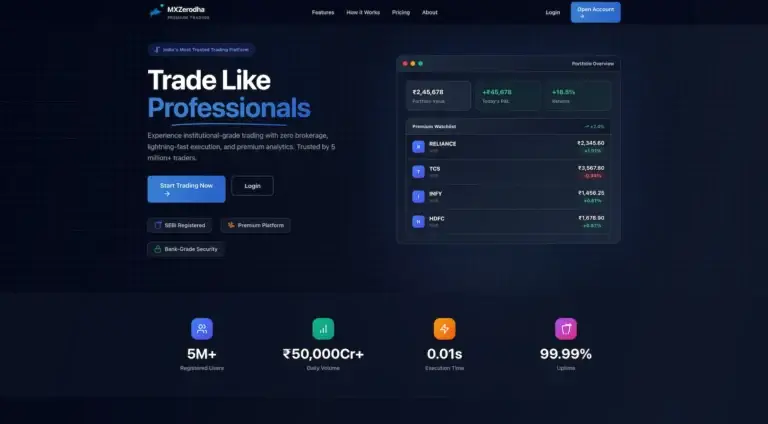
Discount broking platform with order management, market data and portfolio tracking.

Blueberry Markets Clone
Forex and CFD trading platform with multi-account structures, risk controls and settlement.

Zillow Clone
Property listing and discovery portal with search, agent tools and lead capture.
The Commercial Case
Marketability, Revenue Potential & Business Prospects
Fractional property economics are unusual because revenue compounds with assets under management rather than resetting each month. Every property funded adds a management fee base that persists for the holding period.
Six Revenue Levers
Platform fees, management fees, secondary market fees, distribution charges, exit fees and FX spread, each configurable independently.
Revenue That Compounds
Management fees accrue from ownership on a schedule, so assets under management build a recurring base rather than requiring constant new raises.
The Register Is the Moat
Investors with holdings, certificates and a distribution history do not casually move platforms, and the operating record is not portable to a competitor.
Exit Optionality
The full source and a 77-model schema on standard PostgreSQL are yours. A documented domain is an asset in diligence rather than a black box to explain.
Most operators launch with a small number of assets they already control or can source quickly, because the first properties have to fund to prove the model to later investors. Platform fees are collectible on the first subscription and management fees begin accruing from ownership immediately. The secondary market usually stays quiet until the register is large enough to create two-sided interest, which is normal and not a sign anything is wrong. The sequence that works is a short hardening and configuration phase, a controlled launch with a handful of assets and invited investors, then opening registration once distributions have run cleanly at least once.
Defensibility comes from the register and the operating track record, not from features. An investor with holdings across several properties, a distribution history and tax statements in one place has real switching costs, and a regulator who has already reviewed your processes is an asset a new entrant cannot copy. The platform contribution is making onboarding fast enough to build that register, the ledger accurate enough to keep it, and the whole record yours rather than a fund administrator who can reprice you.
Example Revenue Scenarios
The commercial argument for owning the platform is that in this category the asset is the investor register and the operating record. Both live with whoever runs the infrastructure, which is why renting fund administration has a ceiling.
Focused Launch
Properties Funded
Platform and management fees start compounding immediately.
A curated launch where a handful of assets prove the operating model and the register stays small enough to service by hand if needed.
Growth Stage
Properties Funded
Secondary market fees and FX spread join the recurring base.
A scaled operation where distribution batching and the compliance queue are doing real work and the back office justifies itself.
Multi-Market
Properties Funded
Multi-jurisdiction fee schedules and investor tiers all contribute.
A multi-country platform where country profiles and currency support turn one deployment into several national businesses.
Why Miracuves
Miracuves vs Other Fundrise Clone Developers
There are many ways to get a real estate crowdfunding platform: generic scripts, freelancers, agencies, or owning the infrastructure.
Why Founders Choose Miracuves
A Real Ledger, Not a Balance Column
Double-entry posting with integer minor units and derived balances. Generic crowdfunding scripts store a number in a wallet field and hope it stays right.
SPVs and Share Classes Modelled
Property-level vehicles with share classes and an append-only ownership register, rather than a pledge amount attached to a campaign.
The Operator Console Exists
Underwriting, investment committee review, distribution batching, compliance queues and audit. Most scripts in this category ship an investor portal and stop.
Full Source Ownership
The complete Next.js and PostgreSQL codebase is yours to modify and deploy. No per-investor fee and no administrator who can reprice you.
Auditable for Diligence
A ten-document suite with an ERD, API collection, security handbook and VAPT review, enough for an investor or regulator conversation rather than a demo.
Scope You Can Verify
Ten technical documents with status labels against every capability, so what is included, what needs your provider account and what is configured for your market is written down before you buy.
Compare & Discover Why Clients Choose Us as
#1 Ready-Made Clone Solution Partner
| Criteria | Miracuves Fundrise Clone | Generic Clone Script | Custom Dev Agency |
|---|---|---|---|
| Time to Launch | 6 days (Production) | Unknown / DIY | 6-9+ months |
| Source-Code Ownership | ✔ Full | Often limited / encrypted | Usually yes |
| Feature Depth (Fundrise-like) | High (feed, live, monetization) | Basic (upload & feed only) | Depends on budget |
| Security & Compliance | Strong (ISO mindset, GDPR-ready) | Minimal | Varies widely |
| Scalability & Performance | Cloud & CDN-optimized | Rarely considered | Depends on architecture |
| Monetization Options | Multiple (ads, gifts, subs) | Limited / needs custom work | Custom (more time & cost) |
| Admin & Analytics | Full-fledged dashboard | Very basic or missing | Custom build (extra cost) |
| Cost vs Speed vs Quality | Balanced | Cheap but risky | High cost, slow |
| Ongoing Support & Updates | Available with clear plans | Usually none | Depends on contract |
Not every route to a fractional property platform survives its first audit. Here is where we differ.
Industries
Industries We Serve
The Fundrise Clone suits any operator raising capital into property. Fractional residential platforms use the full stack from sourcing through exit. Commercial operators use underwriting, tenancy and valuation history for larger assets. Property developers use the partner pipeline to raise directly. Asset and fund managers replace CRM, spreadsheets and fund administration with one model. Family offices and syndicators digitize existing private raises. REIT operators use multi-currency and country profiles. Proptech startups build on a ledger-backed core. Real estate agencies extend from brokerage into investment products. Systems integrators deliver client platforms on a documented domain.
- 🏘️ Fractional Residential
- 🏢 Commercial Property
- 🏗️ Property Developers
- 📊 Asset Managers
- 👔 Family Offices
- 🤝 Syndicators
- 🌍 Regional REITs
- 🏦 Proptech Platforms
- 🔑 Real Estate Agencies
- 💼 Investment Operators
- 📈 Capital Raising
- 🚀 Agencies & Builders
Miracuves’ Fundrise Clone is built as an SPV-native investment platform adaptable to any property-backed capital raising business, multi-jurisdiction where your footprint requires it, and white-labelled entirely under your brand.
Changelog
Fundrise Clone Release Log - Version History & Updates
| Version | Date | What's New |
|---|---|---|
| v2026.1 | Sep 2026 | Initial release. Fractional real estate platform with property SPVs, double-entry ledger, secondary market and operator console. |
Blog & Resources
Fundrise Clone App - Latest Insights & Guides
Stay updated with the latest trends, guides and case studies on real estate crowdfunding, fractional ownership, investor onboarding and property platform operations.
FAQ
Fundrise Clone FAQ - Pricing, SPVs, Compliance & Readiness
Everything you need to know about the Miracuves Fundrise Clone.
A ready-made real estate crowdfunding platform. Investors browse properties, subscribe to shares held through an SPV, receive rental distributions and can resell on a secondary market. Operators underwrite deals, run investment committee review, batch distributions and manage compliance from one console. It ships with a Next.js 15 web application, an Expo mobile app, 229 API routes and a 77-model PostgreSQL domain.
Fundrise pools investor money into funds, so investors do not choose the asset. This platform gives investors shares in a specific property held in its own SPV, with a share class, an ownership certificate and a secondary market to sell into. That is closer to how Stake, Arrived and Property Partner operate. It is the more flexible base: you can run a per-property model, and the fund flags exist if you later want pooled products.
The software is legal to own and deploy. Operating it is a regulated activity in most jurisdictions, and that is your responsibility, not a property of the code. The platform provides the compliance architecture (KYC case management, accreditation, investor classes, audit logging, maker-checker) but architecture is not authorization. You will need counsel and, in most markets, a licence or an exemption before taking investor funds.
The Miracuves Fundrise Clone starts from $6,099 for a launch-ready white-label deployment. Final scope varies with the security hardening you need, KYC and payment provider integrations, jurisdiction configuration and mobile depth.
Six days from our side to rebrand and deploy to your server. What extends the calendar is anything we need from you: brand assets, hosting access, your property data, and accounts for the KYC vendor and payment processors. If you want the security hardening completed before going public, which for this platform we strongly recommend, that is scoped separately and we will be straight with you about the time it takes.
A defined deployment engagement, and we will quote it before you commit. The demo you can open above runs on sandbox providers and demo accounts, which is what a demo should run on. Your production deployment connects your own payment processor and KYC vendor with provider-native signature verification and reconciliation, enforces the 30-role permission model at route level against your real team structure, gates every admin surface, sets lockout and password policy to your risk appetite, and configures your jurisdiction, fee schedules and legal agreements. The platform ships with a security handbook and a VAPT review so your own auditor or penetration tester has something to work from. None of this is discovered late: it is a written checklist from the first conversation.
Reconciliation instead of investigation. Every money movement posts balanced entries, amounts are stored as integers in minor units so there is no floating-point drift, wallet balances are derived from entries rather than stored separately, and corrections are compensating entries rather than edits. The practical result is that a distribution run can be checked against a bank statement, and an ownership question can be answered from an append-only register rather than reconstructed from three systems.
An investor lists shares they hold, other investors make offers, and an accepted trade transfers ownership and posts ledger entries atomically. Before checkout a buyer must open an investment memo showing seller price and fees, premium or discount to latest NAV, the property proposal, yield and occupancy, capital structure, tenant metrics, valuation history and due-diligence documents. Operators can moderate listings, force-cancel, and read volume and average premium. There is no external exchange connectivity.
Two other paths exist. Operators can schedule exit windows with a pricing method and fee, where eligible investors submit redemption requests subject to holding-period and shares-held checks, and settlement credits proceeds and burns ownership. Separately, a whole-property sale can be proposed, with investors voting yes, no or abstain, one vote each weighted by shares. Neither is a guaranteed redemption promise, and the page should never present them as one.
It is configured for the UAE, United States and United Kingdom with AED, USD and GBP. The interface carries eight locales including Arabic with full right-to-left layout. Adding a market is a country profile, currency and tax configuration rather than a code fork, but jurisdictional tax accuracy and legal agreement wording need your counsel and provider certification.
Yes. You receive the complete codebase: the Next.js 15 web application with the operator console, the Expo mobile app, the Prisma schema of 77 models and 47 enums, the financial engine and permissions packages, the provider adapters and the 229 API routes, with full ownership to modify and extend.
Anything that depends on your market or your vendors. Your payment processor and KYC provider accounts and their live settlement. Sanctions and PEP screening, where the data model is built and the screening vendor is connected to your compliance policy. Native mobile document capture. Tax withholding and legal agreement wording for your jurisdiction, which needs your counsel rather than our assumption. Running several brands from one deployment is an architecture addition we scope separately. And regulatory authorization, which no software vendor can supply to anyone: you hold the licence or exemption, and the platform gives you the compliance architecture to operate under it.
Let's turn your idea into
a live platform.
Get a free consultation, a clear timeline, and honest answers. We'd rather earn your trust than rush a sale.
Miracuves is an independent software development company. We are not affiliated with, connected to, sponsored by, or endorsed by Fundrise.
“Fundrise Clone” is used descriptively. It is how the software industry refers to building a platform with functionality similar to Fundrise, and how clients search for it.
The entire design and codebase is built by our own team. The product contains no code, design, graphics, or content originating from the Fundrise website or applications.
Fundrise and all other third-party names and marks are the property of their respective owners, referenced here solely to describe the category of software offered.
