Key Takeaways
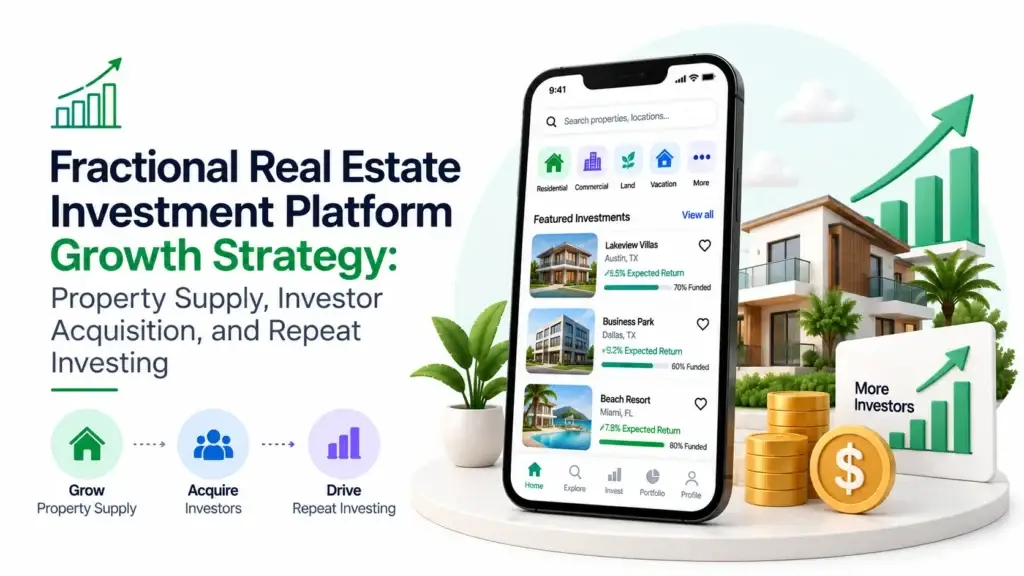
- Real Estate Crowdfunding Growth Strategy should balance sponsor acquisition, investor demand, and a consistent pipeline of quality property deals.
- Growth should be measured through meaningful signals such as completed investor onboarding, repeat investments, sponsor retention, deal quality, and distribution engagement rather than traffic or registrations alone.
- Sponsor acquisition needs clear qualification standards, structured onboarding, document review, and ongoing reporting to protect marketplace credibility.
- Investor growth depends on education, transparent deal pages, clear risk information, simple onboarding, sponsor credibility, and reliable reporting.
- A scalable growth engine should connect marketing with operational capabilities such as deal review, KYC workflows, payments, distributions, reporting, audit logs, and role-based access.
Growth Signals
- Define an ideal sponsor profile based on property experience, documentation quality, financial transparency, realistic exit planning, and communication discipline.
- Segment investors according to experience, investment capacity, and geographic requirements so education and follow-up can match their needs.
- Use curated deal sourcing rather than maximizing the number of listings, with consistent criteria for property type, market, documentation, sponsor quality, risk, and exit strategy.
- Combine SEO education, direct sponsor outreach, webinars, referrals, and relationship-driven acquisition instead of depending on one marketing channel.
- Track activation, completed commitments, repeat deal views, repeat investments, sponsor retention, deal quality, and support volume to identify where the growth funnel is working or breaking.
Real Insights
- More investor traffic does not guarantee growth if the platform lacks credible sponsors or quality investment opportunities.
- Accepting too many weak or incomplete deals can damage investor confidence, making deal quality more important than listing volume.
- Investor education can reduce trust friction by explaining fractional ownership, SPVs, risks, distributions, documents, and exit expectations before commitment.
- Growth becomes easier to scale when sponsor intake, investor onboarding, deal approval, reporting, and post-investment communication are supported by structured platform workflows.
- The strongest growth path is: define target sponsors and investors → build qualified pipelines → establish deal standards → attract credible sponsors → educate and onboard investors → launch quality opportunities → support commitments and reporting → encourage repeat participation → expand the marketplace carefully.
Launching a property investment marketplace is only the first step. The real challenge begins when you need to attract credible sponsors, bring in qualified investors, and maintain a strong pipeline of quality property deals.
Many founders assume growth comes from adding more listings or spending more on investor acquisition. But property-backed investment marketplaces do not grow like simple listing platforms. They grow when trust, deal quality, sponsor credibility, investor education, and operational control work together.
A Real Estate Crowdfunding Platform with too many weak deals can lose investor confidence. A platform with investor demand but no strong sponsor pipeline can struggle with liquidity. A platform with good sponsors but poor onboarding and reporting can become operationally difficult to scale.
That is why growth strategy matters.
This guide explains how founders can build a balanced growth engine for a property investment marketplace by attracting sponsors, investors, and quality property opportunities without damaging trust.
Why Growth Is Different for Property Investment Marketplaces
A normal marketplace connects buyers and sellers. A property investment marketplace connects investors, sponsors, property assets, legal structures, documents, payments, investor eligibility, ownership records, and long-term reporting.
That makes growth more sensitive.
When users join a food delivery marketplace, they can test the experience with a small order. When investors join a property investment marketplace, they are evaluating trust, risk, documentation, sponsor credibility, projected returns, payment safety, reporting quality, and exit possibilities.
The decision cycle is longer. The trust requirement is higher. The consequences of a poor user experience are more serious.
This means growth should not be measured only by traffic or sign-ups. Better growth signals include:
- Completed investor onboarding
- Verified investor profiles
- Repeat deal views
- Saved or shortlisted opportunities
- Completed commitments
- Distribution engagement
- Repeat investments
- Sponsor retention
- Quality of submitted deals
- Investor support volume
The strongest platforms do not simply grow fast. They grow with control.
The Three-Sided Growth Model: Sponsors, Investors, and Property Deals
A property investment marketplace usually has three connected growth engines:
| Growth Side | What You Need to Attract | What Builds Trust | What Can Break Growth |
|---|---|---|---|
| Sponsors | Developers, syndicators, asset managers, property operators | Clear onboarding, investor access, reporting tools, professional deal presentation | Unclear approval rules, slow workflows, weak investor demand |
| Investors | Eligible users seeking property exposure | Transparent deal pages, risk clarity, sponsor history, easy onboarding | Overpromised returns, confusing documents, poor reporting |
| Deals | Quality property opportunities | Strong screening, underwriting, documentation, approval discipline | Too many weak listings, inconsistent review, unclear assumptions |
The goal is not to accept every sponsor or publish every property. The goal is to build a curated marketplace where each new deal improves platform credibility.
How to Attract Real Estate Sponsors Without Becoming a Listing Dump
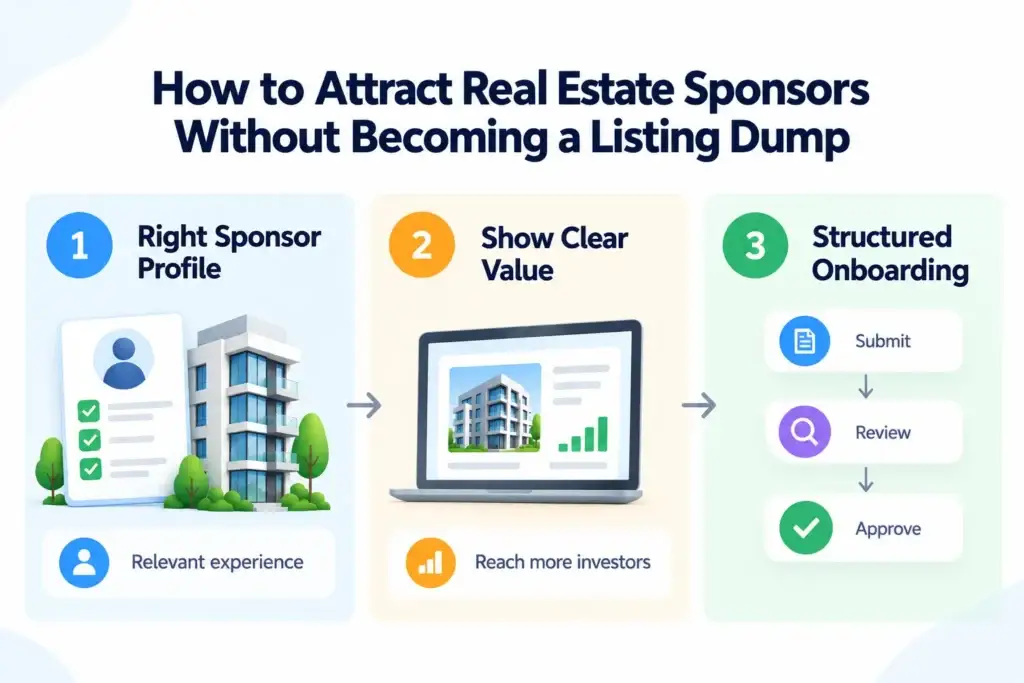
Sponsor acquisition is one of the most important growth levers. Without sponsors, there are no deals. Without quality sponsors, there is no investor trust.
But sponsor growth should not mean accepting every property operator who wants to list. A platform needs clear standards.
Define Your Ideal Sponsor Profile
Before reaching out to sponsors, define what a qualified sponsor looks like.
A strong sponsor profile may include:
- Relevant property experience
- Clear ownership or development role
- Ability to provide complete documents
- Transparent financial assumptions
- Clear use of funds
- Realistic exit strategy
- Communication discipline
- Ability to provide post-funding updates
- Willingness to follow platform review processes
This protects the marketplace from becoming a generic property listing board.
A strong sponsor should not only bring a property. They should bring credibility, documentation, and operational readiness.
Build a Sponsor Value Proposition Beyond “Raise Capital”
Many platforms position themselves as a place where sponsors can raise money. That is useful, but not enough.
Better sponsor messaging should explain how the platform helps them:
- Present opportunities professionally
- Reach a wider investor base
- Reduce manual investor communication
- Organize property documents
- Track investor interest
- Manage deal updates
- Share post-funding reports
- Build long-term investor relationships
The sponsor should see the platform as more than a fundraising channel. It should feel like an investor operations system.
Create a Structured Sponsor Onboarding Funnel
Sponsor onboarding should be controlled and repeatable.
A practical sponsor funnel may include:
- Sponsor submits company and property information.
- Platform team reviews sponsor fit.
- Sponsor uploads documents, financials, images, and deal details.
- Internal team reviews assumptions, risks, and structure.
- Admin or investment committee approves, rejects, or requests changes.
- Deal page is prepared for investor review.
- Sponsor provides post-funding updates and reporting.
This workflow prevents the platform from scaling chaos.
How to Attract Investors by Reducing Trust Friction
Investor acquisition is not only a marketing problem. It is a trust problem.
Paid ads, SEO, social media, webinars, and referrals can bring people to the platform. But investors need confidence before they complete onboarding, review a deal, and commit funds.
Every step should reduce uncertainty.
Educate Investors Before Asking for Commitment
Many users may be interested in property investing but unfamiliar with fractional ownership, SPVs, sponsor due diligence, risk disclosures, distributions, or exit timelines.
That creates a content opportunity.
Useful investor education topics include:
- How fractional property investing works
- How to evaluate a property investment opportunity
- What sponsor track record means
- How rental distributions may work
- What risks investors should review
- How exit timelines are usually structured
- What documents to check before investing
Education attracts better investors. Better-informed users understand the risks, ask better questions, and are more likely to return when the experience is transparent.
Improve Deal Page Transparency
The deal page is one of the most important conversion assets on the platform.
A weak deal page feels like a marketing brochure. A strong deal page helps investors make an informed decision.
A quality deal page should include:
- Property overview
- Location details
- Sponsor profile
- Investment structure
- Minimum investment amount
- Expected hold period
- Use of funds
- Projected distribution logic
- Key assumptions
- Risk factors
- Documents and disclosures
- Fees and platform charges
- Exit strategy
- Investor FAQs
The goal is not to make every deal look risk-free. The goal is to make the opportunity clear enough for serious investors to evaluate.
Segment Investors Instead of Using One Generic Funnel
Not every investor has the same motivation.
A first-time investor may need education and simple onboarding. An experienced investor may care about underwriting details and sponsor history. A high-net-worth investor may expect curated opportunities and better reporting. A cross-border investor may need more clarity around jurisdiction, currency, documents, and withdrawal flows.
| Investor Segment | What They Need | Content That Helps |
|---|---|---|
| First-time property investors | Education, simple explanations, risk clarity | Beginner guides, glossary, checklists |
| Experienced investors | Sponsor history, underwriting details, documents | Deal memos, market notes, sponsor interviews |
| High-net-worth investors | Curated opportunities, larger allocation options | Private previews, portfolio strategy content |
| Cross-border investors | Currency, jurisdiction, document clarity | Country guides, compliance workflow explainers |
Investor segmentation helps you personalize onboarding, content, and follow-up.
How to Source Better Property Deals
A bigger deal pipeline is not always better.
Weak property opportunities can damage trust, increase support burden, and make serious investors hesitant. The stronger strategy is to build a quality-controlled deal sourcing engine.
Create a Clear Property Deal Criteria
Your platform should define what kinds of opportunities it wants to publish.
Deal criteria may include:
- Property type
- Location or market focus
- Minimum documentation standard
- Sponsor experience
- Target investor profile
- Hold period
- Risk level
- Revenue or rental assumptions
- Exit strategy
- Reporting frequency
- Legal structure
- Minimum funding requirement
This helps your team reject poor-fit deals faster and attract the right sponsors.
Use a Deal Review Scorecard
A deal review scorecard creates consistency. It does not replace legal, financial, or underwriting review, but it helps the platform maintain discipline.
| Review Area | What to Check | Why It Matters |
|---|---|---|
| Sponsor Quality | Experience, track record, reporting ability | Strong sponsors improve investor trust |
| Property Fundamentals | Location, demand, asset condition, occupancy | Better fundamentals support better deal confidence |
| Financial Assumptions | Income, expenses, leverage, sensitivity | Investors need realistic assumptions |
| Legal Structure | SPV setup, documents, investor rights | Clear structure supports cleaner operations |
| Exit Logic | Hold period, resale plan, refinance or sale route | Exit clarity reduces investor hesitation |
| Reporting Readiness | Update frequency, distribution data, records | Reporting quality supports retention |
Avoid Launching Too Many Deals Too Early
Early-stage platforms often think more listings make them look stronger. In reality, too many weak or incomplete listings can reduce trust.
A better early-stage approach is:
- Launch with fewer, better-explained opportunities
- Test investor onboarding
- Observe where users hesitate
- Improve deal page clarity
- Run the first reporting cycle properly
- Expand sponsor acquisition after the workflow is stable
Quality creates trust. Trust creates repeat participation.
Marketing Channels That Help Property Investment Marketplace Growth
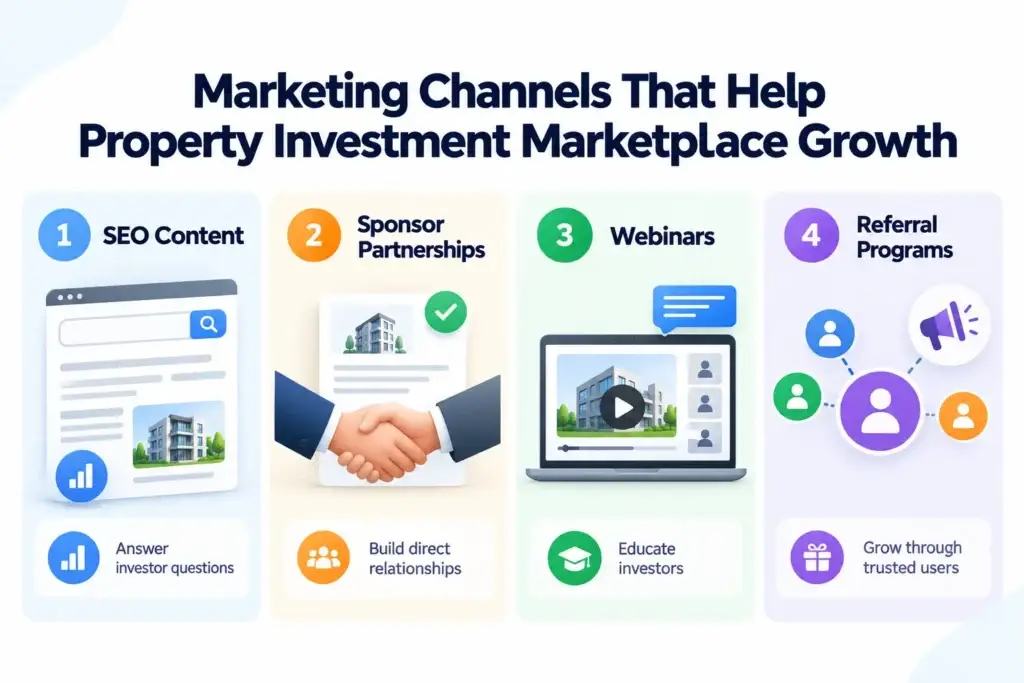
A growth strategy should combine education, sponsor relationships, investor trust-building, and platform credibility.
SEO Content for Investor Education
SEO can attract users who are researching before they invest. Instead of only publishing promotional content, create educational assets that answer pre-investment questions.
Good SEO topics include:
- How to evaluate fractional property investments
- What to check before investing in a property deal
- How property investment distributions work
- Debt vs equity property investment
- Sponsor due diligence checklist
- Real estate investment risk factors
- How property exit timelines work
This kind of content supports long-term trust and brings in users with real interest.
Sponsor Partnerships and Direct Outreach
Sponsors are often acquired through relationships, not just ads.
Potential sponsor sources include:
- Property developers
- Asset managers
- Real estate syndicators
- Local brokers
- Property operators
- Family offices
- Boutique investment firms
- Real estate advisory networks
Your outreach should not sound like “list your property with us.” It should focus on operational value:
- Better investor presentation
- Structured deal rooms
- Simplified document access
- Investor pipeline visibility
- Post-funding communication
- Repeat investor relationship building
Webinars and Deal Education Sessions
Webinars can help investors understand the deal thesis, sponsor background, risk profile, property details, and process.
However, webinars should not become hype-driven sales events. They should educate.
A good webinar should cover:
- Property overview
- Sponsor background
- Market logic
- Deal structure
- Risk factors
- Investor process
- Reporting expectations
- Timeline and exit assumptions
After the webinar, users should be directed to a clear deal room with the same information available in writing.
Referral Loops Built Around Trust
Referral programs can work, but they must be careful in investment categories. Trust-based referrals are usually stronger than aggressive incentive-led referrals.
Good referral moments include:
- After investor onboarding is completed
- After the first commitment
- After a useful investor update
- After a successful distribution
- After a positive support interaction
A satisfied investor is more likely to refer the right kind of user.
Founder Decision Signals: When Your Growth Engine Is Ready to Scale
Speed
You are ready to scale when sponsor onboarding, investor verification, deal review, and reporting no longer depend on manual coordination for every small task.
Cost
Your acquisition cost becomes healthier when education, transparent deal pages, and automated follow-ups reduce repeated support conversations.
Scalability
Your platform is more scalable when documents, approvals, distributions, audit logs, and admin permissions are built into the workflow.
Market Fit
Market fit becomes clearer when investors return for new opportunities and sponsors want to submit more deals through the platform.
Operational Features That Support Growth
Growth becomes harder when the platform cannot support the operating model.
If sponsor intake happens through email, investor documents are tracked manually, deal approvals are handled in spreadsheets, and distributions require disconnected tools, the business becomes difficult to scale.
A growth-ready platform should support:
- Sponsor onboarding
- Deal submission
- Property document management
- Investor onboarding
- KYC and eligibility workflows
- Deal rooms
- Payment workflows
- Distribution records
- Admin approvals
- Investor reporting
- Audit logs
- Role-based access control
- Support and dispute workflows
If your team wants to understand the technical foundation behind these workflows, read Miracuves’ guide on real estate crowdfunding platform architecture.
For founders who want to move faster, the Miracuves provides a launch-ready foundation for investor, operator, finance, compliance, and admin workflows. Teams that want to review the product modules in more detail can also explore the Fundrise Clone features page.
Miracuves’ ready-made approach is especially useful for founders who want to validate faster, customize the product around their market, and retain source-code ownership for long-term flexibility.
Common Growth Mistakes Founders Should Avoid
Growing investor traffic before deal quality is ready
Investor acquisition without strong deals can waste marketing spend. Users may register, review weak opportunities, and never return.
Accepting sponsors without clear review standards
Easy sponsor onboarding may increase supply quickly, but poor-fit sponsors can damage investor trust and platform credibility.
Overpromising returns
Property investment carries risk. Platforms should focus on transparent assumptions, realistic communication, and clear disclosures.
Ignoring post-investment reporting
The investor relationship does not end after funding. Updates, documents, distributions, and reporting are critical for retention.
Compliance and Trust Should Be Part of the Growth Strategy
Property-backed investment marketplaces operate in a sensitive category. Final compliance depends on jurisdiction, legal structure, investor type, marketing rules, payment providers, and legal review.
Founders should involve qualified legal and compliance experts before accepting investor funds.
SPV structure, investor rights, document access, and ownership records are important trust layers. For a deeper educational explanation, read how SPVs work in real estate crowdfunding.
From a product and growth perspective, trust is supported by:
- KYC workflows
- Investor verification
- Investor class management
- Accreditation or suitability workflows where applicable
- Document access records
- Risk disclosures
- Role-based admin permissions
- Audit logs
- Secure payment gateway integration
- Transaction history
- Distribution reporting
- Support and dispute workflows
These controls should not be treated as backend extras. They directly affect investor confidence.
How Miracuves Helps Founders Move From Strategy to Launch
A growth strategy only works when the platform can support it.
Sponsor acquisition needs intake workflows. Investor acquisition needs onboarding and trust-building deal pages. Deal quality needs review and approval controls. Retention needs reporting, distribution visibility, and ongoing communication.
Founders comparing budget and build scope can review the Fundrise Clone development cost page, while teams evaluating the build partner can explore Miracuves as a Fundrise Clone development company.
Miracuves helps founders create white-label, source-code-owned app foundations that can be customized around their business model, brand, sponsor process, and investor journey. For ready-made solutions, Miracuves can support a 6-day launch timeline, helping founders validate faster without building every core workflow from scratch.
That speed matters because early learning usually comes from real sponsor conversations, real investor objections, and real deal review cycles. A faster product foundation gives founders more time to test positioning, refine acquisition channels, and improve operations.
Final Thoughts: Growth Comes From Trust, Not Just Traffic
A property investment marketplace does not grow by adding listings alone. It grows when sponsors trust the platform to present deals professionally, investors trust the platform to explain opportunities clearly, and operators have enough control to manage quality as volume increases.
The strongest growth strategy is not “get more users.” It is to build a repeatable system for sponsor selection, investor education, deal review, onboarding, reporting, and retention.
Once the growth strategy is clear, the next step is business model clarity. Miracuves’ Fundrise Clone business model guide explains how platform operators can think about revenue streams, monetization, and long-term platform economics.
When those layers work together, traffic becomes more valuable, sponsors become easier to attract, and investors have a clearer reason to return.
FAQs
How do property investment marketplaces attract investors?
They attract investors through education, transparent deal pages, clear risk information, easy onboarding, sponsor credibility, reporting, and trust-building content. Investor acquisition works best when users understand the opportunity before they commit funds.
How do you attract sponsors to a property investment marketplace?
Sponsors are attracted by access to qualified investors, structured deal presentation, faster investor communication, document management, reporting workflows, and a platform that helps them build long-term investor relationships.
What makes a property deal suitable for an investment marketplace?
A suitable deal usually has strong property fundamentals, credible sponsor background, complete documentation, realistic assumptions, risk disclosures, clear investor rights, and a practical exit strategy.
Why is investor education important for marketplace growth?
Investor education reduces confusion and builds trust. When users understand risks, distributions, sponsor evaluation, and exit logic, they are more likely to make informed decisions and return for future opportunities.
Can Miracuves help launch a property investment marketplace faster?
Yes. Miracuves offers ready-made, white-label app foundations with source-code ownership and admin control. For ready-made solutions, Miracuves can support a 6-day launch timeline, depending on configuration and deployment scope.
Miracuves is an independent software development company. We are not affiliated with, connected to, sponsored by, or endorsed by any company or product named in this article.
Terms such as “X Clone” are used descriptively. It is how the software industry refers to building a platform with functionality comparable to a known service, and how clients search for it.
The entire design and codebase of our products is built by our own team. Our products contain no code, design, graphics, or content originating from any third-party website or applications.
All third-party names and marks referenced in this article are the property of their respective owners, referenced solely to identify the services discussed.