Key Takeaways
- Sustainable food delivery growth begins with active restaurant supply, accurate menus, reliable fulfillment, and repeat customer demand.
- Customer acquisition campaigns underperform when restaurant, menu, ordering, and delivery workflows are not ready.
- Strong order density within one targeted area usually creates better economics than expanding across multiple thinly served locations.
- First-order discounts can attract customers, but retention depends on relevant choices, reliable delivery, loyalty rewards, and easy reordering.
- Product, operations, restaurant partnerships, delivery management, and marketing must function as one connected growth system.
Growth Strategy Signals
- Onboard enough restaurants across relevant cuisines and customer use cases before scaling paid acquisition.
- Complete restaurant profiles, menus, availability rules, preparation times, payout settings, and support processes.
- Focus initial marketing on one promising zone and measure order density, delivery performance, and customer response before expanding.
- Connect each offer to a measurable goal such as first orders, second orders, higher basket values, category discovery, or reactivation.
- Track restaurant activation, menu completion, conversion, repeat orders, cancellations, delays, refunds, complaints, and campaign returns.
Real Insights
- App installations do not prove marketplace health; completed and repeated orders provide a stronger growth signal.
- Incomplete menus and unavailable products can waste acquisition spending before the delivery process even begins.
- A discount without a retention strategy creates a temporary expense rather than sustainable customer growth.
- Delivery reliability depends on restaurant preparation, rider availability, dispatching, live tracking, and customer support working together.
- Miracuves develops white-label food delivery marketplaces with restaurant, customer, rider, and admin workflows, analytics, source-code ownership, and rapid delivery where the ready-made scope applies.
A food delivery marketplace does not grow only because people are hungry.
It grows when restaurants trust the platform, customers find enough useful choices, delivery operations stay reliable, and the product keeps turning first-time users into repeat buyers. Many founders focus heavily on app installs, launch ads, or opening-day discounts. Those tactics may create temporary attention, but they do not automatically create a healthy marketplace.
The real growth challenge is different.
A food delivery marketplace has to build supply, demand, trust, and habit at the same time. If restaurants are not onboarded properly, customers see weak menus and limited options. If customers do not reorder, restaurants lose interest. If deliveries are late, paid marketing becomes expensive leakage. If the admin team cannot track orders, refunds, commissions, and campaigns, growth becomes harder to control.
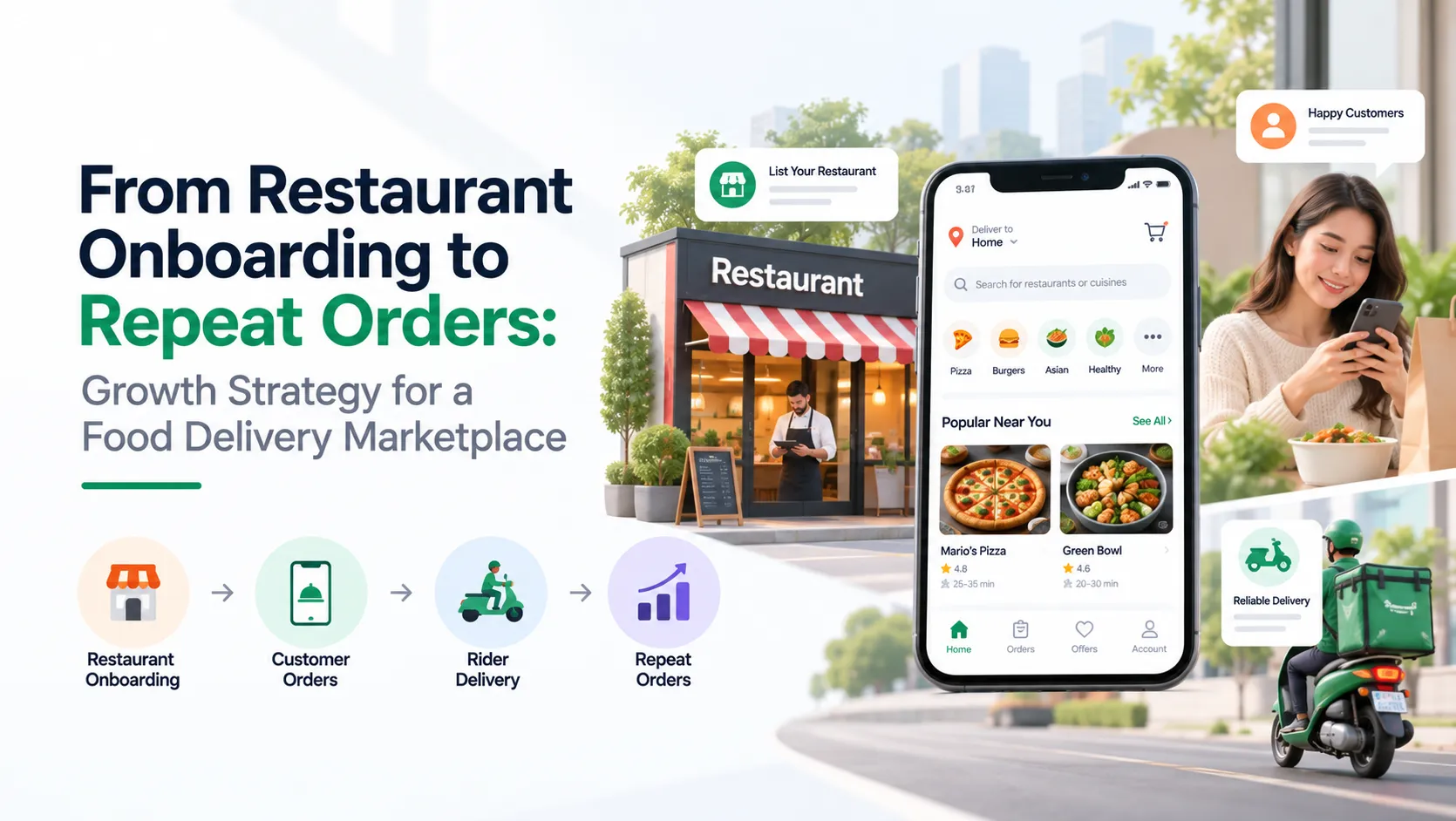
That is why the strongest food delivery growth strategy starts before the first campaign. It begins with restaurant onboarding and continues through menu activation, local order density, first-order conversion, retention, loyalty, and repeat ordering.
For founders planning to launch or scale a food delivery marketplace, the goal is not just to bring users into the app. The goal is to build a platform where every order improves marketplace confidence.
Why Food Delivery Marketplaces Need Growth Loops, Not Just Marketing Campaigns
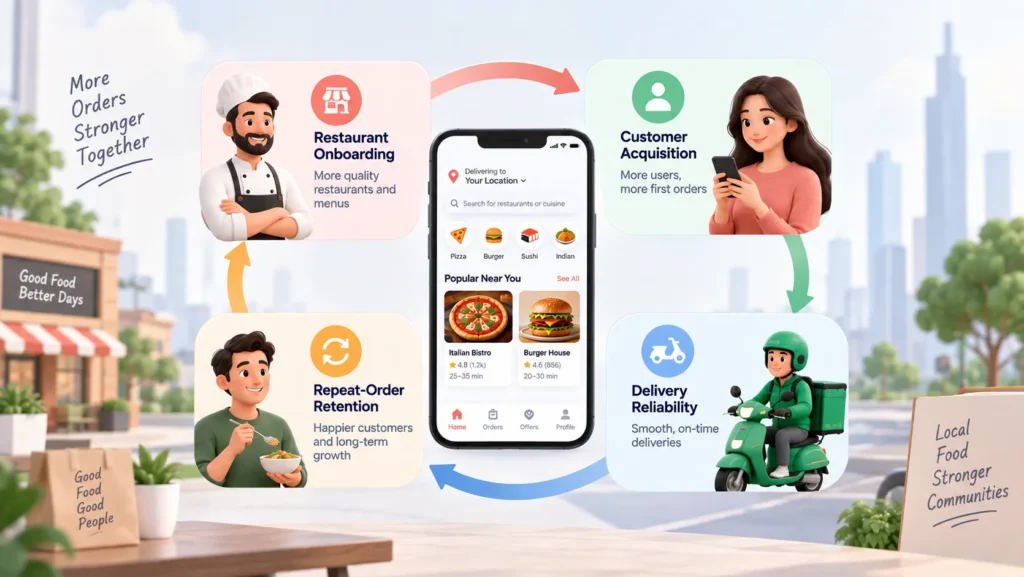
Image Source: AI-generated visual by Miracuves
Marketing can create attention. A marketplace needs repetition.
In a food delivery business, every side of the platform affects the other. Customers want variety, accurate menus, fair delivery charges, fast checkout, reliable tracking, and good food quality. Restaurants want order volume, clear payouts, visibility, and simple order handling. Delivery partners need predictable jobs, routing clarity, earnings visibility, and support when something goes wrong.
If one side is weak, the entire growth system slows down.
A food delivery marketplace usually depends on four connected growth loops:
| Growth Loop | What It Means | Why It Matters |
|---|---|---|
| Restaurant onboarding | Bringing quality restaurants, menus, and offers onto the platform | Creates supply, variety, and local trust |
| Customer acquisition | Getting users to discover, install, and place their first order | Builds demand and validates launch areas |
| Delivery reliability | Ensuring orders are accepted, prepared, picked up, and delivered smoothly | Protects trust and reduces refunds |
| Repeat-order retention | Bringing customers back after the first order | Improves profitability and long-term marketplace value |
A founder should not treat these as separate departments. The restaurant onboarding team affects marketing performance. Delivery reliability affects retention. Customer reviews affect restaurant confidence. Promotions affect margins. Admin visibility affects every operational decision.
The stronger strategy is to build a marketplace where every order produces useful data: which restaurants convert, which areas reorder, which cuisines perform, which offers protect margin, and where delivery issues damage trust.
Start With Restaurant Onboarding Before You Spend Heavily on Customer Acquisition
Many new food delivery platforms make the mistake of launching customer campaigns before the supply side is ready.
That creates a poor first impression. A user downloads the app, enters their address, and sees only a few restaurants, weak images, incomplete menus, unavailable items, high delivery charges, or long estimated delivery times. Even if the app looks polished, the marketplace feels empty.
Restaurant onboarding should happen in stages.
The first stage is category coverage. A launch area should have enough restaurant variety to satisfy common ordering occasions such as lunch, dinner, snacks, family meals, late-night cravings, office orders, and weekend treats.
The second stage is menu readiness. Restaurants should not be listed with incomplete item names, missing descriptions, poor images, unclear customization options, or unavailable bestsellers. Menu quality directly affects conversion.
The third stage is operational training. Restaurants need to understand how to accept orders, update preparation time, mark items unavailable, manage peak-hour load, handle cancellations, and view payout records.
The fourth stage is promotional alignment. Not every restaurant needs the same discount. Some need launch visibility. Some need category placement. Some need combo offers. Some need sponsored listings. Some need loyalty-driven repeat traffic.
A food delivery marketplace becomes stronger when restaurants are not treated as passive listings. They should be active marketplace partners.
What a Strong Restaurant Onboarding Process Should Include
Restaurant onboarding is not just sales. It is marketplace activation.
A founder should build a clear onboarding checklist that helps restaurants go live with confidence.
| Onboarding Area | What to Check | Founder Impact |
|---|---|---|
| Restaurant profile | Name, location, cuisine, hours, images, delivery radius | Improves local discovery and trust |
| Menu setup | Categories, item names, descriptions, variants, add-ons, pricing | Improves conversion and reduces order errors |
| Availability rules | Opening hours, peak timings, item stock, holiday schedules | Prevents failed orders and poor customer experience |
| Order handling | Accept/reject flow, preparation time, packaging readiness | Improves delivery reliability |
| Offers and campaigns | First-order offers, combos, featured placement, loyalty offers | Helps restaurants attract early demand |
| Payout setup | Commission, settlement cycle, refund handling, tax logic | Builds restaurant confidence |
| Support process | Escalation rules, cancellation handling, complaint resolution | Reduces operational friction |
The goal is simple: when the first customers arrive, the restaurant side should already feel prepared.
Weak onboarding creates downstream problems. Customers complain, restaurants feel overwhelmed, delivery partners wait too long, and the support team becomes reactive. Strong onboarding creates marketplace stability before demand grows.
Build Local Order Density Before Expanding Too Widely
Food delivery growth is local by nature.
A marketplace does not need to be everywhere on day one. It needs to work well in the first few launch zones. A smaller area with strong restaurant coverage, reliable delivery, and repeat customers is usually healthier than a large city-wide launch with thin supply.
Order density matters because it improves marketplace economics.
When enough orders happen in a focused area, delivery partners spend less time waiting or traveling long distances. Restaurants receive more consistent demand. Customers see better availability. The platform gets clearer performance data. Promotions become easier to measure.
A practical launch approach can look like this:
- Choose one high-potential zone.
- Onboard enough restaurants across key cuisines.
- Promote lunch, dinner, weekend, and office-order use cases.
- Track first orders, repeat orders, cancellations, delivery delays, and restaurant acceptance rates.
- Improve the weak points before opening the next zone.
Founders should not confuse geographic expansion with growth. Real growth happens when the platform becomes useful enough in one area that customers naturally return.
Turn First Orders Into Repeat Orders With Better Product Timing
A first order is a conversion event. A repeat order is a trust signal.
Most food delivery users do not become loyal because of one discount. They return when the platform makes ordering easier, faster, more relevant, and more predictable than the alternatives around them.
Repeat ordering depends on several small product and marketing decisions:
- Showing recently ordered restaurants.
- Making reordering simple.
- Sending meal-time reminders based on actual behavior.
- Recommending nearby restaurants based on location and cuisine preference.
- Offering wallet credits or loyalty points without damaging margins.
- Giving reliable delivery updates.
- Making support easy when something goes wrong.
- Encouraging ratings and reviews after successful orders.
Timing matters. A lunch customer should not receive random midnight offers. A weekend family-meal customer may respond better to bundle promotions. A user who abandoned a cart may need a reminder, but not three aggressive notifications.
The stronger strategy is behavior-led retention, not generic broadcasting.
Use Offers Carefully: Discounts Should Create Habits, Not Dependency
Discounts can help a marketplace generate first orders, but they can also train customers to wait for offers.
The goal is not to discount every order. The goal is to use incentives where they move the customer closer to a valuable behavior.
A better offer strategy may include:
| Offer Type | Best Use Case | Risk If Misused |
|---|---|---|
| First-order coupon | Reducing signup friction | Attracts one-time bargain users |
| Restaurant-funded offer | Helping partners gain early visibility | Can frustrate restaurants if ROI is unclear |
| Combo meal offer | Increasing average order value | May reduce margin if pricing is not planned |
| Free delivery threshold | Encouraging larger carts | Can hurt economics if distance is ignored |
| Loyalty points | Encouraging repeat orders | Becomes weak if rewards are too slow |
| Referral credits | Bringing new customers through existing users | Can be abused without controls |
Founders should connect every offer to a measurable outcome: first order, second order, higher basket size, category trial, new restaurant discovery, or reactivation.
A discount without retention logic is only a cost. A discount connected to repeat behavior can become a growth lever.
Make Restaurant Partners Part of the Growth Engine
Restaurant partners can help a delivery marketplace grow faster when they are given the right visibility and tools.
A restaurant that understands its performance is more likely to stay active. It can adjust menu pricing, update preparation time, improve images, promote bestsellers, and run offers during slow hours. When restaurants see clear order history, payout records, customer feedback, and campaign results, they are more likely to treat the platform as a serious sales channel.
Useful restaurant-side growth tools include:
- Restaurant dashboard access.
- Menu and item availability control.
- Order acceptance and preparation updates.
- Promotional campaign participation.
- Featured listing options.
- Ratings and review visibility.
- Payout and commission transparency.
- Performance reports by order volume, revenue, and repeat customers.
This helps shift the relationship from “restaurant listing” to “restaurant partner.” That difference matters because marketplace growth depends on active supply-side participation.
Improve Customer Acquisition With Local Search and High-Intent Pages
Food delivery searches are often immediate and local.
People look for nearby meals, open restaurants, specific cuisines, late-night options, office lunches, family dinner deals, and fast delivery in their area. A food delivery marketplace can use this behavior by building search-friendly pages that match local ordering intent.
Useful page types include:
- City food delivery pages.
- Neighborhood delivery pages.
- Cuisine-specific pages.
- Restaurant profile pages.
- Popular dish pages.
- Late-night delivery pages.
- Office lunch delivery pages.
- Weekend meal offer pages.
- Family meal and combo pages.
These pages should not be thin SEO pages. They should help users make ordering decisions with restaurant information, images, menus, timings, ratings, delivery areas, and clear calls to order.
A search-friendly marketplace also helps restaurants. When restaurant profile pages can rank, the marketplace creates discoverability for partners while attracting high-intent customers.
For founders, this is a long-term acquisition advantage. Paid ads can create a launch push, but useful local pages can keep bringing customers after the campaign budget slows down.
Use Push Notifications and Email Without Damaging Trust
Retention messages should feel helpful, not desperate.
Food delivery platforms have strong timing signals: lunch hours, dinner hours, weekends, paydays, local events, rainy evenings, office breaks, and previous ordering habits. The platform can use these signals to send smarter reminders.
Good retention messages are usually based on:
- Previous order history.
- Preferred cuisine.
- Location.
- Cart abandonment.
- Restaurant favorites.
- Offer eligibility.
- Loyalty point balance.
- Reorder timing.
- Delivery availability.
Bad retention messages ignore context. They send too often, promote irrelevant restaurants, repeat the same coupon, or interrupt users at the wrong time.
A good rule for founders: every message should answer a useful customer question.
“What should I eat now?”
“Is my favorite restaurant available?”
“Can I reorder quickly?”
“Do I have a reward to use?”
“Is there a good offer near me?”
When notifications help users make faster decisions, they support repeat orders. When they only push discounts, they create fatigue.
Track Marketplace Health, Not Just App Installs
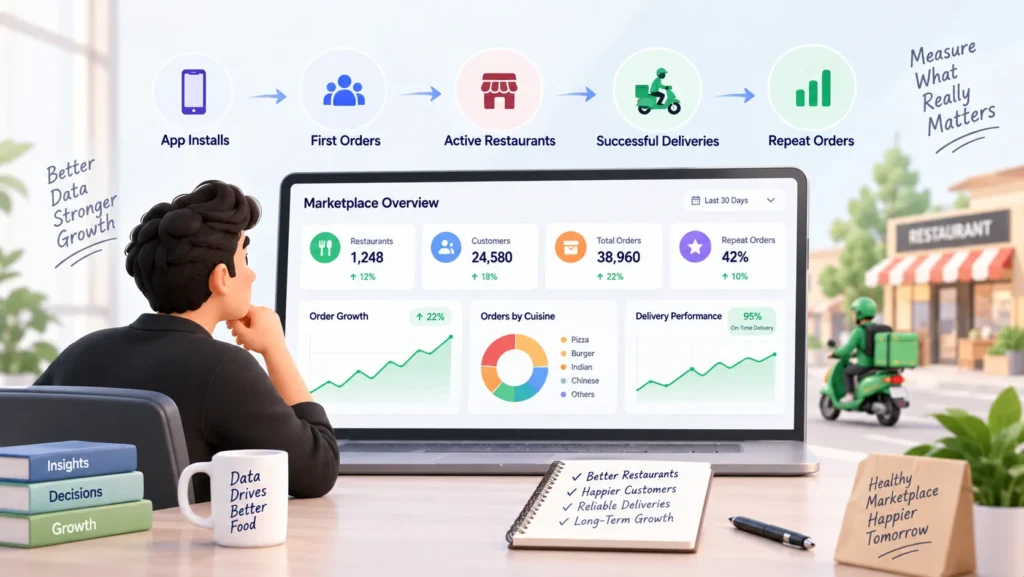
Image Source: AI-generated visual by Miracuves
App installs are easy to celebrate, but they do not prove marketplace health.
A food delivery platform should track the full journey from discovery to repeat order. This gives founders a more accurate picture of what is working.
Important metrics include:
| Metric | Why It Matters |
|---|---|
| Restaurant activation rate | Shows whether onboarded restaurants are actually ready to receive orders |
| Menu completion rate | Indicates whether listings are strong enough to convert customers |
| First-order conversion | Measures how effectively users move from install to purchase |
| Repeat-order rate | Shows whether customers trust the platform enough to return |
| Average order value | Helps evaluate basket size and offer quality |
| Order cancellation rate | Reveals restaurant, stock, delivery, or user-experience issues |
| Delivery delay rate | Shows operational reliability |
| Refund and complaint rate | Highlights trust and service-quality problems |
| Restaurant retention | Shows whether supply-side partners see value |
| Campaign ROI | Measures whether promotions produce useful behavior |
The best founders do not ask only, “How many users did we get?”
They ask, “Which users ordered again, from which restaurants, in which zones, after which campaign, with what delivery experience?”
That level of clarity turns growth from guessing into controlled iteration.
Founder Decision Signals for Food Delivery Marketplace Growth
Supply Readiness
If restaurants are not fully onboarded, customer acquisition will underperform. Menu quality, order acceptance, and payout clarity should be ready before launch campaigns scale.
Local Density
A focused launch zone with strong restaurant coverage and repeat customers is usually more valuable than broad expansion with weak marketplace depth.
Retention Logic
First orders validate interest, but repeat orders validate trust. Loyalty, reorder flows, smart reminders, and reliable delivery help turn usage into habit.
Operational Control
Growth becomes difficult without admin visibility into restaurants, orders, delivery partners, refunds, commissions, campaigns, and performance metrics.
Common Growth Mistakes Food Delivery Founders Should Avoid
Launching demand campaigns before restaurant supply is ready
Customer acquisition becomes expensive when users open the app and find weak restaurant coverage, incomplete menus, or unavailable items.
Using discounts without a repeat-order plan
Discounts can create short-term orders, but retention requires reorder flows, loyalty logic, service reliability, and relevant communication.
Ignoring delivery reliability
Late deliveries, unclear tracking, and poor support can damage trust faster than marketing can repair it.
Treating restaurants as passive listings
Restaurants need dashboards, visibility, payout clarity, campaign tools, and support if they are expected to stay active on the platform.
Expanding into too many zones too early
Broad coverage without order density can increase delivery cost, weaken customer experience, and make operational problems harder to diagnose.
How a Launch-Ready Product Foundation Supports Marketplace Growth
Growth strategy works better when the product can support it.
A food delivery marketplace needs more than customer-facing screens. It needs restaurant workflows, delivery partner operations, order management, payment handling, coupon control, loyalty logic, admin dashboards, reporting, and support processes. Without these foundations, the team may attract demand but struggle to manage the activity that follows.
This is where a ready-made food delivery marketplace solution can help founders move faster.
Instead of building every standard module from zero, founders can start with the core marketplace structure already in place and focus more energy on launch zones, restaurant onboarding, customer acquisition, retention campaigns, and local operations.
Miracuves helps founders launch white-label food delivery marketplace platforms with source-code ownership, branded design, admin control, restaurant workflows, delivery partner apps, payments, tracking, offers, and analytics. For ready-made delivery solutions, Miracuves can support faster deployment, including 6-day solution delivery where the selected scope fits the ready-made product.
The important point is not to copy another platform blindly. The stronger approach is to use a proven marketplace foundation, adapt it to the target market, and build a growth engine around real restaurant and customer behavior.
Final Thoughts: Growth Comes From Marketplace Discipline
Food delivery growth is not one campaign, one offer, or one launch announcement.
It is the result of marketplace discipline.
Founders need to onboard the right restaurants, activate menus properly, build local order density, convert first-time users, protect delivery reliability, and create repeat-order habits. The product, operations, and marketing strategy must work together because customers judge the platform through the full experience, not only through the ad that brought them in.
The strongest food delivery marketplaces do not just generate orders. They learn from every order.
They know which restaurants deserve more visibility, which zones are ready to scale, which offers create repeat behavior, which customers are at risk of leaving, and which operational issues are hurting trust.
For founders, that is the real growth advantage: a marketplace that becomes smarter, more reliable, and more valuable with every order.
FAQs
What is a food delivery marketplace growth strategy?
A food delivery marketplace growth strategy is a plan for growing both sides of the platform: restaurant supply and customer demand. It includes restaurant onboarding, local customer acquisition, first-order conversion, delivery reliability, repeat-order retention, promotions, loyalty, and performance tracking.
Why is restaurant onboarding important for food delivery growth?
Restaurant onboarding affects customer choice, menu quality, order acceptance, preparation speed, and payout trust. If restaurants are not properly activated, users may see limited options or poor service, which reduces first-order and repeat-order conversion.
How can a food delivery app increase repeat orders?
A food delivery app can increase repeat orders through reorder shortcuts, personalized recommendations, loyalty points, meal-time reminders, reliable tracking, fast support, restaurant favorites, and relevant offers based on customer behavior.
Should a food delivery startup focus on discounts or loyalty?
Discounts can help attract first-time users, but loyalty and service quality create stronger retention. A balanced strategy uses discounts to reduce first-order friction and loyalty systems to encourage repeat orders without depending only on price cuts.
Why does local order density matter in food delivery marketplaces?
Local order density improves delivery efficiency, restaurant performance, customer availability, and marketplace economics. A focused launch area with strong supply and repeat customers is often healthier than expanding too widely too early.
What metrics should food delivery founders track?
Founders should track restaurant activation rate, menu completion rate, first-order conversion, repeat-order rate, average order value, cancellation rate, delivery delay rate, refund rate, customer complaints, restaurant retention, and campaign ROI.
How does a ready-made delivery platform help growth execution?
A ready-made delivery platform helps founders start with core ordering, restaurant, delivery, payment, coupon, admin, and reporting workflows already in place. This allows the team to focus more on restaurant onboarding, launch campaigns, local operations, and retention strategy.
How can Miracuves help launch a food delivery marketplace?
Miracuves helps founders build ready-made and white-label food delivery marketplace platforms with source-code ownership, branded design, admin dashboards, restaurant workflows, delivery partner operations, payment integrations, tracking, offers, analytics, and faster deployment based on selected scope.
Miracuves is an independent software development company. We are not affiliated with, connected to, sponsored by, or endorsed by any company or product named in this article.
Terms such as “X Clone” are used descriptively. It is how the software industry refers to building a platform with functionality comparable to a known service, and how clients search for it.
The entire design and codebase of our products is built by our own team. Our products contain no code, design, graphics, or content originating from any third-party website or applications.
All third-party names and marks referenced in this article are the property of their respective owners, referenced solely to identify the services discussed.