


Key Takeaways
What You’ll Learn
- Successful marketplace apps focus on trust, convenience, and smooth user experience.
- Features like user profiles, secure payments, and real-time messaging improve platform engagement.
- Advanced search and filtering help users quickly find relevant services or products.
- Ratings and reviews play a major role in building marketplace credibility.
- Scalable admin panels help businesses manage vendors, users, transactions, and disputes efficiently.
Stats That Matter
- The global online marketplace industry continues growing rapidly across multiple sectors.
- Mobile-first marketplace apps are driving higher user engagement and transaction volume.
- Most users expect integrated payments and instant communication inside marketplace platforms.
- User reviews significantly influence purchase and hiring decisions on digital marketplaces.
- Platforms with personalized recommendations often achieve higher retention and repeat usage.
Real Insights
- Marketplace growth depends heavily on balancing buyer and seller experiences.
- Simple onboarding helps marketplaces scale faster in competitive industries.
- Real-time notifications and messaging increase user activity and conversions.
- Trust and transparency are often more important than adding excessive features.
- Long-term marketplace success comes from operational reliability and strong community engagement.
Building a marketplace app today is one of the most powerful ways to create a scalable business. From Uber to Airbnb to Amazon — marketplaces dominate the digital economy.
But here’s the reality: most marketplace apps fail not because of the idea, but because of missing or poorly implemented features.
If you’re a founder or entrepreneur planning to launch your own platform, understanding the right feature set is critical. This is where expert platforms like Miracuves help businesses move faster with ready-made apps, scalable SaaS solutions, and custom marketplace development tailored for growth.
In this guide, we’ll break down exactly what features your marketplace app needs — so you can build smarter, launch faster, and scale confidently.
What Is a Marketplace App?
A marketplace app is a platform that connects buyers and sellers in one place, enabling transactions, communication, and service delivery.
Examples of Marketplace Apps
- Uber → connects riders and drivers
- Airbnb → connects travelers and hosts
- Amazon → connects buyers and sellers
These platforms succeed because they balance user experience, trust, and operational efficiency.
Read more : – What Is Leonardo AI and How Does It Work?
Why Features Decide Marketplace Success
A marketplace is more complex than a normal app because it serves three types of users simultaneously:
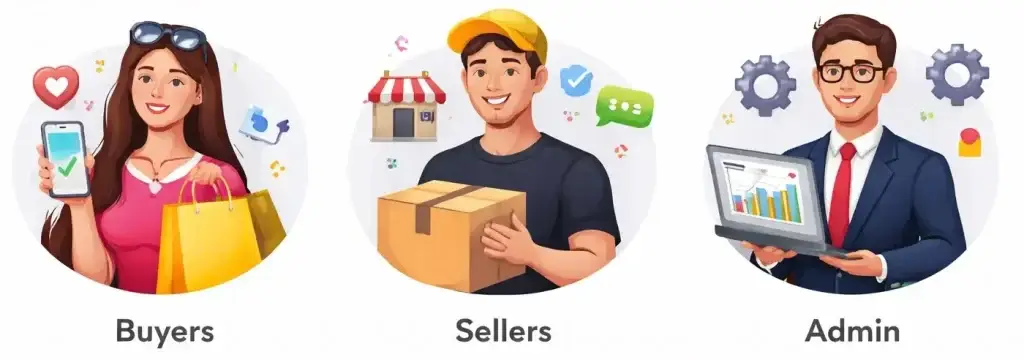
If even one side has a poor experience, the entire system breaks.
Key Factors Driven by Features
- Trust (reviews, ratings)
- Convenience (search, filters, payments)
- Scalability (admin tools, automation)
Core Categories of Marketplace Features
User Features (Buyer Side)
These features ensure a smooth experience for customers.
Easy Registration & Login
- Social login (Google, Facebook)
- Email & phone authentication
Advanced Search & Filters
- Category-based search
- Price, location, ratings filters
Product/Service Listings
- Clear descriptions
- Images/videos
- Pricing details
Secure Payment Integration
- Multiple payment options
- Wallets, cards, UPI
Ratings & Reviews
- Builds trust
- Helps users make decisions
Order Tracking
- Real-time updates
- Notifications
Vendor Features (Seller Side)
Vendors are the backbone of any marketplace.
Vendor Onboarding
- Easy signup process
- Verification system
Product/Service Management
- Add/edit listings
- Inventory management
Vendor Dashboard
- Sales overview
- Order management
Earnings & Payout Tracking
- Commission breakdown
- Withdrawal options
Admin Features (Platform Owner)
Admins control and scale the marketplace.
User & Vendor Management
- Approvals, suspensions
- Profile monitoring
Commission Management
- Flexible commission settings
- Revenue tracking
Analytics Dashboard
- Sales insights
- User behavior tracking
Dispute Resolution System
- Handle complaints
- Maintain trust
Advanced Features That Give Competitive Edge
Once your basic platform is ready, these features help you stand out.
AI-Based Recommendations
- Personalized suggestions
- Increased conversions
In-App Chat System
- Buyer-seller communication
- Faster decision-making
Multi-Language & Multi-Currency Support
- Expand globally
Push Notifications
- Order updates
- Promotions
Subscription Models
- Premium vendor plans
- Recurring revenue
Marketplace Feature Comparison Table
| Feature Type | Basic | Advanced | Optional |
|---|---|---|---|
| Login System | yes | Social login | Biometric |
| Payments | yes | Multi-gateway | Crypto |
| Search | Basic | Smart filters | AI search |
| Chat | no | yes | Video chat |
| Analytics | Basic | Advanced dashboard | Predictive |
Common Mistakes to Avoid
Overloading Features in MVP
Start simple. Too many features increase cost and delay launch.
Ignoring User Experience
A complex UI kills engagement.
Lack of Trust Mechanisms
No reviews or verification = low conversions.
Poor Vendor Experience
If vendors struggle, your marketplace won’t scale.
Read more : – Top 5 Mistakes Startups Make When Building a Flipkart Clone
Build vs Buy: What Should You Choose?

Custom Development
- High flexibility
- Expensive and time-consuming
Ready-Made Solutions
- Faster launch
- Cost-effective
- Proven structure
For startups, ready-made or clone apps are often the smarter choice.
Platforms like Miracuves provide ready-made marketplace apps, SaaS platforms, and custom development services that help businesses launch quickly without compromising quality.
How Miracuves Helps You Build Marketplace Apps
Miracuves offers complete solutions tailored for startups and businesses:
- Ready-made marketplace apps
- Clone apps (Uber, Airbnb, etc.)
- Custom app development
- AI-powered automation platforms
Whether you’re starting from scratch or scaling an existing idea, Miracuves helps reduce time, cost, and technical complexity.
Practical Tips for Building a Successful Marketplace
Building a successful marketplace isn’t about launching big from day one — it’s about making the right moves early. By starting with a focused MVP, balancing buyers and sellers, building trust from the beginning, and targeting a specific niche, you create a strong foundation that can grow sustainably over time.
Start with an MVP
Focus only on essential features first.
Balance Supply & Demand
Ensure both buyers and sellers are active.
Prioritize Trust
Add reviews, ratings, and verification early.
Focus on Niche First
Don’t try to build “another Amazon” immediately.
Conclusion
Building a successful marketplace app isn’t just about having an idea — it’s about executing it with the right features.
From user-friendly interfaces to powerful admin controls and advanced AI features, every element plays a role in your platform’s success.
Start small, focus on essentials, and scale with smart decisions.
If you’re planning to build your marketplace app, contact Miracuves today to get expert guidance and ready-to-launch solutions.
FAQs
1. What is the most important feature in a marketplace app?
Trust features like ratings, reviews, and secure payments are the most critical.
2. How much does it cost to build a marketplace app?
It depends on features, but ready-made solutions are much more affordable than custom builds.
3. Can I launch a marketplace with basic features?
Yes, starting with an MVP is the best strategy.
4. Which industries can use marketplace apps?
eCommerce, services, rentals, healthcare, education, and more.
5. How long does it take to build a marketplace app?
Ready-made apps can launch in weeks, while custom apps may take months.
Related Articles
Miracuves is an independent software development company. We are not affiliated with, connected to, sponsored by, or endorsed by any company or product named in this article.
Terms such as “X Clone” are used descriptively. It is how the software industry refers to building a platform with functionality comparable to a known service, and how clients search for it.
The entire design and codebase of our products is built by our own team. Our products contain no code, design, graphics, or content originating from any third-party website or applications.
All third-party names and marks referenced in this article are the property of their respective owners, referenced solely to identify the services discussed.