

Imagine you’re a digital artist. You’ve created an incredible illustration, but every time you post it online, people can copy, screenshot, or repost it without paying you. You want ownership. You want proof it’s yours. More importantly, you want to monetize it.
That’s where Rarible comes in.
Rarible allows creators to mint their digital artwork as NFTs and sell them directly to collectors without relying on traditional galleries or centralized platforms. Buyers can purchase unique digital assets, verify ownership on the blockchain, and even resell them later.
How Rarible Started and Why It Matters
Rarible launched in 2020 as a decentralized NFT marketplace built on blockchain technology. Unlike centralized platforms, Rarible was designed to give control back to creators and the community through governance tokens and smart contracts.
It quickly became one of the leading NFT marketplaces during the NFT boom, competing with platforms like OpenSea and Foundation. Today, Rarible supports multiple blockchains and continues to evolve with creator tools, royalty systems, and Web3 integrations.
What You’ll Learn in This Guide
By the end of this article, you’ll understand what Rarible is, how Rarible works for creators and collectors, its business model, key features, underlying technology, and how entrepreneurs can build a similar NFT marketplace platform.
What Is Rarible?
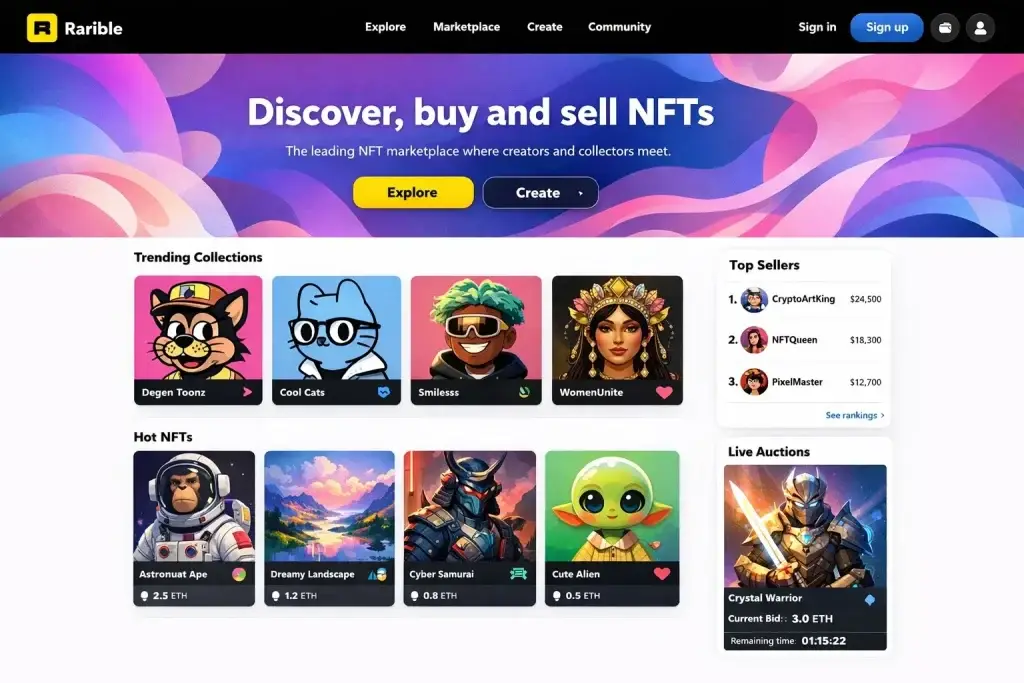
Rarible is a decentralized NFT marketplace where creators can mint, buy, and sell digital assets secured by blockchain technology. It allows artists, musicians, brands, and collectors to trade NFTs (non-fungible tokens) without needing a traditional intermediary. Ownership is verified on-chain, meaning every transaction is transparent and permanently recorded.
The Core Problem Rarible Solves
Before NFTs, digital creators struggled with ownership verification and monetization. Anyone could copy digital art, and there was no reliable way to prove originality or collect royalties on resales.
Rarible solves this by turning digital content into blockchain-based tokens. These NFTs prove authenticity, enable peer-to-peer trading, and allow creators to earn royalties every time their work is resold.
In short, Rarible transforms digital files into tradable digital assets.
Who Uses Rarible?
Rarible serves several types of users:
Digital artists minting and selling artwork
Musicians launching exclusive NFT collections
Brands releasing digital collectibles
Gamers trading NFT-based in-game assets
Crypto collectors investing in rare digital items
It appeals strongly to Web3-native users, crypto investors, and creators looking for decentralized monetization.
Rarible’s Current Market Position
Rarible is one of the well-known NFT marketplaces operating in the Web3 ecosystem. It supports multiple blockchains including Ethereum and other compatible networks, allowing users flexibility in minting and trading.
While competition in the NFT space has increased, Rarible remains recognized for its community governance model, creator royalties, and multi-chain capabilities.
Why Did Rarible Become Popular?
Rarible gained traction for three key reasons:
It allowed anyone to mint NFTs easily
It introduced a governance token (RARI)
It emphasized decentralized control
Unlike curated marketplaces that restrict creators, Rarible opened the platform to broader participation, empowering independent artists.
What Makes Rarible Different from Traditional Marketplaces?
Traditional marketplaces act as centralized intermediaries controlling listings, payments, and fees.
Rarible operates using smart contracts on blockchain networks. Transactions are executed automatically, ownership is verifiable publicly, and users connect through crypto wallets rather than traditional accounts.
This creates a more open, trustless, and global trading environment.
How Does Rarible Work? Step-by-Step Breakdown
Rarible works by connecting creators and collectors through blockchain-powered smart contracts. Everything happens through crypto wallets, NFTs, and decentralized transactions instead of traditional payment systems.
How Rarible Works for Creators
Account Setup
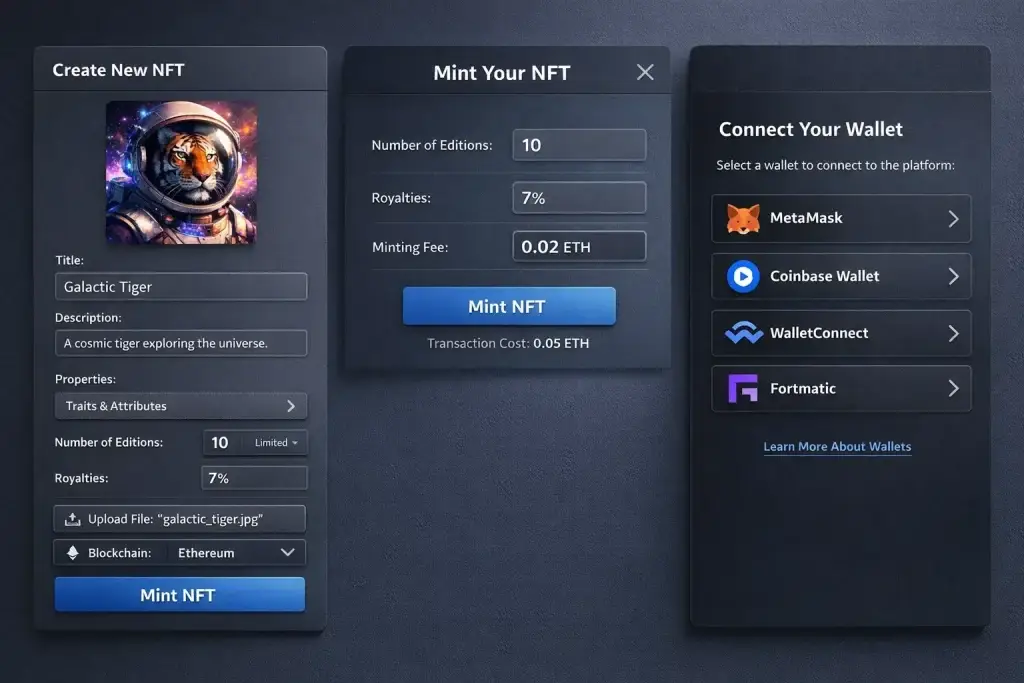
• Visit Rarible and connect a crypto wallet like MetaMask, WalletConnect, or Coinbase Wallet
• No traditional email signup is required — your wallet acts as your identity
• The wallet connection enables secure blockchain transactions
Your wallet becomes your login, payment system, and asset storage all in one.
Minting an NFT
• Upload digital content such as artwork, music, video, or collectibles
• Choose the blockchain network (Ethereum, Polygon, etc.)
• Set royalties percentage for future resales
• Add title, description, and properties
• Confirm minting through your wallet
Once minted, the NFT is recorded on the blockchain. This creates proof of ownership and authenticity.
Listing for Sale
• Choose fixed price, timed auction, or open bidding
• Set cryptocurrency price
• Approve listing transaction in wallet
The NFT becomes visible in the marketplace for collectors worldwide.
Earning Royalties
• Every time your NFT is resold, a percentage automatically goes back to you
• Royalties are enforced through smart contracts
• Payments are transferred directly to your wallet
This allows creators to earn ongoing passive income from secondary sales.
How Rarible Works for Buyers and Collectors
Connecting a Wallet
• Connect crypto wallet to Rarible
• Browse collections or search by category
• View NFT history including ownership and transaction records
All ownership data is publicly verifiable on the blockchain.
Purchasing an NFT
• Select NFT
• Choose to buy instantly or place a bid
• Confirm transaction in wallet
• Pay using supported cryptocurrency
After confirmation, ownership transfers automatically to the buyer’s wallet.
Reselling or Trading
• List purchased NFT at desired price
• Choose auction or fixed price format
• Complete wallet approval
Collectors can flip assets, hold long-term, or trade within the ecosystem.
Technical Overview Explained Simply
Rarible operates using blockchain-based smart contracts. These contracts automatically execute transactions when conditions are met.
Core technical components include:
• Blockchain networks for storing ownership records
• Smart contracts for minting and trading
• Crypto wallets for identity and payments
• Decentralized storage systems for hosting digital files
• Marketplace frontend for browsing and interaction
Instead of relying on a central database, Rarible uses distributed ledger technology. Every transaction is recorded publicly and cannot be altered.
When a user mints an NFT, the blockchain assigns a unique token ID. When someone buys it, the smart contract updates ownership automatically.
In simple terms, Rarible removes the middleman and lets blockchain handle trust, ownership, and payment.
Rarible’s Business Model Explained
Rarible operates as a decentralized NFT marketplace, but behind the scenes it still follows a clear revenue model. Let’s break down how Rarible makes money and sustains its ecosystem.
How Rarible Makes Money
• Marketplace transaction fees
• NFT minting fees (network dependent)
• Platform service fees
• Revenue from multi-chain integrations
• Ecosystem token utility (RARI governance model)
The primary revenue driver is transaction fees collected whenever an NFT is bought or sold.
Marketplace Transaction Fees
Rarible charges a percentage fee on each completed sale. Traditionally, NFT marketplaces charge around 2%–2.5% per transaction, applied to buyers, sellers, or both depending on the structure.
This fee supports platform operations, development, smart contract maintenance, and ecosystem growth.
Why It Matters: Transaction-based revenue scales directly with trading volume.
Technical Innovation: Automated smart contracts instantly deduct platform fees during blockchain settlement without manual processing.
Creator Royalties
Creators can set royalty percentages for secondary sales. While royalties primarily benefit creators, Rarible facilitates and enforces them via smart contracts.
Why It Matters: Encourages high-quality creators to join and stay on the platform.
Technical Innovation: On-chain royalty logic embedded into NFT contract standards.
Minting Costs and Network Fees
When creators mint NFTs, they pay blockchain gas fees depending on the selected network. Some blockchains offer lower-cost minting options.
Rarible itself does not fully control gas fees since they are determined by blockchain networks, but the platform benefits from activity volume.
Why It Matters: Lower minting barriers increase creator participation.
Technical Innovation: Multi-chain support allows users to choose networks with optimized fees.
RARI Token and Governance
Rarible introduced the RARI token to support decentralized governance. Token holders can vote on platform upgrades, fee structures, and feature developments.
This aligns community incentives with platform growth.
Why It Matters: Encourages long-term ecosystem engagement.
Technical Innovation: DAO-style governance using blockchain-based voting systems.
Market Size and Growth Opportunity
The global NFT and digital collectibles market has fluctuated significantly since its peak but continues evolving with gaming, digital identity, and brand adoption.
Web3 marketplaces like Rarible benefit from:
Growing creator economy
Digital asset ownership trends
Metaverse integrations
Brand collaborations
Blockchain adoption across industries
Even during market corrections, infrastructure platforms remain critical to ecosystem development.
Revenue Model Breakdown
| Revenue Stream | How It Works | Why It Matters |
|---|---|---|
| Transaction Fees | Percentage charged on NFT sales | Scales with trading volume |
| Minting Activity | Blockchain gas-related activity | Encourages ecosystem participation |
| Platform Service Fees | Marketplace operations fee | Supports development & scaling |
| Governance Token (RARI) | Community voting & incentives | Builds decentralized engagement |
Rarible’s business model blends decentralized infrastructure with marketplace economics. Instead of controlling assets, it facilitates peer-to-peer digital ownership.
Read More :- Business Model of Rarible : Complete Strategy Breakdown 2026
Key Features That Make Rarible Successful
Rarible stands out in the NFT marketplace space because it combines creator freedom, blockchain transparency, and multi-chain flexibility. Let’s break down the features that drive its success.
Multi-Chain Support
Rarible supports multiple blockchains such as Ethereum and Polygon, giving users flexibility in minting and trading.
Why It Matters: Users can choose networks with lower fees or faster transactions.
Technical Innovation: Cross-chain smart contract deployment and blockchain indexing systems.
Easy NFT Minting
Creators can mint NFTs directly from the platform without needing advanced technical knowledge.
Why It Matters: Lowers the entry barrier for artists and digital creators.
Technical Innovation: User-friendly minting interface connected to automated smart contract generation.
Built-In Royalties
Creators can set royalty percentages for secondary sales.
Why It Matters: Enables long-term passive income for artists.
Technical Innovation: Royalty logic embedded directly into NFT token standards and smart contracts.
Decentralized Governance (RARI Token)
Rarible introduced the RARI governance token to allow community participation in decision-making.
Why It Matters: Gives users a voice in platform upgrades and policy changes.
Technical Innovation: DAO-based governance powered by blockchain voting mechanisms.
Wallet-Based Authentication
Users connect crypto wallets instead of creating traditional accounts.
Why It Matters: Enhances security and aligns with Web3 identity standards.
Technical Innovation: Web3 wallet integrations using decentralized authentication protocols.
Auction and Fixed Price Listings
Creators can sell NFTs via fixed price, timed auctions, or open bidding.
Why It Matters: Offers pricing flexibility and competitive discovery.
Technical Innovation: Smart contract-based automated auction settlement.
On-Chain Ownership Transparency
Every NFT transaction is recorded publicly on the blockchain.
Why It Matters: Ensures authenticity and prevents duplication.
Technical Innovation: Immutable ledger recording via blockchain explorers and indexing APIs.
Lazy Minting Option
Some NFTs can be minted only when purchased rather than upfront.
Why It Matters: Reduces initial gas costs for creators.
Technical Innovation: Deferred smart contract execution triggered at point of sale.
Collection Creation Tools
Creators can launch branded NFT collections with custom metadata and properties.
Why It Matters: Supports brand building and large-scale drops.
Technical Innovation: Modular NFT contract templates and metadata storage systems.
Creator-Centric Marketplace Design
Rarible focuses heavily on empowering independent creators rather than only established brands.
Why It Matters: Builds community loyalty and platform diversity.
Technical Innovation: Decentralized listing architecture with minimal gatekeeping.
Recent Updates and AI Integrations
Rarible has continued expanding multi-chain support and improving user interface design for smoother Web3 onboarding. The platform has also enhanced creator dashboards, analytics tools, and marketplace discovery algorithms.
AI-driven discovery tools are increasingly being used across NFT marketplaces to recommend collections, identify trending assets, and optimize search visibility.
What Sets Rarible Apart
Rarible differentiates itself through its decentralized governance model, multi-chain flexibility, royalty enforcement, and creator-first philosophy. Instead of operating as a strictly curated platform, it gives broader access while maintaining blockchain transparency.
The Technology Behind Rarible
Rarible may look like a simple marketplace on the surface, but underneath it runs on advanced blockchain infrastructure, smart contracts, and decentralized systems. Let’s simplify how the technology actually works.
Blockchain Infrastructure
Rarible operates on multiple blockchain networks such as Ethereum and Polygon. These blockchains act as public digital ledgers that permanently record NFT ownership and transactions.
When someone mints, buys, or sells an NFT, the blockchain updates ownership records automatically.
Why This Matters: No central authority controls the data. Ownership is transparent and verifiable by anyone.
Smart Contracts
Smart contracts are self-executing programs stored on the blockchain. They automatically handle minting, transfers, royalty distribution, and marketplace fees.
When a buyer purchases an NFT:
• The smart contract verifies payment
• Deducts marketplace fees
• Sends royalties to the creator
• Transfers ownership to the buyer
All of this happens automatically without manual approval.
Why This Matters: It removes intermediaries and reduces fraud risk.
Wallet Integration and Web3 Authentication
Rarible does not use traditional usernames and passwords. Instead, users connect crypto wallets like MetaMask or WalletConnect.
The wallet acts as:
• Identity verification
• Payment method
• NFT storage
• Transaction confirmation system
This approach aligns with decentralized Web3 standards.
Decentralized Storage
While ownership data lives on the blockchain, digital files (images, videos, music) are often stored using decentralized storage systems.
These systems ensure:
• Content permanence
• Reduced risk of centralized shutdown
• Global accessibility
This prevents NFTs from being dependent on a single server.
Marketplace Frontend and APIs
The Rarible website acts as the user-friendly interface for interacting with blockchain contracts.
Behind the scenes, it uses:
• Blockchain indexing APIs
• Node infrastructure
• Smart contract interaction layers
• Metadata rendering systems
This allows users to browse NFTs without manually reading blockchain code.
Multi-Chain Architecture
Rarible supports multiple blockchains. This requires:
• Cross-chain contract deployment
• Network selection systems
• Blockchain-specific transaction routing
• Fee calculation based on selected chain
Multi-chain capability gives users flexibility in choosing cost-efficient networks.
Scalability Approach
Blockchain networks can experience congestion and high gas fees. By supporting alternative chains like Polygon, Rarible reduces cost barriers and improves scalability.
The platform also uses indexing systems to speed up NFT search and browsing without overloading blockchain nodes.
Data Handling and Security
Security is fundamental in Web3 platforms.
Rarible relies on:
• Encrypted wallet transactions
• Smart contract audits
• Public ledger transparency
• Non-custodial wallet architecture
Because users control their own wallets, Rarible does not directly hold user funds.
Why This Technology Matters for Business
The technology behind Rarible enables:
• Trustless transactions
• Global peer-to-peer trading
• Automated royalty distribution
• Decentralized governance
For entrepreneurs, this model proves that blockchain marketplaces can operate without centralized asset control while still generating revenue through smart contract automation.
Rarible’s Impact & Market Opportunity
Rarible didn’t just create another digital marketplace. It helped accelerate the shift toward creator-owned economies and blockchain-based digital ownership.
How Rarible Disrupted Digital Asset Ownership
Before NFT marketplaces, digital content had one major flaw — it could be copied infinitely without proof of originality. Rarible helped normalize the idea that digital assets can be scarce, tradable, and verifiable.
Its impact includes:
• Empowering independent creators to monetize directly
• Removing traditional art gatekeepers
• Enabling global peer-to-peer digital trading
• Introducing automated royalty systems
• Supporting decentralized governance
This fundamentally changed how digital art, collectibles, and even brand assets are valued.
Market Size and Growth Potential
The NFT market has experienced strong growth cycles driven by digital art, gaming assets, metaverse items, and brand collaborations.
Key growth drivers include:
• Expansion of Web3 ecosystems
• Integration of NFTs in gaming
• Brand adoption of digital collectibles
• Growth of tokenized real-world assets
• Increased blockchain adoption
Even as speculative hype fluctuates, infrastructure platforms like Rarible remain central to the Web3 creator economy.
User Demographics and Behavior
Rarible attracts:
• Digital artists and illustrators
• Crypto-native investors
• NFT collectors
• Gamers trading digital assets
• Web3 developers launching collections
• Brands experimenting with digital drops
Most users are comfortable with crypto wallets and decentralized systems. The audience often includes tech-savvy millennials, Gen Z creators, and blockchain enthusiasts.
Geographic Reach
Because Rarible operates on blockchain networks, it is globally accessible. Anyone with internet access and a compatible crypto wallet can participate.
This borderless accessibility gives it an advantage over region-locked marketplaces.
Future Projections
The NFT space is evolving beyond digital art.
Emerging areas include:
• Gaming NFTs
• Music and entertainment NFTs
• Digital identity tokens
• Tokenized memberships
• Real-world asset tokenization
• Creator subscription NFTs
As blockchain adoption grows, NFT marketplaces may integrate deeper with social media, virtual worlds, and decentralized finance ecosystems.
Opportunities for Entrepreneurs
The NFT marketplace model offers strong opportunities for startups:
• Niche-specific NFT marketplaces
• Gaming-focused NFT platforms
• Brand-exclusive NFT ecosystems
• Region-based NFT communities
• Tokenized asset platforms
• Creator monetization hubs
The core opportunity lies in building platforms that combine digital ownership, community engagement, and automated revenue systems.
This massive success is why many entrepreneurs want to create similar platforms that combine blockchain technology with marketplace economics.
Building Your Own Rarible-Like Platform
Now that you understand how Rarible works, the real question is — can you build your own NFT marketplace?
The short answer is yes. And many startups are already doing it.
Why Businesses Want a Rarible Clone
NFT marketplaces combine three powerful elements:
• Digital ownership
• Creator monetization
• Automated blockchain transactions
This creates multiple revenue opportunities such as transaction fees, minting services, premium listings, and token-based ecosystems.
Entrepreneurs are attracted to this model because it offers:
• Global reach without geographic limitations
• Automated royalty distribution
• Decentralized asset control
• High scalability
• Web3 community engagement
Instead of building a traditional e-commerce site, you create a decentralized asset marketplace.
Key Considerations Before Development
Before launching a Rarible-like platform, you need clarity on:
• Target niche (art, gaming, music, memberships, real-world assets)
• Supported blockchain networks
• Smart contract architecture
• Token standard (ERC-721, ERC-1155, etc.)
• Wallet integrations
• Revenue model structure
• Governance token strategy (if applicable)
• Legal compliance and crypto regulations
Blockchain-based platforms require both technical expertise and regulatory awareness.
Read Also :- How Safe is a White-Label Rarible App? Security Guide 2026
Cost Factors & Pricing Breakdown
Rarible–Like NFT Marketplace Platform Development — Market Price
| Development Level | Inclusions | Estimated Market Price (USD) |
|---|---|---|
| 1. Basic NFT Marketplace MVP | Creator/user onboarding, wallet login, NFT listing gallery, basic search & filters, NFT detail pages, fixed-price listings, basic admin panel, basic analytics | $25,000–$50,000 |
| 2. Mid-Level NFT Marketplace Platform | Advanced filters & collections, bidding/auctions, royalties setup, user profiles, favorites/watchlist, notifications, moderation workflows, richer analytics, responsive web | $50,000–$100,000 |
| 3. Advanced OpenSea-Level NFT Ecosystem | Multi-chain support, high-scale indexing, advanced security checks, featured listings/ads modules, creator tools, personalization/recommendations, enterprise monitoring & analytics, scalable architecture | $100,000–$250,000+ |
Rarible-Style NFT Marketplace Platform Development
The benchmarks above reflect the global market cost of building an NFT marketplace like Rarible/OpenSea—typically ranging from tens of thousands to well into six figures depending on multi-chain support, marketplace mechanics (fixed price vs auctions), smart-contract workflows, indexing, security, and scalability.
Miracuves Pricing for a Rarible–Like NFT Marketplace
Miracuves Price: Starts at $4,299
This is positioned as a readymade NFT marketplace deployment, which can include:
- NFT listing storefront (collections, items, detail pages)
- User onboarding and creator profiles
- Search, filters, and browsing experience
- Listing management + admin controls
- Core marketplace workflows (ready for customization and expansion)
This solution is built with robust frameworks — Web using PHP, MySQL & Apps using Flutter, optimized for performance, stability, and easy maintenance.
Note: This includes full non-encrypted source code, complete deployment support, backend setup, admin panel configuration, and publishing on the Google Play Store and Apple App Store—ensuring you receive a fully operational ecosystem ready for launch and future expansion.
Delivery Timeline for a Rarible–Like Platform with Miracuves
For this readymade deployment, the typical delivery timeline with Miracuves is 3–6 days, depending on branding, configuration, and deployment environment readiness.
Tech Stack
This solution is built with robust frameworks — Web using PHP, MySQL & Apps using Flutter, optimized for performance, stability, and easy maintenance. Other tech stacks can be discussed upon request — Contact us
Essential Features to Include
A successful NFT marketplace should include:
• Wallet-based authentication
• NFT minting system
• Auction and fixed-price listings
• Royalty management
• Smart contract automation
• Multi-chain support
• Creator dashboards
• Admin control panel
• Blockchain explorer integration
• Secure transaction processing
Advanced features may include:
• DAO governance model
• AI-based NFT recommendations
• Lazy minting options
• Cross-chain trading
• Analytics and trend tracking
Read More :- Best Rarible Clone Scripts 2026: Build a Multi-Chain NFT Marketplace That Scales
Conclusion
Rarible represents more than just an NFT marketplace — it represents a shift in how ownership works in the digital world. By combining blockchain transparency, smart contract automation, and creator-first economics, it helped redefine how digital assets are created, traded, and monetized.
For entrepreneurs, the bigger takeaway is this: when you combine decentralized technology with marketplace dynamics, you unlock global, automated, and scalable business models. As Web3 adoption continues to expand, platforms built around digital ownership and community governance will continue shaping the future of online commerce.
FAQs :-
What is Rarible?
Rarible is a decentralized NFT marketplace where users can create, buy, and sell blockchain-based digital assets. It allows creators to mint NFTs and earn royalties, while collectors can securely trade verified digital items.
How does Rarible make money?
Rarible earns revenue primarily through transaction fees charged on NFT sales. Whenever an NFT is bought or sold, the platform collects a percentage of the transaction through automated smart contracts.
Is Rarible available in my country?
Yes. Rarible operates globally because it runs on blockchain networks. Anyone with internet access and a compatible crypto wallet can use the platform, subject to local crypto regulations.
How much does Rarible charge users?
Rarible charges a marketplace transaction fee on completed NFT sales. Users also pay blockchain network gas fees when minting or transferring NFTs, which vary depending on the selected blockchain.
What’s the commission for creators?
Creators can set their own royalty percentage for secondary sales. This royalty is automatically distributed through smart contracts whenever the NFT is resold.
How does Rarible ensure security?
Rarible uses blockchain-based smart contracts, wallet authentication, and transparent transaction records. Users maintain control of their own crypto wallets, which reduces centralized custody risks.
Can I build something similar to Rarible?
Yes. You can build an NFT marketplace by integrating smart contracts, blockchain networks, wallet authentication, royalty systems, and auction functionality. Using a ready-made clone solution can significantly reduce development time and technical complexity.
What makes Rarible different from competitors?
Rarible stands out for its decentralized governance model, multi-chain support, creator royalty enforcement, and community-driven approach powered by the RARI token.
How many users does Rarible have?
Rarible has served a large global Web3 audience since its launch and continues to attract creators, collectors, and blockchain enthusiasts across multiple supported networks.
What technology does Rarible use?
Rarible uses blockchain infrastructure, smart contracts, Web3 wallet authentication, decentralized storage systems, multi-chain architecture, and DAO governance mechanisms.
How can I create an app like Rarible?
To create an app like Rarible, you need blockchain integration, NFT minting smart contracts, royalty automation, wallet-based authentication, marketplace UI/UX, and scalable cloud infrastructure. Partnering with an experienced blockchain development company like Miracuves can help you launch quickly with customizable NFT marketplace solutions.
Related Articles :-
Miracuves is an independent software development company. We are not affiliated with, connected to, sponsored by, or endorsed by any company or product named in this article.
Terms such as “X Clone” are used descriptively. It is how the software industry refers to building a platform with functionality comparable to a known service, and how clients search for it.
The entire design and codebase of our products is built by our own team. Our products contain no code, design, graphics, or content originating from any third-party website or applications.
All third-party names and marks referenced in this article are the property of their respective owners, referenced solely to identify the services discussed.