Key Takeaways
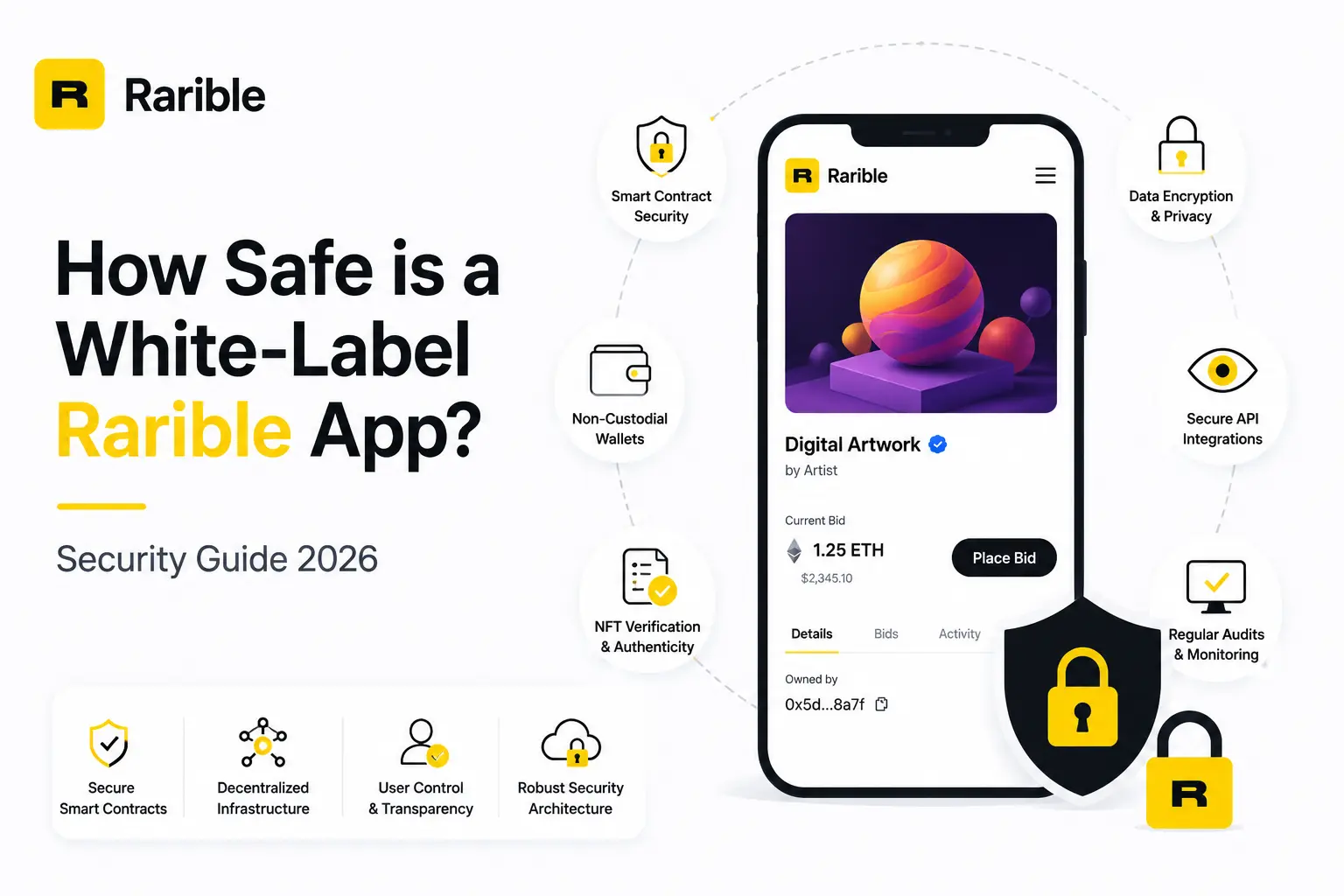
- A white-label Rarible app can be safe with strong NFT marketplace security.
- Smart contract safety is critical for NFT ownership and transactions.
- Wallet protection matters for user trust and secure trading.
- Admin controls help manage creators, listings, disputes, and fraud.
- Regular audits reduce risks from bugs, attacks, and weak code.
What You’ll Learn
- How safe a white-label Rarible app can be for NFT businesses.
- Key risks include wallet attacks, fake NFTs, fraud, and data leaks.
- Security features include encryption, secure login, and verified contracts.
- Marketplace protection helps secure buyers, sellers, and creators.
- Platform safety depends on code quality, audits, hosting, and monitoring.
Real Insights
- NFT security is not optional when users trade digital assets.
- Smart contract audits build trust before marketplace launch.
- Creator verification helps reduce fake listings and fraud.
- Secure payments improve confidence for buyers and sellers.
- The best strategy is to launch with audited code, secure wallets, and ongoing monitoring.
You’ve heard the horror stories about NFT marketplace hacks, wallet drains, and smart contract exploits.
In 2026, security is no longer optional for blockchain platforms. It is the foundation of user trust. One vulnerability in your white-label Rarible app can lead to stolen NFTs, drained wallets, regulatory penalties, and irreversible brand damage.
The NFT market is maturing, but threats are evolving faster. Phishing attacks, smart contract bugs, API exploits, and compliance violations are now common risks in Web3 platforms.
So the real question is not just “Is white-label Rarible app safe?”
The real question is “Is your provider building it with enterprise-grade security?”
In this guide, we’ll give you:
- An honest assessment of white-label Rarible app security risks
- The latest 2026 compliance and blockchain security standards
- A practical checklist to evaluate providers
- And how Miracuves delivers security-first NFT marketplace solutions
Planning to build in this space? Miracuves offers a ready-made NFT marketplace platform that you can launch under your own brand.
Understanding White-Label Rarible App Security Landscape
What “White-Label Security” Actually Means
A white-label Rarible app is a pre-built NFT marketplace solution customized under your brand.
But security depends on:
- The base smart contract architecture
- Backend infrastructure configuration
- Blockchain integration model
- Wallet authentication systems
- Compliance framework implementation
White-label does not mean lower security.
It means security depends entirely on the development partner.
A serious provider builds security into the architecture. A cheap vendor treats it as an add-on.
Common Security Myths vs Reality
| Myth | Reality in 2026 |
|---|---|
| White-label apps are always insecure | Security depends on code audits and infrastructure setup |
| Blockchain makes everything automatically safe | Smart contracts can still be exploited |
| NFT platforms don’t need compliance | AML, KYC, GDPR now apply in many regions |
| Open-source contracts are safe by default | Poor implementation causes major vulnerabilities |
Why People Worry About White-Label NFT Apps
Concerns are valid.
NFT marketplaces handle:
- High-value digital assets
- Crypto payments
- Wallet integrations
- Personal user data
- Cross-border transactions
One breach can cause irreversible loss. Unlike banks, blockchain transactions are often non-reversible.
That fear drives questions like:
- Is white-label Rarible app secure enough?
- Who audits the smart contracts?
- What happens if the platform is hacked?
These are the right questions to ask.
Current Threat Landscape for NFT Marketplace Platforms in 2026
The NFT ecosystem has faced significant attacks over the past few years.
According to recent blockchain security reports:
- Billions of dollars have been lost globally due to DeFi and smart contract exploits.
- Phishing attacks targeting NFT holders remain one of the most common threats.
- Rug pulls and marketplace vulnerabilities continue to impact smaller platforms.
- API and backend misconfigurations are rising in white-label Web3 apps.
Major risks specific to Rarible-style platforms include:
- Smart contract logic flaws
- Wallet signature manipulation
- Malicious NFT listings
- Metadata tampering
- Insider threats
- Front-end injection attacks
Security in 2026 must address both on-chain and off-chain vulnerabilities.
Security Standards in 2026 for NFT Platforms
Modern white-label Rarible app security must align with:
- Smart contract auditing standards
- SOC 2 Type II for backend systems
- ISO 27001 information security controls
- GDPR and global privacy laws
- PCI DSS for fiat payment gateways
- FATF Travel Rule compliance for crypto transactions
Web3 is no longer unregulated. Governments worldwide are tightening compliance requirements.
Real-World NFT & Web3 Security Statistics
Recent industry reports show:
- Crypto-related cybercrime continues to represent billions in annual losses globally.
- Smart contract vulnerabilities remain a leading cause of blockchain exploits.
- Phishing remains the #1 cause of NFT theft.
- Nearly half of Web3 startups fail basic security audit requirements before launch.
This makes one thing clear:
A white-label Rarible app is only as safe as its architecture, audit process, and compliance strategy.
Read more : – Rarible App Marketing Strategy That Actually Works
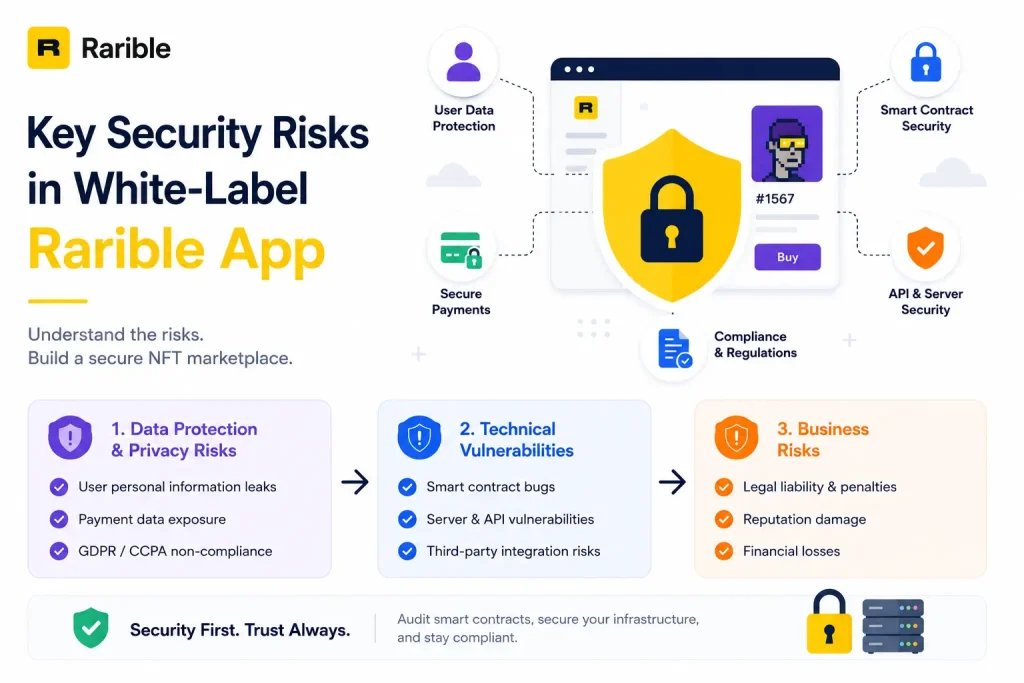
Key Security Risks & How to Identify Them
/
Launching a white-label Rarible app without understanding the risks is like opening a bank without vault protection.
NFT marketplaces combine blockchain, payments, APIs, and user data. That creates multiple attack surfaces.
Let’s break them down clearly.
Data Protection & Privacy Risks
User Personal Information
Even Web3 platforms collect data:
- Email addresses
- IP logs
- Wallet addresses
- KYC details (if enabled)
If stored improperly, this data becomes a major liability under GDPR, CCPA, and other 2026 privacy laws.
What to check:
- Is user data encrypted at rest?
- Are servers regionally compliant?
- Is there a defined data retention policy?
Payment Data Security
Many NFT apps now integrate:
- Crypto wallets
- Fiat on-ramps
- Credit/debit payments
Without PCI DSS compliance, payment data exposure can lead to massive penalties.
Warning sign:
If the provider cannot explain their PCI architecture, walk away.
Location Tracking & Metadata Concerns
NFT apps often track:
- User device information
- Geolocation (for compliance)
- NFT metadata stored off-chain
Improper storage of metadata can allow:
- NFT manipulation
- Broken token references
- Malicious content injection
GDPR / CCPA Compliance
In 2026, regulators are stricter about:
- User consent tracking
- Right to be forgotten
- Data portability
- Transparent privacy policies
Many white-label providers ignore these requirements. That creates long-term legal risk.
Technical Vulnerabilities
Code Quality Issues
Smart contracts with minor logic flaws can result in:
- Unauthorized minting
- Token duplication
- Fund mismanagement
Without third-party audits, this risk increases dramatically.
Server Security Gaps
Even if blockchain is secure, backend servers may not be.
Risks include:
- Misconfigured cloud storage
- Weak admin access controls
- Unpatched software
- Exposed databases
Most NFT platform breaches occur off-chain, not on-chain.
API Vulnerabilities
NFT apps rely heavily on APIs for:
- Blockchain interactions
- Wallet connections
- Metadata retrieval
- User dashboards
Poorly secured APIs allow:
- Data scraping
- Transaction manipulation
- Account takeover
Third-Party Integrations
White-label Rarible apps integrate:
- Wallet providers
- Payment gateways
- Analytics tools
- KYC vendors
Each integration increases risk.
If third-party vendors lack compliance certifications, your app inherits that risk.
Business Risks
Security is not just technical. It is financial and legal.
Legal Liability
If user funds are stolen, you may face:
- Lawsuits
- Regulatory investigation
- Platform shutdown
Reputation Damage
In NFT markets, trust spreads fast — but so does fear.
One breach can permanently damage your brand.
Financial Losses
Costs may include:
- Refunds
- Legal fees
- Compliance fines
- Insurance claims
- Platform downtime
Regulatory Penalties
In 2026, non-compliance penalties under GDPR can reach significant percentages of annual revenue.
Crypto AML violations can also trigger multi-million-dollar fines depending on jurisdiction.
White-Label Rarible App Risk Assessment Checklist
Use this before selecting a provider:
- Are smart contracts audited by a recognized security firm?
- Is backend infrastructure SOC 2 compliant?
- Is data encrypted at rest and in transit?
- Is there a documented incident response plan?
- Are APIs protected with authentication and rate limiting?
- Is PCI DSS followed for fiat transactions?
- Are regular penetration tests conducted?
- Is there cyber liability insurance coverage?
If more than two answers are unclear, the risk level is high.
Security must be proactive, not reactive.
Security Standards Your White-Label Rarible App Must Meet
In 2026, launching an NFT marketplace without formal security standards is not acceptable.
Investors, regulators, and users expect structured compliance. A serious white-label Rarible app must align with internationally recognized certifications and technical safeguards.
Essential Certifications
ISO 27001 Compliance
ISO 27001 ensures:
- Structured information security management
- Risk assessment frameworks
- Access control policies
- Continuous monitoring processes
If your provider cannot demonstrate ISO-aligned practices, internal controls may be weak.
SOC 2 Type II
SOC 2 Type II verifies:
- Security
- Availability
- Confidentiality
- Processing integrity
For NFT platforms handling high-value assets, SOC 2 is becoming a baseline requirement in 2026.
GDPR Compliance
If your platform serves EU users, GDPR requires:
- Explicit consent mechanisms
- Data portability
- Right to erasure
- Transparent data usage
Failure to comply can result in heavy fines based on annual global revenue.
HIPAA (If Applicable)
If your NFT marketplace integrates healthcare NFTs or tokenized medical records, HIPAA compliance becomes mandatory in the United States.
Most NFT apps don’t require this — but niche platforms might.
PCI DSS for Payments
If your white-label Rarible app supports fiat transactions:
- Credit card data must follow PCI DSS standards
- Payment processing must use secure gateways
- Card data must never be stored improperly
Ignoring PCI requirements can lead to immediate payment processing bans.
Technical Requirements
Certifications are not enough. Technical architecture matters more.
End-to-End Encryption
- HTTPS with strong TLS encryption
- Encrypted wallet communications
- Secure database encryption
Both in transit and at rest encryption must be standard.
Secure Authentication (2FA / OAuth)
Modern NFT apps must support:
- Two-factor authentication
- OAuth-based login
- Secure wallet signature verification
- Admin-level multi-factor protection
Admin panel compromise is one of the most common entry points.
Regular Security Audits
Smart contracts and backend code must be:
- Audited before launch
- Re-audited after updates
- Reviewed annually
In Web3, code is law. Bugs are expensive.
Penetration Testing
External ethical hackers should test:
- Admin panels
- APIs
- Wallet flows
- Payment systems
At least once per year in 2026 — ideally twice.
SSL Certificates
SSL is basic but critical.
- Valid SSL certificates
- HSTS enabled
- No mixed content vulnerabilities
Without proper SSL configuration, even secure systems become vulnerable.
Secure API Design
APIs must include:
- Authentication tokens
- Rate limiting
- Input validation
- Logging and monitoring
Most white-label security failures happen at the API layer.
Security Standards Comparison Table
| Standard | Why It Matters | Mandatory in 2026? | Applies To |
|---|---|---|---|
| ISO 27001 | Information security management | Strongly Recommended | All NFT platforms |
| SOC 2 Type II | Backend trust & controls | Increasingly Expected | SaaS & Web3 apps |
| GDPR | Data privacy regulation | Mandatory (EU users) | Global platforms |
| PCI DSS | Payment data protection | Mandatory (Fiat support) | Payment-enabled apps |
| Smart Contract Audit | Blockchain security | Critical | All NFT marketplaces |
| Penetration Testing | Vulnerability detection | Highly Recommended | All platforms |
If your provider cannot clearly explain how they meet these standards, that is a risk indicator.
Security in 2026 is about layered protection — compliance, encryption, audits, monitoring, and governance working together.
Red Flags: How to Spot Unsafe White-Label Providers
Not every white-label Rarible app provider builds with security in mind.
Some focus only on fast delivery and low cost. That shortcut often becomes your long-term liability.
Here are the warning signs you should never ignore.
No Security Documentation
If a provider cannot share:
- Security architecture overview
- Audit reports
- Compliance certificates
- Data protection policy
It means security was likely never formalized.
Cheap Pricing Without Explanation
Enterprise-grade security involves:
- Audits
- Compliance processes
- Infrastructure hardening
- Ongoing monitoring
If pricing seems unrealistically low, ask what has been removed. It is often security layers.
No Compliance Certifications
In 2026, a serious NFT marketplace provider should at least align with:
- ISO 27001 practices
- SOC 2 controls
- GDPR readiness
No documentation means higher regulatory exposure for you.
Outdated Technology Stack
Security depends on modern frameworks.
Red flags include:
- Unsupported blockchain libraries
- Outdated smart contract standards
- Old backend frameworks
- No update roadmap
Outdated tech equals higher exploit risk.
Poor Code Quality
Ask whether:
- Smart contracts are independently audited
- Code reviews are mandatory
- Secure coding standards are followed
Low-quality code is one of the biggest causes of NFT exploits.
No Security Updates Policy
Cyber threats evolve constantly.
If the provider cannot explain:
- Patch management cycles
- Vulnerability response timelines
- Update procedures
Your platform may fall behind quickly.
Lack of Data Backup Systems
Even blockchain platforms rely on off-chain infrastructure.
You need:
- Automated backups
- Disaster recovery planning
- Recovery time objectives
No backup plan means extended downtime after incidents.
No Insurance Coverage
Professional providers carry:
- Cyber liability insurance
- Errors & omissions coverage
If they do not, financial recovery after an incident becomes harder.
Evaluation Checklist Before Selecting a Provider
Use this structured approach.
Questions to Ask Providers
- Who audits your smart contracts?
- How often are penetration tests conducted?
- Are you GDPR compliant by design?
- How is wallet authentication secured?
- Do you offer incident response support?
- What insurance coverage do you maintain?
If answers are vague, dig deeper.
Documents to Request
- Smart contract audit report
- Penetration testing summary
- Security policy documentation
- Compliance certificates
- Data processing agreement template
Review them carefully, not just visually.
Testing Procedures
Before launch, ensure:
- Staging environment testing
- Vulnerability scanning
- Wallet transaction simulations
- Load testing under peak traffic
Security failures often appear under stress conditions.
Due Diligence Steps
- Verify third-party integrations.
- Confirm cloud hosting standards.
- Check blockchain compatibility security.
- Review update and maintenance contracts.
- Evaluate their past project history.
A white-label Rarible app is not risky by default.
Best Practices for Secure White-Label Rarible App Implementation
Security is not something you “add later.”
It must be embedded before launch and maintained continuously after deployment.
A white-label Rarible app that follows structured implementation practices dramatically reduces risk.
Pre-Launch Security
Security Audit Process
Before going live:
- Conduct third-party smart contract audits
- Perform backend security review
- Run vulnerability scans
- Fix all critical and high-risk findings
No NFT marketplace should launch without audit clearance in 2026.
Code Review Requirements
Secure development requires:
- Peer-reviewed smart contracts
- Static code analysis tools
- Secure coding guidelines
- Version control management
Unreviewed code is one of the top causes of Web3 breaches.
Infrastructure Hardening
Your hosting setup must include:
- Secure cloud configuration
- Firewall implementation
- Intrusion detection systems
- DDoS protection
- Role-based access control
Most NFT platform hacks occur due to weak server configurations, not blockchain flaws.
Compliance Verification
Before public access:
- Validate GDPR readiness
- Confirm PCI DSS integration (if fiat enabled)
- Review AML/KYC processes if required
- Finalize privacy policy and terms
Compliance gaps create long-term legal exposure.
Staff Training Programs
Human error remains a major risk.
Train your team on:
- Phishing detection
- Wallet security practices
- Admin panel protection
- Incident reporting process
Internal access misuse is often overlooked in NFT platforms.
Post-Launch Monitoring
Security does not stop after deployment.
Continuous Security Monitoring
Implement:
- Real-time log monitoring
- Suspicious transaction alerts
- API abuse detection
- Admin activity tracking
Early detection prevents large-scale damage.
Regular Updates and Patches
Maintain:
- Smart contract updates (when required)
- Backend framework upgrades
- Security patch schedules
- Third-party integration reviews
Outdated systems are easy targets.
Incident Response Planning
Have a clear plan covering:
- Breach identification
- Communication strategy
- User notification protocol
- Regulatory reporting
- System recovery steps
In 2026, regulators expect formal incident documentation.
User Data Management
Ensure:
- Controlled access to sensitive data
- Encrypted backups
- Defined retention timelines
- Right-to-delete workflows
Data mishandling leads to regulatory penalties.
Backup and Recovery Systems
You must define:
- Recovery Time Objective (RTO)
- Recovery Point Objective (RPO)
- Automated backup schedules
- Disaster recovery simulations
Downtime equals revenue loss and trust damage.
Security Implementation
| Phase | Key Actions |
|---|---|
| Planning | Risk assessment, compliance mapping |
| Development | Secure coding, architecture design |
| Pre-Launch | Audits, penetration testing, fixes |
| Launch | Monitoring setup, live deployment |
| Ongoing | Continuous monitoring & updates |
A properly implemented white-label Rarible app is not just functional.
It is resilient.
Legal & Compliance Considerations
NFT marketplaces are no longer operating in a regulatory gray area.
In 2026, governments worldwide have introduced stricter oversight for crypto platforms, digital assets, and data privacy. A white-label Rarible app must align with evolving global regulations.
Ignoring legal compliance is one of the biggest business risks.
Regulatory Requirements
Data Protection Laws by Region
Different regions enforce different privacy standards:
- European Union: GDPR (strict consent, data deletion, cross-border transfer controls)
- United States: CCPA/CPRA and emerging state-level privacy laws
- United Kingdom: UK GDPR
- UAE & Middle East: Data protection frameworks aligned with international standards
- Asia-Pacific: PDPA-style regulations in multiple countries
If your NFT platform collects user data, these laws apply.
Industry-Specific Regulations
Depending on your NFT marketplace model, you may need:
- AML (Anti-Money Laundering) compliance
- KYC (Know Your Customer) verification
- FATF Travel Rule adherence
- Financial transaction monitoring
Some jurisdictions classify NFT marketplaces as virtual asset service providers (VASPs). That triggers additional reporting obligations.
User Consent Management
In 2026, consent must be:
- Explicit
- Recorded
- Withdrawable
- Transparent
Cookie banners alone are not enough. You must log and store consent records securely.
Privacy Policy Requirements
Your white-label Rarible app must clearly disclose:
- What data is collected
- Why it is collected
- How long it is stored
- Who it is shared with
- User rights
Generic templates often fail compliance checks.
Terms of Service Essentials
Strong terms of service should include:
- Platform liability limitations
- NFT ownership clarification
- Dispute resolution mechanism
- Smart contract risk disclosures
- User responsibility clauses
Without this, you expose your business to legal disputes.
Liability Protection
Security and compliance are also about risk management.
Insurance Requirements
Serious NFT platforms carry:
- Cyber liability insurance
- Professional indemnity insurance
- Directors and officers coverage (if scaling)
Insurance helps mitigate financial damage after breaches.
Legal Disclaimers
Clear disclaimers should cover:
- Volatility of digital assets
- Blockchain transaction irreversibility
- Third-party wallet risks
- Smart contract limitations
Transparency reduces legal exposure.
User Agreements
Every user interaction must be backed by:
- Accepted terms confirmation
- Privacy acknowledgment
- Risk disclosures
Digital acceptance logs should be stored securely.
Incident Reporting Protocols
Many regions now require:
- Timely breach reporting
- User notification within defined timelines
- Regulatory authority reporting
Delays can result in heavy fines.
Regulatory Compliance Monitoring
Compliance is not one-time.
You need:
- Periodic legal reviews
- Policy updates
- Regulatory monitoring
- Cross-border compliance evaluation
Laws evolve quickly in the crypto space.
Compliance Checklist by Region
| Region | Key Regulations | Mandatory for NFT Apps? |
|---|---|---|
| EU | GDPR, AMLD | Yes, if serving EU users |
| USA | CCPA/CPRA, FinCEN AML | Yes, depending on model |
| UK | UK GDPR | Yes |
| UAE | Data Protection Law | Yes |
| Asia-Pacific | PDPA equivalents | Yes |
A compliant white-label Rarible app protects not only user data but also your long-term business viability.
Read more : – How to Develop Rarible App Alternative
Why Miracuves White-Label Rarible App is Your Safest Choice
Security is not a feature at Miracuves.
It is the foundation of every white-label Rarible app we build.
In 2026, NFT marketplaces require enterprise-grade protection, regulatory alignment, and proactive monitoring. Miracuves delivers all three by default.
Miracuves Security Advantages
Enterprise-Grade Security Architecture
Our white-label Rarible app solutions are built with:
- Secure smart contract frameworks
- Layered backend protection
- Role-based admin access control
- Hardened cloud infrastructure
Security is embedded into the architecture, not added later.
Regular Security Audits and Certifications
We follow structured compliance practices aligned with:
- ISO 27001 security controls
- SOC 2 security principles
- GDPR-ready data frameworks
Smart contracts undergo rigorous review before deployment.
GDPR / CCPA Compliant by Default
Miracuves platforms include:
- Consent management modules
- Data export and deletion workflows
- Transparent data handling systems
- Region-aware privacy controls
You stay compliant across jurisdictions.
24/7 Security Monitoring
Our infrastructure includes:
- Real-time log monitoring
- Suspicious activity alerts
- API abuse detection
- Admin activity tracking
Threat detection is proactive, not reactive.
Encrypted Data Transmission
All data is protected with:
- Strong TLS encryption
- Encrypted database storage
- Secure wallet communication layers
User information and transactions remain protected end-to-end.
Secure Payment Processing
For NFT marketplaces integrating fiat payments:
- PCI-aligned payment gateway integration
- Tokenized transaction handling
- No direct card data storage
Payment security is handled responsibly.
Regular Security Updates
Cyber threats evolve constantly.
We provide:
- Scheduled security patches
- Framework upgrades
- Smart contract optimization reviews
- Ongoing vulnerability scanning
Your platform remains protected beyond launch.
Insurance Coverage Included
Risk management is part of responsible development.
Miracuves operates with structured risk mitigation policies to protect clients from unexpected exposure.
Built for Long-Term Trust
With 600+ successful projects delivered, Miracuves maintains a strong track record of security-focused implementations.
Our approach ensures:
- Reduced legal risk
- Regulatory alignment
- Investor confidence
- User trust
Final Thought
Security-first development is one of the biggest reasons businesses choose Miracuves for NFT marketplace solutions. In a space where users trade digital assets, connect crypto wallets, manage transactions, and trust the platform with ownership records, security cannot be treated as an optional feature.
Miracuves white-label Rarible app solutions are built with enterprise-grade security layers to protect users, transactions, wallets, smart contract interactions, and marketplace operations. From secure authentication and encrypted data handling to role-based access, transaction monitoring, and reliable backend architecture, the platform is designed to support safer NFT trading experiences.
With experience across 9k+ successful projects and a record of zero major security breaches, Miracuves helps businesses launch NFT marketplace platforms with stronger confidence, better protection, and a scalable foundation for long-term growth.
Get a free security assessment and see why businesses trust Miracuves for safe, compliant platforms A white-label Rarible app is safe in 2026 only when security, compliance, and monitoring are built into its foundation.
FAQs
1. How secure is white-label Rarible app vs custom development?
Security depends on implementation. A professionally built white-label Rarible app with audited smart contracts and compliant infrastructure can be as secure as custom development.
2. What happens if there is a security breach?
A proper setup includes incident response, user notification protocols, legal reporting, and recovery systems. Without preparation, financial and legal damage increases.
3. Who is responsible for security updates?
Responsibility depends on your agreement. A reliable provider like Miracuves offers ongoing updates, monitoring, and patch management support.
4. How is user data protected in white-label NFT apps?
Through encryption, access control, secure servers, GDPR-compliant data handling, and regular audits.
5. What compliance certifications should I look for?
ISO 27001 alignment, SOC 2 Type II controls, GDPR readiness, PCI DSS (if payments enabled), and smart contract audit reports.
6. Can white-label Rarible apps meet enterprise security standards?
Yes, if built with layered security architecture, penetration testing, and continuous monitoring in place.
7. How often should security audits be conducted?
At least annually, and after every major smart contract or infrastructure update in 2026.
8. What’s included in Miracuves security package?
Smart contract review, encrypted infrastructure, compliance-ready framework, monitoring setup, and structured update cycles.
9. How to handle security in different countries?
Implement region-specific compliance modules, privacy controls, AML/KYC integration where required, and local legal review.
10. What insurance is needed for app security?
Cyber liability insurance and professional indemnity coverage are strongly recommended for NFT marketplace operators.
Related Articles
Miracuves is an independent software development company. We are not affiliated with, connected to, sponsored by, or endorsed by any company or product named in this article.
Terms such as “X Clone” are used descriptively. It is how the software industry refers to building a platform with functionality comparable to a known service, and how clients search for it.
The entire design and codebase of our products is built by our own team. Our products contain no code, design, graphics, or content originating from any third-party website or applications.
All third-party names and marks referenced in this article are the property of their respective owners, referenced solely to identify the services discussed.