
A yacht marketplace is not just a place where buyers browse listings. It is a high-value sales environment where every serious inquiry can represent a premium buyer, a future commission opportunity, and long-term trust between the platform, broker, and seller.
That is why broker response time matters.
When a buyer asks about a yacht, they may want details about condition, viewing availability, survey history, marina location, financing, transport, or similar vessels. If the broker responds late, misses the inquiry, or handles it without proper follow-up, the platform loses more than one lead. It loses buyer confidence.
Response-time analytics helps solve this problem by showing exactly how leads move through the broker workflow. It helps marketplace operators track who received the inquiry, when the broker opened it, how quickly they replied, whether the buyer was followed up, and where delays happen.
For founders planning a yacht marketplace platform, this is not just an analytics feature. It is an accountability system.
Key Takeaways
- Yacht marketplace response-time analytics helps platform operators measure how quickly brokers handle buyer inquiries.
- Broker accountability improves when every lead has ownership, timestamps, response history, and follow-up status.
- Slow broker response can reduce buyer trust, seller confidence, and platform revenue potential.
- Admin dashboards should track first response time, unanswered leads, broker workload, escalation status, and lead stage movement.
- Miracuves helps founders build white-label marketplace platforms with source-code ownership, admin control, and broker-ready workflows.
Why Broker Accountability Matters in a Yacht Marketplace
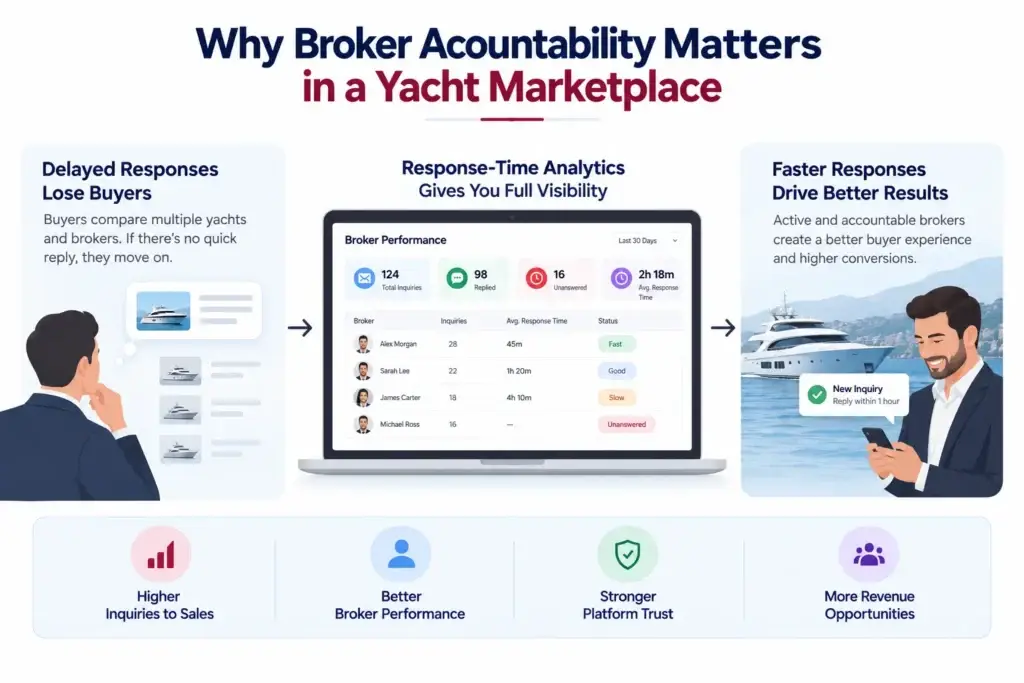
In yacht sales, delayed responses can be costly.
A buyer may already be comparing multiple vessels, contacting different brokers, arranging financing, or planning a viewing. If their inquiry is not answered quickly, they may move to another listing or another platform.
The bigger issue is visibility.
Without response-time analytics, a marketplace operator may not know whether a broker received the lead, opened it, replied to it, ignored it, or lost it during follow-up. This creates operational blind spots.
A founder should be able to answer questions such as:
- Which broker received the inquiry?
- Was the lead opened?
- How long did the broker take to reply?
- Which leads are still unanswered?
- Which brokers respond fastest?
- Which offices or regions have the most delays?
- Which high-intent buyers need admin escalation?
If the platform cannot answer these questions, broker performance depends on manual updates and assumptions. That is risky for a premium marketplace model.
What Response-Time Analytics Means for Yacht Marketplaces
Response-time analytics measures the time between a buyer action and a broker action.
In a yacht marketplace, this should cover the full inquiry journey. It should not stop at counting how many forms were submitted.
A strong response-time analytics workflow may track:
- When the buyer submits an inquiry
- When the inquiry is assigned to a broker
- When the broker receives the notification
- When the broker opens the inquiry
- When the first reply is sent
- Whether the buyer responds again
- Whether a call, viewing, or follow-up task is created
- Whether the lead moves into qualified, nurture, offer, lost, or closed status
This gives the platform a clearer picture of broker performance.
A marketplace may generate many inquiries, but that does not always mean the business is working well. The stronger question is whether those inquiries are being handled quickly, professionally, and consistently.
Core Response-Time Metrics Every Yacht Marketplace Should Track
Response-Time Metrics and Their Business Value
| Metric | What It Measures | Why It Matters |
|---|---|---|
| Time to Assignment | How long it takes for a buyer inquiry to be assigned to a broker. | Shows whether lead routing is fast enough before broker follow-up begins. |
| Time to First View | How quickly the broker opens the assigned lead. | Reveals whether brokers are noticing and acting on new inquiries. |
| Time to First Reply | How long the buyer waits before receiving the first meaningful response. | Directly affects buyer trust and inquiry momentum. |
| Unanswered Lead Count | How many leads have not received any broker response. | Helps admins identify missed opportunities before they become lost leads. |
| Broker Response Score | Average response performance by broker, team, office, or region. | Creates measurable accountability across the broker network. |
| Lead Stage Delay | How long a lead stays stuck in one pipeline stage. | Shows where qualification, viewing coordination, or follow-up is slowing down. |
| Escalation Time | How quickly delayed or high-intent leads are escalated. | Protects premium inquiries and serious buyers from being ignored. |
These metrics help founders move from basic reporting to operational control.
The goal is not to punish brokers. The goal is to make lead handling visible enough that brokers, managers, and platform operators can improve it.
Read more: How Does a Yacht Marketplace Platform Turn Buyer Inquiries Into Qualified Broker Leads?
How Response-Time Analytics Improves Broker Behavior
Broker accountability improves when performance becomes visible.
If every inquiry has a timestamp, owner, response status, and follow-up history, brokers are more likely to treat each lead as a measurable opportunity rather than a message sitting inside an inbox.
Response-time analytics improves broker behavior in several practical ways.
It Creates Clear Lead Ownership
Every buyer inquiry should have a responsible owner.
The platform can assign leads based on listing ownership, vessel category, broker availability, location, buyer region, language preference, or office rules.
Clear ownership prevents confusion. Brokers know which leads belong to them, managers know who is responsible, and admins can see where delays happen.
It Helps Brokers Prioritize High-Intent Buyers
Not every inquiry has the same urgency.
A buyer asking for a viewing, financing information, survey details, or transport options may be more serious than someone asking a general question.
Response-time analytics can help identify high-intent leads based on signals such as:
- Viewing requests
- Repeat visits to the same yacht listing
- Saved or compared vessels
- Budget-related questions
- Finance or insurance questions
- Location and marina inquiries
- Premium listing inquiries
This allows brokers to prioritize leads based on buyer intent, not just inquiry order.
It Helps Managers Coach Brokers With Real Data
Broker managers need more than assumptions.
A response-time dashboard can show whether a broker is overloaded, missing notifications, replying late, or failing to move leads forward.
Instead of saying, “You need to follow up faster,” a manager can say, “Your first response time is slower than the team average, and most delays happen after evening inquiries.”
That kind of feedback is specific, measurable, and easier to act on.
It Improves Seller Confidence
Sellers want to know that their yacht is being handled professionally.
A marketplace can show inquiry volume, buyer interest, broker response activity, and follow-up progress. This helps sellers feel more confident that their listing is not just visible but actively managed.
For premium listings, broker accountability becomes even more important because sellers expect structured communication and clear reporting.
It Supports Marketplace Monetization
Broker accountability also affects revenue.
A yacht marketplace may earn through broker subscriptions, featured listings, premium placements, service referrals, regional partnerships, or lead-based monetization.
These revenue streams become stronger when the platform can prove that buyer inquiries are being captured, routed, tracked, and followed up.
Founders planning revenue streams can explore this related guide on the marine marketplace business model to understand how listing upgrades, broker subscriptions, and service lead fees can work together.
Admin Dashboards Should Track Accountability, Not Just Activity
Basic analytics show page views, clicks, and form submissions. That is useful, but it is not enough.
A yacht marketplace needs admin dashboards that show whether the marketplace is operating properly.
Admins should be able to track:
- Total buyer inquiries
- Qualified and unqualified inquiries
- Lead source by listing, broker, region, or campaign
- Average time to assignment
- Average time to first view
- Average time to first reply
- Unanswered leads by broker
- Overdue follow-up tasks
- Lead conversion by pipeline stage
- Lost lead reasons
- Broker workload distribution
- Escalated leads and resolution status
This gives the platform operator a proper control layer.
Without this visibility, the marketplace may look successful because listings are getting views, while serious buyer inquiries are being mishandled behind the scenes.
For founders comparing platform modules, this yacht marketplace feature breakdown explains how listings, search, leads, CRM, service queues, and admin workflows can fit into a broker-ready marketplace foundation.
Escalation Rules Turn Analytics Into Action
Analytics becomes valuable when it leads to action.
A dashboard that shows slow response time is useful. But a system that alerts the right person before the lead is lost is much stronger.
Yacht marketplace platforms can use escalation rules such as:
- Notify the broker again if a new lead is not opened within a defined time.
- Alert the manager if the lead is not answered within the expected window.
- Reassign high-value inquiries to a backup broker if the original broker is unavailable.
- Flag repeated response delays in broker performance reports.
- Mark a buyer as urgent if they send multiple messages without a reply.
- Notify the admin if a premium listing receives poor follow-up.
Different lead types may need different response expectations.
A general inquiry may not need the same urgency as a viewing request, finance-related question, premium listing inquiry, or repeat buyer message.
This is where the marketplace becomes more than a listing platform. It becomes broker operations software.
Founder Decision Signals
Speed
If brokers currently manage inquiries through email, calls, or scattered messages, response-time analytics can make lead handling faster and easier to monitor.
Cost
Broker analytics should be planned early because CRM logic, notifications, dashboards, timestamps, and escalation rules can affect development scope.
Scalability
If the platform will support many brokers, offices, regions, or service partners, lead assignment and response tracking should be built into the backend from the start.
Market Fit
If buyers expect human guidance before purchase, the marketplace needs strong broker workflows, not only search filters and listing pages.
What a Broker Dashboard Should Include
A broker dashboard should help brokers act faster.
It should not overwhelm them with unnecessary charts. The dashboard should clearly show what needs attention now.
Important broker dashboard elements include:
- New assigned leads
- Urgent buyer inquiries
- Unread leads
- Overdue replies
- Follow-up tasks
- Scheduled calls or viewings
- Buyer profile details
- Vessel interest history
- Notes and communication timeline
- Pipeline status
- Suggested next action
The best broker dashboard helps a broker quickly answer one question: “Which buyer needs my attention first?”
If the platform cannot answer that, brokers may return to personal inboxes, spreadsheets, and manual reminders. That weakens platform control.
How Response-Time Analytics Improves Buyer Experience
Broker accountability is not only an internal management issue. It directly affects the buyer experience.
A yacht buyer often needs personal guidance before making a decision. They may ask about vessel condition, ownership history, survey timelines, maintenance records, delivery options, or alternative yachts.
If the broker responds slowly or without context, the buyer may lose confidence.
Response-time analytics improves buyer experience by supporting:
- Faster first replies
- Better broker assignment
- More relevant follow-up
- Clear communication history
- Reduced duplicate questions
- Better alternative recommendations
- More consistent broker service
The buyer may never see the analytics dashboard, but they feel the result through faster, more professional communication.
Security and Privacy Considerations for Broker Analytics
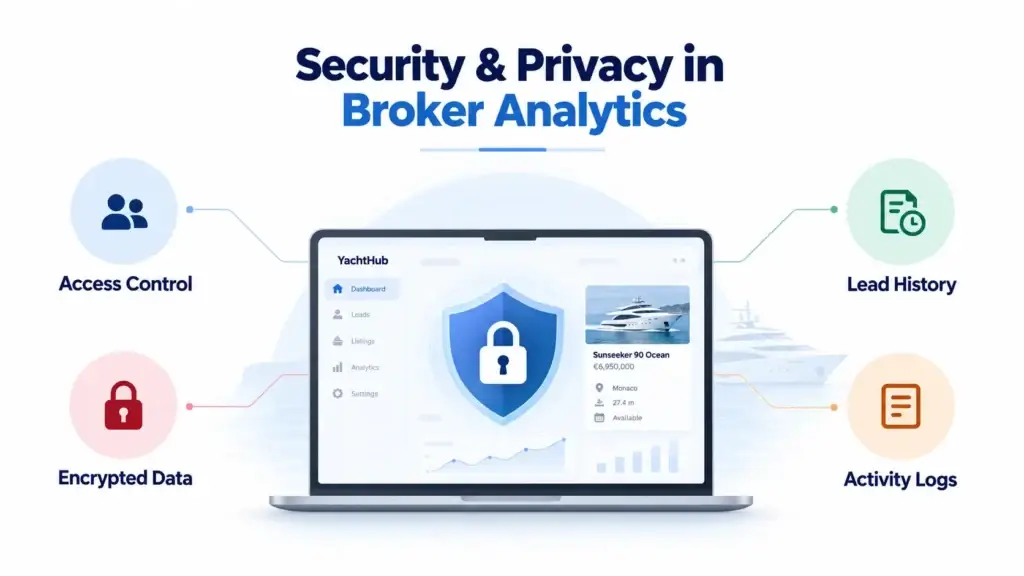
A yacht marketplace may store buyer contact details, budget range, vessel preferences, location interest, conversation history, viewing requests, broker notes, and finance-related inquiries.
That information should be protected carefully.
Important security controls include:
- Role-based access control
- Permission-based broker dashboards
- Encrypted data transfer
- Secure data storage
- Admin access controls
- Activity logs
- Lead assignment history
- Broker note visibility rules
- Spam and fake inquiry monitoring
- Data export or deletion workflows where relevant
Brokers should only access the lead information they need to handle their assigned buyers. Admins should be able to audit lead reassignment, broker activity, response history, and sensitive buyer interactions.
Security should be part of the platform foundation, not an afterthought.
Common Mistakes Founders Should Avoid
Mistakes Founders Should Avoid
Tracking only total inquiries
Total inquiry volume does not show whether brokers are responding quickly, qualifying buyers, or following up properly.
Using one shared inbox for all broker leads
A shared inbox makes ownership unclear. Every lead should have a broker, status, timestamp, and follow-up path.
Ignoring high-intent lead signals
Viewing requests, repeated listing visits, finance questions, and detailed buyer preferences should trigger stronger prioritization.
Adding analytics too late
Response-time analytics depends on backend events, CRM stages, notification logic, timestamps, and admin permissions. Planning it early helps avoid rework.
How Miracuves Helps Founders Build Broker-Ready Yacht Marketplaces
Miracuves helps founders build white-label marketplace platforms where listings, inquiries, broker workflows, CRM records, admin dashboards, and monetization controls work together.
For yacht marketplaces, the platform should not stop at search and listings. It should support the full lead lifecycle: inquiry capture, broker assignment, response tracking, follow-up reminders, pipeline movement, seller reporting, and admin visibility.
A ready-made marketplace foundation can help founders move faster because the core platform logic is already available. The product can then be customized around the target region, broker network, vessel categories, service partners, monetization strategy, and operational model.
For teams planning the build scope, this platform cost planning guide explains how features, integrations, CRM workflows, mobile scope, and infrastructure decisions can affect the final development cost.
Final Thoughts
Broker accountability is one of the most important operational layers in a yacht marketplace.
A platform can have strong listings, advanced filters, high-quality vessel galleries, and premium placement options. But if buyer inquiries are not assigned, opened, answered, tracked, and followed up, the marketplace will struggle to prove its value.
Response-time analytics gives founders visibility into broker behavior. It helps managers coach teams, protects high-intent inquiries, improves seller confidence, and turns lead management into a measurable workflow.
For yacht marketplace founders, the stronger decision is not to build only a listing platform. It is to build a broker-ready marketplace where every serious inquiry has ownership, urgency, context, and accountability.
FAQs
What is response-time analytics in a yacht marketplace?
Response-time analytics tracks how quickly brokers receive, open, respond to, and follow up on buyer inquiries. It helps marketplace operators understand whether leads are being handled properly.
Why is broker response time important in yacht sales?
Yacht buyers often need detailed guidance before making a decision. A slow broker response can reduce trust, weaken buyer momentum, and create missed sales opportunities.
What broker response metrics should a yacht marketplace track?
Important metrics include time to assignment, time to first view, time to first reply, unanswered leads, broker response score, overdue follow-ups, and lead stage delays.
How does response-time analytics improve broker accountability?
It creates visibility. Every inquiry has an owner, timestamp, response status, and follow-up history, making it easier for admins and managers to identify delays.
Should response-time analytics be included from the first platform version?
Yes, if broker-led sales are central to the marketplace. Adding analytics later can be harder because it depends on lead events, CRM stages, notifications, timestamps, and admin permissions.
Can response-time analytics help marketplace monetization?
Yes. Brokers and dealers are more likely to pay for subscriptions, premium listings, or lead access when the platform can show inquiry quality, response visibility, and pipeline activity.
What is the difference between traffic analytics and response-time analytics?
Traffic analytics shows visits, clicks, and page views. Response-time analytics shows whether buyer inquiries are being assigned, answered, escalated, and moved through the broker pipeline.
How can a yacht marketplace reduce missed broker leads?
A platform can reduce missed leads through automated lead routing, broker notifications, unanswered lead alerts, escalation rules, CRM tracking, and admin dashboards.
Miracuves is an independent software development company. We are not affiliated with, connected to, sponsored by, or endorsed by any company or product named in this article.
Terms such as “X Clone” are used descriptively. It is how the software industry refers to building a platform with functionality comparable to a known service, and how clients search for it.
The entire design and codebase of our products is built by our own team. Our products contain no code, design, graphics, or content originating from any third-party website or applications.
All third-party names and marks referenced in this article are the property of their respective owners, referenced solely to identify the services discussed.