






















Key Takeaways
- Yacht Marketplace Broker Leads become more valuable when buyer inquiries include vessel interest, budget, timeline, location, service needs, and behavioral context.
- A yacht marketplace should capture intent from direct inquiries as well as saved vessels, repeated views, comparisons, searches, and viewing requests.
- Lead qualification helps brokers separate serious buyers from casual browsers and prioritize high-intent opportunities faster.
- Lead routing should connect each inquiry with the right broker based on listing ownership, location, specialization, language, territory, or availability.
- Broker CRM, response-time tracking, pipeline stages, and admin reporting help turn individual inquiries into structured long-term sales relationships.
Lead Signals
- Repeated vessel views, saved listings, comparisons, price requests, and specification downloads can reveal buyer intent before direct contact.
- Budget range, buying timeline, intended use, location, finance interest, and survey requirements can strengthen lead qualification.
- Viewing requests, survey interest, and buyers who share budget and timeline generally indicate stronger purchase intent.
- Response-time analytics can identify unanswered inquiries, slow broker follow-up, and high-value leads that require escalation.
- Finance, insurance, survey, transport, valuation, charter, and maintenance inquiries can create additional qualified lead streams beyond vessel sales.
Real Insights
- Lead quality matters more than raw inquiry volume because yacht brokers need enough context to identify which buyers deserve immediate attention.
- Generic contact forms create extra qualification work; structured inquiry fields can give brokers useful context before the first conversation.
- The first yacht a buyer asks about may not be the vessel they eventually purchase, so brokers should be able to recommend relevant alternatives.
- A shared inbox is not enough for scalable lead management because ownership, response time, follow-up, and pipeline movement need to remain measurable.
- The strongest flow is: capture buyer behavior → collect inquiry context → qualify intent → score lead → route to the right broker → track response → manage CRM follow-up → recommend alternatives → move the opportunity through the sales pipeline.
A Yacht Marketplace Platform is not just a place where vessels are listed online. For brokers, dealers, and marine marketplace operators, its real business value comes from turning anonymous browsing into structured buyer intent.
A yacht buyer rarely makes a decision in one visit. They compare models, check specifications, review locations, ask about condition, request more details, discuss financing, and often involve family members, advisors, surveyors, captains, or business partners before moving forward. That means the inquiry is not the end of the journey. It is the beginning of a qualified sales workflow.
For founders building a yacht marketplace, the goal should not be to collect more contact forms. The goal should be to help brokers receive better leads, faster context, clearer intent, and a usable follow-up path.
This blog explains how a yacht marketplace can capture buyer inquiries, qualify them, route them to the right broker, and support the sales pipeline without becoming a generic listing directory.
Why Lead Quality Matters More Than Lead Volume in Yacht Sales
In low-ticket ecommerce, more leads often means more conversions. In yacht brokerage, that logic is incomplete.
A yacht inquiry can represent a serious buyer, a casual browser, a future buyer, a competitor, a broker researching inventory, or someone who likes looking at luxury vessels but has no purchase readiness. If every inquiry is treated the same, broker time gets wasted.
Qualified broker leads should help answer:
- What vessel is the buyer interested in?
- What budget range are they working with?
- Are they buying soon or researching for later?
- Do they need financing, insurance, survey, or transport support?
- Are they interested in similar vessels?
- What location or cruising region matters?
- Has the buyer viewed, saved, compared, or inquired before?
- Which broker should handle the conversation?
- Has the broker responded quickly?
A strong yacht marketplace does not only generate leads. It gives brokers enough context to decide which inquiries deserve immediate attention.
What Counts as a Buyer Inquiry in a Yacht Marketplace Platform?
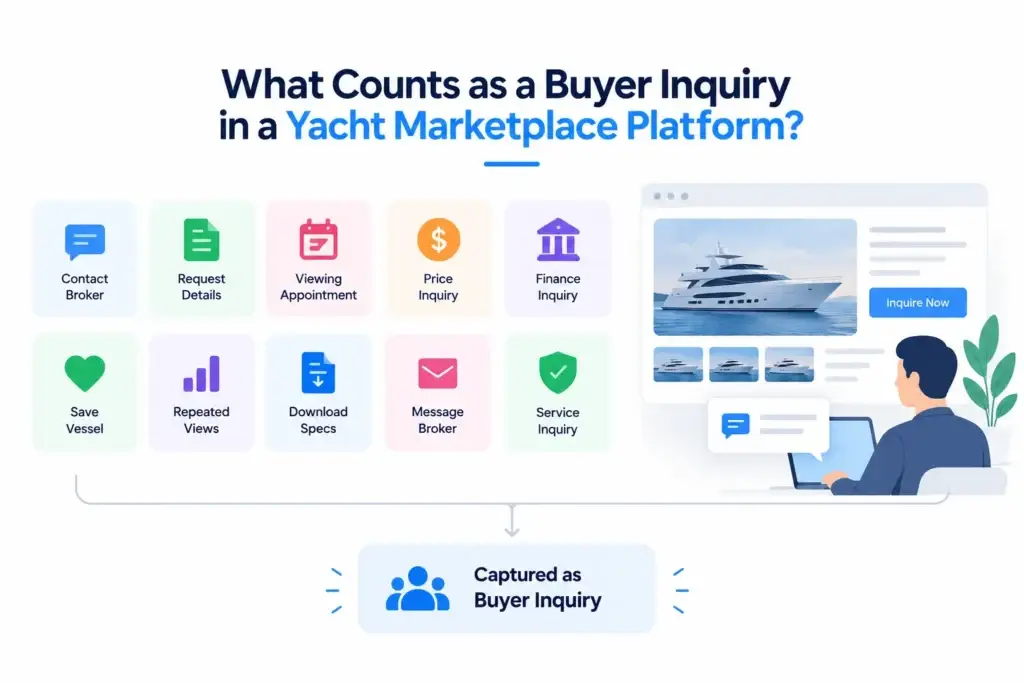
A buyer inquiry is any action that signals interest in a vessel, broker, seller, or marine service.
Some inquiries are direct. Others are behavioral signals that should be captured quietly in the background.
Common inquiry signals include:
- Contact broker form submission
- Request for more vessel details
- Viewing appointment request
- Sea trial interest
- Price inquiry
- Finance inquiry
- Trade-in request
- Saved search creation
- Favorite or shortlist action
- Repeated views on the same vessel
- Compare-list activity
- Downloaded specification sheet
- Message sent to broker
- Charter or service inquiry
- Insurance, survey, transport, or valuation request
The platform should not wait until a buyer fills out a long form. Buyer intent often appears gradually through repeated actions.
The Inquiry-to-Lead Conversion Flow
A Yacht Marketplace Platform should convert buyer activity into broker-ready leads through a clear workflow.
How Buyer Inquiries Become Qualified Broker Leads
| Stage | Platform Action | Broker Value |
|---|---|---|
| Discovery | Buyer searches by vessel type, length, brand, location, price, age, engine hours, or usage intent. | Shows what the buyer is actually looking for. |
| Engagement | Buyer views, saves, compares, revisits, or requests more details about listings. | Creates behavioral context before direct contact. |
| Inquiry Capture | Buyer submits a form, sends a message, requests viewing, or asks about finance, survey, transport, or valuation. | Turns interest into a record the broker can act on. |
| Qualification | Platform captures budget, timeline, location, buying purpose, vessel preferences, and readiness. | Helps brokers prioritize serious buyers. |
| Lead Routing | Inquiry is assigned based on vessel owner, broker territory, listing office, availability, or specialization. | Reduces delays and prevents leads from getting lost. |
| Broker Follow-Up | Broker receives listing context, buyer profile, inquiry source, notes, and response timeline. | Improves first response quality and sales continuity. |
| Pipeline Management | Lead moves through stages such as new, contacted, qualified, viewing, offer, negotiation, closed, or nurture. | Keeps the sales process visible and measurable. |
1. Specification-Rich Listings Help Buyers Pre-Qualify Themselves
A generic listing page creates weak inquiries because buyers do not have enough information before contacting a broker.
Yacht buyers need detail. A serious buyer may evaluate length, builder, model year, location, hull material, engine hours, cabin layout, refit history, survey status, flag, berth availability, price movement, usage type, and onboard systems before deciding whether to inquire.
A strong vessel listing should include:
- Vessel type
- Make and model
- Year
- Length, beam, draft, and displacement
- Engine type and hours
- Cabins and berths
- Hull material
- Location
- Price and currency
- Photo gallery
- Video tour
- Equipment details
- Ownership or condition notes where appropriate
- Broker details
- Similar vessel suggestions
- Inquiry and viewing options
This level of detail helps buyers self-filter. Instead of sending vague questions, they arrive with sharper intent.
2. Smart Search and Filters Reveal Buyer Intent
Search behavior is one of the earliest signs of buyer intent.
A buyer searching for “40-foot sailing yacht in Greece” is different from a buyer exploring “luxury motor yacht over 70 feet.” The platform should capture these search patterns because they help brokers understand what the buyer is trying to solve.
Useful search and filter signals include:
- Vessel category
- Brand or manufacturer
- Price range
- Length range
- Location or marina
- New vs pre-owned preference
- Engine type
- Cabin count
- Charter suitability
- Delivery region
- Saved search alerts
- Repeated search refinements
Search data becomes more powerful when connected with inquiry records. A broker should not only see that a buyer asked about one vessel. They should also see the broader buying pattern.
3. Inquiry Forms Should Qualify, Not Just Collect Contact Details
Many marketplace inquiry forms ask only for name, email, phone, and message. That creates extra work for brokers because they must manually qualify every lead.
A better yacht inquiry form should collect enough structured information without becoming too long.
Useful fields may include:
- Preferred contact method
- Buying timeline
- Approximate budget range
- Current ownership status
- Trade-in interest
- Intended use: private, charter, liveaboard, business, racing, or family cruising
- Preferred location
- Finance interest
- Survey requirement
- Transport support requirement
- Similar vessel interest
- Message or special request
The goal is not to interrogate the buyer. The goal is to help brokers respond with relevance.
A buyer who says, “I am comparing 45–55 ft motor yachts in the Mediterranean for purchase within six months” is far more actionable than a buyer who only says, “Is this still available?”
4. Lead Scoring Helps Brokers Prioritize Follow-Up
Not every inquiry should receive the same urgency. Lead scoring helps broker teams prioritize serious opportunities.
A Yacht Marketplace Platform can score leads based on:
- Number of listing views
- Repeated visits
- Saved vessels
- Compare-list activity
- Budget match
- Timeline urgency
- Direct inquiry
- Viewing request
- Finance or survey interest
- Response to broker message
- Similar vessel engagement
- Previous inquiry history
Lead scoring does not need to be overly complex at launch. Even a simple score based on direct inquiry, budget, timeline, and repeat engagement can help brokers focus faster.
Practical Lead Scoring Example
| Buyer Signal | Lead Strength | Why It Matters |
|---|---|---|
| Views one vessel once | Low | May be casual browsing. |
| Saves multiple vessels in one category | Medium | Shows active comparison. |
| Requests price or more details | Medium | Indicates direct interest. |
| Asks about viewing or survey | High | Suggests serious purchase intent. |
| Shares budget and timeline | High | Helps broker qualify faster. |
| Repeats visits over multiple days | Medium to high | Shows ongoing interest. |
The purpose of scoring is not to ignore lower-intent buyers. It is to decide who needs immediate broker action and who should move into nurture.
5. Lead Routing Sends the Right Inquiry to the Right Broker
A buyer inquiry loses value when it sits in the wrong inbox.
Lead routing decides which broker, office, dealer, or team should handle the inquiry. This is especially important when a yacht marketplace has multiple sellers, regional brokers, or specialist teams.
Routing rules may consider:
- Listing broker
- Seller office
- Buyer location
- Vessel location
- Vessel type
- Broker specialization
- Broker availability
- Language preference
- Lead source
- Existing buyer relationship
- Territory rules
- Response-time performance
For example, a buyer asking about a sailing catamaran in Croatia should not automatically go to a broker focused on U.S. sportfishing inventory. Routing should match the inquiry with expertise and ownership.
6. Broker CRM Turns One Inquiry Into a Sales Relationship
A qualified lead should not disappear after the first reply.
The broker CRM is where the platform stores buyer details, preferences, budgets, notes, vessel shortlists, messages, tasks, and pipeline stages. This is critical because yacht sales often involve long consideration cycles.
A broker CRM should help teams manage:
- Buyer profile
- Inquiry history
- Vessel interests
- Budget notes
- Buying timeline
- Preferred vessel type
- Saved or recommended listings
- Broker notes
- Follow-up tasks
- Appointment scheduling
- Message history
- Lead stage
- Lost reason
- Nurture status
The value of CRM is continuity. If a buyer is not ready today, the platform should still remember what they wanted six months later.
7. Response-Time Tracking Protects High-Value Opportunities
Speed matters in broker lead management.
A buyer who submits an inquiry expects a professional response. If the platform cannot track response time, operators may not know which leads are being handled and which are being ignored.
Response-time tracking can show:
- Time from inquiry to first broker view
- Time from inquiry to first reply
- Open leads without response
- Broker response performance
- Office-level follow-up patterns
- High-value inquiries needing escalation
- Leads stuck in one stage too long
This matters because a yacht lead can represent a high-value opportunity. The platform should make follow-up discipline visible.
8. Buyer Matching Helps Brokers Recommend Better Alternatives
The first yacht a buyer inquires about may not be the yacht they eventually buy.
A strong marketplace should help brokers recommend alternatives based on the buyer’s behavior, stated preferences, and budget.
Buyer matching can use:
- Vessel type
- Price range
- Length range
- Location
- Brand preference
- Saved listings
- Viewed listings
- Inquiry history
- Similar vessels
- Broker-curated shortlist
- Availability
- Seller status
This creates a better sales conversation. Instead of replying only about one vessel, the broker can say, “This yacht fits your search, but here are three comparable options that may also match your cruising plan.”
9. Marine Service Inquiries Create Additional Qualified Lead Streams
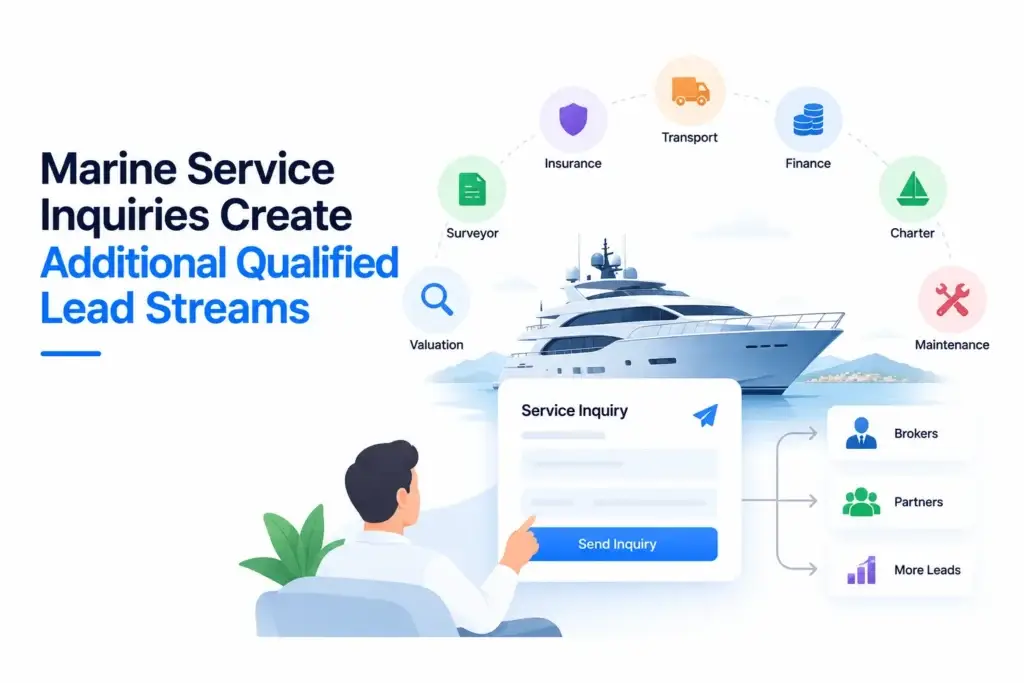
A yacht marketplace can generate leads beyond buying and selling vessels.
Buyers often need related services before or after a purchase. Sellers may also need valuation, listing help, transport, and brokerage support.
Service lead categories may include:
- Yacht valuation
- Surveyor request
- Marine insurance
- Yacht transport
- Finance inquiry
- Charter inquiry
- Boat show interest
- Sell-my-yacht intake
- Maintenance or refit request
These service inquiries can become valuable lead streams for partners, brokers, or marketplace operators. They also help the platform stay useful even when the buyer is not ready to purchase immediately.
Buyer support does not end after the first inquiry. Serious yacht buyers may need help with finance, insurance, survey coordination, transport, valuation, charter questions, or post-inquiry guidance before they are ready for broker follow-up. Founders can review this buyer support workflows guide to understand how service workflows can strengthen the buyer journey.
10. Admin Visibility Keeps Lead Operations Accountable
A marketplace operator needs visibility across lead volume, broker response, seller quality, inquiry source, and conversion stages.
Admin dashboards should track:
- Total inquiries
- Inquiry source
- Listing-level lead performance
- Broker response time
- Unanswered inquiries
- Qualified vs unqualified leads
- Stage movement
- Service inquiry volume
- Seller response quality
- Lead-to-viewing conversion
- Lead-to-offer conversion
- Lost lead reasons
- Spam or fake inquiry patterns
Without admin visibility, the marketplace cannot improve lead quality. It can only count form submissions.
A strong marine marketplace feature set should connect listings, search, buyer inquiry, broker CRM, service queues, response tracking, and admin reporting into one operating layer.
Founder Decision Signals
Speed
If brokers currently receive leads through scattered forms, emails, or messaging apps, a structured inquiry pipeline can reduce missed follow-ups and make lead ownership clearer.
Cost
Lead qualification features should be planned before development starts because CRM, inquiry forms, routing rules, admin reporting, and broker dashboards affect platform scope.
Scalability
If the platform will support many brokers, sellers, or regional offices, lead routing, role-based access, response tracking, and activity logs should be built early.
Market Fit
If buyers need human guidance before purchase, the marketplace should behave like a broker enablement system, not only a listing directory.
How Lead Qualification Supports Marketplace Revenue
Lead qualification is not only a sales workflow. It also affects revenue.
A Yacht Marketplace Platform may earn from dealer subscriptions, listing upgrades, featured placements, service leads, broker tools, market reports, or white-label licensing. But brokers and dealers are more likely to pay when the platform delivers useful buyer intent, not just traffic.
Founders planning monetization can review this marine marketplace business model breakdown to understand how broker subscriptions, listing visibility, service inquiries, and platform-controlled revenue streams can work together.
Better lead quality can support:
- Higher broker retention
- Stronger subscription value
- More useful listing upgrades
- Better service partner leads
- More measurable broker performance
- Improved seller confidence
- Stronger marketplace positioning
If the marketplace can prove that leads are structured, traceable, and easier to follow up, it becomes more than an advertising surface. It becomes broker infrastructure.
Security and Privacy in Broker Lead Management
Lead data must be handled carefully because buyer inquiries may include contact details, budget range, purchase timeline, location preference, financing interest, and personal notes.
Security controls should include:
- Secure buyer login
- Broker role-based access
- Inquiry-scoped messaging
- Activity logs
- Permission-based dashboards
- Encrypted data transfer
- Secure data storage
- Admin access controls
- Spam and fake inquiry detection
- Data export and deletion workflows where relevant
Brokers should see the buyer data needed for follow-up, but not unnecessary platform-wide user information. Admins should be able to audit sensitive actions, especially when leads, broker assignments, client notes, and service requests are involved.
Lead quality also depends on marketplace trust. Dealer verification, listing moderation, dispute handling, spam control, and buyer protection workflows help brokers focus on serious inquiries instead of risky or low-quality interactions. This yacht marketplace trust and safety guide explains how stronger platform controls can protect buyers, brokers, listings, and marketplace reputation.
Common Mistakes Founders Should Avoid
Using a generic contact form for every vessel
A basic form may collect contact details, but it does not qualify budget, timeline, usage intent, location preference, or service needs. This creates more manual work for brokers.
Sending every inquiry to one shared inbox
Shared inboxes make ownership unclear. A platform should route inquiries to the right broker, office, or team and track whether a response happened.
Ignoring buyer behavior before the inquiry
Saved searches, repeated views, comparisons, and favorites can reveal intent before a buyer sends a message. Losing this context weakens the broker conversation.
Treating service leads as separate from brokerage
Finance, survey, insurance, transport, and valuation inquiries can support the same buyer journey. Keeping them disconnected reduces marketplace visibility and revenue potential.
Not measuring broker response time
High-value inquiries should not quietly sit unanswered. Response tracking helps operators identify missed opportunities and improve accountability.
What Founders Should Plan Before Building Lead Workflows
Before developing a yacht marketplace, founders should define how inquiries will become qualified leads.
Important planning questions include:
- What makes a lead qualified?
- Which buyer fields should be required?
- Which questions should remain optional?
- How will the platform avoid form friction?
- Should leads be scored automatically?
- How will inquiries be routed?
- Can brokers reassign leads?
- Will buyers message brokers inside the platform?
- Can brokers create private notes?
- Will buyers receive automated confirmation?
- How will response time be measured?
- Can admins view unanswered leads?
- How will service inquiries be handled?
- Which reports will dealers need?
Planning these workflows early helps avoid rebuilding the broker dashboard later.
For founders comparing build scope and pricing, this yacht marketplace development cost guide explains how features, integrations, mobile scope, CRM workflows, service modules, and infrastructure decisions can affect the final platform plan.
How Miracuves Helps Founders Build Broker-Ready Yacht Marketplaces
Miracuves helps founders build white-label marketplace platforms for high-value listing categories where buyer trust, broker follow-up, and structured inquiries matter.
For yacht marketplaces, that means the platform should not stop at vessel listings. It should support buyer search, saved vessels, inquiry capture, lead qualification, broker CRM, service queues, admin reporting, and response tracking.
If your yacht marketplace needs custom buyer journeys, broker dashboards, CRM workflows, mobile app experiences, or advanced integrations, Miracuves also offers custom mobile app development services to shape the platform around your market, audience, and operational model.
Miracuves offers a broker-ready yacht marketplace foundationfor founders who want to launch faster with vessel listings, broker workflows, lead management, admin control, and source-code ownership.
If you are evaluating technical partners, this marine marketplace development partner checklist can help you review source-code ownership, CRM depth, inquiry workflows, release scope, broker dashboards, and long-term platform control.
Final Thoughts
A Yacht Marketplace Platform succeeds when it does more than publish vessel listings. It should help brokers understand who the buyer is, what they want, when they may buy, which vessel triggered interest, and what follow-up should happen next.
The strongest platforms turn buyer behavior into structured sales context. They capture search intent, listing engagement, inquiry details, service needs, broker ownership, CRM notes, and response performance.
For founders, the decision is clear: do not build only a beautiful listing site. Build a marketplace that turns interest into qualified broker leads and gives every serious inquiry a clear path to follow-up.
FAQs
How does a Yacht Marketplace Platform generate broker leads?
A Yacht Marketplace Platform generates broker leads by capturing buyer inquiries from vessel listings, saved searches, comparison activity, contact forms, viewing requests, finance interest, and service requests. These signals are then structured into lead records for brokers.
What makes a yacht buyer inquiry qualified?
A yacht buyer inquiry becomes qualified when it includes useful context such as budget, timeline, vessel preference, location, intended use, financing interest, trade-in needs, and readiness for broker follow-up.
Why is a broker CRM important in a yacht marketplace?
A broker CRM helps manage buyer profiles, inquiry history, vessel preferences, notes, tasks, messages, shortlists, and pipeline stages. This is important because yacht sales often involve long decision cycles and repeated follow-up.
How can a marketplace route yacht inquiries to the right broker?
A marketplace can route inquiries based on listing ownership, vessel location, broker specialization, buyer region, language preference, office rules, existing client relationship, or broker availability.
Should yacht marketplace inquiry forms be long?
Not too long. Forms should collect enough information to qualify the buyer without creating friction. Budget range, buying timeline, preferred vessel type, contact method, and service needs are usually more useful than a generic message box alone.
How does lead scoring help yacht brokers?
Lead scoring helps brokers prioritize inquiries based on intent signals such as repeated vessel views, saved listings, direct messages, viewing requests, budget match, timeline urgency, and finance or survey interest.
Can marine service inquiries become broker leads?
Yes. Requests for finance, insurance, transport, survey, valuation, charter, or sell-my-yacht support can become valuable service leads and may also reveal future buying or selling intent.
What should founders track in yacht lead management?
Founders should track inquiry source, vessel interest, buyer profile, broker assignment, response time, lead stage, follow-up tasks, service requests, conversion status, and lost lead reasons.
Miracuves is an independent software development company. We are not affiliated with, connected to, sponsored by, or endorsed by any company or product named in this article.
Terms such as “X Clone” are used descriptively. It is how the software industry refers to building a platform with functionality comparable to a known service, and how clients search for it.
The entire design and codebase of our products is built by our own team. Our products contain no code, design, graphics, or content originating from any third-party website or applications.
All third-party names and marks referenced in this article are the property of their respective owners, referenced solely to identify the services discussed.