






Live Entertainment App · Production Ready

White Label Ticketing Platform - Events & Box Office You Own

Miracuves' ready-made, white-label box office hands you a white label ticketing platform you own: one TypeScript repository holding the buyer app, the venue portal, the operator console and the API, with schema and migrations, switched on under your name in six working days.

Fares build from a base price through matinee, weekend or surge windows, promo codes and spent points, and a group order splits into member shares that confirm only once everyone has paid. Buyers book on a responsive web app or the included Android and iOS apps, and single sign-on and ERP sync are available add-ons. A dedicated search engine or another notification channel is priced in writing before work starts, typically taking 2-8 weeks.

Launch in 6 Days with

  • Full Repository
  • Database Schema
  • Buyer Booking App
  • Venue Portal
  • Box Office Admin
  • Technical Docs

StackTypeScript · React 19 · Next.js 16 · Tailwind CSS · Drizzle ORM · PostgreSQL 14+ · Redis 6

MXBMS admin · Ops DeskIllustrative
Today's ticket sales4,860
Seats held right now212
Verticals on sale6

Shows on right now

See it in action
0 double-sold seatsversioned locks stay correct when launch day gets busy
  • 4Seat Statesavailable, locked, booked and unavailable on a live map
  • 4Seat Classesstandard, premium, VIP and recliner with their own multipliers
  • 0%Revenue Share With Miracuvesno per-ticket fee, no runtime license and no vendor roadmap to wait on
  • 3Sign-In Methodsemail with password, a phone OTP and Google
  • 6Days to Launchand if the delay is ours, we keep going free
  • $3,999Paid Once, Not Rentedsource code yours, no per-seat fee, no monthly rental

Live in six working days, or we keep working free until you launch. Every build carries 60 days guidance, 6 months bug fixes and 12 months updates.Verify every figure

Doors That Count Once

A QR ticket flips to checked in on its first scan; any repeat is logged as an attempt with counters and an audit trail, never as a second guest.

Ledgers You Can Replay

Points balances and partner payouts sit on append-only journals, so an audit is a database query and any balance can be rebuilt from the start.

Four Gateways, Your Merchant Accounts

Stripe, Razorpay, PayPal and Adyen process the card details, so card numbers never reach your servers; each needs a merchant account in your name before real money moves.

Ready to start selling tickets under your own brand?Speak With a Product Expert

Our work is trusted by 6,000+ companies worldwide

Miracuves named one of the best managed IT service providers in New York City by Expertise.comMiracuves is an official member of Forbes Business CouncilMiracuves is a verified agency with design rush. Miracuves is reviewed on TrustpilotMiracuves is one of the top managed service providers, companies by themanifest. Miracuves ranked as a top software development company by Design Rush. Miracuves is recognized as top software developed company by goodfirms. Miracuves Ranked among top 1000 companies globally by ClutchMiracuves is a top-minus service provider in the United States by Clutch

01Try it yourself

Running Live

White Label Ticketing Software Demo - Booking App, Vendor Portal, Admin Console & Android App

Try the Miracuves platform before you talk to anyone. Four live environments are open, and every role has a working login, so there is nothing to set up. Hold a seat, scan a ticket at the door and run a partner settlement yourself.

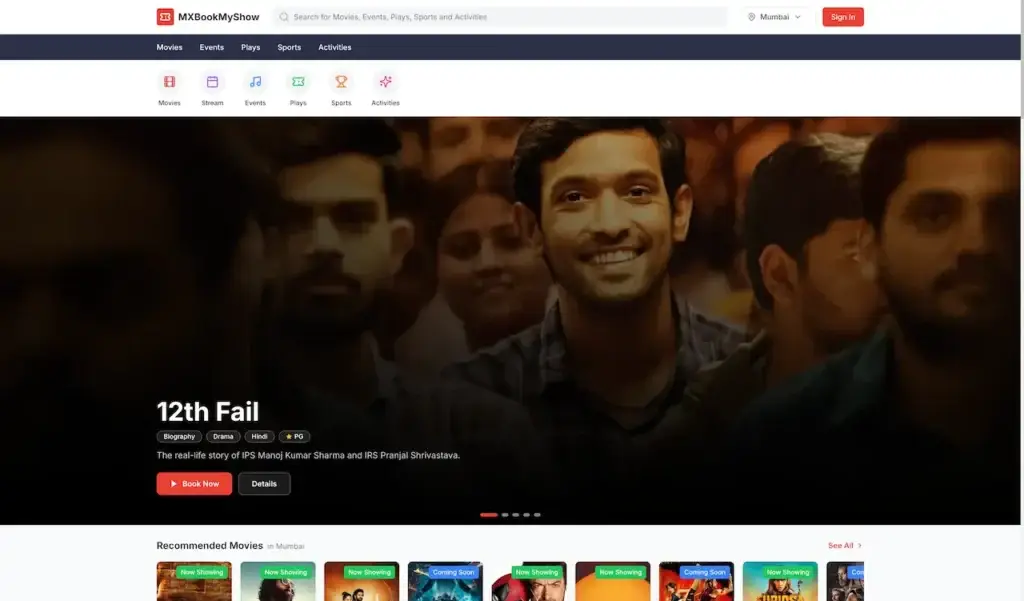
Desktop homepage featuring 12th Fail with Book Now action, entertainment categories, and recommended movies
Customer web app

Ticketing Platform - Customer App

What your buyers use: browsing across six verticals, referrals, loyalty points, QR tickets, checkout and interactive seat maps.

  1. 1Point any browser window at the web app
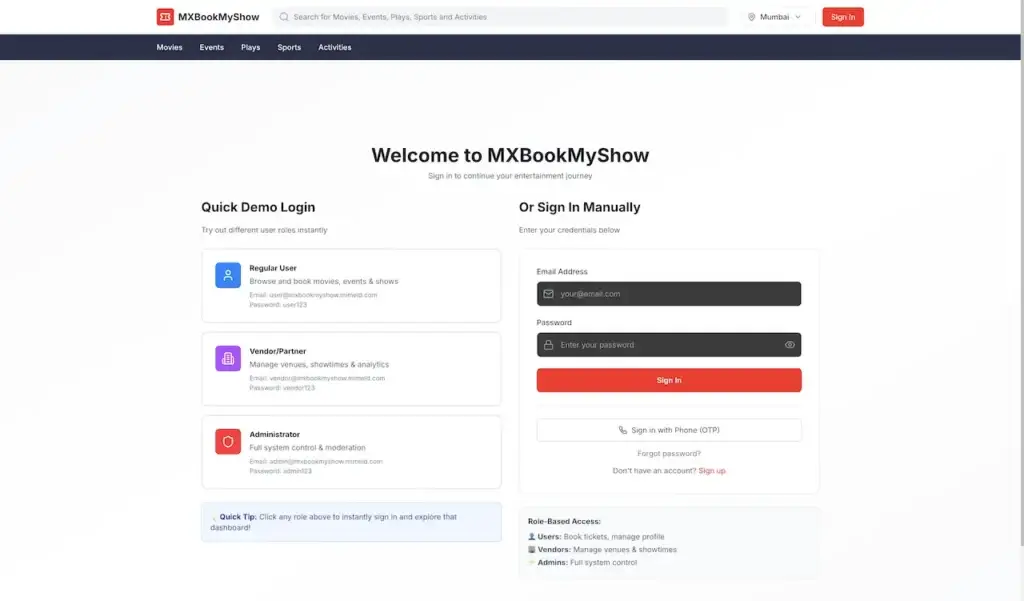
  2. 2Sign in with the demo logins listed below
  3. 3Try: Movies, Events, Seat map, Checkout
Try:user@mxbms.mimeld.com | user123
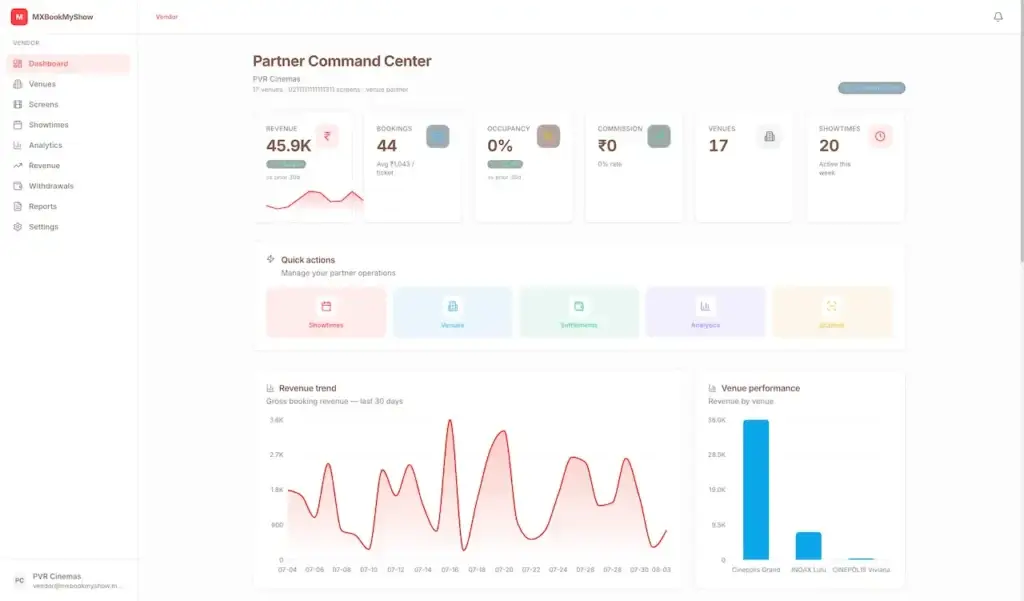
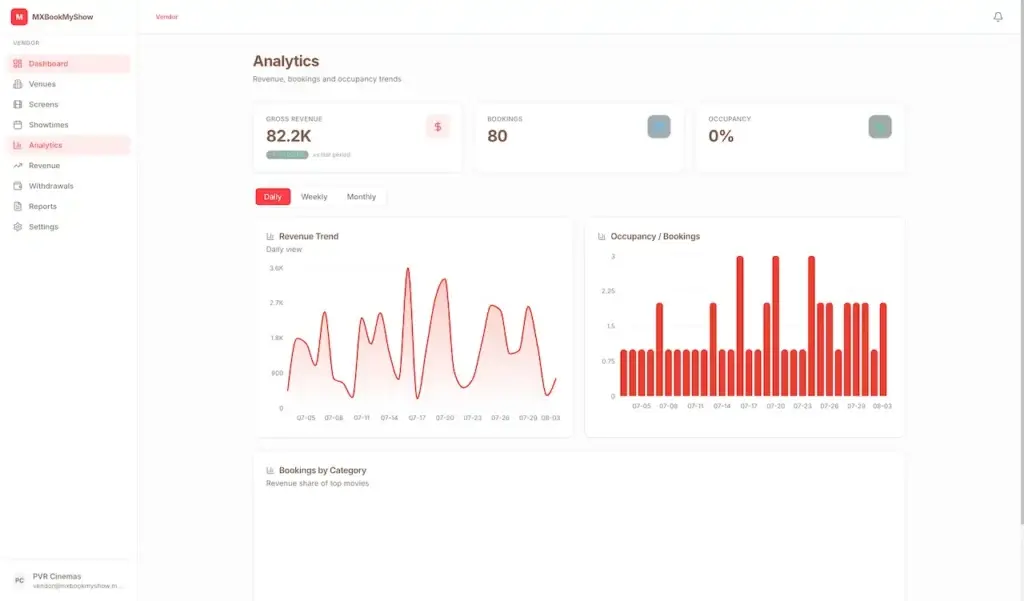
Venue-partner dashboard with revenue, bookings, occupancy, commission, venues, showtimes, quick actions, and performance charts
Vendor portal

Venue Ticketing & Entry Validation

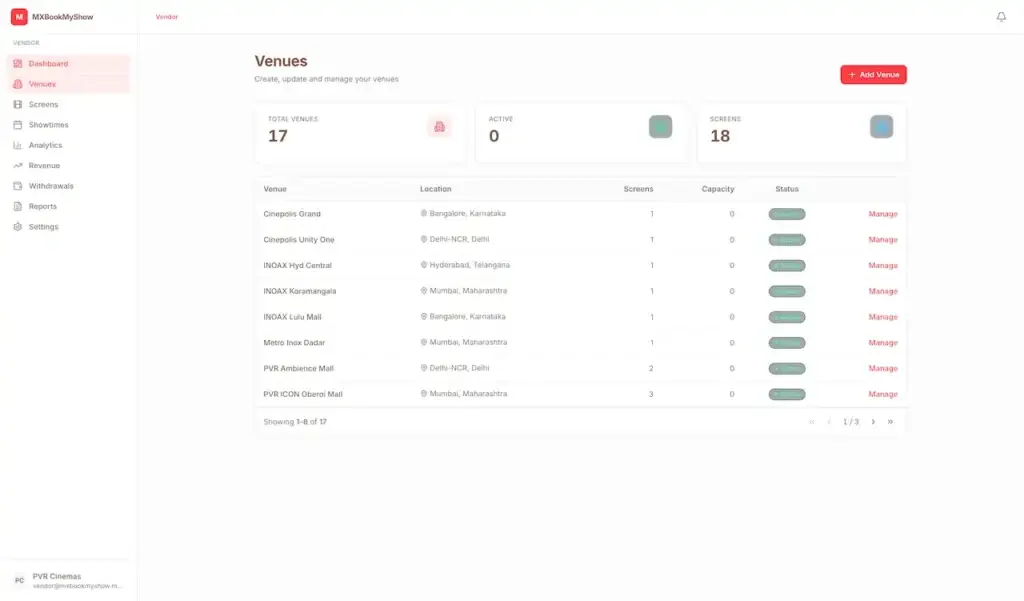
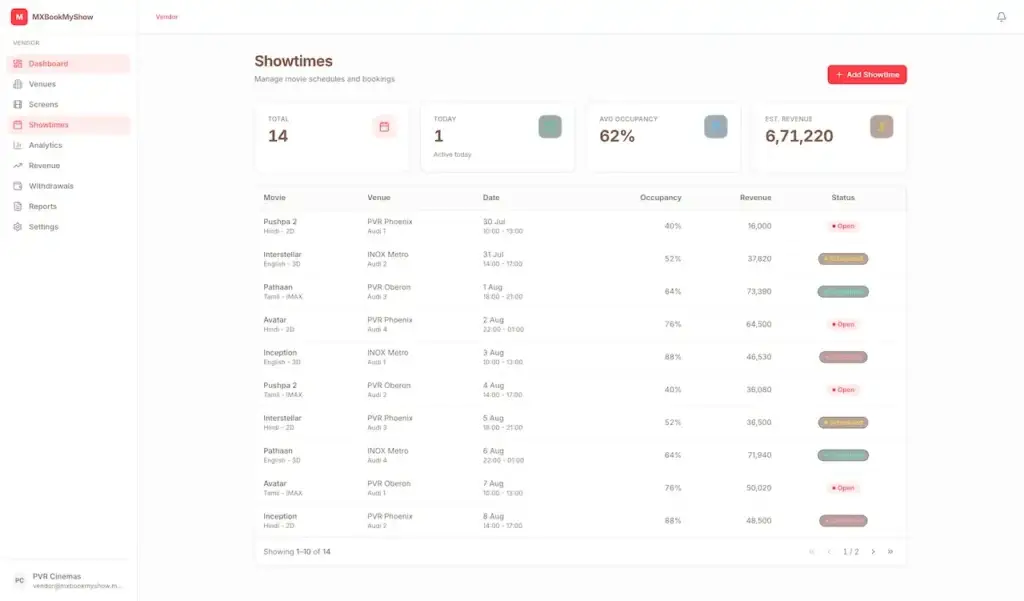
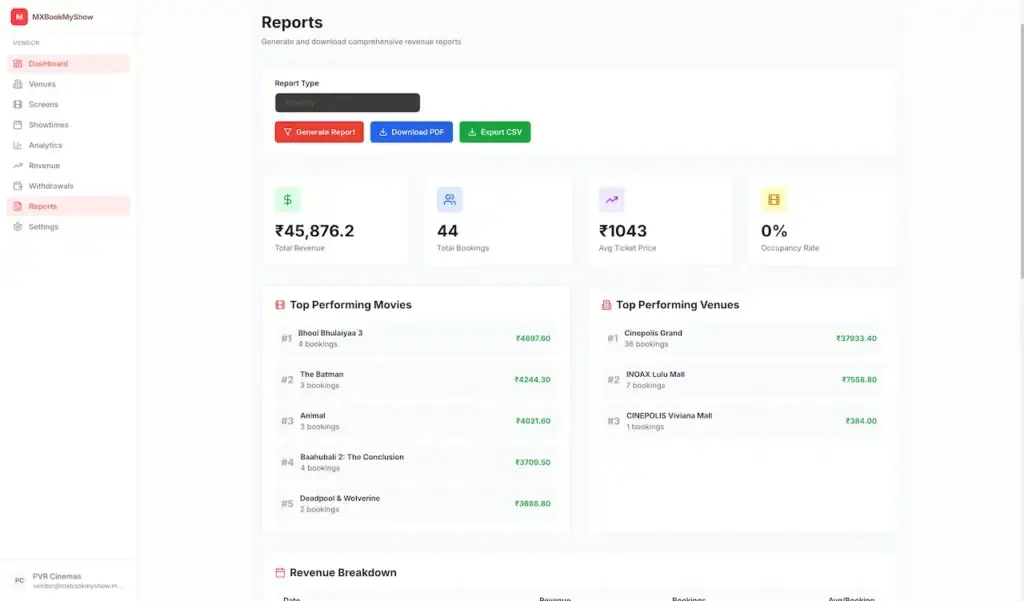
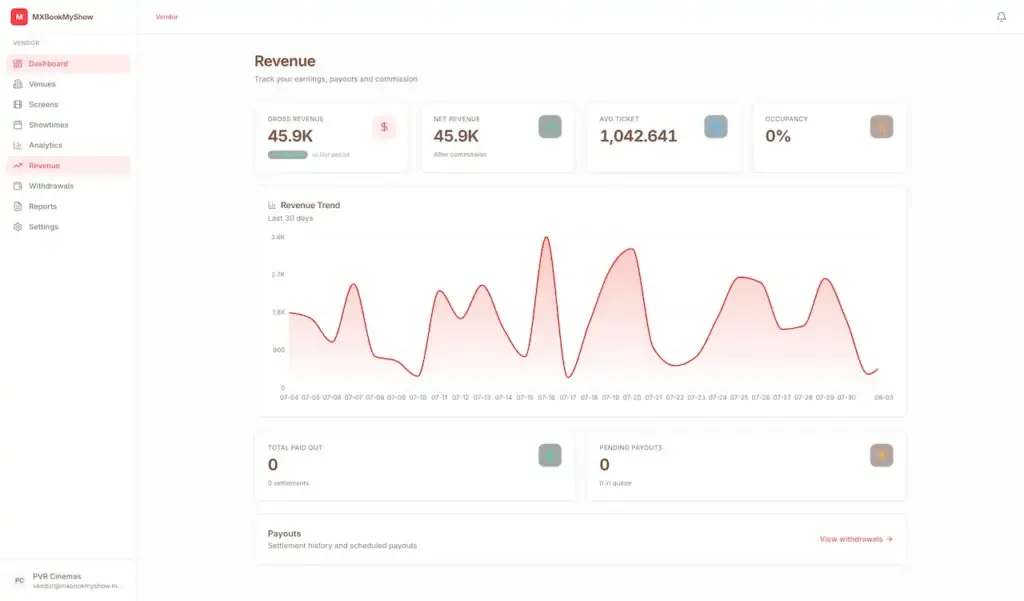
The venue team's workspace: the QR scanner, payout balances, occupancy analytics, showtime scheduling and screen and seat setup.

  1. 1Launch the vendor portal in a browser tab
  2. 2Look around: Venues, Showtimes, Scanner, Payouts
Try:vendor@mxbms.mimeld.com | vendor123
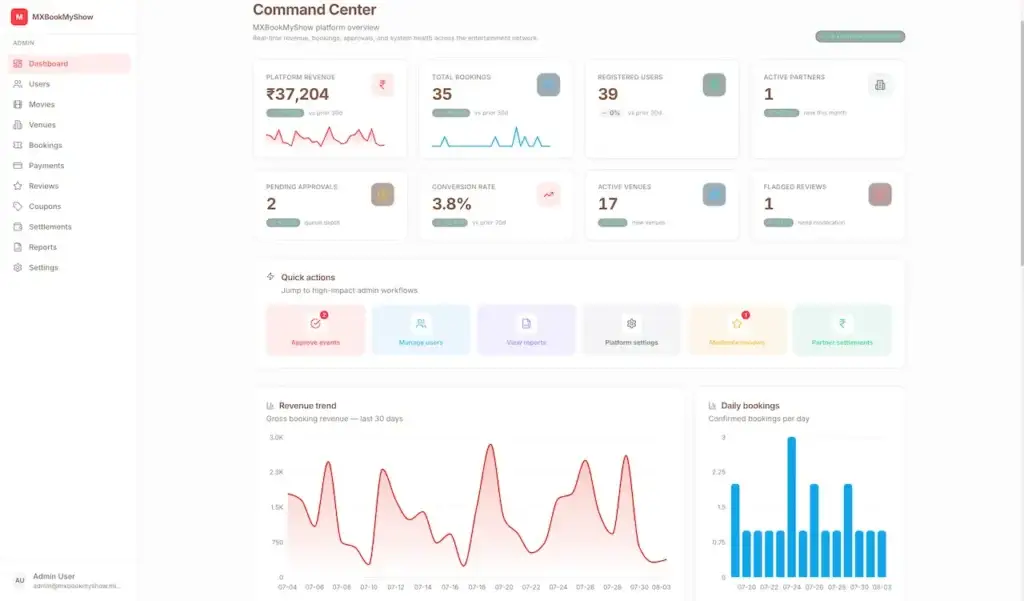
Platform overview with revenue, bookings, users, partners, approvals, conversion, venues, reviews, quick actions, and trend charts
Box office backend

Admin Control & Commerce

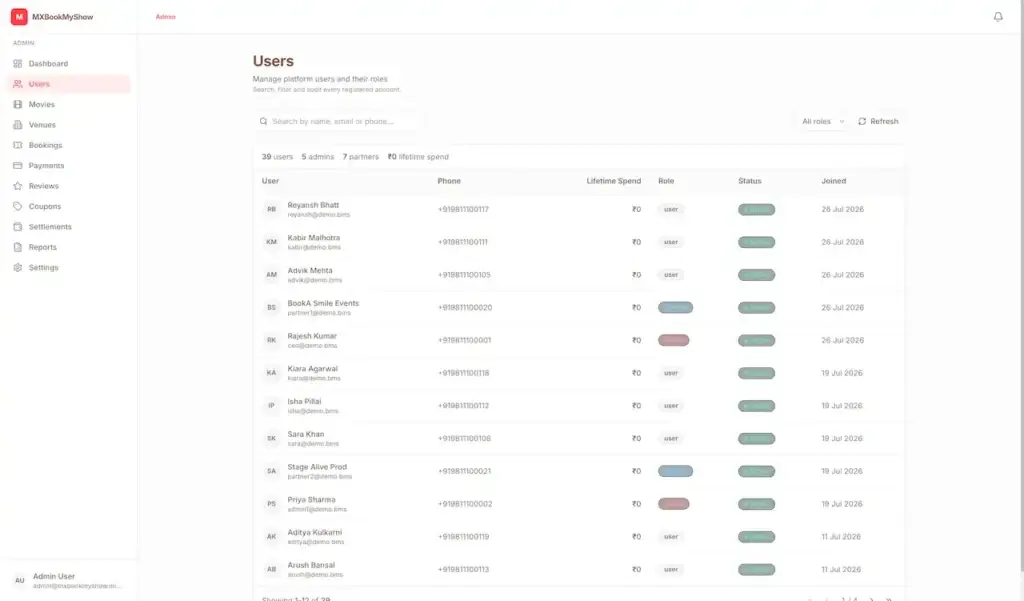
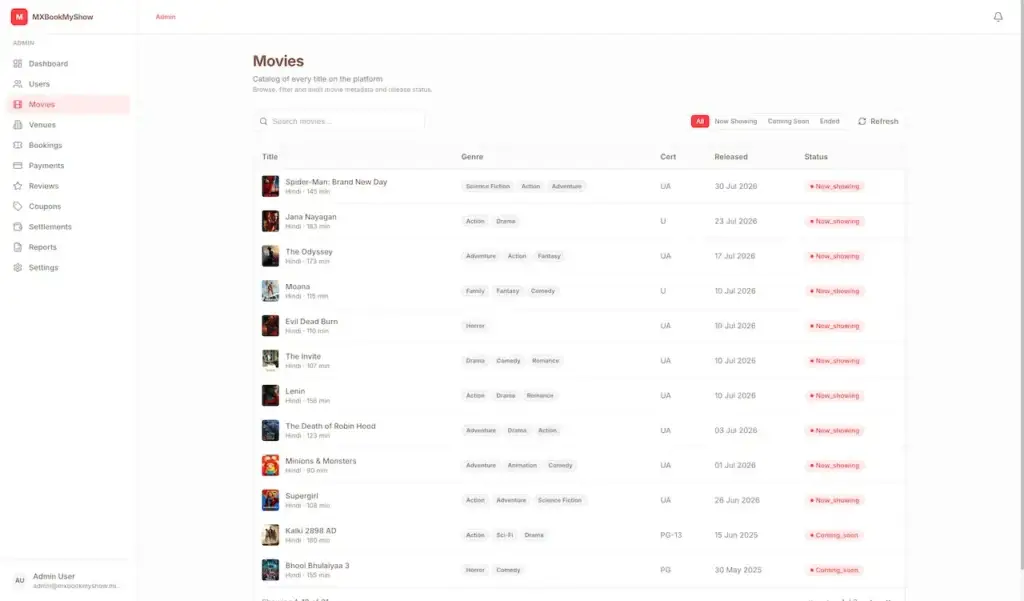
Whole-platform control: system health, settlements, promo codes, bookings and refunds, a TMDB-import catalog, and user and role management.

  1. 1Open the admin console in a new browser tab
  2. 2Look around: Users, Catalog, Refunds, Settlements
Try:admin@mxbms.mimeld.com | admin123
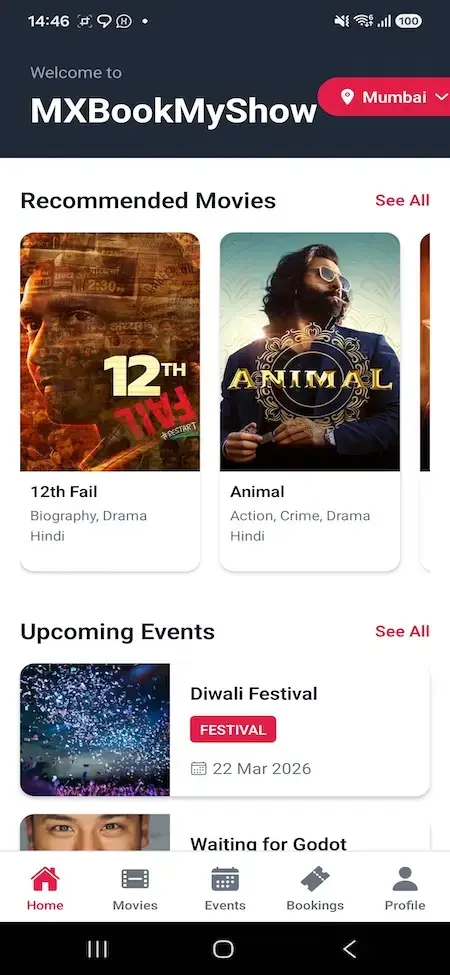
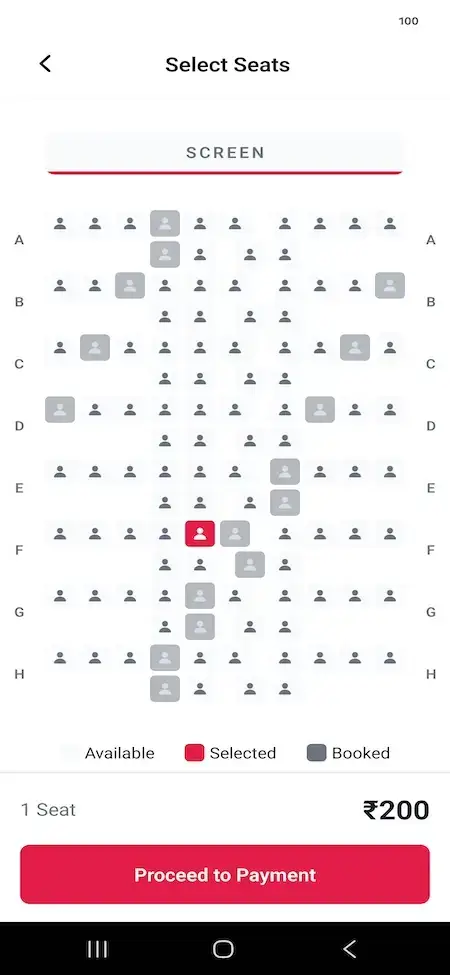
Mobile Mumbai home screen with recommended movies, upcoming events, location control, and main booking navigationMobile interactive cinema layout showing available, selected, and booked seats with ticket total and payment action
Android app

Ticketing Platform - Android App

An Android build of the booking app in your branding, calling the platform's own APIs just like the responsive web application.

  1. 1Put the app on an Android phone
  2. 2Look around: Discovery, Seat map, Bookings, Wallet

Video Walkthrough

Ticketing Platform Video Demo: Picking Seats, Vendor Portal & Settlement Walkthrough

Would a guided tour help? Reserve a 30-minute call and we will map your launch together: go-live sequence, loyalty design, commission structure, gateway choice and venue onboarding.

Book a live walkthrough call.

Flow From Seat to Show

Event Ticketing Software Screen Flows - Customer, Vendor, Admin & Handset Walkthrough

Miracuves ships about 135 API endpoints, grouped in ten route families, behind buyer booking, venue operations and the whole admin console.

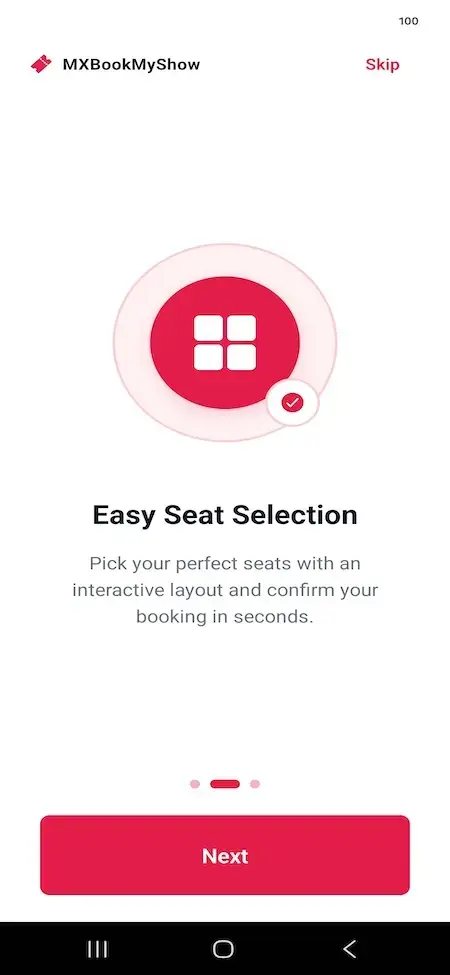
Mobile onboarding explaining interactive seat layouts and rapid booking confirmation
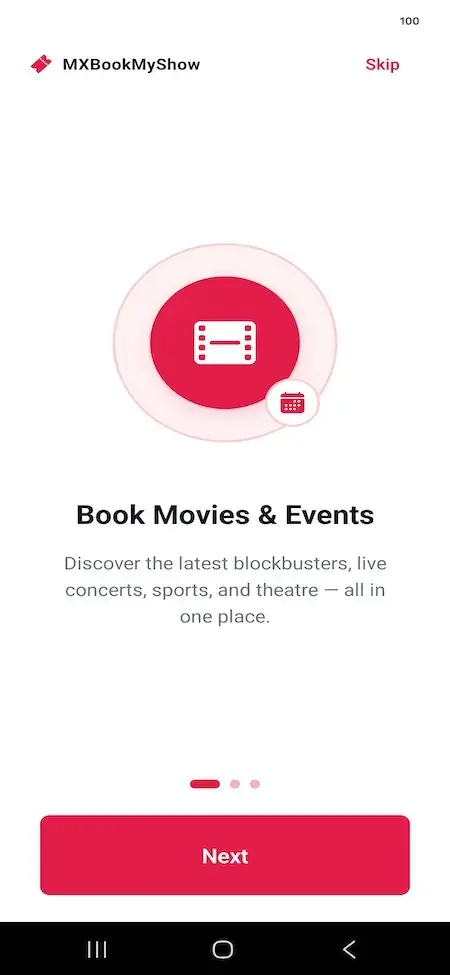
Mobile onboarding introducing movie, concert, sports, theatre, and event discovery in one booking app
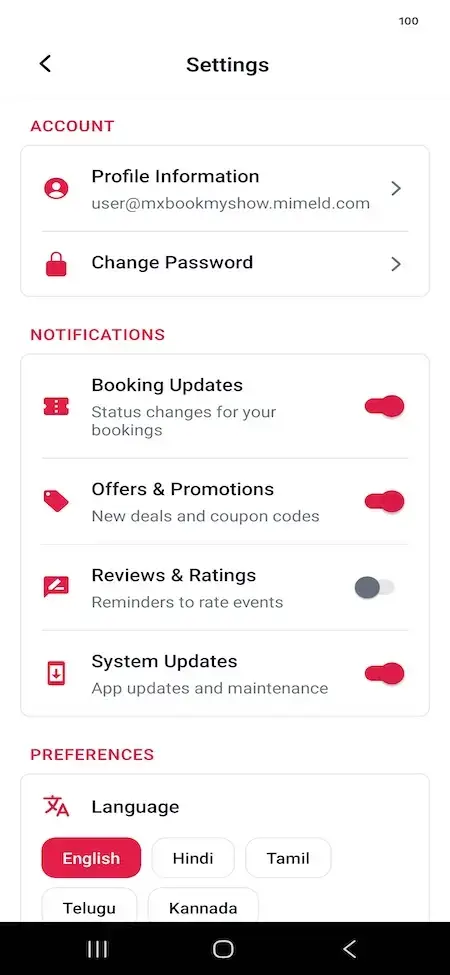
Mobile account settings for profile, password, booking updates, promotions, review reminders, system updates, and language
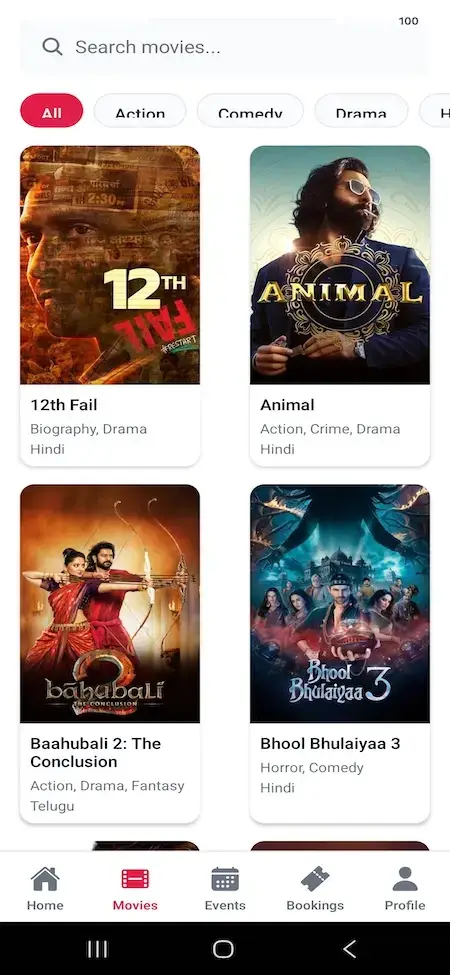
Mobile movie catalog with search, genre filters, posters, languages, and titles including 12th Fail, Animal, and Baahubali
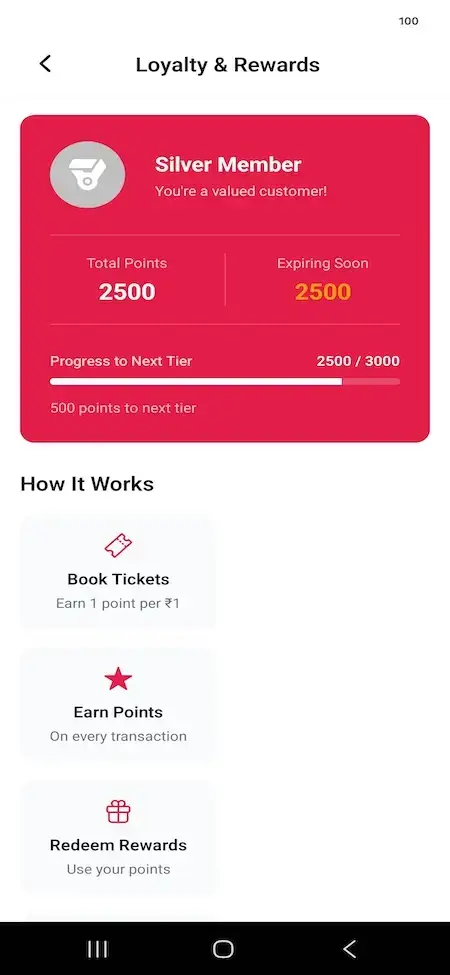
Mobile Silver Member dashboard with 2,500 points, tier progress, ticket-earning rules, and reward redemption
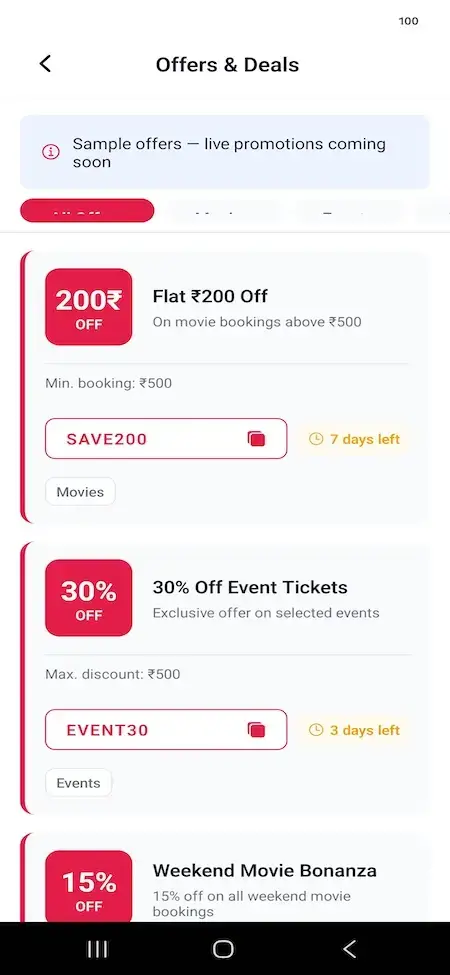
Mobile promotions page with movie and event discounts, coupon codes, minimum booking values, and expiry periods
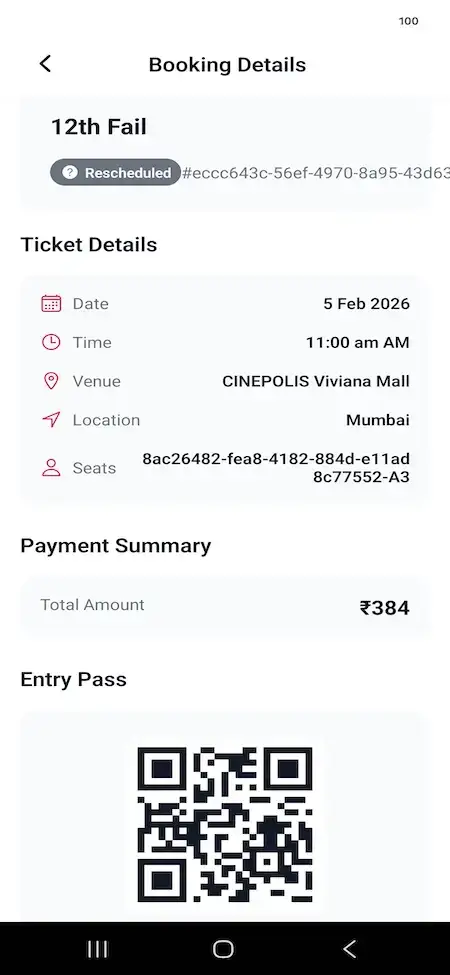
Mobile booking details for 12th Fail with rescheduled status, venue, seats, payment summary, and QR entry pass
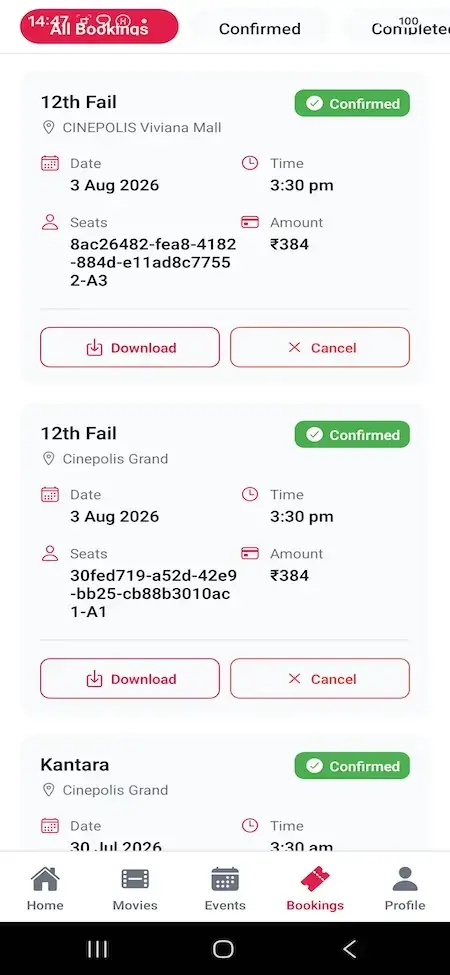
Mobile booking list with confirmed 12th Fail and Kantara tickets, dates, times, seats, amounts, download, and cancellation controls
Mobile interactive cinema layout showing available, selected, and booked seats with ticket total and payment action
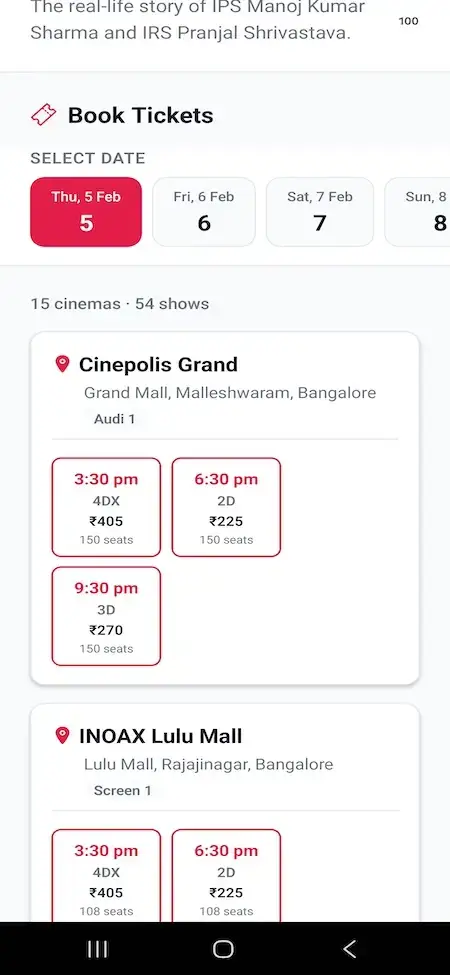
Mobile booking page listing dates, cinemas, formats, prices, available seats, and showtimes for 12th Fail
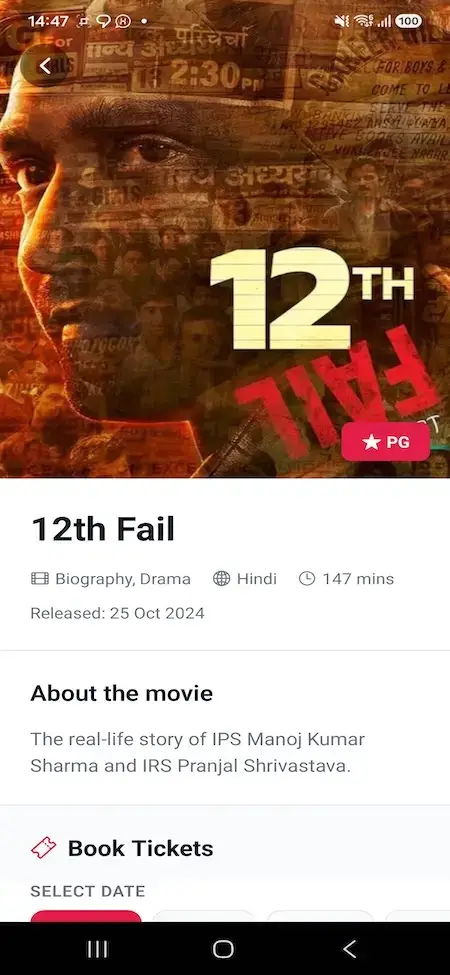
Mobile 12th Fail movie page with poster, genres, language, runtime, release date, synopsis, and ticket-booking section
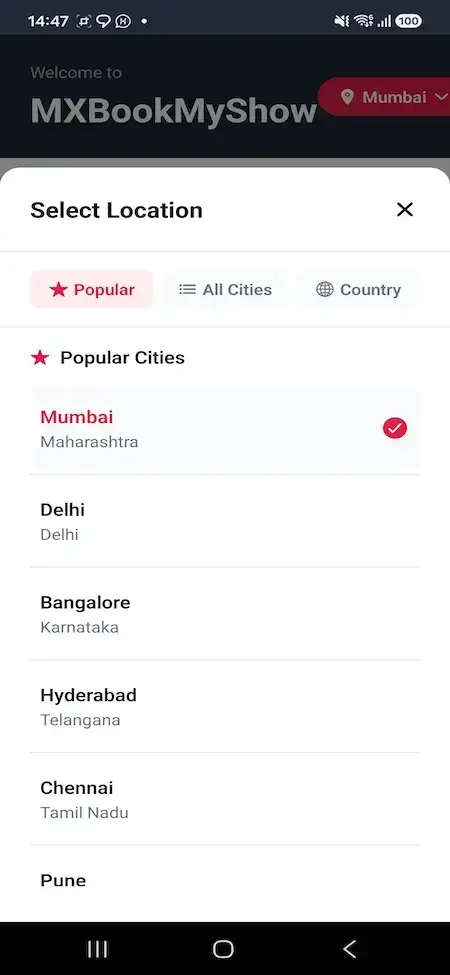
Mobile location panel listing popular Indian cities with Mumbai selected and city and country tabs
Mobile Mumbai home screen with recommended movies, upcoming events, location control, and main booking navigation
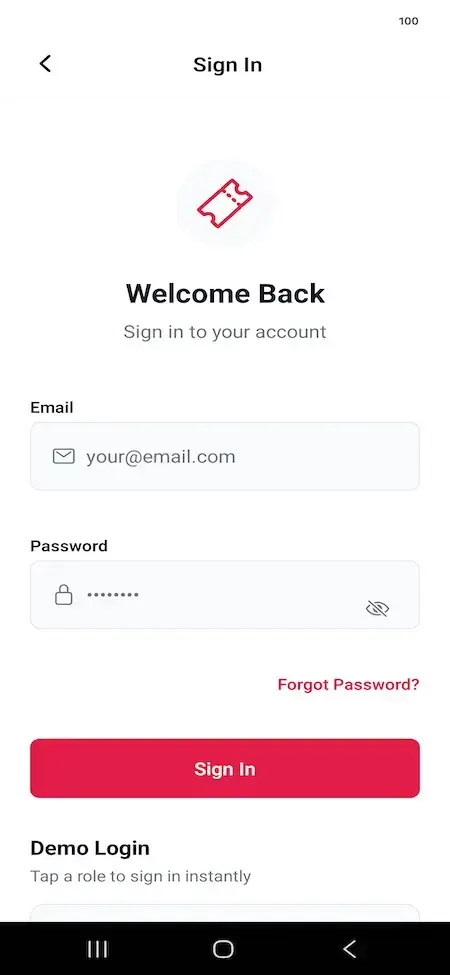
Mobile sign-in page with email, password, password recovery, and role-based demo login access
14 screens · slide →
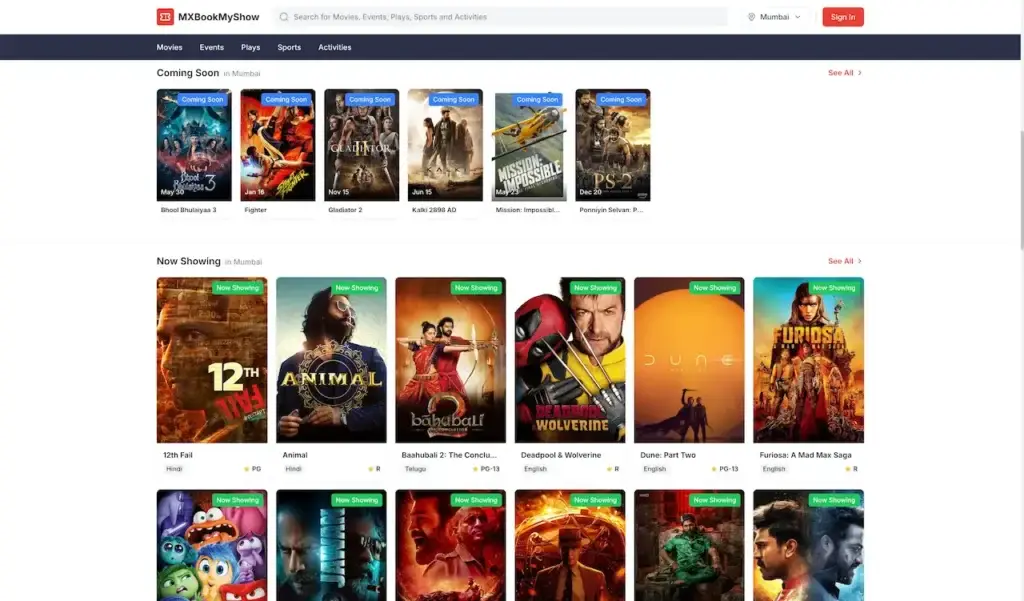
Desktop movie catalog separating Coming Soon and Now Showing releases with posters, languages, and certificates
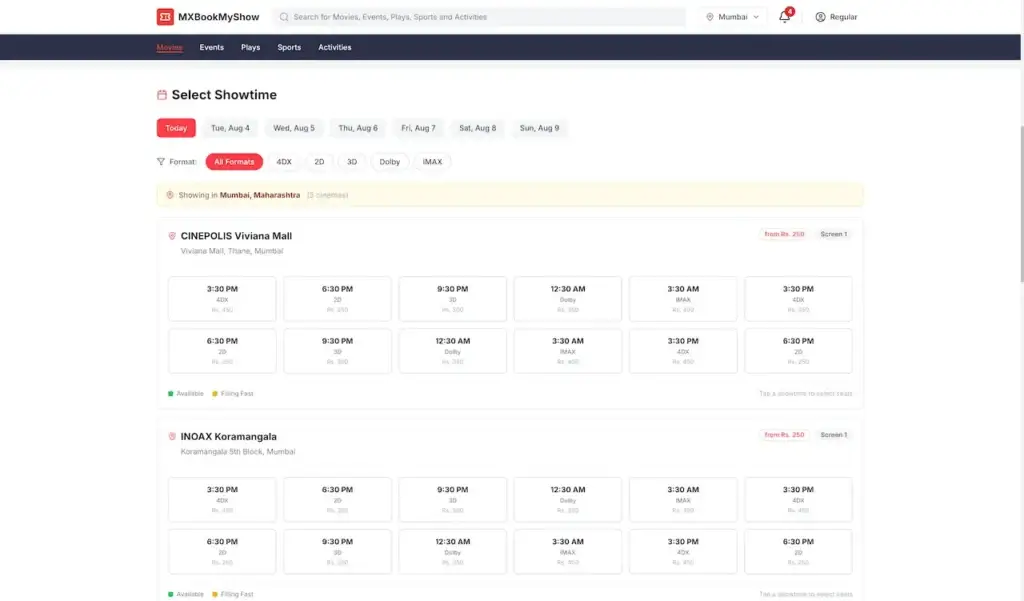
Desktop showtime selector with dates, formats, cinema locations, screen numbers, prices, and availability indicators
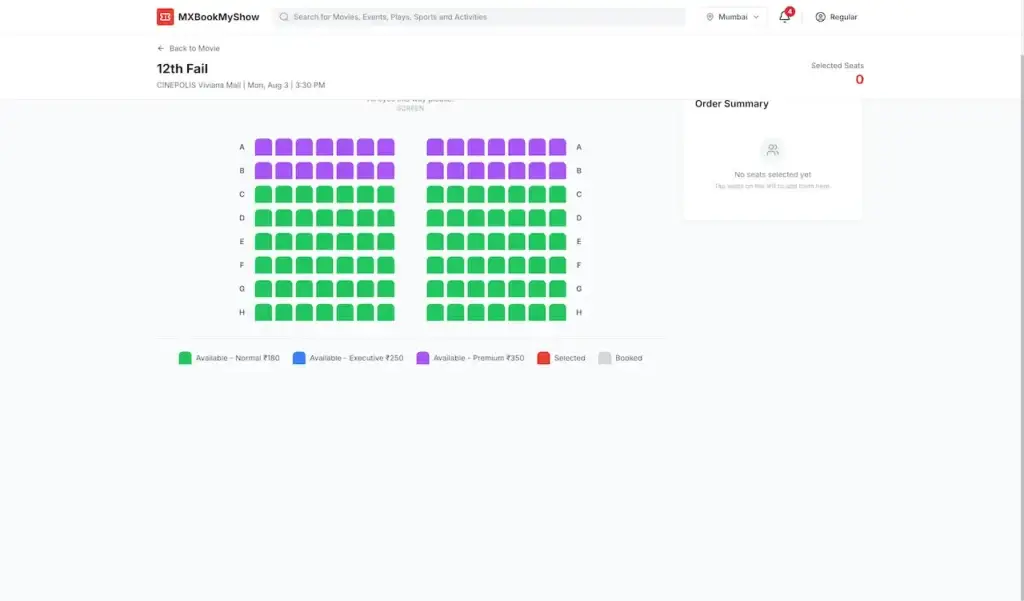
Desktop cinema seat map for 12th Fail with normal, executive, premium, selected, and booked seat states plus order summary
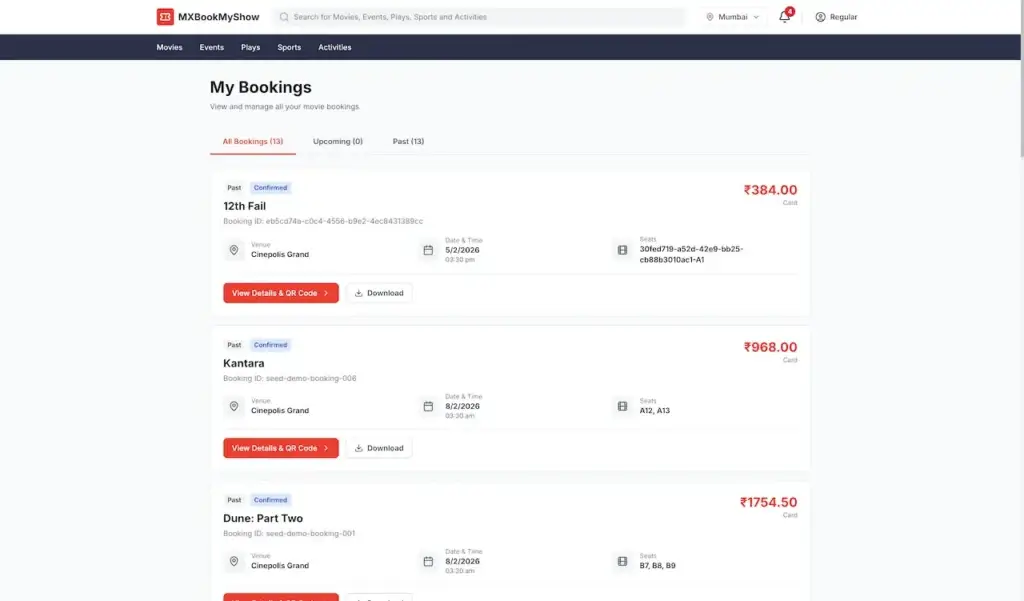
Desktop My Bookings page with confirmed films, venues, dates, seats, payment amounts, downloads, and QR detail actions
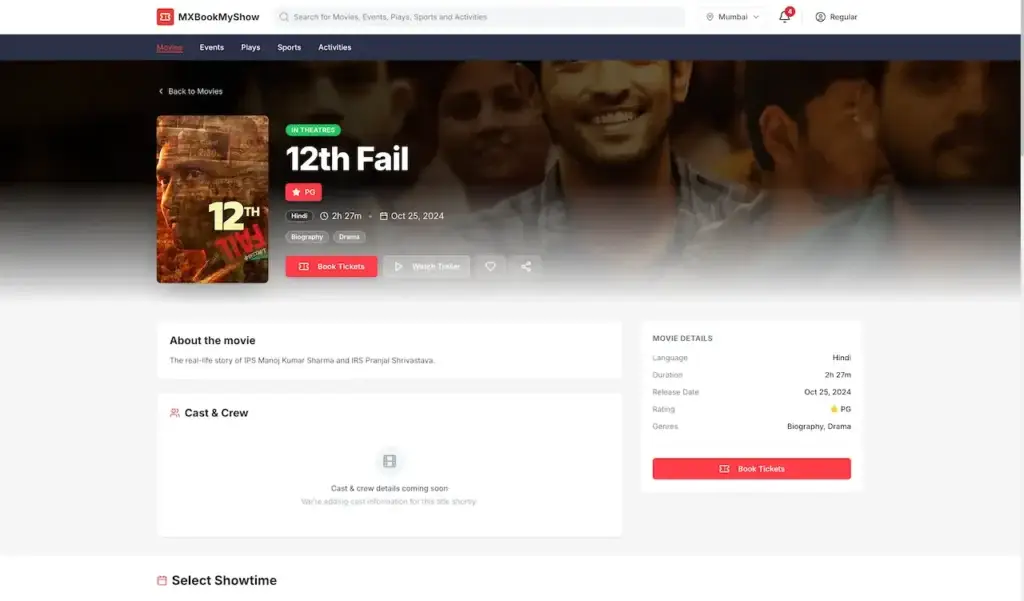
Desktop 12th Fail page with theatrical status, poster, movie metadata, trailer, synopsis, cast section, and Book Tickets actions
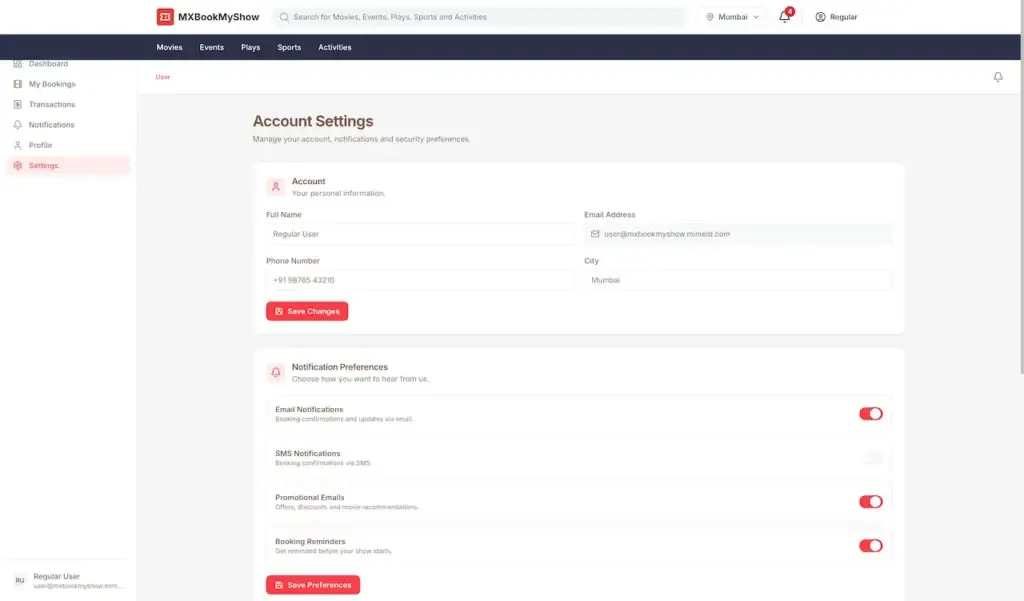
Desktop customer settings for profile details, email and SMS notifications, promotional emails, and booking reminders
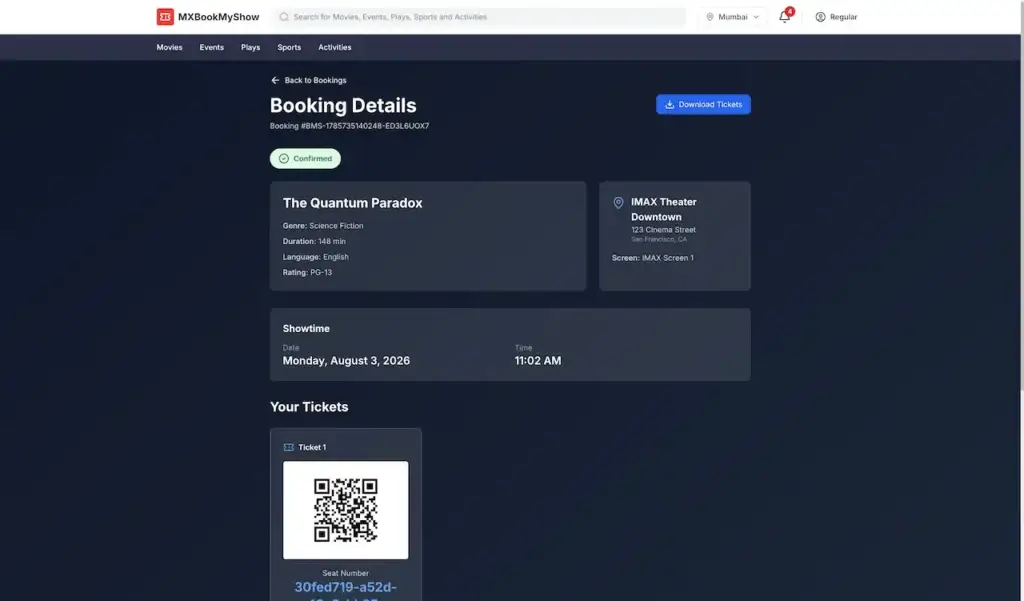
Dark desktop booking detail page with confirmed status, film and venue information, showtime, downloadable ticket, seat, and QR code
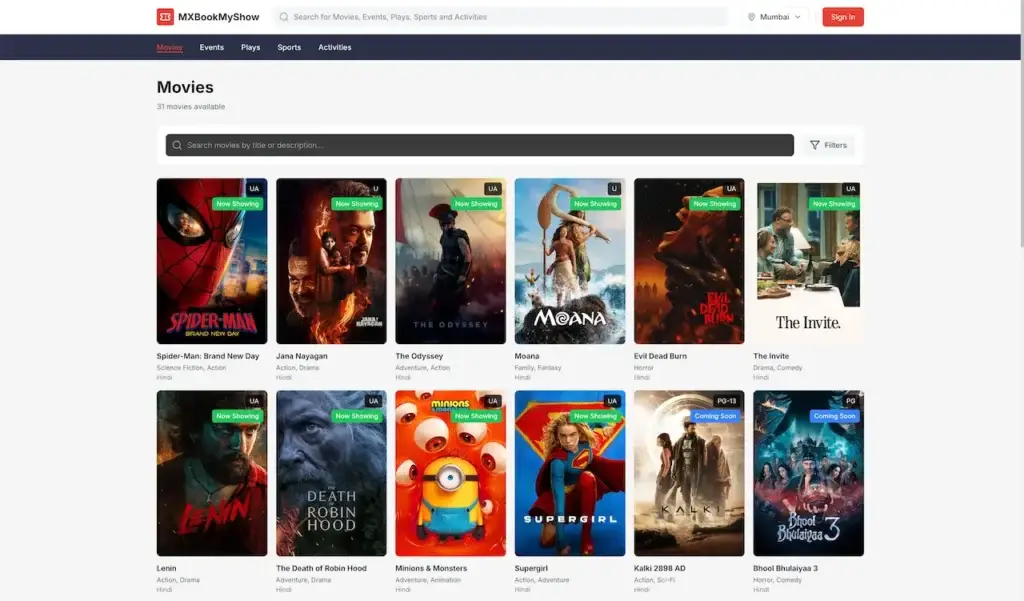
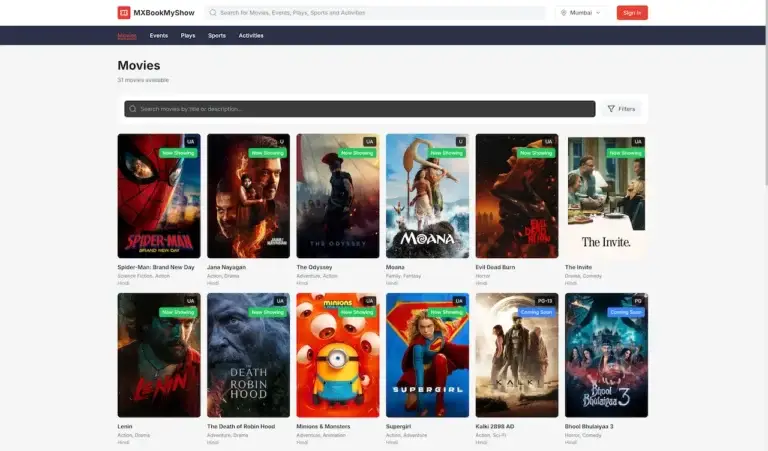
Desktop searchable movie grid with now-showing and coming-soon films, genres, languages, and certificates
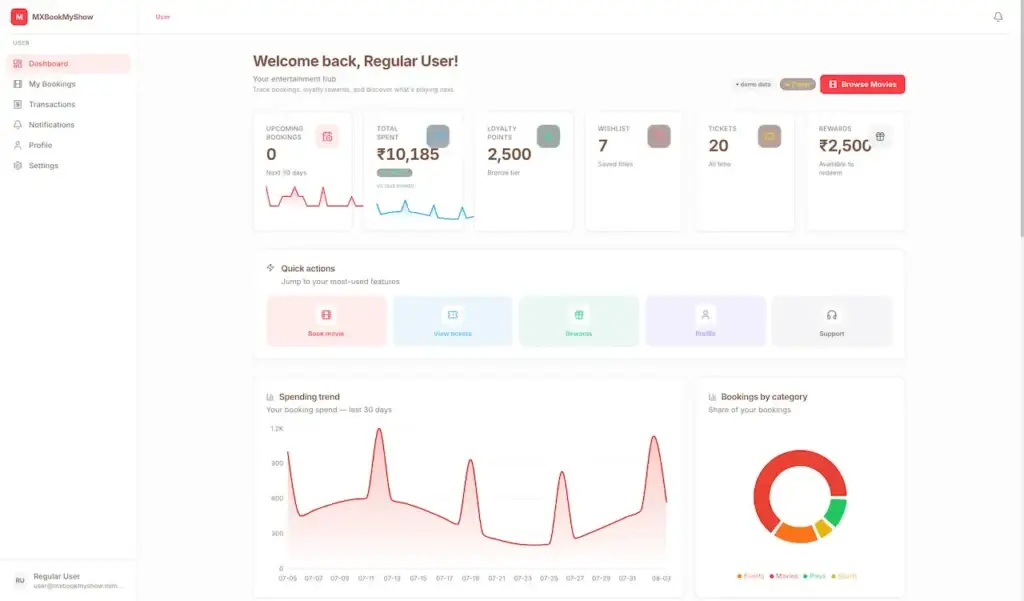
Customer dashboard with spending, loyalty points, wishlist, ticket count, rewards, quick actions, and booking-category analytics
Desktop authentication page with quick demo access for regular users, venue partners, and administrators plus manual sign-in
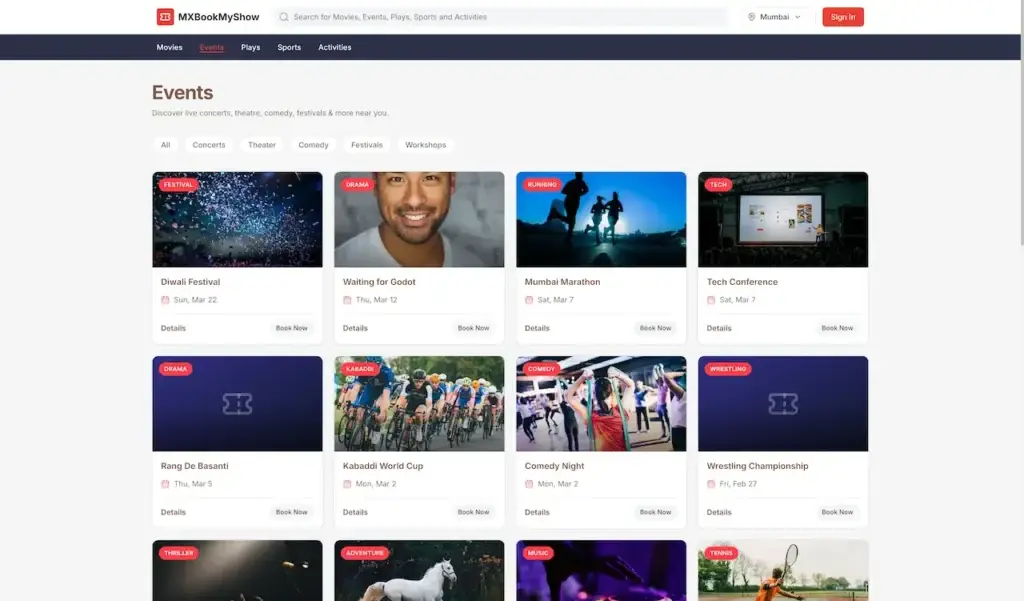
Desktop events catalog with concerts, theatre, comedy, festivals, workshops, sports, technology, and booking controls
Desktop homepage featuring 12th Fail with Book Now action, entertainment categories, and recommended movies
12 screens · slide →
Cinema-partner venue table with locations, screen counts, capacity, active status, and Add Venue or Manage actions
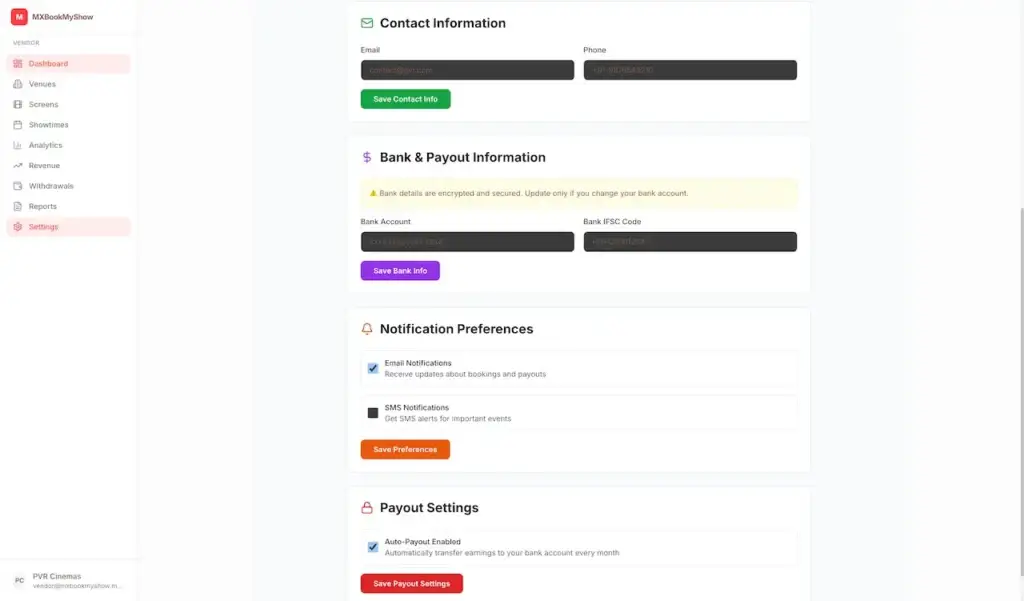
Partner settings for contact information, encrypted bank details, notification preferences, and automatic payouts
Showtime management table with movies, venues, dates, occupancy, revenue, status, and Add Showtime action
Partner report center with PDF and CSV exports, revenue, bookings, average ticket price, occupancy, and top performers
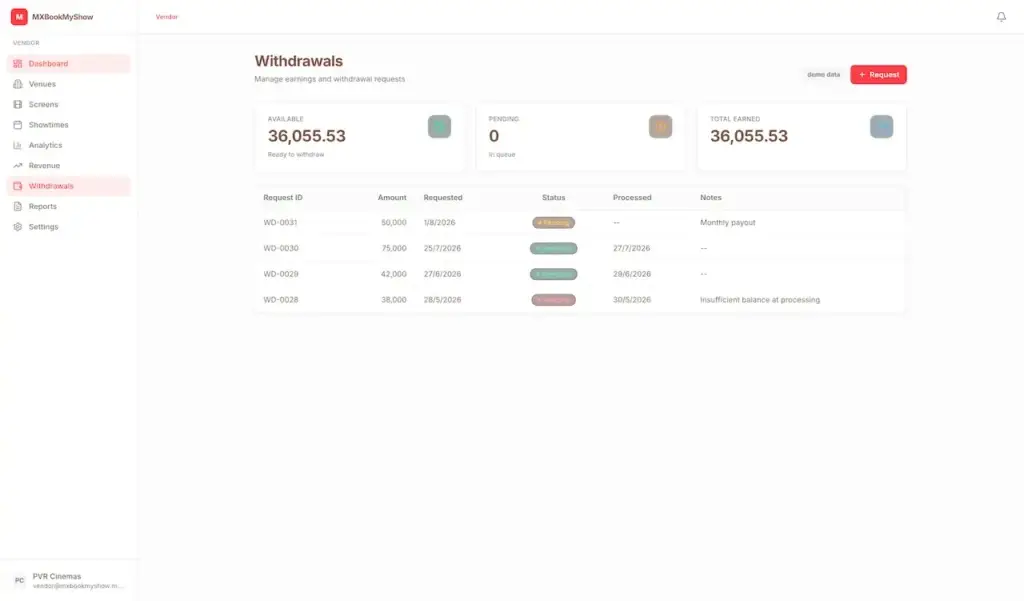
Partner withdrawals table showing available balance, pending amount, total earned, request values, dates, statuses, and notes
Partner earnings view with gross and net revenue, average ticket value, occupancy, payout totals, and revenue trend
Partner analytics dashboard with gross revenue, bookings, occupancy, daily revenue, and occupancy-versus-bookings charts
Venue-partner dashboard with revenue, bookings, occupancy, commission, venues, showtimes, quick actions, and performance charts
8 screens · slide →
Admin user table with registered customers, venue partners, administrators, roles, status, contact details, and lifetime spend
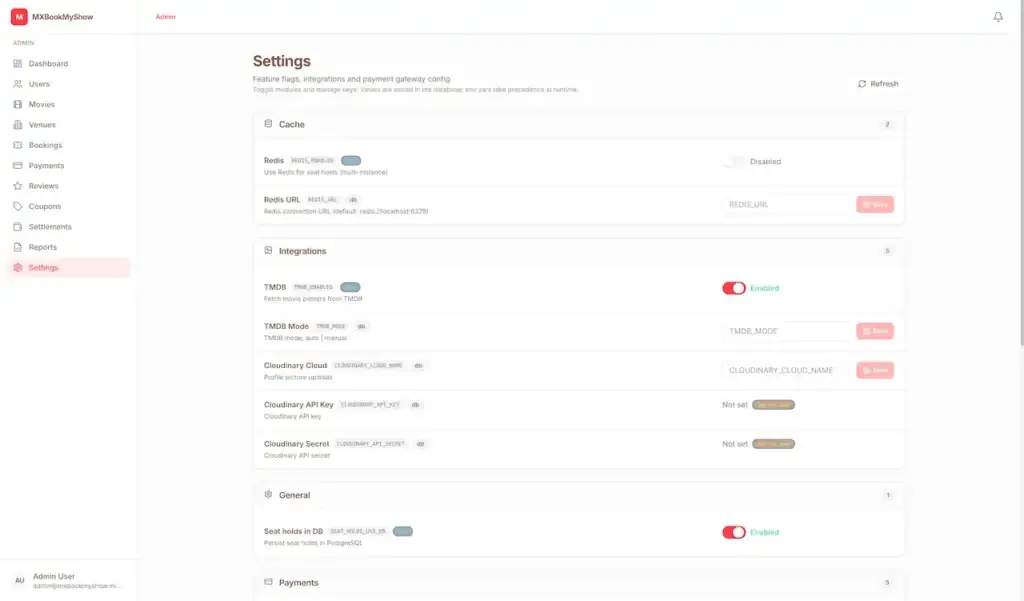
Admin configuration for Redis caching, TMDB and Cloudinary integrations, seat-hold persistence, and payment settings
Admin movie directory with titles, genres, certificates, release dates, and now-showing or coming-soon statuses
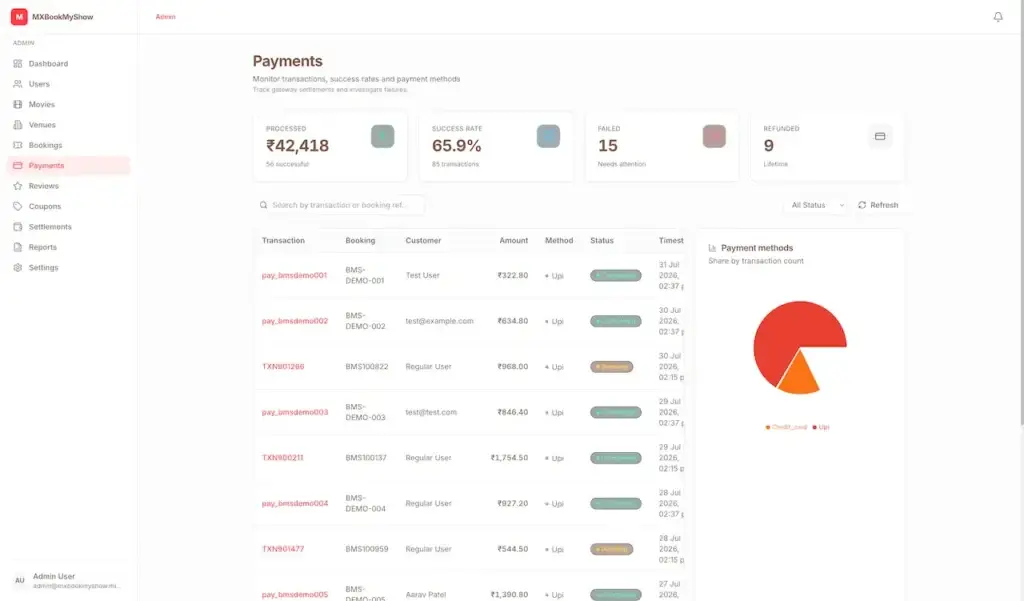
Admin payments dashboard with processed value, success rate, failures, refunds, transaction records, methods, and status breakdown
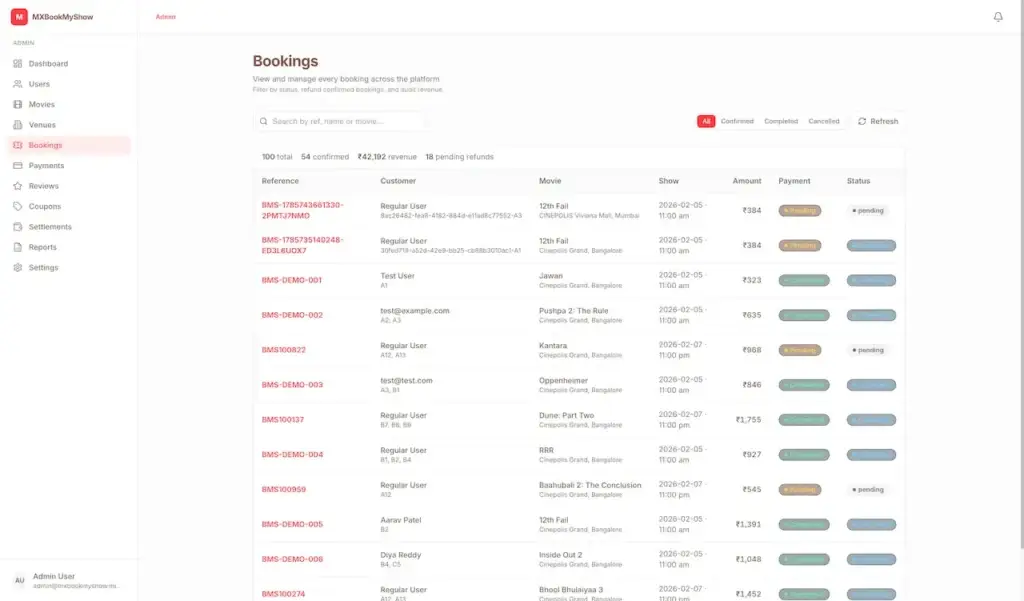
Admin bookings table with customers, movies, venues, showtimes, amounts, payment states, booking statuses, and refund totals
Platform overview with revenue, bookings, users, partners, approvals, conversion, venues, reviews, quick actions, and trend charts
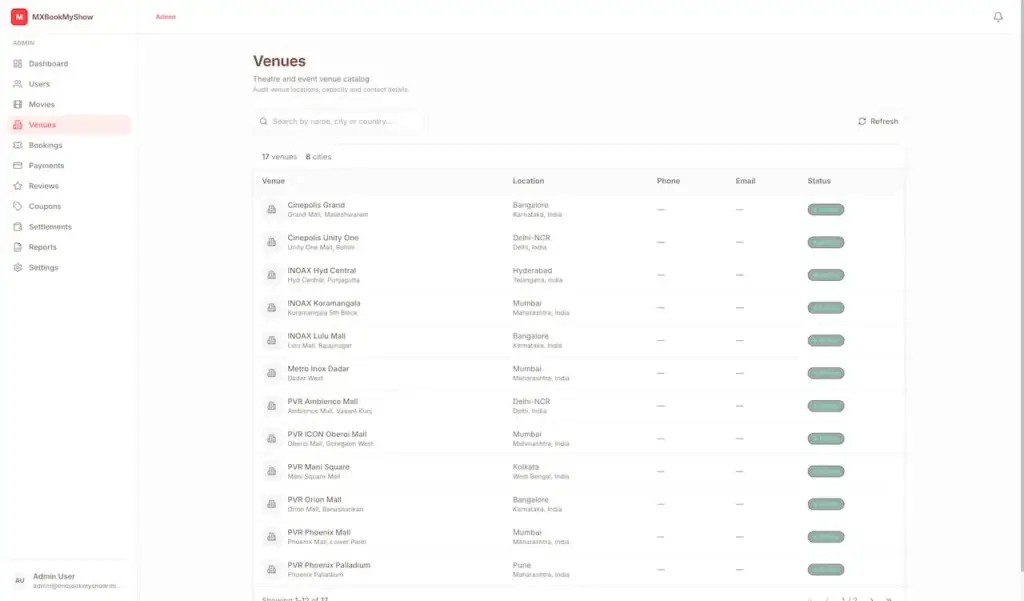
Admin venue directory listing cinema locations, contact details, status, cities, and theatre operators
7 screens · slide →

Each walkthrough follows one person: a buyer who browses, picks seats and ends with a scanned QR ticket; a venue user who sets up a screen and gets a payout; an operator who imports a catalog and processes a refund.

02Proof

Client Voices

What Clients Say About the Ticketing Platform - Real Deployments, What They Got Out of It

Feedback from cinema and event operators who launched ticketing platforms with Miracuves. Client identities withheld under NDA.

FFinance LeadEvent Ticketing Platform
“Partner settlement used to be four days of spreadsheet work every month. It now runs on a cycle and the statements generate themselves.”
GGeneral ManagerTheatre Group
“Our venue managers had never used a portal before. They were configuring showtimes and scanning tickets within a day, which was the real test.”
FFounderIndependent Cinema Network
“TMDB import meant our movie catalogue populated itself. That alone removed weeks of data entry before we could even launch.”
OOperations DirectorRegional Multiplex Chain
“Seat concurrency was the thing we were most afraid of building. Watching two browsers fight over the same seat in the demo and the second one lose cleanly is what convinced us.”
Read More Client TestimonialsFounders, CTOs and operator teams on our testimonials page

Proof in Production

White Label Ticketing Case Study - A Multi-Venue Regional Platform Deployment

One operator went live with a regional entertainment ticketing platform built on Miracuves software. The client's identity stays confidential under an NDA.

Case Study
Multi-Venue Ticketing Platform

A regional entertainment ticketing platform launched on the Miracuves BookMyShow Clone, with real-time seat maps and automated partner payouts.

Name withheld under NDAClient
IndiaRegion
Entertainment Ticketing & Venue OperationsIndustry
6Content verticals live
4Payment gateways active
5 wksKickoff until it is live
Venue-partner dashboard with revenue, bookings, occupancy, commission, venues, showtimes, quick actions, and performance charts
Challenges
  • Preventing double-booked seats during high-demand ticket launches
  • Automated partner payouts replacing monthly spreadsheet reconciliation
  • A loyalty program that measurably lifted repeat booking rates
Goal
  • Launch a multi-venue ticketing platform without building seat concurrency from zero
  • Give venue operators their own portal and scanner instead of phone calls
  • Give venue teams settlement visibility instead of month-end spreadsheets
🛠 Ticketing Product by Miracuves
  • Real-time seat inventory with concurrency handling
  • Four payment gateways with automated settlement runs
  • Loyalty tiers and promotional campaign tooling
  • QR validation for on-site entry scanning
  • Venue portal for listings, scheduling and reporting
“Seat inventory held up on our first weekend on sale, which was the only thing we were worried about. Venues reconcile their own settlement now.”Operations Director · Multi-venue ticketing platform - name withheld under NDA
Reach our teamSee how a multi-venue ticketing platform was deployed end to end.

03What it is

The Basics

What Is a White Label Ticketing Platform?

With a white label ticketing platform from Miracuves you run ready-built ticketing software, covering seat booking, payments and venue tools, as your own brand. Here it covers streaming, activities, plays, sports, events and movies, with live seat choice, multi-gateway checkout, QR checks at the entrance and the operator tools behind them.

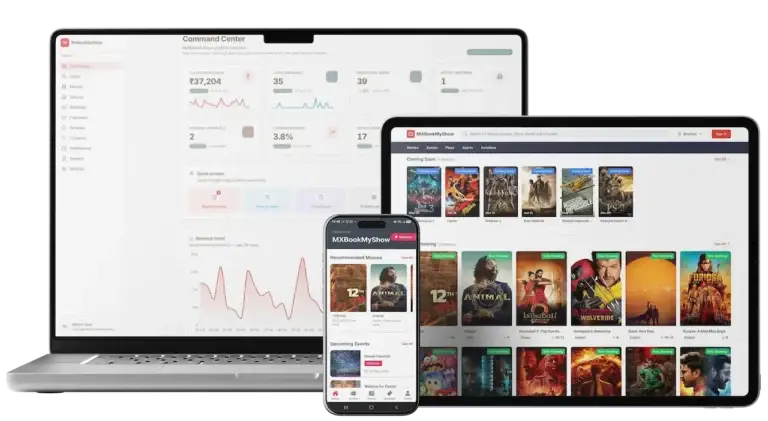
Laptop, tablet, and phone showing the admin command center, movie discovery catalog, and mobile events dashboard

Not Just a Storefront Theme

What matters is how seats are protected. Each seat row carries a version number, a distributed lock guards it and holds expire on a timer, so the same seat is not sold twice when a launch is busy.

No Per-Ticket Fees

You receive the source code, database schema and migrations. There is no per-seat or per-ticket fee to us, no vendor roadmap to wait on, and the database is standard PostgreSQL.

Go Live on Your Own Accounts

Payment gateways, SMS, email and push are wired in and start handling real money and messages the moment your own provider accounts are connected.

Covers Web, Android, iOS & API

What Exactly Is a Ticket Booking Platform Script?

A storefront is the easy bit. The difficult work is making sure one seat cannot be sold twice at the same moment, paying venue partners the correct amount on time, and checking tickets at a gate where the signal is weak. This platform has those problems handled.

Desktop searchable movie grid with now-showing and coming-soon films, genres, languages, and certificates
  1. 01Live seat maps with oversell protection
  2. 02Stripe, Razorpay, PayPal and Adyen already wired in
  3. 03Partner payouts that run automatically on cycles you set
  4. 04Four loyalty tiers over an append-only points ledger
  5. 05Fraud checks and audit logs on QR validation

Counted up, the package holds a four-tier loyalty engine, four payment gateways, customer, vendor and admin surfaces of their own, roughly 135 API endpoints and around 40 database tables spread across thirteen domains.

What Comes in the Box

White Label Ticketing Platform Features - Seat Booking, Payments, Discovery, Loyalty & Operations

Miracuves built every item here already, and each can be tried in the live demo. Some features need your own account with a third-party provider before they can move real money or deliver a real message, and those entries say so directly.

Part 01 / 12

Movie Ticket Booking & More

Streaming, activities, plays, sports, events and movies each have a scheduling model that fits: cinema runs on showtimes, and the other five run on event instances, so no single format is squeezed over all six.

  • Six verticals live together: cinema, events, sports, plays, activities, streaming
  • Movie details, posters and cast imported from TMDB
  • Catalog-wide search that offers suggestions
  • Filters for city, genre, language, format and date
Part 02 / 12

Seat Map Booking in Real Time

Maps are drawn from a stored seat layout, and live availability is pushed over WebSocket, so a seat someone else just took turns grey on your screen.

  • Seat maps built from a saved layout, fully interactive
  • Each seat is available, locked, booked or unavailable
  • Seats held for five minutes, then released automatically
  • A version column and distributed lock stop oversell
Part 03 / 12
Dynamic Pricing Rules

Price by seat type, then layer on matinee, evening, weekend or surge-window adjustments; promo codes can be a percentage, a fixed amount or buy-one-get-one.

  • Pricing by seat type: standard, premium, VIP, recliner
  • Adjustments for matinee, evening, weekend and surge periods
  • Percentage, fixed and BOGO promo codes
  • Points can be spent against the booking total
Part 04 / 12

Group Booking and Split Payment

An organizer invites friends and every member sees a share of their own, while payment status is tracked per member, so a group that has only partly paid never confirms by accident.

  • Group bookings with invited friends
  • Each member's share and payment status
  • Organizer sees who accepted and who paid
  • Groups that never finish expire cleanly
Part 05 / 12

Checkout on Four Gateways

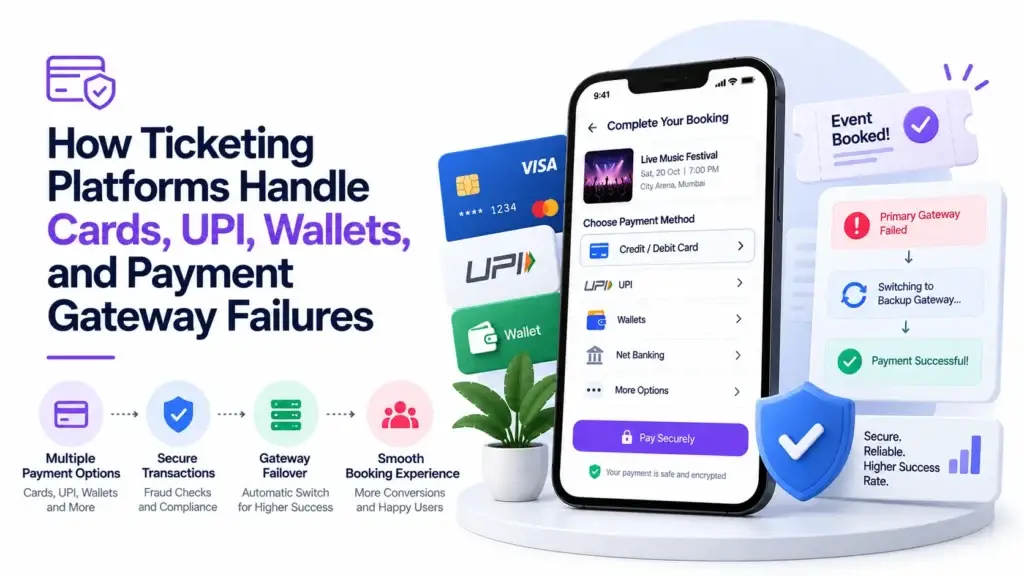
Stripe, Razorpay, PayPal and Adyen are all connected. Webhooks are HMAC-verified and refunds are supported, so buyers are not lost because their usual payment method is absent.

  • Support for Stripe, Razorpay, PayPal and Adyen
  • Every gateway webhook checked with HMAC-SHA256
  • Refunds in full or in part on all four gateways
  • You need your own merchant accounts to go live
Part 06 / 12

QR Tickets & Door Checks

Each ticket gets a unique QR code at confirmation. A scan at the gate marks it checked in, while attempt counters and audit logs keep a record behind the scenes.

  • A QR ticket is created when a booking confirms
  • The vendor's scanner flips a ticket to checked in
  • Counters and audit logs for each scan attempt
  • Repeat scans trigger fraud-oriented checks
Part 07 / 12

Scheduled Partner Settlements

Each partner has its own commission rate and a weekly, fortnightly or monthly cycle, paid out through Stripe Connect and PayPal Payouts, with a statement for every cycle.

  • Commission rate set per partner
  • Settle weekly, fortnightly or monthly
  • Payouts run via Stripe Connect and PayPal Payouts
  • Statements backed by a complete payout ledger
Part 08 / 12

Four Loyalty Tiers

Tiers climb from Bronze up to Platinum, each with earning multipliers and discounts. An append-only points ledger lets any balance be recalculated from the start.

  • Tiers named Bronze, Silver, Gold and Platinum
  • Tier-linked earning multipliers and booking discounts
  • Unalterable points ledger that can be replayed
  • Birthday bonuses and an annual reset you can configure
Part 09 / 12

Two-Sided Referrals

The referrer and the new user both earn. Attribution is captured at signup, the reward is released at the first confirmed booking, and duplicate detection guards the loop.

  • Rewards for both sides of a referral
  • Every user gets a unique code
  • Attribution captured at signup, reward paid at first booking
  • Duplicates caught, points clawed back
Part 10 / 12

Notifications on Every Channel

One notification service handles email, SMS and push, plus live WebSocket updates, for confirmations, reminders, refunds and loyalty events.

  • SendGrid for email, Twilio for SMS
  • Firebase Cloud Messaging for push
  • Seat changes shown live via WebSocket
  • Live delivery needs your own provider accounts
Part 11 / 12

Vendor Portal for Venue Teams

The mobile-optimized entry scanner sits alongside payout balances, occupancy analytics, showtime scheduling, seat layout editing and venue and screen setup.

  • A portal for managing venues, screens and showtimes
  • Occupancy and revenue figures for each showtime
  • Payout balances plus withdrawal requests
  • Entry scanner built for mobile
Part 12 / 12

Admin Console for Operators

Platform analytics, cache diagnostics, review moderation, promo codes, booking oversight with refunds, a TMDB-import catalog, and user and role management.

  • One console for users, catalog and commerce
  • Refund handling, promo codes, review moderation
  • Redis cache checks and system health
  • Analytics on revenue, bookings and conversion
Limits to know before you buy:

The software itself is finished on delivery. You still have to connect SMS, email, push and the payment gateways, because each needs provider accounts and credentials in your own name before launch. The interface ships in English with multi-language groundwork built in, and catalog search runs on fast direct database queries, with a dedicated search engine on offer as an add-on.

Speak With Our Team

Daily operation needs no developers

Box Office Software Admin Console - Users, Catalog, Commerce & Platform Health

Miracuves keeps identity, catalog, commerce, moderation and platform health together in a single admin console. Permissions are verified deep in the code, at route, handler and service level, so a hidden menu link is never the only protection.

Platform overview with revenue, bookings, users, partners, approvals, conversion, venues, reviews, quick actions, and trend charts
Admin payments dashboard with processed value, success rate, failures, refunds, transaction records, methods, and status breakdown

Event Organizer Tools Backend

  • 01

    Dashboard

    Recent activity, pending approvals and platform KPIs - the first screen an operations lead checks each morning to find out what needs attention.

  • 02

    User Account Controls

    Login history, suspension and deletion sit beside full user records, where each account is assigned a role as customer, vendor, partner or admin.

  • 03

    Catalog

    Movies come in directly from TMDB with metadata, posters and cast, and events in the other five verticals are created by hand.

  • 04

    Venues & Screens

    Venue records with amenities, the seat layout editor behind the customer map, and screen setup for each format.

  • 05

    Showtimes

    A calendar view for scheduling, bulk creation, copying from existing patterns and clash detection against runtime.

  • 06

    Bookings & Refunds

    Every booking platform-wide with its lifecycle status, and refunds in full or in part across all four gateways.

  • 07

    Payments

    Reconciliation view for resolving disputes, next to the transaction ledger, webhook delivery history and gateway health.

  • 08

    Promo Codes

    Redemption tracking, usage limits and validity windows for every code, whether it is a percentage, fixed or buy-one-get-one offer.

  • 09

    Settlements

    See each partner's earnings, the commission taken and payout status, and start a payout by hand when a cycle must run early.

  • 10

    Moderation & Health

    Reviews go through an approval workflow, next to Redis cache diagnostics, system health and analytics dashboards covering the whole platform.

  • Cache stats and memory use per key pattern
  • Hit and miss rates, plus when entries expire
  • Stale entries can be invalidated by hand
  • Dependency status, API latency and error rates
  • Revenue split by day, week, month or year
  • Average order value, booking volume and conversion
  • Best-performing titles and venues
  • Refund anomalies and gateway success rates
Need tighter controls?

Larger buyers usually ask for some extras: syncing with accounting or ERP systems, real-time streaming analytics, a separate database for each tenant, and SAML or OIDC single sign-on. Treat these as add-ons. Send us the requirement and we will scope it.

Speak With Our Team

04Scope of the build and its price

Complete Package

What the White Label Ticketing Software Includes: Deployment, Mobile Apps & Codebase

Miracuves delivers one deployable platform in full, with the application source, a data schema and the paperwork a technical reviewer expects. Ownership passes to you entirely. There is no runtime license, seat fee or per-ticket fee, and you do not depend on our roadmap.

01

Full Repository Delivered

The whole Next.js 16 and React 19 application, written in TypeScript, with the customer, vendor, admin and API surfaces in one pnpm monorepo that you can change and redeploy.

  • The full Next.js 16 and React 19 app
  • TypeScript end to end, typed through Drizzle ORM
  • One codebase holds customer, vendor, admin and API
  • Modify, extend and redeploy it however you like
02

Schema & Data Model

Standard PostgreSQL holds roughly 40 tables in thirteen domains. Lifecycles are enum-driven, seat inventory uses optimistic locking, and ledger tables cannot be edited after the fact.

  • Roughly 40 tables spanning thirteen business domains
  • A PostgreSQL schema using enum-driven state machines
  • The seat inventory table uses optimistic locking
  • Points ledger and audit log tables that cannot change
Desktop homepage featuring 12th Fail with Book Now action, entertainment categories, and recommended movies
03

Buyer Booking App

Buyers get referrals, rewards, a wishlist and booking history, along with QR tickets, checkout, interactive seat maps, global search and six verticals to browse.

  • Buyer-facing booking app covering six verticals
  • Browse, search, pick seats, pay and get confirmation
  • Booking history, wishlist, rewards, referrals
  • Notification center plus profile management
Venue-partner dashboard with revenue, bookings, occupancy, commission, venues, showtimes, quick actions, and performance charts
04

Vendor Portal

Venue teams manage their screens and venues here, edit seat layouts, schedule showtimes, read occupancy analytics, check payout balances and use the mobile entry scanner.

  • Portal for running venues and screens
  • Bulk creation when scheduling showtimes
  • Occupancy and revenue reporting
  • QR entry scanner tuned for mobile
Platform overview with revenue, bookings, users, partners, approvals, conversion, venues, reviews, quick actions, and trend charts
05

Box Office Admin

Analytics, cache diagnostics, moderation, settlements, promo codes, bookings with refunds, a catalog with TMDB import, and users with roles.

  • Admin tools for users, catalog and commerce
  • Review moderation, promo codes and refunds
  • Manage settlements and start payouts
  • System health and cache diagnostics
06

Payments & Settlements

Four gateways are integrated with verified webhooks and refunds, and Stripe Connect and PayPal Payouts are set up for automatic partner settlement.

  • Four payment gateways already integrated
  • Every provider's webhooks verified with HMAC
  • Settlements paid via Stripe Connect and PayPal Payouts
  • Going live requires merchant accounts of your own
07

Connected Services

TMDB for catalog import, Twilio for SMS, SendGrid for email, Firebase for push, AWS S3 with CloudFront, and Redis handling caching, rate limiting and pub/sub.

  • TMDB wired in for movie catalog import
  • Notifications routed via Twilio, SendGrid and Firebase
  • Media and documents served from AWS S3 and CloudFront
  • Redis covers caching, rate limiting and pub/sub
08

Technical Documentation Pack

An entity-relationship diagram, a guide to reading the schema, the full API collection, a developer and security handbook, the VAPT posture and a product dossier.

  • ERD, a schema guide and the API collection
  • Handbook for developers and security
  • A document on VAPT and compliance posture
  • Product requirements plus a technical dossier
Prefer to watch it run before buying?

Log in to the demo as any of the three roles shown above. If you would rather be guided, a walkthrough call lets us run a live seat booking, a QR check and a settlement against your own venue model.

Speak With Our Team

Price Breakdown

How Much Does a White Label Ticketing Platform Cost to Buy Outright in 2026?

Ticketing platform cost with Miracuves begins at $3,999 for the ready-to-launch white label package. It rises with venue count, gateway choice, loyalty setup, integrations and infrastructure complexity.

Popular pick

Professional

Ready-Built Ticketing Package
$3,999one-time payment
Live in 6 days

Best for: Independent cinemas, event promoters, regional ticketing platforms and venue groups

What you see in the demo is what you get, under your brand and self-hosted.

Get Started

Enterprise

Tailored, Regulated & Peak-Load
Customquote
Live date: set by final scope

Best for: Multiplex chains, stadium operators, theater groups and multi-venue enterprises

A custom build shaped around your own circumstances and business needs.

Ask for a Quote
Development Cost

White Label Ticketing Platform Development Cost in 2026

Miracuves sells this white label ticketing platform at $3,999, paid once. The price covers your brand on the buyer web app plus Android and iOS apps, the venue portal and admin console, deployment to your hosting and the full TypeScript repository with its roughly 40-table schema.

$3,999 Paid once
6 working days Rebranded and live
0% Revenue share

What moves your total sits outside the software invoice

  • Hosting and a domain in your name
  • Merchant accounts at the payment gateways you switch on
  • Provider accounts for SMS, email and push messages
  • Apple and Google developer memberships for the app listings
  • Contracts, refund terms and ticket-tax filings for your markets

A dedicated search engine, single sign-on or accounting sync is a separate module: written quote first, then usually 2-8 weeks of effort.

Compare Your Options

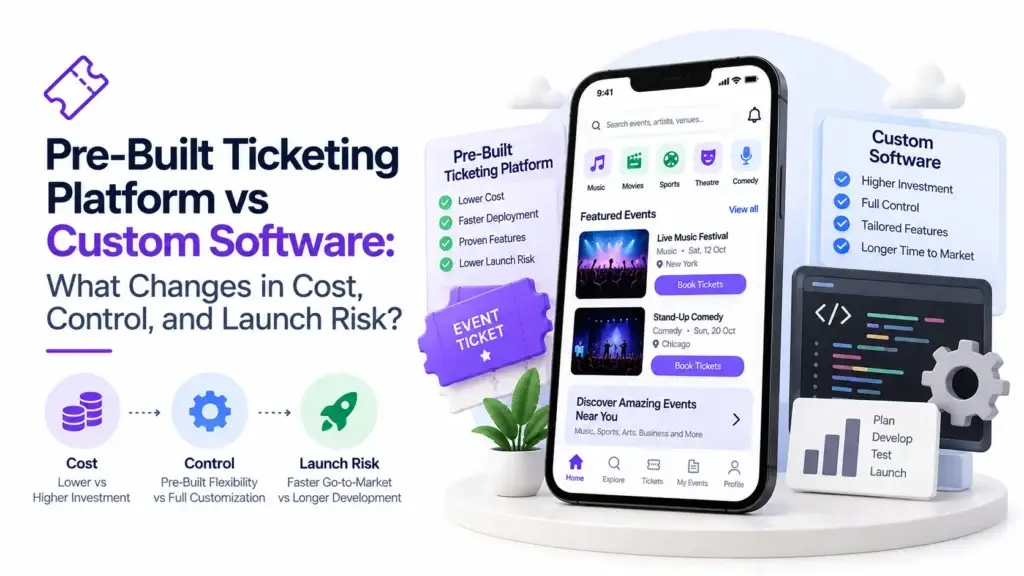
Ready-Made White Label Ticketing Platform vs Custom Development vs SaaS

A ticketing brand can rent a hosted box office, hire an agency, or own finished software from Miracuves. The table weighs owning this white label ticketing platform against both on time, money and control.

CriteriaMiracuvesReady-Made White Label Ticketing PlatformCustom DevelopmentSaaS
Launch time6 working days on your serverScoped per project, usually monthsInstant account on vendor terms
Upfront cost$3,999 one-time, no per-ticket feeQuoted per specificationPer-ticket or monthly charges
Source code ownershipFull Next.js, React and PostgreSQL codeOnly if the contract assigns itVendor keeps the code
CustomizationVerticals, seat tiers, fees and loyalty rulesBuilt to order at extra costVendor configuration only
Ongoing feesNo seat fee, revenue share or ticket feeMaintenance billed separatelyA cut of every ticket sold
Branding & app-store listingYour brand on web, Android and iOS appsYour brand on a new buildVendor name on checkout or tickets
Best forCinemas, promoters, venue groups and aggregatorsVenue logic no product supportsOne-off or small events

Ownership

What White Label Means on This Ticketing Platform

The phrase white label ticketing platform gets used loosely, so Miracuves draws the line here: you own and brand the software, and no hosted service is rented to you.

What carries your brand

The customer web app and the Android and iOS apps carry your brand, and the whole platform runs self-hosted under your name. Confirmations, reminders, refunds and loyalty messages go out through your own SendGrid, Twilio and Firebase accounts, so buyers hear from your business. The vendor portal and admin console stay under the same brand.

What you keep for good

You own the full repository: the TypeScript application built on Next.js 16 and React 19, held in one pnpm monorepo, with the customer, vendor, admin and API surfaces, the Drizzle ORM schema of about 40 tables in 13 domains, and the technical documentation pack. There is no revenue share, seat fee or per-ticket fee to Miracuves.

What it does not mean

There is no hosted subscription here that a vendor can turn off: you hold the code and host it yourself. Merchant accounts for the payment gateways and provider accounts for SMS, email and push stay registered to you. Extra interface languages, a dedicated search engine, SSO, per-tenant databases and ERP sync are all available as add-ons when you want them.

Where It Fits Best

Ticketing Platform Use Cases - Sports, Live Events, Cinema & Regional Aggregators

Very different operators share one Miracuves codebase, and whichever vertical they lead with decides which tools they lean on. Cinemas lean on seat maps and TMDB import, stadiums on tiered pricing, and promoters on promo codes and group bookings. Configuration covers the differences, so there is no fork to maintain.

CinemaMultiplexCinemas & Multiplex Groups

Operate a multiplex or a standalone cinema: movie records come in automatically from TMDB, each screen gets its own auditorium seat map, and premium formats are priced with seat-type multipliers.

01
Mobile interactive cinema layout showing available, selected, and booked seats with ticket total and payment action
ConcertsFestivalsConcerts, Comedy Nights & Festivals

Promoters can sell concerts, comedy nights and festivals at several venues. Presale promo codes serve affiliate channels, group invitations serve fan communities, and seat holds keep working when tickets go on sale and the crowd arrives.

02
Desktop events catalog with concerts, theatre, comedy, festivals, workshops, sports, technology, and booking controls
SportsStadiumsSports Ticketing & Stadiums

Operate a stadium with tiered sections and season programs; premium prices and loyalty tiers together account for a meaningful share of revenue.

03
Desktop showtime selector with dates, formats, cinema locations, screen numbers, prices, and availability indicators
TheaterPerforming ArtsTheater & Performing Arts

Put on a season of shows with membership tiers behind it. Schools and corporate groups book together, and split payment means nobody has to chase the rest of the party for money.

04
Mobile booking page listing dates, cinemas, formats, prices, available seats, and showtimes for 12th Fail
RegionalAggregatorsRegional Multi-Venue Aggregators

A region's venues sell under one brand. Every partner venue gets an operating portal of its own and its own settlement cycle, and customers log in once to a shared identity.

05
Cinema-partner venue table with locations, screen counts, capacity, active status, and Add Venue or Manage actions
ActivitiesExperiencesExperiences & Activities

Sell experiences and activities that depend on registration and capacity, not a numbered seat, through the same booking, payment and validation backbone.

06
Mobile Mumbai home screen with recommended movies, upcoming events, location control, and main booking navigation
Business Model

White Label Ticketing Platform Business Model: Three Ways to Run It

One TypeScript codebase serves businesses that sell time-bound or seated entry, and three of them put it to work in different ways.

Venue group box office

A cinema chain or stadium owner sells its own shows under one brand, with each site holding its own prices, seat maps and scanner staff.

Promoter and festival seller

A promoter sells concerts, comedy nights and festivals across several venues, using presale promo codes, group orders and seat holds built for a surge.

Regional aggregator

An operator gathers a region's venues under one name, gives each partner a portal and a settlement cycle, and lets customers sign in once.

In every case the ticket records, partner ledgers and customer relationships stay on infrastructure you hold.

One platform, many setups. All of these use cases share three role surfaces and one schema. What differs is your lead vertical, the pricing rules and the venue model, and you never end up maintaining a separate fork.

Speak With Our Team

Industries

Sectors We Serve

Miracuves' platform fits any business whose inventory is scheduled, seated or limited by capacity.

  1. 01Cinemas & Multiplexes
  2. 02Live Music & Concerts
  3. 03Sport & Stadiums
  4. 04Theater & Performing Arts
  5. 05Fairs & Festivals
  6. 06Comedy Clubs & Small Venues
  7. 07Ticket Aggregators
  8. 08Experiences & Activities
  9. 09Hybrid & Streaming Events
  10. 10Conferences & Corporate
  11. 11Community & Campus Venues
  12. 12Studios & Dev Agencies

Cinemas, from single screens to chains, use everything from TMDB import to the QR scan at the door. Promoters of concerts and festivals rely on presale promo codes, group bookings and seat holds for launch day. Stadiums price by tier and run season programs. Theater companies combine memberships with group bookings from schools and corporates. Regional aggregators give every partner venue a portal and a settlement cycle. Activity and experience sellers use the same booking flow when there are no numbered seats. Comedy clubs and small venues get up-to-date booking with no IT department. Streaming operators can bundle digital access with physical tickets for hybrid events.

Miracuves built this as a concurrency-first ticketing platform that fits any business selling scheduled inventory. It handles several venues where your footprint needs them and runs entirely under your brand.

06Inside the build

From Booking to Show

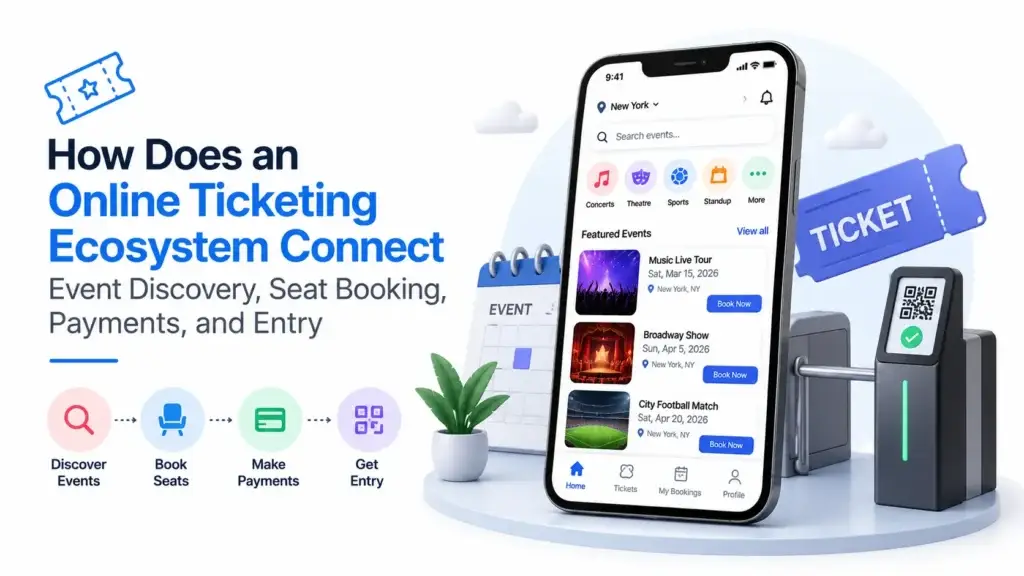
How Online Ticket Booking Works - Browse, Hold a Seat, Pay & Enter

From the outside, ticketing looks easy. In Miracuves' build, a booking moves through an ordered sequence: seat lock, payment, then entry check. Follow one booking from first browse to the scan at the gate and the payout that settles it.

Buyer Journey - From Browsing to Checked In

  1. Mobile Mumbai home screen with recommended movies, upcoming events, location control, and main booking navigation
    1Browsing Movies, Events & Sports

    Buyers explore one catalog across six verticals, from films and live events to sports and plays, and movie details arrive automatically from TMDB, so no one keys them in.

    • Movie records pulled from TMDB with posters and cast
    • Plus events, sports, plays, activities and streaming
    • Browsing tuned to the city, with distance-based discovery
    • Search across everything, with suggestions and filters
  2. Mobile interactive cinema layout showing available, selected, and booked seats with ticket total and payment action
    2Seat Selection With a Timed Hold

    The moment two buyers reach for one seat is where weaker ticketing builds break. This one takes a distributed lock on the seat first, then runs an update that only lands if no one has claimed it already.

    • A distributed lock is taken on the seat key
    • A version column guards the conditional update
    • Hold lasts five minutes and carries an expiry time
    • New seat state is pushed to all other viewers
  3. Mobile promotions page with movie and event discounts, coupon codes, minimum booking values, and expiry periods
    3Pricing Breakdown at Checkout

    Ahead of paying, buyers see the whole fare build-up: the base price, the seat multiplier, the time factor, any discount applied and the fees.

    • Multipliers by seat type, factors by time
    • Percentage, fixed and BOGO promo codes
    • Loyalty points can reduce the total
    • Group orders divided into member shares
  4. Mobile booking list with confirmed 12th Fail and Kantara tickets, dates, times, seats, amounts, download, and cancellation controls
    4Payment & QR Ticket Confirmation

    Buyers pay through the gateway they prefer, and a booking is confirmed only when that gateway's webhook arrives with a verified signature. QR tickets are issued right after.

    • Four gateways handling cards, UPI, wallets and BNPL
    • Every callback checked with HMAC-SHA256
    • Idempotency stops duplicate webhook deliveries
    • Booking confirmed and tickets issued as QR codes
  5. Mobile account settings for profile, password, booking updates, promotions, review reminders, system updates, and language
    5Entry Scanning at the Venue Gate

    Venue staff scan each QR code and the ticket changes state exactly once. Any repeat scan is recorded as an attempt instead of letting another person through.

    • A mobile-optimized scanner inside the vendor portal
    • Ticket status moves from valid to checked in
    • Counters and audit logs for validation attempts
    • Live entry count and a door list
  6. Mobile Silver Member dashboard with 2,500 points, tier progress, ticket-earning rules, and reward redemption
    6Settlement, Payouts & Loyalty Points

    After the show, each partner is paid out on its own settlement cycle and buyers earn points toward their next booking, so both the money and the relationship are looked after.

    • Commission deducted, partner net worked out
    • Payout sent through Stripe Connect or PayPal
    • Points added to a ledger that cannot be altered
    • Tier changes checked and communicated
Booking Flow DiagramBrowsePick SeatsHold 5 minPayQR CodeCheck In

Build Overview

Ticketing Platform Architecture & How the Backend Flows

Speak With Our Team
  1. Layer 01

    A Single App, Three Surfaces

    Customer, vendor and admin are all served from one Next.js application sharing a database package, so the surfaces cannot drift apart on what is true.

  2. Layer 02

    Database-Level Concurrency

    A version column and a conditional update settle seat contention, instead of coordination in application code, and that is why the result stays correct under load.

  3. Layer 03

    Redis Handles Coordination

    Pub/sub broadcasting, rate limiting, hold expiry and distributed locks all go through Redis, which also lets the platform scale out horizontally.

  4. Layer 04

    Confirmation by Webhook

    Only a gateway callback with a verified signature confirms a booking, and idempotency on the transaction ID means a repeated delivery cannot confirm it twice.

  5. Layer 05

    Append-Only Financial Records

    Nobody can rewrite the points ledger or audit log, since both are append-only, so any balance or admin action can be rebuilt instead of trusted.

  6. Layer 06

    One Shared Schema Package

    Table definitions and services sit in a single workspace package that the application imports, so frontend and backend share one source of truth for types.

Stack Overview

Ticket Booking Software Stack - PostgreSQL & Redis, Next.js 16, React 19

Miracuves tackles three hard problems behind the booking screens: two buyers wanting one seat, payment callbacks that can be trusted, and an operator console that stays steady when a big on-sale opens. These are the layers that solve them.

Frontend

Customer, Vendor & Admin Front Ends

TypeScript React 19 Next.js 16 App Router
  • Server components first, client code only where a screen is interactive
  • Tailwind CSS 3.4 handles layout and brand theming
  • Recharts draws the admin and vendor analytics charts
  • Seat map booking runs on clickable maps drawn from saved layout data
API & Data Access

Typed Queries & REST API

Booking Data via Drizzle ORM Typed SQL
  • One set of typed queries serves both the API and the app
  • Roughly 135 REST endpoints, grouped into ten route families
  • Every response, success or error, uses a fixed envelope
  • A tRPC route sits next to the REST endpoints
Database

Bookings, Seat Stock & Ledgers

~40 Tables PostgreSQL 14+
  • A single relational schema covers thirteen business domains
  • Status lifecycles are enforced by the database through enums
  • Seat inventory rows carry a version column for optimistic locking
  • Seat layouts, metadata and preferences are stored as JSONB
Cache & Live Sync

Seat Locks & Live Seat State

WebSocket Redis 6 Pub Sub
  • Distributed locks protect each seat selection
  • Rate limits are shared by every application instance
  • Pub/Sub pushes live seat state to everyone viewing the map
  • Caching in layers, from in-process memory up to Redis
Identity

Sign-In, Sessions & Roles

bcrypt JWT NextAuth
  • Sign in with email and password, a phone OTP or Google
  • JWT sessions roll over thirty days and use hardened cookies
  • Separate roles for customers, vendors, partners and administrators
  • At startup, weak or missing secrets are rejected
Integrations

Payments, Catalog & Notifications

AWS TMDB Four Gateways
  • Stripe, Razorpay, PayPal and Adyen, each with signature-verified webhooks
  • TMDB imports the catalog behind movie ticket booking
  • Notifications go out through Twilio, SendGrid and Firebase
  • Media, tickets and statements are served from S3 and CloudFront
A note for your developers:

payment capture, SMS, email, push messages and movie metadata all connect at documented integration points, using the provider credentials you hold - each one goes live as soon as your keys are plugged in. Every layer listed is mainstream and easy to hire for, with no proprietary framework, and the schema moves to any PostgreSQL 14 instance.

Speak With Our Team

Room to Grow

Scaling Ticket Sales - Indexed Queries, Seat Locks & Headroom for Big On-Sales

Miracuves runs a long-lived Node.js server instead of serverless functions, deliberately, so live seat updates, scheduled jobs and the Redis pool share one process and never face a cold start.

01

Fast Hot-Path Queries

Foreign keys, status columns and date ranges carry indexes, and partial indexes cover seats still open, which keeps the most frequent query inexpensive.

  • An on-sale is the load that breaks simple builds, so contention is settled in the database instead of in application code
  • Updates are conditional on a version column
  • A Redis distributed lock wraps the moment of selection
  • Expiring holds free abandoned seats on their own
  • Pub/Sub broadcasts the change, so every viewer sees it at once
02

Easy to Scale Out

Sessions and live seat updates sit in Redis, which lets you add instances as demand grows.

  • Catalog reads far outnumber writes, so reads are cached in layers and writes remain strictly transactional
  • Per-process memory holds hot, short-lived state
  • Redis is the layer every application instance shares
  • Seat availability is loaded ahead of showtime
  • PostgreSQL stays the permanent source of truth
03
Callback arrivesTransaction id is uniqueRepeat is dropped

Idempotent Webhooks

Each gateway transaction id has a unique constraint, so a repeated callback is dropped instead of confirming the same booking twice.

  • Sooner or later each operator needs something tailored to their venues or market
  • Adding to a mainstream stack is ordinary development work
  • A new gateway takes one interface plus a route handler, and a new notification channel extends one orchestrator
  • Skills in Next.js, TypeScript, PostgreSQL and Redis are in common demand
04
Points journalPayout journalReconciled

Books That Reconcile

Points balances and payout records are checked against append-only journals, so an audit is a database query, not an investigation.

  • At scale, manual payout reconciliation is documented as taking fifty to a hundred hours a month - the work the settlement engine takes over
  • Commission rate and cycle set for each partner
  • Payout runs start from cron on a schedule
  • Payments go out via Stripe Connect and PayPal Payouts
05
PartitioningRead replicasArchiving

Documented Growth Path

Growth steps are written down: partition the busiest append-only tables, put analytics on read replicas and archive old ledger entries, each in small increments.

  • A points balance nobody can audit turns into a support headache, so each movement is an append-only journal entry and not an edited counter
  • Birthday and promo bonuses are recorded as typed entries
  • Expired points show up as a negative entry, never a deletion
06

Runtime Monitoring

The platform offers structured logs, security audit events, health and metrics endpoints and cache diagnostics inside the admin console.

  • Statements are generated from an auditable ledger
  • Each tier change is logged with its reason and threshold
For founders and operators:

Begin small and keep growing on the same deployment. When volume climbs, you resize instances, bring in read replicas and partition the heaviest append-only tables, and the architecture underneath does not change.

Speak With Our Team

07Security and controls

Designed for Audits

Ticketing Platform Security - OWASP-Mapped, Webhook-Verified & Ready for Inspection

The security posture is written up against the OWASP Top 10 in its own VAPT file. In ticketing the harder questions are whether a payment callback can be trusted and if a ticket could be forged or replayed; both are handled inside the transaction path itself, not bolted on beside it.

  1. 01 · Callbacks

    Signed Payment Callbacks

    The platform checks every gateway webhook with HMAC-SHA256 over the raw body and rejects it on any mismatch, which means a forged callback cannot complete a booking.

    • CSRF Protection: State-changing requests use a double-submit cookie with a timing-safe comparison; webhooks are exempt because their signature already authenticates them.
  2. 02 · Card details

    Card Details Stay Off Servers

    Card numbers never reach your servers because the gateway does the processing, which leaves the deployment clear of the toughest part of PCI scope.

    • Data Retention & Privacy: Payment records are kept for seven years for audit; accounts can be deleted and data exported to answer privacy requests; logs hold minimal personal data.
  3. 03 · Tickets

    Replay-Proof Tickets

    Scanning a QR code marks the ticket as checked in a single time; attempt counters and audit logs record any second scan instead of letting a second person in.

    • Activity Records: A separate audit logger captures failed sign-ins, breaches of rate limits, suspicious payloads, bad webhook signatures and administrator actions.
  4. 04 · Access

    Access Checked in Layers

    Roles are enforced in route middleware, in the API handler and in the service layer, and customer-scoped resources get ownership checks.

    • OWASP Top 10 Alignment: Each category is assessed with its control named, covering integrity, injection, cryptography, access control and insecure design through specific mechanisms.
  5. 05 · Abuse

    Throttling Against Abuse

    Logins, OTP requests and ordinary API traffic are throttled at documented thresholds, and Redis backs the counters so limits apply across instances.

    • Injection Defense: ORM parameterization is the main control, and helpers that detect SQL injection and cross-site scripting patterns add a second layer on request bodies.
  6. 06 · Encryption

    Encryption at Rest & in Transit

    Passwords are hashed with bcrypt at twelve rounds, sensitive fields are encrypted with AES-256-GCM, and TLS is enforced through strict transport security headers.

    • Hardened Deployment: Secret strength is checked at startup; origin allowlists, credential rotation and centralized logging are written down as pre-launch requirements.

Hardening that depends on the deployment - secrets for production, allowed origins, rotating credentials, centralized logs - sits on a pre-launch checklist in the documentation, and coverage is never assumed.

Talk Through Security & Compliance

Where Responsibility Sits

Ticketing Platform Trust & Compliance - What the Code Covers and What the Operator Still Owns

A white label ticketing platform is software, and software cannot stand in for a license or a certification. Miracuves delivers the booking, payment, settlement and entry tooling described on this page. Running ticket sales lawfully - your contracts with venues and promoters, your resale and refund rules, the tax charged per ticket and your duties under local law - remains yours as the operator.

Review-friendly by design, with every control in the code.

The safeguards that ticketing operators get asked about are already in the code. Every payment callback has its signature checked, and no card data is stored on the platform. A QR ticket lets one person in, once, backed by audit logs and attempt counting. Role checks run in the service layer, at the handler and on the route; rate limiting is on; an audit logger tracks administrator actions. Payment records stay for seven years, and account deletion plus data export handle privacy requests.

What the Software Delivers

Seats are guarded against overselling. You also get four gateway integrations that handle full and partial refunds, per-partner commission and settlement statements, promo codes limited by usage caps and validity windows, review moderation, and QR entry validation with an audit trail of operator actions. The source code for all of it is handed over, and it belongs to you.

Where Responsibility Stays With You as Operator

Contracts with venues and promoters, including their commission and payout terms, your refund and cancellation policy, and the way you settle disputes and chargebacks are yours. The software follows the rules you configure and does not write them.

Payment, Tax and Resale Rules

Ticket payments settle into merchant accounts of your own at Stripe, Razorpay, PayPal or Adyen. Partner payouts run through Stripe Connect or PayPal Payouts. You are responsible for setting and filing entertainment tax or GST per ticket, invoices, and whatever resale limits apply where you sell.

Local Law Sets the Terms

Duties differ by market. In India, operators deal with GST on tickets and the country's Digital Personal Data Protection Act. In the EU and UK, GDPR applies alongside consumer-protection law, and some markets also restrict ticket resale. Ask a qualified lawyer which rules apply to you. Legal advice sits outside the scope of what Miracuves sells.

08Extend the platform

Included out of the boxMXBMS
  • Live seat inventory
  • Checkout with four gateways
  • Partner settlements
  • Loyalty tiers & QR entry

How modules work

  1. 1
    Choose your modules

    Pick modules at the start or bolt them on later; the core stays untouched.

  2. 2
    Scoped & priced per module

    Each module has its scope and price written out.

  3. 3
    Delivered in your repository

    Like the core, each one is delivered as source code under your ownership.

Ask About Custom Add-Ons

Add More

Ticketing Platform Add-Ons - SSO, Search, Languages & Oversight Features

Miracuves hands over a finished platform that already runs in the demo. Operators usually add the modules below when an outside provider account is needed, or when scale or procurement rules ask for more.

  • Apps, languages & payments

    iOS App, Included

    Your branded iOS app ships with the base platform next to the Android build, running on the same APIs as the responsive web app and published from your own Apple developer account.

    iOS · Mobile
  • Search & analytics

    Dedicated Search Engine

    Direct database search handles the launch catalog with ease, and an Elasticsearch, Algolia or Meilisearch engine slots in as the catalog grows.

    Search · Discovery
  • Controls for big teams

    Enterprise Sign-On

    Google OAuth is already part of the platform. For enterprise identity providers, SAML and OIDC is the module procurement teams request most.

    SSO · Big Teams
  • Search & analytics

    Streaming Analytics

    Dashboards refresh straight from the database out of the box, and sub-second streaming analytics on a dedicated pipeline is ready for operators who want live telemetry.

    Analytics · Live
  • Apps, languages & payments

    Multilingual Screens

    Internationalization groundwork is already in the codebase. This module switches it on and translates the screens, so you can sell in each of your markets in its own language.

    i18n · Languages
  • Controls for big teams

    Accounting & ERP Sync

    Settlement and revenue figures are all available and exportable. Native sync with an enterprise ERP, QuickBooks or Xero arrives as an integration module.

    ERP · Bookkeeping
  • Controls for big teams

    Tenant Isolation

    A shared schema with partner-scoped filtering is what ships. Separate databases per tenant, for enterprise isolation needs, are a deployment variant.

    Tenancy · Isolation
  • Apps, languages & payments

    Extra Payment Rails

    Four gateways come wired in. Regional rails beyond those connect through the same webhook validator interface, so each added provider is a contained task.

    Gateways · Regional

Sister Entertainment Platforms

Beyond Ticketing? See the Neighboring Platforms.

This white label ticketing platform is one product in a wider entertainment and booking range. If your roadmap reaches past ticketing, these are the natural next ones.

TikTok Clone01
Pick it if: Creators and short clips are your productTikTok Clone

Short-video app built around an algorithmic feed, with creator tools, live streams and virtual gifts.

Explore Solution
Youtube Clone, Video Sharing by Miracuves, Video Sharing Platform02
Choose it for: long-form video channelsYouTube Clone

Long-form video app covering channels, monetization, subscriptions and watch-time analytics.

Explore Solution
Netflix Clone, OTT by Miracuves, Netflix Clone Script03
Choose it for: selling streaming subscriptionsNetflix Clone

OTT streaming app featuring subscription billing, sync across devices and content licensing workflows.

Explore Solution
Airbnb Clone Platform Across Guest, Web, and Admin Interfaces04
Choose it for: selling stays instead of seatsAirbnb Clone

Booking marketplace offering availability calendars, onboarding for hosts, commission and automated payouts.

Explore Solution
CatalogBrowse 90+ solutions

09The revenue case

Where Ticket Revenue Comes From

Ticketing Platform Revenue Models - Commission, Fees, Pricing & Loyalty

Each ticketing income line is a separate setting in Miracuves' build, so changing one leaves the others alone.

  1. 01

    Ticket Sales Commission

    A percentage of gross booking value, configurable for each partner, applied automatically at settlement instead of being reconciled later.

  2. 02

    Booking Fee Per Ticket

    A fixed service charge added at checkout. The operator sets it, and the fare breakdown shows it next to taxes.

  3. 03

    Seat Tier Pricing

    Multipliers by seat type across standard, premium, VIP and recliner tiers let the best seats in the house carry a price to match.

  4. 04

    Showtime & Surge Pricing

    Matinee discounts fill quiet slots and surge multipliers apply on opening weekends; both are rules you configure, with no manual repricing.

  5. 05

    Loyalty and Repeat Visits

    Tier perks and points give customers a reason to stay. The payoff shows up as more frequent bookings, not as a separate line item.

  6. 06

    Food, Drinks & Add-Ons

    Food and drink can be added to the booking during checkout, which captures per-visit spend that would otherwise be made at the counter or not made at all.

What a ticketing platform can charge: ticket commission, booking fee, pricing rules and concessions, with the published fees and cinema-operator results that frame each.
Revenue streamHow it is chargedTake rateTypical rangeWhat sets the ceiling
Commission on Ticket SalesA percentage of each sale deducted from the partner's settlement.Eventbrite US: 3.7% plus $1.79 per ticket, with 2.9% processing per order.Three stacked charges. Eventbrite splits its price into a percentage, a per-ticket amount and a per-order fee, and the FTC rule effective May 12, 2025 requires US live-event sellers to show the all-in price upfront.
Per-Ticket Booking FeeA fixed per-ticket amount the buyer sees as its own line beside the taxes.PVR INOX FY26: convenience fees equal about 6.8% of ticket sales.Law and tax. The Bombay High Court struck down Maharashtra orders barring convenience fees in July 2025, but the fee remains subject to GST, which lands on top of what the buyer sees.
Time-Based and Surge PricingRules that discount off-peak shows and apply multipliers on high-demand dates.PVR INOX average ticket price: INR 280 in FY26; INR 315 in Q4, up 22.4%.Demand for the films showing. PVR INOX's Q4 price rose 22.4% on admissions up only 1.5%, so price rather than volume carried that quarter.
Concessions and Add-OnsSnacks and drinks sold with the seat, so the cinema books that spend before the guest reaches the lobby.PVR INOX FY26: INR 147 food and beverage spend per head against a INR 280 ticket.Footfall. Food and beverage sales were INR 20,884 million against INR 35,301 million of ticket sales, about 59%, so the line is large but moves with admissions.

How to read this. Cinema figures are from PVR INOX's Q4 and FY26 investor update; the 6.8% and 59% ratios are our division of its reported convenience fee, ticket and food and beverage income (INR 2,410, 35,301 and 20,884 million), and the 22.4% change is its own reported number. Eventbrite's charges are on its pricing page, the US disclosure rule in the FTC guidance, the court ruling as reported by Storyboard18 and GST treatment in the Razorpay explainer. Operator results describe a single exhibitor, so use each number as a modeling input and nothing beyond that.

Revenue Model

White Label Ticketing Platform Revenue Model, Stage by Stage

Each earning line on this white label ticketing platform, from per-partner commission to booking fees and surge pricing, is its own rule in the console, so income can deepen as venues and shows multiply.

Launch

Early sales rest on a booking fee added at checkout and a commission rate set for each venue partner, with seat tiers pricing the best seats higher from the first show.

Traction

As regulars return, matinee and weekend windows fill quiet slots, promo codes bring in new buyers, and Bronze to Platinum tiers reward repeat bookings with points.

Scale

Across many venues, scheduled settlement cycles pay partners automatically, group bookings lift basket size and surge windows lift opening weekends.

Gateways keep their own processing fees, and Miracuves charges no per-ticket fee or revenue share.

Dynamic pricing and loyalty move the numbers most - the first lifts revenue per seat, the second brings customers back more often.Speak With Our Team

Market Benchmarks

Ticketing Market Benchmarks - Independent 2025-2026 Figures

Our own revenue models appear above, but these figures come from elsewhere. They are reproduced as published by Ormax Media, the FICCI-EY media and entertainment report, and the newest yearly filings from Eventbrite and Live Nation Entertainment. Together they indicate how big India's box office is and what listed ticketing platforms actually retain per sale.

Ormax Media01

Rs 13,395 Crore India Box Office in 2025

Ormax Media reports that India's gross box office reached Rs 13,395 crore in 2025, the first year above Rs 13,000 crore. Revenue grew even though admissions fell 6 percent to 83.2 crore, because the average ticket price rose 20 percent, from Rs 134 to Rs 161. Ormax counts 37 films above Rs 100 crore, against 22 in 2024.

FICCI-EY02

India Live Events Up 44% in 2025

The FICCI-EY report, published on 24 March 2026, says India's media and entertainment sector grew 9 percent to INR 2.78 trillion in 2025. Live events grew 44 percent, supported by ticketed concerts, large public events and religious gatherings, and the organized segment rose 44 percent on higher spending on ticketed events. Film segment revenue reached a record INR 205 billion.

Live Nation03

$37.1bn Fee-Bearing Ticket Value at Ticketmaster

Live Nation's 2025 annual report (10-K, filed 19 February 2026) shows Ticketmaster sold 346 million fee-bearing tickets worth US$37.1 billion in gross transaction value, while the Ticketing segment generated US$3.1 billion of revenue. By our arithmetic on those reported figures, that is a take rate of about 8 percent of ticket value.

Eventbrite04

258m Tickets, Over $3bn in Sales on Eventbrite

Eventbrite's 2025 annual report (10-K, filed 12 March 2026) states that creators hosted nearly 4.6 million free and paid events and issued 258 million tickets, resulting in over US$3.0 billion in gross ticket sales. Net revenue was US$291.8 million, so by our arithmetic on reported figures the platform kept roughly 10 percent of gross ticket sales.

Sources, as released.

Ormax Media, The Ormax Box Office Report 2025, 15 January 2026 - ormaxmedia.com

EY India and FICCI, India's media and entertainment sector grew 9 percent to INR 2.78 trillion in 2025 (press release on the FICCI-EY report), 24 March 2026 - ey.com

Live Nation Entertainment, Annual Report on Form 10-K for the year ended 31 December 2025, filed 19 February 2026 - sec.gov

Eventbrite, Annual Report on Form 10-K for the year ended 31 December 2025, filed 12 March 2026 - sec.gov

Every figure is a result or estimate reported by its publisher, reproduced as published. Our own arithmetic on the reported numbers produced the take-rate percentages shown for Eventbrite and Live Nation. These describe the market rather than how any Miracuves-built platform performs, and none of it projects revenue for your business.

Market Timing

Why Start an Online Ticketing Business in 2026?

Spending on entertainment outside the home keeps recovering, and market share goes to the ticketing brands whose checkout never stalls and whose venue partners are paid correctly, not to whoever charges the lowest fee.

01

Concurrency Is the Hard Part

Selling one seat twice costs refunds and goodwill. Optimistic locking with expiring holds is already handled in this build, so it never surfaces as a surprise on launch day.

02

Payment Choice Drives Conversion

Buyers who cannot find their preferred way to pay quietly leave the cart. Four gateways take cards, UPI, wallets and pay-later options, closing off that leak.

03

Partners Judge You on Payouts

Venues and promoters stick with an operator that settles accurately and on time. Scheduled settlement cycles take over the monthly reconciliation that would otherwise tie up your operations team.

04

Loyalty Lifts Frequency

How often buyers come back is the figure a ticketing brand can move most, and tiered perks with points give people a reason to stay that a price cut alone cannot.

05

Multi-Vertical Is Table Stakes

Audiences want films and live events under one roof. Running six verticals on a single schema is simpler than keeping a separate platform for each content type.

06

Build-or-Buy Question Answered

Coding booking, payments, settlement and operator tools from nothing takes most of a year. This white-label deployment is live on a server you control within six working days.

The Product in Figures

40

Number of Tables

4+

Checkout Rails Supported

6

Content Verticals

4

Loyalty Tiers

That middle layer is where a from-scratch year disappears. Seat concurrency, automated settlement and four gateway integrations are unglamorous, necessary jobs that are slow to get right.

The Commercial Case

Ticketing Business Model - Revenue Potential, No Per-Ticket Fees & Outlook

Going out is a habit with a steady rhythm, so it responds unusually well to loyalty mechanics. Someone who books every month and someone who books every quarter are separated by a gap that discounts rarely close and a tier program can.

  1. 01

    Several Revenue Streams

    Income comes from concessions, surge windows, premium seats, booking fees and commission, so it never hangs on one lever or one kind of content.

  2. 02

    Loyalty Raises Repeat Bookings

    Repeat booking rate is the number ticketing can improve most, and a tier program with points ties customers in a way that discounts never do.

  3. 03

    A Lean Team Is Enough

    Settlement runs automatically and the vendor portal is self-service, so venues can multiply faster than the operations team does, and that is the core economics of an aggregator.

  4. 04

    Exit Options

    The code and the schema belong to you, and both run on standard PostgreSQL. There is no proprietary format to untangle and no vendor to renegotiate with.

Core Revenue Drivers
  • Ticket Sales Commission
  • Booking Fee Per Ticket
  • Seat Tier Pricing
  • Showtime & Surge Pricing
  • Loyalty and Repeat Visits
  • Food, Drinks & Add-Ons
Staying Power

In venue ticketing, staying power comes from venue supply and customer habit, not from the software itself.

  1. 01The codebase and schema are yours
  2. 02You hold the customer relationship
  3. 03Venues stay where settlement is accurate
  4. 04Customers come back to wherever their points are kept
Revenue Scenarios Explained

Ticketing revenue is thin per transaction, so results depend on volume, operating cost and partner retention - and those come from the software you run, not from the deal you sign. Miracuves takes no revenue share and sets no per-ticket license.

Independent Operator5Screens, VenuesEarly revenue comes from booking fees and premium seat pricing.

A single-site or small-chain operator that swaps phone bookings and a counter for the platform, with premium pricing capturing value the old process missed.

Regional Chain50Screens, VenuesCommission and dynamic pricing lead, while loyalty raises how often people book.

A multi-city operator where automated settlement and the vendor portal let the venue count climb without operations headcount climbing with it.

Ticketing Aggregator500Partner VenuesPartner commission is the business, and accurate payouts decide who stays.

A marketplace that grows by adding supply, where the partner portal and the settlement engine are in effect the product venues actually use.

10Why Choose Us

Our Approach

Where Miracuves Differs From Other Event Ticketing Software Vendors

There are a few ways to get box office software on your own brand: build the infrastructure yourself, hire an agency or freelancer, or buy a generic script.

What Operators Value About Miracuves

  • 01

    Concurrency Properly Solved

    Versioned inventory rows, a distributed lock and expiring holds. Generic scripts read availability and then insert, which oversells the instant two buyers click at once.

  • 02

    Four Gateways, Not Just One

    Stripe, Razorpay, PayPal and Adyen come wired with verified webhooks and refunds, so the way a buyer prefers to pay does not turn into an abandoned cart.

  • 03

    Built-In Settlements

    Commission and payout cycles set for each partner run through Stripe Connect and PayPal Payouts, taking over the reconciliation most operators handle in spreadsheets.

  • 04

    You Own the Whole Codebase

    The complete Next.js, TypeScript and PostgreSQL codebase is yours to modify and deploy. No seat fee or per-ticket license applies, and no provider can rewrite the terms on you.

  • 05

    Documented for Procurement Review

    Documentation covers the VAPT posture, a developer and security handbook, an API collection, a schema guide and an ERD - enough for a procurement review, not only a demo.

  • 06

    Plain Readiness Labels

    Every capability says whether it runs on day one or connects through accounts in your name, so the next step is never a guess.

Development Company

How to Choose a White Label Ticketing Platform Development Company

Judge a ticketing vendor by whether a seat can sell twice, whether partners are paid correctly and whether you can inspect it all yourself.

What to look for Miracuves

  • A demo you can operate Open customer, vendor and admin logins let you hold a seat, scan a ticket and run a settlement
  • Code you own The full TypeScript repository, schema, migrations and documentation pack
  • Seats that cannot double-sell Versioned seat rows, a distributed lock and timed holds
  • Every surface covered Buyer web app, Android and iOS apps, venue portal and operator console
  • Support after launch Free after go-live: guidance, fix priority and product updates

Walk away from any vendor who

  • Rents the platform and takes a fee on every ticket
  • Keeps the source code or ships it encrypted
  • Has no scanner or settlement tooling for venue partners

Compare & See Why Operators Pick Us for Their White Label Ticketing Software

CriteriaMiracuvesMiracuves Ticketing PlatformGeneric Booking ScriptCustom Agency Build
Launch Time6 days, production-readyUnknown / DIY6 to 9+ months
Code Ownership✔ FullFrequently restricted / encryptedUsually yes
Feature Depth for TicketingHigh: seat inventory, payments and partner settlementsBasic (listings and a feed only)Varies with budget
Security & ComplianceStrong (controls built in and GDPR readiness)MinimalVaries widely
Scalability & PerformanceTuned for cloud & CDNRarely consideredVaries with architecture
Monetization OptionsSeveral (commission, fees, dynamic pricing)Limited / custom work neededCustom-built (extra time & cost)
Admin & AnalyticsComplete admin dashboardBare-bones or absentCustom build, extra cost
Cost, Speed & QualityBalancedLow cost, high riskExpensive and slow
Support & UpdatesOffered under clear plansUsually noneSet by the contract
Not every way of getting a ticketing platform holds up on its first on-sale day. Our approach is different.Speak With Our Team

Changelog

Event Booking Software Changelog - Releases & Updates

VersionDateRelease Notes
v2026.1Jul 2026First release: live seat inventory, QR validation, loyalty tiers, automated settlements and four payment gateways in one ticketing platform.

Start the conversation

Ready to turn your plan into a working platform.

A free consultation gets you a timeline and direct answers. For us, winning your confidence comes before closing a quick sale.

  • Answers in 24 hrs
  • Free consultation
  • No contract lock-in
  • You own all source code

11Learn more

Blog & Resources

Ticketing Platform Insights - Latest Reading & Analysis

Follow current trends, guides and case studies covering ticketing technology, venue operations and entertainment commerce.

Product5 answers

01What is a white label ticketing platform?

A white label ticketing platform is ready-made ticketing software that an operator runs under its own brand, with seat booking, payments and partner settlements already built. This one has a four-tier loyalty program, automated partner settlements, QR ticket validation, four payment gateways, real-time seat selection and browsing for movies, events, sports, plays, activities and streaming content. Customers, vendors and admins each get their own surface on one codebase, with branded Android and iOS apps alongside, so you launch under your own brand without starting from zero.

02How does a ticketing platform stop two people booking one seat?

It combines a distributed lock with a versioned, conditional update. When a seat is selected, the update only goes through if the inventory row still has the version the client read. If another buyer got there first, the update touches no rows and the second buyer gets an immediate conflict message. A held seat expires after five minutes, so abandoned checkouts free themselves, and live seat state is pushed over WebSocket so everyone else watching sees the seat disappear.

03Which payment gateways come built in?

Four: Stripe, Razorpay, PayPal and Adyen. Depending on the gateway, buyers can pay by card, UPI, net banking, wallet, Apple Pay, Google Pay or buy-now-pay-later. Every one of them has HMAC-verified webhooks and supports refunds in full or in part, and card details never touch your servers. Each provider you enable needs your own merchant account and credentials before going live.

04How do partner settlements work?

Each venue or promoter partner has its own commission rate and a weekly, fortnightly or monthly cycle, and a scheduled job settles it automatically. The job works out the net amount, generates a statement and pays through Stripe Connect or PayPal Payouts, with status moving from pending to processing to paid. Partners can reconcile their own settlements instead of waiting for month-end spreadsheets.

05What loyalty features does the platform include?

It has four tiers running from Bronze up to Platinum. Each tier carries an earning multiplier and a booking discount, and there are birthday bonuses, annual resets you can configure and a rewards catalog to redeem points. Because every points movement is written to an append-only ledger, a balance can always be recalculated and checked.

Cost & timeline5 answers

06How much does a white label ticketing platform cost?

Pricing starts from a fixed one-time $3,999, which covers the white label ticketing platform ready to launch with full source code, and there is no per-ticket fee on top. Final scope depends on infrastructure, integrations, loyalty setup, gateway choice and venue count, and any work outside the ready-made platform gets a written quote before it starts.

07How long does it take to launch?

It takes 6 working days on our side. Because the product is already built, we apply your brand and deploy it to your server inside that window. The timeline stretches only while we wait for your hosting access, brand assets, seat-map and venue data, and merchant accounts with your payment gateways. The 6-day commitment is recorded on the Miracuves facts page.

08Is a mobile app part of the package?

Yes. Branded Android and iOS apps are both included and share their APIs with the fully responsive web application. Each app is published from the store developer accounts you hold, and the time each store takes to review them runs outside the 6 working days.

09Which languages does the interface support?

The interface launches in English, and the internationalization groundwork already sits in the codebase. Adding more languages is a ready add-on: we switch that layer on and translate the screens for the markets you sell in.

10How does a white label ticketing platform differ from a custom build?

The platform is finished software, while a custom build starts from nothing. Here you get seat locking, four payment gateways, partner settlements, a vendor portal and an admin console with full source code in 6 working days, whereas an agency build is typically 6-9+ months at higher cost. Agencies often deliver the code too, but admin tools are extra work and support depends on the contract.

Legal & security2 answers

11Is launching a white label ticketing platform legal?

Yes, as software. A white label ticketing platform is a product category, and the Miracuves platform copies nothing from another ticketing brand; you launch under your own brand with your own catalog and commercial terms. Lawful operation rests on what you put in place: a refund and cancellation policy, contracts with venues and promoters, ticket-level GST or entertainment tax, resale limits where you sell, and data-protection law. A qualified lawyer should confirm which rules apply; Miracuves gives no legal advice.

12Will the platform pass a security review?

Yes, it is built for review. The security file maps the platform to the OWASP Top 10 and lists its controls: HMAC checks on payment webhooks, double-submit CSRF protection, bcrypt for passwords, AES-256-GCM for sensitive fields, layered rate limits and structured audit logs. Items that depend on the deployment - production secrets, allowed origins, rotated credentials and centralized logs - sit on a checklist we complete with your team before launch.

Code & Miracuves5 answers

13Do I get the full source code?

Yes, all of it: the full TypeScript application built on Next.js 16 and React 19, the shared database package, every integration service and a PostgreSQL schema of roughly 40 tables, free for you to change and extend. Miracuves takes no revenue share and sets no per-ticket license, so there are no per-ticket fees and your booking fees stay yours.

14Why should I trust Miracuves with this?

Because the company has a long track record and this platform already solves the parts of ticketing that usually go wrong. Miracuves, building software since 2010, counts 6,000+ clients and 9,000+ delivered projects, and each of its 90+ ready-made solutions launches in 6 working days. The usual trouble spots are handled here: seat concurrency, four payment gateways, QR entry validation and partner settlement. Every ready-made solution carries three support windows from launch: platform guidance runs 60 days, priority bug fixes run 6 months, and product updates run 12 months. The scope behind each company figure is on the Miracuves facts page.

15Is this the same platform as the BookMyShow Clone?

Yes. The BookMyShow Clone pages describe a platform shaped around a famous consumer app, whereas this one explains the platform beneath it. Both pages sell identical code, an identical demo and an identical price. Every Miracuves solution, clone or not, ships white-label under the client's own brand, so the product itself does not change from one page to the other.

16What is the business model of a white label ticketing platform?

The operator earns on every ticket. A commission on gross booking value is set for each venue or promoter and taken at settlement, and a fixed booking fee appears at checkout. Seat tier multipliers, showtime and surge rules and food and drink add-ons lift revenue per order, while loyalty tiers bring buyers back more often. Miracuves takes no revenue share and charges no per-ticket license, so those fees stay with you.

17What is the step-by-step process to launch my white label ticketing platform?

Begin in the demo, signing in with the customer, vendor and admin logins. Then hand over your brand assets, hosting access, venue and seat-map data, and merchant accounts for the gateways you plan to use. Miracuves then puts your brand on the web app, vendor portal, admin console and both mobile apps, Android and iOS, and deploys everything to your server in 6 working days. Store review by Google and Apple follows on their own timetable.

Disclaimer

Miracuves is an independent software development company. We are not affiliated with, connected to, sponsored by, or endorsed by BookMyShow.

Read our full Legal Notice & Disclaimer →
The brand name's origin

“White label ticketing platform” describes a category of product, not any one company. Brand names appear elsewhere on this site only to describe the kind of platform being built and the terms buyers search for.

Builder of this product

The entire design and codebase is built by our own team. The product contains no code, design, graphics, or content originating from the BookMyShow website or applications.

Trademarks

BookMyShow and all other third-party names and marks are the property of their respective owners, referenced here solely to describe the category of software offered.