
Key Takeaways
- Founders evaluating a ticketing platform should consider event discovery, seat selection, booking, payments, ticket generation, entry validation, refunds, organizer tools, and admin operations.
- Development scope and pricing depend on event types, user roles, seat-map complexity, payment integrations, ticket formats, organizer workflows, reporting, security, and customization requirements.
- Scalability matters because ticketing systems may experience sudden traffic spikes during popular event releases, limited-seat sales, promotions, and high-demand booking windows.
Feature & Pricing Signals
- Core features can include event listings, search, filters, venue maps, seat selection, booking limits, promo codes, payment processing, digital tickets, QR codes, cancellations, and notifications.
- Costs can increase with dynamic seat maps, multiple organizer dashboards, memberships, loyalty features, dynamic pricing, reseller workflows, API integrations, fraud controls, and advanced analytics.
- Founders should also evaluate payment gateway fees, cloud infrastructure, notification services, third-party APIs, maintenance, security testing, support requirements, and ongoing operational costs.
Scalability & Founder Insights
- A scalable architecture should handle concurrent searches, seat holds, booking requests, payment confirmations, ticket issuance, notifications, and entry validation without overselling inventory.
- Founders should assess load balancing, caching, database performance, queue management, real-time inventory updates, failure recovery, monitoring, and traffic-spike handling before selecting a platform.
- Miracuves develops customizable ticketing platforms with event discovery, seat booking, payments, QR ticketing, organizer dashboards, entry validation, analytics, scalable backend services, and admin controls.
Building a ticketing platform looks simple from the outside. A user discovers an event, selects a seat or ticket type, pays online, and receives a digital ticket. But for founders, the real challenge sits behind that visible booking journey.
A scalable event booking platform needs accurate inventory, reliable checkout, organizer tools, venue controls, admin governance, payment visibility, refund handling, QR validation, and reporting. If these layers are weak, the platform may still look good in a demo but fail during peak booking moments.
That is why founders should evaluate a ticketing platform as a business operating system, not just as a booking app. The right foundation should help you launch faster, onboard partners, manage events, prevent double bookings, track payments, support multiple revenue streams, and scale across cities, venues, and event categories.
Why Ticketing Platform Evaluation Matters Before Development Starts
A ticketing platform is not just a catalogue of events. It is a time-sensitive commerce system where every booking depends on inventory accuracy, payment confirmation, ticket validity, and venue coordination.
In normal ecommerce, inventory may sit in a warehouse. In ticketing, inventory expires by date, time, seat, venue, section, show, ticket class, and entry rule. A seat that is available for one show may be unavailable for another. A general admission ticket may have quantity limits. A premium event may need access rules, presale codes, and tiered pricing.
This makes evaluation important before development begins. Founders need to know whether the platform can handle the business they want to run, not just the first version they want to launch.
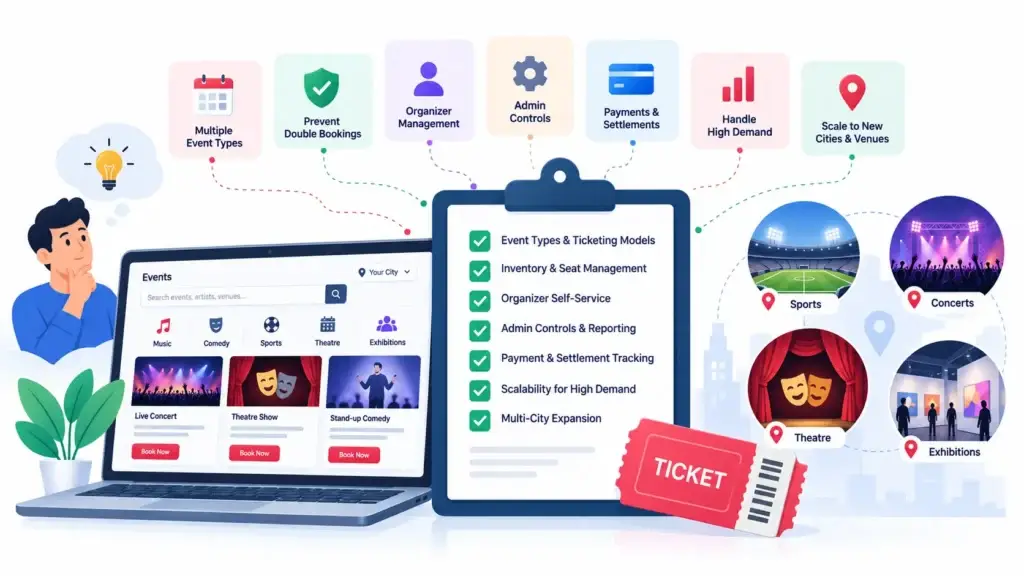
A strong evaluation should answer:
- Can the platform support different event types?
- Can it prevent double bookings?
- Can organizers manage listings without constant support?
- Can the admin control commissions, refunds, users, venues, and reports?
- Can payments and settlements be tracked clearly?
- Can the platform handle launch-day demand?
- Can the business add new cities, venues, and categories later?
If the answer is unclear, the platform may create operational issues after launch.
Core Ticketing Platform Features Founders Should Evaluate
The best way to evaluate a ticketing platform is to separate features by user role. Customers, organizers, venue operators, and platform admins all need different workflows. If one workflow is weak, the entire booking experience suffers.
| Platform Area | Features to Evaluate | Why It Matters for Founders |
|---|---|---|
| Customer Experience | Event discovery, filters, seat selection, checkout, booking history, QR tickets | Improves conversion and reduces support queries |
| Organizer Tools | Event creation, ticket pricing, inventory control, sales reports, payout visibility | Helps partners manage events without depending on your team |
| Venue Operations | Hall setup, seat maps, showtimes, entry scanning, occupancy reports | Supports cinema, theatre, sports, and reserved seating use cases |
| Admin Dashboard | User control, event approval, payments, refunds, commissions, reports | Gives the founder control over the full business |
| Payments | Gateways, payment status, refunds, failed payment handling, transaction records | Protects revenue and improves customer trust |
| Scalability | Seat locks, real-time inventory, caching, backend validation, analytics | Helps the platform perform during high-demand booking periods |
A platform that only focuses on the customer app may look attractive but become difficult to operate. Founders should pay equal attention to the backend control layer because that is where pricing, disputes, refunds, event approvals, commissions, and partner relationships are managed.
Founders who want a deeper module-level breakdown can review Miracuves’ ticketing platform feature modules to understand how customer booking, organizer management, venue operations, payment flows, and admin controls work together inside a scalable event booking ecosystem.
Customer Booking Experience: What Users Expect From a Modern Ticketing Platform
Customers expect the booking journey to feel fast, clear, and predictable. They want to find events, compare dates, check prices, choose seats or ticket types, pay securely, and receive confirmation without confusion.
Important customer-facing features include:
- Event search by city, category, venue, artist, show, or date
- Filters for price, language, genre, venue, and timing
- Event detail pages with description, media, location, terms, and pricing
- Seat map or ticket quantity selection
- Cart and checkout
- Promo code support
- Multiple payment options
- Booking confirmation
- QR ticket generation
- Booking history
- Cancellation and refund visibility
- Push, SMS, email, or WhatsApp notifications
The customer app should not overload the user with too many steps. Every extra click during checkout can create drop-offs, especially for high-demand events where users want to complete payment quickly.
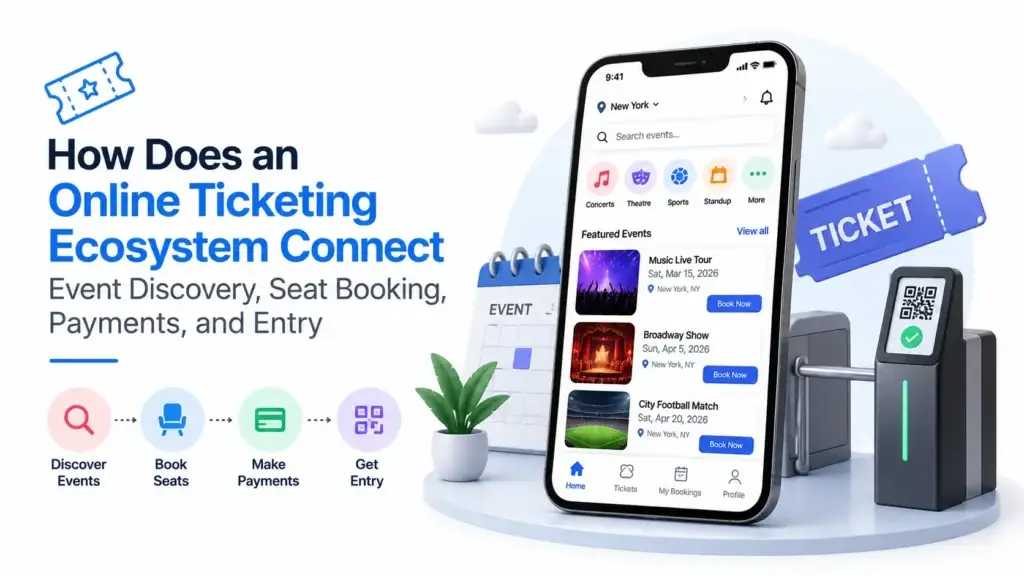
A smooth ticket booking journey should guide users from event discovery and seat selection to payment confirmation, QR ticket access, and venue check-in without creating confusion or unnecessary friction.
For founders, this means the front-end experience should be designed around confidence. Users should always know what they are booking, how much they are paying, what the refund rules are, and how they will enter the venue.
Seat Inventory and Booking Logic: The Hidden Layer That Decides Trust
Seat inventory is one of the most important technical areas in a ticketing platform. It decides whether users can trust the availability they see on screen.
A strong seat inventory system should support:
- Available, locked, booked, blocked, and unavailable states
- Temporary seat holds during checkout
- Automatic release after payment timeout
- Backend validation before final booking confirmation
- Protection against double booking
- Admin seat blocking and release rules
- Different ticket classes and sections
- General admission quantity management
- Real-time updates across web and mobile
- Audit logs for inventory changes
This matters most during peak demand. When multiple users try to book the same seat or ticket type, the backend must decide who gets the valid hold. The front-end seat map should not be treated as the final source of truth. It should always revalidate with the backend before payment confirmation. Founders should also understand seat inventory management before finalizing reserved seating, temporary holds, blocked seats, and booking confirmation rules.
Miracuves already supports deeper education around this topic through its guide on seat inventory management in event ticketing platforms, which can be internally linked from this section.
Organizer Dashboard: Why Partner Experience Affects Platform Growth
Founders often focus heavily on users and forget the organizer experience. But a ticketing marketplace cannot scale if every organizer needs manual help from the platform team.
A practical organizer dashboard should allow partners to:
- Create and edit events
- Upload banners, trailers, posters, and descriptions
- Choose categories and tags
- Set event date, time, and venue
- Create ticket types and price tiers
- Control ticket quantity or seat allocation
- Apply promo codes or early-bird pricing
- View booking reports
- Download attendee lists
- Track refunds and cancellations
- Monitor payout status
For organizers, visibility creates trust. They want to know how many tickets were sold, which price tiers performed well, when payouts are expected, and what customer data they can access based on platform rules.
For founders, a strong organizer dashboard reduces support workload and improves partner retention. It also makes the platform easier to expand because new event partners can self-manage listings without waiting for manual backend updates.
Venue and Entry Management: Where Online Booking Meets the Real World
Ticketing platforms do not end at payment confirmation. The booking must work at the venue gate.
Venue and entry workflows may include:
- Venue profile management
- Hall, screen, stadium, or zone setup
- Seat layout configuration
- Showtime management
- Capacity control
- Entry gate information
- QR code scanning
- Duplicate ticket detection
- Offline scan support where required
- Occupancy tracking
- Entry logs
This is especially important for cinemas, theatres, concerts, sports events, conferences, and festivals. If scanning is slow or ticket validation fails, the customer experience breaks at the most visible moment.
A founder should evaluate whether the platform supports both online and on-ground operations. Digital tickets, scanner access, venue staff roles, and entry logs can make the difference between a smooth event and a support-heavy launch.
Admin Dashboard: The Control Center Founders Should Not Ignore
The admin dashboard is where the platform operator manages the business. It should not be treated as a basic backend panel. It should give the founder visibility and control across users, events, organizers, payments, refunds, commissions, and reports.
Important admin features include:
- User management
- Organizer approval
- Venue approval
- Event category control
- Event moderation
- Booking monitoring
- Payment records
- Refund handling
- Commission settings
- Promo code management
- Featured listing controls
- Banner and homepage controls
- Review moderation
- Dispute management
- Role-based access control
- Activity logs
- Analytics and reports
Admin control matters because ticketing platforms involve many moving parts. A founder may need to pause an event, approve a new organizer, resolve a refund, adjust commission rules, feature a high-value event, or investigate a suspicious booking.
Without a strong admin dashboard, every small operational change becomes a development request. That slows growth and increases dependency on the technical team.
Miracuves Digital Banking Platform Solution Cost and Tech Stack
Miracuves Pricing for a Digital Banking Platform developed in JavaScript For $3,399 USD (One-Time Price) in just 6 days
Get a fully developed, deployment-ready digital banking platform built for fintech startups, neobanks, financial institutions, payment companies, and founders planning to launch a modern banking product. Built on a modern JavaScript foundation, this complete package includes everything you need to launch and scale:
Core Workflows: User onboarding, KYC verification, digital account creation, wallet balance, money transfers, beneficiary management, transaction history, bill payments, card management, spending insights, and customer notifications.
Built-in Revenue Logic: Premium account plans, transaction fees, interchange revenue, card-related charges, foreign exchange margins, business account subscriptions, withdrawal fees, lending add-ons, partner offers, and platform service charges.
Management Hub: Centralized admin dashboard, user management, KYC review, account controls, transaction monitoring, wallet management, card controls, payment records, compliance logs, risk monitoring, support handling, and banking analytics.
Launch-Ready: Fully prepared for your custom branding, configuration, payment gateway setup, KYC/AML workflows, banking API integrations, card issuing connections, transaction rules, and immediate market entry.
Why Is Digital Banking Platform Development More Affordable?
Most digital banking platforms become expensive when businesses choose fully custom development from scratch. Building separate workflows for users, KYC, accounts, wallets, payments, cards, transaction monitoring, compliance, fraud controls, notifications, reporting, and admin operations can significantly increase cost, timeline, and technical complexity.
We took a smarter, more practical approach:
You Aren’t Paying for Ground-Up Development: Our digital banking platform engine is already developed, tested, and ready to deploy. You skip the inflated cost and long development cycles normally associated with building a complete digital banking ecosystem from scratch.
The Power of JavaScript: We built this solution on a modern JavaScript architecture that supports interactive banking dashboards, scalable transaction workflows, real-time account updates, API-driven financial integrations, and smooth administrative operations.
You get a launch-ready digital banking platform with practical account management, payments, card controls, compliance, monetization, and administrative features, source code access, and faster deployment without the high custom development price tag.
Note: This cost is for the solution, re-branding, deployment, and source code only.
Pricing Drivers: What Actually Affects Ticketing Platform Cost?
Ticketing platform pricing depends on scope. A simple event listing and ticket quantity platform is very different from a multi-venue platform with reserved seating, multiple payment gateways, partner dashboards, automated settlements, loyalty, and analytics.
The main pricing drivers include:
- Number of platforms: web, Android, iOS, admin, organizer dashboard, scanner app
- Event types: movies, concerts, sports, theatre, festivals, activities, conferences
- Seat complexity: general admission, reserved seating, zones, rows, sections, stadium maps
- Payment gateways: cards, UPI, wallets, net banking, local gateways, payout systems
- Booking logic: temporary holds, failed payment recovery, refunds, cancellations
- Organizer tools: listing management, sales reports, attendee data, payout tracking
- Venue tools: screen setup, showtimes, seat layout, QR scanning, occupancy reports
- Admin controls: moderation, disputes, commission, coupons, analytics, role access
- Integrations: maps, notifications, CRM, accounting, marketing tools, analytics
- Customization: branding, UI changes, workflows, business model adjustments
- Infrastructure: cloud hosting, caching, database design, monitoring, scaling needs
Founders should avoid evaluating cost only by app screens. The largest cost usually comes from the correctness of the booking engine, payment flow, seat inventory, partner operations, and admin governance.
For a more focused breakdown, founders can review the key ticketing platform development cost factors that influence app scope, seat map complexity, payment integrations, organizer dashboards, admin controls, and customization depth.
Miracuves’ ready-made approach reduces development time because the foundation already includes core ticketing workflows, admin control, and launch-ready modules. Final pricing should still be confirmed based on selected features, integrations, branding, and customization scope.
Ready-Made vs Custom Ticketing Platform Development
Founders usually compare two paths: building a platform from scratch or starting with a ready-made foundation.
| Evaluation Factor | Ready-Made Ticketing Foundation | Custom Development From Scratch |
|---|---|---|
| Launch Speed | Faster because core modules already exist | Slower because every workflow must be designed and built |
| Cost Control | More predictable when scope is clear | Can expand as features and edge cases grow |
| Customization | Suitable for branding, workflows, categories, and integrations | Suitable for highly unique or complex requirements |
| Booking Logic | Pre-built foundation can reduce early technical risk | Must be engineered, tested, and refined from zero |
| Founder Fit | Good for faster validation and market entry | Good for unusual models or enterprise-specific workflows |
| Ownership | Should be checked carefully before purchase | Usually depends on contract terms |
If you are still deciding between a faster launch-ready foundation and a fully custom build, this guide on ready-made vs custom ticket booking platform development explains the tradeoffs in more detail, including flexibility, cost control, launch speed, and long-term ownership.
A ready-made platform is useful when the founder wants faster launch, practical validation, and a working product foundation. Custom development is better when the business model has unusual rules, highly specialized integrations, or complex enterprise workflows.
For founders who want to move faster, Miracuves provides a white-label ticketing platform with 6-day solution delivery, source-code ownership, branded deployment, and admin control.
Scalability: What Founders Should Check Before Launch
Scalability in ticketing is not only about handling more users. It is about handling the right pressure points at the right time.
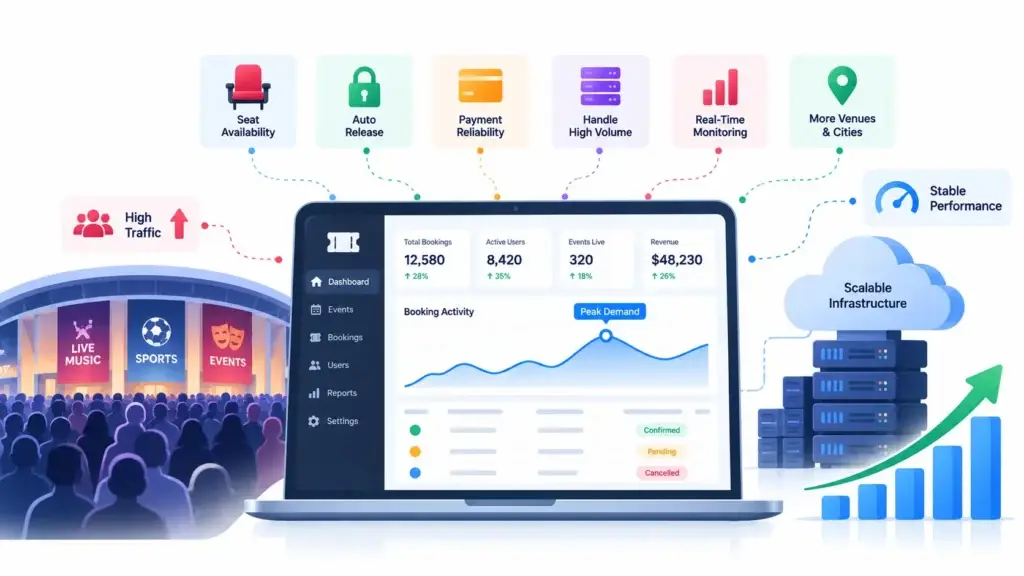
A ticketing platform may face sudden traffic spikes when a popular event goes live. Users may open the same seat map, select seats, apply coupons, and initiate payments within seconds of each other. During that moment, the platform must keep inventory accurate and payment confirmation reliable.
Scalability checks should include:
- Can the backend validate seat availability before confirmation?
- Can temporary locks expire automatically?
- Can failed payments release inventory properly?
- Can the platform handle high booking volume during event launches?
- Can the admin monitor booking activity in real time?
- Can the system track gateway failures and refund anomalies?
- Can the database handle event, seat, payment, and user records cleanly?
- Can the platform support more venues, cities, and categories later?
- Can reports help founders understand event performance?
A scalable platform should also support operational growth. Adding new organizers, venues, ticket categories, payment options, and promotional rules should not require rebuilding the product each time.
Revenue Model Evaluation: How the Platform Can Make Money
A ticketing platform can support different revenue streams depending on the market and event categories.
| Revenue Stream | How It Works | Founder Use Case |
|---|---|---|
| Booking Commission | Platform earns a percentage or fixed fee per ticket sale | Useful for event marketplaces and venue networks |
| Convenience Fee | User pays a platform fee during checkout | Works well for high-volume ticketing businesses |
| Featured Listings | Organizers pay for better visibility | Helps monetize homepage and category placements |
| Organizer Subscription | Event partners pay monthly or yearly for tools | Useful for B2B organizer-focused platforms |
| Advertising | Brands or organizers promote events inside the platform | Works when the platform has meaningful traffic |
| Add-On Sales | Food, merchandise, parking, VIP access, or bundles | Useful for venues, concerts, sports, and festivals |
| Loyalty Programs | Rewards encourage repeat bookings | Helps improve retention and repeat purchase behavior |
The right revenue model should be decided before development because it affects checkout, admin controls, reporting, partner contracts, and payment settlement workflows.
Before finalizing checkout and admin workflows, founders should define the event ticketing business model, including commissions, convenience fees, featured listings, organizer plans, advertising placements, and add-on revenue opportunities.
A platform that supports only one revenue model may limit growth later. Founders should evaluate whether the system can support commission rules, service fees, promo codes, featured placements, and partner payouts from the admin dashboard.
Security and Trust Features Founders Should Expect
Trust is central to ticketing because users pay before attending, organizers depend on accurate sales records, and venues need valid entry control.
A reliable platform should include:
- Secure payment gateway integration
- Encrypted data transfer
- Role-based access control
- Organizer verification
- Admin approval workflows
- QR ticket validation
- Duplicate ticket prevention
- Refund and cancellation tracking
- Activity logs
- Suspicious booking monitoring
- Permission-based dashboards
- Dispute management
Security should be treated as a foundation, not a marketing add-on. Final compliance depends on the country, payment partners, legal review, data handling rules, and operating model. Founders should make sure the platform can support the controls required for their target market.
Founder Decision Signals Before Choosing a Ticketing Platform
Speed
Choose a faster launch route when the core booking, payment, admin, and ticket validation workflows already match your business model.
Cost
Evaluate cost by module depth, not just app screens. Seat maps, payment logic, refunds, and organizer tools can affect pricing significantly.
Scalability
Check whether the platform can handle seat locks, payment failures, high-demand events, reporting, and multi-venue operations.
Market Fit
Pick a foundation that supports your first event category but can expand into new cities, venues, ticket types, and revenue streams.
Mistakes Founders Should Avoid When Evaluating Ticketing Platforms
Choosing Based Only on the Customer App
A clean customer interface is important, but it is only one part of the platform. Founders should also evaluate organizer tools, venue workflows, payment records, refund controls, analytics, and admin permissions.
Ignoring Seat Locking and Inventory States
Weak inventory logic can create double bookings, stuck seats, payment disputes, and customer frustration. Seat locking should be evaluated before launch, especially for reserved seating and high-demand events.
Treating Payment Integration as a Basic Feature
Payment handling includes gateway selection, status tracking, failed payment recovery, refunds, settlement records, and transaction visibility. A simple “payment gateway added” checkbox is not enough.
Underestimating Organizer and Venue Operations
If organizers cannot create listings, manage pricing, track sales, or view payouts, the platform team will carry unnecessary manual work. Strong partner tools make the business easier to scale.
Forgetting About Reporting
Founders need data to make decisions. Reports should show bookings, revenue, event performance, customer behavior, payment success, refunds, occupancy, and category demand.
Where Miracuves Fits Into Ticketing Platform Development
Miracuves helps founders launch white-label, source-code-owned app platforms faster by starting with a ready-made foundation and customizing it around business goals.
For ticketing businesses, that means the platform can include event discovery, seat selection, ticket booking, payment handling, QR validation, organizer tools, venue workflows, admin controls, reporting, and monetization logic.
The key advantage is speed with control. Instead of building every module from zero, founders can start with a launch-ready platform foundation and focus on branding, market entry, organizer partnerships, venue onboarding, and growth. Founders who need implementation support can also explore Miracuves as a ticketing platform development partner for white-label deployment, source-code ownership, admin control, and faster launch execution.
Final Thoughts
Founders should evaluate a ticketing platform by how well it supports the full business, not just how quickly users can book tickets.
The strongest platform foundation should connect event discovery, inventory accuracy, checkout, QR validation, organizer tools, venue operations, admin control, payments, refunds, monetization, and reporting. These are the systems that protect trust when demand rises and operations become more complex.
After the platform foundation is ready, founders should also plan ticketing platform marketing strategies around city launches, organizer partnerships, event discovery, seasonal campaigns, and repeat bookings.
A ready-made ticketing platform can help founders move faster, but the decision should still be based on scope, scalability, ownership, customization needs, and launch goals. Miracuves supports this path with a white-label, source-code-owned foundation designed for faster deployment and practical business control.
FAQs
What features should founders evaluate in a ticketing platform?
Founders should evaluate event discovery, search filters, seat selection, ticket inventory, online payments, QR ticket validation, organizer dashboards, venue tools, refund control, admin management, reports, and scalability.
What affects the cost of building a ticketing platform?
Cost depends on platform scope, number of apps, event categories, seat map complexity, payment gateways, organizer tools, venue workflows, admin features, integrations, infrastructure, and customization needs.
Why is seat inventory important in ticketing platforms?
Seat inventory is important because users may try to book the same seat at the same time. A strong system uses temporary locks, backend validation, payment confirmation, and automatic release rules to prevent double bookings.
Should founders choose a ready-made or custom ticketing platform?
A ready-made platform is useful when founders want faster launch, lower development complexity, and a proven foundation. Custom development is better for highly specialized workflows, unusual business models, or complex enterprise integrations.
Can a ticketing platform support different event categories?
Yes. A well-planned ticketing platform can support movies, concerts, sports, theatre, festivals, comedy shows, conferences, workshops, activities, and community events, depending on category setup and ticketing workflows.
What admin features are important in a ticketing platform?
Important admin features include user management, organizer approval, venue control, event moderation, booking tracking, payment records, refunds, commissions, promo codes, featured listings, reports, role-based access, and activity logs.
How does Miracuves help founders launch ticketing platforms faster?
Miracuves helps founders launch white-label ticketing platforms with source-code ownership, branded design, booking workflows, admin control, payment handling, QR validation, and 6-day solution delivery where the ready-made scope fits.
Why should founders evaluate scalability before launch?
Ticketing platforms can face sudden traffic spikes during popular event launches. Scalability helps the platform manage real-time seat selection, payment failures, booking confirmation, refunds, analytics, and multi-venue growth without breaking user trust.
Miracuves is an independent software development company. We are not affiliated with, connected to, sponsored by, or endorsed by any company or product named in this article.
Terms such as “X Clone” are used descriptively. It is how the software industry refers to building a platform with functionality comparable to a known service, and how clients search for it.
The entire design and codebase of our products is built by our own team. Our products contain no code, design, graphics, or content originating from any third-party website or applications.
All third-party names and marks referenced in this article are the property of their respective owners, referenced solely to identify the services discussed.