Farm-to-Table App · Production Ready

AmazonFresh Clone App - White-Label Farm-Direct Grocery Marketplace

Built by Miracuves, this ready-made, white-label AmazonFresh clone turns growers, producers and suppliers into stores that nearby shoppers order from, with Android and iOS Flutter apps for every role, a browser storefront, three web panels and source code you own, ready in six working days.

Every seller runs a catalog of its own and goes live only once you approve it, and organic items can carry a badge. The software has no farm traceability, cold-chain or certification checks, so origin and freshness claims are yours to verify with each seller; four optional modules are priced on their own. If your grower network needs a changed flow, it is scoped and quoted in writing before work starts and usually built in 2-8 weeks.

Launch in 6 Days with

  • Source Code
  • Customer App
  • Seller App
  • Delivery App
  • Customer Website
  • Admin Panel

StackFlutter · PHP · Bootstrap · MySQL · Payment APIs · Amazon S3

MXGroc console · GroceryIllustrative
Orders today64
Stores live12
Delivery men on shift7

Store and order activity

AmazonFresh Clone app home screen with a location bar, an item and store search, a vegetable banner, product categories and a Visit Again row.
Every store sees its own orderson its own panel
  • 2Item Unitspriced per kilogram or per piece, shown on every item card
  • 4Steps to Onboard a Growerregister with business details, upload a catalog, admin approval and going live
  • 0%Revenue Share With Miracuvesno cut of what growers sell or of the commission you charge them
  • 3Location Optionstyped search, GPS, or a map pin
  • 6Days to Launchand if the delay is ours, we keep going free
  • $2,499Paid Once, Not Rentedsource code yours, no per-seat fee, no monthly rental

Live in six working days, or we keep working free until you launch. Every build carries 60 days guidance, 6 months bug fixes and 12 months updates.Verify every figure

Co-ops Run a Store per Member

A farmer co-op or producer group can give each member its own store under one storefront, with one set of delivery partners and shared reporting.

Surplus Moves Through Clearance

Release 15.0 added a clearance section on store pages and the home screen, while flash sales, coupons and cashback run from the admin menus.

Your Gateway, Your KYC

Card and local-wallet payments run through the payment gateways you connect with your own account, which you open and verify; cash on delivery switches on or off in the admin panel.

Ready to open your own farm-to-table grocery marketplace?Talk to Product Expert

Chosen by 6,000+ clients across the globe

Miracuves is listed by Expertise.com as a managed IT service provider.Miracuves is an official member of the Forbes Business Council.Miracuves is a verified agency on DesignRush, listed among top design agencies in India.Miracuves is reviewed on Trustpilot as a software development company.Miracuves is listed by The Manifest among top managed software development companies.Miracuves is listed by DesignRush as a top software development company.Miracuves is recognized by GoodFirms as a top software development company.Miracuves is ranked among the top 1000 companies globally by Clutch.Miracuves is a top managed service provider in the United States on Clutch.

01See it live

Live in Action

AmazonFresh Clone Demo - Customer, Store & Delivery Apps and Web Panels

Open the Miracuves AmazonFresh Clone and use it yourself. Three app logins cover a shopper, a store owner and a delivery man, and the web demo opens the customer website and the panels. Set a location, open a store for grocery shopping, check an order and follow it on the map.
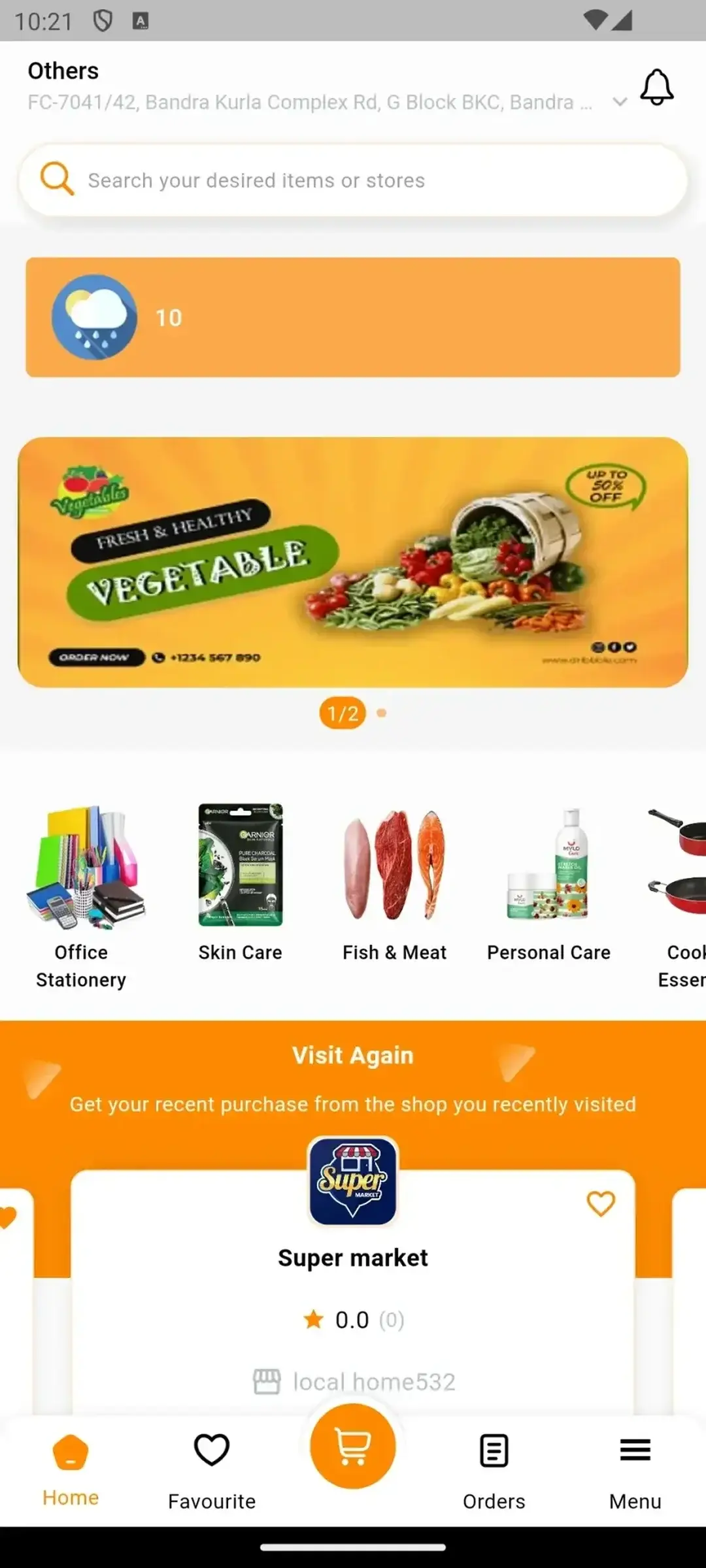
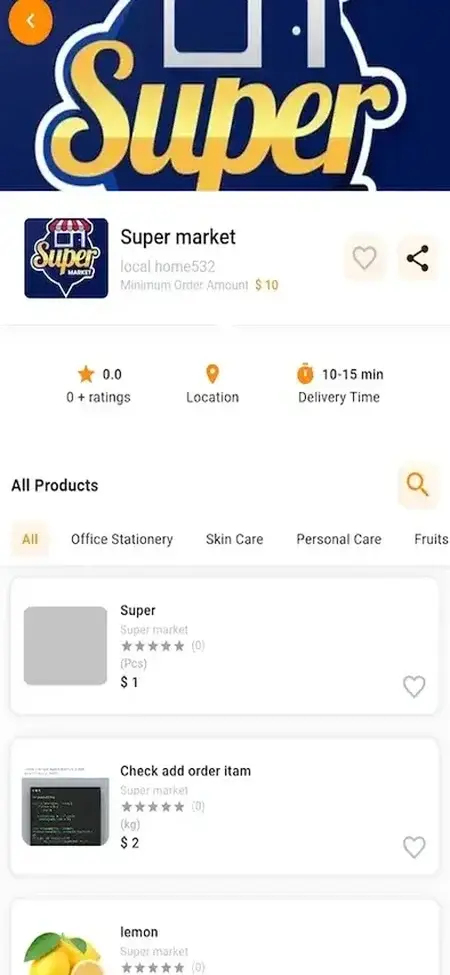
AmazonFresh Clone app home screen with a location bar, an item and store search, a vegetable banner, product categories and a Visit Again row.AmazonFresh Clone store page with the store logo, rating, location and delivery time, category chips and a list of all products with prices.
Customer app

AmazonFresh Clone - Customer App

Seen from a phone, the shopper side lets you set a location, search items or stores, browse categories, open a store page, check an order and follow it on a map.

  1. 1Open the app portal and pick your phone
  2. 2Sign in with the demo login below
  3. 3Explore: Home, Store page, Orders, Menu
Try:+91 9876543210 | User_321
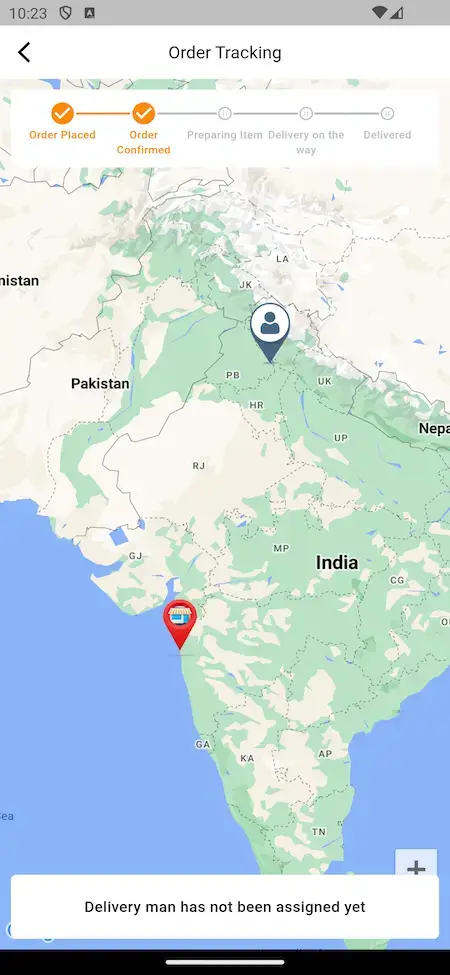
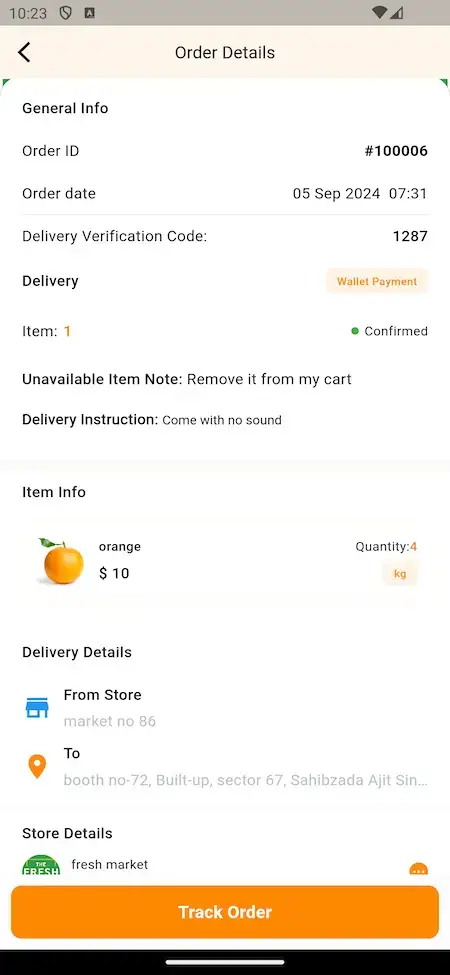
AmazonFresh Clone order details screen with the order number, payment method, item list, delivery details from the store to an address and a Track Order button.AmazonFresh Clone order tracking screen with a map and the steps Order Placed, Order Confirmed, Preparing Item, Delivery on the Way and Delivered.
Store & delivery apps

Store App & Delivery App

Each side has an app of its own: a store owner signs in to run its orders and products, and a delivery man signs in to take and complete deliveries. The screens shown are the customer's order and tracking views, which follow what the store and the delivery man do.

  1. 1Open the store or delivery app portal
  2. 2Sign in with the matching demo login
  3. 3Explore: orders, products, deliveries
Store:grocery@demo.com | Store_321 · Delivery: +91 9876543211 | Driver_321
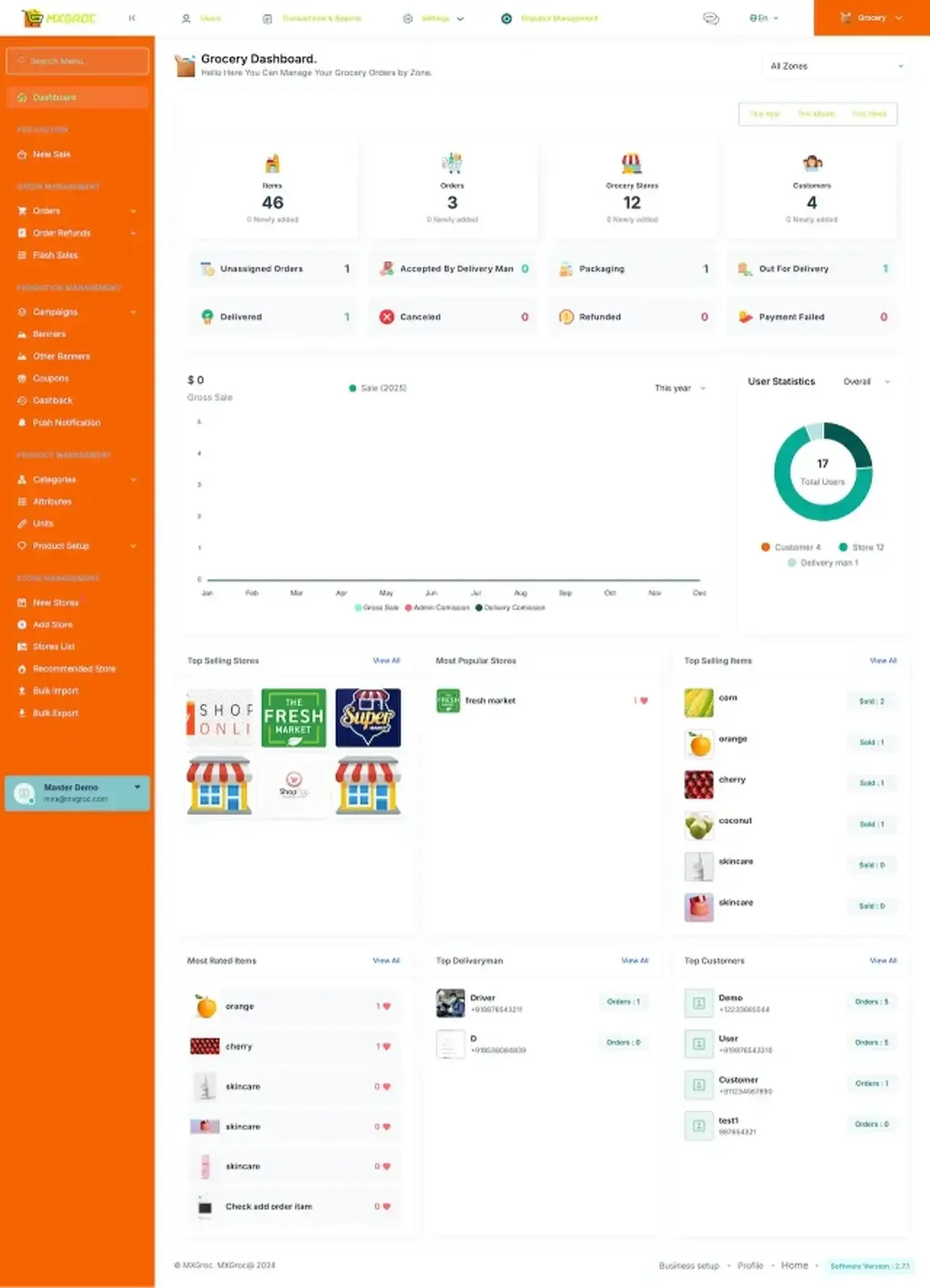
AmazonFresh Clone admin dashboard with item, order, store and customer counts, order status tiles, a sales chart, user statistics and top selling stores and items.
Web & admin panels

Customer Website, Admin & Store Panels

The customer website with its location search, categories and stores, plus browser panels for the operator and for each store. Ask for the panel logins when you book a guided call.

  1. 1Open the demo site in a browser tab
  2. 2Pick the website or a panel login page
  3. 3Explore: storefront, dashboard, stores
Panel logins:ask when booking a guided call
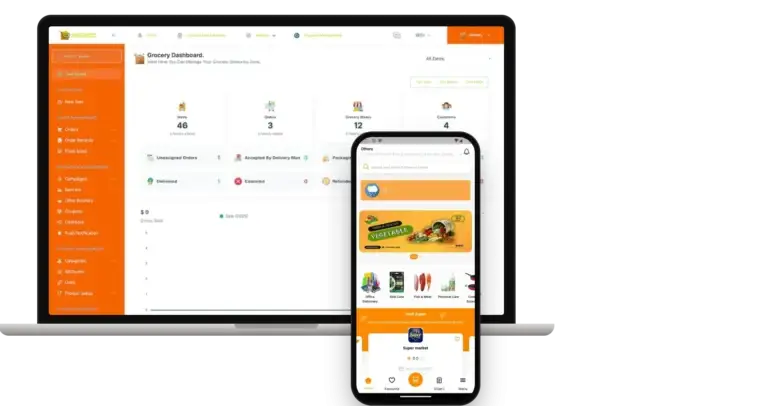
AmazonFresh Clone shown across a laptop and phone: the admin grocery dashboard by zone and the grocery home with categories and offers

Guided Tour

AmazonFresh Clone Walkthrough: From a Farm Listing to a Delivered Order

A live call is the fastest route through every surface. Over roughly half an hour we open the customer app, the store side and the admin panel together and relate each one to your plan: the growers you would onboard first, the commission you would set and the area you would serve.

Book a live demo call

Every Screen Mapped

Screens From a Grocery App Like AmazonFresh: Customer App & Admin Dashboard

Miracuves lays out the real customer app screens of its AmazonFresh clone in the order a shopper meets them, from the home screen to the account menu, beside the dashboard an operator opens each morning.
AmazonFresh Clone app home screen with a location bar, an item and store search, a vegetable banner, product categories and a Visit Again row.
AmazonFresh Clone store page with the store logo, rating, location and delivery time, category chips and a list of all products with prices.
AmazonFresh Clone order details screen with the order number, payment method, item list, delivery details from the store to an address and a Track Order button.
AmazonFresh Clone order tracking screen with a map and the steps Order Placed, Order Confirmed, Preparing Item, Delivery on the Way and Delivered.
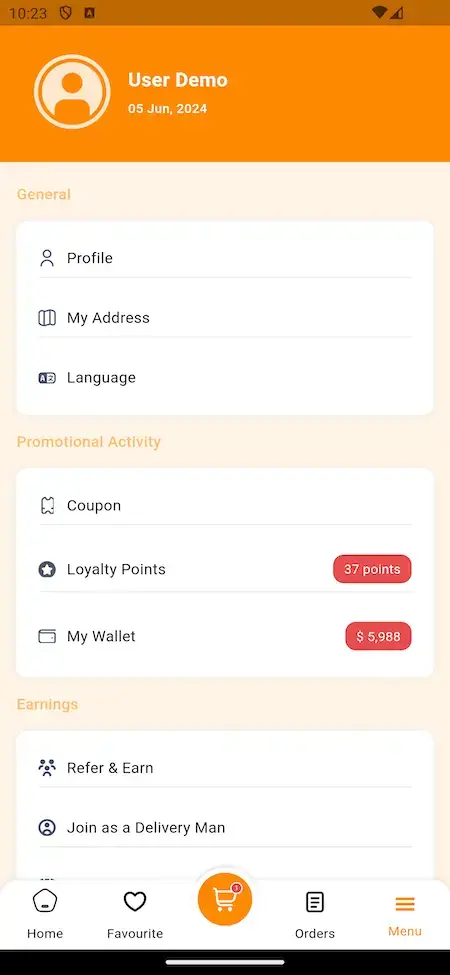
AmazonFresh Clone account menu with profile, my address, language, coupon, loyalty points, my wallet, refer and earn and join as a delivery man.
5 screens · scroll →
AmazonFresh Clone admin dashboard with item, order, store and customer counts, order status tiles, a sales chart, user statistics and top selling stores and items.
1 screen

Follow a shopper from a location and a search through a store page and an order to live tracking and the account menu, then see the same orders counted on the admin dashboard.

Explore Our Solutions

02Proof

Client Voices

AmazonFresh Clone Client Reviews - Operators in Their Own Words

Talokitoko serves the African diaspora in Europe, and Izi Technologies' managing partner says it went live months faster than planned. Click2Deliver, Speedyven and Makaalu round out four delivery businesses that carry grocery orders in some form.

CCharles EveillardManaging Partner, Izi Technologies
“Talokitoko is grocery and food delivery for the African diaspora market in Europe. The rider app, dispatch and the merchant console were already built, so we spent the engagement on our own local payment mix, the vendor onboarding flow and the regions we actually operate in. The platform was live inside a month, which was months faster than our internal estimate.”
CClick2Deliver TeamFounding team, Click2Deliver
“Two order types, one courier fleet. The base handled multi-vertical ordering, so the work was our merchant mix and the grocery-specific substitution and weight rules. Live inside a month.”
MMustafa H.CTO, Speedyven Networks
“Speedyven is a hyperlocal courier network — packages, food, and same-day essentials across a few metros. The dispatch and rider app were the parts where we needed to move fastest, because riders have low tolerance for clunky tools. Miracuves's Delivery Genie base gave us the rider app, the dispatch console, and live tracking. We added our custom surge-pricing engine, our multi-merchant order router, and a custom rider-incentives module. We launched in 7 weeks. Rider activation is high and the platform's been stable through weekend peaks.”
MMakaalu TeamFounding team, Makaalu
“We needed three apps that agree with each other: customer, driver and store. The shared state model was already built, which is the part people underestimate. Live inside a month with all three in the stores.”
Read More Client TestimonialsOperators and founders in their own words

Proof You Can Check

AmazonFresh Clone Case Study - The Status of Proof and How to Verify

A short status report on proof for this product, and the ways to test it yourself before you commit.

Case Study
No named deployment is published for this product

No client has published a launch on this exact product yet, so there is no case study to show and none is invented. What follows is a checklist of what you can verify yourself, and a plain line on what we will not offer as proof.

Not publishedNamed client
Demo and guided callHow to verify
Farm-to-table groceryModel
3Apps to open
4Web surfaces
6 daysBuild window
AmazonFresh Clone admin dashboard with item, order, store and customer counts, order status tiles, a sales chart, user statistics and top selling stores and items.
Challenges
  • Many small sellers need onboarding, approval and a catalog each
  • Items sold by weight need units and prices that stay clear
  • Orders have to reach the right store and delivery man without anyone relaying them by hand
Goal
  • Watch an order travel from a store to a delivery man before paying anything
  • Test store onboarding against the way you plan to recruit growers
  • Inspect the code itself for whatever the demo hides
Solution by Miracuves
  • Sign-in details for the three apps, one per role
  • A customer website and browser panels open to you
  • A guided call through the admin dashboard
  • Release notes from 14.0 to 15.0 listing what shipped
  • The price stated up front, with 6 days of build work

No invented client, borrowed logo or unmeasured result will stand in for proof on this page. A real deployment of this product, once published, gets its own case study and a link here.Miracuves · Our position on proof

Visit the published case studiesThe portfolio lists real delivery builds, grocery and food among them, made on neighboring Miracuves bases.

03The product

The Basics

What an App Like AmazonFresh Does for Growers, Suppliers and Shoppers

Miracuves' AmazonFresh clone is a ready-made multi-vendor grocery delivery app and e-commerce marketplace with a farm-to-table angle. Growers, producers and suppliers join as stores, shoppers find the stores near them and order what they need, a delivery man brings it, and an admin panel runs approvals, orders and commission.

AmazonFresh Clone shown across a laptop and phone: the admin grocery dashboard by zone and the grocery home with categories and offers

More Than a Storefront

The value sits around the shop window: store approval, a catalog for every seller, orders that reach the right store, delivery partners and an admin console that tracks the lot.

Not a Locked Box

You get the complete source code with no encryption, so your team can reshape flows and screens as the marketplace grows, with no per-seat fee to pay.

Plain About What Is Extra

Four optional extras are priced one by one: shopping-list suggestions, recipe links, a virtual assistant and a community wishlist. Each carries an add-on label and sits outside the base feature count.

Web, Android & iOS

What Is an AmazonFresh Clone Script?

The hard part of a produce marketplace is the supply side: many small sellers, each with a catalog, units and prices of their own, who have to be approved and paid. That part ships working, together with the order flow around it.

AmazonFresh Clone admin dashboard with item, order, store and customer counts, order status tiles, a sales chart, user statistics and top selling stores and items.
  1. 01Store sign-up, approval and a catalog per seller
  2. 02Location search, store pages and item search
  3. 03Cart, checkout, wallet and order tracking
  4. 04Customer, store and delivery apps
  5. 05Admin dashboard with orders, stores and reports

You receive three apps (customer, store and delivery) and four web surfaces (the customer website plus admin, store and delivery panels). The Flutter apps come with it, along with the full source code.

What Is in the Box

AmazonFresh Clone Features - Stores, Catalog, Cart, Tracking, Wallet & Admin

Each of the ten feature groups below, from store discovery to admin reports, is something you can check yourself in the Miracuves AmazonFresh clone demo, its admin dashboard or its release notes. Anything that needs an extra module is named as an optional extra lower on the page.

Feature 01 / 10

Location & Store Discovery

Shoppers set a location by search, by GPS or on a map, then see the stores around them, with one search bar on the home screen that looks up items and stores.

  • Set a location by search, by GPS or with a map pin
  • Search bar for desired items or stores on the home screen
  • Best Stores Nearby row with distance and star rating
  • Product categories as tappable tiles on the user-friendly home screen
  • Visit Again row for stores the shopper has bought from
  • Zones in the admin panel for splitting service areas
Feature 02 / 10

Farmer & Supplier Onboarding

Growers, producers and suppliers join as stores. They register with their business details, upload a catalog and go live once the admin approves them.

  • Registration with business details through the vendor portal
  • Product catalog uploaded by the seller
  • Admin approval before a store appears to shoppers
  • New Stores queue and an Add Store form in the admin menu
  • Stores list with a Recommended Store option
  • Bulk import and bulk export tools under store management
Feature 03 / 10

Store Pages & Item Catalog

Every store has a page of its own with a logo, a rating, a location and a delivery time, above a product list with category chips, prices and units.

  • Store logo, rating, location and delivery time at the top
  • All Products list with category filter chips
  • Price and unit on every item, such as per kilogram
  • Favorite and share buttons on the store page
  • Item badges such as Organic on product cards
  • Categories, attributes and units managed in the admin panel
  • Stock clearance discount section on store details and the home page (release 15.0)
Feature 04 / 10

Cart & Checkout

The cart keeps whatever the shopper has not bought yet, and checkout covers payment, delivery instructions and a note for items that turn out to be unavailable.

  • Check out selected products while the rest stay in the cart
  • Buy now checkout kept apart from the cart
  • Guest checkout without creating an account first
  • Reorder from previous orders
  • Minimum order amount set by the admin and by each store
  • Free delivery above a set order amount
  • Unavailable item note and delivery instruction on the order
  • My Address book in the account menu
  • Delivery and billing address edit option (release 14.0)
Feature 05 / 10

Order Tracking & Delivery Partners

Orders can be followed on a map through five status steps, while delivery partners join from the app and are assigned by location, availability and rating.

  • Tracking screen with a map and five status steps
  • Order Placed, Confirmed, Preparing Item, On the Way, Delivered
  • A notice while no delivery man is assigned yet
  • Delivery men join from the account menu and wait for admin approval
  • Automatic assignment by location, availability and ratings
  • Earnings view for completed deliveries and bonuses
  • Dispatch Management in the admin top bar
Feature 06 / 10

Wallet, Referral & Loyalty

Shoppers can pay from a wallet, top it up, earn rewards by referring friends and collect loyalty points, all visible in the account menu.

  • Wallet payment shown on the order details screen
  • Add funds to the wallet from web and app (release 14.0)
  • Add-fund bonus (release 14.0)
  • Refer and Earn, paid after the friend's first delivered order (release 14.0)
  • Loyalty Points and My Wallet in the account menu
  • Coupon entry in the account menu
Feature 07 / 10

Promotions & Offers

Operators and stores can run offers from the admin panel: campaigns, banners, coupons, cashback, flash sales and push notifications.

  • Campaigns, banners and other banners menus
  • Coupons and cashback menus
  • Flash Sales menu
  • Several products added at once to flash deals and feature deals (release 14.7)
  • Push notifications that open a chosen page on tap (release 14.8)
  • Stores can create their own discounts and offers
  • Call-to-action section on product details (release 15.0)
Feature 08 / 10

Reviews, Chat & Support

Customers can rate and review, stores can answer, and chat connects customers and sellers with the admin team.

  • Rating and reviews on items and stores
  • Review reply feature for sellers (release 14.7)
  • Customer chat with the admin from the website and app (release 14.4)
  • Improved chat in the admin and store panels (release 14.5)
  • In-app help for questions about an order
  • Refund details page redesigned (release 15.0)
Feature 09 / 10

Admin Dashboard & Reports

The admin home is a grocery dashboard filtered by zone, with counts, an order pipeline, a sales chart and top lists, plus a point-of-sale screen and refunds.

  • Zone filter, with item, order, store and customer counts
  • Order status tiles from unassigned to delivered, canceled and refunded
  • Gross sale chart with admin and delivery commission
  • User statistics for customers, stores and delivery men
  • Top selling stores and items, most rated items, top delivery men and customers
  • New Sale point-of-sale screen (calculation fixes in release 15.0)
  • Order Refunds and Transactions and Reports menus
  • Automated commission calculation for stores
Feature 10 / 10

Settings, Languages & Integrations

The back-office settings run everything else: sign-in options, translations, payment and SMS gateways, analytics tags and maintenance controls.

  • Manual, OTP and social sign-in, managed by the admin (release 14.8)
  • Firebase mobile OTP authentication (release 14.8)
  • Apple login for the user app (release 14.0)
  • Language switcher for multi-language support and better translation tools (release 14.7)
  • Cash on delivery switched on or off from the admin panel (release 15.0)
  • Tag Manager, Analytics and ad pixel support (release 15.0)
  • Advanced maintenance mode with module-level control (release 14.8)
  • SEO section control and an Amazon S3 storage connection (release 14.7)
  • Dynamic email templates for every email (release 14.6)

What you supply: We hand over a rebranded platform running on your hosting. From your side we need a domain, your branding and business details, store developer accounts that are already verified, a live payment gateway account with KYC approved, and any third-party keys. The two stores review apps on their own clock, separate from our 6 days of build work.

Talk to Our Team

How Operators Earn

AmazonFresh Clone Revenue Models - Store Commission, Delivery Charges, Featured Stores & In-House Sales

A farm-to-table app like AmazonFresh earns in several places, and Miracuves makes every line its own setting, so tuning one leaves the others alone.

Commission on store orders and the charges around delivery tend to move the numbers most, with promotion and in-house sales added later. None of the six lines ships with a rate chosen for you, featured placement is priced in whatever deal you strike with a store on top of its commission, and none of the order revenue is shared with Miracuves.

  1. 01

    Store Commission

    The admin sets a commission rate and the platform calculates it on every store order, so a grower or supplier is paid out net of your share.

  2. 02

    Delivery & Minimum-Order Charges

    Delivery charges, a minimum order amount and a free-delivery threshold are all settings, so the cost of the last mile can be recovered or waived by basket size.

  3. 03

    Featured Stores & Banners

    The admin panel has a Recommended Store option and banner menus, so prominent placement can be offered to the stores that want to be seen first.

  4. 04

    Promotions & Flash Sales

    Campaigns, coupons, cashback and flash sales are menus of their own, and a stock clearance offer section helps move slow stock and pull orders in quiet periods.

  5. 05

    In-House Store Sales

    The admin can run a store of its own, listed first among the sellers, so margin on goods you source yourself sits beside the commission from everyone else.

  6. 06

    Wallet Top-Ups & Bonuses

    Shoppers can add funds to a wallet, and the add-fund bonus is a lever you control, trading a small reward for money already held on the platform.

What published grocery and delivery businesses charge on the lines this platform can run, with each figure traced to a fee page, a filing or a gateway price list.
Revenue streamHow it is chargedTake rateTypical take rateWhat sets the ceiling
Store CommissionA percentage of each order, taken from the store payout once the order is paid.Uber Eats publishes Marketplace tiers of 20%, 25% and 30%; DoorDash publishes delivery tiers of 15%, 25% and 30%.What stores will tolerate against the tier they could pick elsewhere. Each page also shows a cheaper pickup rate (Uber Eats 7%, DoorDash 6%) and notes that fees may vary by market.
Delivery & Minimum-Order ChargesA charge per order, waived above a set basket value or for members.No flat fee is published. Instacart+ members pay no delivery fee on eligible orders from $10 per retailer.The basket value at which a waiver earns its keep. The same help page adds that delivery fees for non-members depend on retailer, window and order total.
Featured Stores & BannersA paid placement or promotion for a store, sold on top of its commission.Instacart booked advertising and other revenue of about 2.9% of order value in 2025 (our arithmetic on the filing).How much traffic each placement can reach. The filing calls the advertising investment rate effectively flat year on year, so this line grows with volume.
In-House Store SalesMargin on goods the operator buys and sells itself through its own store.Eternal reported about 80% of quick-commerce order value on its own-inventory model in Q2 FY2026.You hold the stock. Revenue under that model counts the full value of goods sold, so it cannot be compared with a commission percentage.
Wallet Top-Ups & BonusesA gateway fee on each card top-up, recovered in pricing or absorbed.Stripe lists 2.9% + $0.30 per card payment in USD.Your gateway, country and card mix set the fee. Any add-fund bonus you offer is a cost you choose, not a rate someone publishes.

How to read this. Percentages for the two commission tiers are taken from the Uber Eats merchant pricing page and the DoorDash Marketplace page. The delivery waiver is from an Instacart help page, and the advertising ratio is our arithmetic on Instacart's annual report on Form 10-K. The own-inventory share comes from an Eternal results post, and the card price from a Stripe support page. Commission tiers are published plans, the middle three rows rest on company documents, and the card price is a gateway list price. Use every figure as a modeling input only: none of it is a quote or a forecast of what your marketplace will earn, and your own rates belong in the admin settings.

Revenue Model

AmazonFresh Clone Revenue Model, Stage by Stage

Miracuves builds six income lines into the AmazonFresh clone, and a farm-to-table marketplace earns best when it adds them as its growers and shoppers mature.

Launch

Store commission on every grower's order carries the first months, and a minimum order amount with delivery charges recovers the cost of the last mile on small baskets.

Traction

As shoppers return, the stock clearance section, flash sales and coupons move produce that must sell soon, and featured stores give busy growers a paid way to stand out.

Scale

Across many zones, an in-house store sells goods you source yourself beside the growers, and wallet top-ups with an add-fund bonus keep money on the platform.

Each rate is a setting you choose, and no part of a grower's sale is shared with Miracuves.

Want a revenue model built around your own farm-to-table marketplace?Design My Revenue Model

Run the Marketplace

White-Label AmazonFresh App Admin Panel: Orders, Stores, Delivery Men & Reports

One dashboard in the Miracuves admin panel covers the operator's day: which orders still wait for a delivery man, which stores are live, what gross sales look like and who needs approving.

AmazonFresh Clone admin dashboard with item, order, store and customer counts, order status tiles, a sales chart, user statistics and top selling stores and items.

Admin Panel Sections

  • 01

    Dashboard by Zone

    A Grocery Dashboard filtered by zone, with counts for items, orders, stores and customers, a gross-sale chart for the year and commission lines for the admin and for delivery.

  • 02

    Order Pipeline

    Status tiles count unassigned orders, orders accepted by a delivery man, packaging, out for delivery, delivered, canceled, refunded and payment-failed orders.

  • 03

    Stores & Onboarding

    New Stores, Add Store, a Stores list, a Recommended Store option and bulk import and export for the sellers who join the marketplace.

  • 04

    Items, Categories & Units

    Categories, attributes, units and product setup, with top selling and most rated item lists that show what is moving.

  • 05

    Delivery Men & Dispatch

    Dispatch Management in the top bar, a top delivery men list and user statistics that split customers, stores and delivery men.

  • 06

    Campaigns & Coupons

    Campaigns, banners, coupons, cashback, flash sales and push notifications, all reached from the same menu column.

  • 07

    Transactions, Refunds & Reports

    Order Refunds, Transactions and Reports, and the commission figures that show what the operator earns.

  • 08

    POS, Settings & Languages

    A New Sale screen for point-of-sale orders, a Settings menu with business setup and a language switcher in the header.

Money Movement

The money menus, covering everything from a customer's first order to the store's payout.

  • Wallet payment and add funds
  • Transactions and Reports menu
  • Order Refunds with a redesigned details page
  • Commission calculated on every store order

Settings & Controls

The switches behind the public site and the daily operation.

  • Business setup and Settings menus
  • Cash on delivery on or off
  • Language switcher in the header
  • Maintenance mode with module-level control

Need the console to go further? New reports, another payout cadence, added languages or a bespoke approval step: each one is priced on request. Explain how your operations team runs and we send the quote in writing.

Talk to Our Team

04Package and price

The Full Package

Your Farm-to-Table Package: Source Code, Apps & Deployment for Your AmazonFresh-Like App

From Miracuves you get a working AmazonFresh clone, not a pile of components: three apps, a customer website, browser panels for the admin, the stores and the delivery side, and every line of source code behind them, with full ownership transferred to you. Running costs then go straight to providers in your name, never to Miracuves: card processing on your merchant account, an SMS gateway and Firebase for OTP and push, Google Maps keys billed on usage, a server with MySQL, a domain and tested backups, optional Amazon S3 for product photos, and verified Apple and Google publisher accounts.

01

Complete Source Code

The full source for the web platform and the mobile apps, unencrypted, so your team can change whatever the business needs.

  • Web platform source with no encryption
  • Flutter source for the Android and iOS apps
  • Yours to modify, extend and redeploy
  • Source and project codes together
02

Customer Website

The responsive customer site with location search, categories, favourites, stores and the cart, in a browser.

  • Home, Categories, Favourite and Stores pages
  • Set Location and Pick From Map controls
  • Sign-in and a language switcher
  • A Join Us menu in the header
03

Alerts & Messaging

Push notifications, SMS and email, plus chat between customers, sellers and the admin team.

  • Push notifications that open a chosen page
  • SMS gateway support for notifications
  • Dynamic email templates for every email
  • Chat from the website, the apps and the panels
AmazonFresh Clone admin dashboard with item, order, store and customer counts, order status tiles, a sales chart, user statistics and top selling stores and items.
04

Admin, Store & Delivery Panels

Three browser panels: the admin console, a panel for each store and a panel for the delivery side.

  • Admin dashboard with orders, stores and reports
  • Store panel for catalog, orders and offers
  • Delivery panel for assigned deliveries
  • Separate logins for every role
05

Customer, Store & Delivery Apps

Three Flutter apps for Android and iOS, one for each role, installed from the same app portal.

  • Customer app: home, stores, orders, menu
  • Store app: the orders and products of one store
  • Delivery app: deliveries and earnings
  • Store listings created under your developer accounts
AmazonFresh Clone app home screen with a location bar, an item and store search, a vegetable banner, product categories and a Visit Again row.
06

Payments & Wallet

Gateway connections, a wallet with add-fund bonuses and cash on delivery that the admin can switch off.

  • Gateway APIs connected with your own account
  • Wallet with add funds and a bonus
  • Cash on delivery on or off from the admin
  • Refund handling and a refund details page
07

Access & Security Layer

Separate roles and sign-in options, with approvals for stores and delivery men and controls for blocking users.

  • Separate logins for customer, store, delivery and admin
  • Manual, OTP and social sign-in options
  • Approve or deny users, with email notices
  • Maintenance mode with module-level control
08

Rebranding & Support

Your logo, icons and colors applied across web and apps, deployment done for you, and the three support periods that run side by side.

  • Your logo, icons and colors across web and apps
  • Deployment to your hosting
  • Source and project codes handed over
  • 60 days guidance, 6 months bug fixes, 12 months updates

Prefer to look before you decide? Sign in to the demo as a shopper, a store owner or a delivery man, or request a guided walk-through of a single order from a store to a doorstep, set against your own plan.

Talk to Our Team

Transparent Pricing

How Much Does It Cost to Build a Farm-to-Table Grocery Marketplace Like AmazonFresh?

The white-label AmazonFresh Clone, ready to launch, costs a fixed $2,499. Extras such as add-ons, more integrations or changed flows are scoped and quoted in writing before any work starts.

Most Popular

Professional

Ready-Made Launch Package
$2,499paid once
Ships in 6 days

Suited to: Farm-direct startups, regional produce marketplaces, co-ops and food hubs

What arrives is the platform you saw in the demo, carrying your logo, icons and colors and deployed to your own hosting.

Get Started

Enterprise

Tailored Builds for Bigger Projects
Customquote
Go-live: based on final scope

Suited to: Multi-country grocers, grower networks with special flows, cooperative platforms

If the base lacks a flow you need, we build it to your brief and settle the scope and the price first.

Request a Quote
Development Cost

AmazonFresh Clone Development Cost in 2026

A single $2,499 payment covers the whole farm-to-table marketplace from the demo: growers get a seller app and store panel, households get a phone app and customer website, and delivery men get an app of their own, all on unencrypted code that Miracuves deploys to your hosting in six working days.

$2,499 Paid once
6 working days Live on your hosting
0% Revenue share

What your providers bill directly, apart from the software

  • Card processing on your merchant account
  • SMS and Firebase charges for sign-in codes and push alerts
  • Google Maps keys billed on usage
  • A MySQL server, a domain and tested backups
  • Optional Amazon S3 storage for product photos

Delivery memberships, split deliveries and the shopping-list, recipe, assistant and wishlist add-ons are each quoted in writing up front, and most custom builds finish in 2-8 weeks.

Compare Your Options

Ready-Made AmazonFresh Clone vs Custom Development vs SaaS

Choosing how to build an app like AmazonFresh comes down to three routes, one of them the ready-made clone Miracuves supplies. Here is how a ready-made farm-to-table marketplace compares against building custom or renting a hosted SaaS store.

CriteriaMiracuvesReady-Made AmazonFresh CloneCustom DevelopmentSaaS
Launch timeFarm-to-table marketplace live in 6 working daysGenerally 2-8 weeks once the scope is signedSame-day signup on a generic produce storefront
Upfront cost$2,499 in a single paymentPriced per written quoteSmall setup charge plus plan tiers
Source code ownershipUnencrypted code for apps, website and panelsDepends on the agency's contract termsNo code access; the vendor keeps it
CustomizationGrower flows and screens reworked freelyEverything, at the pace of the buildWithin the vendor's feature menu
Ongoing feesNothing to Miracuves per basket; providers bill directlyRetainers for fixes and changesRecurring fees that grow with sales
Branding & app-store listingYour brand on three apps under your developer accountsYour brand after delivery and testingVendor branding or shared listings are common
Best forGrowers' co-ops and farm-direct startups launching nowUnusual supply chains no base coversShort trials with no plans to own the platform

Where It Fits

Use Cases for a Farm-to-Table App Like AmazonFresh: Farm-Direct Produce, Flash Sales, Repeat Shoppers & Supplier Hubs

Each kind of produce operator leans on a different corner of the Miracuves AmazonFresh clone. A farm-direct startup puts store onboarding and commission first, a hub puts catalogs and the admin view first, and a promotion-led shop puts flash sales and coupons first. The emphasis is a matter of configuration.

FarmDirectFarm-Direct Produce Marketplace

Open a marketplace where growers register as stores, list produce by the kilogram and deliver through your delivery partners, while you earn commission and decide who joins.

01
AmazonFresh Clone app home screen with a location bar, an item and store search, a vegetable banner, product categories and a Visit Again row.
LocalNetworkNeighborhood Grocery Network

Bring several local grocers onto one app, each with its own store page, catalog and delivery time, and let shoppers pick the one nearest to them.

02
AmazonFresh Clone store page with the store logo, rating, location and delivery time, category chips and a list of all products with prices.
SupplierHubSupplier & Food Hub Storefront

Give a hub or a co-op one branded storefront with a store for every supplier, categories for fish, meat and pantry goods and a single admin view of all orders.

03
AmazonFresh Clone admin dashboard with item, order, store and customer counts, order status tiles, a sales chart, user statistics and top selling stores and items.
ClearanceOffersStock Clearance & Flash Sales

Run flash sales, coupons and a stock clearance offer to move produce that must sell soon, and promote it with banners and push notifications.

04
AmazonFresh Clone account menu with profile, my address, language, coupon, loyalty points, my wallet, refer and earn and join as a delivery man.
RepeatLoyaltyRepeat Shoppers & Loyalty

Keep households coming back with reorder from past orders, favorites, loyalty points, a wallet and refer and earn rewards.

05
AmazonFresh Clone order details screen with the order number, payment method, item list, delivery details from the store to an address and a Track Order button.
OrganicSpecialtySpecialty & Organic Sellers

List organic produce, fish and meat, skin care or cooking essentials in categories of their own, with a price and a unit on every item.

06
AmazonFresh Clone app home screen with a location bar, an item and store search, a vegetable banner, product categories and a Visit Again row.
Business Model

AmazonFresh Clone Business Model: Three Ways to Run It

Growers and suppliers sell to households through one branded storefront, and this AmazonFresh clone runs that trade in three shapes, from farm-direct listings to a hybrid with your own in-house store.

Farm-direct marketplace

Growers register as stores and list produce by the kilogram, while you earn commission on each order without holding stock.

Co-op or food hub

A co-op or hub gives every member or supplier a store under one storefront, sorted into shared fish, meat and pantry categories, with one admin view of all orders.

Hybrid with an in-house store

You stock and sell goods of your own in an in-house store listed first, with outside growers selling beside it on commission.

Whichever shape you pick, the admin panel's store approvals, commission settings and zones decide who sells, what they pay and where you deliver.

One product, six uses. All six share the customer, store and delivery apps and the admin panel. What differs is which sellers you invite, what commission you set, which zones you serve and how it is branded, so there is a single codebase to look after.

Talk to Our Team

Market Timing

Why Build a Farm-to-Table Grocery Marketplace in 2026?

The case Miracuves makes for a produce marketplace starts here: growers and suppliers are many and small, and most shoppers meet them one stall or one phone call at a time. A marketplace under your own brand gathers that supply, the shoppers and the commission in one place.

01

Growers Need a Storefront, Not a Project

A grower who sells at a stall or by phone can reach more households through a catalog, orders and delivery that already exist, and you gain the supply without building any of it.

02

Shoppers Choose by Store as Well as by Item

The home screen puts the best stores nearby first, with rating and distance, so a trusted seller stands out much as a favorite shop does.

03

Sellers Stay Where Their Own Prices Hold

Each store sets its own prices and units and can run its own discounts, which is what keeps good growers on your marketplace.

04

Repeat Shoppers Are Easier to Keep

Reorder from past orders, favorites, loyalty points and a wallet balance give a shopper reasons to return to the same marketplace.

05

Your Name on the Marketplace, Not Another Brand's Listing

When the marketplace carries your name, the customer list, the reviews and the repeat orders stay with you.

06

Buying Beats Building Here

Stores, catalogs, cart, wallet, delivery and an admin console make up most of a marketplace, and a white-label copy of all of it can be running on your hosting once 6 days of build work are done.

The Build in Four Numbers

3

Apps, One Codebase

4

Web Surfaces

5

Order Tracking Steps

6

Days of Build Time

Most of the work in a produce marketplace is the unglamorous middle: onboarding sellers, keeping catalogs tidy, assigning deliveries and reconciling commission. Here it is already built.

Industries

Industries We Serve

The AmazonFresh Clone suits any business that connects people who grow or supply food with the people who buy it. Farm-direct sellers list their harvest. Produce marketplaces gather many growers under one brand. Co-ops and food hubs run a store per member or supplier. Local grocers move online. Specialty and organic sellers keep their own categories, from fish and meat to personal care. Wholesale suppliers and agencies building for them use the same base.

  1. 01Farm-Direct Sales
  2. 02Produce Marketplaces
  3. 03Farmer Co-ops
  4. 04Food Hubs
  5. 05Local Grocers
  6. 06Organic Retail
  7. 07Fish & Meat
  8. 08Pantry Goods
  9. 09Personal Care
  10. 10Specialty Foods
  11. 11Wholesale Suppliers
  12. 12Agencies

Miracuves’ AmazonFresh Clone is a multi-vendor grocery platform you can adapt to many food-selling models, with the store onboarding, delivery and admin panel carrying your name from the first screen.

06Under the hood

End to End

How the AmazonFresh Clone App Works: Locate, Browse, Order, Track & Manage

To a shopper, an order in the Miracuves AmazonFresh clone app is a few taps. Underneath it is a chain of location, store, cart, assignment and delivery. Below is that chain from the home screen to a tracked order, followed by the architecture that carries it.

How Shoppers Order Fresh Groceries in the AmazonFresh Clone App

  1. AmazonFresh Clone app home screen with a location bar, an item and store search, a vegetable banner, product categories and a Visit Again row.
    1Find Fresh Produce Near You

    Shoppers set a delivery location, then use one search field for items and stores, or browse the categories and offer banners on the home screen.

    • Location bar with map or GPS lookup
    • Search for desired items or stores
    • Categories and offer banners
  2. AmazonFresh Clone store page with the store logo, rating, location and delivery time, category chips and a list of all products with prices.
    2Browse a Grower's Store

    Every store page shows its logo, rating, location and delivery time over an All Products list, with category chips and a price on each item.

    • Rating, location and delivery time
    • Category chips and a search icon
    • Price and unit on every item
  3. AmazonFresh Clone order details screen with the order number, payment method, item list, delivery details from the store to an address and a Track Order button.
    3Check the Basket Details

    Order details show the number, date, payment method, quantities and prices, plus a delivery instruction and a note covering unavailable items.

    • Order number, date and payment method
    • Item list with quantity and price
    • Delivery instruction and unavailable item note
  4. AmazonFresh Clone order tracking screen with a map and the steps Order Placed, Order Confirmed, Preparing Item, Delivery on the Way and Delivered.
    4Track Grocery Delivery on a Map

    Tracking plots the address on a map across five status steps, and tells the shopper plainly while no delivery man is assigned yet.

    • Map with the delivery location
    • Five steps from Order Placed to Delivered
    • A notice while no delivery man is assigned
  5. AmazonFresh Clone account menu with profile, my address, language, coupon, loyalty points, my wallet, refer and earn and join as a delivery man.
    5Use Wallet, Coupons and Loyalty Points

    Wallet balance, coupons and loyalty points live in one menu, alongside refer and earn, the profile, addresses and language.

    • Profile, My Address and Language
    • Coupon, Loyalty Points and My Wallet
    • Refer and Earn and Join as a Delivery Man
Visual Flow DiagramLocateBrowseOrderTrackManage

How It's Built

Platform Architecture of an AmazonFresh-Style Marketplace & Order Flow

Talk to Our Team
  1. Part 01

    Separate Panels, Separate Roles

    Admin, store and delivery each have a panel and a login of their own, so a seller never sees the operator console.

  2. Part 02

    Order Status Pipeline

    Every order moves through placed, confirmed, preparing, on the way and delivered, with unassigned, canceled and refunded as the side branches the dashboard counts.

  3. Part 03

    A Catalog for Every Store

    Items belong to a store, with categories, attributes and units kept in shared lists so each seller's catalog stays consistent.

  4. Part 04

    Prices & Charges

    Item prices, minimum order amounts and free-delivery thresholds are settings that the cart applies at checkout.

  5. Part 05

    Payments & Commission

    Wallet, cash on delivery and gateway payments are recorded against each order, and commission is calculated on every store order.

  6. Part 06

    Alerts & Caching

    Push messages and chat keep each role informed, while caching on the back end and the front end keeps long lists responsive.

What It Runs On

Tech Stack to Build an App Like AmazonFresh: Flutter Apps, PHP, MySQL & Payment APIs

Miracuves builds its AmazonFresh clone on what a grocery marketplace depends on: a steady web tier, a database that keeps orders consistent and apps that feel at home on a phone. This is what the platform is made of, according to its product pages and release notes.

WEB & ADMIN

Web Platform

PHP Bootstrap
  • Customer website, admin, store and delivery panels
  • Bootstrap-based responsive interface
  • Back-end caching plus front-end caching (release 14.9.1)
  • Dynamic email templates for every email
DATABASE

Data Tier

MySQL
  • MySQL for stores, items, orders and users
  • Optimized queries with caching (release 14.9)
  • Exports with filters for customers and subscribers
  • Amazon S3 storage connection for files (release 14.7)
MOBILE

Customer, Store & Delivery Apps

Flutter Android iOS
  • Flutter full-component apps with current dependencies
  • Customer app, store app and delivery app
  • Compatible with Flutter SDK 3.27.1 (release 15.0)
  • Listed from your own developer accounts
PAYMENTS

Gateways & Wallet

Payment APIs Wallet COD
  • Payment gateway APIs on your own account
  • Wallet with add funds and an add-fund bonus
  • Cash on delivery switched from the admin panel
  • Gateway account and KYC completed by you
INTEGRATIONS

Outside Services

Google Maps Twilio Firebase
  • Google Maps for location and map views
  • Firebase mobile OTP authentication (release 14.8)
  • Push notifications through FCM HTTP v1 (release 14.6)
  • Tag Manager, Analytics and ad pixel support
HANDOVER

Source & Rebranding

Source Rebrand Deploy
  • Source and project codes with no encryption
  • Your logo, icons and colors applied
  • Deployment to your own hosting
  • Support periods that run side by side
Tech buyer notes:

According to the product pages, the web and admin tier runs on PHP with the Bootstrap framework, MySQL stores the data and the apps are written in Flutter. Maps, messaging, push, payment and translation services run on accounts and keys that belong to you, entered when the platform is deployed. Every piece named here is mainstream and simple to hire for.

Talk to Our Team

Build to Scale

Built to Scale - Zones, Many Stores & Growth Headroom

Miracuves builds the marketplace as separate panels and apps around a shared set of building blocks, so adding growers, zones and orders is a matter of capacity and configuration rather than a rewrite.

Zones Before Rewrites. Service areas are set up as zones in the admin panel, so opening a new neighborhood means adding a zone and the stores that serve it.

Sellers Scale Sideways. Every new grower is one more store with its own catalog and panel, not one more change to the platform itself.

Lists That Stay Responsive. Caching and optimized queries were added in later releases so that long lists of stores, items and orders keep loading as the catalog grows.

Files Off the Web Server. An Amazon S3 connection can keep product images and other files in storage of your choosing instead of on the web tier.

01

Zones & Regions

The admin dashboard filters by zone and the platform supports multi-city management, so a second area is configuration rather than a rewrite.

02
StoresStockOrders

Many Stores, One Console

Stores are added one by one or in bulk, each with its own panel, catalog and orders, all under one admin view.

  • New Stores queue
  • Add Store form
  • Bulk import and export
  • Stores list
03

Caching & Optimized Queries

Back-end and front-end caching and tuned database queries arrived in releases 14.9 and 14.9.1.

  • Caching on back end and front end
  • Database queries optimized with caching
  • Settings and list APIs first
  • Excel exports redesigned for vendors
04
RolesSign-InPanels

Roles Kept Apart

Customer, store, delivery and admin sign in separately, so load and change in one area stay away from the others.

  • Admin panel
  • Store panel
  • Delivery panel
  • Customer website and apps
05

Storage You Can Move

An Amazon S3 connection can hold images and files so media does not have to sit on the web server (release 14.7).

  • Amazon S3 connection
  • Media kept off the web tier
  • Connected with your own account
  • Set from the admin side
06

Documented Hand-Over

Source and project codes are handed over so that another team can run and extend the platform.

Room to Change and Grow. Each marketplace eventually needs something specific to its region or its growers. Because the full source and a mainstream stack are in your hands, adding a screen, a rule or an integration is routine development that your team or ours can do.

If you are launching a marketplace: Begin with the growers and zones you can bring on board, using the single deployment you already have. When orders pick up, capacity becomes a hosting and settings decision, and anything the base does not cover gets a scope and a price of its own.

Talk to Our Team

07Security and trust

Built to Be Checked

Grocery Marketplace Security: Role Separation, Sign-In Controls & Honest Limits

Because a grocery marketplace holds identities, addresses, orders and payment references, Miracuves centers its controls on who can see what, how people sign in and what happens before launch. This section says what the platform does and what remains your work.

  1. 01 · Roles
    Role Separation

    Customer, store, delivery and admin each sign in to a surface of their own, so a seller can never open the operator console.

    • Changeable Admin Address: The admin sign-in address can be set from the admin panel, so it need not stay at a default path (release 14.0).
  2. 02 · Sign-in
    Sign-In Options

    Manual login, OTP login and social login can each be switched on or off by the admin, with Firebase mobile OTP and Apple login available.

  3. 03 · Approvals
    Approvals & Blocking

    Stores and delivery men are approved by the admin, and users can be blocked, unblocked, approved or denied, with notices sent by email.

    • Store Approval: New stores wait for admin approval, which keeps the marketplace from filling with sellers nobody has vetted.
    • Delivery Partner Approval: Delivery men submit documents, are verified and are approved before any order is assigned to them.
  4. 04 · Maintenance
    Maintenance Controls

    A maintenance mode can switch chosen parts of the platform off while the admin carries on working in the site.

    • Maintenance Switch: Maintenance mode can be limited to chosen modules, and the admin can still browse the site while it is on.
  5. 05 · Payments
    Payments at the Gateway

    Card payments run through the gateway accounts you connect, and cash on delivery can be switched on or off from the admin panel.

    • Refund Handling: Order Refunds sits in the admin menu, and the refund details page was redesigned in release 15.0.
  6. 06 · Launch
    Launch Security, Planned In

    We book a security test, key rotation and a backup restore trial into the deployment calendar with you.

    • Named Launch Tasks: An outside security test, rotating every key, proving that a backup restores and reviewing your gateway settings are all named as pre-launch work, never assumed done.

Security teams will recognize the controls in the base, and each behavior is documented here for reviewers. During go-live planning we book the security test, secret rotation and backup restore trial with you. For the grocery platform, Miracuves follows ISO 27001, SOC 2 and GDPR controls while building. Independent audit partners conduct any audit you pursue, and the attestation names your own company (grocery audit support).

Discuss Security Before Launch

Marketplace Readiness

Operator Readiness: What the Software Handles and Where Your Duties Begin

A farm-to-table marketplace puts food from many small sellers into strangers' kitchens. Miracuves builds the store, order and delivery tooling; deciding who may sell, what may be claimed about the food and what the law requires where you operate stays with you as the operator.

Built as a marketplace; certified under no regime.

Ready here covers software that runs in the demo or the admin dashboard today. Licenses and local approvals belong to your entity; this page is not legal advice.

Built Into the Software

Store registration with admin approval, a catalog with categories, attributes and units for every seller, orders with status tracking, delivery partners assigned by the platform, a wallet, coupons, commission calculation, separate logins and an admin dashboard with reports.

Left to the Operator

Your terms of service and privacy policy, which growers and suppliers you accept and what proof you ask them for, how disputes and refunds are settled beyond the defaults you configure, and how you pay out and report tax.

Food Safety & Claims

Farm-to-table is the way you run the marketplace: growers join as stores, and labels such as organic, origin and freshness, handling rules for perishables and any food-business license are verified by you with each seller. Farm traceability or cold-chain checks can be built to your brief as scoped custom work.

Where You Operate

Rules on food handling, weights and measures, delivery, consumer protection and personal data change from one country to the next, and frequently from one city to the next. Review them for every market you serve with qualified local advisers before orders open.

08Grow the platform

Included coreMXGroc
  • Stores, items & catalogs
  • Cart, wallet & orders
  • Customer, store & delivery apps
  • Admin panel & reports

Adding a module

  1. 1
    Pick what you need

    Planning aids or community features, now or after launch.

  2. 2
    Price settled first

    A written scope and quote exist for each module before work begins.

  3. 3
    Delivered as code

    The finished module is merged into the source you hold.

Request a Custom Module

Go Further

AmazonFresh-Style Add-Ons: Shopping Lists, Recipes, Assistant & Community Wishlist

Delivered as is, the platform runs from first order to final delivery, as the demo proves. The four modules below are optional, each quoted separately since scope varies by marketplace.

  • Planning

    Smart Shopping Lists

    Drafts a shopping list from what a shopper likes, has bought before and has coming up, so the next basket begins partly filled.

    Lists · Suggestions
  • Planning

    Recipe Integration

    Links popular recipe sites or recipes written by users, and puts every ingredient of a chosen recipe into the cart in one step.

    Recipes · Cart
  • Engagement

    Virtual Assistant

    A natural-language assistant that walks shoppers through the catalog, answers questions and makes personal suggestions.

    Assistant · NLP
  • Engagement

    Community Wishlist

    Shoppers propose products they would like to find on the platform, so demand helps decide which items and sellers come next.

    Wishlist · Community

The Delivery Suite

Selling Something Other Than Farm-Fresh Goods? Meet the Neighbors.

Among the Miracuves delivery products this is the farm-to-table choice. If you carry something else, the four below are the nearest alternatives.

AgriMove Clone logistics platform shown across a laptop, tablet and phone with an admin command center and transporter tracking.01
Pick it if: Your hard part is moving produce off the farmAgriMove Clone

An agricultural supply-chain platform for moving farm produce, with farmer, buyer and transporter roles, lot tracking and cold-chain alerts.

Explore Solution
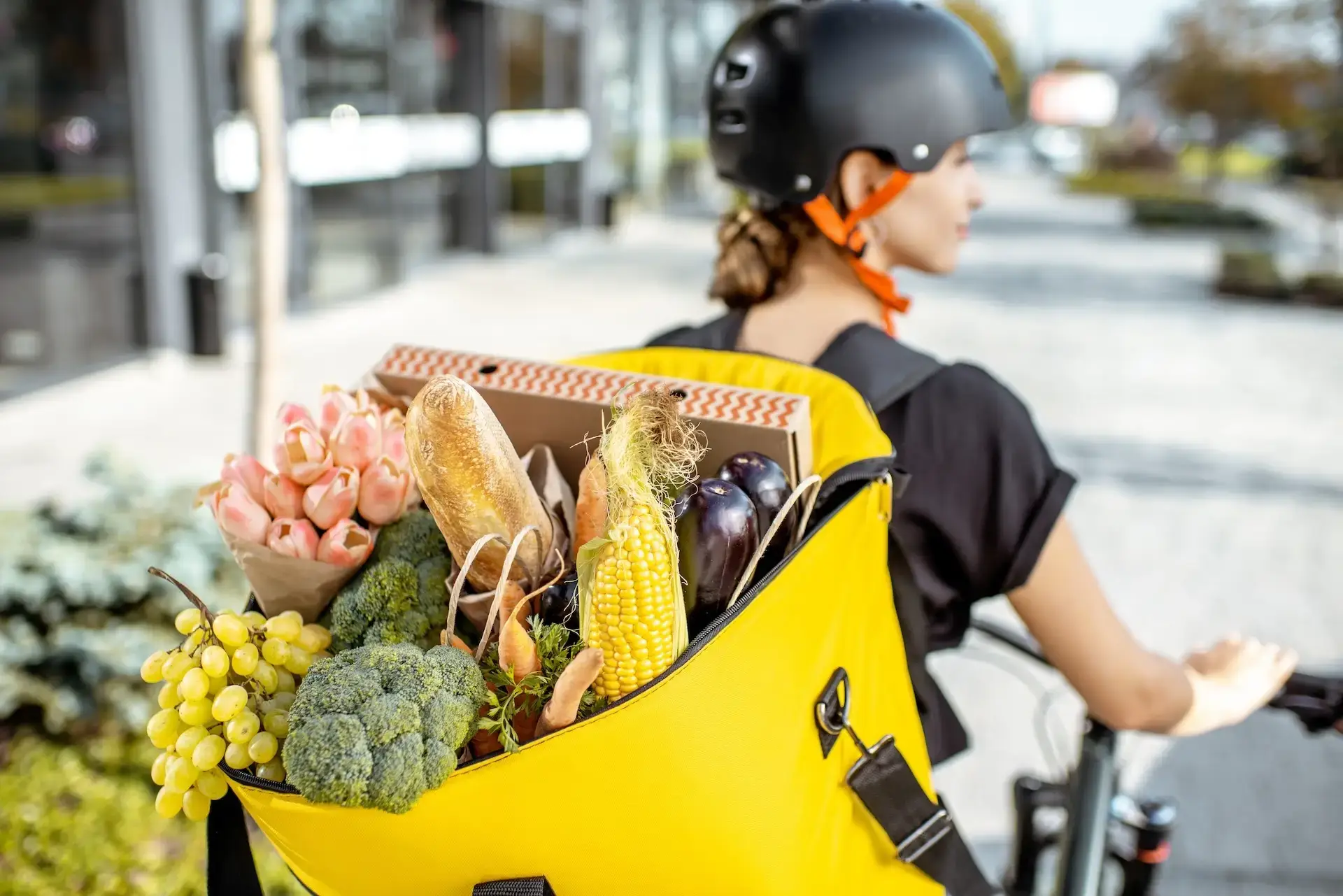
Courier delivering a box of fresh products to a doorstep, the page image of the Blinkit Clone.02
Pick it if: You prefer branch stores to many small sellersBlinkit Clone

A quick-commerce grocery platform built around branch stores and fast neighborhood delivery.

Explore Solution
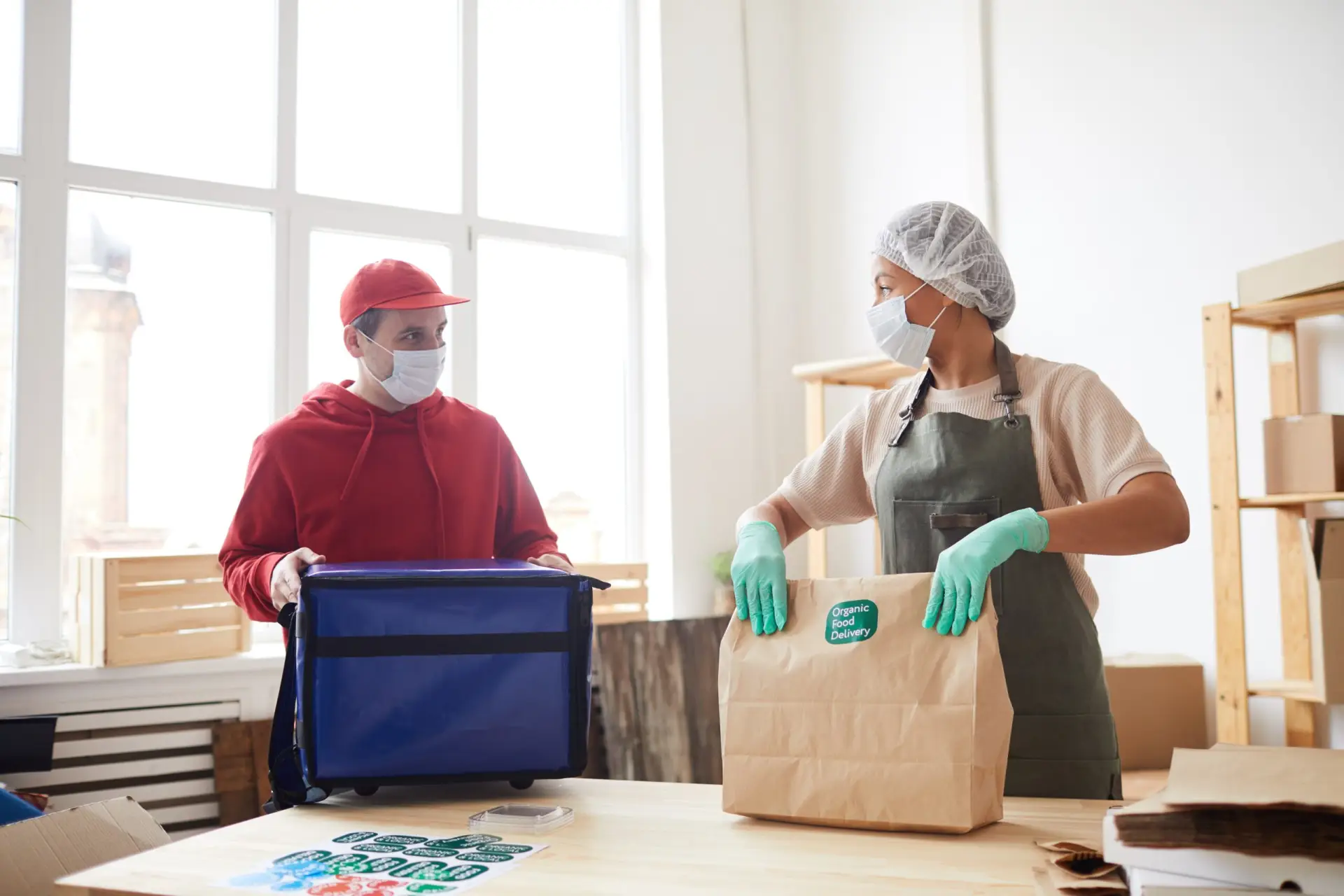
Kitchen worker sending out food delivery orders, the page image of the Swiggy Clone.03
Pick it if: Your menu is cooked meals, not raw produceSwiggy Clone

A food ordering and delivery platform for restaurants, with order tracking and delivery partners.

Explore Solution
Courier carrying a parcel to a doorstep, the page image of the Uber Delivery Clone.04
Pick it if: Your cargo is parcels instead of produceUber Delivery Clone

A parcel delivery platform in which couriers work from their own app and every job is dispatched and followed live.

Explore Solution
CatalogAll 90+ solutions

09The business case

Market Benchmarks

Grocery Delivery Market Benchmarks - Independent 2025-2026 Data

The revenue models above are ours. The figures below are not. They come from the Instacart (Maplebear) and Walmart annual reports on Form 10-K, Kroger's full-year 2025 results and Swiggy's Q4 FY2026 shareholder letter, reproduced as published. Together they show what grocery delivery looks like at scale in the US and India, so you can test a business case against numbers you can check.

Instacart 10-K01

$37.2bn in Instacart Order Value in 2025

Maplebear, the parent of Instacart, reports in its 2025 annual report on Form 10-K that gross transaction value (GTV) increased 11 percent to $37,224 million on 338.8 million orders, up 15 percent. Revenue was $3,742 million, made up of $2,677 million in transaction revenue and $1,065 million in advertising and other revenue. Transaction revenue is about 7.2 percent of GTV.

Kroger02

$16bn+ in Kroger eCommerce Sales in 2025

Kroger reports in its fourth quarter and full-year 2025 results, released 5 March 2026, that it delivered more than $16 billion in eCommerce sales in fiscal 2025, and that adjusted eCommerce sales increased 20 percent in the fourth quarter. Kroger also reports it completed an eCommerce strategic review expected to deliver $400 million of operating profit improvement in 2026.

Swiggy03

Instamart GOV Up 68.8% to INR 7,881 Crore

Swiggy's Q4 FY2026 shareholder letter reports that quick commerce gross order value (GOV) grew 68.8 percent year on year to INR 7,881 crore, with average order value up 33 percent to INR 700 and 1,143 dark stores across 129 cities. Contribution margin improved to negative 1.8 percent of GOV, and negative 1.1 percent for March 2026.

Walmart 10-K04

eCommerce Added 4.3% to Walmart U.S. Comp Sales

Walmart's annual report on Form 10-K for the fiscal year ended 31 January 2026 states that Walmart U.S. eCommerce sales positively contributed approximately 4.3 percent to comparable sales, against 2.9 percent in fiscal 2025. Walmart attributes the growth primarily to store-fulfilled pickup and delivery, alongside customer and Walmart+ member engagement with omnichannel offerings.

Where each figure comes from.

Maplebear Inc. (Instacart), Annual report on Form 10-K for the fiscal year ended December 31, 2025, filed February 2026 - sec.gov

The Kroger Co., Kroger Reports Fourth Quarter and Full-Year 2025 Results and Announces Guidance for 2026, 5 March 2026 - s202.q4cdn.com

Swiggy Limited, Q4 FY2026 Shareholder letter, May 2026 - swiggy.com

Walmart Inc., Annual report on Form 10-K for the fiscal year ended January 31, 2026, filed March 2026 - sec.gov

All figures are the publishers’ own reported results and statements, reproduced as published. The 7.2 percent transaction-revenue ratio is our arithmetic on reported figures ($2,677 million divided by $37,224 million). They describe the market, not the performance of any platform Miracuves builds, and nothing here is a revenue projection for your business.

The Commercial Case

Marketability, Revenue Potential & Business Prospects

The AmazonFresh clone Miracuves delivers earns when sellers trust it enough to list and shoppers trust it enough to reorder. Everything below is about making those two decisions easier, and about owning the relationship once they have been made.

  1. 01

    Commission on Every Store Order

    Each store order leaves the operator with a share, which means income follows the count of stores and orders instead of the size of your team.

  2. 02

    Several Levers, One Console

    Delivery charges, featured stores, promotions and in-house sales are separate settings in the same admin panel, so one can be switched on without redesigning the rest.

  3. 03

    Owned Sellers and Shoppers

    Store accounts, reviews and order history sit in your database, so the marketplace gains value for you and not for someone else's listing site.

  4. 04

    Exit Optionality

    You hold the complete source code, so changing host, team or direction later needs nobody's approval.

Main Revenue Levers
  • Store Commission
  • Delivery & Minimum-Order Charges
  • Featured Stores & Banners
  • Promotions & Flash Sales
  • In-House Store Sales
  • Wallet Top-Ups & Bonuses
Long-Term Value

Defensibility comes from sellers who stay and shoppers who return, rather than from features.

  1. 01Growers with a catalog and reviews do not casually move
  2. 02Shoppers with favorites and a wallet balance have a reason to return
  3. 03That accumulation starts at launch and stays in your database
  4. 04Careful approval of new stores is the second moat
Example Revenue Scenarios

These three cases differ only in how many stores are listed, and each names the lever that leads at that size. They are examples for planning conversations, not predictions of what any marketplace will earn.

Local Grocer Network10Stores Listed

Store commission carries the early revenue.

A small local marketplace where a handful of growers and grocers list items and the commission on each paid order covers running costs. Illustrative size, not a forecast.

Regional Produce Marketplace100Stores Listed

Commission plus delivery charges and flash sales.

A regional marketplace where many stores compete for the same shoppers, so delivery charges and flash sales begin to matter next to commission. Illustrative size, not a forecast.

Multi-Region Platform1,000Stores Listed

Several zones, with featured placement and in-house sales active.

A platform spanning many zones, where featured stores, an in-house store and wallet top-ups add up beside commission, and the dashboard shows where to focus. Illustrative size, not a forecast.

10Why Miracuves

Why Miracuves

Miracuves Compared With Other AmazonFresh Clone Developers

There are four ways to get a grocery marketplace: buy a generic multi-vendor script, hire a freelancer, sign an agency, or start on a ready-made produce marketplace whose builders have delivered before. Whichever you shortlist, run a real order through every role before you pay, ask how units and prices stay consistent across many sellers, check which listed features are extras, and read the release notes. This base is built to pass each of those checks.

Why Founders Choose Miracuves

  • 01

    Seller Side Included

    Stores get an app and a panel of their own, with their own catalog, prices and offers. Many grocery scripts stop at the shopper site.

  • 02

    Wallet and Commission Built In

    Orders can be paid from a wallet, and commission is calculated on every store order, so the money story is visible from the first sale.

  • 03

    Three Apps, One Codebase

    The customer, store and delivery apps plus four web surfaces arrive already connected, instead of separate projects waiting to be joined.

  • 04

    Full Source Code Ownership

    You receive the entire codebase and its project codes without encryption, so no one else can reprice it or move the goalposts afterwards.

  • 05

    Release Notes You Can Read

    The notes list what each version added, which lets you see what is in the product rather than trusting a brochure of features.

  • 06

    Plain Readiness Language

    This page keeps three lists apart: what the base includes, what is optional and what you provide yourself (a gateway, hosting and store accounts).

Development Company

How to Choose an AmazonFresh Clone Development Company

Judge a farm-to-table app development company by running a real order through every role, not by reading its pitch deck.

What to look for Miracuves

  • Proof in the product Separate shopper, store and delivery app logins you can test today
  • Seller tools for growers A store app and panel for each grower's catalog and prices
  • Consistent units across sellers One set of categories, attributes and units for all catalogs
  • Source ownership The complete codebase and project codes, with no encryption
  • Support after launch Guidance for 60 days and, running alongside, priority fixes for 6 months and updates for 12

Walk away from any vendor who

  • Gives growers no store app
  • Lets a seller go live without admin approval
  • Cannot price an item per kilogram
  • Hides the extras until you sign
  • Withholds the unencrypted Flutter and web source

How the AmazonFresh Clone Measures Against Generic Scripts and Agencies, Line by Line

CriteriaMiracuvesMiracuves AmazonFresh CloneGeneric Multi-Vendor ScriptCustom Dev Agency
Time to Launch6 working days of build workUnknown or DIYScoped per project, usually months
Source-Code OwnershipComplete, unencryptedOften limited or lockedUsually yes
Grocery DepthStores, catalogs, cart, wallet, tracking and chatPlain product listingsWhatever the budget allows
Seller ToolsStore app, store panel and approvalsRarely includedBuilt to order
Payments & WalletWallet, cash on delivery and gateway APIsVaries by scriptCustom integration
Admin & ReportsZone dashboard, refunds and reportsThin or absentBuilt to order, extra cost
Security & ComplianceRole logins, approvals, honest limitsMinimalVaries widely
Cost vs Speed vs QualityFixed price, fast, tested baseLow price, high riskExpensive and slow
Ongoing Support & Updates60 days guidance, 6 months bug fixes, 12 months updatesRarely offeredSet by the contract

The differences tend to show up in the first busy season, not in the sales call.

Talk to Our Team

Version History

Release Notes: Versions & What Changed

Release notes for the web platform and the apps, newest first. The notes carry no dates, and entries about modules this build does not include are left out.

VersionChangesWhat changed
V15.07 updates, 2 fixesAdded or updated
Stock clearance discount section on store details and the home page
Call-to-action section on the product details page
Support for Tag Manager, Analytics, Meta, LinkedIn, TikTok, Snapchat, X and Pinterest pixels
Cash on delivery switched on or off from the admin panel
Redesigned refund details page
Smoother login page
Flutter SDK raised to 3.27.1
Fixed
Order calculation in the point-of-sale screen
Several performance and reliability issues
V14.9.15 updates, 1 fixAdded or updated
Caching on the back end and the front end, starting with business settings and list APIs
Leaner asset files for faster screens
Clearer system messages and labels
UI and UX refinements
Flutter SDK raised to 3.24.5
Fixed
Various stability issues
V14.97 updates, 1 fixAdded or updated
Restock requests from customers, with an alert when the item returns
Restock-requested list in the customer profile
Exports with filters for customers and subscribers in the admin panel
Improved point-of-sale in the admin panel, store panel and store app, with paid amount and change
Redesigned admin login pages
Optimized database queries with caching
Flutter SDK raised to 3.24.4
Fixed
Various stability issues
V14.86 updates, 1 fixAdded or updated
Push notification taps open a chosen page
Centralized login by manual, OTP-based and social sign-in, all managed by the admin
Firebase mobile OTP authentication
Advanced maintenance mode with module-level control
Shipping policy page
Flutter SDK raised to 3.24.3
Fixed
Several issues and slow queries
V14.78 updates, 1 fixAdded or updated
Amazon S3 storage connection
SEO section control
Better translation tools for multi-language use
Review reply feature, so sellers can answer customers
Smoother chat
Several products added at once to flash deals and feature deals
Printable invoices sent by email
Flutter raised to 3.22.2
Fixed
Known issues in the admin panel, vendor panel, website and vendor app
V14.69 updates, 1 fixAdded or updated
Custom sorting for every list in the admin panel
Dynamic email templates
Low-stock popup warning in the admin and vendor panels
Checkout of selected products while the rest stay in the cart
Buy now checkout kept apart from the cart
Create-account checkbox for guest checkout
A more helpful seller registration page
Push notifications moved to FCM HTTP v1
Flutter SDK raised to 3.19.6
Fixed
Many smaller issues in the web panels and the apps
V14.59 updates, 1 fixAdded or updated
Admin can browse the site in maintenance mode
Smoother chat in the admin panel and seller panel
Option to toggle the Google Map display
Block, unblock, approve and deny users, with notices by email
Redesigned invoices with translation support
Empty states across the system
UI refresh across the admin, store panel, apps and website
In-house shop listed first among the vendors
Flutter SDK raised to 3.19.4
Fixed
Many smaller issues in the web panels and the app
V14.48 updates, 1 fixAdded or updated
UI refresh across the admin, store panel, default theme and apps
Restructured app code
SMS gateway added
Improved order review section
Chat with the admin from the user website and app
New mail and push notifications
Many database query improvements
Flutter SDK raised to 3.16.9
Fixed
Many smaller issues in the web panels, website and apps
V14.012 updates, 1 fixAdded or updated
Redesigned user app
Add funds to the wallet from the user web and app, with an add-fund bonus
Guest checkout
Edit option for delivery and billing addresses
Minimum order amount set by the admin and by the seller
Free delivery above a set order amount
Reorder from previous orders
Refer and earn, paid after the referred customer's first delivered order
Admin login address set from the admin panel
Order delivery verification by image and OTP
Apple login for the user app
Flutter SDK raised to 3.13.6
Fixed
Translation issues and a few small ones

Let's build together

Let's take your farm-to-table grocery idea and make it a working marketplace.

Book a free consultation and leave with a clear timeline and straight answers to your questions. Earning your trust matters more to us than closing a fast sale.

  • First reply in under 2 hours
  • Free consultation
  • No lock-in contracts
  • Full source code ownership

11Learn more

Blog & Resources

AmazonFresh Clone App: Newest Guides & Insights

Stay up to date with guides on what an app like AmazonFresh offers, how the business models of the big grocery players compare and how to build an alternative of your own.
The product5 questions

01What is an AmazonFresh Clone?

It is a ready-made, white-label grocery marketplace from Miracuves for a business that wants to connect growers and suppliers with shoppers. Sellers join as stores, shoppers order by location and a delivery man brings the order, through customer, store and delivery apps plus a website and web panels. It follows the category that AmazonFresh belongs to and is not affiliated with it.

02Can I customize the AmazonFresh Clone to suit my brand?

Yes. Putting your logo, icons and colors across web and apps is part of the package, and you own the full source code, so screens, flows and integrations can all be changed. Features beyond the base are scoped and quoted in writing.

03Is the AmazonFresh Clone scalable for large operations?

The platform is built around zones, many stores and a separate panel for each role, so adding growers or areas is mostly configuration. Caching and optimized queries arrived in releases 14.9 and 14.9.1, and an Amazon S3 connection can hold files. A very large operation may need hosting sized and tuned for it, which is a deployment decision we plan with you.

04What technology stack is used to build the AmazonFresh Clone?

The web and admin side is PHP with the Bootstrap framework, MySQL holds the data, and the Android and iOS apps are Flutter. Google Maps, Twilio, Firebase, payment APIs and translation connect through accounts and keys of your own.

05Do you provide technical support after deployment?

Yes. From launch the platform carries three periods side by side: 60 days of dedicated guidance, 6 months of priority bug fixes and 12 months of product updates.

Shopping & delivery5 questions

06How do I order groceries using the AmazonFresh Clone app?

A shopper sets a location, searches for items or stores or browses the categories, opens a store page, adds items to the cart and checks out. The order details screen then lists the items, the payment method and the delivery details, with a Track Order button.

07How do I track my grocery delivery?

The tracking screen shows a map and five steps: Order Placed, Order Confirmed, Preparing Item, Delivery on the Way and Delivered. While no delivery man has been assigned, the screen says so.

08What payment methods are supported?

Orders can be paid from the in-app wallet, and cash on delivery can be switched on or off from the admin panel. Card and local wallet payments run through the payment gateways you connect with your own account, so your gateway decides which cards and wallets are accepted.

09How can I report issues with my order?

Customers can write to the admin team through the chat in the website and the app, and the platform has a refund route with a details page for orders that need one.

10Can the platform support combo bundles or delivery to several addresses?

Both are available as custom work. If your plan needs combo bundles or one order split across several delivery addresses, we scope it and quote it in writing before anything is built.

Stores & delivery partners8 questions

11How can grocery stores register on the platform?

A farm, a supplier or a grocery store registers through the vendor portal with its business details, uploads its product catalog and waits for the admin to approve it. The admin can also add a store directly or import stores and items in bulk. A farm joins the same way as any seller, as a store with a catalog of its own.

12How do vendors manage their inventory and orders?

Each vendor signs in to a store panel or the store app to manage its products, update prices, process its orders and watch its sales. The admin sees every store from one console.

13Can vendors offer discounts or promotions?

Yes. Stores can create discounts and offers of their own, and the admin runs campaigns, banners, coupons, cashback and flash sales across the whole marketplace.

14What commission do vendors pay per order?

The commission is configured from the admin panel and calculated automatically on each store order. Typically it is a percentage per order, and you can change it to fit your business model.

15How are payments processed for vendors?

Order payments go through the platform, and the admin settles them with each vendor on a schedule the admin sets.

16How do I become a delivery partner on the platform?

A delivery man joins from the account menu in the app, submits documents, completes verification and waits for the admin to approve the application.

17How are delivery assignments managed?

Orders are assigned automatically by location, availability and performance measures such as rating and delivery time. The admin has a Dispatch Management area and a list of top delivery men.

18Can delivery partners track their earnings?

Yes. Delivery men have a dashboard of completed deliveries, earnings and bonuses.

Admin, money & growth7 questions

19What features are included in the admin panel?

The admin panel has a grocery dashboard filtered by zone, order status tiles, store and item management, delivery men and dispatch, campaigns and coupons, refunds, transactions and reports, a point-of-sale screen and settings with a language switcher.

20Can I manage operations in multiple regions?

Yes. Zones split the service area on the dashboard, and the platform supports multi-region and multi-city management.

21How do I approve vendors and delivery partners?

New stores wait in a New Stores queue and delivery men in an approval list, where the admin reviews each application and approves or denies it. Users can also be blocked or unblocked, with notices sent by email.

22Can I integrate custom payment gateways?

Payment gateways connect through their APIs on your own merchant account. The base supports several, and more can be added as scoped work.

23Does the admin panel provide performance analytics?

Yes. The dashboard shows counts, a gross-sale chart with commission lines, user statistics and top lists of stores, items, delivery men and customers, and the Transactions and Reports menu covers the money side.

24What is a practical route to the first revenue?

Store commission usually comes first in a grocery marketplace. It needs no additional product and begins with your very first paid order. Delivery charges are the next layer, once every zone has enough shoppers for basket size to count, and featured placement follows as stores start competing for visibility. The base also allows selling goods through an in-house store. Affiliate and brand partnership income rests on your own agreements, so it is negotiated, not built in.

25How defensible is a farm-to-table grocery marketplace?

Defensibility comes from sellers who stay and shoppers who return, rather than from features. Growers who have listed a catalog, collected reviews and learned the store panel do not casually move, and shoppers with favorites, an order history and a wallet balance have a reason to return. The platform lets that accumulation start at launch and keeps it in your database. Careful approval of new stores is the second moat, because a marketplace whose sellers are vetted is hard to copy.

Launch & Miracuves12 questions

26What is the schedule for rolling out the solution?

The ready-made platform goes live on your hosting in 6 days of our build time. Review by Apple and Google runs on its own timetable, and any custom work beyond the base is scoped and dated in writing.

27Is the source code included?

Yes. Everything arrives unencrypted: the web platform, the apps and the project codes.

28What do I have to prepare before going live?

You provide a domain and hosting, your branding and business details, store developer accounts that are already verified, a live payment gateway account with KYC approved, and any third-party keys. We rebrand, deploy and publish from your accounts. Gateway applications, legal pages and hosting stay in your name and under your control.

29Why choose Miracuves to build an AmazonFresh clone?

Because the seller side, the wallet and the admin dashboard arrive working, on a base with release notes you can read. Miracuves began in 2010 and has delivered 9,000+ projects for 6,000+ clients, with 90+ ready-made solutions to build from. The AmazonFresh Clone is a fixed $2,499, goes live in 6 working days and comes with 60 days of guidance, 6 months of priority bug fixes and 12 months of product updates, with a first response in under 2 hours Monday to Saturday, 10:00-19:00 IST.

30How much does an AmazonFresh clone cost?

The AmazonFresh Clone sells for $2,499, paid once. That buys the customer, store and delivery apps plus the web platform and its panels, rebranding, deployment on your server and every line of source code, unencrypted. It is the most direct way to build an app like AmazonFresh: start from a farm-to-table marketplace that already runs. Custom scope is quoted separately, in writing, and never blended into the base price.

31Is a ready-made AmazonFresh clone better than custom development?

When speed and budget matter, yes. Grower onboarding, a catalog per store, five-step tracking, the wallet and commission already work, and your branded build is up on your hosting in 6 working days, while a from-scratch marketplace has to specify, code and test all of that first. Choose custom work for needs outside the base, such as delivery memberships or split deliveries; we quote it in writing, usually 2-8 weeks.

32How long until my AmazonFresh clone is live on the App Store and Google Play?

Build work takes 6 working days, after which your branded farm-to-table platform is running on your hosting. We then submit the customer, store and delivery apps through your own Apple and Google publisher accounts, verified on your side before launch. Review is handled by each store on its own schedule, so the listings go public as Apple and Google approve them, often a little after the web launch.

33What is the business model of an app like AmazonFresh?

An app like AmazonFresh earns as the marketplace between many small growers and the shoppers who buy their produce. Commission on each store order is the base. Delivery charges and basket minimums, featured stores and banners, coupons and flash sales, your own in-house store and wallet top-ups add further lines, and each one is a setting you control in the admin panel.

34What is the step-by-step process to launch my AmazonFresh clone?

First, test the demo as a shopper, a grower store and a delivery man. Next, brief us on your zone, your first sellers, your branding and your gateway. We then rebrand and deploy everything on your hosting within 6 working days and send all three apps to Apple and Google under your accounts. You open the marketplace to orders, while Apple and Google review the apps outside those 6 days.

35Who can use an AmazonFresh clone besides a grocery store?

Any business that connects people who grow or supply food with the people who buy it can use it. Farm-direct sellers list their harvest, produce marketplaces gather many growers under one brand, and co-ops and food hubs run a store per member or supplier. Local grocers, specialty and organic sellers and wholesale suppliers all use the same base.

36What are the main challenges of running a grocery delivery marketplace?

The hard parts are routing orders, keeping many sellers consistent and trusting who sells. The platform assigns each order by location, availability and rating without manual relaying, store pages show prices and units in a consistent layout, and every new store waits for admin approval before it goes live. You decide how strict that vetting is.

37What running costs come after I buy an AmazonFresh clone?

Running costs go straight to providers in your name, never to Miracuves. They include card processing on your merchant account, an SMS gateway and Firebase for OTP and push, Google Maps keys billed on usage, a server with MySQL, a domain and tested backups. Amazon S3 for product photos is optional, and you also need verified Apple and Google publisher accounts.

Disclaimer

Miracuves is an independent software development company. We are not affiliated with, connected to, sponsored by, or endorsed by AmazonFresh.

Read our full Legal Notice & Disclaimer →
Why this name

“AmazonFresh Clone” is used descriptively. It is how the software industry refers to building a platform with functionality similar to AmazonFresh, and how clients search for it.

Who built this

The entire design and codebase is built by our own team. The product contains no code, design, graphics, or content originating from the AmazonFresh website or applications.

Trademarks

AmazonFresh and all other third-party names and marks are the property of their respective owners, referenced here solely to describe the category of software offered.