
Key Takeaways
- AI toy databases can help founders build quick MVPs, but they often fail when real users, transactions, and workflows grow.
- Production SQL engines provide stronger structure, reliability, indexing, relationships, and long-term data control.
- Relational models, migrations, transactions, foreign keys, backups, and query optimization are core production layers.
- Scalability depends on database architecture, schema quality, indexing strategy, and backend engineering discipline.
- A production-ready SQL foundation can help startups move beyond prompt-built prototypes into real business software.
Architecture Signals
- Founders need databases that support users, orders, payments, roles, reports, disputes, and admin workflows.
- Developers need clear schemas, indexed tables, relational integrity, query logs, migrations, and rollback control.
- Admins need visibility into records, transactions, permissions, reports, failed jobs, and operational activity.
- SQL transactions help protect business logic when money, inventory, status, or account balances change.
- Monitoring alerts help detect slow queries, database locks, failed writes, connection pressure, and scaling issues.
Real Insights
- AI-generated MVPs often hide database weakness because early demos do not test real operational complexity.
- Toy databases can become expensive to fix when workflows, relationships, and reporting requirements expand.
- Production SQL engines protect data consistency by defining relationships and enforcing predictable business rules.
- A clean migration path should focus on schema design, data cleanup, backend refactoring, and performance testing.
- Miracuves builds production-ready app backends with Laravel, MySQL, relational database design, migrations, indexing, and admin control.
AI can now generate a working app faster than many founders can write a product brief. A prompt can create tables, login screens, dashboards, CRUD flows, and even a simple backend connected to a Backend-as-a-Service platform. For early validation, that speed is useful.
But the moment real users arrive, the question changes. The founder no longer asks, “Can this demo work?” The question becomes, “Can this backend survive real transactions, complex roles, reporting, permissions, integrations, audit logs, and product expansion?”
This is where many technical founders hit the BaaS Ceiling.
The problem is not that Firebase, Supabase, or other Backend-as-a-Service tools are weak. Many are useful and production-capable when designed correctly. The real problem is that AI-generated MVPs often use them as toy databases: quick table stores, shallow auth layers, and prompt-created schemas that look functional but were never designed as a long-term operating system for the business.
Miracuves helps founders move beyond this fragile stage by rebuilding or migrating fast-moving product ideas into structured, source-code-owned, Laravel/MySQL-backed app foundations designed for real operations, admin control, and scalable growth.
Why AI MVPs Often Start With Toy Databases
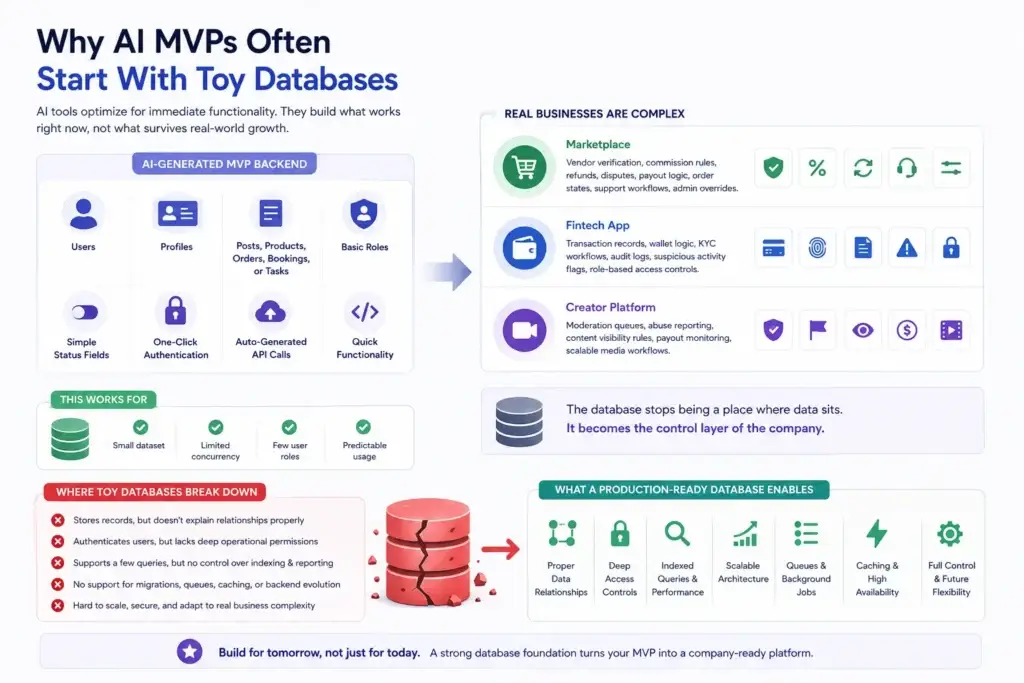
Image Source: AI-generated visual by Miracuves
When a founder asks an AI tool to build an app, the model usually optimizes for immediate functionality. It wants the screen to work. It wants the form to submit. It wants the dashboard to show records. That is helpful for quick validation, but it often produces a backend that is too shallow for production growth.
A prompted backend usually starts with simple entities:
- Users
- Profiles
- Posts, products, orders, bookings, or tasks
- Basic roles
- Simple status fields
- One-click authentication
- Auto-generated API calls
This works when the app has a small dataset, limited concurrency, few user roles, and predictable usage. But real businesses are rarely that clean.
A marketplace needs vendor verification, commission rules, refunds, disputes, payout logic, order states, support workflows, and admin overrides.
A fintech app needs transaction records, wallet logic, KYC workflows, audit logs, suspicious activity flags, and role-based access controls.
A creator platform needs moderation queues, abuse reporting, content visibility rules, payout monitoring, and scalable media workflows.
The database stops being a place where data sits. It becomes the control layer of the company.
That is where a toy database breaks down. It may store records, but it does not explain relationships properly. It may authenticate users, but it does not support operational permissions deeply. It may support a few queries, but it does not give the founder full control over indexing, reporting, migrations, queues, caching, and backend evolution.
Read More: Why AI-Built MVPs Break at Scale: Founder Crash Patterns After Launch Traffic
Hitting the BaaS Ceiling: When AI Tools Stop Scaling
The BaaS Ceiling is the point where the convenience that helped you launch starts limiting the product you need to become.
Backend-as-a-Service tools are attractive because they remove early backend setup. They often provide authentication, database access, storage, serverless functions, and real-time capabilities from one dashboard. For a prototype, this can be a strong choice.
But when an AI-generated app depends too heavily on BaaS defaults, founders can face limits that are not obvious at the demo stage.
1. Query Complexity Starts Outgrowing the Generated Schema
AI tools often create schemas based on what the founder asked for in the prompt, not based on how the business will operate six months later.
A simple booking table might work until the app needs cancellation policies, provider payouts, dispute states, promotional credits, region-based rules, and finance reports.
At that point, the backend needs deliberate relational design. You need normalized tables where appropriate, clear foreign keys, indexing strategy, migration control, and predictable joins. Without that foundation, every new feature becomes a workaround.
2. Authorization Becomes Too Shallow
Most early AI MVPs treat authorization as a checklist: user, admin, maybe vendor. But production platforms need layered access control.
A marketplace may need different permissions for platform admins, finance teams, support agents, merchants, delivery partners, regional managers, and external partners.
If the authorization model was generated quickly, permissions often become scattered across frontend conditions, database rules, and serverless functions. That may work temporarily, but it becomes difficult to audit, test, and safely extend.
3. Business Logic Gets Trapped in the Wrong Layer
A strong production backend separates concerns.
Controllers receive requests. Services handle business logic. Repositories manage data access. Queues process heavy tasks. Admin dashboards expose operational controls.
Prompt-generated apps often blur these boundaries. Business logic may appear inside frontend components, BaaS rules, edge functions, database triggers, or generated API handlers. This makes the app difficult to debug and risky to scale.
4. Platform Defaults Begin Driving Product Decisions
The founder should decide the business model. The platform should support it. But when a backend is tightly coupled to BaaS defaults, founders often start asking the wrong questions:
- Can we build this feature inside the current rule system?
- Will this query become too expensive?
- Can we export this data cleanly later?
- Can our team maintain this if the AI-generated code becomes messy?
- Can we customize the admin panel without rewriting half the app?
Those are not product questions. They are architecture debt symptoms.
Founder Decision Signals
Speed
If the app was built fast but every new backend change now takes longer than expected, the original speed advantage has expired.
Cost
If simple features require workarounds, duplicate data, extra services, or specialist debugging, the low-cost MVP may become expensive to maintain.
Scalability
If traffic, reporting, permissions, or workflow complexity create backend uncertainty, the product has likely moved beyond prompt-generated architecture.
Market Fit
If users are validating the product but the backend cannot support deeper monetization, the infrastructure is now blocking growth.
Comparison Matrix: Prompted Backends vs MVC Architecture
The right comparison is not “SQL vs NoSQL.” That framing is too shallow.
The stronger comparison is between a backend generated to satisfy a prompt and an architecture designed to operate a business.
Prompted Backend vs Production MVC Architecture
| Decision Area | AI-Prompted BaaS Backend | Laravel/MySQL MVC Architecture | Founder Impact |
|---|---|---|---|
| Primary goal | Make the demo work quickly | Support business workflows, admin control, and long-term growth | Fast validation is useful, but production needs operational depth. |
| Data model | Generated from prompt context, often simplified | Designed around entities, relationships, transactions, and reporting | Better data modeling reduces rewrite risk as features expand. |
| Business logic | Often mixed across frontend, rules, functions, and generated handlers | Separated into controllers, services, repositories, jobs, and policies | Cleaner structure makes the app easier to test, debug, and extend. |
| Admin control | Basic dashboards or generated panels | Purpose-built admin dashboard for users, transactions, roles, reports, disputes, and settings | The founder gains operational control instead of depending on developers for every small change. |
| Query strategy | Works for simple queries; complex filtering can require workarounds | SQL joins, indexes, transactions, reporting queries, and optimization paths | Production teams can optimize the actual business queries that matter. |
| Scalability path | Depends heavily on platform limits, pricing, and generated implementation quality | Can evolve with caching, queues, read replicas, indexing, background workers, and cloud deployment strategy | Growth planning becomes architecture-led, not platform-default-led. |
| Ownership | May be coupled to platform-specific APIs, rules, and generated code patterns | Source-code-owned backend with clearer portability and customization control | Founders reduce vendor lock-in and gain long-term product flexibility. |
| Security controls | Often depends on generated rules and tool defaults | Role-based access control, audit logs, secure API middleware, admin permissions, and structured review flows | Security becomes part of the product foundation, not a late-stage patch. |
Why Production SQL Engines Still Matter After the AI MVP Stage
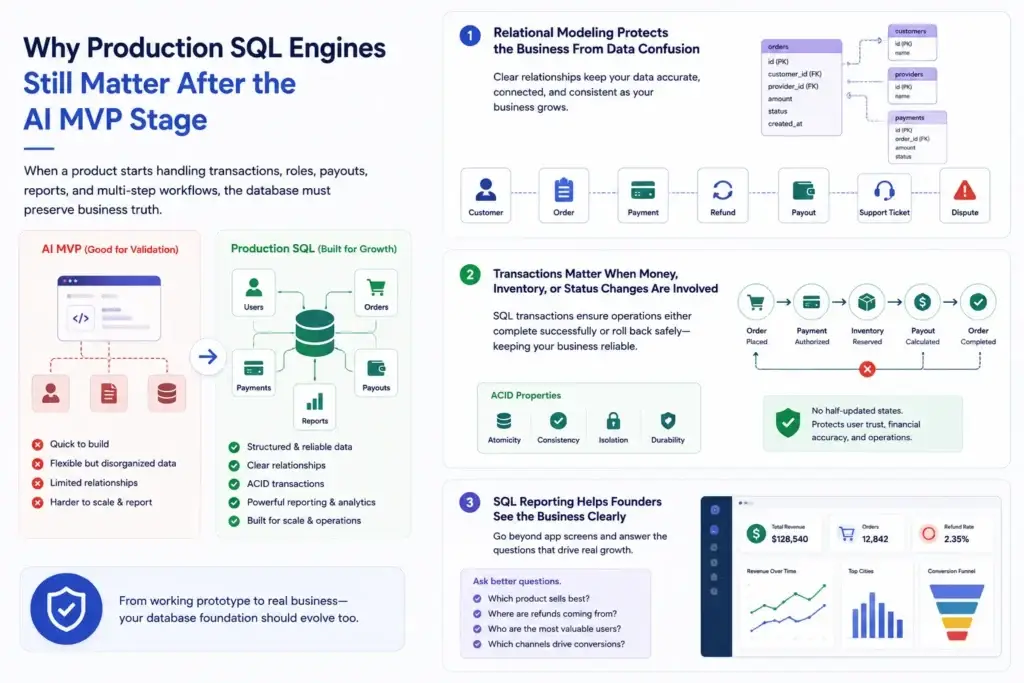
Image Source: AI-generated visual by Miracuves
Production SQL is not old-fashioned. It is operationally practical.
When a product starts handling transactions, roles, payouts, reports, and multi-step workflows, the database must preserve business truth.
A production SQL engine such as MySQL gives founders a mature foundation for structured data. In a Laravel/MySQL setup, the backend can define relationships clearly, manage migrations, enforce business logic through service layers, and support admin dashboards that reflect how the company actually operates.
Relational Modeling Protects the Business From Data Confusion
In a simple AI-generated app, it may be acceptable to duplicate user details or store flexible data quickly. But in a production marketplace, delivery app, fintech platform, or booking system, unclear relationships create real risk.
For example, an order is not just an order. It may connect to a customer, provider, payment, refund, discount, invoice, support ticket, payout, and dispute.
A proper SQL model helps maintain those relationships instead of scattering them across disconnected collections or generated tables.
Transactions Matter When Money, Inventory, or Status Changes Are Involved
Production apps need predictable state changes.
If a wallet balance updates, an order is accepted, a payout is calculated, or inventory is reserved, the system should not leave the business in a half-updated state.
This is where SQL transaction logic matters. It helps teams design operations that either complete correctly or roll back safely. For founders, that is not just a technical detail. It affects user trust, finance accuracy, and support workload.
SQL Reporting Helps Founders See the Business Clearly
AI-generated backends often focus on app screens, not business intelligence.
But once founders start tracking retention, order volume, failed payments, refund reasons, high-value users, regional demand, and conversion drop-offs, they need reliable reporting.
SQL gives teams a powerful way to ask deeper business questions from structured data. That matters when a founder moves from “Does anyone want this?” to “Which part of the business should we scale next?”
The Migration Path to Miracuves Enterprise Infrastructure
Outgrowing an AI MVP does not always mean throwing everything away. The smarter path is to separate what has been validated from what needs to be rebuilt.
Miracuves usually looks at three layers:
- Product truth: What did users validate? Which workflows are worth keeping?
- Data truth: Which records, roles, and relationships need to be preserved or redesigned?
- Infrastructure truth: Which backend decisions are blocking scale, security, monetization, or admin control?
From there, the product can move into a stronger Laravel/MySQL foundation.
Founders can explore Laravel app development when they need a structured MVC backend, service layers, API architecture, queues, and admin workflows.
For database-heavy products, MySQL database development helps create a clearer relational foundation for transactions, reporting, and long-term app control.
Step 1: Audit the AI-Generated Backend
The first step is not migration. It is diagnosis.
A serious audit should review:
- Database schema quality
- Authentication and authorization logic
- Business rules hidden inside frontend code
- BaaS-specific dependencies
- Query complexity and performance risks
- Security gaps and exposed data paths
- Admin panel limitations
- Exportability of existing data
This audit shows whether the product needs incremental hardening, a partial backend rebuild, or a full migration into production architecture.
Step 2: Rebuild the Core Data Model Around Business Workflows
A production data model should be built around business operations, not screen components.
For a delivery platform, that means customers, merchants, delivery partners, orders, payments, zones, commissions, coupons, refunds, and support workflows.
For a creator app, that means creators, content, wallets, subscriptions, reports, moderation queues, and payouts.
Miracuves ready-made clone app solutions give founders a faster starting point because the core platform flows, admin control, and monetization logic can begin from a launch-ready foundation instead of a blank backend.
Step 3: Move Business Logic Into a Maintainable Laravel Layer
In a stronger backend, business rules should be visible, testable, and maintainable.
Laravel supports this through a clean MVC pattern, Eloquent ORM, policies, middleware, queues, service classes, and repository patterns.
This structure matters because it gives the founder a backend that can evolve. New features do not need to be patched randomly into generated functions. They can be added through proper modules, migrations, policies, and admin controls.
Step 4: Build the Admin Dashboard as the Operating Console
Many AI MVPs underestimate the admin dashboard.
A founder may get a simple records panel, but not a real operating console.
A production admin dashboard should help the platform operator manage:
- Users, providers, vendors, merchants, or creators
- Approvals and verification
- Transactions, commissions, payouts, and refunds
- Disputes, support tickets, and abuse reports
- Content, listings, orders, bookings, or catalogues
- Analytics and operational reporting
- Roles, permissions, and audit logs
This is where a Miracuves white-label app foundation becomes more than a codebase. It becomes a business control layer.
Step 5: Plan Scalability With Queues, Caching, and Deployment Control
Production scalability is not a single switch. It is a set of engineering decisions: indexing, caching, background processing, queue workers, API design, load testing, monitoring, and deployment practices.
A Laravel/MySQL backend can be extended with Redis caching, queue workers, cloud deployment, scheduled jobs, and dedicated background processes.
This is especially important for apps with notifications, payouts, email workflows, reports, media processing, delivery dispatching, booking reminders, and payment reconciliation.
Read more: The Infinite API Loop: Why AI-Built MVPs Bankrupt Founders on Day 1
When Should a Founder Move Beyond the AI-Generated Backend?
You do not need to migrate the moment the AI MVP works. But you should plan migration before backend risk starts damaging users, revenue, or investor confidence.
Strong signals include:
- Users are active, but backend changes are becoming slow or risky.
- The product needs roles beyond basic user/admin access.
- You need finance-grade reporting, audit logs, or transaction history.
- The generated schema no longer reflects how the business operates.
- Pricing, limits, or platform coupling are shaping product decisions.
- Your team is afraid to change backend logic because nobody fully understands it.
- You need a proper admin panel to manage operations without developer dependency.
At that point, continuing to patch the AI-generated backend may be more expensive than rebuilding the foundation correctly.
Mistakes Founders Should Avoid
Mistake 1: Treating the AI MVP Schema as Production Architecture
A generated schema is usually designed to satisfy the first prompt. It should be reviewed before it becomes the long-term foundation for payments, reporting, permissions, and business workflows.
Mistake 2: Confusing BaaS Convenience With Backend Ownership
BaaS tools can accelerate validation, but founders still need to understand portability, data access, pricing behavior, and how much business logic is tied to platform-specific rules.
Mistake 3: Waiting Until Users Feel the Backend Problem
Backend debt becomes expensive when it shows up as slow dashboards, failed workflows, inconsistent data, support complaints, or blocked feature releases.
Why Miracuves Uses Laravel/MySQL for Clone App Infrastructure
Miracuves focuses on launch-ready clone app foundations because founders often need more than a prototype. They need customer apps, provider or vendor workflows, admin dashboards, payments, reports, support tools, and monetization logic working together.
Laravel/MySQL is practical for this environment because it supports clean backend structure, relational data modeling, admin control, API workflows, caching, queues, and source-code ownership.
For founders, the value is not that Laravel and MySQL are trendy. The value is that they are understandable, maintainable, widely supported, and strong enough for business-heavy applications.
No stack is literally infinite. But raw Laravel/MySQL architecture gives founders far more direct control over scaling variables than a prompt-generated backend locked into platform defaults.
That control matters when a product starts needing:
- Custom role-based dashboards
- Multi-step approval workflows
- Payment and payout logic
- Reporting and analytics
- Scalable APIs
- Background jobs
- Admin audit trails
- Custom integrations
- Data ownership
- Long-term maintainability
If you want to understand Miracuves’ broader app development approach, explore the clone app strategy resources or read the related Miracuves perspective on why Laravel and Flutter are preferred for clone app foundations.
Final Thoughts: The Prompt Built the Demo, but the Database Runs the Business
AI-generated MVPs are useful because they reduce the distance between idea and validation. But once users, revenue, workflows, and operational risk enter the picture, the backend needs to mature.
The real issue is not whether a founder should use SQL or NoSQL. The stronger question is whether the backend has enough structure, ownership, and operational clarity to support the next stage of the business.
A toy database can prove that people want the product. A production SQL engine can help the business serve them reliably.
For founders who have outgrown their AI MVP, that difference matters.
FAQs
What are AI toy databases?
AI toy databases are simple backend structures generated quickly by AI tools for demos or early MVPs. They may store basic records and support simple workflows, but they often lack the relational design, permissions, reporting, transaction handling, and admin control needed for production systems.
What is the BaaS Ceiling?
The BaaS Ceiling is the point where a Backend-as-a-Service setup stops helping the founder move faster and starts limiting the product. This can happen because of query complexity, platform coupling, pricing behavior, shallow authorization, limited customization, or generated backend debt.
Is Backend-as-a-Service bad for AI MVPs?
No. BaaS tools can be useful for fast validation, authentication, storage, and simple app workflows. The risk appears when founders treat an AI-generated BaaS backend as permanent production architecture without auditing schema quality, security, permissions, data portability, and scalability.
Why use Laravel and MySQL after an AI MVP?
Laravel and MySQL give founders a structured backend foundation with MVC architecture, relational data modeling, migrations, queues, caching, role-based access control, API workflows, and admin dashboard logic. This makes them practical for marketplaces, delivery apps, fintech platforms, SaaS products, and other business-heavy apps.
When should I migrate from an AI-generated backend?
You should consider migration when real users validate the product, backend changes become risky, reporting becomes difficult, roles and permissions expand, transaction logic becomes important, or the admin dashboard can no longer support daily operations.
Can Miracuves migrate an existing AI MVP?
Miracuves can help founders assess an existing AI MVP, identify backend limitations, redesign the data model, and move toward a structured Laravel/MySQL or white-label app foundation. The right path depends on the existing code quality, data structure, business model, integrations, and launch scope.
Miracuves is an independent software development company. We are not affiliated with, connected to, sponsored by, or endorsed by any company or product named in this article.
Terms such as “X Clone” are used descriptively. It is how the software industry refers to building a platform with functionality comparable to a known service, and how clients search for it.
The entire design and codebase of our products is built by our own team. Our products contain no code, design, graphics, or content originating from any third-party website or applications.
All third-party names and marks referenced in this article are the property of their respective owners, referenced solely to identify the services discussed.