A professional networking platform succeeds when it does more than collect profiles and connection requests. Its real purpose is to turn professional identity into useful outcomes: meaningful relationships, relevant opportunities, better hiring decisions, knowledge exchange, stronger visibility, and long-term career growth.
That distinction matters for founders building a professional community, recruitment network, alumni ecosystem, industry association, talent marketplace, or career platform. A long feature list can make a product look complete while still failing to create a reason for members, recruiters, and companies to return.
The stronger product question is therefore not, “How many features should the platform have?” It is, “Which features help the right people discover each other, establish professional credibility, communicate efficiently, and convert interactions into real opportunities?”
This guide breaks those capabilities into practical layers covering professional identity, networking, search, hiring, communication, content, career development, trust, analytics, and platform control. The goal is to help founders prioritize features around user value rather than simply reproducing familiar social-networking patterns.
Key Takeaways
- Professional networking platform features should be designed around outcomes such as trusted discovery, hiring, visibility, collaboration, and career progression.
- A detailed professional identity layer gives search, recommendations, hiring, networking, and credibility systems better data to work with.
- Search and discovery can be more strategically important than adding more feed features because users need a practical way to find relevant people and opportunities.
- Hiring works better when jobs, candidate profiles, communication, saved intent, and recruiter workflows operate as one connected journey.
- Trust features such as verification, privacy controls, moderation, reporting, and role-based administration protect the quality of the network.
- Founders should prioritize features according to the audience’s main professional job-to-be-done rather than trying to launch every possible module at once.
Why Feature Selection Matters More Than Feature Count
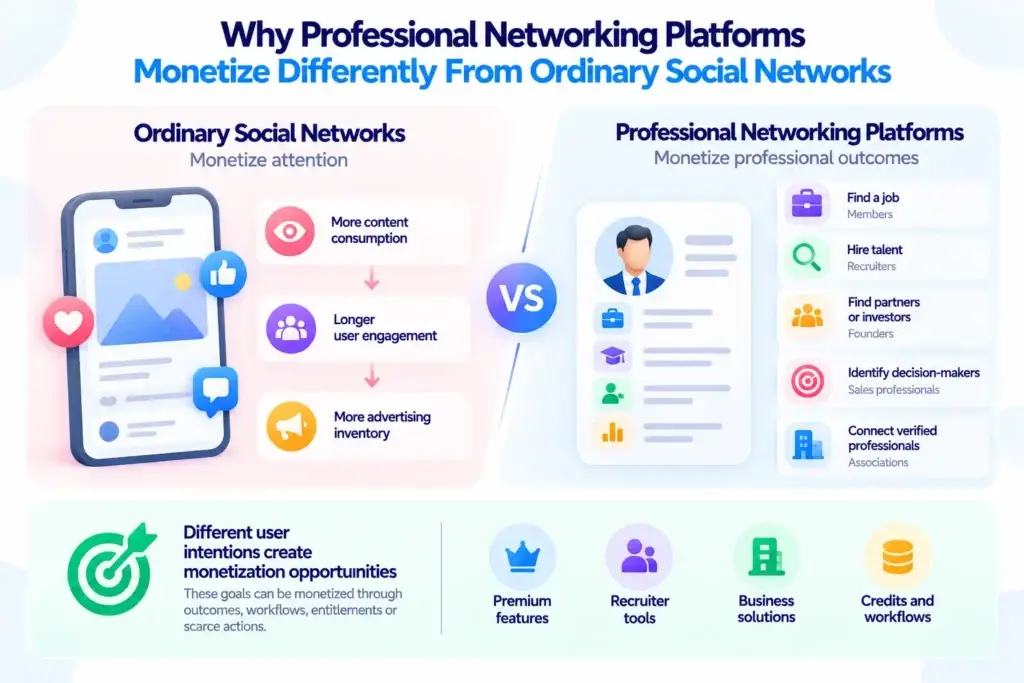
Professional networks have a different engagement model from general social platforms. Users are not necessarily opening the product simply to be entertained. They may be searching for a specialist, evaluating a candidate, looking for their next role, following developments in their industry, finding a mentor, building credibility, recruiting a team, or reconnecting with someone from their professional network.
That means every important feature should improve at least one professional outcome. A profile should improve credibility and discovery. Search should reduce the time required to find the right person. Messaging should help relevant conversations begin. Job functionality should connect professional identity with employment opportunities. Content should help expertise become visible.
When features are disconnected, the platform becomes a collection of screens. When they reinforce each other, the platform begins developing network value.
For example, adding skills to a profile is useful. But those skills become substantially more valuable when they can also influence people search, candidate discovery, recommendations, job matching, professional credibility, and learning suggestions. The same underlying information is now contributing to several user journeys.
This is an important product-design principle for founders: prioritize features that create value across multiple workflows before adding isolated features that look impressive but have limited impact on retention or professional outcomes.
1. Professional Profiles Should Function as Trusted Career Identities
The professional profile is one of the foundational components of any career-focused network. But it should be treated as more than a biography page.
A strong profile acts as a structured professional identity that other parts of the platform can use for discovery, recommendation, hiring, collaboration, and credibility assessment.
Depending on the audience, useful profile information may include experience, education, skills, certifications, projects, portfolio material, achievements, publications, languages, availability, professional interests, location, and industry information.
The exact fields should depend on the network. A platform for designers may give more importance to portfolios. A healthcare professional community may emphasize qualifications and credentials. A founder network may prioritize companies, industries, investment interests, and previous ventures. A skilled-trades community may need licences, locations, specialties, and work history.
Profile completeness should encourage useful data, not unnecessary data
Profile-completion indicators can help members understand what information increases their discoverability. However, completion mechanics should focus on information that actually improves the network rather than encouraging users to fill unnecessary fields merely to reach 100%.
The strongest profile system ultimately answers three questions for another member or recruiter: Who is this person? What can they do? Why should I trust the information I am seeing?
2. Connection and Follow Systems Should Reflect Different Professional Relationships
Not every professional relationship means the same thing. Someone may know another professional personally, follow their expertise, work at the same organization, belong to the same alumni group, participate in the same association, or simply want to keep track of their work.
A well-designed networking platform can recognize these differences instead of treating every relationship as an identical connection.
- Connections can represent mutual professional relationships.
- Follows can let members receive updates without requiring reciprocal acceptance.
- Organization follows can connect members with employers, associations, schools, or professional groups.
- Interest-based relationships can connect people around industries, specialties, topics, or communities.
This distinction improves network quality because it reduces pressure to turn every interesting professional into a personal connection.
Connection recommendations need context
Recommendation systems become more useful when they explain why a connection may matter. Shared organizations, mutual contacts, similar skills, common industries, alumni relationships, geographic proximity, or participation in the same professional community can all provide useful context.
The objective should not simply be to maximize the number of connections. It should be to increase the probability that a suggested relationship has professional relevance.
3. Search and Discovery Are Core Infrastructure for Professional Networking
A professional network becomes significantly less useful when members cannot efficiently discover the people, expertise, organizations, jobs, or opportunities contained inside it.
That makes search one of the highest-value product layers—not an auxiliary feature to add after profiles and feeds.
Useful professional search can include combinations of name, location, industry, skills, experience, role, company, education, credentials, availability, keywords, and other niche-specific attributes.
For a recruiter, this can mean discovering candidates with particular experience. For a founder, it can mean finding an advisor with specialized knowledge. For a professional, it can mean locating people working in a target industry. For an association, it can mean making member expertise easier to discover.
As the network becomes more complex, saved searches, alerts, structured filters, and personalized recommendations can further reduce discovery friction. Readers interested specifically in hiring discovery can explore Miracuves’ guide to advanced job search and recruiter discovery.
4. Messaging Should Help Professional Conversations Move Forward
Discovery has limited value if users cannot convert that discovery into communication. Messaging therefore forms an important bridge between networking activity and professional outcomes.
The basic requirement is straightforward: members need a reliable way to communicate. The more important strategic decision is determining who can contact whom and under what conditions.
Completely unrestricted messaging can create spam and reduce trust. Excessive restrictions can make networking frustrating. Different platforms may therefore use connection-based messaging, contact requests, controlled outreach, message permissions, organization messaging, or premium communication allowances.
Useful supporting capabilities may include conversation history, notifications, attachments, message requests, blocking, spam reporting, and moderation controls. For hiring-focused products, recruiter-candidate conversations should also connect naturally with job applications and candidate records where appropriate.
The success metric is not simply message volume. The better question is whether messaging helps members create legitimate professional conversations without making the network noisy or unsafe.
5. Job Discovery Should Connect Opportunities With Professional Identity
Job functionality becomes particularly powerful in a professional network because the platform may already understand a member’s skills, experience, location, industry, connections, interests, and career history.
Instead of functioning as a separate classified-listing section, jobs can become part of the broader professional graph.
A useful career-opportunity layer may include job listings, structured filters, saved jobs, saved searches, alerts, application tracking, company information, role recommendations, and clear application workflows.
Relevant jobs matter more than a large number of jobs
A platform does not become valuable simply because thousands of listings are available. Search quality, categorization, freshness, job credibility, and relevance strongly influence whether members consider the job marketplace worth revisiting.
For niche networks, smaller but more relevant opportunity pools can become strategically useful. An industry-specific network may know much more about the credentials, specialties, and professional context that matter to its audience than a broad job marketplace.
6. Recruiter Features Should Reduce Hiring Friction, Not Just Add More Filters
The candidate side and recruiter side of a professional network need different tools. A professional wants visibility, relevant opportunities, and control over how they are discovered. A recruiter wants to identify qualified candidates, organize prospects, communicate efficiently, and move people through a hiring process.
Recruiter functionality may therefore include candidate search, saved candidates, notes, search alerts, job management, applicant stages, interview coordination, candidate communication, and internal collaboration.
What matters is continuity. If recruiters find candidates through search but must manage the rest of the process in disconnected tools, the platform loses part of its potential value.
Founders should therefore think about hiring as a workflow rather than a single “jobs” feature: discover → evaluate → communicate → shortlist → interview → decide.
7. Company and Organization Pages Build the Employer Side of the Network
Professional networks contain more than individuals. Companies, universities, associations, communities, recruiters, training organizations, and other institutions can all become important parts of the graph.
Organization pages provide an identity layer for these entities and can bring together company information, updates, opportunities, employees or members, culture information, relevant content, and audience relationships.
For hiring, company pages also support employer credibility. Candidates often want to understand the organization behind an opportunity before applying. For networking, organizations can become meeting points around industries, alumni relationships, memberships, certifications, or professional interests.
Founders building vertical professional communities should decide early what role organizations play in the network because organization data can influence search, profiles, job listings, recommendations, subscriptions, and administration.
8. A Professional Content Feed Should Improve Knowledge and Visibility
Content gives members a reason to return even when they are not actively job searching or recruiting. It also lets professional expertise become visible outside the static profile.
A useful feed can support industry observations, professional updates, questions, project discussions, research, hiring announcements, career lessons, event information, company news, and specialist knowledge.
The product challenge is keeping that content professionally relevant. If the ranking system optimizes only for raw engagement, sensational or broadly entertaining content may gradually crowd out the specialized information that originally made the community valuable.
Founders therefore need to consider relevance signals alongside engagement signals. Industry, expertise, network relationships, topic preferences, content quality, recency, and user feedback can all influence discovery.
9. Recommendations, Skills, and Credentials Help Establish Professional Trust
Professional networks operate on trust. A user viewing another profile is often trying to determine whether that person’s experience and expertise are credible enough to justify a conversation, interview, referral, or collaboration.
Skills, recommendations, endorsements, certificates, verified credentials, portfolios, completed projects, and professional history can provide supporting context. However, simply adding badges is not enough.
Credential systems become more useful when users understand what the signal represents. A self-declared skill, a recommendation from another member, a certificate issued by an organization, and a verified professional licence carry different levels and types of evidence.
For specialist networks, this is an opportunity to build domain-specific credibility systems rather than copying generic profile fields.
10. Learning and Career Development Can Extend the Platform Beyond Job Search
Career growth is not limited to finding the next job. Professionals also need to identify skill gaps, learn new capabilities, demonstrate progress, connect with mentors, and understand how their industry is changing.
Learning functionality can therefore complement networking and hiring when it has a clear connection to professional identity.
Potential capabilities include courses, learning paths, certifications, mentorship discovery, cohort communities, career resources, assessments, professional events, and progress tracking.
The most interesting product opportunities often appear when these systems connect. Completing a credential might update the professional profile. New skills might influence job recommendations. Learning interests might improve mentor matching. Employers may search for professionals with particular verified qualifications.
This turns career development from a separate content library into a meaningful part of the professional network.
11. Notifications Should Prioritize Professional Relevance
Notifications can support retention, but excessive notifications quickly become noise. Professional networks have a particularly strong reason to prioritize quality because an important job message or connection request can become buried among low-value engagement alerts.
Useful notifications may cover messages, connection requests, recruiter activity, job alerts, application status, relevant profile interactions, professional mentions, event reminders, organization updates, or meaningful responses to published content.
User-level notification settings are equally important. Professionals should be able to decide which events deserve email, push, in-app alerts, or no notification at all.
12. Trust, Privacy, and Moderation Are Product Features, Not Back-Office Tasks
A professional network stores information that can influence careers, hiring decisions, professional reputation, and business relationships. Trust therefore needs to be designed into the product rather than added only after problems appear.
Relevant controls can include secure authentication, profile visibility settings, connection permissions, messaging controls, blocking, abuse reporting, recruiter or company verification, moderation queues, spam detection, admin activity records, and role-based access controls.
Users should also understand who can see their information and how platform interactions affect visibility. A person looking for a job quietly may need different controls from someone actively trying to maximize professional discovery.
The business impact is substantial. Fake profiles, spam, misleading job listings, harassment, automated outreach, and weak moderation can reduce the perceived quality of the entire network. For a deeper examination of this layer, see the guide to professional networking platform safety and trust.
Professional Networking Feature Priorities by User Outcome
| Feature Layer | Primary User Value | Business Impact |
|---|---|---|
| Professional profiles | Establish identity, experience, expertise, and credibility | Creates structured data for discovery, matching, and network quality |
| Connections and follows | Build meaningful professional relationships | Strengthens the professional graph and recurring engagement |
| Search and discovery | Find people, jobs, organizations, and expertise efficiently | Makes the accumulated network useful |
| Messaging | Turn discovery into professional conversations | Creates measurable interaction and opportunity flow |
| Jobs and hiring | Connect candidates and employers | Creates a high-intent recurring use case |
| Professional content | Share expertise and stay informed | Supports retention between major career events |
| Skills and credentials | Demonstrate capability and professional trust | Improves matching and profile differentiation |
| Safety and moderation | Protect identity and interactions | Preserves marketplace and community quality |
| Analytics | Understand visibility and outcomes | Improves decision-making and premium-value potential |
13. Analytics Should Help Members, Recruiters, and Operators Make Better Decisions
Different platform participants need different types of feedback.
Members may want to understand profile visibility, content engagement, search appearances, or professional interest. Recruiters may need job performance, candidate pipeline, response rates, and hiring activity. Company administrators may monitor audience and employer-brand engagement. Platform operators need broader data around activation, retention, moderation, search behaviour, network growth, and marketplace activity.
Analytics should therefore be tied to decisions. Adding a dashboard full of numbers is less useful than showing information that helps each role improve an outcome.
For founders, operator analytics are especially important because a networking product can appear busy while still failing to create useful connections. Measuring registrations alone tells little about whether members are building profiles, finding relevant people, messaging, returning, applying for jobs, or forming durable professional relationships.
14. Admin Controls Determine Whether the Network Can Be Operated at Scale
User-facing features attract most of the attention during product planning, but the administrative layer determines whether the platform can be governed effectively as activity grows.
Operators may need controls for users, organizations, jobs, reports, content, verification, subscriptions, permissions, disputes, moderation, feature availability, and analytics.
This matters because professional networks involve multiple participant types with different permissions and risks. A recruiter should not necessarily have the same capabilities as an ordinary member. An organization administrator should control designated company assets without gaining platform-wide access. Moderators may need enforcement tools without access to financial or system settings.
Role-based administration makes those boundaries manageable and reduces dependence on developers for routine operational decisions.
How Should Founders Prioritize Professional Networking Platform Features?
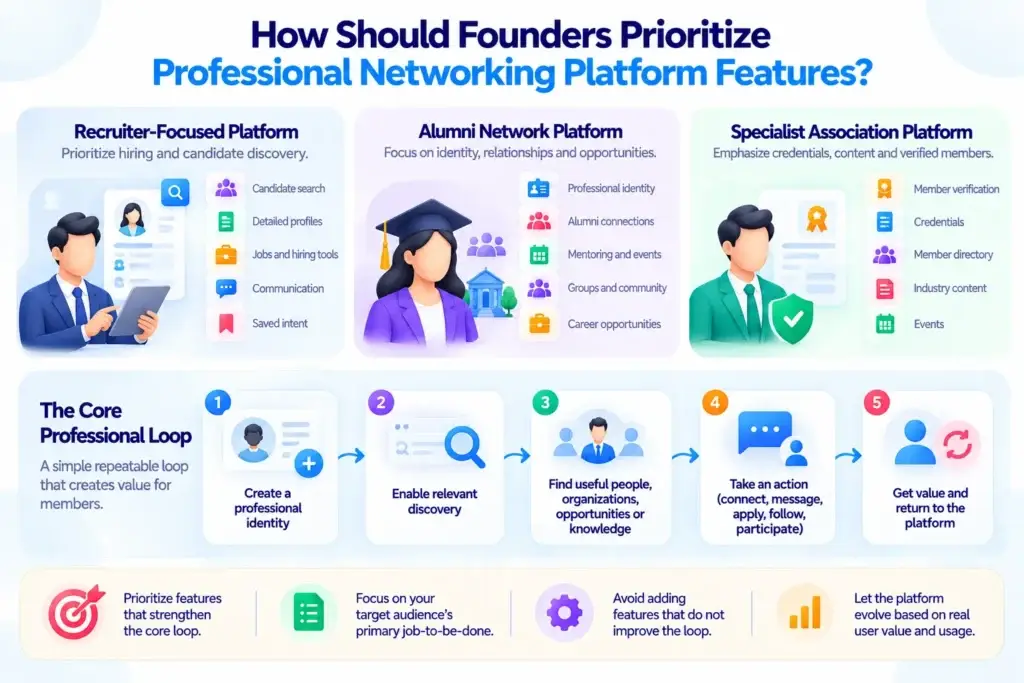
The right priority depends on the network’s primary professional job-to-be-done.
A platform for recruiters should place candidate search, structured profiles, jobs, communication, saved intent, and hiring workflows near the centre of the experience. An alumni network may prioritize identity, institutional relationships, mentoring, events, groups, and career opportunities. A specialist association may emphasize credentials, member directories, industry content, events, and verification.
This means founders should not start with a generic list of every capability available in the professional networking category.
Start with the core professional loop
Identify the smallest repeatable loop that creates value for the target audience.
- A member creates a credible professional identity.
- The platform uses that identity to improve relevant discovery.
- The member finds a useful person, organization, opportunity, or piece of knowledge.
- The member takes an action such as connecting, following, messaging, applying, saving, or participating.
- The resulting interaction creates enough value for the member to return.
Features that strengthen this loop deserve priority. Features that do not materially improve it can often wait.
Founder Decision Signals
Audience
Define whether the network primarily serves job seekers, recruiters, industry professionals, alumni, associations, creators, enterprises, or another professional community. Feature priority should follow that audience.
Core Outcome
Decide whether the strongest recurring value comes from networking, hiring, knowledge, credentials, mentorship, business development, or a combination of these outcomes.
Trust
Determine which professional signals require verification, moderation, visibility controls, or stronger identity checks before the network begins scaling.
Expansion
Build the foundation so adjacent workflows can be introduced after usage data shows what members actually need rather than adding complexity based on assumptions.
Common Feature-Planning Mistakes That Weaken Professional Networks
Building a generic social feed before solving professional discovery
A feed can create engagement, but it cannot compensate for weak identity, search, or discovery. If the primary reason people join is to find professionals or opportunities, those workflows deserve attention first.
Collecting profile information that the platform never uses
Every additional profile field creates effort for members. If information does not improve search, matching, credibility, recommendations, hiring, or another meaningful workflow, founders should question whether it needs to be collected.
Treating jobs as a disconnected listings board
The advantage of combining professional networking and hiring is that identity data can improve career discovery while professional relationships can add context around opportunities. Separating the job layer from the network gives up much of that advantage.
Allowing outreach without adequate anti-spam controls
Communication tools can rapidly lose value when users receive excessive unsolicited messages. Permission models, rate controls, reporting, verification, and moderation should evolve alongside messaging capability.
Leaving administrative controls until after launch
Manual intervention may work with a small test community but becomes increasingly difficult as users, jobs, organizations, content, and reports increase. Operator workflows belong in the product plan from the beginning.
Should Every Professional Network Have the Same Features?
No. In fact, trying to reproduce every familiar networking capability may weaken differentiation.
The strongest opportunities often come from building for a more specific audience: healthcare professionals, engineers, creators, founders, researchers, students, alumni, tradespeople, freelancers, executives, regional professionals, or members of an industry association.
A specialized audience allows the platform to make better product decisions because “professional value” becomes more specific. The credentials that matter become clearer. The right search filters become clearer. Relevant content becomes easier to define. Employers know which talent they are reaching. Members understand why joining this network gives them something different from participating in a broad professional community.
This is why founders should think in terms of a professional network’s value architecture, not simply its feature count.
How Miracuves Helps Founders Turn Feature Priorities Into a Launch-Ready Platform
Once the product priorities are clear, the next question is execution. Founders need to decide whether to assemble every profile, networking, search, messaging, hiring, moderation, and administrative workflow independently or begin from an existing product foundation.
Miracuves helps founders launch professional networking products using a ready-made, white-label, source-code-owned foundation that can be adapted around the audience and business model. Founders who want to evaluate the implementation layer can explore the professional networking platform solution rather than treating this educational feature guide as a product specification.
The distinction is important: this article helps determine which capabilities should matter to your users; the solution page helps evaluate how those capabilities can be delivered as an actual platform.
For teams that have already established their priority workflows, Miracuves‘ ready-made approach can provide a faster route to deployment, with a 6-day delivery path for the applicable base solution. Custom requirements, integrations, operational configuration, data preparation, and marketplace launch activities should still be planned according to the individual business.
Founders who need a more detailed implementation-oriented breakdown can also review the professional network feature implementation guide. That page is the better destination for evaluating product-level functionality, while this article remains focused on feature strategy and user outcomes.
Final Thoughts: The Most Important Features Are the Ones That Create Professional Outcomes
A successful professional networking platform does not need every possible networking, social, hiring, learning, and communication feature on day one. It needs a coherent group of features that helps a particular professional audience accomplish something valuable.
Profiles establish identity. Search makes that identity discoverable. Connections build relationships. Messaging turns discovery into conversation. Jobs and recruiter workflows create employment opportunities. Content makes expertise visible. Credentials strengthen trust. Learning supports long-term growth. Moderation protects network quality. Admin controls keep the ecosystem manageable.
The strongest platforms connect these layers instead of treating them as independent modules.
For founders, that leads to a more useful question than “Which features should we copy?” Ask instead: What professional outcome should happen more easily because our network exists?
Once that answer is clear, the right feature priorities become much easier to identify.
FAQs
What are the most important features of a professional networking platform?
The most important features usually include detailed professional profiles, search and discovery, connections or follows, messaging, job discovery, recruiter workflows, organization pages, professional content, credentials, privacy controls, moderation, analytics, and administration. The exact priority should depend on the audience and the professional outcome the platform is designed to improve.
Which professional networking features matter most for career growth?
Career-focused users benefit most from credible professional profiles, skill and credential visibility, job discovery, personalized recommendations, professional search, messaging, networking suggestions, learning resources, mentorship opportunities, and controls that help them manage professional visibility.
What features are important for recruiters on a professional networking platform?
Recruiters typically need candidate search, skills and experience filters, saved candidates, saved searches, job posting, applicant management, messaging, interview workflows, organization profiles, collaboration tools, and analytics. These capabilities are most useful when they connect directly with structured professional profile data.
Why is search important in a professional networking platform?
Search determines how efficiently users can turn the network’s accumulated profiles, jobs, organizations, skills, and expertise into useful discoveries. Strong search reduces the time required to find relevant professionals, candidates, opportunities, or organizations and therefore increases the practical value of the network.
Does a professional networking platform need a content feed?
A content feed can be valuable because it gives members reasons to return between major career events and allows expertise to become visible. However, feeds should prioritize professionally relevant knowledge and relationships instead of being added purely to increase generic engagement.
How do trust and safety features improve professional networking?
Verification, privacy settings, secure authentication, reporting, blocking, spam controls, moderation, and role-based administration help protect professional identities and conversations. These features reduce low-quality behaviour that can damage member confidence and the credibility of the overall network.
Should a new professional networking platform launch with every possible feature?
No. Founders should first identify the core professional loop their audience needs, such as professional discovery, hiring, mentorship, industry networking, or credentialing. Features that strengthen that repeatable loop should be prioritized before secondary modules are added.
Miracuves is an independent software development company. We are not affiliated with, connected to, sponsored by, or endorsed by any company or product named in this article.
Terms such as “X Clone” are used descriptively. It is how the software industry refers to building a platform with functionality comparable to a known service, and how clients search for it.
The entire design and codebase of our products is built by our own team. Our products contain no code, design, graphics, or content originating from any third-party website or applications.
All third-party names and marks referenced in this article are the property of their respective owners, referenced solely to identify the services discussed.