Planning a professional networking platform is not just about adding profiles, posts, and messaging. A serious platform must support identity, trust, career discovery, hiring workflows, business pages, recruiter access, admin control, monetization, and long-term scalability.
That is why founders should think beyond visible features. The real question is not, “Can we build something that looks like a professional network?” The better question is, “Can this platform support real users, real professional value, and a business model that can grow?”
This guide explains the features and cost factors that matter most before launching a professional networking platform. It is written for founders, startups, agencies, associations, recruitment businesses, alumni communities, and niche professional groups that want to create a focused network without wasting budget on the wrong build priorities.
For teams that want a faster launch path, Miracuves helps build ready-made and white-label professional networking platforms with source-code ownership, branded design, admin control, monetization-ready workflows, and 6-day solution delivery where the ready-made scope fits the business requirement.
Key Takeaways
- Professional networking platform cost factors depend on feature depth, user roles, admin controls, integrations, scalability, security, and customization scope.
- Profiles, connections, feeds, messaging, jobs, company pages, and recruiter tools should work together instead of behaving like separate modules.
- The admin dashboard is one of the most important cost and scalability layers because it controls users, content, moderation, payments, reports, and operations.
- A ready-made or white-label foundation can reduce launch time when the core workflows already match your business model.
- The smartest launch scope is not the longest feature list. It is the feature set that helps your audience create professional value quickly.
Why Feature Planning Matters Before You Estimate Development Cost
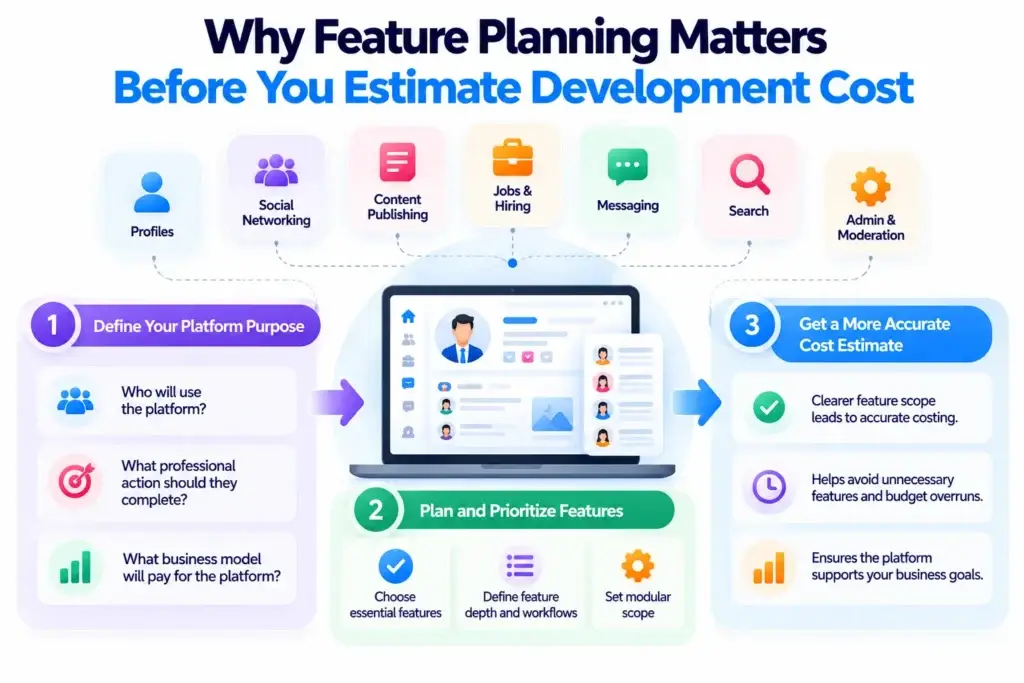
A professional networking platform combines multiple product layers. It has social networking behavior, career identity, content publishing, hiring workflows, business discovery, private communication, and platform governance. Because of that, the cost is not driven by design alone. It is driven by how deeply each workflow needs to function.
For example, a simple profile page may be affordable to build. But a verified professional profile with skills, endorsements, certifications, work history, portfolio items, privacy controls, recruiter visibility, and profile analytics is a much deeper product module. The same applies to messaging, job applications, feeds, search, and admin tools.
Founders often make the mistake of asking for “all features” before defining the platform’s real purpose. A professional network for alumni will need different workflows than a recruiter marketplace, a private industry association, or a founder-investor community. The clearer the business model, the more accurate the feature scope and cost planning become.
Before estimating cost, answer three questions: Who will use the platform? What professional action should they complete? What business model will pay for the platform? Once those answers are clear, features become easier to prioritize.
Core Features Every Professional Networking Platform Should Plan Carefully
The feature set should not be chosen only because users are familiar with large professional networks. A strong platform should serve your specific niche, whether that niche is recruiters, founders, freelancers, creators, healthcare professionals, legal experts, alumni, consultants, or internal enterprise teams.
Below are the feature groups that usually matter most when planning a professional networking product.
Professional Networking Platform Features and Business Value
| Feature Area | Business Value | Founder Impact |
|---|---|---|
| Professional Profiles | Creates user identity, credibility, career history, skills, and portfolio depth. | Helps the platform become useful even before network effects become large. |
| Connection Graph | Allows users to connect, follow, discover people, and build professional relationships. | Improves retention because users return when their network activity grows. |
| Content Feed | Supports posts, comments, reactions, polls, articles, and knowledge sharing. | Creates daily engagement and gives experts a reason to publish inside the platform. |
| Messaging | Enables private conversations, recruiter outreach, business introductions, and member communication. | Turns passive profiles into active relationship-building workflows. |
| Job Board | Lets companies post roles, candidates apply, and recruiters manage applications. | Creates monetization potential through job posts, recruiter plans, and hiring tools. |
| Company Pages | Allows businesses, agencies, institutions, and communities to create branded profiles. | Supports B2B monetization through featured pages, employer branding, and subscriptions. |
| Admin Dashboard | Controls users, content, jobs, payments, reports, permissions, and moderation. | Reduces operational dependency on developers and improves platform governance. |
| Monetization Tools | Supports subscriptions, paid job posts, recruiter seats, featured listings, credits, and ads. | Helps founders test revenue without rebuilding the product after launch. |
1. Professional Profiles Should Carry Real Business Value
The profile is the product foundation of a professional network. It should not feel like a basic registration page. It should help users present identity, credibility, expertise, achievements, availability, and professional intent.
A strong profile system may include work experience, education, skills, certifications, portfolio links, recommendations, endorsements, profile visibility settings, saved resumes, featured work, language preferences, and profile completion prompts.
The more important trust is in your niche, the more profile depth matters. For example, a healthcare professional network may need credential verification. A freelancer network may need portfolios and ratings. An alumni network may need institution verification. A recruiter marketplace may need candidate availability and resume parsing.
This is where cost can increase. Basic profiles are simple. Trust-building professional identity systems require deeper fields, verification logic, privacy controls, search filters, and admin review workflows.
2. Connection and Follow Logic Should Match the Community Model
Not every professional network needs the same relationship model. Some platforms work best with mutual connections. Others need one-way following, group membership, role-based access, invite-only communities, or organization-based networks.
This decision affects both user experience and development cost. A simple “follow” feature is different from a layered relationship graph with connection requests, pending states, blocked users, recommendations, mutual connections, private groups, company followers, and event-based networking.
For founders, the key is to match connection logic to the platform’s purpose. If your platform is for industry experts, users may want to follow thought leaders. If it is for recruiters, users may need controlled messaging and candidate visibility. If it is for private communities, membership approval and access control may matter more than open discovery.
3. Feed and Publishing Features Drive Engagement
A professional network becomes active when users have a reason to publish and respond. The feed can support short posts, long-form articles, polls, media uploads, document sharing, hashtags, mentions, comments, reactions, saved posts, and reporting.
However, a feed can also become expensive if it needs advanced ranking, recommendation logic, personalization, moderation queues, media processing, trending topics, and notification rules. Many founders underestimate this layer because the feed looks simple on the screen. Behind the scenes, feed quality depends on backend logic, database performance, caching, moderation, and user relevance.
For early launch, founders can start with a clean chronological or lightly personalized feed, then expand into advanced recommendations after user behavior becomes clearer. This keeps the initial build cost practical while leaving room for growth.
4. Messaging Needs Privacy, Limits, and Abuse Controls
Messaging is one of the most valuable features in a professional network because it turns discovery into action. Recruiters can contact candidates, members can request introductions, businesses can discuss opportunities, and communities can create private conversations.
But messaging should not be planned as a simple chat box only. A professional platform may need message requests, connection-based messaging, paid outreach credits, file sharing, unread indicators, spam detection, abuse reporting, blocked users, admin review, and notification settings.
Cost increases when messaging includes real-time delivery, group conversations, advanced media sharing, message search, encrypted communication workflows, or outreach limits by membership tier. Founders should decide early whether messaging is a free engagement tool, a paid communication feature, or a controlled trust layer.
5. Job Posting and Hiring Workflows Can Become a Revenue Engine
For many professional networking platforms, jobs and hiring tools are not optional. They are the commercial layer that gives companies, recruiters, and candidates a reason to pay.
A basic job board may include job listings, filters, applications, saved jobs, and employer dashboards. A deeper hiring workflow may include candidate pipelines, screening questions, application statuses, interview scheduling, assessments, recruiter notes, team collaboration, and applicant analytics.
This is one of the biggest cost variables. A job board is relatively straightforward. A recruiting workflow that connects candidate profiles, recruiter seats, company accounts, messaging, payments, and analytics requires a more advanced architecture.
If hiring is central to your business model, do not treat it as an add-on. Plan it as a core workflow from the start.
6. Company Pages Help Shift the Platform From Social to Commercial
Company pages allow businesses, recruiters, institutions, and communities to build presence inside the platform. This can support employer branding, service discovery, hiring, partnerships, sponsored content, and premium visibility.
Important company page features may include business profiles, logos, team members, job posts, follower counts, company updates, verification badges, featured posts, contact buttons, and analytics.
For founders, this matters because company pages create B2B revenue opportunities. A platform that only monetizes individual members may struggle early. A platform that lets organizations pay for hiring, visibility, recruiting, or community access may have stronger revenue paths.
7. Search and Discovery Decide How Useful the Network Feels
Professional networking platforms depend on discovery. Users need to find people, jobs, companies, skills, posts, groups, and opportunities. Weak search makes the platform feel empty even when useful data exists inside it.
Search features can include keyword search, skill filters, location filters, industry filters, company filters, experience filters, job filters, saved searches, recruiter search, and recommendations.
The cost depends on how intelligent the search experience needs to be. Simple database search may work at the beginning. Advanced search, ranking, saved alerts, permission-based results, and recruiter filters require more planning.
If your business model depends on recruiters, sales teams, or expert discovery, search should be treated as a core revenue feature, not a secondary utility.
The Admin Dashboard Is Where Long-Term Cost Control Happens
The admin dashboard is often underestimated because users do not see it. But for the platform operator, it is one of the most important parts of the product.
A strong admin dashboard allows the business owner to manage users, roles, reports, payments, job listings, content, subscriptions, disputes, verification requests, abuse reports, analytics, feature access, and platform settings. Without it, every small operational change may require developer involvement.
That creates hidden cost. A platform may look affordable upfront but become expensive later if the admin layer is weak. Founders should ask whether the platform can be operated by a business team, not just maintained by developers.
Admin control also affects trust. Professional communities need moderation, reporting, appeals, content review, spam control, profile verification, and role-based access. These features protect the quality of the network as it grows.
Major Cost Factors When Building a Professional Networking Platform
The cost to build a professional networking platform depends on scope, depth, delivery model, and ownership requirements. A simple directory-style network costs much less than a full platform with recruiter tools, monetization, mobile apps, advanced search, moderation, and analytics.
Instead of asking for a single number too early, founders should understand which factors increase or reduce the budget.
Cost Factors That Affect Professional Networking Platform Development
| Cost Factor | Why It Affects Budget | Planning Advice |
|---|---|---|
| Platform Scope | Web-only, mobile app, admin panel, recruiter dashboard, and company dashboard all add development work. | Start with the platforms your first users need most, then expand based on adoption. |
| Profile Complexity | Basic profiles are simpler than verified profiles with skills, credentials, portfolios, and privacy controls. | Define what makes a profile valuable in your niche before adding fields. |
| Hiring Workflows | Job posts are simpler than pipelines, assessments, interviews, recruiter seats, and candidate tracking. | Prioritize hiring depth only if recruitment is central to the business model. |
| Messaging Depth | Real-time chat, message requests, paid outreach, attachments, and abuse controls increase complexity. | Decide whether messaging is a free feature, paid feature, or trust-controlled feature. |
| Monetization Logic | Subscriptions, credits, job fees, paid boosts, and plan limits require billing and entitlement logic. | Plan revenue models early so monetization does not require rebuilding later. |
| Admin and Moderation | User management, content review, reports, payments, permissions, and analytics require backend control. | Do not cut admin features too aggressively because they reduce operational cost later. |
| Integrations | Payment gateways, email services, push notifications, analytics, CRM, calendar tools, and verification APIs add scope. | Use only essential integrations at launch and keep advanced integrations for later phases. |
| Customization | Unique workflows, niche-specific fields, custom dashboards, and branded UX increase planning and development time. | Separate must-have customization from nice-to-have differentiation. |
1. Web, Mobile, or Both?
Platform choice affects cost immediately. Some professional networking products can launch with a responsive web app first. Others need Android and iOS apps because the target users expect mobile-first access.
A web-first launch can be practical for professional communities, associations, recruiter portals, and B2B networks. Mobile apps become more important when daily engagement, real-time messaging, push notifications, or creator-style posting are central to the experience.
The best approach depends on user behavior. If your audience will mostly update profiles, search candidates, publish thought leadership, or manage job applications from desktop, web-first may be enough for launch. If your platform depends on quick responses and frequent engagement, mobile becomes more important.
2. Ready-Made Foundation vs Custom Development
One of the biggest cost decisions is whether to build from scratch or start with a ready-made foundation. Custom development gives maximum flexibility but usually requires more time, planning, testing, and budget. A ready-made foundation can reduce time when the core workflows already match the business model.
This does not mean founders should copy another platform blindly. The smarter approach is to use a proven product structure for profiles, networking, messaging, jobs, and admin control, then customize branding, niche workflows, monetization, and user experience around the target market.
For example, founders evaluating a launch-ready professional network can review Miracuves’ white-label professional networking solution to understand how a structured platform foundation can support profiles, hiring, communication, and admin operations without starting every module from zero.
3. Monetization Requirements
Monetization is not just a payment button. It affects access rules, user roles, plan limits, feature permissions, reporting, billing history, and upgrade prompts.
Common monetization models for professional networking platforms include:
- Premium member subscriptions
- Paid job postings
- Recruiter subscriptions
- Company page upgrades
- Featured profiles or featured companies
- Paid outreach credits
- Sponsored content
- Learning programs or certification access
- Private community memberships
If monetization is planned late, the platform may need expensive restructuring. A professional network should define early which features are free, which are paid, which belong to companies, and which are controlled by admin approval.
For deeper revenue planning, founders can explore Miracuves’ professional network business model breakdown and use it as a reference for subscription, recruiter, company, and communication-based monetization planning.
4. Feature Depth and Launch Scope
The same feature can have different levels of complexity. “Messaging” can mean basic inbox communication, real-time chat, paid outreach credits, attachments, spam filtering, or recruiter-only contact permissions. “Jobs” can mean simple job posts or a full hiring pipeline.
That is why founders should define launch scope carefully. A first launch should include enough value for users to join and return, but not so many advanced workflows that the platform becomes expensive before market validation.
A practical launch scope usually includes strong profiles, basic networking, feed activity, messaging, job listings if relevant, admin control, moderation, and one or two monetization paths. Advanced analytics, AI recommendations, complex recruiter workflows, and deep automation can be added after user behavior is proven.
Founder Decision Signals: What Should You Prioritize First?
Founder Decision Signals
Speed
If your priority is market validation, choose a launch scope that includes core identity, networking, messaging, and admin control before advanced automation.
Cost
Cost rises when features require custom logic, multiple user roles, deep integrations, mobile apps, real-time systems, and complex monetization rules.
Scalability
Plan database structure, search, feed performance, moderation, and admin controls early so the platform does not need heavy rebuilding after traction.
Market Fit
The strongest feature set is the one that solves a clear professional problem for a defined audience, not the one with the longest checklist.
Read more : Pre-Launch vs Post-Launch Marketing for a Professional Networking Platform: What Should Startups Prioritize?
How to Prioritize Features Without Overbuilding
Overbuilding is one of the fastest ways to increase cost without increasing user value. A professional networking platform should launch with the features that support the first clear use case.
If the platform is for recruiters, prioritize profiles, search, jobs, candidate pipelines, messaging, company accounts, and recruiter plans. If it is for an alumni network, prioritize verification, member directory, groups, events, mentorship, and private communication. If it is for industry professionals, prioritize profiles, publishing, expert discovery, groups, and paid community access.
The platform does not need every advanced feature on day one. It needs a clear reason for users to create profiles, return, connect, publish, hire, learn, or pay.
A useful planning method is to divide features into three groups:
- Launch-critical: Features without which the platform cannot deliver its core promise.
- Growth-critical: Features that improve retention, monetization, or operational control after early traction.
- Future expansion: Features that are valuable but not necessary for the first market release.
This keeps the platform practical while protecting the roadmap.
Security, Privacy, and Trust Features Should Not Be Treated as Optional
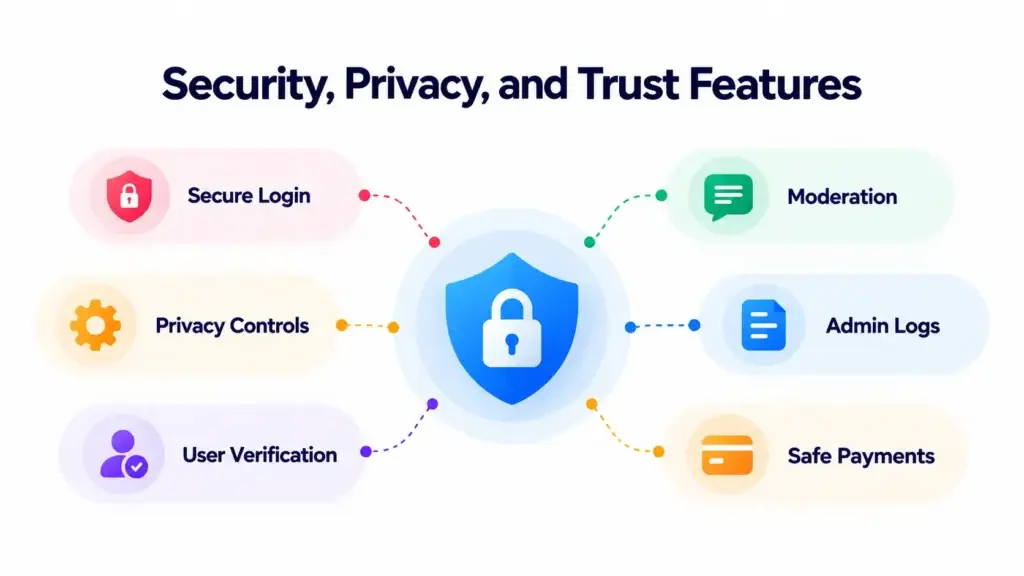
Professional networking platforms handle sensitive identity and career information. Users may share job history, contact details, portfolio links, resumes, certifications, business conversations, hiring activity, and private messages. That makes trust a product requirement, not just a technical detail.
Important trust and safety features may include:
- Role-based access control
- Secure authentication
- Profile privacy settings
- User verification workflows
- Company verification
- Content moderation
- Abuse reporting
- Blocked users
- Admin activity logs
- Data export and deletion workflows where required
- Secure payment gateway integration
These features affect cost because they require planning across database design, admin tools, frontend permissions, backend rules, and operational workflows. But skipping them can create higher risk later, especially when the platform grows or enters regulated professional categories.
Ready-Made vs Custom Build: Which Path Makes More Sense?
There is no single right answer for every founder. The better choice depends on timeline, budget, differentiation needs, ownership expectations, and technical complexity.
Ready-Made Foundation vs Custom Development
| Build Option | Best For | Cost and Timeline Logic |
|---|---|---|
| Ready-Made / White-Label Foundation | Founders who need profiles, connections, jobs, messaging, admin control, branding, and monetization-ready workflows quickly. | Usually faster and more cost-efficient because core modules already exist and can be customized. |
| Custom Development | Businesses with highly unique workflows, unusual user roles, advanced integrations, or product logic that cannot fit an existing foundation. | Usually requires more planning, design, engineering, testing, and budget because everything is built from scratch. |
| Hybrid Approach | Founders who want to start with a proven foundation but add niche-specific workflows over time. | Can balance speed and differentiation when the foundation supports customization and source-code ownership. |
For many founders, the hybrid path is practical. Start with the proven product foundation, launch faster, validate the niche, then expand based on user behavior. This reduces the risk of spending heavily before confirming what the market actually uses.
If your team is comparing detailed modules before launch, Miracuves’ professional networking platform features page can help you review how profiles, roles, hiring, sales, admin, and platform controls can be organized inside a structured product.
Cost Planning Checklist for Founders
Before requesting a quote or finalizing the platform scope, use this checklist to make the cost discussion clearer.
- Who are the primary users: members, recruiters, companies, admins, moderators, or community managers?
- Does the platform need web only, mobile apps, or both?
- What makes a user profile credible in your niche?
- Will users connect mutually, follow one another, join groups, or access invite-only spaces?
- Is the feed central to engagement, or is search and hiring more important?
- Will messaging be free, restricted, credit-based, or tied to paid plans?
- Do you need a simple job board or a full hiring pipeline?
- What monetization model will launch first?
- Which admin actions should your team control without developer help?
- Which integrations are essential at launch?
- What security, privacy, and moderation controls are required?
- How much customization is truly needed before launch?
When these answers are clear, the quote becomes more realistic. Without them, founders often receive vague estimates that later change because the actual scope was never defined properly.
Mistakes Founders Should Avoid
Building Every Advanced Feature Before Launch
Advanced recommendations, complex analytics, automation, and deep integrations can be useful later, but they may slow down validation if added too early. Start with the workflows that prove user demand.
Ignoring the Admin Dashboard
A weak admin panel creates hidden operational cost. Founders should plan user management, moderation, payments, reports, and role permissions from the beginning.
Treating Monetization as a Future Add-On
Subscriptions, job fees, recruiter seats, credits, and company upgrades affect access logic. If monetization is added too late, the product may need major restructuring.
Copying a Broad Platform Instead of Serving a Niche
A focused professional network does not need to compete with global platforms feature-for-feature. It needs to solve a sharper problem for a clearer audience.
Where Miracuves Fits Into Professional Networking Platform Planning
Miracuves helps founders move faster by starting with a ready-made, white-label, source-code-owned product foundation instead of building every module from zero. For professional networking platforms, this can include branded design, profiles, connections, feeds, messaging, hiring workflows, admin control, monetization logic, and deployment support.
The value is not in copying a large professional network feature by feature. The value is in launching a focused platform for your audience with the right identity, trust, engagement, hiring, and revenue layers already planned.
If your goal is to understand pricing and scope before making a build decision, you can review the professional networking platform cost breakdown from Miracuves and compare which modules are essential for your first launch.
Final Thoughts: Plan the Platform Around Value, Not Just Features
A professional networking platform succeeds when users see clear value in creating a profile, building relationships, discovering opportunities, publishing knowledge, hiring talent, or joining a trusted community.
That is why feature planning and cost planning should happen together. Every feature should answer a business question: Does it improve trust? Does it increase engagement? Does it support monetization? Does it reduce operational effort? Does it help users achieve a professional outcome?
The strongest platform is not always the most complex one. It is the one that launches with the right foundation, serves a focused audience, gives operators control, and leaves room to scale as real user behavior becomes clear.
For founders comparing launch options, a ready-made professional networking foundation can reduce avoidable development risk, especially when speed, source-code ownership, branded deployment, and admin control matter from day one.
FAQs
What features matter most in a professional networking platform?
The most important features include professional profiles, connection requests, follows, content feeds, messaging, job posts, company pages, recruiter tools, search, notifications, admin dashboard, moderation, monetization tools, and analytics. The exact priority depends on whether the platform is built for hiring, alumni networking, industry communities, freelancers, or private professional groups.
What affects the cost of building a professional networking platform?
Cost depends on platform scope, web and mobile requirements, profile complexity, messaging depth, hiring workflows, monetization rules, admin dashboard features, security controls, third-party integrations, design customization, and scalability requirements. A simple professional directory costs less than a full platform with recruiter tools, subscriptions, real-time messaging, and advanced moderation.
Should I build a professional networking platform from scratch or use a ready-made foundation?
Custom development is useful when your workflows are highly unique. A ready-made or white-label foundation is useful when you want to launch faster with core modules such as profiles, networking, messaging, jobs, company pages, admin control, and monetization already available. Many founders choose a hybrid approach: launch with a proven foundation and customize around their niche.
How can a professional networking platform make money?
Common revenue models include premium memberships, recruiter subscriptions, paid job posts, company page upgrades, featured profiles, sponsored posts, paid outreach credits, learning access, private community memberships, and event-based monetization. The right model depends on the audience and the professional outcome the platform supports.
Is a job board necessary for every professional networking platform?
No. A job board is important when hiring is part of the core business model. Some professional networks may focus more on expert discovery, alumni engagement, private groups, industry discussions, mentorship, or learning. However, job-related features can become a strong monetization layer when employers, recruiters, or candidates are part of the target audience.
Why is the admin dashboard important for a professional networking platform?
The admin dashboard helps platform operators manage users, roles, content, payments, reports, jobs, verification, moderation, analytics, and platform settings. A weak admin panel creates hidden operational costs because every small change may require developer support. Strong admin control makes the platform easier to manage as it grows.
Can Miracuves help launch a professional networking platform quickly?
Yes. Miracuves helps founders launch ready-made and white-label professional networking platforms with branded design, source-code ownership, admin control, and faster deployment. Where the ready-made scope fits the business requirement, Miracuves can support 6-day solution delivery.
Miracuves is an independent software development company. We are not affiliated with, connected to, sponsored by, or endorsed by any company or product named in this article.
Terms such as “X Clone” are used descriptively. It is how the software industry refers to building a platform with functionality comparable to a known service, and how clients search for it.
The entire design and codebase of our products is built by our own team. Our products contain no code, design, graphics, or content originating from any third-party website or applications.
All third-party names and marks referenced in this article are the property of their respective owners, referenced solely to identify the services discussed.