

Key Takeaways
- Online Retail Marketplace Launch Mistakes usually come from weak planning across sellers, catalog structure, payments, delivery, returns, admin control, and launch readiness.
- A marketplace should not launch until sellers can manage listings, stock, orders, returns, and payouts without constant manual support.
- Catalog structure, product attributes, filters, variants, and search logic should be defined before large-scale inventory is uploaded.
- Payment gateways alone are not enough; commission, refunds, seller payouts, delivery fees, cash handling, and settlement records need clear workflows.
- Founders should prioritize stable buyer, seller, delivery, payment, return, and admin workflows before adding advanced features.
Launch Signals
- Seller readiness means enough active vendors, accurate listings, clear stock, understood payout rules, and reliable order processing.
- Delivery readiness requires defined service areas, shipping responsibility, tracking, failed-delivery handling, return pickup, and cash collection where relevant.
- Admin teams should be able to manage sellers, products, commissions, payments, refunds, disputes, promotions, and reports before launch.
- Mobile testing should cover product discovery, filters, checkout, payments, order tracking, returns, and support on real devices.
- Marketing preparation should begin before launch so seller activation, buyer acquisition, offers, category positioning, and retention are not handled at the last minute.
Real Insights
- A marketplace can look launch-ready from the buyer side while still being operationally weak on seller, finance, delivery, refund, and admin workflows.
- Launching with too many advanced features can increase cost and delay validation while essential transaction workflows remain unstable.
- Weak admin control creates hidden post-launch costs because routine business changes may require developer involvement.
- A low initial development quote can become expensive when source code, seller tools, payment logic, deployment, customization, or operational modules are missing.
- The strongest pre-launch flow is: validate sellers → structure the catalog → define payments and payouts → finalize delivery → plan returns and disputes → confirm admin control → test mobile journeys → prepare marketing → verify ownership and deployment terms → go live.
Launching a Online Retail Marketplace is exciting, but going live too early can create expensive problems. Many startups focus on product screens, payment setup, and basic listings, while ignoring the operational systems that actually decide whether the platform can handle real buyers, sellers, orders, delivery issues, refunds, and support requests.
A marketplace is not just an ecommerce app. It is a business system where sellers, buyers, products, payments, delivery teams, support workflows, and admin controls must work together from day one.
The biggest launch mistakes usually happen before the first customer places an order. Founders may launch without seller readiness, weak product catalog structure, unclear commission rules, poor delivery planning, missing refund workflows, or limited admin control. These gaps may not look serious during testing, but they become visible quickly after launch.
This guide explains the most common retail marketplace launch mistakes startups should avoid before going live. It also shows how founders can reduce risk by planning the right workflows, cost priorities, and operational foundation early.
Why Retail Marketplace Launches Fail Before They Scale
Many marketplace startups fail to prepare for what happens after the platform goes live. They test the homepage, product pages, checkout, and payment gateway, but they do not properly test seller activity, delivery exceptions, refund cases, catalog errors, failed payments, customer complaints, and admin workflows.
Founders who want to understand the full buyer, seller, product, order, payment, and delivery flow can also review this guide on retail commerce platform workflow.
That is risky because the real platform begins when different users take different actions at the same time.
A buyer may cancel an order. A seller may update stock incorrectly. A delivery partner may fail pickup. A refund may need manual approval. A support agent may need order history. The admin team may need to pause a product, adjust a commission, approve a seller, or resolve a dispute quickly.
If these workflows are not planned, the startup ends up solving operational problems manually. That increases cost, slows the team, and weakens customer trust.
For founders exploring a launch-ready commerce foundation, Miracuves offers a regional retail marketplace platform that supports buyer, seller, delivery, payment, and admin workflows under your own brand.
Mistake 1: Treating the Marketplace Like a Simple Ecommerce Store
A single-seller ecommerce store and a multi-seller retail marketplace are not the same. A store usually has one inventory source, one pricing strategy, one fulfillment process, and one support structure. A marketplace has many sellers, many catalog rules, multiple order scenarios, payout logic, commission rules, disputes, seller dashboards, and platform-level controls.
Startups make a mistake when they build only product listing, cart, checkout, and payment screens without planning seller-side operations.
A marketplace needs:
- Seller onboarding
- Seller approval
- Product listing control
- Category and attribute management
- Inventory updates
- Seller order processing
- Commission tracking
- Payout records
- Returns and refunds
- Dispute handling
- Admin moderation
Without these workflows, the platform may look ready from the buyer side but break on the operator side.
Founder fix: Plan the platform around three core roles from the beginning: buyer, seller, and admin. Delivery, support, and finance roles can be added depending on your business model.
Mistake 2: Launching Without Seller Readiness
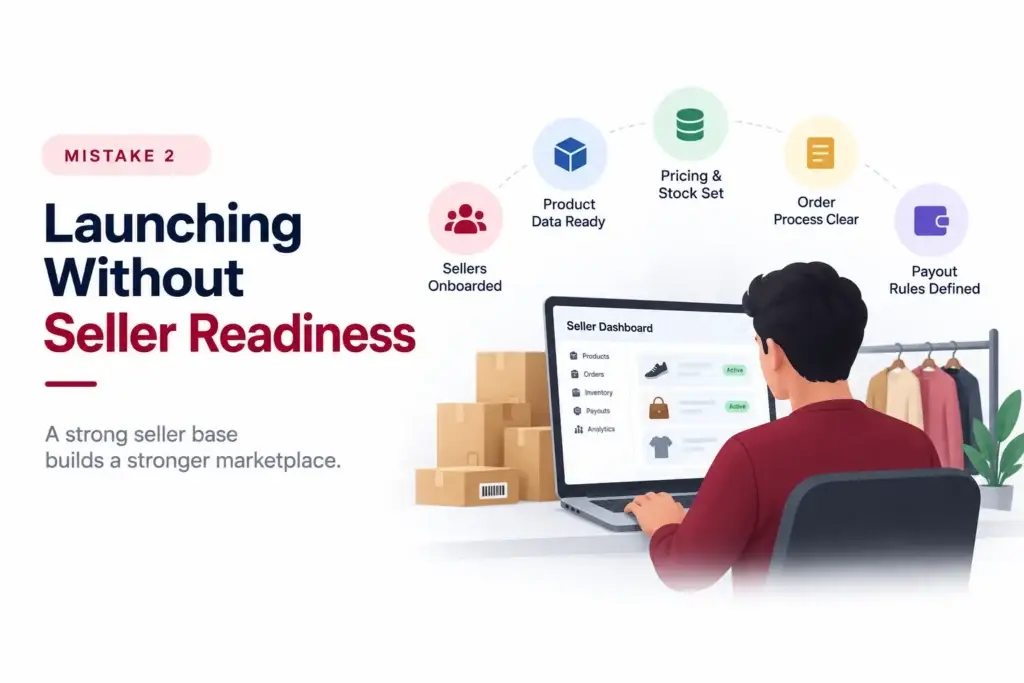
A marketplace cannot grow if sellers are not prepared before launch. Many startups spend heavily on buyer acquisition but forget that buyers will leave quickly if the catalog is thin, product data is poor, prices are inconsistent, or sellers do not respond to orders.
Seller readiness includes more than onboarding sellers into the system. It means making sure sellers understand how to list products, manage stock, update prices, process orders, handle returns, and track payouts.
Before going live, founders should check:
- Are enough sellers onboarded for the first launch category?
- Are product images and descriptions complete?
- Are prices, stock, and variants accurate?
- Do sellers understand order processing timelines?
- Are payout rules clearly communicated?
- Are return and refund responsibilities defined?
- Can sellers use the dashboard without constant support?
A weak seller launch creates a weak buyer experience.
Founder fix: Start with a focused seller group and category set. Validate seller activity before opening the platform to a wider buyer audience.
Mistake 3: Ignoring Catalog Structure and Product Discovery
Product discovery is one of the most important parts of a retail marketplace. If buyers cannot find what they want quickly, they leave—even if the platform has good sellers and competitive prices.
Startups often upload products quickly without planning category structure, filters, product attributes, variants, and search behavior. This creates a messy catalog that becomes harder to fix later.
A strong catalog should include:
- Clear category hierarchy
- Product attributes
- SKU and variant logic
- Brand filters
- Price filters
- Rating filters
- Stock visibility
- Product image standards
- Search suggestions
- Related product sections
- Product approval rules
Catalog planning also affects cost. A marketplace with multiple categories, variants, sellers, and filters requires a stronger backend than a basic product listing system.
For a deeper product-level view, founders can explore this retail marketplace feature breakdown to understand how buyer journeys, seller workflows, order handling, delivery operations, and admin controls can be structured.
Founder fix: Define category, product, and filter logic before uploading inventory. A clean catalog improves search, conversion, seller trust, and admin control.
Mistake 4: Going Live Without Logistics and Delivery Planning
Getting a buyer to place an order is only half the job. The real test begins after checkout.
Many retail marketplace startups launch without clear delivery workflows. They assume sellers will manage shipping, or they plan to integrate logistics later. This creates confusion when buyers ask for tracking, sellers miss pickup timelines, delivery fees are unclear, or orders fail.
Founders should define:
- Who handles delivery?
- Which locations are serviceable?
- How are delivery fees calculated?
- Will sellers ship independently?
- Will the platform use third-party logistics?
- Will the platform manage its own delivery agents?
- How will buyers track orders?
- What happens if delivery fails?
- How are return pickups handled?
- Who handles cash collection where relevant?
Delivery problems damage buyer trust quickly. Even if the product is good, late delivery or unclear tracking can create negative reviews and support pressure.
Founder fix: Choose the fulfillment model before launch. Seller-managed shipping, platform-managed delivery, third-party logistics, and hyperlocal delivery all require different workflows.
Mistake 5: Not Planning Returns, Refunds, and Disputes
Returns and refunds are not edge cases in retail commerce. They are part of the operating model.
Startups often launch with a basic order flow but no clear process for cancellations, damaged products, wrong items, delayed delivery, refund approval, seller responsibility, or dispute resolution. This creates manual chaos after launch.
A proper return and refund system should define:
- Which products are returnable?
- How many days does the buyer have to request a return?
- Who approves the return?
- Who pays for reverse logistics?
- When is the refund released?
- What happens if the seller disagrees?
- What proof is required?
- How does the admin team resolve disputes?
- How are refund records stored?
If these rules are unclear, the platform may lose money and trust at the same time.
Founder fix: Create return rules before launch. Keep the first version simple, but make sure buyers, sellers, and admins understand the process.
Mistake 6: Weak Payment, Commission, and Payout Logic
Payment planning is one of the biggest technical and business mistakes startups make. They integrate a payment gateway but do not define how the platform earns money, how sellers are paid, how refunds are handled, or how commissions are tracked.
A marketplace needs more than payment acceptance. It needs payment logic.
Founders should define:
- Payment methods
- Cash collection where relevant
- Platform commission
- Category-wise commission
- Seller payout cycle
- Refund deductions
- Delivery fee handling
- Transaction charges
- Wallet or ledger records
- Promotional discount responsibility
- Settlement reports
If commission and payout rules are unclear, sellers may lose confidence in the platform. If refund and payment records are weak, the admin team may struggle to resolve disputes.
For founders planning monetization, this revenue and margin model explains how commissions, seller plans, delivery margins, promoted placements, transaction charges, and settlement workflows can connect inside a commerce platform.
Founder fix: Map every payment scenario before development. A simple payment gateway is not enough for a multi-seller business.
Mistake 7: Underestimating the Admin Dashboard
The admin dashboard is the control center of the marketplace. It decides whether the founder can manage daily operations without depending on developers for every small change.
A weak admin system creates hidden costs because the business team cannot easily manage sellers, products, payments, orders, refunds, banners, reports, commissions, and disputes.
A strong admin dashboard should support:
- Buyer management
- Seller management
- Product approval
- Category control
- Order monitoring
- Commission settings
- Payment records
- Seller payouts
- Refund handling
- Dispute management
- Coupon and offer control
- Banner management
- Notifications
- Reports and analytics
- Role-based access control
Admin control becomes more important as the marketplace grows. A founder may need to approve sellers, pause risky products, change commission rates, manage promotional campaigns, track refunds, or resolve complaints quickly.
Founder fix: Treat the admin dashboard as a launch-critical feature, not a backend extra.
Mistake 8: Choosing Features Without Understanding Cost Impact
Every feature has a cost impact. Startups often create long wishlists without separating must-have launch features from later-stage improvements.
This creates scope confusion and unnecessary development cost.
Launch-critical features usually include:
| Launch Feature | Why It Matters |
|---|---|
| Buyer registration | Required for order history, address management, and repeat purchases |
| Seller onboarding | Required to build supply |
| Product catalog | Required for structured browsing and search |
| Cart and checkout | Required for transactions |
| Payment integration | Required for revenue flow |
| Order management | Required for buyer, seller, and admin visibility |
| Delivery workflow | Required for fulfillment clarity |
| Returns and refunds | Required for trust and dispute control |
| Admin dashboard | Required for operational control |
| Notifications | Required for order updates and user communication |
Advanced features such as loyalty programs, AI product recommendations, marketplace ads, multi-language support, multi-currency support, advanced analytics, and dynamic pricing can be useful later. But they should not delay launch if the core transaction system is not ready.
For a more focused pricing view, founders can review this marketplace development cost before finalizing scope.
Founder fix: Build the first launch around operational stability. Add advanced features after real user behavior shows what matters.
Mistake 9: Ignoring Mobile-First Shopping Behavior
Many retail marketplace users browse and purchase on mobile. If the mobile experience is slow, cluttered, or difficult to use, conversion suffers.
A mobile-first marketplace should make it easy to:
- Search products quickly
- Apply filters
- View product details
- Add to cart
- Use saved addresses
- Apply coupons
- Choose payment methods
- Track orders
- Request returns
- Contact support
Startups sometimes overdesign the homepage but ignore product page speed, image size, checkout friction, and order tracking visibility. These details directly affect buyer confidence.
Founder fix: Test the buyer journey on real mobile devices before launch. Focus on speed, clarity, and fewer checkout steps.
Mistake 10: Waiting Too Long to Plan Marketplace Marketing
A marketplace launch needs buyers and sellers. Many startups wait until the product is ready before thinking about marketing, seller activation, launch campaigns, category positioning, and early customer acquisition.
That is too late.
Pre-launch planning should include:
- Seller onboarding campaigns
- Category selection
- Early buyer waitlist
- Launch offers
- Referral campaigns
- Local SEO planning
- Social media campaigns
- Influencer or affiliate outreach
- Email and WhatsApp communication
- Post-launch retention campaigns
Product planning and marketing should move together. Before launch, founders should prepare a launch marketing plan so seller onboarding, buyer acquisition, and launch campaigns are not handled at the last moment.
Founder fix: Build demand before the platform goes live. A marketplace with no launch audience loses momentum quickly.
Mistake 11: Selecting a Development Path Without Ownership Clarity
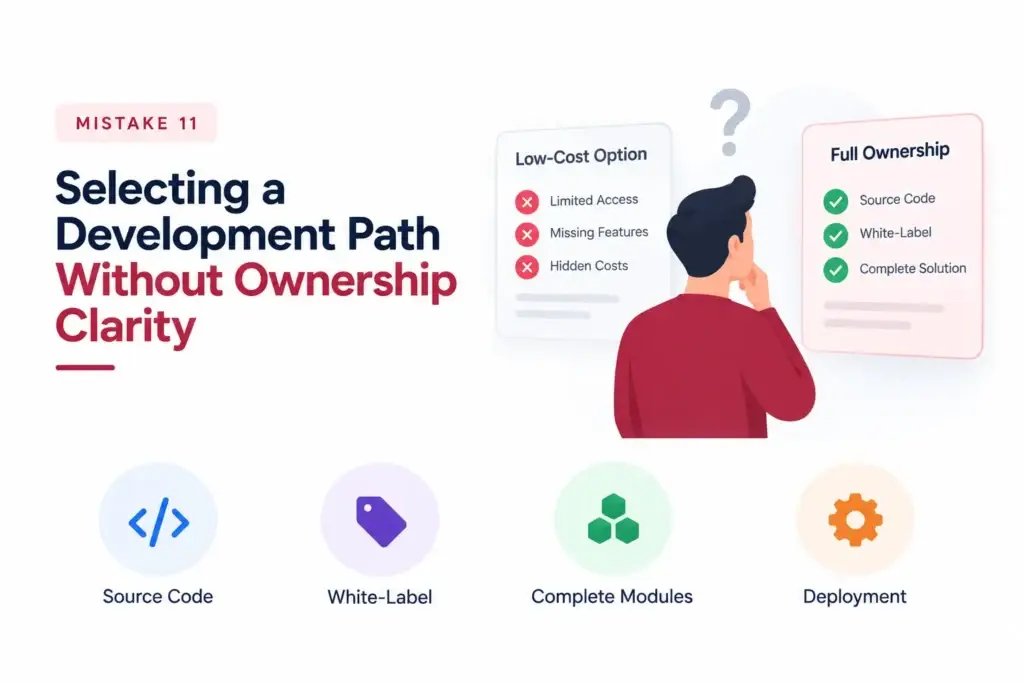
Startups often compare development options only by price. That can be dangerous if they do not check what is actually included.
Before choosing a marketplace development partner, founders should ask:
- Do I get full source code?
- Is the platform white-label?
- Which buyer, seller, delivery, and admin workflows are included?
- Are payment and payout flows included?
- Is deployment included?
- Are custom branding and configuration included?
- What integrations are included?
- What changes require additional scope?
- Is post-launch support available?
- Can the platform be customized later?
A low initial quote can become expensive if the founder later discovers missing seller tools, weak admin control, limited code access, missing deployment support, or hidden customization limits.
Founders comparing build paths can also read this guide on marketplace build options to understand how speed, ownership, flexibility, and cost affect the decision.
Founder fix: Evaluate ownership, deployment, customization, and support—not only the starting price.
Founder Decision Signals Before Going Live
Seller Readiness
If sellers cannot list, update stock, process orders, and understand payouts, the marketplace is not ready for buyer traffic.
Operational Control
If the admin team cannot manage products, sellers, orders, payments, refunds, and disputes, launch operations will become slow.
Delivery Readiness
If delivery zones, tracking, failed deliveries, and return pickup rules are unclear, buyer trust can suffer quickly.
Cost Discipline
If advanced features are delaying core workflows, founders should simplify the first launch and improve after validation.
Pre-Launch Checklist for Retail Marketplace Startups
Before going live, founders should confirm these basics:
| Launch Area | Questions to Check |
|---|---|
| Seller onboarding | Are sellers approved, trained, and ready to process orders? |
| Catalog quality | Are categories, SKUs, images, prices, variants, and stock accurate? |
| Buyer journey | Can buyers search, filter, buy, pay, track, cancel, and request support easily? |
| Payment logic | Are commissions, refunds, payouts, delivery fees, and transaction records clear? |
| Delivery workflow | Are service zones, tracking, failed delivery, and return pickup rules defined? |
| Admin dashboard | Can the team control sellers, products, orders, refunds, offers, and reports? |
| Support process | Are complaints, disputes, and refund cases assigned to the right team? |
| Marketing readiness | Are seller campaigns, buyer acquisition, launch offers, and retention plans ready? |
| Technical readiness | Has the platform been tested for speed, mobile usability, order flow, and payment failures? |
| Ownership clarity | Are source code, deployment, branding, and customization terms clearly understood? |
This checklist helps founders avoid launching a marketplace that looks ready but cannot operate smoothly.
Avoid Launch Mistakes Before They Become Expensive
Launch With Seller Workflows Already Planned
Miracuves helps founders start with ready-made seller onboarding, product listing, order handling, and marketplace management workflows so the platform is not built from zero.
Control Buyer Journeys and Payment Logic
A retail marketplace needs smooth buyer registration, product discovery, cart checkout, secure payment setup, order tracking, refunds, and customer notifications from the beginning.
Keep Admin Operations Clear From Day One
The admin dashboard helps manage sellers, buyers, products, categories, orders, payment records, disputes, refunds, and marketplace analytics without daily technical dependency.
Move Faster With a Launch-Ready Foundation
With white-label branding, source code access, admin control, and 6-day deployment where applicable, Miracuves helps founders validate their marketplace idea faster.
Where Miracuves Fits Into Launch Planning
Miracuves helps founders build ready-made and white-label marketplace platforms with source-code ownership, branded design, admin control, seller workflows, buyer journeys, payment logic, and deployment support.
The value is not only faster development. The value is starting with a structured commerce foundation where common marketplace workflows are already prepared.
Depending on the selected modules, branding, configuration, integrations, and final scope, Miracuves can support 6-day solution delivery for ready-made marketplace deployments. This helps founders move faster while keeping core workflows such as seller onboarding, product catalog, checkout, order management, delivery handling, refunds, and admin control in place.
Final Thoughts
Most marketplace launch mistakes do not come from one missing feature. They come from unclear planning across sellers, catalog, payments, delivery, returns, support, admin control, and marketing.
A startup should not go live only because the app screens look ready. It should go live when the operating system behind the marketplace is ready to handle real transactions and real problems.
The strongest launch is not always the largest feature set. It is the version that helps founders validate demand, support sellers, serve buyers, manage operations, and improve the platform with confidence.
Miracuves helps founders reduce launch risk with ready-made, white-label, source-code-owned marketplace solutions designed for faster execution and practical growth.
FAQs
What are the most common marketplace launch mistakes startups make?
Common mistakes include weak seller onboarding, poor catalog structure, unclear delivery workflows, missing refund rules, weak payment logic, limited admin control, poor mobile experience, and delayed marketing planning.
Why do retail marketplace startups fail after launch?
Many startups fail because they launch before operations are ready. A marketplace needs sellers, products, payments, delivery, returns, support, and admin control working together before buyer traffic increases.
What should founders check before launching a marketplace platform?
Founders should check seller readiness, catalog quality, checkout flow, payment logic, delivery rules, return policies, admin controls, support workflows, mobile usability, and marketing readiness.
Is seller onboarding important before launch?
Yes. Seller onboarding is critical because sellers create product supply. If sellers cannot list products, manage stock, process orders, and understand payouts, the marketplace experience becomes weak.
Why is the admin dashboard important for marketplace launch?
The admin dashboard helps the platform operator manage sellers, buyers, products, categories, orders, payments, refunds, disputes, promotions, and reports. Without it, daily operations become difficult.
Should startups build advanced features before launch?
Not always. Advanced features such as recommendations, loyalty programs, and advertising tools are useful later. At launch, startups should prioritize stable buyer, seller, payment, delivery, return, and admin workflows.
Can Miracuves help startups launch a marketplace faster?
Yes. Miracuves helps founders launch ready-made and white-label marketplace platforms with source-code ownership, branded design, admin control, marketplace workflows, and 6-day deployment where applicable.
What is the safest way to avoid launch mistakes?
The safest approach is to validate sellers, define catalog rules, plan payments and payouts, prepare delivery workflows, set refund policies, test the buyer journey, and ensure the admin team can control operations before going live.
Miracuves is an independent software development company. We are not affiliated with, connected to, sponsored by, or endorsed by any company or product named in this article.
Terms such as “X Clone” are used descriptively. It is how the software industry refers to building a platform with functionality comparable to a known service, and how clients search for it.
The entire design and codebase of our products is built by our own team. Our products contain no code, design, graphics, or content originating from any third-party website or applications.
All third-party names and marks referenced in this article are the property of their respective owners, referenced solely to identify the services discussed.