
Key Takeaways
- A peer-to-peer rental engine needs accurate availability logic to prevent double-bookings and calendar conflicts.
- Renters, asset owners, admins, payment teams, and support teams need synchronized booking and deposit workflows.
- Availability calendars, booking holds, deposits, cancellations, time zones, and status updates are core rental layers.
- Booking risk depends on concurrency control, database states, payment timing, calendar rules, and asset handover logic.
- A strong rental engine helps founders manage high-value assets with fewer disputes, failed bookings, and manual corrections.
Availability Signals
- Renters need real-time availability, clear pricing, secure deposits, booking confirmation, and cancellation visibility.
- Asset owners need calendar control, approval rules, blocked dates, payout tracking, booking history, and damage deposit logic.
- Admins need control over listings, users, payments, deposits, disputes, booking states, refunds, and availability overrides.
- Backend systems should lock booking windows during payment or approval to avoid two users reserving the same asset.
- Time-zone handling helps prevent checkout-date conflicts, late returns, unavailable slots, and incorrect calendar displays.
Real Insights
- Double-booking is usually not a design issue; it is a database state and concurrency control problem.
- High-value rentals need stricter logic for deposits, verification, cancellations, extensions, and late returns.
- A rental platform should treat availability as a live system, not a static calendar display.
- Founders should test booking flows with overlapping requests, failed payments, time-zone changes, and refund scenarios.
- Miracuves builds peer-to-peer rental marketplace apps with dynamic availability engines, booking holds, deposit workflows, time-zone handling, and admin control.
A peer-to-peer rental marketplace looks simple from the outside. A renter searches for a car, property, camera, boat, equipment, or premium asset. The owner sets availability. The platform collects payment, blocks dates, confirms the booking, and releases the asset after the rental period.
But the hard part is not the booking button.
The hard part is the availability engine behind that button.
For founders building car-sharing, real-estate rental, equipment rental, luxury asset rental, or high-value peer-to-peer marketplaces, double-booking is not a small bug. It can create refunds, disputes, chargebacks, asset handover failures, angry owners, and broken trust before the platform has a chance to scale.
That is why a serious peer-to-peer rental engine needs more than a booking website. It needs database-level availability control, transactional validation, deposit state management, and time-zone-safe calendar logic.
Miracuves helps founders launch ready-made and white-label rental marketplace foundations such as a Turo clone app, Airbnb clone platform, and broader rental marketplace solutions with source-code ownership, admin control, and launch-ready architecture.
The Booking Dilemma: Concurrency and Double-Bookings in P2P Systems
In a normal ecommerce platform, two users may try to buy the same product. Inventory logic decides whether stock exists.
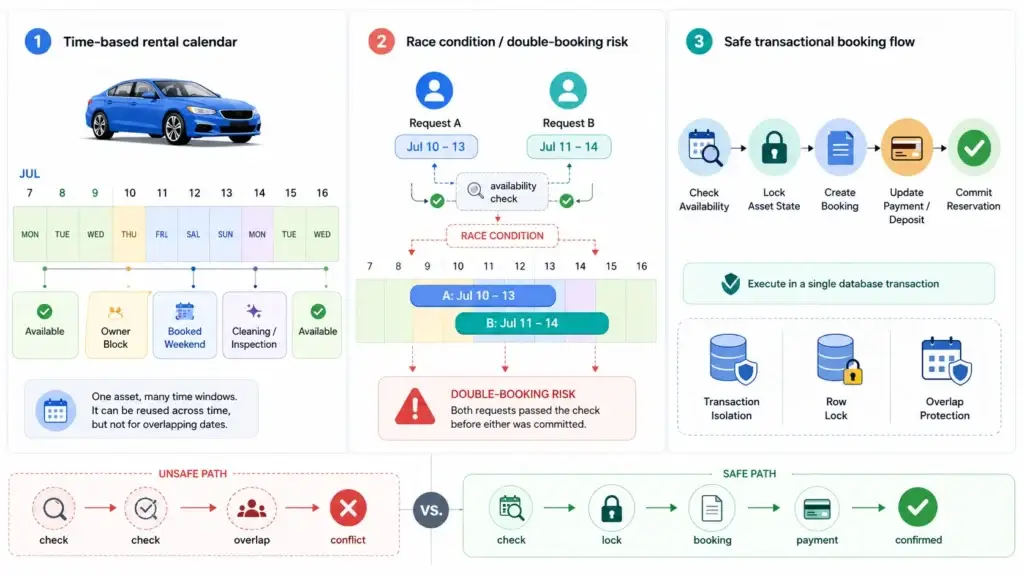
In a peer-to-peer rental marketplace, the problem is more complex. The same asset can be rented again and again, but never during overlapping time windows. A car may be available from Monday to Thursday, blocked by the owner on Friday, booked by a renter for the weekend, and unavailable for cleaning or inspection on Monday morning.
Now imagine two renters trying to book the same asset at almost the same time.
Renter A selects July 10 to July 13.
Renter B selects July 11 to July 14.
Both see the asset as available because the calendar displayed cached or pre-confirmation data.
Both click “Book Now.”
If the system simply checks availability first and inserts the booking afterward, both requests can pass the availability check before either booking is committed. That creates a race condition.
This is why rental marketplaces need transactional booking logic. The platform must check availability, lock the relevant asset state, create the booking, update payment/deposit status, and commit the reservation as one safe operation.
Modern databases provide tools for this kind of consistency, including transaction isolation, row-level locking, and constraints that can prevent overlapping ranges. PostgreSQL, for example, documents transaction isolation behavior and locking options such as SELECT FOR UPDATE, and its range/exclusion constraint features can be used to prevent overlapping reservation ranges at the database level.
Read More: Best Rentalcars Clone Script 2026: Build Your Own Car Rental Marketplace
Why Availability Is a Database State Problem, Not Just a Calendar UI
Many founders first think of availability as a calendar screen. That is understandable because users interact with a calendar.
But the calendar is only the presentation layer.
The real availability truth lives in the backend. It must combine multiple state sources:
| Availability Source | What It Controls | Why It Matters |
|---|---|---|
| Owner availability | Dates the owner allows renters to book | Prevents renters from booking when the asset is unavailable for personal use |
| Confirmed bookings | Committed rental periods | Blocks overlapping reservations |
| Pending bookings | Temporary booking requests awaiting payment or owner approval | Prevents multiple users from holding the same slot indefinitely |
| Maintenance blocks | Cleaning, inspection, repairs, charging, servicing, or downtime | Protects asset quality and handover reliability |
| Cancellation state | Cancelled, expired, refunded, or partially refunded bookings | Releases dates only when the booking state allows it |
| Deposit and damage state | Security hold, capture, refund, claim, or dispute | Prevents asset release workflows from breaking after the rental ends |
A weak booking system treats availability as a visual calendar.
A professional dynamic availability engine treats availability as a calculated state derived from bookings, blocks, payments, approvals, cancellations, disputes, and operational buffers.
That difference matters most for high-value assets. A double-booked bicycle may cause inconvenience. A double-booked car, villa, camera rig, yacht, construction machine, or luxury watch can create financial exposure and trust damage.
Read More: Top Airbnb Features Every Vacation Rental App Needs
Mapping Database States for High-Value Asset Calendars
A strong rental marketplace database should separate the asset, availability rules, booking attempts, booking confirmations, payment records, and operational blocks.
A simplified model may include:
assets
- id
- owner_id
- asset_type
- title
- location_id
- status

availability_rules
- id
- asset_id
- weekday
- start_time
- end_time
- min_duration
- max_duration
- advance_notice_hours

asset_blocks
- id
- asset_id
- block_type
- starts_at_utc
- ends_at_utc
- reason
- created_by

bookings
- id
- asset_id
- renter_id
- starts_at_utc
- ends_at_utc
- booking_status
- payment_status
- deposit_status
- owner_approval_status

payment_transactions
- id
- booking_id
- amount
- type
- status
- gateway_reference

booking_events
- id
- booking_id
- event_type
- previous_state
- next_state
- created_at
This structure is not just for organization. It allows the platform to answer critical questions safely:
- Is the asset active?
- Is the owner accepting bookings during this period?
- Does the requested range overlap an existing confirmed booking?
- Is there a maintenance or inspection block?
- Is a pending booking already holding this slot?
- Has the payment authorization succeeded?
- Has the deposit been placed, captured, released, or disputed?
- Should the calendar show this slot as available, unavailable, pending, or blocked?
For a founder, this is where technical architecture becomes business protection. The database should not only store bookings. It should enforce booking truth.
Read More: How to Build an App Like Turo: A Developer’s Guide
How a Dynamic Availability Engine Should Validate Every Booking Request
A reliable dynamic availability engine should validate bookings through a transaction-safe sequence.
1. Normalize the Requested Rental Window
Every booking request should be converted into a consistent time format, usually UTC at the storage layer. The user may see local time, but the database should compare normalized timestamps.
This is especially important for founders targeting multiple cities, cross-border property rentals, vehicle rentals near airports, or asset owners operating in different time zones.
2. Check Asset Eligibility
Before checking dates, the system should confirm that the asset can be booked at all.
It should validate:
- Asset status
- Owner account status
- Required verification
- Asset category rules
- Minimum and maximum booking duration
- Location availability
- Platform policy restrictions
A suspended asset should not be bookable even if the calendar looks open.
3. Validate Against Availability Rules
The engine should check whether the owner’s rules allow the requested time range.
For example, a car owner may allow weekend bookings only. A property owner may require a two-night minimum. A camera rental owner may require 24-hour advance notice. A boat rental owner may block early morning handovers.
These rules should be stored separately from bookings so the platform can calculate availability without hardcoding every case.
4. Check Overlap Against Confirmed and Blocking States
The core booking test is overlap detection.
Conceptually, a conflict exists when:
requested_start < existing_end
AND requested_end > existing_start
If this condition is true for the same asset, the requested booking overlaps an existing booking or block.
In advanced database systems, date/time ranges and exclusion constraints can help enforce non-overlap at the database level. PostgreSQL range types are specifically designed to represent ranges, and its exclusion constraints can prevent overlapping values from existing together in a table.
5. Lock the Asset or Booking Range During Confirmation
The system should not allow two confirmation requests to commit conflicting bookings at the same time.
Depending on architecture, this may involve:
- Row-level locking on the asset record
- Serializable transactions for critical booking flows
- Database-level exclusion constraints
- Idempotency keys for repeated payment or booking attempts
- Temporary reservation holds with expiry
- Retry logic for safe conflict handling
The practical goal is simple: once one renter is confirming a slot, another renter should not be able to confirm an overlapping slot at the same time.
6. Create a Pending or Confirmed Booking State
Not every rental platform confirms instantly.
Some business models require owner approval. Some require payment authorization first. Some require both. The engine must create the right booking state:
| Booking State | Meaning | Calendar Impact |
|---|---|---|
| Draft | User selected dates but has not submitted booking | Does not block availability |
| Pending payment | Booking request submitted but payment is not completed | May temporarily hold slot with expiry |
| Pending owner approval | Owner must accept or reject request | May hold slot depending on marketplace policy |
| Confirmed | Booking accepted and payment/deposit rules satisfied | Blocks overlapping bookings |
| Cancelled | Booking cancelled before rental begins | May release slot after refund rules are processed |
| Completed | Rental ended and asset was returned | Historical state; does not block future availability |
| Disputed | Damage, late return, or payment issue exists | May trigger admin review or asset block |
This is why a rental engine should not be built as a generic appointment scheduler. Peer-to-peer rentals involve ownership, payments, damage risk, handover windows, cancellation rules, and trust workflows.
Deposit, Payment, and Damage Claim States in Rental Marketplaces
For high-value rentals, deposit logic is part of the booking engine.
A renter may pay the rental fee upfront while the platform places a hold or authorization for the security deposit. Payment providers support authorization-hold patterns where a payment method can be authorized and captured later, subject to network and payment-method rules. Stripe, for example, documents manual capture and extended authorization options for placing holds on payment methods.
From a product architecture perspective, the rental platform should not treat deposits as a simple “extra fee.”
It needs deposit states such as:
- Deposit required
- Authorization pending
- Authorization succeeded
- Authorization failed
- Deposit captured
- Deposit partially captured
- Deposit released
- Deposit expired
- Deposit disputed
This matters because availability and payment states affect each other. For example:
If payment fails, the booking slot should be released.
If deposit authorization fails, the booking may remain pending or be cancelled.
If a damage claim is raised, the asset may need a temporary admin block.
If the renter extends the rental period, the deposit may need review.
If the asset is returned late, the calendar should update future availability.
A serious rental marketplace should connect deposit logic, booking logic, and asset state into one controlled workflow.
Read More: AI Features for Car Rental Platforms: How Turo-Like Apps Boost Profitability
Multi-Time-Zone Calendar Logic for Cars, Properties, and High-Value Assets
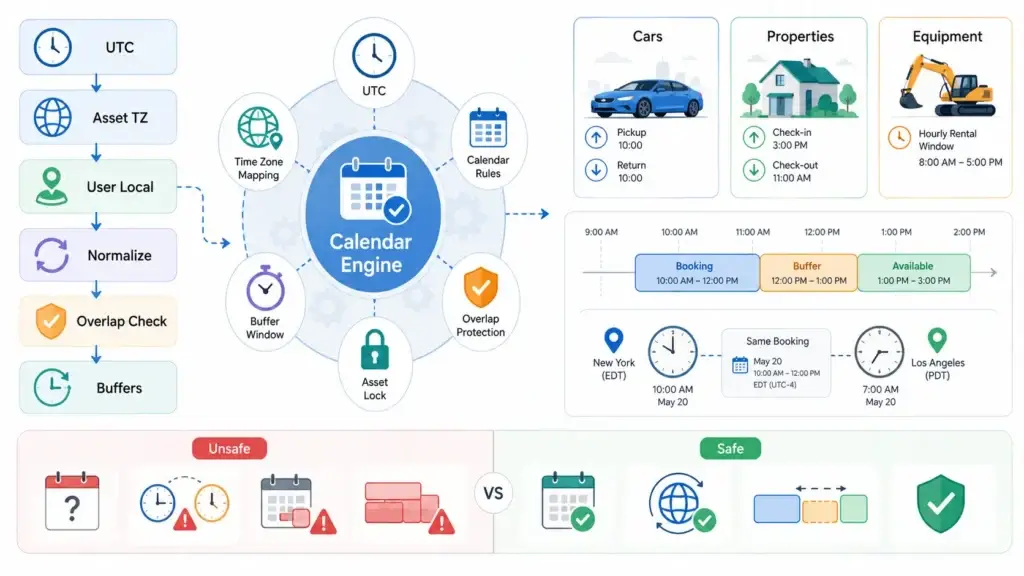
Time zones create some of the most underestimated bugs in rental marketplaces.
A founder may start in one city and assume local time is enough. But as soon as the platform supports multiple regions, airport pickups, travel rentals, remote owners, or international guests, calendar state becomes harder.
The safest approach is usually:
- Store canonical timestamps in UTC.
- Store the asset’s operating time zone.
- Display times in the user’s relevant local time.
- Run overlap checks against normalized timestamps.
- Avoid storing ambiguous date-only ranges for time-sensitive rentals.
- Define check-in, pickup, return, cleaning, inspection, and buffer periods clearly.
For example, a car rental from 10:00 AM to 6:00 PM is not only a date range. It is a time-bound asset lock. If the platform ignores time zones or buffers, the next renter may see the asset as available before it has been returned, inspected, charged, cleaned, or relocated.
In real-estate rentals, the logic may be different. A nightly stay may be represented by check-in and check-out rules. In equipment rental, hourly windows may matter. In car-sharing, exact pickup and return timestamps are essential.
This is why Miracuves-style rental architecture should be adapted to the rental category instead of treating every rental asset the same way.
Read More: How to Build an iCal Calendar Sync System for Vacation Rental Platforms
Founder Decision Signals: When You Need a Pre-Tested Rental Engine
Speed
If your launch depends on building listings, booking, payments, owner panels, renter panels, and admin control from zero, your team may spend months before validating demand.
Cost
Availability bugs are expensive because they appear after users start booking. A pre-tested rental foundation reduces avoidable rebuild risk.
Scalability
If the platform will support multiple cities, asset categories, owners, and booking rules, the availability engine must be designed for growth from the start.
Market Fit
Founders should validate rental demand quickly, but not with a weak booking layer that damages trust during the first real transactions.
Out of the Box: Deploying Flawless Rental Software Faster With Miracuves
Founders do not need to reinvent every layer of a rental marketplace.
The smarter path is to start with a proven rental product foundation, then customize the market-specific rules: car-sharing, property rentals, high-value assets, equipment rentals, boat rentals, luxury goods, event spaces, or local peer-to-peer rentals.
Miracuves’ ready-made rental marketplace solutions give founders a faster starting point because the core workflows are already structured around users, owners, listings, bookings, admin control, white-label branding, and source-code ownership. For car-sharing founders, the Miracuves Turo clone app provides a ready-made foundation for peer-to-peer vehicle rentals. For property marketplace founders, the Miracuves Airbnb clone supports the vacation rental model with listing, host, booking, and availability workflows.
The advantage is not that founders avoid customization. The advantage is that they avoid starting from an empty database, empty admin panel, empty booking workflow, and untested rental logic.
A pre-compiled rental engine can help founders move faster while still customizing:
- Asset categories
- Booking rules
- Owner approval flows
- Deposit policies
- Cancellation logic
- Commission models
- Admin dashboards
- Verification workflows
- Calendar buffers
- Payment gateways
- Damage protection add-ons
- Location-specific rental rules
For complex peer-to-peer rental platforms, the real question is not “Can we build a booking website?”
The real question is “Can we trust the booking engine when real users, real assets, real deposits, and real disputes enter the system?”
Read More: Best Airbnb Clone Script in 2026: Features, Pricing & Cost
Mistakes Founders Should Avoid While Building a Peer-to-Peer Rental Engine
Building Availability as a Frontend Calendar Only
A calendar UI can show dates, but it cannot guarantee booking safety. Availability must be validated at the backend and protected at the database level during confirmation.
Ignoring Pending Booking Expiry
If pending bookings hold inventory forever, real renters cannot book. If they do not hold inventory at all, two renters may race for the same asset. The platform needs clear hold duration and expiry logic.
Treating Deposits Like Normal Payments
Deposits often require authorization, release, capture, or dispute workflows. They should have separate states from rental fees.
Not Planning for Time Zones Early
Rental platforms that expand across cities can break when local display time and backend storage time are not designed carefully.
Skipping Admin Override and Audit Logs
Admins need visibility into booking changes, manual blocks, refunds, dispute actions, owner approvals, and asset status updates. Without audit logs, support teams cannot resolve conflicts confidently.
Security and Trust Layers Every Rental Marketplace Should Include
Peer-to-peer rentals require trust between strangers. The higher the asset value, the more important the trust layer becomes.
A scalable rental engine should support:
- User and owner verification
- Asset verification
- Secure payment gateway integration
- Role-based admin access
- Booking audit logs
- Damage reporting
- Refund and dispute workflows
- Review moderation
- Admin approval controls
- Activity history for bookings and payments
This does not mean a platform is automatically compliant in every jurisdiction. Final compliance depends on the target market, legal review, payment partners, insurance model, data handling, and operating structure.
But founders should treat security and trust workflows as part of the product foundation, not as features to “add later.”
Final Thoughts: The Strongest Rental Platforms Are Built on Availability Truth
The real challenge in peer-to-peer rental marketplace development is not creating a page where owners list assets. It is building a system that knows when an asset is truly available, when it is temporarily held, when payment has failed, when a deposit is still active, when a booking is disputed, and when the calendar should safely reopen.
That is why the dynamic availability engine is one of the most important parts of a rental marketplace.
For founders planning car-sharing, real-estate rentals, high-value asset rentals, or multi-category rental platforms, the strongest decision is not always to build every layer from scratch. A pre-tested rental marketplace foundation can reduce avoidable engineering risk, accelerate validation, and give the team more time to focus on positioning, supply acquisition, trust, and growth.
Miracuves helps founders launch faster with white-label, source-code-owned rental marketplace solutions that can be customized around the business model, booking logic, and operational workflows needed for serious peer-to-peer rental platforms.
FAQs
What is a peer-to-peer rental engine?
A peer-to-peer rental engine is the backend system that manages listings, availability, booking requests, owner approvals, payments, deposits, cancellations, and asset return workflows in a rental marketplace.
Why do peer-to-peer rental marketplaces get double-bookings?
Double-bookings usually happen when availability is checked and booking confirmation happens in separate unsafe steps. If two renters confirm overlapping time slots before the database commits one final booking, both may appear successful unless the system uses transactional protection.
What is a dynamic availability engine?
A dynamic availability engine calculates real-time rental availability by combining owner rules, confirmed bookings, pending requests, maintenance blocks, deposits, cancellations, and operational buffers.
Why is a Turo clone app technically harder than a normal booking website?
A Turo clone app must manage owner listings, exact pickup and return times, renter verification, vehicle availability, deposits, extensions, late returns, damage claims, admin review, and location-based handover workflows. A simple booking website usually does not handle this level of asset risk.
How should a rental marketplace manage deposits?
A rental marketplace should manage deposits with separate states such as authorization pending, authorized, captured, released, expired, partially captured, or disputed. Deposit logic should connect to booking, return, and damage claim workflows.
Should rental calendars store local time or UTC?
Most scalable systems store canonical timestamps in UTC and display local time based on the asset, owner, or renter context. This helps reduce overlap errors when the platform operates across multiple time zones.
Can Miracuves help launch a peer-to-peer rental marketplace faster?
Yes. Miracuves offers ready-made and white-label rental marketplace foundations such as Turo clone and Airbnb clone solutions that can be customized for car-sharing, property rentals, and other asset rental models.
What should founders check before choosing rental marketplace software?
Founders should check booking logic, double-booking prevention, source-code ownership, admin dashboard control, payment and deposit workflows, owner/renter panels, customization flexibility, support, and the ability to scale beyond the first market version.
Miracuves is an independent software development company. We are not affiliated with, connected to, sponsored by, or endorsed by any company or product named in this article.
Terms such as “X Clone” are used descriptively. It is how the software industry refers to building a platform with functionality comparable to a known service, and how clients search for it.
The entire design and codebase of our products is built by our own team. Our products contain no code, design, graphics, or content originating from any third-party website or applications.
All third-party names and marks referenced in this article are the property of their respective owners, referenced solely to identify the services discussed.