


Key Takeaways
- A vacation rental marketplace must connect guest, host, booking, payment, and admin workflows.
- Essential features include property listings, advanced search, availability calendars, reservations, messaging, reviews, and payouts.
- Development pricing depends on platform coverage, integrations, customization, security, deployment, and support.
- Complete source-code ownership gives founders control over hosting, customization, and future development.
- Founders should evaluate operational readiness instead of comparing only features or initial pricing.
Platform Evaluation Signals
- Confirm whether web, Android, iOS, guest, host, and admin interfaces are included.
- Test availability calendars, date blocking, pricing rules, booking updates, cancellations, and refunds.
- Review host onboarding, verification, listing management, guest communication, and payout processing.
- Check admin controls for commissions, users, disputes, reports, permissions, and marketplace settings.
- Clarify payment integrations, app publishing, documentation, customization, and post-launch support costs.
Real Insights
- Inaccurate calendars and double bookings can quickly damage guest and host trust.
- A complete payment system must manage guest charges, commissions, host payouts, refunds, and reconciliation.
- A low initial price can create higher costs when the source code is restricted or poorly documented.
- Long-term platform value depends on reliability, scalability, customization freedom, and technical ownership.
- Miracuves develops vacation rental marketplaces with guest and host apps, admin control, and complete source code.
Launching a vacation rental marketplace is not only about putting property listings online. A serious rental platform needs guest discovery, host onboarding, calendar logic, booking flow, payments, reviews, commission control, dispute workflows, and an admin dashboard that allows the platform operator to manage the business without depending on developers for every small change.
That is why founders should not evaluate rental marketplace software only by asking, “How many features are included?” A better question is: Which features directly affect bookings, trust, pricing control, host retention, and long-term scalability?
This guide breaks down the core features, pricing factors, hidden cost drivers, and founder decision signals you should review before launching a vacation rental marketplace.
If you are already evaluating a launch-ready rental marketplace platform, Miracuves offers a ready-made rental marketplace solution that helps founders move faster with branded design, admin control, source-code ownership, and deployment support. The goal of this guide is to help you understand what to check before you choose any development route.
Why Feature Evaluation Matters Before Building a Vacation Rental Platform
A vacation rental marketplace has multiple user groups: guests, hosts, and the platform operator. Each group depends on different workflows.
Guests want to search, compare, book, pay, message, and review. Hosts want to list properties, manage availability, set prices, receive payouts, and respond to bookings. The platform operator needs control over users, commissions, listings, disputes, payments, reports, and content quality.
If one side is weak, the entire marketplace suffers. A polished guest interface cannot compensate for poor host tools. A beautiful listing page cannot solve double bookings. A low upfront software price cannot protect the business if the admin dashboard lacks commission, cancellation, payout, and dispute controls.
For founders, feature evaluation is really risk evaluation.
The goal is not to buy the longest feature list. The goal is to choose a platform foundation that supports your first market version and can still handle future growth.
Core Guest Features Every Vacation Rental Marketplace Needs
Guests are the demand side of the marketplace. If the guest journey feels confusing, slow, or untrustworthy, bookings will drop even if the platform has good property supply.
A strong guest experience should make it easy to move from search intent to confirmed booking.
Guest Features and Business Value
| Feature | Business Value | Founder Impact |
|---|---|---|
| Location-Based Search | Helps guests find properties by city, region, distance, or destination type. | Improves discovery and reduces friction before booking. |
| Smart Filters | Allows guests to filter by price, dates, amenities, property type, rating, and availability. | Increases conversion by helping users find relevant stays faster. |
| Property Detail Pages | Shows photos, amenities, rules, pricing, availability, location, and host details. | Builds trust and reduces pre-booking doubts. |
| Booking Flow | Allows guests to select dates, review pricing, confirm details, and complete payment. | Directly affects revenue because every booking passes through this flow. |
| In-App Messaging | Helps guests clarify check-in, rules, amenities, and special requests. | Reduces abandoned bookings and improves guest confidence. |
| Reviews and Ratings | Creates social proof for properties and hosts. | Improves marketplace trust and repeat usage. |
The most important guest-side decision is not whether the platform has search and booking. It is whether the flow feels complete enough for real users to trust the platform with travel plans and payments.
Host Features That Decide Supply Quality
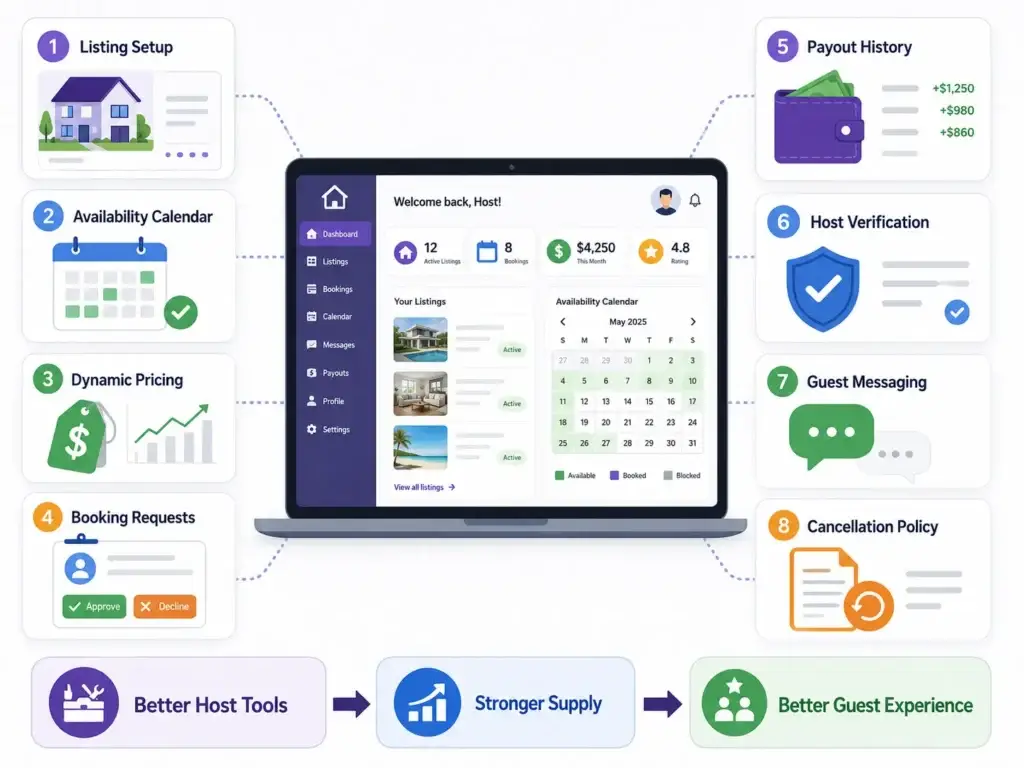
Image Source: AI-generated visual by Miracuves
Most founders focus first on guests because bookings generate revenue. But a vacation rental marketplace cannot grow without host supply.
Hosts need tools that help them add listings, manage availability, update pricing, communicate with guests, and track bookings. If host tools are weak, property owners may abandon the platform or avoid adding their best inventory.
Important host features include:
- Property listing creation with photos, descriptions, amenities, rules, and location
- Availability calendar with date blocking and booking visibility
- Pricing management for weekday, weekend, seasonal, or special-date rates
- Booking request management and approval workflows
- Payout visibility and transaction history
- Host profile, verification, and performance indicators
- Messaging with guests
- Cancellation and refund policy management
For founders, host-side depth matters because supply quality drives marketplace credibility. A marketplace with poor host controls can quickly face inaccurate listings, calendar conflicts, unclear pricing, and guest complaints.
A good platform should make hosts feel in control while giving the platform operator enough oversight to maintain quality.
Admin Dashboard Features Founders Should Not Ignore
The admin dashboard is where the rental marketplace becomes a business, not just an app.
Many founders underestimate this layer because users do not see it. But the admin panel controls the operational engine: users, hosts, listings, commissions, disputes, payments, content, reports, cancellations, and settings.
Without a strong admin dashboard, the founder may need developer help for routine decisions such as changing commission rates, approving hosts, removing unsafe listings, adjusting categories, or reviewing payment issues.
Key admin dashboard features include:
| Admin Feature | Why It Matters |
|---|---|
| User Management | Helps manage guests, hosts, blocked users, verification status, and account activity. |
| Listing Approval | Prevents low-quality, duplicate, or policy-breaking listings from going live. |
| Commission Settings | Allows the platform to define how revenue is earned from bookings. |
| Booking Management | Gives visibility into confirmed, pending, cancelled, and disputed bookings. |
| Payment and Payout Controls | Helps track platform earnings, host payouts, refunds, and transaction status. |
| Dispute Management | Supports operational control when guests and hosts disagree. |
| CMS and Content Control | Helps manage banners, static pages, FAQs, policies, and platform messaging. |
| Reports and Analytics | Gives founders visibility into bookings, revenue, listings, users, and growth trends. |
A rental marketplace without a useful admin dashboard can look ready from the outside but become difficult to operate after launch.
This is one reason source-code-owned and admin-controlled platforms are important for founders who want flexibility beyond the first release.
Pricing Factors That Affect Vacation Rental Marketplace Cost
Pricing depends on what is included, how much customization is needed, and whether the founder chooses custom development, no-code tools, a SaaS marketplace platform, or a ready-made white-label foundation.
Instead of comparing only the final quote, founders should compare the cost structure behind it.
| Pricing Factor | How It Affects Cost |
| Web Platform | A responsive web marketplace adds cost depending on design, listing depth, booking flow, and admin features. |
| Mobile Apps | Android and iOS apps increase cost if built natively or customized separately. |
| Host Dashboard | Advanced host tools such as pricing rules, calendar sync, and payout visibility add complexity. |
| Booking Engine | Date-based booking, availability rules, cancellation logic, and payment flow affect development effort. |
| Payment Gateway | Gateway type, wallet logic, refunds, payout flow, and regional payment methods influence cost. |
| Calendar Sync | External calendar integrations can add complexity but help reduce double-booking risk. |
| Multi-Language Support | Useful for travel markets but requires content, UI, and translation logic. |
| Admin Panel Depth | More operational control usually means more backend work but less manual dependency later. |
| Custom Branding | Logo, color theme, domain setup, email templates, and UI adjustments affect launch scope. |
| Support and Maintenance | Bug fixes, updates, hosting, monitoring, and enhancements affect long-term cost. |
The cheapest quote is not always the most cost-efficient option. A founder may save money upfront but spend more later if the platform lacks booking stability, payment clarity, admin control, or customization access.
Miracuves Vacation Rental Marketplace Solution Cost and Tech Stack
Miracuves Pricing for a Vacation Rental Marketplace App developed in PHP/Laravel with Flutter Apps For $3,099 USD (One-Time Price) in just 6 days
Get a fully developed, deployment-ready vacation rental marketplace built for property owners, hosts, travelers, rental operators, and hospitality startups. Built on a stable PHP/Laravel foundation with Flutter apps, this complete package includes everything you need to launch and scale:
- Core Workflows: Guest registration, host onboarding, property listing, availability calendar, booking requests, instant booking, check-in details, cancellation flow, reviews, ratings, and customer notifications.
- Built-in Revenue Logic: Booking commissions, host service fees, guest service charges, cleaning fees, featured listings, cancellation charges, subscription plans, promo codes, and payout setup.
- Management Hub: Centralized admin dashboard, host management, guest management, property approval, booking tracking, payment records, refund handling, dispute management, review moderation, and rental analytics.
- Launch-Ready: Fully prepared for your custom branding, configuration, payment gateway setup, map integration, host onboarding, property category setup, and immediate market entry.
Why Is Vacation Rental Marketplace Development More Affordable?
Most vacation rental marketplaces become expensive when businesses choose fully custom development from scratch. Building separate workflows for guests, hosts, admins, listings, bookings, calendars, payments, refunds, reviews, messaging, and dispute handling can increase cost, timeline, and technical complexity.
We took a smarter, more practical approach:
- You Aren’t Paying for Ground-Up Development: Our vacation rental marketplace engine is already developed, tested, and ready to deploy. You skip the inflated cost and long waiting period usually required for building a rental marketplace from scratch.
- The Power of PHP/Laravel with Flutter Apps: We built this solution on a reliable and cost-effective PHP/Laravel backend with Flutter apps. This keeps the upfront price practical while supporting property listings, booking workflows, host management, guest experiences, payment operations, and admin control.
You get a launch-ready vacation rental marketplace with practical booking features, source code access, and faster deployment without the high custom development price tag.
Note: This cost is for the solution, re-branding, deployment, and source code only.
Ready-Made vs Custom Development: Which Route Fits Your Launch Stage?
There is no single right development route for every founder. The better choice depends on market clarity, budget, speed pressure, technical requirements, and customization depth.
| Build Route | Best For | Strength | Limitation |
| Custom Development | Businesses with unique workflows, large budgets, and complex requirements | Maximum flexibility | Higher cost, longer timeline, more planning risk |
| SaaS Marketplace Tool | Founders testing a marketplace concept quickly | Low initial setup and hosted infrastructure | Less control over source code, customization, and long-term ownership |
| Ready-Made White-Label Platform | Founders who want faster launch with core workflows already built | Faster deployment, branded experience, admin control, lower early build risk | Custom features still need scope review |
| No-Code Setup | Early idea validation or small experiments | Fast testing and low technical barrier | May struggle with custom booking logic, scale, or deeper workflows |
For many founders, the practical question is: “Do I need a fully custom product from day one, or do I need a strong product foundation that can help me validate the market faster?”
A ready-made rental marketplace platform can be useful when the founder wants guest, host, booking, payment, and admin workflows without building every module from zero.
Founder Decision Signals
Speed
If your goal is to validate a rental market quickly, a ready-made foundation may reduce early development effort compared with building every workflow from scratch.
Cost
Compare what is included in the platform, not only the headline price. Booking logic, admin control, payments, and support can change the true cost.
Scalability
A marketplace should support more listings, bookings, users, and payment activity without forcing a rebuild too early.
Market Fit
The first version should match your niche, whether you are targeting villas, homestays, apartments, cabins, luxury stays, regional rentals, or local travel experiences.
Hidden Cost Drivers Founders Often Miss
A vacation rental marketplace can look simple at the feature-list level, but hidden costs appear when real users start booking.
The biggest hidden cost drivers usually come from operational complexity. Before comparing vendors, founders should also review the broader vacation rental marketplace cost factors that influence pricing beyond the visible feature list.
Calendar Accuracy
Double bookings can damage trust quickly. Founders should check whether the platform supports clean availability management, blocked dates, booking status updates, and calendar integrations where needed.
Payment and Payout Logic
Accepting guest payments is only one part of the flow. The platform also needs to handle host payouts, commission deductions, refunds, cancellations, failed payments, and transaction records.
Trust and Verification
Rental marketplaces involve real people, real properties, and real money. Guest profiles, host verification, reviews, ratings, reporting, and dispute handling all help reduce marketplace risk.
Customization Access
If the platform cannot be modified deeply, every growth idea becomes difficult. Founders should check whether they receive source-code access, documentation, and the ability to customize workflows later.
Post-Launch Support
Even a strong launch version needs bug fixes, updates, hosting support, app store updates, payment adjustments, and feature improvements. Support terms should be reviewed before signing.
Monetization Models to Consider Before Choosing Features
Feature decisions should connect directly to revenue logic. A rental marketplace can monetize in several ways, but each model requires the right backend control.
Common revenue models include:
| Revenue Model | How It Works | Required Platform Control |
| Booking Commission | Platform earns a percentage from each completed booking. | Commission settings, transaction tracking, payout control |
| Guest Service Fee | Guests pay a service fee at checkout. | Checkout fee logic and transparent pricing display |
| Host Subscription | Hosts pay monthly or yearly to list properties. | Subscription plans, listing limits, payment renewal |
| Featured Listings | Hosts pay to appear higher in search or category pages. | Promotion slots, ranking rules, admin approval |
| Cancellation Fees | Platform earns or manages fees based on cancellation policy. | Cancellation rules and refund workflows |
| Add-On Services | Platform sells cleaning, local experiences, insurance, or concierge services. | Add-on catalog, checkout integration, partner management |
A founder should not select features in isolation. If the business model depends on host subscriptions, the admin should support plan limits. If the strategy depends on commissions, the platform needs reliable payment and payout logic. If the marketplace depends on premium hosts, listing quality controls become essential.
Security and Trust Features for Rental Marketplaces
Security should not be treated as a final checkbox. It is part of the marketplace foundation.
For a vacation rental platform, users need confidence that payments, profiles, listings, messages, and booking records are handled responsibly.
Important trust and security layers include:
- Secure payment gateway integration
- Encrypted data transfer
- Role-based access control
- Admin access controls
- User and host verification workflows
- Review and rating moderation
- Abuse reporting
- Dispute management
- Activity logs
- Refund and cancellation records
- Privacy-conscious data handling
Final compliance depends on the target market, legal review, payment integrations, and operating model. Founders should avoid any provider that casually promises universal compliance without explaining the actual controls, workflows, or responsibilities.
Mistakes Founders Should Avoid
Choosing by Feature Count Alone
A long feature list does not always mean the platform is operationally ready. Booking accuracy, host tools, payment flow, and admin control matter more than surface-level modules.
Ignoring the Admin Dashboard
The admin panel decides how easily the business can manage users, listings, commissions, bookings, disputes, and reports after launch.
Underestimating Calendar and Pricing Logic
Vacation rentals depend on date-based availability and flexible pricing. Weak calendar controls can lead to booking errors and host frustration.
Not Checking Source-Code Ownership
If the founder cannot access or modify the codebase, customization and future scaling may become expensive or restricted.
How to Evaluate Rental Marketplace Pricing Before You Commit
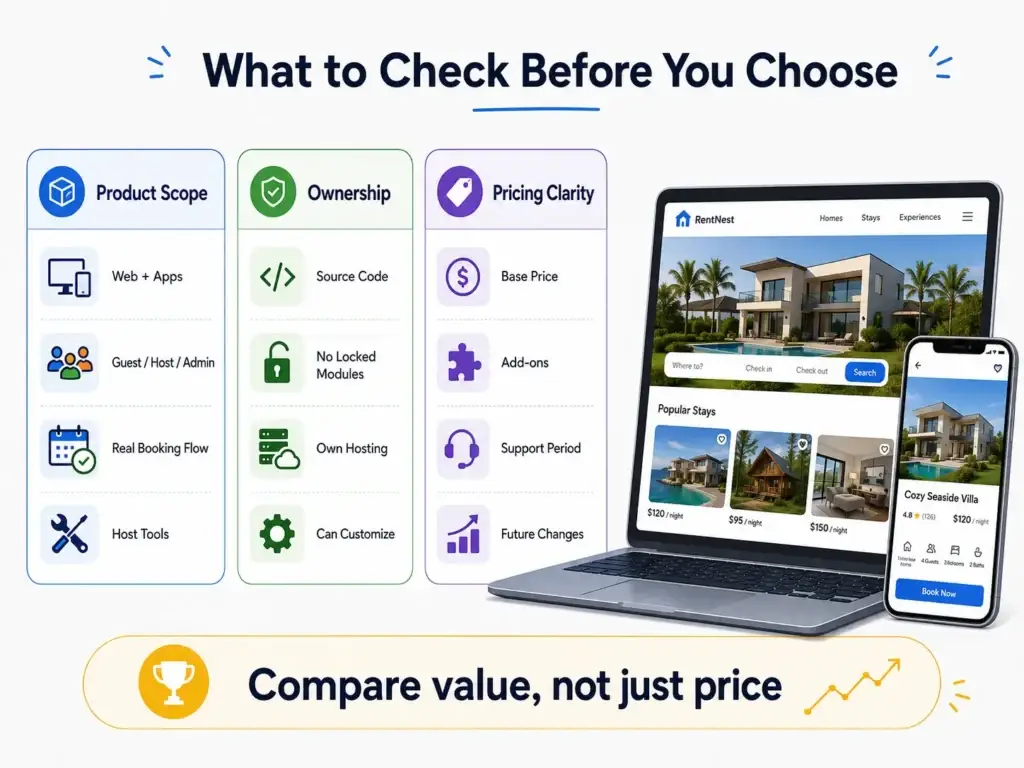
Image Source: AI-generated visual by Miracuves
Before comparing vendors or development options, founders should ask practical questions.
Product Scope Questions
- Does the platform include web, Android, and iOS?
- Are guest, host, and admin workflows included?
- Does the booking flow support real availability and pricing logic?
- Can hosts manage calendars, listings, payouts, and messages?
- Does the admin dashboard support commissions, disputes, users, and reports?
Technical Ownership Questions
- Do you receive source code?
- Are there encrypted files or locked modules?
- Can the platform be hosted on your own infrastructure?
- Can your team or future vendor customize it later?
- Is documentation provided?
Pricing Clarity Questions
- What is included in the base price?
- What is charged separately?
- Are payment gateway integrations included or scoped as add-ons?
- Does app store publishing cost extra?
- What support period is included?
- What happens when you need new features after launch?
These questions help founders avoid comparing only headline price and instead compare real product value.
When a Ready-Made Rental Marketplace Platform Makes Sense
A ready-made platform makes sense when you want to launch faster, validate demand, and avoid building standard marketplace workflows from zero.
It is especially relevant when:
- You already know your rental niche or target geography
- You want guest, host, booking, payment, and admin modules ready early
- You need branded design without starting with a blank codebase
- You want source-code ownership for long-term control
- You need to test pricing, commission, and supply acquisition quickly
- You prefer a cost-efficient launch path before deeper custom expansion
Miracuves helps founders launch ready-made and white-label app solutions with source-code ownership, admin dashboards, branded design, and faster deployment. For a rental marketplace founder, this can create a stronger starting point than attempting to coordinate every guest, host, payment, and admin module from scratch.
Explore the relevant solution page here: View Miracuves’ ready-made rental marketplace platform.
Final Thoughts: Evaluate the Platform Behind the Price
Vacation rental marketplace pricing should never be judged only by the lowest quote or the longest feature list. The stronger decision is to evaluate the system behind the platform.
Does it help guests book confidently?
Does it help hosts manage inventory easily?
Does it give the platform operator control over payments, listings, commissions, disputes, and reports?
Can it support your niche, pricing model, and growth plan?
A rental marketplace is not just a booking interface. It is a trust, availability, payment, and operations system. Founders who understand this before launch make better software decisions, avoid hidden costs, and build with more control from day one.
For founders comparing ready-made platforms with custom development support, it also helps to review how a professional Vacation rental marketplace development company approaches architecture, source-code ownership, branding, deployment, and long-term customization before choosing the right launch path.
FAQs
What features should a vacation rental marketplace include?
A vacation rental marketplace should include property listings, location-based search, filters, booking flow, availability calendar, host dashboard, guest profiles, secure payments, messaging, reviews, ratings, admin controls, and reporting. The exact feature scope depends on your target niche, business model, and launch stage.
What affects the pricing of rental marketplace software?
Pricing depends on the web platform, mobile apps, booking engine, host tools, payment gateways, admin dashboard, calendar sync, custom branding, integrations, hosting, support, and customization requirements. Founders should compare what is included rather than only comparing headline cost.
Is a ready-made rental marketplace platform better than custom development?
A ready-made platform is better when speed, cost-efficiency, and early market validation are priorities. Custom development is better when the business has highly unique workflows, enterprise-level requirements, or complex integrations from day one.
Why is the admin dashboard important for a rental marketplace?
The admin dashboard gives the platform operator control over users, hosts, listings, bookings, commissions, payments, disputes, content, and reports. Without strong admin controls, day-to-day operations may become manual and difficult to scale.
What host features are most important in a rental platform?
Important host features include listing creation, photo uploads, pricing control, availability calendar, booking request management, messaging, payout visibility, cancellation settings, and profile management. Strong host tools help improve supply quality and host retention.
How do vacation rental marketplaces make money?
Common revenue models include booking commissions, guest service fees, host subscriptions, featured listings, cancellation fees, and add-on services. The platform should have admin controls that support the selected monetization model.
What hidden costs should founders watch for?
Hidden costs can come from weak calendar sync, missing payment logic, limited customization, poor support, lack of source-code access, app store publishing, hosting, maintenance, and post-launch feature changes.
How can Miracuves help with vacation rental marketplace launch?
Miracuves helps founders launch ready-made and white-label rental marketplace platforms with branded design, admin control, source-code ownership, and faster deployment. This helps reduce the need to build every standard marketplace workflow from zero.
Miracuves is an independent software development company. We are not affiliated with, connected to, sponsored by, or endorsed by any company or product named in this article.
Terms such as “X Clone” are used descriptively. It is how the software industry refers to building a platform with functionality comparable to a known service, and how clients search for it.
The entire design and codebase of our products is built by our own team. Our products contain no code, design, graphics, or content originating from any third-party website or applications.
All third-party names and marks referenced in this article are the property of their respective owners, referenced solely to identify the services discussed.