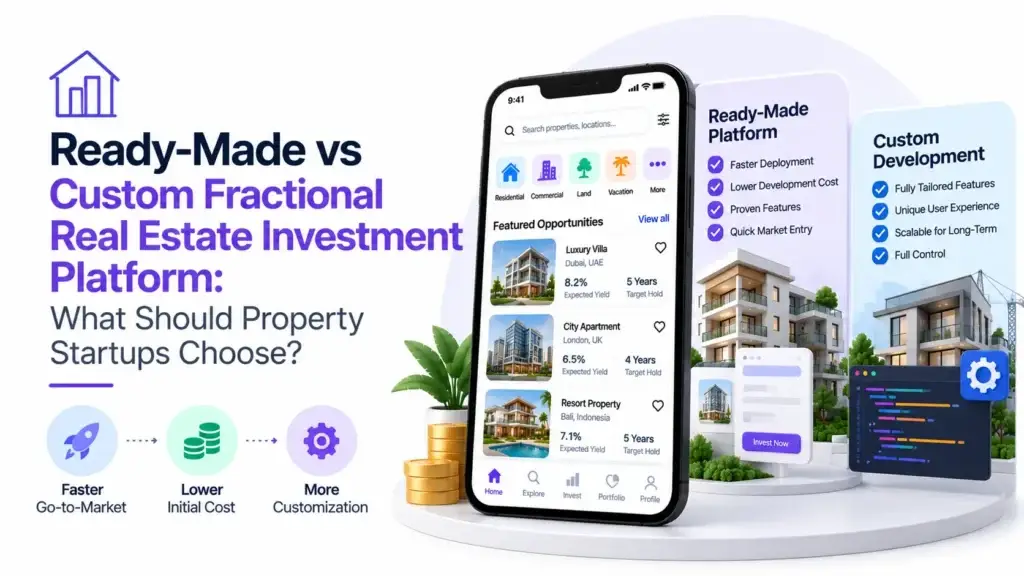
Key Takeaways
- A secondary market gives fractional real estate investors a structured way to sell eligible ownership interests before the underlying property is fully exited.
- The platform needs clear eligibility rules, seller disclosures, buyer verification and transfer workflows before a resale can move forward.
- Liquidity is not guaranteed, so investors should be able to see demand, pricing conditions, holding restrictions and expected timelines before listing an interest.
- A well-designed resale process can improve investor confidence by making the exit path more transparent without presenting fractional property ownership as instantly liquid.
How the Secondary Market Works
- Eligible investors can submit their ownership interests for resale with information such as quantity, asking price and applicable transfer conditions.
- Potential buyers can review available interests alongside property information, historical performance data and relevant investment disclosures.
- Identity checks, investor eligibility and transaction approvals should be completed before ownership records are transferred between parties.
- The platform should update cap-table or ownership records, payment status and investor dashboards once the resale transaction is successfully completed.
Exit and Liquidity Insights
- Secondary-market pricing may differ from the original investment value because resale demand, property performance and market conditions can change over time.
- Holding periods, transfer limits or approval requirements should be displayed clearly so investors understand when an interest can be offered for resale.
- Platforms should track unsuccessful listings, buyer demand and average resale time to understand where liquidity is strong or limited.
- A structured exit mechanism is most useful when it combines transparent rules, accurate ownership records and realistic expectations about how quickly a buyer may be found.
Fractional real estate investment gives more investors access to property-backed opportunities without requiring them to buy an entire apartment, villa, office, or commercial asset. But once the investment is made, one question becomes more important than many founders expect:
How does an investor exit before the property itself is sold?
That question is where the secondary market becomes important.
A fractional real estate secondary market gives investors a structured way to sell their ownership interest to another eligible investor. It does not magically make property as liquid as public stocks, and it should never be positioned that way. But when designed correctly, it can reduce investor hesitation, improve platform trust, and give operators a more mature investment ecosystem.
For founders building a fractional property investment platform, the secondary market is not just a nice feature. It affects investor confidence, retention, compliance workflows, admin control, revenue logic, and long-term platform credibility.
For founders planning this kind of investment product, the secondary market should be designed as part of the broader fractional real estate investment platform, not added later as a disconnected resale feature. When investor onboarding, property subscriptions, wallet activity, ownership records, distributions, and exit workflows are planned together, the platform becomes easier to manage and more trustworthy for long-term investors.
What Is a Fractional Real Estate Secondary Market?
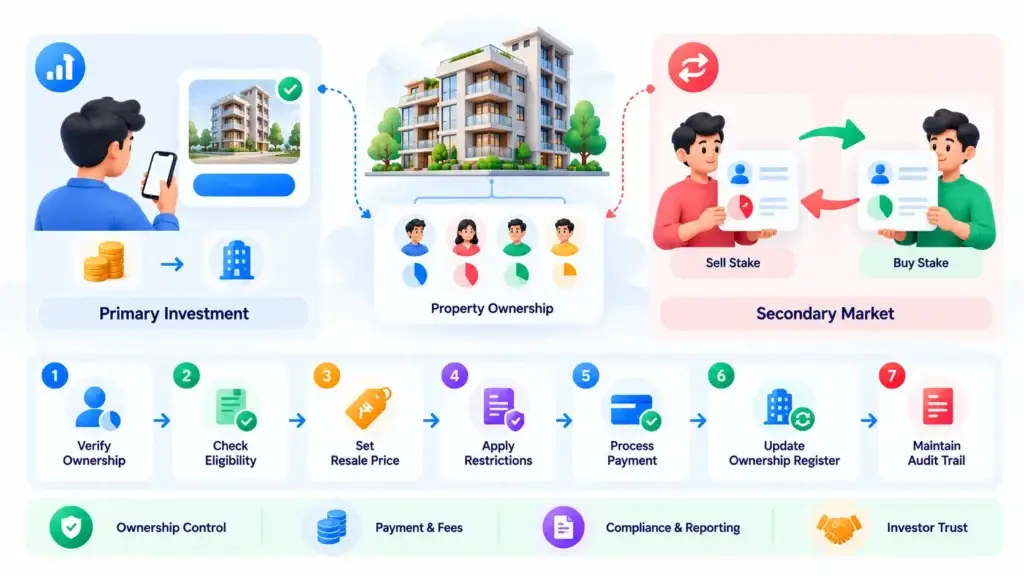
A fractional real estate secondary market is a resale layer inside a property investment platform where existing investors can list their ownership stake for sale, and eligible buyers can purchase that stake.
In a primary investment flow, investors subscribe to a new property offering. Their money goes into a new allocation, and the platform updates the ownership register. In a secondary market, the asset has already been funded. One investor wants to exit, and another investor wants exposure to the same property.
That changes the platform logic.
The platform now has to answer questions such as:
- Who owns the stake today?
- Is the seller eligible to sell?
- Is the buyer eligible to buy?
- What price is being offered?
- Are there resale restrictions?
- Does the sale affect distribution rights?
- How will the register update after settlement?
- What fees apply?
- What audit trail should be retained?
This is why secondary-market functionality should not be treated as a simple listing board. In fractional real estate, the resale workflow touches ownership, payments, compliance, reporting, and investor trust.
Why Investor Exit Matters in Fractional Property Investing
Real estate is naturally less liquid than public-market assets. A property cannot be sold instantly without affecting price, documentation, due diligence, and legal transfer. Fractional ownership improves access to real estate, but it does not remove the underlying liquidity challenge.
That creates a business problem for platform operators.
Investors may like the idea of earning rental distributions or participating in long-term asset appreciation. But many still hesitate if they feel locked in until the entire property is sold. A secondary market gives them a clearer answer.
It tells investors:
“You may not be able to exit instantly, but there is a structured process for offering your stake to another eligible buyer.”
That difference matters. A platform with no exit logic can feel rigid. A platform with a transparent resale process feels more mature, even when liquidity is still subject to demand, pricing, eligibility, and local rules.
Secondary Market Does Not Mean Guaranteed Liquidity
This is one of the most important points founders need to understand.
A secondary market is a path to liquidity, not a guarantee of liquidity.
For example, an investor may list a property stake for sale, but the sale still depends on buyer demand, asset performance, pricing, platform rules, and regulatory restrictions. In some markets, resale of private or crowdfunding-style securities may be restricted for a defined period or may require a registered intermediary or exemption. The SEC, for example, explains that securities purchased in U.S. Regulation Crowdfunding transactions generally cannot be resold for one year, with limited exceptions. SEC
The SEC also describes private secondary markets as transactions where investors sell private securities to other investors, while noting that securities law restrictions may still apply. SEC
For platform founders, this means the product should avoid language like “instant exit” or “guaranteed liquidity.” A stronger and safer positioning is:
- “Structured exit workflow”
- “Secondary resale option”
- “Liquidity support subject to demand and eligibility”
- “Admin-reviewed transfer process”
- “Marketplace-based exit path”
That language is more realistic and builds trust with both investors and compliance reviewers.
How a Fractional Property Exit Flow Usually Works
A well-designed secondary market should guide both the seller and buyer through a controlled process. The goal is not just to display a “sell” button. The goal is to create a documented transfer of beneficial ownership.
A practical exit flow may look like this:
| Step | What Happens | Why It Matters |
|---|---|---|
| Investor initiates exit | Seller chooses a holding and requests to list it | Prevents unsupported or accidental resale actions |
| Eligibility check | Platform checks holding period, market rules, and account status | Avoids allowing restricted transfers |
| Price and quantity selection | Seller defines units, asking price, or exit preference | Creates transparency for buyers |
| Admin or automated review | Operator reviews listing based on platform policy | Adds control before public visibility |
| Buyer discovery | Eligible investors view available secondary listings | Creates demand within the platform ecosystem |
| Buyer verification | Buyer must pass KYC, suitability, or market eligibility checks | Protects the platform from unauthorized transfers |
| Settlement | Wallet, payment, or ledger movement is recorded | Keeps financial records accurate |
| Register update | Ownership register reflects new beneficial owner | Preserves long-term auditability |
| Distribution rights update | Future rental distributions follow the new ownership record | Prevents payout disputes |
| Audit trail retained | Listing, approval, settlement, and transfer evidence are stored | Supports compliance and investor support |
These workflows work best when the core fractional property investment platform features already include investor verification, wallet settlement, ownership tracking, admin approvals, distribution logic, transaction history, and secondary-market controls. Without these connected modules, a resale flow can quickly become difficult to audit, reconcile, or explain to investors.
The stronger the register and ledger design, the easier it becomes to answer future questions about who owned what, when, and why.
The Ownership Register Is the Heart of Secondary Trading
In many investment platforms, founders focus heavily on the front-end investor experience. That makes sense during fundraising because the user needs to browse properties, review documents, invest, and track returns.
But in a secondary market, the most important system is often invisible to the investor: the ownership register.
The register should record ownership changes in a way that is clear, auditable, and difficult to manipulate casually. If the register simply overwrites ownership values, the platform may struggle to reconstruct historical ownership later. A better model is to preserve a clear record of allocation, transfer, certificate issue, and ownership changes.
This matters because secondary-market activity creates more movement than primary subscriptions. Investors may buy, sell, partially exit, or transfer positions. Without strong register logic, the operator may face problems with:
- distribution calculations
- investor statements
- tax summaries
- ownership disputes
- regulatory review
- asset sale proceeds
- auditor questions
- future acquisition due diligence
A secondary market is only as trustworthy as the register behind it.
This is why founders should think beyond the investor-facing resale screen and understand the full fractional real estate investment platform architecture behind ownership records, wallet movement, rental distributions, asset data, and admin controls. A secondary market works smoothly only when the backend structure can support every transfer without breaking reporting or investor trust.
Why the Wallet Ledger Must Stay Accurate
The wallet and ledger layer is another critical part of secondary-market infrastructure.
When an investor sells a fractional property stake, money has to move. That may involve buyer balance checks, payment gateway confirmation, platform fees, seller proceeds, withholding rules, currency conversion, or distribution adjustments.
A weak platform may treat this as a simple balance update. A stronger platform records money movement in a way that can be reconciled.
For operators, ledger accuracy matters because secondary transactions create financial questions:
- Did the buyer pay?
- Was the seller credited?
- Was the platform fee deducted?
- Was the transaction reversed or cancelled?
- Was the correct currency used?
- Was the settlement linked to the ownership transfer?
- Did the distribution batch reflect the new owner?
When the ledger and register work together, the platform can support both investor confidence and operational control.
Buyer Eligibility and KYC Cannot Be Skipped
A secondary market cannot simply allow any user to buy any fractional real estate stake. The buyer may need to meet the same eligibility standards required during the original offering.
Depending on the market, asset type, operating model, and legal structure, this may include:
- KYC verification
- identity checks
- accreditation or suitability checks
- jurisdiction-based restrictions
- investment limits
- source-of-funds checks
- risk acknowledgement
- document acceptance
- tax residency information
This is why founder teams should treat secondary trading as a controlled investment workflow, not just a marketplace feature.
The buyer experience can still feel simple. But behind the interface, the platform should confirm that the buyer is eligible before the ownership record changes.
Admin Controls Decide Whether the Market Is Safe to Operate
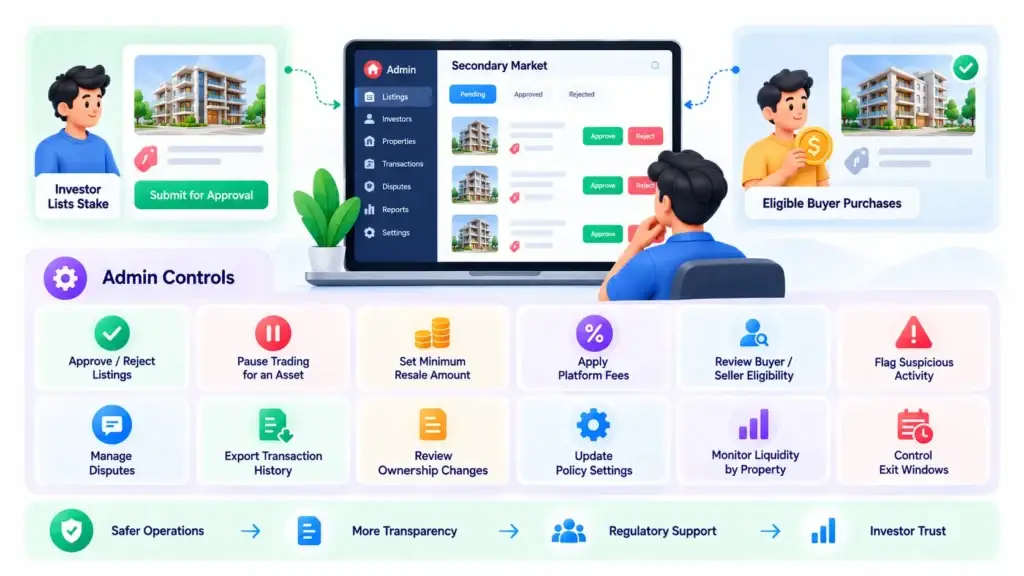
Secondary markets need operator control.
Without admin controls, a platform may expose itself to unauthorized listings, incorrect pricing, suspicious transfer patterns, unsupported jurisdictional activity, or investor-support disputes.
A practical admin layer should allow the operator to:
- approve or reject resale listings
- pause secondary trading for an asset
- define minimum resale amounts
- apply platform fees
- review buyer and seller eligibility
- flag suspicious activity
- manage disputes
- export transaction history
- review ownership changes
- update policy settings
- monitor liquidity by property
- control exit windows
This is especially important for founders launching in regulated or semi-regulated investment environments. The software can support compliance workflows, but final compliance depends on jurisdiction, legal review, integrations, and the operator’s business model.
Common Secondary-Market Models for Fractional Real Estate Platforms
Not every fractional property platform needs the same liquidity design. The right model depends on the asset, investor profile, legal structure, and operational maturity.
| Secondary-Market Model | How It Works | Best For | Founder Consideration |
|---|---|---|---|
| Open resale marketplace | Investors list stakes and buyers browse available holdings | Mature platforms with enough investor demand | Needs strong eligibility, pricing, and moderation controls |
| Admin-approved listing model | Every resale listing requires operator review before going live | Early-stage or compliance-sensitive platforms | Slower but safer for controlled launches |
| Scheduled exit windows | Investors can sell only during defined periods | Platforms managing liquidity carefully | Easier to control than always-on trading |
| Internal buyer matching | Platform matches sellers with interested buyers privately | High-value or limited-inventory assets | Requires strong CRM and investor demand data |
| Redemption request workflow | Investor requests exit and operator reviews available options | Platforms that do not want peer-to-peer trading | May require clear liquidity reserves or operating rules |
| Asset-sale exit only | Investors exit when the full property is sold | Long-term real estate strategies | Simple to operate but less flexible for investors |
For many new platforms, the best first step is not a fully open marketplace. It is a structured, admin-reviewed exit workflow that can mature into broader secondary trading as the investor base grows.
Founder Decision Signals
Investor Confidence
If investors ask “How do I exit?” before they ask about returns, your platform needs clear resale, redemption, or exit-window logic.
Operational Control
If your team needs to review eligibility, pricing, fraud signals, or jurisdiction rules, secondary-market workflows should include admin approvals.
Liquidity Maturity
If your platform is new, a controlled exit request flow may be safer than launching a fully open resale marketplace on day one.
Revenue Expansion
If your primary raises slow down later, secondary transaction fees and exit charges can become supporting revenue levers.
How Secondary Markets Improve Platform Monetization
A secondary market can support the business model beyond primary fundraising.
For platform operators, secondary-market activity should connect to the wider fractional real estate business model, including primary investment fees, resale transaction charges, exit fees, distribution-related fees, FX spread, and admin-controlled monetization rules. This helps founders decide whether liquidity should be treated as a pure investor-experience feature or as an additional revenue layer.
Most founders think first about platform fees on new investments. That is important, but once the platform grows, the existing investor base becomes a second layer of activity. Investors may want to rebalance holdings, exit early, buy into already funded assets, or increase exposure to high-performing properties.
This creates monetization options such as:
- listing fees for sellers
- transaction fees on completed secondary trades
- exit or redemption fees
- spread-based pricing where legally suitable
- premium liquidity windows
- admin service fees
- portfolio management fees
- currency conversion spread
- document or statement generation fees
The key is to make fees transparent. Investors should understand what they pay, when they pay it, and how it affects their proceeds.
A platform that hides exit fees may create short-term revenue but long-term distrust. A platform that explains fees clearly can turn liquidity infrastructure into a credible business advantage.
Secondary Market vs. Redemption: What Should Founders Choose?
Secondary sale and redemption are often confused, but they are not the same.
A secondary sale usually means one investor sells their stake to another investor. The platform facilitates the listing, buyer checks, settlement, register update, and fee logic.
A redemption usually means the platform, issuer, or operating entity buys back or processes an exit request based on predefined rules. This may require liquidity planning, reserves, or specific legal structuring.
| Exit Type | Who Buys the Stake? | Liquidity Source | Operational Complexity |
|---|---|---|---|
| Secondary sale | Another investor | Marketplace demand | Medium to high |
| Redemption | Platform, issuer, or structure-defined buyer | Operator-controlled liquidity | High |
| Scheduled exit window | Buyer pool or operator-defined process | Time-bound liquidity event | Medium |
| Asset sale | Final property buyer | Sale of the underlying property | Lower during holding period, high at final sale |
For early platforms, secondary sale workflows may be easier to explain than guaranteed redemption. But the right model depends on legal structure, market rules, asset strategy, and investor promises.
Founders should decide this before development, not after launch.
What Investors Expect From a Strong Exit Experience
Investors do not expect private real estate to behave like public equities. But they do expect clarity.
A strong exit experience should show:
- what holdings are eligible for resale
- whether a lock-in period applies
- estimated value or seller-defined asking price
- fees deducted from proceeds
- expected settlement steps
- buyer eligibility conditions
- status of the listing
- reason for rejection if blocked
- distribution impact after transfer
- documents generated after completion
A weak exit experience creates support tickets. A strong exit experience reduces uncertainty.
This matters because uncertainty is one of the biggest barriers in fractional real estate. Investors may accept long-term holding periods, but they want to understand the rules before they invest.
Mistakes Founders Should Avoid
Promising Instant Liquidity
A secondary market can support exits, but it cannot guarantee buyers. Overpromising liquidity creates investor trust and compliance risk.
Treating Resale as a Simple Listing Feature
Fractional property resale affects ownership, payments, eligibility, distributions, statements, and audit history. It needs deeper platform logic.
Skipping Buyer Eligibility Checks
A buyer in a secondary transaction may need the same KYC, suitability, and jurisdiction checks as a primary investor.
Using a Weak Ownership Register
If the platform cannot prove who owned what on a given date, secondary-market activity can become difficult to reconcile later.
Feature Table: What a Secondary Market Needs Behind the Scenes
Secondary Market Features and Their Business Value
| Feature | Business Value | Founder Impact |
|---|---|---|
| Investor resale request | Allows investors to initiate exit in a structured way | Reduces uncertainty and support burden |
| Eligibility checks | Prevents unsupported transfers | Protects the platform from operational and compliance risk |
| Admin approval workflow | Gives operators control over listings and exceptions | Supports safer early-stage liquidity management |
| Buyer verification | Ensures the buyer is allowed to hold the investment | Keeps resale aligned with investor onboarding rules |
| Wallet and ledger settlement | Records buyer payment, seller proceeds, and platform fees | Improves reconciliation and finance control |
| Ownership register update | Transfers beneficial ownership after settlement | Creates clear evidence for audits and investor records |
| Distribution rights update | Ensures future rental payouts go to the correct holder | Prevents payout disputes after resale |
| Audit trail and exports | Stores listing, approval, settlement, and transfer history | Helps operators respond to reviews, disputes, and diligence |
When Should a Founder Add Secondary-Market Functionality?
Not every platform needs a full resale marketplace on day one. But every serious fractional real estate platform should think about exit logic early.
You should prioritize secondary-market planning if:
- your investors ask about exit before investing
- your assets have long holding periods
- you expect repeat investors with portfolio needs
- you operate across multiple currencies or markets
- you want to support investor-to-investor transfers
- you plan to charge exit or resale fees
- you need a stronger trust story during onboarding
- you want to reduce investor fear of being locked in
For a very early launch, the first version may only need controlled exit requests. As the platform matures, the operator can introduce seller listings, buyer matching, liquidity windows, and more advanced trading controls.
The important point is that the data model should be ready from the beginning. Rebuilding ownership, wallet, and distribution logic later is usually harder than designing the right foundation early.
At this stage, founders should also evaluate whether they need a custom build team, hosted system, script, or fractional real estate platform development company that already understands investor onboarding, ownership registers, multi-currency wallets, admin approvals, and structured exit workflows. The right development partner can reduce rebuild risk when the platform expands beyond its first property offerings.
How Miracuves Helps Operators Launch Faster
Building a fractional real estate platform from zero can take significant planning because the product is not just a property listing website. It needs investor onboarding, property records, document handling, wallet flows, ownership tracking, distribution logic, reporting, admin controls, and security workflows.
Before choosing a build route, founders should evaluate the real fractional property platform development cost, including software, branding, KYC and payment provider setup, hosting, security hardening, legal review, and market-specific operating requirements. This gives operators a clearer view of what they are paying for beyond the visible investor interface.
Miracuves helps founders move faster with ready-made and white-label app foundations that can be branded, configured, and deployed with source-code ownership. For operators exploring fractional property investment, Miracuves’ platform approach helps reduce the time spent building standard modules from scratch and gives teams a stronger starting point for market validation.
For relevant ready-made solutions, Miracuves offers a 6-day delivery timeline, subject to final scope, branding, provider setup, and required configuration. That speed is valuable when founders already understand the market but need a launch-ready foundation instead of a long custom build.
Operators who want to move from planning to execution can explore Miracuves’ ready-made property investment platform foundation for investor onboarding, property listings, KYC flows, wallet activity, ownership tracking, distributions, admin control, and secondary-market workflows.
Final Thoughts
A fractional real estate secondary market is not just an exit feature. It is a trust layer.
Investors want to know what happens after they invest. Operators need to know how ownership changes, how money moves, how fees apply, how distributions update, and how every decision can be reviewed later.
The strongest platforms do not promise instant liquidity. They provide structured, transparent, admin-controlled exit workflows that protect both the investor experience and the operator’s long-term credibility.
For founders, the better question is not simply “Should we add a secondary market?” The better question is:
“Can our platform prove every ownership change, money movement, eligibility decision, and distribution update after an investor exits?”
If the answer is yes, the platform is no longer just raising capital. It is building a more mature investment ecosystem.
FAQs
What is a secondary market in fractional real estate?
A secondary market in fractional real estate is a resale system where existing investors can offer their ownership stake to other eligible investors. It gives investors a structured exit path before the underlying property is sold, subject to buyer demand, platform rules, and applicable regulations.
Does a secondary market guarantee liquidity for investors?
No. A secondary market can support liquidity, but it does not guarantee instant exits or available buyers. Liquidity depends on investor demand, asset performance, pricing, eligibility rules, and legal restrictions.
Why is investor exit important in fractional property platforms?
Investor exit is important because real estate is naturally illiquid. A clear exit process helps reduce investor hesitation, improves trust, and gives the platform a more mature investment experience.
What features are needed for fractional ownership resale?
Key features include resale requests, eligibility checks, KYC verification, admin approval, buyer matching, wallet settlement, ownership register updates, distribution-right adjustments, fee calculation, and audit trails.
How does the ownership register support secondary-market transactions?
The ownership register records who owns each fractional interest. During secondary sales, it must update ownership accurately while preserving historical records so the operator can verify past and current beneficial ownership.
Can a fractional real estate platform charge fees on secondary sales?
Yes, depending on the business model and legal structure. Common fees may include listing fees, transaction fees, exit fees, redemption fees, or currency conversion spread. These fees should be transparent to investors.
Should new platforms launch with a full secondary marketplace?
Not always. Some early platforms may start with admin-reviewed exit requests or scheduled exit windows before launching a broader resale marketplace. The right approach depends on investor demand, legal review, asset type, and operational maturity.
How can Miracuves help with fractional property platform development?
Miracuves helps founders launch ready-made and white-label fractional property platforms with investor workflows, admin control, wallet logic, ownership tracking, and source-code ownership. For relevant ready-made solutions, Miracuves can support a 6-day delivery timeline based on final scope and configuration.
Miracuves is an independent software development company. We are not affiliated with, connected to, sponsored by, or endorsed by any company or product named in this article.
Terms such as “X Clone” are used descriptively. It is how the software industry refers to building a platform with functionality comparable to a known service, and how clients search for it.
The entire design and codebase of our products is built by our own team. Our products contain no code, design, graphics, or content originating from any third-party website or applications.
All third-party names and marks referenced in this article are the property of their respective owners, referenced solely to identify the services discussed.