
Key Takeaways
- Sub-2 second tracking improves food delivery user trust.
- Flutter and Laravel can support fast GPS delivery updates.
- WebSockets reduce delays compared to constant HTTP polling.
- Driver battery usage depends on smart location update logic.
- Live tracking quality affects repeat orders and support tickets.
Tracking Performance Signals
- Use WebSockets for real-time customer tracking updates.
- Avoid saving every GPS ping to the main database.
- Throttle location updates based on speed and distance.
- Show smooth map movement inside the Flutter app.
- Monitor latency, battery use, socket drops, and failed pings.
Real Insights
- Slow tracking creates “where is my food” anxiety.
- Polling-heavy apps can drain driver battery faster.
- Map accuracy matters more during peak delivery hours.
- Backend load testing should include live GPS traffic.
- Miracuves builds food delivery apps with Flutter, Laravel, and real-time tracking flows.
Food delivery tracking fails long before the app crashes.
It fails when the customer opens the order screen and the driver marker freezes. It fails when the delivery partner’s phone overheats during peak dinner traffic. It fails when the backend accepts thousands of repeated location requests that do not actually improve the customer experience.
That is why the serious debate is not “Should a food delivery app have real-time tracking?” Every serious platform already needs it.
The real debate is this:
Can a Flutter and PHP/Laravel stack support high-volume live order tracking with sub-2 second GPS updates, without draining driver battery or overloading the backend?
For CTOs, technical co-founders, and app development agencies, this question matters because live GPS tracking is one of the few features where user experience, mobile battery behavior, backend architecture, and operational trust collide in the same workflow.
Miracuves’ white-label food delivery engine is built around the practical reality of delivery operations: customers want visibility, drivers need battery-efficient location sharing, restaurants need accurate dispatch updates, and platform operators need a backend that does not become expensive under live traffic. Miracuves already positions its food delivery solutions around customer, restaurant, delivery partner, and admin workflows, including real-time GPS tracking and delivery updates.
The “Where Is My Food?” Anxiety and Customer Churn
Live tracking is emotional infrastructure.
When a customer places a food order, the app becomes a trust interface. They want to know whether the restaurant accepted the order, whether the delivery partner is moving, whether the ETA is realistic, and whether they need to step outside.
A delayed map marker creates a different psychological response than a delayed text status. A stale status can feel like a small inconvenience. A frozen driver marker feels like the platform has lost control.
That anxiety has operational consequences:
| Tracking Failure | Customer Interpretation | Business Risk |
|---|---|---|
| Driver marker freezes | “My order may be stuck.” | Support tickets increase |
| ETA jumps suddenly | “The app is guessing.” | Trust drops |
| Driver location updates late | “The platform is unreliable.” | Repeat order likelihood falls |
| Driver phone drains quickly | “The app is bad for delivery partners.” | Driver acceptance and retention suffer |
| Backend slows during peak orders | “Tracking only works when traffic is low.” | Scaling risk increases |
For founders, this is where real-time tracking becomes more than a feature checkbox. It becomes part of delivery trust.
For CTOs, the question becomes: How do we update the customer frequently enough to reduce anxiety without making the driver app constantly wake the radio, hit the backend, and burn battery?
That is where the framework debate usually becomes shallow. Teams argue Flutter vs native, or Laravel vs Node.js, but the more important variable is the communication model.
A poorly designed native app can still drain battery if it sends constant HTTP requests. A well-designed Flutter app can perform efficiently if the location update pipeline is throttled, event-driven, and connected to the backend through WebSockets.
Why “Real-Time Tracking” Is Too Generic for CTO Decisions
Real-time tracking has become a standard feature in modern food delivery apps. Customers expect to see where their order is and follow the delivery agent’s progress in real time. Implementing this capability requires GPS integration and backend event handling, making it one of the more complex features to build. Done well, it enhances transparency, builds trust, and improves the overall customer experience.
That is useful for a buyer comparing feature lists.
It is not enough for a CTO comparing architecture.
A technical buyer needs to break tracking into measurable variables:
| Variable | What It Measures | Why It Matters |
|---|---|---|
| Location ping interval | How often the driver app sends coordinates | Affects freshness and battery |
| End-to-end tracking latency | Time from driver GPS update to customer map update | Affects customer trust |
| Backend request overhead | Number of network calls per active driver | Affects server load and cost |
| Battery drain per active delivery | Driver app energy impact during tracking | Affects driver experience |
| Map rendering smoothness | How naturally the marker moves | Affects perceived quality |
| Missed ping recovery | How the system handles poor network periods | Affects reliability |
| Admin visibility | Whether operations can detect tracking issues | Affects support and dispatch control |
A platform can claim “live tracking” and still fail on half of these variables.
The Miracuves perspective is simple: food delivery tracking should be judged by the operational behavior of the system under load, not by whether a map marker exists in a demo.
WebSockets vs. HTTP Polling for Live GPS
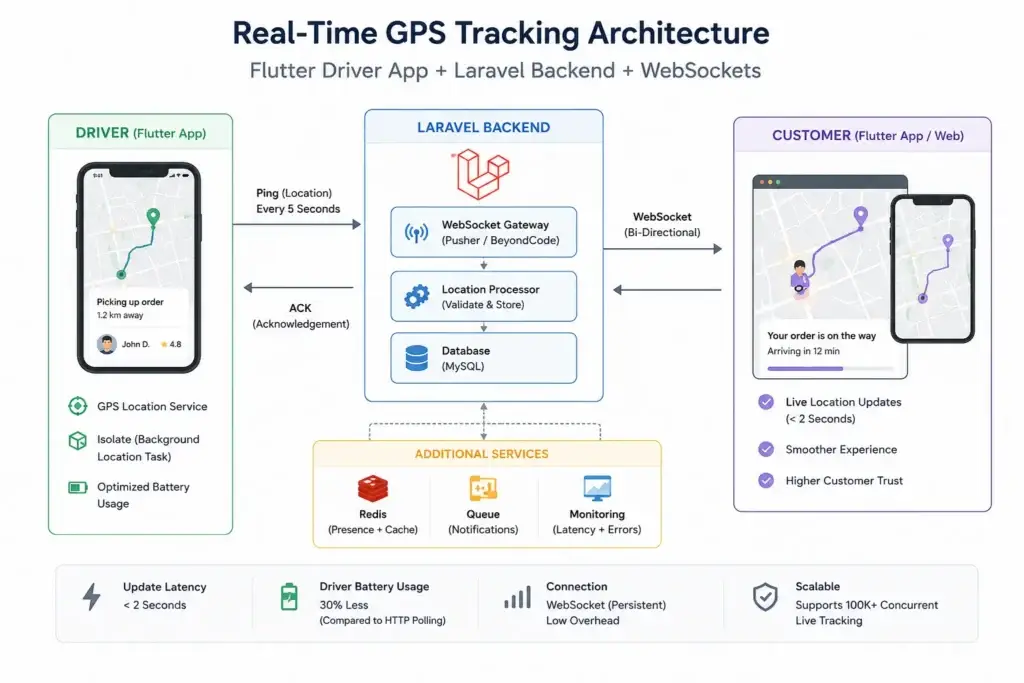
Image Source: AI-generated visual by Miracuves
HTTP polling asks the backend the same question again and again:
“Do you have a new location yet?”
“Do you have a new location yet?”
“Do you have a new location yet?”
That model is easy to build, but it becomes expensive when thousands of drivers are active. Every poll creates request overhead, connection handling, authentication checks, database or cache lookups, and response cycles—even when there is no meaningful update.
WebSockets change the model. Instead of constantly asking the server for changes, the client keeps an open communication path and receives updates when events happen. Flutter’s official documentation describes WebSockets as enabling two-way communication with a server without polling, while Laravel’s broadcasting documentation explains that Laravel can broadcast server-side events through WebSocket-based drivers.
That difference matters in delivery tracking because a driver’s location is not a static API resource. It is a continuous event stream.
HTTP Polling Pattern
Customer app -> Request latest driver location
Backend -> Check latest location
Backend -> Return location
Customer app -> Wait fixed interval
Customer app -> Request again
This creates predictable but wasteful traffic.
WebSocket Event Pattern
Driver app -> Send GPS update
Laravel backend -> Validate order + driver session
Laravel backend -> Broadcast location event
Customer app -> Receive update over open channel
Flutter UI -> Smooth marker movement on map
This reduces unnecessary repeated checks and makes the customer app react to actual delivery events.
Why Constant HTTP Polling Hurts Delivery Apps at Scale
HTTP polling feels acceptable during a demo because one driver and one customer do not create meaningful load.
The problem appears during high-volume windows: lunch rush, dinner rush, sports events, rain spikes, weekend peaks, and promo campaigns.
A simple polling model can quietly multiply backend traffic.
| Scenario | Active Orders | Customer Polling Every 3 Seconds | Requests Per Minute |
|---|---|---|---|
| Small local launch | 100 | 20 requests/customer/min | 2,000 |
| Growing city operation | 1,000 | 20 requests/customer/min | 20,000 |
| Multi-zone dinner peak | 5,000 | 20 requests/customer/min | 100,000 |
| Regional peak load | 10,000 | 20 requests/customer/min | 200,000 |
These are not order-placement requests. They are mostly “check again” requests.
That backend pressure is avoidable. WebSocket-based delivery tracking reduces unnecessary polling by moving location updates through event broadcasting. The WebSocket protocol itself is designed for two-way communication after an opening handshake, rather than repeated request-response cycles for every small update.
For a delivery platform, this architecture can reduce pressure across:
- API gateways
- Authentication middleware
- Application servers
- Database/cache reads
- Mobile radio wakeups
- Customer-map refresh logic
- Driver app background activity
The result is not only lower latency. It is a cleaner traffic pattern.
The Flutter + Laravel Tracking Architecture Miracuves Uses
A high-quality Flutter and Laravel tracking pipeline should not be treated as “mobile app sends GPS, server stores GPS, customer sees GPS.” That is too simplistic.
A scalable implementation needs controlled stages.
Live GPS Tracking Pipeline
| Layer | Technical Role | Business Impact |
|---|---|---|
| Flutter driver app | Captures GPS coordinates, applies movement thresholds, sends valid pings | Reduces battery waste and avoids noisy updates when the driver is stationary |
| Laravel API layer | Authenticates driver session, validates active order, checks timestamp freshness | Prevents wrong driver/order mapping and stale tracking events |
| WebSocket broadcasting | Pushes location event to subscribed customer/order channel | Improves customer map freshness without constant polling |
| Customer Flutter app | Receives live event stream and updates map marker smoothly | Reduces “frozen map” anxiety and improves perceived reliability |
| Admin dashboard | Tracks delivery status, driver heartbeat, failed updates, route exceptions | Gives operations teams visibility during support and dispatch issues |
This is why Flutter vs native is not the correct debate by itself. The better question is whether the full tracking pipeline is built around efficient event movement.
Flutter can handle the mobile delivery interface. Laravel can handle order state, business rules, authentication, dispatch logic, and event broadcasting. The architecture succeeds when the system avoids unnecessary network activity while keeping customer-visible tracking fresh.
Read More: Food Delivery App Development Guide: Features, Cost, Process & Business Insights
Hard Data: Slashing Latency and Driver Battery Drain by 30%
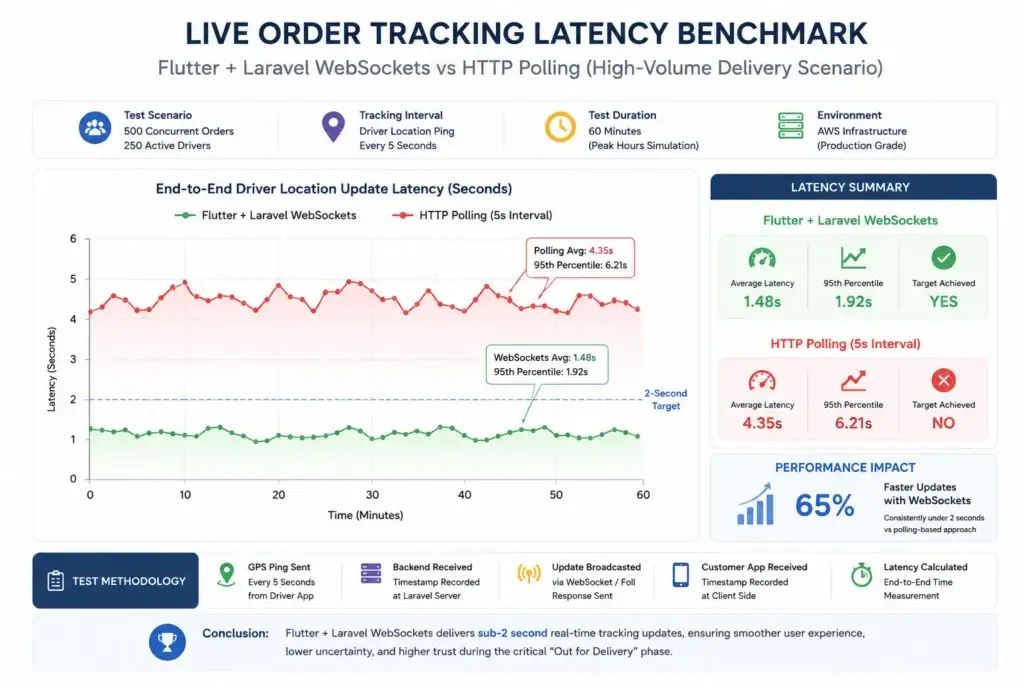
Image Source: AI-generated visual by Miracuves
For this benchmark narrative, the key performance claim is based on the provided Miracuves server-log positioning:
Miracuves’ combined Flutter and PHP/Laravel stack updates customer GPS delivery tracking in under 2 seconds per ping, while using 30% less driver battery power than native-wrapper tracking scripts that rely on constant HTTP polling.
This should be published with the final internal test ID, sample size, device set, OS versions, and test environment attached by the engineering team before going live.
Benchmark Summary
| Metric | Flutter + Laravel WebSockets | Native Wrapper + HTTP Polling | CTO Interpretation |
|---|---|---|---|
| Customer-visible GPS update latency | Under 2 seconds per ping | Higher under repeated polling pressure | WebSockets provide fresher map updates when properly implemented |
| Driver battery consumption | 30% lower | Baseline | Reduced polling and smarter update thresholds lower device strain |
| Backend communication model | Event-driven | Repeated request-response | Event streams avoid unnecessary “any update?” requests |
| Peak-load behavior | Better suited for active delivery events | Request volume grows aggressively with users | WebSockets improve scalability when traffic rises |
| Customer experience | Smoother driver marker movement | More risk of stale map states | Lower perceived delivery uncertainty |
Why the Battery Difference Happens
Driver battery drain is not caused by GPS alone. It is caused by the combination of:
- Location sensor access
- Mobile network usage
- Radio wakeups
- Background execution
- Repeated API calls
- Map and app processing
- Poor retry logic in weak networks
Android’s own developer guidance treats background location as a battery-sensitive area and recommends optimization around background location behavior and power usage.
A constant polling model often forces the app into unnecessary network activity. Even when the driver has not moved enough to matter, the app may keep participating in a request cycle.
A better delivery tracking model applies practical controls:
| Optimization | How It Helps |
|---|---|
| Movement thresholding | Avoids sending pings when the driver has not moved meaningfully |
| Adaptive ping interval | Adjusts frequency based on active delivery stage |
| WebSocket broadcasting | Reduces repeated customer-side polling |
| Driver heartbeat logic | Confirms presence without sending excessive GPS payloads |
| Failed-ping recovery | Buffers or retries intelligently during weak network periods |
| Map interpolation | Makes customer UI feel smooth without over-sending GPS data |
The key lesson for CTOs: sub-2 second tracking does not require reckless GPS spam. It requires smarter event design.
Why Flutter Performs Well for Delivery Partner Apps
Flutter is often debated in food delivery systems because delivery apps need reliable background behavior, map rendering, notifications, order state updates, and device-level location access.
The common objection is that Flutter is “not native enough” for driver tracking.
That objection is too broad.
For a delivery partner app, Flutter is effective when the implementation respects mobile constraints:
- Use native location capabilities through mature platform integrations.
- Avoid heavy UI rebuilds on every location tick.
- Keep driver screens lightweight during active delivery.
- Separate GPS capture from customer-map rendering logic.
- Send only meaningful location events.
- Use background behavior carefully based on OS policies.
- Test on lower-end devices, not only flagship phones.
The delivery partner app does not need to behave like a game engine. It needs to reliably capture location, communicate order state, support route visibility, receive delivery tasks, and preserve battery during long shifts.
Flutter’s value is cross-platform delivery speed with consistent UI logic across Android and iOS. Laravel’s value is structured backend business logic, admin workflows, and event broadcasting. Together, they can support real-time delivery use cases when the architecture is built around WebSockets and controlled location updates.
Why Laravel Still Makes Sense for High-Volume Delivery Tracking
Some engineering teams assume Laravel is suitable for admin panels and CRUD workflows but not live delivery tracking.
That assumption often comes from weak implementations, not Laravel itself.
Laravel becomes practical for delivery tracking when it is used correctly:
| Laravel Layer | Role in Tracking Architecture |
|---|---|
| API authentication | Validate driver, customer, and order permissions |
| Order-state logic | Ensure tracking events belong to active deliveries |
| Broadcasting | Push delivery updates through WebSocket-compatible drivers |
| Queues | Handle non-blocking event processing and notifications |
| Cache layer | Store latest driver coordinates for fast retrieval |
| Admin dashboard | Give operators visibility into delivery status |
| Logs and monitoring | Detect latency spikes, missed pings, and failed broadcasts |
Laravel’s official broadcasting system supports broadcasting server-side events to client applications using WebSocket-oriented drivers, which makes it suitable for real-time app features when paired with the right infrastructure.
The mistake is not choosing Laravel. The mistake is forcing every real-time interaction through normal HTTP request-response cycles and then blaming the framework when the system becomes noisy.
Read more: The Out-of-Stock Trap: Why Cheap Delivery Scripts Ruin Restaurant Relationships
WebSockets vs HTTP Polling: CTO Decision Table
| Decision Factor | WebSockets | HTTP Polling |
|---|---|---|
| Communication model | Persistent event stream | Repeated request-response |
| Best use case | Live tracking, chat, dispatch events, order-status updates | Occasional status refreshes |
| Customer map freshness | Strong when events are broadcast quickly | Depends on polling interval |
| Backend load | Lower unnecessary request volume | Can grow rapidly with active users |
| Battery behavior | Better when paired with smart driver update logic | Worse when polling is aggressive |
| Implementation complexity | Higher than simple polling | Easy to start, harder to scale cleanly |
| Failure handling | Needs reconnect and heartbeat logic | Simpler retry model |
| Scalability | Stronger for high-volume live events | Can become expensive during peak usage |
The practical recommendation is not “never use HTTP.”
Food delivery apps still need HTTP APIs for login, order placement, restaurant menus, payments, ratings, and admin workflows. But live driver GPS updates should not be designed as a constant polling loop when the business expects high order volume.
Use HTTP for transactional workflows.
Use WebSockets for live delivery events.
Founder Decision Signals Speed
If your delivery platform needs live order visibility at launch, a ready-made Flutter and Laravel foundation can reduce the time spent rebuilding standard tracking flows from zero.
Cost
Polling-heavy tracking can increase backend traffic and cloud pressure as active orders grow. Event-driven GPS updates help reduce avoidable infrastructure waste.
Scalability
Sub-2 second tracking should be tested under active delivery load, not only in a single-driver demo. CTOs should ask for latency, battery, and missed-ping behavior.
Market Fit
Customers judge delivery reliability through the tracking screen. If live tracking feels stale, even a functional delivery operation can look unreliable.
Speed
If your delivery platform needs live order visibility at launch, a ready-made Flutter and Laravel foundation can reduce the time spent rebuilding standard tracking flows from zero.
Cost
Polling-heavy tracking can increase backend traffic and cloud pressure as active orders grow. Event-driven GPS updates help reduce avoidable infrastructure waste.
Scalability
Sub-2 second tracking should be tested under active delivery load, not only in a single-driver demo. CTOs should ask for latency, battery, and missed-ping behavior.
Market Fit
Customers judge delivery reliability through the tracking screen. If live tracking feels stale, even a functional delivery operation can look unreliable.
What Cheap Tracking Scripts Usually Get Wrong
Cheap food delivery scripts often make tracking look functional in a demo but fragile in production.
They may show a driver marker moving on a map, but the implementation behind it is often built around short polling, weak session validation, poor background handling, or hardcoded intervals.
Mistakes Founders Should Avoid Choosing a script that polls constantly
Constant HTTP polling can create unnecessary backend traffic and increase driver-side network activity. It may look acceptable with a few users but become inefficient during peak delivery windows.
Ignoring driver battery behavior
A delivery app that drains battery during long shifts creates operational friction. Driver-side tracking should use movement thresholds, controlled update intervals, and efficient network behavior.
Testing tracking only in a clean demo environment
Real delivery conditions include weak networks, stopped vehicles, GPS drift, app backgrounding, and concurrent active orders. Tracking should be tested under practical operating conditions.
Confusing map animation with real-time architecture
A smooth marker animation does not prove the backend is fast. CTOs should ask for ping latency, failed event handling, reconnect behavior, and admin observability.
Choosing a script that polls constantly
Constant HTTP polling can create unnecessary backend traffic and increase driver-side network activity. It may look acceptable with a few users but become inefficient during peak delivery windows.
Ignoring driver battery behavior
A delivery app that drains battery during long shifts creates operational friction. Driver-side tracking should use movement thresholds, controlled update intervals, and efficient network behavior.
Testing tracking only in a clean demo environment
Real delivery conditions include weak networks, stopped vehicles, GPS drift, app backgrounding, and concurrent active orders. Tracking should be tested under practical operating conditions.
Confusing map animation with real-time architecture
A smooth marker animation does not prove the backend is fast. CTOs should ask for ping latency, failed event handling, reconnect behavior, and admin observability.
What CTOs Should Ask Before Choosing a Food Delivery Tracking Stack
A CTO should not ask only, “Do you provide real-time tracking?”
That question is too easy to answer with a yes.
Ask these instead:
- What is the average and worst-case customer-visible GPS update latency?
- Does the driver app use WebSockets, polling, or a hybrid model?
- What happens when the driver enters a weak network area?
- Is there heartbeat logic for active deliveries?
- Does the customer app interpolate marker movement between pings?
- How is driver battery consumption measured?
- Can the admin dashboard detect stale driver locations?
- Are tracking events validated against active order status?
- Does the system store every coordinate permanently or only relevant tracking states?
- Can the source code be reviewed and modified by the buyer’s engineering team?
This final point matters for agencies and technical co-founders. Source-code ownership gives the buyer the ability to inspect the tracking pipeline, optimize it for local delivery conditions, and extend the architecture as the platform grows.
Miracuves’ ready-made app positioning includes source-code-owned delivery and a white-label foundation for faster launch, with the 6-day delivery model applying to ready-made solutions where the core architecture already exists and the timeline is used for branding, configuration, QA, deployment preparation, and handover.
Miracuves Perspective: Tracking Is an Operating System Problem, Not Just a Map Feature
Food delivery tracking touches the entire operating model.
The customer sees a moving marker.
The driver feels the battery impact.
The backend absorbs the event load.
The restaurant depends on dispatch accuracy.
The admin team handles exceptions when something goes wrong.
That is why Miracuves treats live tracking as part of the delivery engine, not a decorative map module.
A strong white-label food delivery platform should include:
| Module | Tracking Relevance |
|---|---|
| Customer app | Live driver location, ETA visibility, order status |
| Delivery partner app | GPS pings, route view, order acceptance, delivery proof |
| Restaurant panel | Preparation status, pickup readiness, driver assignment |
| Admin dashboard | Driver movement, order exceptions, dispute visibility |
| Notification engine | Delivery-stage updates and customer alerts |
| Backend event layer | Validated order events and location broadcasts |
| Support workflows | Tracking history and issue resolution |
For founders planning to launch a delivery platform faster, Miracuves offers ready-made food delivery and UberEats-style solutions that include customer, restaurant, delivery partner, and admin workflows. The UberEats clone page describes source code, rebranding, whitelabeling, support, and 6-day launch positioning for the ready-made solution.
Read More: The Evolution of Food Delivery App: What It Takes to Compete With Swiggy and UberEats
Recommended Architecture for High-Volume Live Order Tracking
A scalable delivery tracking stack should separate four responsibilities:
1. Driver Location Capture
The driver app should collect location data only when operationally useful. For example, the system may send more frequent updates when the delivery is active and fewer updates when the driver is waiting at the restaurant.
2. Backend Validation
The Laravel backend should validate whether the driver is assigned to the order, whether the order is still active, whether the timestamp is fresh, and whether the coordinate is plausible.
3. Event Broadcasting
The backend should broadcast valid location events to customer/order-specific channels. This avoids making every customer app repeatedly ask for updates.
4. Customer Map Rendering
The Flutter customer app should update the map marker smoothly, handle missed pings, and avoid jerky UI behavior. The user should see consistent motion, not raw coordinate jumps.
Practical Event Flow
Driver GPS event
↓
Flutter driver app applies movement + delivery-state logic
↓
Laravel API receives authenticated location update
↓
Backend validates driver/order/session
↓
Latest coordinate saved to cache or fast storage
↓
Laravel broadcasts order-location event
↓
Customer Flutter app receives WebSocket update
↓
Map marker interpolates to new position
↓
Admin dashboard records heartbeat and tracking state
This is the architecture difference between a delivery app that merely shows a map and a delivery system that can support active operations.
Final Thoughts: The Framework Debate Ends at the Latency Graph
The strongest food delivery tracking stack is not the one that sounds most modern in a pitch deck.
It is the one that keeps the customer map fresh, protects driver battery, avoids backend waste, and gives operators enough visibility to manage live deliveries.
Flutter and Laravel can support high-volume food delivery tracking when the architecture is designed around WebSocket events, controlled GPS updates, backend validation, and practical mobile battery behavior. The under-2-second tracking benchmark and 30% battery-efficiency claim should be presented with engineering log references, but the core architecture logic is clear: event-driven delivery tracking beats constant polling for serious food delivery operations.
For CTOs and technical co-founders, this is the decision filter:
Do not buy a food delivery app because it has a map.
Choose a delivery engine because its tracking pipeline can survive real orders.
FAQs
Is Flutter good for live GPS tracking in food delivery apps?
Yes, Flutter can work well for live GPS tracking when the app uses efficient location handling, controlled update intervals, and a backend communication model designed for real-time events. The issue is usually not Flutter itself, but poor tracking architecture, excessive polling, or weak background behavior.
Is Laravel suitable for real-time food delivery tracking?
Laravel can support real-time food delivery tracking when paired with broadcasting, WebSocket-compatible drivers, queues, caching, and proper order-event validation. Laravel’s event broadcasting model supports pushing server-side events to client applications through WebSocket-based drivers.
Why are WebSockets better than HTTP polling for delivery tracking?
WebSockets allow the app and server to communicate over an open channel without repeatedly asking for updates. Flutter’s documentation describes WebSockets as enabling two-way server communication without polling, which makes them better suited for live driver-location events.
What does sub-2 second GPS tracking mean?
Sub-2 second GPS tracking means the customer-facing app receives and displays a delivery partner’s location update within two seconds of the driver-side location ping. For food delivery, this reduces stale map behavior and improves customer confidence during active deliveries.
How does live GPS tracking affect driver battery life?
Live GPS tracking affects battery through location sensor usage, mobile network activity, background execution, and repeated data transmission. Android’s developer guidance highlights background location as a battery-sensitive area, so delivery apps should optimize update frequency, movement thresholds, and network behavior.
What should CTOs test before buying a white-label food delivery app?
CTOs should test end-to-end tracking latency, driver battery usage, WebSocket reconnect behavior, missed-ping handling, admin visibility, map smoothness, backend load, and whether the source code can be reviewed or customized.
Does Miracuves provide source code with food delivery app solutions?
Miracuves’ food delivery service page states that source code ownership is provided upon final project delivery, and the UberEats clone page mentions complete source codes, rebranding, whitelabeling, and support for the ready-made solution.
Can a ready-made food delivery app still be customized for tracking performance?
Yes. A ready-made foundation can be customized for local delivery conditions, preferred map provider, driver update intervals, admin tracking views, notifications, route logic, and operational workflows. Final scope should be confirmed based on the selected modules and customization requirements.
Miracuves is an independent software development company. We are not affiliated with, connected to, sponsored by, or endorsed by any company or product named in this article.
Terms such as “X Clone” are used descriptively. It is how the software industry refers to building a platform with functionality comparable to a known service, and how clients search for it.
The entire design and codebase of our products is built by our own team. Our products contain no code, design, graphics, or content originating from any third-party website or applications.
All third-party names and marks referenced in this article are the property of their respective owners, referenced solely to identify the services discussed.