
For a delivery startup, the most dangerous software cost is not always the one paid on Day 1.
It is the cost that quietly grows every time the business succeeds.
Many SaaS delivery builders look attractive at launch because the upfront commitment feels low. A founder can sign up, configure the storefront, add restaurants or merchants, and start accepting orders without a large development investment. For a small restaurant or a local experiment, that may be reasonable.
But for a startup CFO, angel investor, or founder building a scalable delivery marketplace, the real question is different:
What happens after 36 months when order volume grows?
That is where the debate changes from “Which platform is cheaper to start?” to “Which platform protects unit economics over time?”
This report compares two delivery software ownership models:
- SaaS delivery builders that charge recurring fees, usage fees, or transaction-based percentages.
- Owned white-label delivery engines where the founder pays a flat acquisition cost and owns the source-code foundation.
The model below uses a 3% per-transaction SaaS fee as the comparison variable provided in the brief. Actual SaaS vendor pricing varies, and some platforms may combine subscriptions, transaction fees, feature limits, usage tiers, or support charges. Recent white-label software comparison guides also warn that some platforms use monthly plans, one-time licenses, or transaction-sharing structures, while hidden hosting, updates, and support costs can change the real budget.
Why Day-1 Software Cost Misleads Delivery Startups
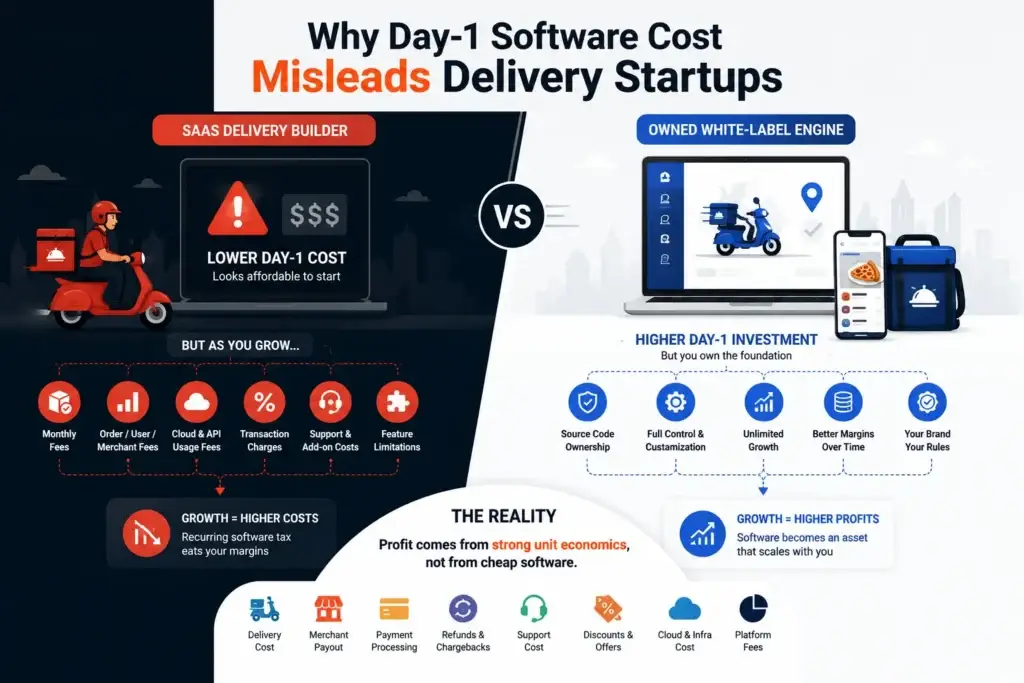
Image Source: AI-generated visual by Miracuves
A delivery business does not become profitable because the software was inexpensive on launch day.
It becomes financially stronger when each order leaves enough contribution margin after delivery cost, merchant payout, payment processing, refunds, support, discounts, cloud costs, and platform fees.
That is why a Day-1 pricing comparison is incomplete.
A SaaS delivery builder may appear cheaper because it avoids a larger upfront acquisition or development payment. But in many SaaS models, the operator keeps paying as the business grows. The startup may pay for monthly access, order volume, users, merchants, drivers, features, API usage, or transaction value.
An owned white-label delivery engine works differently. The founder acquires the software foundation, applies branding, configures business rules, and controls the source-code-owned platform. Miracuves positions its Food Delivery Platform around white-label app solutions, source code ownership, scalability, and branded delivery workflows.
For a founder, that changes the cost structure.
SaaS turns growth into a recurring software tax. Ownership turns software into a controlled asset.
Read more: Online Food Delivery Platform Development: Hidden Costs You Should Know
The Per-Transaction Tax: How SaaS Delivery Platforms Penalize Your Growth
A percentage fee is psychologically easy to ignore when order volume is low.
At 1,000 monthly orders, a 3% software fee may feel manageable. At 50,000 or 100,000 cumulative orders, it becomes a board-level finance issue.
Here is why.
A delivery startup already operates with margin pressure. The company may need to fund customer acquisition, merchant incentives, rider operations, support, refunds, app maintenance, and local expansion. If the platform also takes a percentage of every transaction, the software vendor participates in revenue growth without taking delivery execution risk.
That matters because delivery marketplaces usually need scale to become efficient. The more orders the startup processes, the more valuable every basis point of margin becomes.
A 3% fee does not sound large until CFOs translate it into annualized gross merchandise value.
The core formula
SaaS transaction fee cost = Total orders × Average order value × Transaction fee percentage
Using the brief’s 3% SaaS fee assumption:
SaaS transaction fee cost = Orders × AOV × 3%
This is not a fixed software expense. It is a variable cost attached to growth.
Read more: How to Start a Regional Food Delivery Platform Business
The Mathematics of Total Cost of Ownership at 100,000 Orders
Let us build the first model.
Base assumptions
| Variable | Assumption |
|---|---|
| Cumulative order volume | 100,000 orders |
| Average order value | $25 |
| Gross merchandise value | $2,500,000 |
| SaaS transaction fee | 3% |
| SaaS transaction fee paid | $75,000 |
At 100,000 orders, the SaaS delivery builder collects:
100,000 × $25 × 3% = $75,000
That is only the transaction-fee layer. It does not include monthly SaaS subscription charges, premium feature access, hosting add-ons, payment gateway fees, SMS fees, map usage, support tiers, or migration cost.
The same cost logic appears across the broader food delivery app market: development, API usage, payment gateway charges, maps, hosting, and maintenance all contribute to real long-term cost. Recent food delivery cost guides point to third-party APIs, payment gateways, maps, hosting, and maintenance as recurring cost drivers beyond the initial build.
Now compare that with a flat-fee white-label engine.
Miracuves publicly lists a Zomato clone current price of $2,799 with 6-day deployment, source code, white-labeling, rebranding, app publishing support, support, and updates on its Zomato clone page. Miracuves also publishes a Swiggy clone package at $3,399 as a one-time price in a 6-day delivery context. Final pricing still depends on scope, customization, integrations, and the selected delivery model.
Using the $3,399 Swiggy-like package as an illustrative published Miracuves benchmark:
| Cost Model | Cost at 100,000 Orders |
|---|---|
| SaaS builder at 3% of $2.5M GMV | $75,000 |
| Miracuves published Swiggy-like one-time package example | $3,399 |
| Difference before other costs | $71,601 |
This is the key CFO insight:
The SaaS platform does not need to look expensive on Day 1 to become expensive by Month 36.
36-Month TCO Model: SaaS Fees vs. Owned White-Label Engine
A stronger TCO model should not use one order scenario only. Delivery startups grow unevenly. Some remain local. Some expand into multi-zone operations. Some add grocery, pharmacy, courier, or quick-commerce categories.
Below is a 36-month model using three scenarios.
Assumptions used in this model
| Variable | Value |
|---|---|
| SaaS transaction fee | 3% |
| Average order value | $25 |
| Period | 36 months |
| Owned white-label engine benchmark | $3,399 one-time published Miracuves Swiggy-like example |
| Exclusions | Payment gateway charges, hosting, custom integrations, support plans, rider cost, marketing, tax, and legal cost |
36-month comparison table
36-Month TCO Model: SaaS Transaction Fee vs Owned White-Label Engine
| 36-Month Order Scenario | GMV at $25 AOV | SaaS Cost at 3% | Owned Engine Benchmark | Estimated SaaS Premium |
|---|---|---|---|---|
| 100,000 orders | $2,500,000 | $75,000 | $3,399 | $71,601 |
| 300,000 orders | $7,500,000 | $225,000 | $3,399 | $221,601 |
| 1,000,000 orders | $25,000,000 | $750,000 | $3,399 | $746,601 |
This table shows why SaaS can be useful for small experiments but dangerous for scaling marketplaces.
At 100,000 cumulative orders, the SaaS fee already exceeds the illustrative Miracuves package benchmark by more than $70,000. At 300,000 cumulative orders, the gap crosses $220,000. At 1,000,000 orders, the software fee alone reaches $750,000.
That money could otherwise fund:
- rider incentive optimization
- merchant acquisition
- customer retention campaigns
- cloud infrastructure
- route optimization
- city expansion
- support operations
- loyalty and referral programs
- product customization
- investor runway extension
For CFOs, the concern is not just software cost. It is capital allocation.
Read More: The Role of Predictive Analytics in Modern Logistics and Delivery Apps
Break-Even Analysis: When Does Ownership Start Winning?
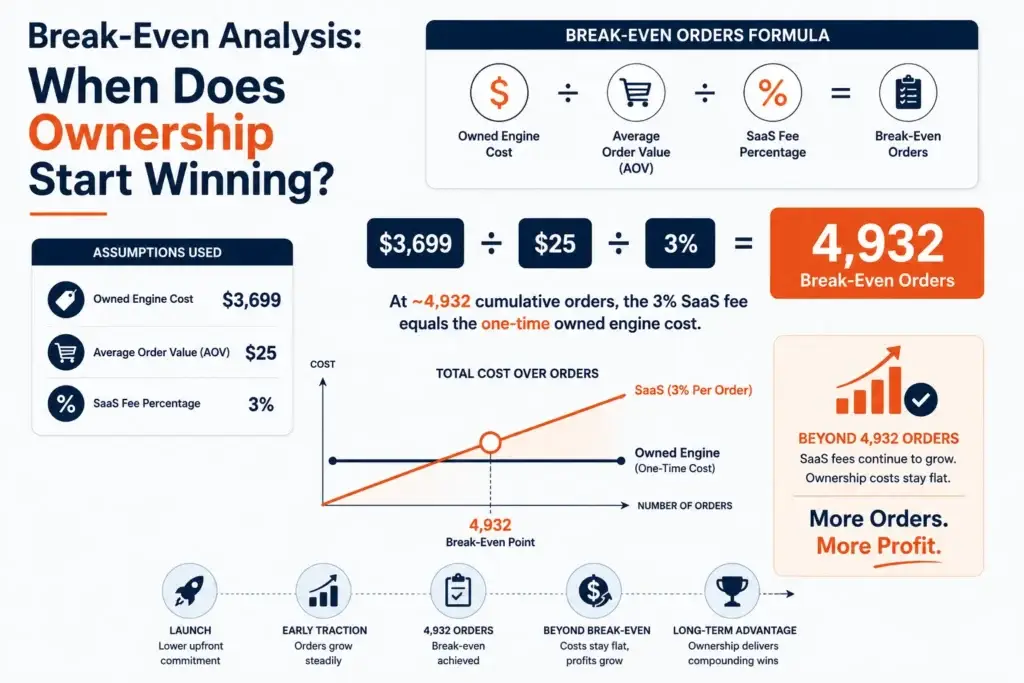
Image Source: AI-generated visual by Miracuves
A break-even model helps investors understand when a flat-fee owned engine becomes financially stronger than a transaction-fee SaaS platform.
Using the same assumptions:
Break-even orders = Owned engine cost ÷ AOV ÷ SaaS fee percentage
With a $3,399 owned engine benchmark, $25 AOV, and 3% SaaS fee:
$3,399 ÷ $25 ÷ 3% = 4,532 orders
That means the 3% SaaS fee equals the illustrative one-time engine cost after roughly 4,532 cumulative orders.
For a delivery startup, 4,532 orders is not a mature scale milestone. It can be an early validation milestone. Once the platform crosses that volume, the SaaS percentage fee continues growing while the flat acquisition cost does not automatically rise per order.
The Miracuves Flat-Fee Advantage: Protecting Your Profit Margins
The strongest case for an owned white-label engine is not that it looks cheaper in a pricing table.
It is that it gives founders more control over the cost curve.
A ready-made delivery app foundation from Miracuves can help founders launch faster because the core app flows are already structured. Miracuves’ 6-day model is described as a process built on ready-made foundations, branding, QA, deployment workflows, and source-code handover rather than building every module from zero.
For a delivery business, this matters because the app is not just a storefront. It is the operating layer for:
- customer ordering
- restaurant or merchant management
- delivery partner workflows
- admin control
- commission configuration
- order tracking
- payment gateway integration
- refund and dispute workflows
- promotions and coupons
- reporting and analytics
- service zones and delivery logic
Miracuves’ delivery app service page positions its delivery solutions around white-label app development, source-code ownership, scalability, and branded food delivery workflows.
That ownership changes three financial levers.
1. Margin retention
When software cost is not tied to every transaction, the founder can retain more contribution margin as order volume grows.
2. Operating control
With source-code ownership, the startup has more flexibility to customize features, integrate tools, change workflows, and avoid platform dependency. Miracuves’ broader clone app positioning emphasizes source code ownership, white-label branding, admin control, and faster deployment for founders.
3. Investor clarity
Investors prefer understanding how costs behave at scale. A flat acquisition model is easier to forecast than a percentage fee that expands with GMV.
Founder Decision Signals: When SaaS Stops Being Financially Efficient
Founder Decision Signals
Speed
SaaS may help launch a small test quickly, but a ready-made white-label engine can also support fast deployment while giving the founder more long-term control.
Cost
If your order volume is expected to cross a few thousand orders quickly, percentage-based SaaS fees can become more expensive than a flat acquisition model.
Scalability
Scaling delivery operations requires flexible admin control, integrations, pricing rules, merchant workflows, and dispatch logic. Ownership gives more room to adapt.
Market Fit
If the business is still testing demand, SaaS can be acceptable. If the founder is raising capital or building a category-specific marketplace, owned infrastructure becomes more strategic.
What CFOs Should Include in Delivery App TCO
A serious 36-month TCO model should include more than software license price.
For delivery startups, the real model should include:
| Cost Layer | Why It Matters |
|---|---|
| Platform acquisition or subscription | Determines fixed vs. recurring software cost |
| Transaction fees | Directly affects contribution margin |
| Payment gateway fees | Applies to every paid order |
| Hosting and cloud infrastructure | Increases with traffic, order volume, and data usage |
| Maps and routing APIs | Can become material as delivery volume grows |
| SMS, email, and notification tools | Required for order updates and retention |
| Custom integrations | Needed for payment, POS, ERP, courier, or analytics tools |
| Support and maintenance | Keeps the platform stable after launch |
| Feature upgrades | Needed as competitors and customers evolve |
| Migration cost | Becomes painful if the startup outgrows a SaaS platform |
| Data ownership and export risk | Affects analytics, retention, CRM, and investor reporting |
Food delivery cost guides frequently mention that APIs, maps, payment gateways, hosting, and maintenance continue after launch, so CFOs should treat software as an operating system, not a one-time website expense..
Read More: The “Ghost Driver” Problem: Comparing GPS Accuracy in Cheap Scripts vs. Enterprise Engines
SaaS vs. Owned White-Label Engine: CFO Comparison
| Decision Factor | SaaS Delivery Builder | Owned White-Label Engine |
|---|---|---|
| Day-1 cost | Usually lower upfront | Higher upfront than basic SaaS, but predictable |
| Cost at scale | Rises with orders, GMV, users, or features | Does not automatically rise per transaction |
| Source code | Usually not owned | Owned when provided under source-code terms |
| Customization | Often limited by platform rules | More flexible based on codebase and scope |
| Investor view | Operating expense with dependency risk | Software asset with more control |
| Migration risk | Can be high once data and workflows are locked in | Lower if the founder owns the foundation |
| Margin impact | Percentage fees reduce contribution margin | Flat acquisition helps protect margin |
| Best for | Small experiments, single-store tests, low-volume use cases | Growth-focused delivery startups, marketplaces, agencies, and funded founders |
Mistakes Founders Should Avoid
Mistakes Founders Should Avoid
Comparing only upfront price
A low Day-1 price can hide expensive transaction fees, usage limits, premium feature charges, or migration costs. CFOs should model 36-month cost, not only setup cost.
Ignoring order-volume sensitivity
A 3% fee may look small at low order volume, but it becomes a major software cost when GMV grows. Always model conservative, growth, and scale scenarios.
Treating software as a disposable tool
For a delivery marketplace, the app controls ordering, logistics, payments, merchants, drivers, and customer data. It should be treated as core infrastructure.
Overlooking source-code ownership
Without source-code ownership, the startup may face limits on customization, data access, migration, and investor-grade technical control.
When SaaS Still Makes Sense
This is not an argument that SaaS is always wrong.
SaaS delivery builders may make sense when:
- a restaurant wants a simple branded ordering page
- the business has very low monthly order volume
- the founder is testing an idea for a few weeks
- source-code ownership is not important
- the business does not need deep workflow customization
- the operator accepts platform dependency as a tradeoff
But the moment a startup starts thinking about funding, city expansion, multi-merchant operations, vertical expansion, or serious unit economics, the ownership question becomes unavoidable.
At that point, the better question is not:
“Which platform is cheapest today?”
The better question is:
“Which platform lets us keep more margin when the business works?”
Read more: Best Talabat Clone Script 2026 — Launch Your Food Delivery App
The Miracuves Position: Own the Engine Before Growth Makes It Expensive
A delivery startup should not wait until SaaS fees become painful before thinking about ownership.
By then, migration becomes harder. Customer data, merchant records, rider workflows, integrations, promotion logic, and order history may already be embedded into the SaaS system.
Miracuves helps founders avoid that late-stage dependency by starting with a ready-made, white-label delivery app foundation. For founders planning a Swiggy clone, Zomato clone, Uber Eats-style, grocery, courier, or hyperlocal delivery model, Miracuves’ source-code-owned approach can support faster launch, admin control, branded workflows, and long-term customization.
The financial argument is simple:
When the platform is leased, growth increases software rent. When the platform is owned, growth improves operating leverage.
Final Thoughts: The Cheapest Platform Is Not Always the Most Capital-Efficient
The delivery software decision is not only a technology decision. It is a 36-month financial decision.
SaaS delivery builders can look attractive at launch because they reduce upfront friction. But if the platform takes a percentage of every transaction, the software cost grows exactly when the startup needs margin discipline the most.
An owned white-label engine changes the equation. It gives founders a predictable software foundation, stronger customization control, and a clearer path to protect contribution margin as order volume increases.
For startup CFOs and angel investors, the takeaway is straightforward:
Do not compare delivery platforms by Day-1 cost. Compare them by 36-month total cost of ownership, margin retention, and control over the operating engine.
FAQs
What is the 36-month TCO of a delivery app?
The 36-month TCO of a delivery app is the total cost of owning, operating, maintaining, and scaling the platform over three years. It includes software acquisition or subscription fees, transaction fees, hosting, APIs, payment gateway charges, support, updates, integrations, and migration risk.
Why can SaaS delivery builders become expensive over time?
SaaS delivery builders can become expensive when they charge a percentage of each order, monthly subscriptions, usage fees, or premium feature fees. A 3% fee may look small early, but at $2.5 million in GMV it becomes $75,000 in platform cost.
Is a white-label delivery app better than SaaS?
A white-label delivery app can be better for founders who want brand control, source-code ownership, custom workflows, and stronger long-term cost control. SaaS may still work for small tests or low-volume restaurants, but ownership usually becomes more attractive when order volume grows.
How many orders does it take for a 3% SaaS fee to exceed an owned engine cost?
Using a $3,399 owned engine benchmark, a $25 average order value, and a 3% SaaS fee, the break-even point is about 4,532 cumulative orders. After that, the SaaS fee keeps growing with every order.
What should CFOs compare before choosing delivery app software?
CFOs should compare upfront cost, recurring fees, transaction fees, source-code ownership, hosting, support, API usage, payment processing, customization flexibility, migration cost, and data ownership.
Does Miracuves offer source-code-owned delivery app solutions?
Miracuves positions its ready-made and white-label clone app solutions around source-code ownership, branded design, admin dashboards, faster launch, and customization support for founders and businesses.
Is the 3% SaaS fee used here the same for every vendor?
No. The 3% fee is a model assumption from the brief. Actual SaaS delivery platform pricing may include different transaction fees, monthly subscriptions, order limits, support fees, or feature-based charges.
Why is source-code ownership important for delivery startups?
Source-code ownership gives founders more control over customization, scaling, integrations, migration, and long-term platform strategy. For delivery startups, this matters because the app controls orders, merchants, delivery partners, customer data, payments, and admin operations.
Miracuves is an independent software development company. We are not affiliated with, connected to, sponsored by, or endorsed by any company or product named in this article.
Terms such as “X Clone” are used descriptively. It is how the software industry refers to building a platform with functionality comparable to a known service, and how clients search for it.
The entire design and codebase of our products is built by our own team. Our products contain no code, design, graphics, or content originating from any third-party website or applications.
All third-party names and marks referenced in this article are the property of their respective owners, referenced solely to identify the services discussed.