


Key Takeaways
- AI moderation helps short video apps detect risks at scale.
- Spam and harmful content can quickly damage feed trust.
- Fake engagement can distort recommendations and creator visibility.
- Moderation should cover videos, comments, accounts, and behavior.
- Human review remains important for complex moderation decisions.
AI Moderation Signals
- Scan video frames, audio, captions, hashtags, and comments.
- Detect duplicate uploads, spam links, and suspicious accounts.
- Monitor fake likes, views, follows, and engagement bursts.
- Use risk scores to prioritize moderation queues.
- Support appeals, reason codes, audit logs, and admin review.
Real Insights
- Moderation protects growth as much as platform safety.
- Fake engagement is also a recommendation data problem.
- AI flags need strong admin workflows to become useful.
- AI-assisted moderation works better than AI-only enforcement.
- Miracuves builds short video apps with moderation and admin workflows.
Short video apps grow fast when users trust the feed. They stop growing when the feed becomes full of spam, harmful uploads, copied videos, unsafe comments, bot activity, fake likes, fake followers, or manipulated trends.
For a video creation platform, AI Moderation for Short Video Apps is no longer optional. Manual review alone cannot keep up with high-volume video uploads, comments, messages, live interactions, hashtags, captions, reports, and engagement events. Large platforms already use automated systems to support moderation at scale. TikTok says it continues to invest in moderation technologies, including AI, and reports that a large share of violating content removals are identified and removed by automation before user reports. YouTube also says AI classifiers help detect potentially violative content at scale, while human reviewers confirm whether content crosses policy lines.
For founders, this matters because moderation is not only a safety layer. It protects retention, creator trust, recommendation accuracy, advertiser confidence, and long-term monetization. A TikTok-style creator platform cannot scale if bad actors can pollute engagement signals or if unsafe content repeatedly reaches users.
Miracuves helps founders build white-label short video apps, influencer video platforms, and creator monetization platforms with admin control, moderation workflows, scalable backend logic, and source-code ownership.
Why AI Moderation Matters in Short Video Apps
Short video apps are built for speed. Users upload quickly, scroll quickly, comment quickly, share quickly, and react quickly. That speed creates growth, but it also creates risk.
A small platform may start with simple manual moderation. But once uploads increase, manual review becomes slow, inconsistent, and expensive. Harmful videos may stay live too long. Spam comments may spread across creator posts. Fake accounts may inflate likes, follows, and views. Copied content may enter the feed. Bad engagement data may confuse the recommendation engine.
That creates a direct business problem.
If users repeatedly see unsafe or low-quality content, they stop trusting the app. If real creators feel that bots and spam accounts are getting visibility, they stop publishing. If advertisers see brand-safety risk, they hesitate to spend. If platform operators cannot identify fake engagement, they may reward the wrong creators.
AI helps by screening large volumes of content and behavior quickly, then routing suspicious cases to human review or admin workflows.
What AI Actually Detects in a Video Creation Platform
AI Moderation for Short Video Apps is not one tool. It is a group of detection layers working across different parts of the platform.
| Detection Area | What AI Looks For | Why It Matters |
|---|---|---|
| Video frames | Nudity, violence, weapons, graphic content, unsafe visual patterns, restricted objects | Protects users and reduces harmful feed exposure |
| Audio | Hate speech, threats, abusive language, harmful instructions, suspicious voice patterns | Detects issues that visual checks may miss |
| Captions and text overlays | Spam links, abusive phrases, scams, misleading claims, prohibited keywords | Helps moderate short videos with text-heavy content |
| Comments and DMs | Harassment, spam, phishing, repeated promotional text, unsafe links | Protects creator-fan interaction |
| Hashtags | Trend manipulation, banned tags, spam clusters, misleading tags | Keeps discovery cleaner |
| Accounts | Bot-like registrations, duplicate behavior, suspicious profile patterns | Reduces platform abuse |
| Engagement | Fake likes, fake follows, fake views, unnatural comment bursts, bot farms | Protects recommendation quality |
| Reports | Repeated user flags, mass reporting abuse, escalated safety cases | Helps prioritize moderation queues |
A strong short video app should not only scan uploaded videos. It should also analyze behavior around the videos.
How AI Detects Spam in Short Video Apps
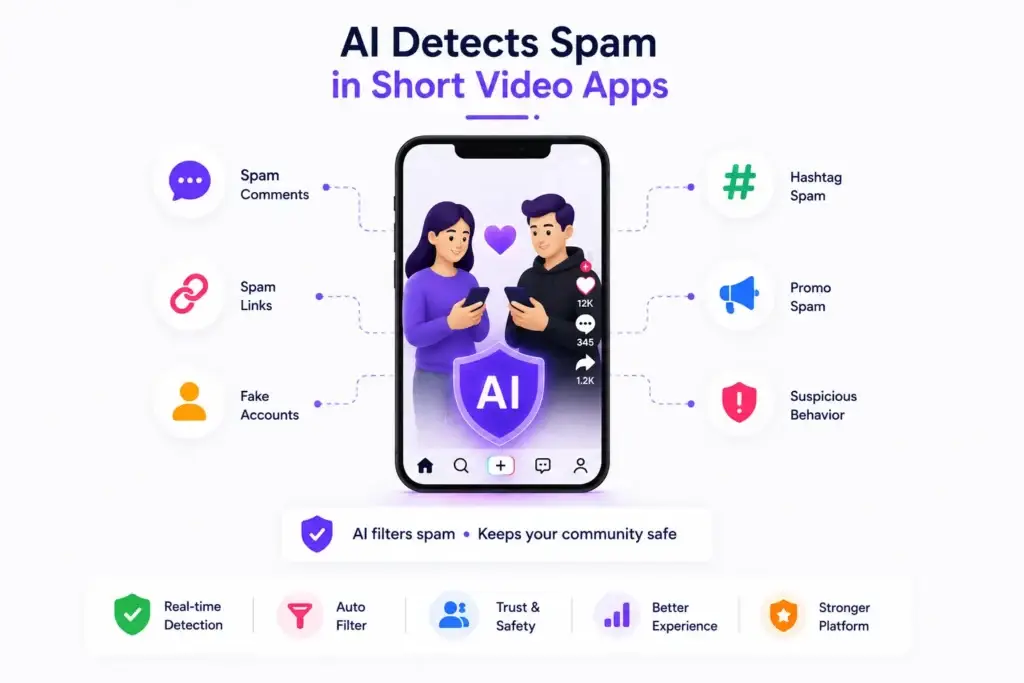
Spam in a short video app can appear in many places: comments, captions, bios, hashtags, DMs, live chat, usernames, links, and repetitive uploads.
AI can help detect spam by analyzing patterns such as:
- Repeated comments across many videos
- High-volume link posting
- Duplicate captions or captions with suspicious formatting
- Accounts that post the same message repeatedly
- Hashtag stuffing
- Sudden comment bursts from low-trust accounts
- Repeated promotional content with little real engagement
- Suspicious signup and posting behavior
TikTok’s community guidelines prohibit account behavior that may spam or mislead users, including automation used to register or operate accounts in bulk, distribute high-volume commercial content, artificially increase engagement signals, or evade enforcement. YouTube’s spam policy also addresses repetitive, deceptive, or high-volume comments, live chats, and messages that drive traffic or manipulate engagement.
For founders, the practical lesson is simple: spam detection should be built into the platform flow, not handled only after users complain.
How AI Identifies Harmful or Policy-Violating Content
Harmful content detection usually requires multiple AI systems working together.
A short video may look safe visually but include harmful speech in the audio. Another video may use text overlays to promote scams. Another may include misleading captions, harmful hashtags, or manipulated synthetic media. AI moderation must inspect the full media object, not just the thumbnail.
Common AI moderation layers include:
- Computer vision for video frames and thumbnails
- Speech-to-text transcription for audio
- Natural language processing for captions, comments, and hashtags
- Image recognition for restricted visuals
- Link and QR-code detection
- Duplicate media detection
- Synthetic or manipulated-media review signals
- Community-report prioritization
- Creator history and repeat-violation scoring
TikTok requires creators to label AI-generated content when realistic images, audio, or video are generated or modified by AI, and its policy explains that users can report videos they believe violate edited media or AI-generated content rules. YouTube has also said creators must disclose realistic altered or synthetic content in certain cases, with labels used to inform viewers.
This matters because short videos can spread quickly. AI moderation helps reduce the time between upload, risk detection, review, and enforcement.
AI Detection Layers Founders Should Prioritize
AI Moderation Layers and Business Value
| AI Layer | What It Detects | Founder Impact |
|---|---|---|
| Video frame analysis | Unsafe visuals, restricted content, graphic material, suspicious thumbnails | Protects feed quality before harmful uploads spread |
| Audio transcription | Harmful speech, threats, abusive language, unsafe instructions | Finds violations hidden inside spoken content |
| Caption and hashtag analysis | Spam links, banned terms, misleading tags, trend abuse | Keeps discovery and search cleaner |
| Comment moderation | Harassment, scams, spam, repeated promotions, unsafe links | Improves creator and user trust |
| Behavior analysis | Bot-like accounts, fake likes, fake follows, suspicious traffic clusters | Protects recommendation quality and creator fairness |
| Duplicate-content detection | Copied uploads, reuploaded videos, repeated spam media | Protects original creators and feed quality |
| Risk scoring | Combines content, account, report, and engagement signals | Helps admins prioritize review queues |
| Appeal and feedback loop | Tracks creator appeals and moderator decisions | Improves policy consistency over time |
How AI Finds Fake Engagement and Bot-Like Activity
Fake engagement is one of the most damaging problems in a short video app. It includes fake views, fake likes, fake comments, fake followers, fake shares, engagement pods, bot accounts, automated watch loops, and services that sell artificial popularity.
AI can help detect fake engagement by looking at platform-level behavior patterns instead of judging a single like or view in isolation.
Useful detection signals include:
- Sudden engagement spikes from low-trust accounts
- Repeated activity from suspicious account clusters
- Watch patterns that do not match human behavior
- Like bursts without meaningful watch time
- Follower growth with weak retention or no interaction
- Many comments using similar wording
- Repeated engagement from the same device or network patterns
- Accounts that only like, follow, or comment but never watch normally
- Unusual ratios between impressions, watch time, likes, comments, and shares
TikTok says it does not allow the trade or marketing of services that artificially increase engagement or deceive its recommendation system. It also says it may remove fake followers or likes when it becomes aware of inauthentically inflated metrics. YouTube defines fake engagement as artificially increasing metrics such as views, likes, comments, or other signals, and says it verifies and reviews activity to keep numbers accurate.
For a founder, fake engagement is not only a policy issue. It is a data-quality issue.
Why Fake Engagement Damages Recommendation Quality
A short video recommendation system depends on user behavior signals. Watch time, completion rate, rewatches, likes, comments, shares, follows, and skips help the platform understand what users enjoy.
Fake engagement pollutes those signals.
If bot accounts artificially like a video, the recommendation engine may assume the video is valuable. If fake comments create the appearance of popularity, the app may push weak content into more feeds. If paid engagement inflates creator metrics, genuine creators may lose visibility to manipulated accounts.
That affects:
- Feed relevance
- Creator fairness
- User trust
- Advertiser safety
- Monetization accuracy
- Platform analytics
- Content ranking quality
This is why fake engagement detection should connect with recommendation logic. Suspicious engagement should not be treated the same as trusted engagement. The platform should be able to reduce the ranking weight of suspicious activity, hold metrics for review, or route accounts and content into moderation queues.
AI Moderation Workflow: From Upload to Admin Review
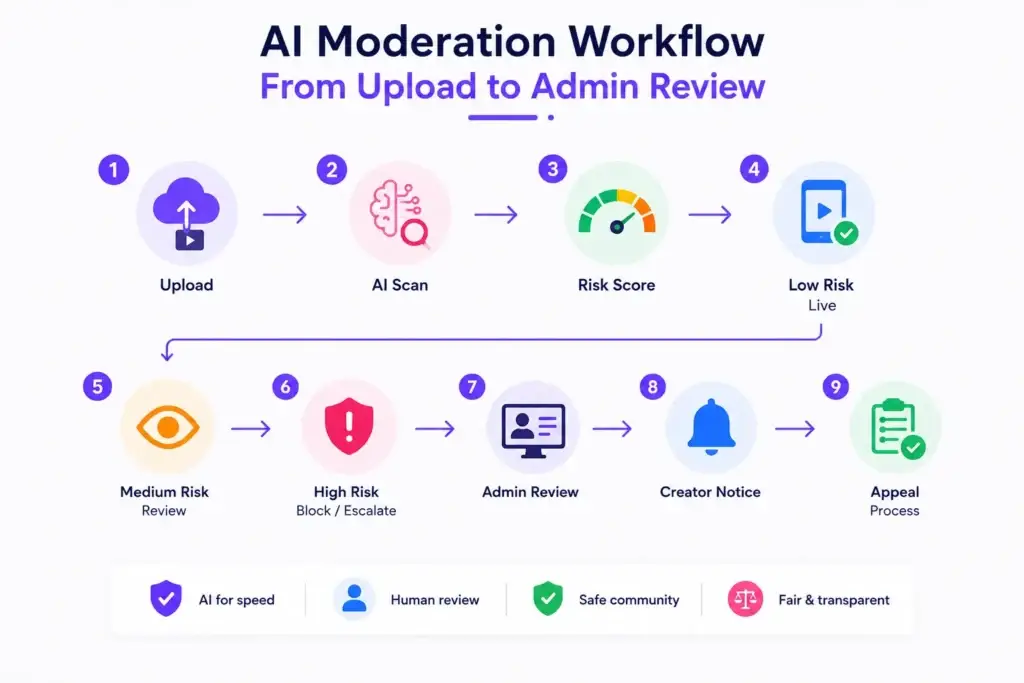
A good AI moderation workflow should be fast enough to protect users and flexible enough to avoid unfair removals.
A practical workflow looks like this:
- User uploads a video
The platform receives the video, thumbnail, caption, hashtags, creator profile data, audio, and metadata. - AI pre-screening begins
The system scans video frames, audio, captions, text overlays, hashtags, links, and creator history. - Risk score is assigned
The platform assigns a risk level such as safe, needs review, restricted, blocked, or escalated. - Low-risk content enters the feed
Safe content can be published quickly to protect creator experience. - Medium-risk content goes to review
Content may be limited, held, blurred, age-gated, or placed in a human moderation queue. - High-risk content is blocked or escalated
Serious policy risks should trigger stronger review, logging, or immediate restriction. - Admin dashboard records the action
Moderators see the content, risk reason, reports, account history, and recommended action. - Creator receives notice when needed
Clear notices help creators understand what happened and reduce confusion. - Appeal workflow is available
Appeals protect creators from over-enforcement and improve long-term trust.
YouTube’s public approach highlights this hybrid model: AI classifiers help identify potentially violative content at scale, and reviewers confirm policy-line decisions. CapCut similarly says it uses automated tools and human moderation to identify, review, and enforce community guidelines.
What Founders Should Include in the Admin Dashboard
AI detection is only useful if the platform operator can act on it. That is why the admin dashboard matters.
A moderation-ready short video app should include:
- Flagged video queue
- Flagged comment queue
- Spam account review
- Fake engagement alerts
- Reported user and creator profiles
- Content risk score
- Reason codes for AI flags
- Review status labels
- Moderator notes
- Appeal management
- Repeat-offender history
- Creator verification status
- Age-gating controls where relevant
- Policy category filters
- Activity logs
- Role-based access control
- Analytics for moderation volume and response time
Miracuves’ TikTok Clone solution includes admin dashboard controls for users, content, moderation, analytics, monetization, and platform settings. It also describes video and comment moderation, reports, flags, policy enforcement, verification workflows, wallet management, and revenue analytics as admin-side controls.
For founders, this admin layer is where platform safety becomes operational. Without it, AI flags may exist, but the business cannot manage them properly.
Founder Decision Signals
Speed
If your app allows open video uploads, comments, live sessions, or creator monetization, moderation should be planned before launch. Adding it later can create operational risk.
Cost
AI moderation cost depends on upload volume, video length, media processing, live monitoring, third-party APIs, human review scope, storage, and admin workflow complexity.
Scalability
Short video apps need moderation systems that can scale with uploads, comments, reports, engagement events, and recommendation traffic without slowing the creator experience.
Market Fit
A niche creator community may need stricter creator verification, while a public TikTok-style app may need stronger spam, fake engagement, and feed-quality controls.
Human Review Still Matters: Where AI Should Not Decide Alone
AI can detect patterns quickly, but moderation decisions can involve context. Short videos often include humor, satire, commentary, music, culture-specific references, educational content, news context, or creator-specific style.
Human review is still important for:
- Borderline harmful content
- Context-sensitive speech
- Appeals
- Repeated creator disputes
- Public-interest content
- News and commentary
- Satire or parody
- Monetization eligibility
- High-reach videos
- Creator account penalties
The strongest system is not AI-only. It is AI-assisted moderation with human review, clear policies, user reporting, audit logs, and escalation rules.
This approach also helps avoid over-blocking. If creators feel the platform is unfair or unpredictable, they may stop posting. If users feel unsafe, they may stop watching. The moderation system must protect both safety and creator confidence.
How AI Moderation Supports Creator Monetization Platforms
AI moderation is not only relevant to TikTok-style short video apps. It also matters for any creator platform, creator monetization platform, influencer platform, celebrity platform, or subscription based creator platform where users upload content, message creators, tip, buy PPV content, subscribe, or interact with creators directly.
Platforms inspired by OnlyFans, LoyalFans, Fansly, and IsMyGirl often rely on creator uploads, paid media, private messages, fan subscriptions, wallet payments, and creator payouts. Those workflows require moderation and payment trust because content risk, spam, impersonation, stolen media, abusive messages, chargeback patterns, and fake fan activity can affect platform reputation.
An influencer video platform may need AI moderation for:
- Brand-safe creator campaigns
- Fake follower detection
- Suspicious engagement review
- Comment safety
- Live-stream monitoring
- Creator verification
- Paid collaboration integrity
- Copyright and duplicate-content detection
A creator monetization platform succeeds when creators trust the platform, fans feel safe, and platform operators can manage risk without slowing down every interaction.
Mistakes Founders Should Avoid
Treating moderation as a post-launch task
Once users start uploading videos, commenting, and sharing content, platform risk starts immediately. Moderation workflows should be part of the first product foundation.
Only moderating videos and ignoring behavior
Spam and fake engagement often appear through accounts, comments, timing patterns, traffic clusters, and repeated actions. Content review alone is not enough.
Letting fake engagement influence recommendations
If suspicious likes, views, and follows are treated as genuine signals, the feed may promote low-quality or manipulated content.
Removing content without explanation
Creators need clear notices, reason codes, and appeal options. Otherwise, moderation may damage creator trust even when the platform is trying to improve safety.
Building AI moderation without admin control
AI flags must connect to review queues, escalation rules, audit logs, policy categories, moderator notes, and platform analytics.
How Miracuves Helps Build Safer Short Video Platforms
Miracuves helps founders launch short video and creator platforms with a practical foundation for content creation, discovery, moderation, monetization, and admin control.
For short video businesses, founders can explore the TikTok Clone App, which supports short-form video creation, discovery, engagement tools, monetization workflows, live streaming, admin controls, moderation, analytics, and source-code ownership. Miracuves’ TikTok Clone page describes a white-label short-video app powered by AI recommendations, monetization tools, live streaming, and full source-code ownership.
For broader media businesses, the Video Content Platform supports video streaming, content creation, and monetization use cases. Founders can also use Miracuves’ related resources on AI-powered content moderation for user-generated video apps , smart video feed design, scaling short video apps without breaking UX, and processing for creator platforms to plan safer platform architecture.
The goal is not to copy TikTok, OnlyFans, LoyalFans, Fansly, or IsMyGirl blindly. The stronger founder decision is to build a creator platform with the right moderation layer, engagement quality controls, admin workflows, and monetization foundation for the target niche.
Final Thoughts: AI Moderation Protects Growth, Not Just Safety
AI helps short video apps detect spam, harmful content, fake engagement, bot-like behavior, unsafe comments, suspicious accounts, and manipulated activity before they damage the feed.
But the real value is bigger than detection.
AI moderation protects recommendation quality, creator fairness, user trust, monetization accuracy, advertiser confidence, and platform reputation. It helps founders build a cleaner ecosystem where real creators can grow and real users can engage safely.
For a TikTok-style app, influencer video platform, celebrity platform, or creator monetization platform, AI moderation should be treated as core infrastructure. Miracuves helps founders build that foundation with white-label solution apps, admin dashboards, scalable workflows, source-code ownership, and faster launch support.
FAQs
How does AI detect spam in short video apps?
AI detects spam by analyzing repeated comments, suspicious links, duplicate captions, hashtag stuffing, bulk account behavior, high-volume posting patterns, and unusual activity clusters across videos, comments, profiles, and messages.
How does AI detect harmful content in a video creation platform?
AI can analyze video frames, thumbnails, audio, captions, hashtags, comments, and text overlays to identify unsafe visuals, abusive language, spam links, misleading content, restricted material, or potential policy violations.
What is fake engagement in short video apps?
Fake engagement includes artificial views, likes, comments, shares, follows, watch loops, bot activity, engagement pods, and paid services that manipulate popularity or recommendation signals.
Why is fake engagement dangerous for short video apps?
Fake engagement can damage recommendation quality, promote low-quality content, mislead advertisers, hurt real creators, distort analytics, and reduce user trust in the feed.
Can AI moderation replace human moderators?
No. AI can screen large volumes of content quickly, but human review is still important for appeals, context-sensitive content, creator disputes, satire, public-interest content, and borderline policy decisions.
What should a moderation dashboard include?
A moderation dashboard should include flagged videos, flagged comments, spam account review, fake engagement alerts, report queues, risk scores, policy categories, moderator notes, repeat-offender history, appeal workflows, audit logs, and role-based access control.
Does AI moderation help creator monetization platforms?
Yes. AI moderation helps creator monetization platforms protect paid content, creator trust, fan safety, brand reputation, payout integrity, subscription quality, and engagement authenticity.
How can Miracuves help launch a safer short video app?
Miracuves helps founders build white-label short video apps and creator platforms with admin dashboards, moderation workflows, creator features, monetization tools, scalable backend logic, and source-code ownership.
Miracuves is an independent software development company. We are not affiliated with, connected to, sponsored by, or endorsed by any company or product named in this article.
Terms such as “X Clone” are used descriptively. It is how the software industry refers to building a platform with functionality comparable to a known service, and how clients search for it.
The entire design and codebase of our products is built by our own team. Our products contain no code, design, graphics, or content originating from any third-party website or applications.
All third-party names and marks referenced in this article are the property of their respective owners, referenced solely to identify the services discussed.