

Key Takeaways
- A yacht marketplace needs trust and safety because buyers deal with high-value inventory and long purchase decisions.
- Dealer verification, listing moderation, dispute handling, and admin control should be planned before launch.
- Verified dealers help improve buyer confidence and reduce anonymous sellers, duplicate accounts, and weak accountability.
- Listing moderation protects buyers from outdated vessel details, misleading claims, duplicate posts, and low-quality data.
- Dispute workflows help operators manage complaints, evidence, status updates, and resolution history in one place.
Trust Signals
- Dealers need business verification, approval status, listing permissions, complaint history, and payout or lead-fee controls.
- Buyers need accurate vessel data, verified seller details, secure inquiries, clear communication, and complaint support.
- Admins need queues for dealer approval, listing review, reported listings, disputes, support tickets, and audit logs.
- Marketplace teams need role-based access, activity logs, moderation notes, evidence uploads, and notification templates.
- Security controls should protect account data, dealer documents, inquiry records, payment references, and support history.
Real Insights
- Trust is not separate from revenue; credible inventory and serious buyer demand make monetization more durable.
- Open publishing may grow inventory faster, but it can also invite fake listings, duplicate posts, and reputation risk.
- A hybrid moderation model can balance supply growth with stricter checks for new dealers and risky listings.
- Founders should avoid overpromising verification because it improves trust signals but does not guarantee vessel condition or transaction outcome.
- Miracuves builds yacht marketplace platforms with dealer verification, listing moderation, dispute workflows, inquiry tracking, security controls, and admin control.
A yacht marketplace is not a simple listing website. It handles high-value inventory, professional dealers, private sellers, serious buyers, service partners, and long decision cycles. That means trust is not a decorative feature. It is the foundation that decides whether buyers send inquiries, dealers upload inventory, and operators can scale without drowning in support issues.
For founders planning to launch a yacht marketplace platform, the biggest mistake is thinking the product is only about search filters, vessel photos, and lead forms. Those are important, but they are not enough. A marketplace becomes reliable when the platform can verify who is listing, moderate what is published, track communication, handle disputes, and give the admin team enough control to intervene before small issues become reputation problems.
Miracuves helps founders build launch-ready marketplace platforms where listings, dealers, inquiries, admin workflows, monetization, and safety controls are planned together. For yacht marketplaces, this matters because every fake listing, outdated vessel detail, duplicate inventory post, or unresolved buyer complaint can weaken the entire platform.
Why Trust and Safety Matter More in Yacht Marketplaces Than Generic Listing Apps
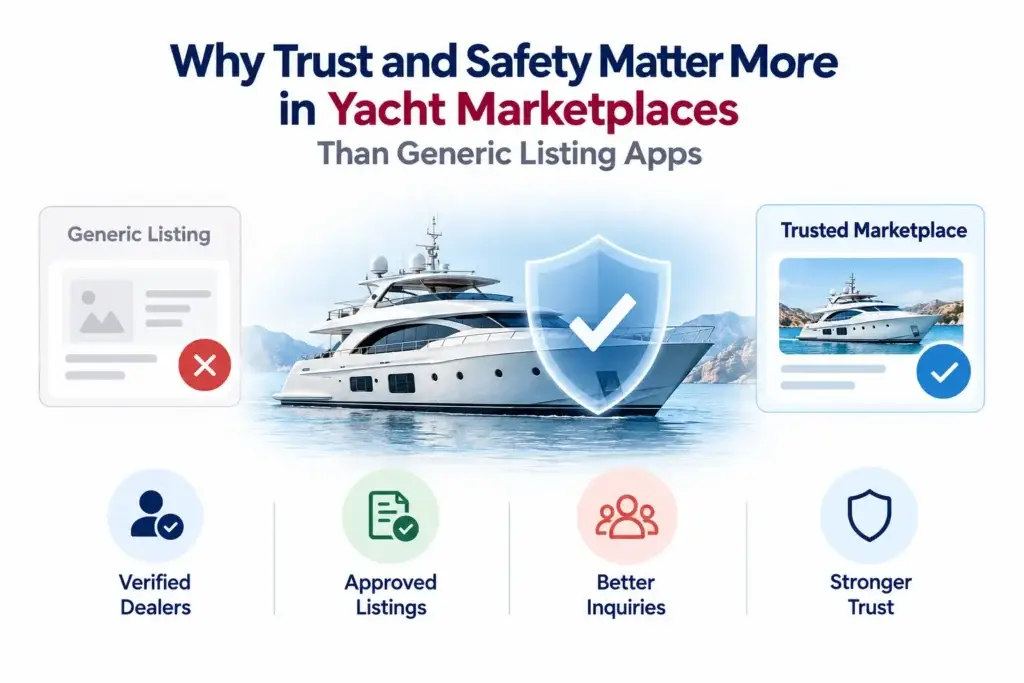
A generic classified platform can survive some low-quality listings because the transaction value is often small. A yacht marketplace has a different risk profile. Buyers expect vessel data to be detailed, dealers expect serious leads, and platform operators need to protect the credibility of the marketplace from the first supply cohort.
The buyer is not casually browsing a low-cost product. They may be comparing vessels by length, year, engine hours, location, condition, cabin layout, hull material, survey readiness, finance options, and transport requirements. Even before contacting a dealer, the buyer is silently asking one question: “Can I trust this listing enough to take the next step?”
That is why trust and safety should be designed into the platform from day one. It affects:
- Dealer onboarding quality
- Listing approval speed
- Buyer inquiry conversion
- Broker response quality
- Admin workload
- Dispute resolution time
- Marketplace reputation
- Long-term monetization
A founder who treats trust as a later add-on may launch faster on the surface but lose control once inventory, inquiries, and complaints start increasing.
Dealer Verification: The First Trust Layer of a Yacht Marketplace
Dealer verification is the process of confirming whether a dealer, broker, or professional seller is allowed to operate on the platform. In a yacht marketplace, this is more important than simple email signup because listings often represent expensive assets, third-party owners, dealership inventory, or broker-managed vessels.
A strong dealer verification workflow should not make onboarding unnecessarily slow. It should separate low-risk steps from high-risk permissions. For example, a dealer may be allowed to create an account quickly but not publish unlimited listings until business verification is complete.
What a Dealer Verification Workflow Should Check
A practical yacht dealer verification system can include:
- Business name and registered contact details
- Dealer or broker license details where applicable
- Business address and operating region
- Website, phone, email, and social proof
- Association membership or professional credential fields
- Authorized representative details
- Bank or payout details if payments or lead fees are enabled
- Document upload and admin approval workflow
- Status labels such as pending, verified, rejected, suspended, or under review
The goal is not to create friction for genuine dealers. The goal is to prevent anonymous sellers, duplicate dealer accounts, unauthorized inventory posts, and weak lead accountability.
Why Verification Should Be Tiered
Not every platform needs the same verification depth on day one. A regional yacht marketplace may start with manual document review and admin approval. A larger multi-region marketplace may need API-based business checks, automated risk scoring, and separate permissions for listing, advertising, payments, and service leads.
A tiered model gives the platform operator control. New dealers can be limited until their documents are reviewed. Established dealers can receive faster approval. Suspicious accounts can be paused without deleting historical data.
Dealer Verification Layers for Yacht Marketplace Platforms
| Verification Layer | Business Value | Founder Impact |
|---|---|---|
| Business profile review | Confirms the dealer is operating as a real business or professional seller. | Reduces anonymous or low-quality supply before listings go live. |
| Broker or dealer credential fields | Creates a professional trust signal for serious buyers. | Helps position the platform as more credible than a generic listing board. |
| Listing authorization evidence | Checks whether the dealer has the right to represent a vessel. | Reduces duplicate inventory, unauthorized posts, and dealer conflicts. |
| Admin approval queue | Lets operators approve, reject, request edits, or suspend accounts. | Keeps marketplace quality under operator control. |
| Activity and complaint history | Tracks repeated disputes, listing removals, response delays, and buyer complaints. | Helps the admin team identify risk before reputation damage spreads. |
Listing Moderation: Protecting Buyers From Bad Data Before It Spreads
In yacht marketplace platforms, listing quality is not just a design issue. It is a trust issue. Poor data creates buyer confusion, weakens search results, damages dealer credibility, and increases support tickets.
A strong listing moderation system should review the information that actually matters in a marine purchase journey. That includes vessel specifications, images, location, price, condition, dealer details, and ownership-related signals.
For founders evaluating a yacht marketplace platform foundation, the listing workflow should be reviewed carefully because it directly affects marketplace trust, buyer conversion, and dealer satisfaction.
Common Listing Problems a Yacht Marketplace Should Catch
A marketplace operator should be able to detect and act on issues such as:
- Duplicate vessel listings from multiple dealers
- Outdated price or availability status
- Missing engine, length, year, or location details
- Misleading vessel condition claims
- Low-quality or reused images
- Suspiciously low pricing
- Inconsistent dealer contact information
- Listings published under the wrong category
- Unauthorized use of another dealer’s inventory
- Spam listings created to capture buyer leads
The moderation workflow can be manual, automated, or hybrid. In early stages, manual review may be enough. As the platform grows, the admin system should support rules, flags, review queues, and audit logs.
Pre-Publish vs Post-Publish Moderation: Which Is Better?
There is no single answer. The right approach depends on marketplace maturity, inventory pressure, and risk tolerance.
Pre-publish moderation gives the operator more control but may slow dealer onboarding. Post-publish moderation keeps supply moving faster but requires strong flagging, reporting, and enforcement tools.
The strongest model is usually hybrid. New dealers and high-risk listings go through stricter checks. Trusted dealers get faster publishing. Listings can still be flagged later by buyers, brokers, admins, or automated rules.
| Moderation Model | Best For | Risk | Founder Decision |
|---|---|---|---|
| Pre-publish approval | New marketplaces, premium inventory, verified dealer networks | Slower listing growth | Best when trust matters more than speed |
| Post-publish review | Large supply networks and faster listing volume | Bad listings may appear briefly | Works only with strong reporting and admin controls |
| Hybrid moderation | Most scalable yacht marketplace models | Requires better admin logic | Best balance between quality and growth |
Dispute Handling: Turning Marketplace Conflict Into a Controlled Workflow
Disputes are not a sign that a marketplace has failed. They are a sign that real transactions, inquiries, expectations, and service relationships are happening. The problem is not the existence of disputes. The problem is handling them through emails, phone calls, WhatsApp threads, and disconnected spreadsheets.
A yacht marketplace needs a dispute management workflow that keeps evidence, status, parties, admin notes, and resolution history in one place.
Common Dispute Scenarios in Yacht Marketplaces
A dispute may come from:
- Buyer claims that listing information was inaccurate
- Dealer says an inquiry was fake or abusive
- Seller claims another dealer posted unauthorized inventory
- Buyer complains about hidden fees, outdated availability, or misleading condition
- Service partner delays inspection, transport, finance, valuation, or survey support
- Payment, refund, deposit, or lead-fee disagreement
- Duplicate listing conflict between brokers
The platform does not need to act as a legal authority. But it does need to create a structured path for reviewing issues, recording facts, notifying parties, and applying marketplace rules.
What a Dispute Workflow Should Include
A reliable dispute workflow should include:
- Dispute category selection
- Listing, inquiry, dealer, buyer, or service reference
- Evidence upload
- Message history attachment
- Assigned admin or support owner
- Status labels such as open, under review, waiting for response, resolved, rejected, or escalated
- Internal notes visible only to admins
- Resolution summary
- Account or listing enforcement action where needed
This is where admin control becomes more than a backend convenience. It becomes the operating system for marketplace trust.
Founder Decision Signals
Speed
Launch speed matters, but a yacht marketplace should not publish dealer inventory without enough verification and moderation control.
Cost
Trust workflows may feel like extra scope early, but they reduce future support cost, rework, and reputation risk.
Scalability
Manual moderation can work at first, but growth requires queues, rule-based flags, role-based access, and activity logs.
Market Fit
If buyers do not trust the listings and dealers do not trust lead quality, marketplace liquidity becomes difficult to build.
Admin Control: The Difference Between a Listing Website and a Managed Marketplace
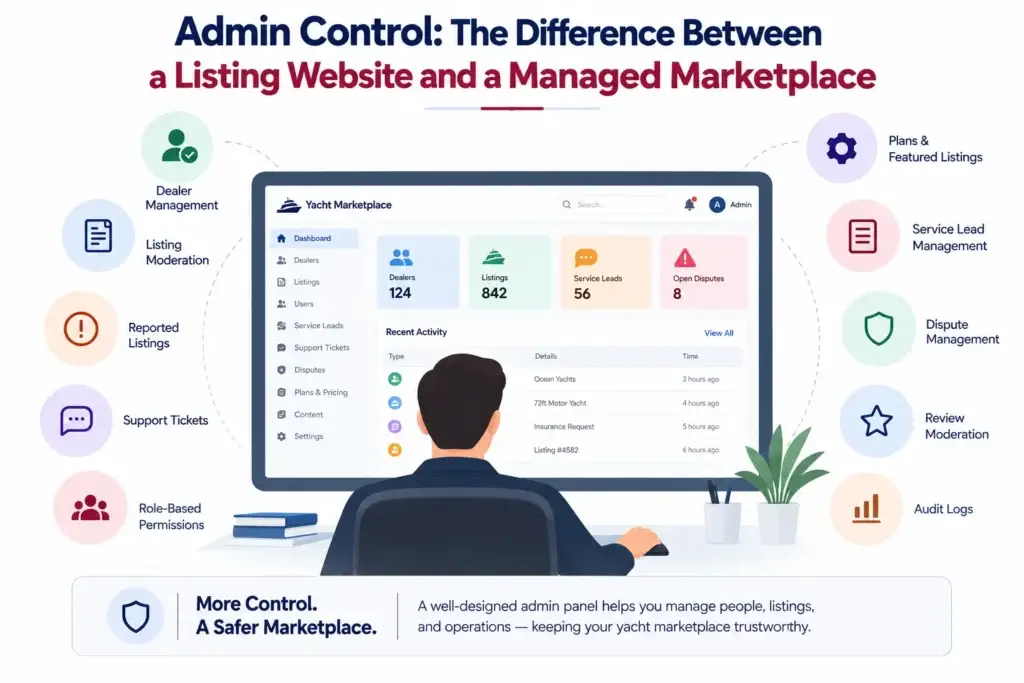
Many founders underestimate the admin panel. They focus on what buyers see and forget that marketplace quality is controlled behind the scenes.
In a yacht marketplace, the admin team should be able to manage dealers, users, listings, plans, moderation queues, support tickets, disputes, service leads, and content controls from one permission-based dashboard.
The feature set for a yacht marketplace platform should therefore be reviewed through an operational lens, not only a front-end design lens. Search filters and listing pages bring users in. Admin workflows keep the marketplace trustworthy after launch.
Admin Features That Support Trust and Safety
A founder should look for admin capabilities such as:
- Dealer approval and suspension
- Listing approval, rejection, and edit requests
- Category, condition, and specification control
- Reported listing queue
- Buyer and dealer complaint history
- Dispute assignment and status tracking
- Role-based staff permissions
- Audit logs for sensitive admin actions
- Email and notification templates
- Service lead queue management
- Featured listing and plan controls
- Review and rating moderation
These controls help the operator act quickly without depending on developers for every small rule change.
Secure Communication and Lead Quality
Trust does not end after listing approval. It continues inside the inquiry workflow. Buyers may want to ask about survey records, viewing availability, sea trials, financing, transport, or insurance. Dealers need enough context to identify serious buyers and respond properly.
A yacht marketplace should reduce unstructured communication by keeping inquiries tied to listings, dealers, buyers, and timestamps. This helps the platform understand response quality, lead quality, and dispute context.
For example, when a buyer complains that a dealer misrepresented a vessel, the platform should be able to review the listing version, inquiry history, messages, and any status changes. Without this record, support decisions become guesswork.
Monetization Depends on Trust, Not Just Traffic
A yacht marketplace can monetize through dealer subscriptions, listing upgrades, service leads, market reports, and related partner workflows. But these revenue lines only work when the marketplace has credible inventory and serious buyer demand.
That is why the dealer subscription and service lead monetization model should be connected to trust operations. Dealers will pay for visibility when the platform delivers qualified attention. Buyers will submit inquiries when listings feel reliable. Service partners will pay for leads when the platform captures structured intent.
Trust is not separate from revenue. In a premium marketplace, trust is what makes revenue durable.
Security and Compliance-Ready Workflows for Yacht Marketplace Platforms
A yacht marketplace may handle account data, dealer documents, inquiry details, payment references, service requests, and support records. That means security must be part of the product foundation.
Important security layers include:
- Encrypted data transfer
- Encrypted data storage where sensitive information is involved
- Role-based access control
- Admin access controls
- Secure API integration
- Activity logs
- User and dealer verification
- Secure payment gateway integration where payments are enabled
- Privacy-conscious data handling
- Dispute and support history controls
Final compliance depends on jurisdiction, legal review, payment integrations, verification vendors, and the operating model. The safest product approach is to build a compliance-ready foundation that can support local requirements rather than claiming universal compliance from day one.
Mistakes Founders Should Avoid When Building Yacht Marketplace Safety Workflows
Mistakes Founders Should Avoid
Allowing Every Dealer to Publish Without Review
Open publishing may increase inventory quickly, but it can also invite fake listings, duplicate posts, and weak dealer accountability.
Treating Listing Moderation as a Manual Inbox
Email-based moderation breaks down as the marketplace grows. Operators need queues, status labels, notes, evidence, and audit history.
Ignoring Disputes Until After Launch
Dispute workflows should exist before the first serious buyer complaint. Retrofitting them later creates operational confusion.
Overpromising What Verification Means
Verification improves trust signals, but it should not be presented as a guarantee of vessel condition, ownership, pricing, or transaction outcome.
Ready-Made vs Custom Trust and Safety Development
Founders usually have two routes. They can build every marketplace module from scratch, or they can begin with a ready-made platform foundation and customize the trust layer around their market.
A custom build may be useful when the operating model is highly unique, the marketplace requires complex integrations, or the founder already has a technical team. But it can take longer to reach a usable product because every workflow must be designed, coded, tested, and connected.
A ready-made approach gives founders a faster starting point with core marketplace flows already structured. Miracuves’ white-label approach can help founders launch faster with source-code ownership, branded design, admin control, and customizable workflows. The final scope should still be confirmed based on dealer verification depth, moderation logic, service modules, payment requirements, and regional operating needs.
For founders comparing vendors, the development partner selection guide for a marine marketplace can help evaluate whether the team understands marketplace operations, not just UI development.
How Miracuves Helps Founders Build Safer Yacht Marketplace Platforms
Miracuves helps founders create ready-made and white-label marketplace platforms with source-code ownership, branded interfaces, admin dashboards, and business-specific customization. For yacht marketplace founders, the important advantage is not just faster launch. It is starting from a product foundation that already understands listings, dealers, inquiries, service modules, and operator control.
A trust-focused yacht marketplace can include:
- Buyer, seller, dealer, and admin workflows
- Dealer profiles and verification presentation
- Specification-rich vessel listing flows
- Inquiry-scoped communication
- Admin-controlled listing moderation
- Support ticket and dispute workflows
- Plan and subscription controls
- Service lead queues for adjacent marine services
- Role-based dashboard access
- Marketplace settings and content control
For adjacent marketplace thinking, founders can also review Miracuves’boat rental app development guide, which explains how listings, bookings, payments, verification, and admin control support trust in marine rental platforms.
Final Thoughts: Trust Is the Real Marketplace Infrastructure
A yacht marketplace does not win only by having more listings. It wins when buyers trust the listings, dealers trust the lead quality, and operators can control risk from one dashboard.
Dealer verification protects the supply side. Listing moderation protects discovery quality. Dispute handling protects the platform when expectations break. Together, these workflows turn a simple listing product into a managed marketplace.
For founders, the smarter decision is to plan trust and safety before growth begins. Once traffic, inventory, and dealer relationships increase, the platform needs more than attractive pages. It needs operational control.
FAQs
What is yacht marketplace trust and safety?
Yacht marketplace trust and safety refers to the verification, moderation, reporting, dispute, security, and admin workflows that help protect buyers, dealers, sellers, and platform operators from low-quality listings, fraud, confusion, and unresolved complaints.
Why is dealer verification important in a yacht marketplace?
Dealer verification helps confirm whether a broker, dealer, or seller is a real and accountable participant. It improves buyer confidence, reduces unauthorized listings, and gives the platform operator more control over marketplace quality.
What should yacht listing moderation include?
Listing moderation should review vessel specifications, price, location, images, category, condition claims, dealer details, duplicate posts, and suspicious listing patterns. The goal is to prevent misleading or incomplete listings from damaging buyer trust.
Should all yacht listings be manually approved?
Not always. New marketplaces may prefer manual approval to maintain quality. As the platform grows, a hybrid system can allow trusted dealers to publish faster while new or risky listings go through stricter checks.
How does dispute handling work in a yacht marketplace platform?
A dispute workflow usually includes complaint category, listing reference, buyer or dealer details, evidence upload, admin assignment, status tracking, internal notes, and resolution history. This keeps support decisions structured instead of scattered across emails or calls.
Can verification guarantee that every yacht listing is accurate?
No. Verification improves trust signals and accountability, but it should not be presented as a guarantee of vessel condition, ownership, pricing, legal status, or transaction outcome. Final due diligence still depends on the buyer, seller, dealer, documentation, and local rules.
What admin features are needed for a safer yacht marketplace?
A safer yacht marketplace needs dealer approval, listing moderation, reported listing queues, dispute management, role-based access, audit logs, support tickets, plan controls, review moderation, and service lead management.
Miracuves is an independent software development company. We are not affiliated with, connected to, sponsored by, or endorsed by any company or product named in this article.
Terms such as “X Clone” are used descriptively. It is how the software industry refers to building a platform with functionality comparable to a known service, and how clients search for it.
The entire design and codebase of our products is built by our own team. Our products contain no code, design, graphics, or content originating from any third-party website or applications.
All third-party names and marks referenced in this article are the property of their respective owners, referenced solely to identify the services discussed.