

Key Takeaways
- A following feed gives users control by showing content from accounts they intentionally choose to follow.
- A personalized feed improves discovery by recommending relevant posts, creators, topics, replies, and conversations.
- Using both feed types helps balance familiarity, trust, exploration, creator reach, and user retention.
- New platforms can begin with topic preferences, follow suggestions, trending posts, and simple engagement-based recommendations.
- A strong microblogging feed should balance relevance, freshness, diversity, safety, monetization, and user control.
Feed Discovery Signals
- Use follows, replies, reposts, searches, dwell time, and topic interests to understand positive user intent.
- Apply mutes, blocks, hides, skips, and reports to reduce unwanted, repetitive, unsafe, or irrelevant recommendations.
- Offer separate following and discovery feeds so users can move between intentional consumption and exploration.
- Give new users topic selection, suggested accounts, language preferences, and regional discovery during onboarding.
- Track feed engagement, follow conversion, creator discovery, repeat sessions, content diversity, reports, and user retention.
Real Insights
- A following-only feed can feel empty for new users who have not yet developed a social graph.
- An overly aggressive personalized feed can reduce trust when users cannot understand why posts appear.
- High engagement does not always indicate quality, so ranking should also consider moderation and satisfaction signals.
- Feed monetization should not overpower organic conversations or weaken the user’s sense of control.
- Miracuves develops source-code-owned microblogging platforms with following feeds, personalized discovery, recommendations, moderation, monetization, and admin controls.
A microblogging platform succeeds when users can discover the right conversations at the right moment.
That sounds simple, but discovery is not only about showing trending posts. It depends on how the platform balances two very different feed experiences: the Personalized and Following Feeds.
The following feed gives users control. It shows updates from accounts they intentionally follow. The personalized feed expands discovery by recommending posts, creators, topics, replies, and conversations that may be relevant even when the user has not followed those accounts yet.
Modern text-first social platforms increasingly use both. Meta describes Threads as having a “For You” feed that mixes followed profiles and recommended content, plus a “Following” feed that only shows posts from followed accounts. Bluesky also separates experiences through chronological following feeds, discover feeds, and custom algorithmic feeds that users can choose from.
For founders, this is not just a user interface decision. Feed design affects onboarding, retention, creator growth, moderation, monetization, and long-term product trust.
Why Feed Discovery Matters in a Microblogging Platform
A microblogging platform usually begins with a simple promise: let users post short updates, follow people, reply to conversations, and stay connected to what is happening.
But users do not stay because posting exists. They stay because the feed feels alive.
A strong discovery system answers three questions quickly:
- What is worth reading right now?
- Who should I follow next?
- Which conversations match my interests?
If the feed shows only random popular posts, users may feel disconnected. If it shows only followed accounts, new users may face an empty timeline. If it over-personalizes too early, recommendations may feel confusing or repetitive.
This is why the strongest microblogging products usually separate feed surfaces. Miracuves’ own microblogging platform approach includes multiple feed variants such as personalized, following, public, and other discovery surfaces so one content graph can support different user journeys.
The strategic point is simple: discovery should not depend on one feed doing every job.
Personalized Feed vs Following Feed: What Is the Difference?
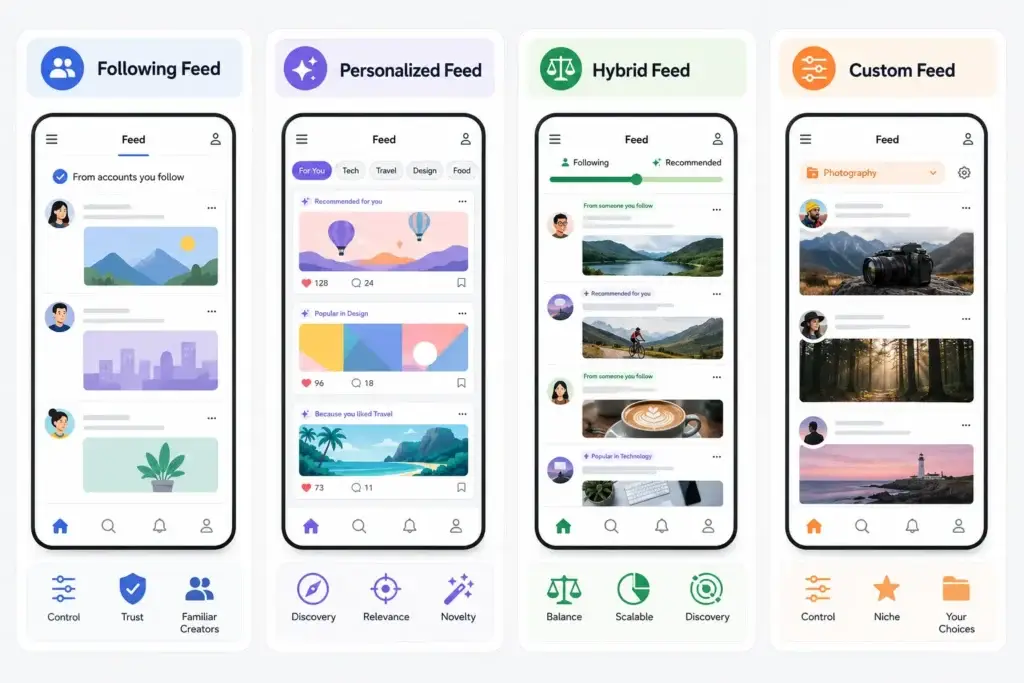
Image Source: AI-generated visual by Miracuves
A following feed is built around explicit choice. The user follows an account, and the platform shows content from that account.
A personalized feed is built around inferred relevance. The platform uses signals such as follows, clicks, replies, searches, topics, reposts, language, location, mutes, hides, and engagement history to recommend content that may interest the user.
Both feeds matter, but they solve different problems.
| Feed Type | What It Shows | User Value | Founder Value |
|---|---|---|---|
| Following Feed | Posts from accounts the user follows | Control, familiarity, trust | Builds relationship-based retention |
| Personalized Feed | Recommended posts, creators, topics, and conversations | Discovery, relevance, novelty | Improves engagement and creator reach |
| Hybrid Feed | Followed content plus recommended content | Balance between control and exploration | Helps scale discovery without making the app feel random |
| Custom Feed | User-selected topic or account-based feed | More control over interests | Supports niche communities and deeper engagement |
A following feed is the user’s chosen network. A personalized feed is the platform’s discovery engine.
The mistake is treating one as a replacement for the other.
Read More:Microblogging App Feature Checklist: What Founders Should Compare Before Buying a Ready-Made Script
How Following Feeds Build Trust and User Control
The following feed is the clearest expression of user intent.
When someone follows a creator, expert, friend, journalist, founder, brand, or community account, they are telling the platform: “I want to hear from this source again.”
That signal should be respected.
A following feed helps users feel in control because the reason behind each post is obvious. The post appears because the user followed the author. This matters especially in text-first conversation apps, where people often follow accounts for specific viewpoints, communities, expertise, humor, local updates, or professional insight.
A strong following feed may include:
- Recent posts from followed accounts
- Replies from followed users
- Reposts or quote posts
- Posts from close interactions
- Muted or blocked account filtering
- Freshness controls
- Optional chronological sorting
Chronological following feeds are especially useful because they reduce confusion. Users understand why they are seeing content, and they can scan updates without wondering whether the platform is hiding posts from people they chose to follow.
For founders, the following feed becomes a trust layer. It protects the user from feeling trapped inside an algorithmic experience.
How Personalized Feeds Improve User Discovery
A personalized feed helps users find value before they have built a strong social graph.
This is especially important for new platforms. A new user may sign up without following anyone. If the app shows an empty feed, the onboarding experience fails before the product has a chance to prove itself.
Personalized discovery can solve that problem by surfacing:
- Trending conversations
- Recommended creators
- Topic-based posts
- Popular replies
- Hashtag activity
- Content similar to what the user engaged with
- Posts from adjacent communities
- Region-specific or language-specific conversations
The goal is not to guess perfectly. The goal is to help users move from a cold start to an active discovery loop.
Threads, Bluesky, and similar text-first platforms show how important this balance has become. Threads uses For You and Following feed modes, while Bluesky emphasizes user choice through custom feeds and algorithmic feed selection.
For founders building a new microblogging product, personalization should start simple and become smarter over time. Early-stage platforms may not have enough behavioral data for advanced recommendations, so they can begin with topic preferences, onboarding interests, trending posts, and follow suggestions.
The Discovery Loop: How Both Feeds Work Together
Personalized and following feeds should not operate in isolation. They should reinforce each other.
A practical discovery loop looks like this:
- A user joins the platform.
- The personalized feed shows active topics, creators, and conversations.
- The user follows accounts they find valuable.
- The following feed becomes more useful.
- The personalized feed learns from those follows and interactions.
- Better recommendations lead to more follows, replies, and saved posts.
- The platform gains stronger engagement signals.
This loop is important because it turns discovery into habit.
A platform that relies only on personalized content may feel entertaining but unstable. A platform that relies only on following content may feel controlled but limited. The strongest product experience gives users both: a place to explore and a place to return.
For founders planning a text-first social product, a ready-made microblogging platform foundation can help accelerate this feed structure because core flows such as posting, following, replies, discovery, moderation, and admin management do not need to be built from zero.
Key Signals That Shape Personalized Feed Recommendations
Personalization depends on signals. But not all signals are equal.
A like is useful, but it may be weak. A reply may show stronger intent. A follow may show long-term interest. A mute or hide may show what the user does not want to see again.
Founders should think about both positive and negative signals.
Feed Personalization Signals and Their Business Value
| Signal | What It Indicates | Founder Impact |
|---|---|---|
| Follows | Long-term interest in a creator or account | Improves creator discovery and relationship-based retention |
| Replies | Active conversation intent | Helps identify posts that create community engagement |
| Reposts and Quotes | Content worth redistributing | Expands organic reach and topic visibility |
| Dwell Time | Interest even without visible engagement | Helps improve recommendations beyond likes |
| Searches | Topic-level intent | Supports hashtag, creator, and trend recommendations |
| Mutes and Blocks | Negative preference or safety need | Improves trust and reduces irrelevant recommendations |
| Reports | Potential policy or safety issue | Connects feed distribution with moderation workflows |
The best feed systems do not only ask, “What gets clicks?” They also ask, “What improves the user’s next session?”
That difference matters. A post may get attention but still reduce trust. A healthy personalized feed should consider relevance, freshness, diversity, content quality, safety, and user control.
Why Following Feeds Are Still Important in Algorithmic Platforms
Algorithmic feeds often improve engagement because they can surface content beyond the user’s existing network. But following feeds remain essential because they protect intentional consumption.
Users do not always want discovery. Sometimes they want certainty.
They want to check specific creators. They want to see what their network posted. They want to follow a conference, creator circle, professional community, local group, or niche topic without the feed being dominated by unrelated viral content.
Following feeds support:
- User trust
- Creator-audience relationships
- Predictable consumption
- Professional use cases
- Community consistency
- Reduced recommendation fatigue
This is why platform control features matter. Threads has continued adding ways for users to manage feeds, including custom feeds and feed personalization features. Meta also announced “Dear Algo,” which lets users publicly request temporary feed adjustments around what they want to see more or less of.
For founders, the lesson is clear: personalization should not remove control. The stronger strategy is to let users move between discovery and intention.
Feed Discovery and the Cold Start Problem
Every new microblogging platform faces the cold start problem.
A user joins, but the platform does not yet know their interests. The user has no follow graph. The app has limited engagement history. The personalized feed has weak data.
This is where onboarding and discovery design become critical.
A founder can reduce cold start friction by asking users to choose:
- Topics they care about
- Suggested creators to follow
- Communities or categories
- Language preferences
- Location or regional interests
- Content formats they prefer
- Accounts imported or suggested from existing networks where appropriate
Bluesky’s starter packs are one example of helping users find accounts and feeds quickly. Bluesky describes starter packs as personalized invites that help new users follow recommended accounts and feeds.
A microblogging platform does not need to copy that exact model, but it should solve the same problem: help users reach a useful first feed as quickly as possible.
For Miracuves clients, this is where product planning matters. A launch-ready text-first social platform should not only include posting and profiles. It should include discovery paths that help users find value before the network becomes large.
Founder Decision Signals
Speed
Start with a clear following feed, topic-based discovery, and simple personalization before investing in complex machine learning workflows.
Cost
Advanced ranking engines require data pipelines, experimentation, moderation logic, and analytics. A staged approach helps control development scope.
Scalability
Feed systems should be designed for more users, more posts, more follows, more replies, and higher read frequency as the platform grows.
Market Fit
The right feed mix depends on the audience. Professional communities may prefer control, while creator-led communities may need stronger discovery.
How Feed Design Impacts Creator Discovery
Creators need reach. Users need relevance. The feed sits between both.
If the following feed is the only distribution surface, creators mostly reach people who already know them. That can work for mature creator accounts, but it makes discovery difficult for new voices.
If the personalized feed is too aggressive, creators may chase the algorithm instead of building loyal communities.
A better system gives creators multiple discovery paths:
- Posts appearing in personalized recommendations
- Replies appearing in active conversations
- Hashtags helping topic discovery
- Reposts expanding network reach
- Suggested accounts improving follow growth
- Trending topics surfacing timely participation
- Public discovery feeds helping logged-out or new users explore
This balance is especially important for niche communities. A microblogging platform may not win by showing everyone the same viral content. It may win by helping each user find the right smaller conversations.
For founders, that is the business opportunity. Better discovery creates more creators. More creators create more content. More content improves the feed. A stronger feed increases retention.
Product Architecture Behind Personalized and Following Feeds
Even though this blog focuses on product strategy, founders should understand the basic technical layers behind feed discovery.
A following feed depends on the social graph. The system needs to know who follows whom, which accounts are muted or blocked, which posts are public or private, and which updates should appear.
A personalized feed needs additional ranking and filtering layers. It must collect candidate posts, remove restricted content, score relevance, balance freshness, avoid duplicates, apply moderation rules, and deliver the feed quickly.
A practical feed system may include:
- Post service
- Social graph service
- Feed generation service
- Ranking logic
- Recommendation rules
- Moderation filters
- Cache layer
- Search and hashtag indexing
- Analytics events
- Admin controls
For a deeper architecture view, founders can also read Miracuves’ guide on microblogging platform feed architecture , which explains public discovery, following feeds, and personalized content from a system-design perspective.
This blog focuses on discovery strategy. The architecture guide supports the technical layer.
Personalization Should Include Negative Signals
Many founders overvalue positive engagement.
They track likes, replies, reposts, and follows, but ignore mutes, skips, hides, reports, blocks, and “not interested” actions.
That creates a problem. If the feed only rewards visible engagement, controversial or low-quality content may receive more distribution than useful content. A healthy microblogging platform should understand what users reject, not only what they click.
Negative signals help the platform:
- Reduce repetitive content
- Avoid unwanted creators
- Prevent topic fatigue
- Improve safety
- Reduce spam exposure
- Protect user trust
- Improve recommendation quality
This is where moderation and personalization connect. A reported post should not be treated the same as a highly trusted post. A blocked account should not appear in recommendations. A muted topic should be respected across feed surfaces.
Feed discovery is not only about growth. It is also about control.
Common Mistakes Founders Make With Feed Discovery
Building Only One Timeline
A single feed often fails because new users need discovery, active users need relevance, and loyal users need control. Separate feed surfaces solve different user moments.
Making Personalization Too Complex Too Early
Advanced algorithms need reliable data. Early platforms should begin with explainable signals such as topics, follows, recency, engagement, and muted preferences.
Ignoring the Following Feed
If users cannot easily access posts from people they follow, they may lose trust in the platform’s distribution logic.
Rewarding Engagement Without Quality Controls
High engagement does not always mean high value. Feed ranking should consider moderation, reports, repetition, spam, and user satisfaction signals.
Read More: Reasons startup choose our Threads clone over custom development
How Feed Choice Affects Monetization
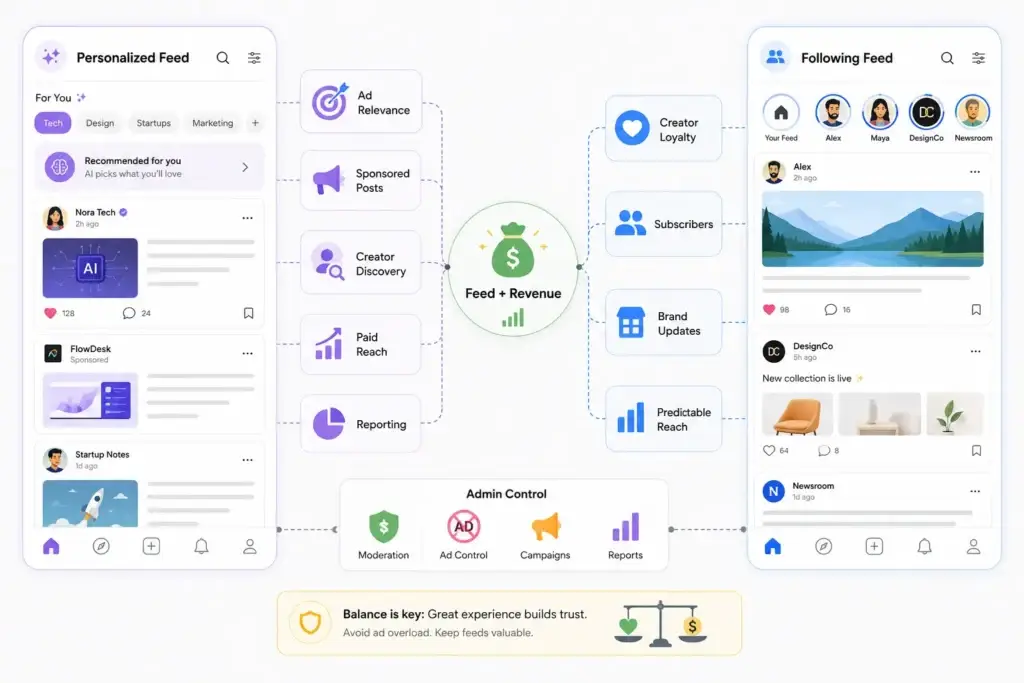
Image Source: AI-generated visual by Miracuves
Feed design also affects revenue.
If a platform plans to monetize through ads, promoted posts, creator subscriptions, brand accounts, premium visibility, or verified profiles, feed logic becomes part of the business model.
A personalized feed can help with:
- Better ad relevance
- Sponsored content placement
- Creator recommendations
- Topic-based promotion
- Paid discovery
- Engagement-based campaign reporting
A following feed can help with:
- Creator loyalty
- Subscriber-only visibility
- Brand community updates
- Professional network retention
- Predictable content delivery
The risk is over-commercialization. If promoted content appears too aggressively, users may lose trust. A strong admin dashboard should allow platform operators to control ad review, campaign visibility, content rules, and reporting.
Miracuves’ social platform solution includes feed, discovery, monetization, moderation, and admin layers that help founders plan beyond the basic posting experience. Founders comparing build options can explore the social conversation app solution to understand how these modules connect inside a launch-ready product foundation.
What a Balanced Feed Strategy Looks Like
A balanced feed strategy does not force every user into the same experience.
It gives users clear modes:
| User Need | Best Feed Experience | Why It Works |
|---|---|---|
| “Show me people I chose.” | Following feed | Protects control and trust |
| “Help me find new conversations.” | Personalized feed | Expands discovery beyond the social graph |
| “Show what is happening now.” | Trending or public discovery feed | Supports news, events, and active topics |
| “Let me focus on one interest.” | Custom or topic feed | Supports niche communities |
| “Do not show this again.” | Preference controls | Improves recommendation quality |
A founder does not need to build every advanced feed type at launch. But the product foundation should leave room for them.
At minimum, a strong first version should include:
- Following feed
- Public or discovery feed
- Basic personalized recommendations
- Search and hashtag discovery
- Suggested accounts
- Mute, block, and report controls
- Admin visibility management
- Analytics for feed engagement
This gives the platform enough structure to support both user growth and operational control.
Miracuves Perspective: Discovery Is a Product Strategy, Not Just an Algorithm
The best microblogging platforms do not treat feed discovery as a technical add-on.
They treat it as the core product engine.
The following feed protects intent. The personalized feed creates exploration. Topic discovery helps communities form. Moderation keeps distribution safe. Analytics shows what users actually value. Admin controls help the platform operator manage the system without depending on developers for every small change.
For founders, the practical question is not, “Should we build a personalized feed?” The better question is, “What kind of discovery experience does our audience need first?”
A professional networking community may need stronger following and credibility signals. A creator-led community may need stronger recommendations and repost discovery. A local conversation app may need location and topic relevance. A brand-led community may need admin curation and content controls.
Miracuves helps founders turn these decisions into product workflows through ready-made and white-label app solutions with source-code ownership, branded design, admin control, and faster deployment.
Final Thoughts
Personalized and following feeds shape how users discover value inside a microblogging platform.
The following feed gives users control. The personalized feed helps them explore. Together, they create a healthier discovery system where users can follow trusted voices, find new conversations, engage with relevant topics, and return to the platform with a clear reason.
For founders, the feed is not just a screen. It is the product’s growth engine.
A strong feed strategy should balance relevance, freshness, creator visibility, moderation, monetization, and user control. That balance is what separates a basic posting app from a scalable social platform.
FAQs
What is a personalized feed in a microblogging platform?
A personalized feed is a content stream that recommends posts, creators, topics, replies, and conversations based on user behavior, interests, follows, engagement history, and platform-level ranking rules.
What is a following feed?
A following feed shows posts from accounts a user follows. It is usually more transparent than a recommendation feed because the user understands why each post appears.
Which is better: a personalized feed or a following feed?
Neither is universally better. A personalized feed improves discovery, while a following feed protects user choice and trust. Most modern microblogging platforms benefit from offering both.
How do personalized feeds improve user discovery?
Personalized feeds help users discover content beyond their existing follow graph. They can recommend trending conversations, related creators, hashtags, topics, and posts based on user interests and engagement signals.
Why is the following feed important for user trust?
The following feed respects explicit user choice. When people follow an account, they expect to see that account’s content. Keeping this feed accessible helps prevent users from feeling controlled by hidden algorithms.
What signals are useful for feed personalization?
Useful signals include follows, likes, replies, reposts, search activity, dwell time, topic interests, language preferences, hides, mutes, blocks, reports, and previous engagement patterns.
Should a new microblogging platform launch with advanced AI recommendations?
Not always. Early platforms can start with simple personalization based on topics, follows, recency, engagement, and user preferences. Advanced AI recommendations become more useful once the platform has enough behavioral data.
Can Miracuves help build a microblogging platform with feed discovery features?
Yes. Miracuves helps founders build white-label, source-code-owned social platforms with posting, following, personalized feeds, discovery, moderation, monetization workflows, and admin controls.
Miracuves is an independent software development company. We are not affiliated with, connected to, sponsored by, or endorsed by any company or product named in this article.
Terms such as “X Clone” are used descriptively. It is how the software industry refers to building a platform with functionality comparable to a known service, and how clients search for it.
The entire design and codebase of our products is built by our own team. Our products contain no code, design, graphics, or content originating from any third-party website or applications.
All third-party names and marks referenced in this article are the property of their respective owners, referenced solely to identify the services discussed.