


Launching a microblogging platform can look deceptively simple from the outside. Users create profiles, publish short posts, follow accounts, reply to conversations, receive notifications, and discover new discussions. But behind that familiar experience sits a much larger product system involving feeds, user relationships, moderation, discovery, administration, infrastructure, privacy controls, and continuous community operations.
For a startup, the first major decision is therefore not simply which features to build. It is how much of the product foundation actually needs to be built from zero.
A ground-up custom build offers maximum freedom, but that freedom comes with discovery work, architecture decisions, UI/UX design, backend development, testing, deployment, operational tooling, and months of decisions before founders can learn how real users behave. A ready-made microblogging platform takes a different approach: begin with established social-networking workflows, adapt them to the brand and audience, and concentrate custom development on the areas that genuinely differentiate the business.
That distinction matters for startups because the earliest business questions are usually not technical. Founders need to discover whether people will join, whether conversations will remain active, which communities generate repeat engagement, what moderation burden emerges, and whether the product has a sustainable path to growth.
This guide explains why a ready-made foundation can be a practical starting point, where it creates business value, what founders still need to evaluate carefully, and when custom development remains the stronger choice.
Key Takeaways
- A ready-made microblogging platform lets startups begin with established social workflows instead of engineering every foundational module from zero.
- The main startup advantage is not simply faster coding. It is reaching real users earlier and turning assumptions into measurable product decisions.
- Founders should evaluate feed quality, moderation, admin control, ownership, scalability, customization, and operational readiness—not just the visible interface.
- Custom development remains valuable when the core interaction model or technical architecture is genuinely unique.
- The strongest strategy is often to standardize the common infrastructure and customize the parts responsible for market differentiation.
What Does a Ready-Made Microblogging Platform Actually Mean?
A ready-made microblogging platform is a pre-developed social product foundation containing the standard workflows needed to operate a text-first community. Instead of beginning with an empty codebase, the startup begins with established user, content, engagement, administrative, and operational components and then adapts them to its own market.
The distinction between ready-made and generic is important. A serious ready-made product should not force every business into the same identity. Branding, community positioning, policies, selected workflows, integrations, monetization strategy, and differentiated functionality can still be customized.
Think of the ready-made foundation as infrastructure rather than the finished business idea. The startup still needs to decide who the platform serves, why that audience should participate, what conversations belong there, how trust will be maintained, how users discover relevant people and content, and what will make the community difficult to replace.
If you first need to understand the mechanics behind text-first social products, the guide on how text-first social apps work provides useful background on feeds, replies, communities, discovery, and engagement before evaluating the development approach.
Why Building a Microblogging Platform From Scratch Becomes Complex So Quickly
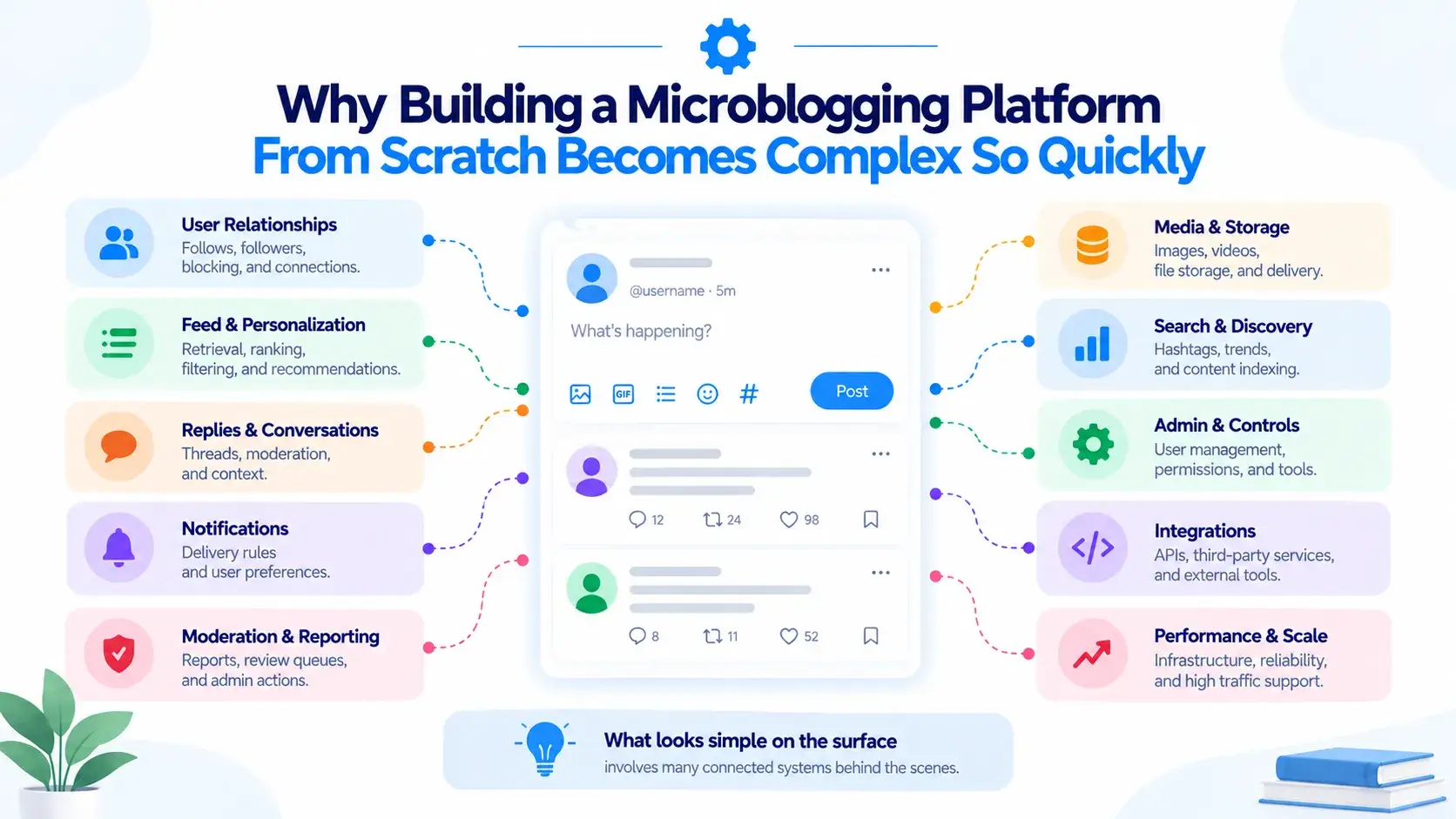
The visible posting interface represents only a small part of a functioning social network. Once real users enter the system, every simple interaction creates additional product requirements.
A follow button requires relationship logic. A feed requires retrieval, ordering, filtering, and eventually personalization. Replies create conversation trees and moderation requirements. Notifications need delivery rules. Blocking affects profiles, feeds, messages, discovery, and recommendations. Reporting creates review queues and administrative decisions. Media creates storage and delivery considerations. Growth creates performance and infrastructure questions.
This is why a startup can underestimate the project by looking only at screens. The challenge is not merely creating a compose box and timeline. It is making dozens of connected workflows behave consistently as the community becomes larger and more active.
Custom development creates decisions before it creates learning
With a ground-up build, founders must make many decisions before meaningful user data exists. Teams debate navigation, feed structure, account relationships, notification behavior, moderation states, database models, admin permissions, reporting logic, integrations, and deployment architecture based largely on assumptions.
Some of those decisions will eventually prove correct. Others will change as soon as users interact with the product.
For an early-stage company, that creates an opportunity-cost problem. Every week spent perfecting a standard social workflow is a week in which the business is not learning whether its target community actually wants the product.
Ready-Made vs. Custom Development: What Changes for a Startup?
| Decision Area | Ready-Made Platform | Custom Development | Startup Implication |
|---|---|---|---|
| Starting point | Existing product foundation | Architecture and workflows created from zero | Ready-made reduces foundational implementation work |
| Time to market learning | Earlier because common modules already exist | Learning begins after design, development and testing | Earlier feedback can improve prioritization |
| Customization | Custom development layered over an existing base | Maximum freedom from the beginning | The right choice depends on how unusual the product concept is |
| Budget allocation | More capital can potentially remain for launch and growth | Larger early engineering commitment | Founders should evaluate total launch economics, not development alone |
| Product risk | Common workflows are already structured | Every workflow needs specification and implementation | Ready-made reduces reinvention of standard mechanics |
| Operational readiness | Can begin with admin and moderation workflows already available | Operational tooling must be deliberately scoped | Back-office readiness matters once users arrive |
| Differentiation | Created through positioning and selected customization | Can be engineered into every layer | Custom is stronger when differentiation depends on original architecture |
| Ownership | Depends on licensing and source-code terms | Depends on the development agreement | Founders should verify ownership in either model |
1. Startups Reach Market Validation Earlier
The most valuable startup resource is not code. It is validated knowledge.
Before launch, founders operate with hypotheses: people will join, creators will post, discussions will develop, users will return, and a particular niche will generate enough activity to support a business. Development cannot confirm those assumptions. Only market behavior can.
A ready-made platform shortens the distance between the hypothesis and that feedback. Instead of spending the earliest phase rebuilding standard social mechanics, the team can focus on preparing the audience, community rules, launch positioning, content seeding, onboarding, and acquisition strategy.
Once real users arrive, the roadmap becomes more informed. The startup can see whether users prefer public discovery or followed accounts, whether replies create meaningful conversations, which categories become active, where users abandon onboarding, and which behaviors correlate with retention.
This changes development from speculative building into evidence-led iteration.
2. Founders Avoid Rebuilding Standard Social Workflows
Every social startup wants differentiation, but differentiation rarely comes from rebuilding registration, profile editing, follows, notifications, reports, blocks, or basic publishing from first principles.
Users already understand many of these interaction patterns. The startup’s competitive identity is more likely to come from its audience, community structure, discovery experience, content model, trust rules, creator strategy, specialist functionality, or distribution model.
Starting from a ready-made foundation lets the company separate commodity product infrastructure from strategic differentiation.
That is an important product-management discipline. A founder should ask: “Does building this module differently make users choose us?” If the answer is no, recreating it from zero may consume resources without strengthening the business proposition.
3. More of the Early Budget Can Stay Focused on Growth
A social product without active users has limited value regardless of how polished the codebase is.
After development, a startup still needs resources for community building, launch content, creator outreach, user acquisition, moderation, customer support, infrastructure, analytics, experiments, and ongoing product improvement.
This is where the development-model decision becomes a capital-allocation decision.
If most early capital is consumed before the platform meets users, the company may reach launch with a sophisticated product but insufficient resources to create the activity that makes a social network valuable. A ready-made foundation can reduce the amount of duplicated foundational engineering and leave more room for the activities that create demand.
The right financial question is therefore not simply, “Which option has the lower development cost?” A better question is, “Which approach gives us enough product capability and enough remaining runway to validate the business?”
4. The Startup Can Focus Differentiation Where Users Will Notice It
Choosing ready-made software does not mean accepting a generic market proposition.
A niche professional network, sports discussion community, regional social product, creator network, private member community, education network, or brand-owned community can all use familiar microblogging mechanics while delivering very different value to users.
Differentiation can come from community access, specialized profiles, discovery rules, content categories, reputation systems, creator programs, verification, local language support, moderation policies, specialist integrations, or entirely new functionality layered over the established foundation.
This is often more strategically useful than making every basic component unique. Familiar interaction patterns reduce learning friction, while carefully selected custom layers give users a reason to choose the new platform.
5. Admin Control Becomes a Day-One Requirement, Not a Later Addition
Founders naturally focus on the user-facing experience before launch. Once the platform is active, however, the operator experience becomes equally important.
Someone needs to review reports, manage accounts, investigate abuse, adjust settings, monitor activity, respond to problems, and understand what is happening across the community.
If operational controls are missing, routine business decisions turn into development tickets. That creates unnecessary dependency precisely when the startup should be moving quickly.
When evaluating a ready-made foundation, founders should therefore inspect the operator side as carefully as the user interface. A polished feed means little if the business lacks the controls required to operate the community safely and efficiently.
6. Moderation Can Be Designed Into the Product Before Growth Arrives
Microblogging products are user-generated-content environments. That means spam, harassment, impersonation, inappropriate content, unwanted contact, and disputes cannot be treated purely as future-scale problems.
The platform needs practical mechanisms for reporting, blocking, reviewing content, controlling accounts, documenting actions, and enforcing community policies. The exact moderation model will depend on the audience, geography, product positioning, and operating team, but the workflow needs to exist before growth makes manual improvisation unmanageable.
For founders, moderation is therefore more than a technical checklist. It influences user trust, community quality, operational workload, advertiser confidence where advertising is relevant, and the long-term reputation of the platform.
A ready-made product foundation can provide a useful head start because these operational workflows can be evaluated before launch rather than discovered only after harmful behavior appears.
7. Feed and Discovery Decisions Can Be Improved After Real Usage Data Exists
The feed is one of the most strategically important parts of a microblogging product because it determines what users encounter after opening the platform.
But startups do not necessarily need the most sophisticated recommendation system on day one. Early communities may benefit from understandable discovery mechanisms such as recent content, followed accounts, active discussions, topics, hashtags, or simple relevance rules.
Once usage develops, the platform can make more informed personalization decisions using actual behavior rather than assumptions.
Founders who want to understand this layer in greater technical depth can explore the guide to microblogging platform feed architecture, which examines public discovery, following feeds, personalization, freshness, ranking signals, and related system considerations.
The strategic principle is simple: build enough discovery capability to create useful experiences, collect meaningful signals, and then improve ranking as the network produces better data.
8. Source-Code Ownership Can Protect Long-Term Product Flexibility
Ready-made software can follow very different ownership models, so founders should never assume that buying access means owning the underlying product.
Before selecting a platform, clarify whether the business receives source code, whether modifications are permitted, where the application will be deployed, which third-party services remain external, what ongoing licensing applies, and whether another engineering team could maintain the product later if necessary.
This matters because a startup’s requirements will evolve. The first market version may rely heavily on the ready-made foundation, while later versions may introduce specialist integrations, new discovery logic, unique community mechanics, monetization layers, or architectural changes.
Source-code ownership can make that transition easier by giving the business greater control over its technical roadmap. The specific rights still depend on the commercial agreement, so they should be confirmed explicitly before development begins.
Founder Decision Signals
Speed
Choose a ready-made foundation when reaching users and validating demand matters more than engineering standard social workflows from zero.
Capital
Look beyond development cost. Calculate how much runway remains for acquisition, community operations, moderation, infrastructure, and iteration after launch.
Differentiation
Identify exactly which parts of your product must be original. If the core interaction model itself is unique, deeper custom development may be justified.
Control
Verify source-code terms, admin capabilities, deployment arrangements, customization rights, and third-party dependencies before committing.
9. A Faster Launch Moves the Team From Product Assumptions to Community Data
Speed should not be treated as a vanity metric. Launching quickly only matters when the startup uses the time advantage to learn.
For a microblogging business, useful early signals include activation, posting frequency, reply depth, follow behavior, content discovery, returning users, reporting patterns, creator activity, and the communities that form naturally.
Those signals help determine where subsequent investment belongs. Perhaps discovery needs improvement. Perhaps onboarding needs simplification. Perhaps a particular niche produces much stronger conversations than the broader audience originally targeted. Perhaps users need stronger controls over what appears in their feeds.
A faster development path creates value when it accelerates this feedback loop.
After launch, the challenge shifts from development to distribution. The guide to microblogging platform growth and user acquisition can help founders think through audience seeding, acquisition, engagement, and the transition from launch to an active network.
10. Ready-Made Does Not Remove the Need for Technical Due Diligence
Speed should never be confused with skipping evaluation.
A weak ready-made platform can create a different form of technical debt. Attractive screens may hide rigid code, poor operational controls, weak moderation, limited scalability, unclear ownership, or functionality that works only in a demonstration environment.
Founders should ask to see real workflows rather than relying entirely on feature lists. Create an account. Publish content. Follow another user. Trigger a notification. Submit a report. Block an account. Review the moderation process. Inspect administrative controls. Understand how configuration changes are made.
Also ask what requires external accounts or integrations. Payments, email delivery, push notifications, hosting, analytics, and other services may require separate credentials, configuration, or ongoing operating costs.
The purpose of due diligence is not to find a platform claiming to contain everything. It is to understand precisely what is ready, what must be configured, what needs customization, and what remains part of your operating responsibility.
What Startups Should Evaluate Before Choosing a Ready-Made Platform
A founder comparing options should evaluate the product across several layers rather than making the decision based on screenshots or the number of features advertised.
- Core interaction quality: Can users publish, reply, follow, discover, and navigate conversations naturally?
- Feed behavior: Are the available feed experiences appropriate for the community model you plan to launch?
- Moderation: Can users report and block? Can operators review issues and record outcomes?
- Administrative control: Can the business manage users, content, platform settings, and operational workflows without developer intervention for routine actions?
- Customization: Can branding, workflows, integrations, policies, and selected functionality be adapted?
- Ownership: What exactly does the startup own, and what restrictions apply to the code or deployment?
- Scalability: Can the architecture evolve as posting volume, relationships, notifications, and traffic increase?
- Deployment readiness: Which components are production-ready and which require external accounts, configuration, infrastructure, or additional work?
- Post-launch flexibility: Can the team continue extending the platform after user feedback begins shaping the roadmap?
If feature-level evaluation becomes the next step, use a dedicated microblogging app feature checklist rather than turning the development-model decision into an oversized feature comparison.
When Custom Development Is the Better Choice
Ready-made development is not automatically the right strategy for every startup.
Custom development becomes more appropriate when the product’s central value depends on technology or interaction logic that does not fit established microblogging patterns. A startup developing a fundamentally new social graph, unusual communication mechanic, specialized enterprise workflow, proprietary recommendation architecture, or deeply integrated ecosystem may need a ground-up approach.
Custom development may also make sense when the organization has sufficient capital, an experienced product and engineering team, validated requirements, and no significant pressure to reach the market quickly.
The key distinction is whether custom engineering creates strategic differentiation or merely recreates functionality users already expect.
If originality lives in the fundamental architecture, custom development deserves serious consideration. If originality lives mainly in the audience, positioning, community model, branding, policies, growth strategy, or a smaller number of differentiated features, starting with a ready-made foundation can be more efficient.
A Hybrid Strategy Can Be More Practical Than Treating the Decision as Binary
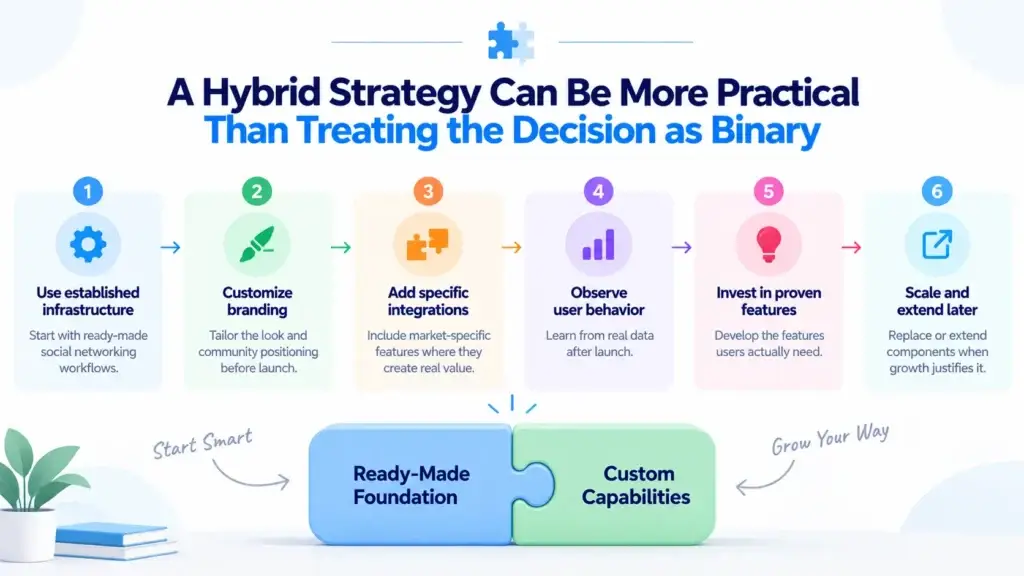
Founders sometimes frame the decision as either buying a fixed product or custom-building everything. In practice, there is a useful middle ground.
A startup can begin with ready-made infrastructure for standard social networking workflows and then commission custom development for the capabilities that define its market proposition.
This creates a layered product strategy:
- Use established infrastructure for common account and social workflows.
- Customize branding and community positioning before launch.
- Add market-specific integrations where they create real operational value.
- Observe user behavior after launch.
- Invest subsequent development into the features users actually prove they need.
- Replace or extend underlying components later when scale or differentiation justifies the investment.
This approach helps prevent a startup from spending heavily on speculative differentiation before it has evidence that users value it.
Common Mistakes Founders Make With Ready-Made Social Platforms
Choosing based only on launch speed
Speed is valuable, but an unusable or operationally weak product launched quickly does not create an advantage. Evaluate what happens after users arrive.
Treating a feature list as proof of product quality
Two platforms can advertise the same feature and implement it very differently. Test workflows and administrative behavior rather than counting checkmarks.
Launching without a defined community
A broad social platform faces a difficult cold-start problem. Startups should know which initial group they intend to serve and why that group should participate before opening registration.
Ignoring moderation until the community grows
Safety workflows become harder to retrofit once problematic behavior is already happening at scale. Establish reporting, review, blocking, and community policies early.
Assuming ownership without checking the agreement
Clarify source-code rights, licensing, deployment, external dependencies, customization rights, and future maintenance before committing to a platform.
Trying to customize everything before validation
Excessive pre-launch customization can recreate the same delays founders hoped to avoid by selecting a ready-made platform. Prioritize changes that are essential to positioning, operations, trust, or the core user proposition and defer speculative additions until real usage provides direction.
How Miracuves Helps Startups Take the Ready-Made Route
Miracuves helps founders start with a ready-made, white-label product foundation rather than rebuilding common social networking workflows from zero. For a startup exploring a text-first community business, this approach can reduce the distance between product planning and real market validation while preserving room for branding and customization.
Founders who move from general research into product evaluation can explore the Miracuves Threads Clone solution to understand the available commercial platform in greater detail. That page is the appropriate next step for product-specific capabilities, demos, deployment information, and solution evaluation rather than repeating those details here.
Where the selected ready-made scope fits the project, Miracuves offers a 6-day solution delivery. The practical advantage is not simply getting software sooner. It is giving the startup an opportunity to move into branding, launch preparation, audience building, community operations, and market learning earlier.
Founders with substantially different product logic should still consider custom development. The objective is to choose the development path that matches the actual business problem rather than forcing every idea into the same delivery model.
Final Thoughts: Standardize the Foundation and Customize the Advantage
The strongest argument for a ready-made microblogging platform is not that custom development is unnecessary. It is that startups should be selective about where custom development creates value.
Profiles, posting, following, replies, notifications, reporting, administrative workflows, and other familiar social mechanics are foundational requirements. Rebuilding every layer from zero can consume time and capital before the startup has answered the more important business question: does this community deserve to exist as a standalone product?
A ready-made foundation lets founders move that question closer to real users.
The business can launch its brand, seed its initial community, observe conversations, learn how people discover content, identify moderation pressure, measure engagement, and determine where deeper product investment belongs.
Custom development remains valuable when it serves genuine differentiation. The mistake is assuming that every line of code must be original for the business itself to be original.
For many startups, a stronger sequence is to start with the proven foundation, customize what defines the market proposition, validate the community, and let actual user behavior guide the next stage of development.
FAQs
What is a ready-made microblogging platform?
A ready-made microblogging platform is a pre-developed social networking foundation that includes established workflows for publishing, profiles, conversations, user relationships, engagement and platform operations. Startups can customize the foundation for their branding, community model and selected product requirements instead of building every standard workflow from zero.
Why do startups choose ready-made microblogging platforms?
Startups often choose them to reach the market sooner, reduce foundational development work and begin validating user behavior earlier. The approach can also preserve resources for audience acquisition, community management, moderation and post-launch improvements.
Is a ready-made social platform the same as a generic app?
Not necessarily. A ready-made foundation provides established product infrastructure, while branding, positioning, policies, integrations and differentiated functionality can still be customized. The amount of flexibility depends on the platform and commercial agreement.
Is custom development better for a unique social media idea?
Custom development can be the stronger option when the core interaction model, architecture or technical capability is genuinely different from established microblogging patterns. If most differentiation comes from audience, branding, community strategy or selected features, a ready-made foundation may still provide a practical starting point.
What should founders check before choosing ready-made microblogging software?
Founders should evaluate real user workflows, feed behavior, moderation, admin control, customization options, source-code terms, deployment requirements, scalability, integrations and post-launch flexibility. Testing actual workflows is more useful than relying only on a feature checklist.
Why is moderation important before a microblogging platform launches?
Microblogging platforms depend on user-generated content, so reporting, blocking, review processes and community policies are operational requirements rather than optional extras. Establishing them early helps the team manage harmful behavior and community quality as participation grows.
Does source-code ownership matter for a startup social platform?
It can. Source-code ownership can provide greater flexibility for future customization, maintenance and technical changes. Founders should still verify the exact ownership, licensing, deployment and modification terms in their agreement.
Can a startup begin ready-made and customize the platform later?
Yes, provided the selected platform and ownership model support ongoing customization. This hybrid approach lets the startup launch common functionality first, collect real user feedback and then invest development resources in the capabilities that prove strategically important.
Miracuves is an independent software development company. We are not affiliated with, connected to, sponsored by, or endorsed by any company or product named in this article.
Terms such as “X Clone” are used descriptively. It is how the software industry refers to building a platform with functionality comparable to a known service, and how clients search for it.
The entire design and codebase of our products is built by our own team. Our products contain no code, design, graphics, or content originating from any third-party website or applications.
All third-party names and marks referenced in this article are the property of their respective owners, referenced solely to identify the services discussed.