


Key Takeaways
- A microblogging app needs more than posting and replies; founders should compare feed logic, discovery, moderation, notifications, user controls, and admin capabilities.
- A ready-made microblogging script should support profiles, posts, media sharing, likes, comments, follows, hashtags, search, reporting, privacy controls, and analytics.
- Source-code ownership, customization flexibility, scalability, security, integrations, deployment support, and monetization options are equally important when evaluating a platform.
Feature Comparison Signals
- Compare content feeds, recommendations, trending topics, hashtags, search, user discovery, mentions, reposts, bookmarks, and real-time notifications.
- Review moderation features such as user reporting, blocking, content filtering, spam prevention, role-based admin access, account suspension, and moderation logs.
- Check monetization, advertising controls, premium memberships, creator tools, analytics, API integrations, payment support, and backend configuration before choosing a script.
Founder Buying Insights
- Founders should compare a script against their target community, content model, moderation requirements, revenue strategy, expected traffic, and future product roadmap.
- A lower upfront price can become less valuable if the platform lacks customization, scalable architecture, security updates, deployment support, or control over the source code.
- Miracuves develops customizable microblogging platforms with social feeds, discovery, moderation, monetization, analytics, notifications, user management, integrations, and admin controls.
A microblogging app looks simple from the outside. Users post short updates, follow people, reply to conversations, discover trending topics, and return when notifications pull them back in.
But for founders, the product is more than a feed.
A serious microblogging platform needs publishing workflows, profile identity, follow logic, reply structures, discovery systems, notifications, moderation tools, privacy settings, reporting, analytics, monetization options, and admin control. If these pieces are weak, the app may look ready during a demo but fail when real users start posting, reporting, sharing, and expecting fast response times.
That is why buying a ready-made script should not be treated as a simple feature-count decision. The smarter approach is to compare how each feature supports engagement, trust, revenue, and long-term control.
This checklist is designed for founders who are evaluating a ready-made text-first social networking script and want to understand what actually matters before making a purchase decision.
Why Founders Need a Feature Checklist Before Buying a Microblogging Script
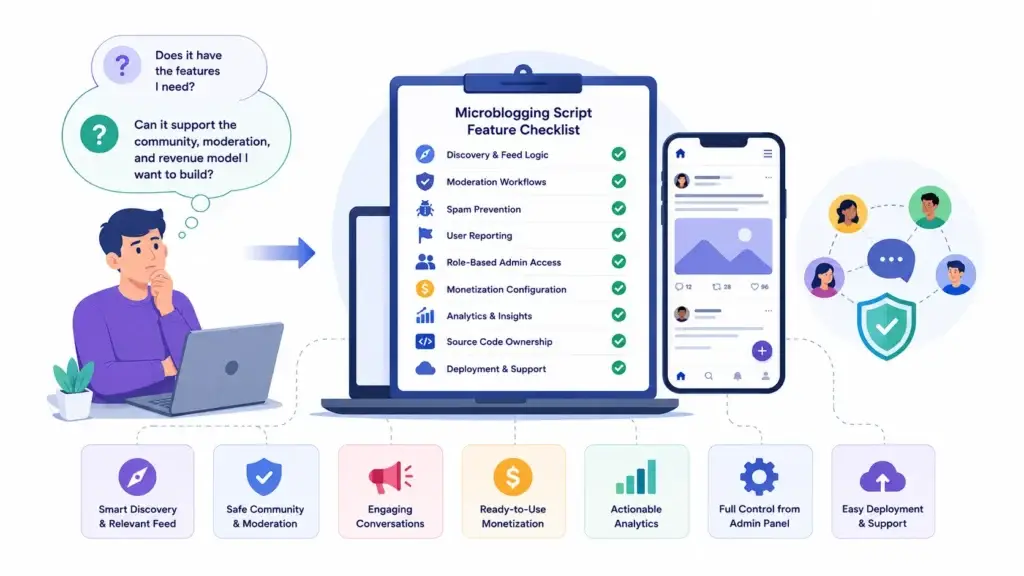
Many founders compare ready-made scripts by asking one question: “Does it have the features I need?”
That question is useful, but incomplete.
A better question is: “Can this script support the kind of community, conversation flow, moderation model, and revenue system I want to build?”
A public conversation app has different pressure points from a marketplace, delivery platform, or ecommerce app. The product lives or dies on how quickly users understand the posting flow, how relevant the feed feels, how safe the community feels, and how much control the operator has from the backend.
A script may include posting, replies, likes, and profiles, but still miss the deeper layers founders need, such as:
- Real discovery logic.
- Clear moderation workflows.
- Spam prevention.
- User reporting.
- Role-based admin access.
- Monetization configuration.
- Analytics for content and users.
- Source-code ownership.
- Deployment and support clarity.
This is where a structured comparison checklist helps. It keeps the buying decision practical instead of emotional.
The Core Product Loop Comes Before the Feature List
Before comparing individual features, founders should understand the core loop of a microblogging product.
A strong text-first social app usually follows this loop:
- User joins the platform.
- User creates a profile.
- User follows people or topics.
- User publishes a post.
- Other users reply, like, repost, or quote.
- The platform recommends or surfaces relevant posts.
- Notifications bring users back.
- Moderation keeps conversations safe.
- Analytics and monetization help the operator improve the platform.
If this loop is weak, extra features will not fix the product.
For example, a script may offer media uploads, hashtags, groups, and profile badges. But if the first-session feed is empty, the reply flow is confusing, or notifications are noisy, users may leave before they understand the value of the platform.
That is why the first comparison point should always be the product loop, not the longest feature list.
Microblogging App Feature Checklist
Use this table to compare ready-made scripts before buying one.
| Feature Area | What to Check | Why It Matters for Founders |
|---|---|---|
| User onboarding | Signup, login, profile setup, password recovery, optional two-factor authentication | First-session friction affects activation and trust |
| Profile system | Avatar, bio, username, privacy visibility, follower/following lists | Profiles create identity and help users build audience ownership |
| Publishing flow | Text posts, media support, hashtags, mentions, polls, drafts, scheduled posts | Publishing is the core action that drives platform activity |
| Reply structure | Threaded replies, nested conversations, quote posts, reposts | Clear conversation structure prevents messy discussions |
| Feed logic | Following feed, discovery feed, trending posts, topic-based feeds | Feed relevance affects retention and session depth |
| Search and discovery | Hashtag pages, search history, saved queries, trending topics | New users need easy ways to find relevant conversations |
| Notifications | Replies, mentions, follows, reposts, likes, moderation updates | Notifications bring users back when used carefully |
| Messaging | Direct messages, group chat, message requests, user controls | Private communication improves community depth |
| Moderation | Reports, content review, user suspension, abuse controls, admin queues | Moderation protects trust and reduces platform risk |
| Privacy controls | Blocking, muting, visibility settings, reply permissions | Users need control over their social experience |
| Monetization | Ads, promoted posts, subscriptions, verification plans, creator payouts | Revenue features turn the app into a business model |
| Analytics | User growth, post activity, engagement, reports, revenue signals | Founders need data to improve product and growth decisions |
| Admin dashboard | User, post, report, ad, payment, and platform controls | The operator needs backend control without constant developer dependency |
| Source code | Full source-code access, handoff process, documentation | Source-code ownership reduces long-term vendor lock-in |
| Deployment support | Server setup, branding, app publishing, QA, configuration | Launch support reduces operational confusion |
| Customization scope | Branding, UI changes, feature edits, integrations, workflows | The script should adapt to your niche, not force a generic product |
After using this checklist, founders who want to compare product-level modules in more detail can review the full feature breakdown for a modern microblogging platform before finalizing their launch scope.
User and Creator Features Founders Should Compare
A microblogging platform depends on user-generated activity. If posting feels slow or profile identity feels weak, the platform struggles to build a habit.
Founders should compare whether the user side includes clean registration, editable profiles, profile visibility controls, posting tools, replies, reposts, quote posts, saved posts, hashtags, mentions, media support, and notification preferences.
Creator features also matter if the platform is designed for influencers, niche experts, journalists, educators, brand communities, sports fan groups, or paid membership audiences.
Creator-focused workflows may include audience insights, profile verification, content analytics, promoted visibility, subscriptions, bonus tracking, or monetized posts. These features are not required for every first launch, but the product foundation should not block them later.
The key is to avoid building a platform that only lets users post. A better script helps users build identity, return to conversations, and grow an audience.
Feed and Discovery Features Decide Whether Users Return
Most social apps fail quietly because users do not see enough relevant content.
For a microblogging product, the feed is not just a timeline. It is the engine that decides what users see, who gets discovered, and whether the platform feels alive.
Founders should compare how the script handles:
- Following-based feeds.
- Discovery feeds.
- Trending topics.
- Hashtag pages.
- Search results.
- User recommendations.
- Freshness and engagement signals.
- Muted or blocked content.
- Saved searches or query history.
A basic chronological feed may be enough for a closed community or internal network. But if the app is meant for public growth, niche communities, creators, or advertisers, discovery logic becomes much more important.
A good evaluation question is: “Can a new user find something relevant within the first minute?”
If the answer is no, the product may need stronger onboarding, default topics, suggested users, trending sections, or seeded content workflows.
Moderation and Safety Should Not Be Treated as Add-Ons
Public conversation platforms attract spam, impersonation, abusive replies, low-quality content, and reporting disputes. These issues usually appear after launch, not during the sales demo.
That is why moderation must be part of the buying checklist.
A strong ready-made script should include user reporting, post reporting, comment review, account suspension, content removal, admin notes, abuse tracking, and clear review statuses. For larger communities, the platform may also need role-based access, audit logs, IP controls, automated abuse signals, and separate queues for different review types.
Moderation is not only about removing bad content. It protects the platform’s brand, keeps users comfortable, and helps advertisers or community partners trust the environment.
Founders should ask vendors how reports move through the system. A simple “report button” is not enough if the admin side cannot review, resolve, dismiss, or track moderation decisions.
Messaging and Community Controls Improve Retention
Not every microblogging app needs direct messaging at launch, but messaging can become important when the platform supports creators, professionals, communities, fan groups, or brand-led networks.
The important part is control.
A healthy messaging system should not simply allow anyone to message anyone. It should include message requests, block controls, report options, accepted and declined states, and admin visibility into abuse reports where appropriate.
For founders, this matters because private messaging can improve retention, but it can also increase spam and safety concerns if it is not designed carefully.
The script should let the platform operator decide how open or restricted messaging should be based on the target audience.
Monetization Features Should Match the Community Model
A ready-made script becomes more valuable when it supports a real business model.
For microblogging platforms, common monetization options include:
- Sponsored posts.
- Promoted profiles.
- Ad placements.
- Verification subscriptions.
- Creator monetization.
- Paid communities.
- Premium analytics.
- Brand campaign tools.
- Membership access.
- Platform service fees.
Not every platform needs all of these from day one. A local community app may start with sponsored posts. A creator-led network may need subscriptions and creator analytics. A professional community may monetize through memberships, premium visibility, or paid access.
The founder’s job is to match monetization to audience behavior.
To connect these revenue options to a practical launch plan, founders can explore the social platform business model and revenue streams before deciding which monetization layers should be active from day one.
The vendor’s job is to provide a flexible foundation that does not require rebuilding the platform when monetization becomes important.
Admin Dashboard Features Are Where Founders Gain Control
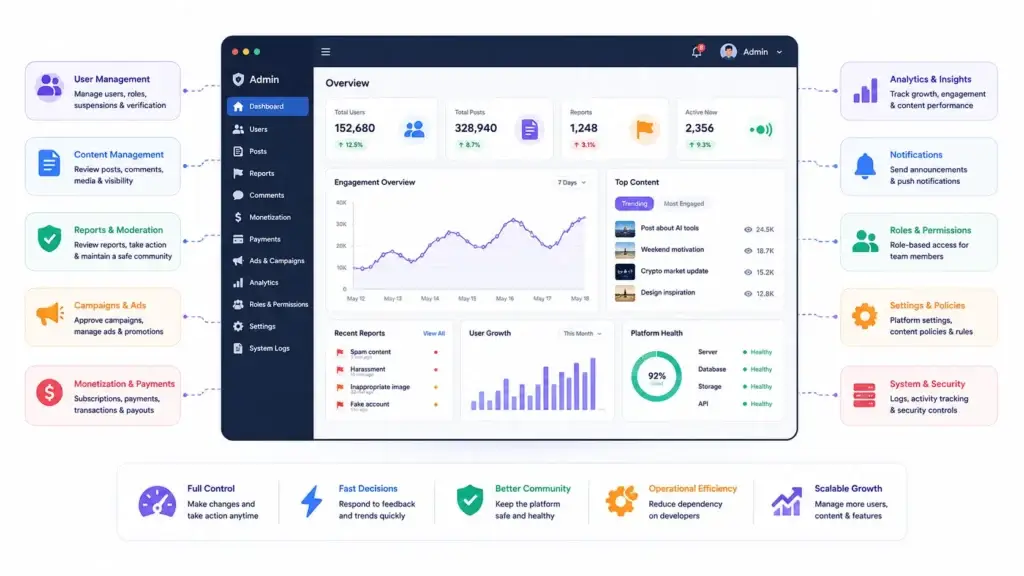
The admin dashboard is one of the most important parts of a ready-made script because it decides how much control the founder has after launch.
A good admin dashboard should help the operator manage users, posts, reports, trends, notifications, monetization settings, payments, ads, analytics, roles, and platform policies.
Without admin control, even small changes become developer tasks.
For example, the operator should be able to review reported posts, suspend users, approve campaigns, view engagement data, manage content visibility, and adjust key settings without waiting for engineering support every time.
This is especially important for founders who are validating a market. Early feedback is unpredictable. The platform may need small operational changes quickly, and the admin dashboard should support that speed.
Miracuves Microblogging App Solution Cost and Tech Stack
Get a fully developed, deployment-ready microblogging platform built for founders launching community networks, creator platforms, niche social apps, professional discussion networks, and real-time content-sharing products. Built on a modern JavaScript foundation, this complete package includes everything you need to launch and scale:
Core Workflows: User registration, profile creation, short-form post publishing, follows, likes, replies, reposts, hashtags, mentions, media attachments, search, personalized feeds, and notifications.
Built-in Revenue Logic: Premium subscriptions, promoted posts, sponsored content, creator monetization, paid communities, advertising placements, verification plans, and platform service fees.
Management Hub: Centralized admin dashboard, user management, post moderation, report handling, hashtag controls, content visibility settings, role-based permissions, monetization tracking, and platform analytics.
Launch-Ready: Fully prepared for your custom branding, configuration, user onboarding, moderation rules, notification setup, monetization options, community categories, and immediate market entry.
Why Is Microblogging App Development More Affordable?
Most microblogging platforms become expensive when businesses choose fully custom development from scratch. Building separate workflows for users, feeds, posting, replies, follows, media sharing, notifications, moderation, search, monetization, and admin controls can significantly increase cost, timeline, and technical complexity.
We took a smarter, more practical approach:
You Aren’t Paying for Ground-Up Development: Our microblogging platform engine is already developed, tested, and ready to deploy. You skip the inflated cost and long development cycles normally associated with building a social networking product from scratch.
The Power of JavaScript: We built this solution on a modern JavaScript architecture that supports interactive feeds, fast user engagement, scalable social workflows, API-driven integrations, and smooth administrative operations.
You get a launch-ready microblogging platform with practical publishing, engagement, moderation, monetization, and community management features, source code access, and faster deployment without the high custom development price tag.
Note: This cost is for the solution, re-branding, deployment, and source code only.
Ready-Made Script vs Custom Development
Founders often compare ready-made scripts with fully custom development. Both can be useful, but they serve different situations.
| Build Option | Best For | Main Advantage | Main Risk |
| Ready-made script | Founders who want faster launch, lower initial risk, and proven app flows | Faster validation with existing modules | May need customization to fit a unique niche |
| Custom development | Founders with highly original product logic or unusual architecture needs | Maximum flexibility from day one | Higher cost, longer timeline, more early uncertainty |
| Hybrid approach | Founders who want a launch-ready base with selected custom modules | Balanced speed and flexibility | Requires clear scope control |
For a deeper founder-focused comparison, read this guide on choosing a ready-made foundation instead of building from zero when speed, validation, and launch control matter.
A ready-made script works well when the product model is familiar but the market, audience, brand, or monetization angle is different.
Custom development works better when the product depends on a unique algorithm, deeply original interaction model, unusual privacy structure, or complex proprietary workflow.
Founders who need deeper customization, unique interaction flows, or advanced community features can also explore Miracuves’ social media app development services before deciding whether a ready-made foundation or custom build is the better route.
If vendor selection is the bigger concern, founders can also compare what to look for in a social platform development partner before choosing a ready-made or custom build route.
Founder Decision Signals
Speed
Choose a ready-made script when your priority is launching quickly, testing audience demand, and avoiding months of basic social app development.
Control
Look for source-code access, admin dashboard depth, role-based controls, and clear ownership terms before committing to a vendor.
Trust
Prioritize moderation, reporting, privacy controls, and abuse prevention if your app depends on public conversations or creator communities.
Monetization
Pick a script that supports the revenue model you actually plan to use, whether that is ads, subscriptions, promoted posts, verification, or paid communities.
Mistakes Founders Should Avoid When Comparing Scripts
Choosing the Longest Feature List Without Checking Workflows
A long feature list can look impressive, but workflows matter more. Posting, replies, feed discovery, reports, messaging, monetization, and admin actions should work together. If they feel disconnected, the platform may become difficult to operate after launch.
Ignoring Moderation Until Users Arrive
Moderation should be reviewed before launch. Waiting until users start reporting content can damage trust quickly. Founders should check report handling, review statuses, user suspension, content controls, and admin roles before buying.
Treating Pricing as a Single Number
A script price only makes sense when the full scope is clear. Founders should confirm whether source code, white-label branding, deployment, app publishing, support, integrations, and customization are included or billed separately.
Buying Without Understanding Source-Code Ownership
Source-code access affects long-term flexibility. If the founder cannot access or extend the codebase, future customization may depend entirely on the original vendor. This can create operational and pricing risk later.
Forgetting the First-Session User Experience
The first session matters. A user should quickly understand who to follow, what to post, where to discover content, and why to return. Scripts that only focus on backend features may miss this product experience layer.
This is also why founders should plan a growth strategy before launch, especially for community-led products where empty feeds can reduce early retention.
When a Ready-Made Social App Foundation Makes Sense
A ready-made foundation makes sense when the founder already understands the audience and wants to move faster with proven social networking workflows.
For example, a founder may want to build:
- A local public discussion platform.
- A creator-led conversation network.
- A regional language community.
- A private professional network.
- A sports or fan engagement app.
- A media-led discussion space.
- A brand-owned community platform.
- A membership-based social app.
In these cases, the founder’s advantage is not inventing posting or reply features from scratch. The advantage comes from audience selection, positioning, moderation quality, creator relationships, monetization strategy, and consistent execution.
For founders ready to move from evaluation to launch, Miracuves offers a ready-made text-first social networking platform that can be customized around branding, community rules, monetization needs, and admin control.
Final Thoughts: Compare the Foundation, Not Just the Feature List
A microblogging app does not grow only because it includes posts, likes, replies, and follows. Those features create the surface experience, but the real value comes from how well the platform supports meaningful conversations, user retention, content discovery, moderation, monetization, and backend control.
Before choosing a ready-made script, founders should look beyond the demo and compare the complete product foundation: the user journey, admin dashboard, safety workflows, pricing scope, customization flexibility, and source-code ownership. This helps reduce the risk of launching a platform that looks complete but cannot support real community activity.
For founders who want to move faster without losing long-term control, Miracuves helps build launch-ready microblogging platforms with white-label branding, admin control, monetization-ready modules, and a scalable foundation that can grow with the audience.
FAQs
What features should a microblogging app script include?
A microblogging app script should include user registration, profiles, posting, replies, reposts, likes, follows, hashtags, feeds, search, notifications, moderation, reporting, analytics, monetization tools, and an admin dashboard.
How should founders compare ready-made social app scripts?
Founders should compare scripts based on product workflows, source-code access, admin control, customization scope, moderation tools, monetization options, deployment support, and post-launch flexibility.
What affects the price of a ready-made microblogging app script?
Pricing usually depends on platform coverage, feature depth, branding, customization, integrations, deployment, app publishing support, support period, infrastructure setup, and whether full source code is included.
Is a ready-made script better than custom social app development?
A ready-made script is better when speed, cost-efficient validation, and proven app workflows matter. Custom development is better when the product requires a unique architecture, original algorithm, or complex proprietary logic from the beginning.
Why is moderation important in a public conversation app?
Moderation protects users, creators, advertisers, and the platform brand. Reporting tools, review queues, suspension controls, privacy settings, and abuse prevention help founders maintain trust as the community grows.
Should a microblogging app include monetization from day one?
Not always. Some founders should validate engagement first. However, the platform foundation should support future monetization options such as ads, promoted posts, subscriptions, verification plans, paid communities, or creator earnings.
Why does source-code ownership matter?
Source-code ownership gives founders more long-term control over customization, integrations, hosting, scaling, and vendor flexibility. Without it, future changes may depend heavily on the original provider.
When should I speak with Miracuves?
Speak with Miracuves when you have a clear audience, community model, or monetization direction and want to evaluate whether a ready-made social app foundation can help you launch faster with branding, admin control, and source-code ownership.
Miracuves is an independent software development company. We are not affiliated with, connected to, sponsored by, or endorsed by any company or product named in this article.
Terms such as “X Clone” are used descriptively. It is how the software industry refers to building a platform with functionality comparable to a known service, and how clients search for it.
The entire design and codebase of our products is built by our own team. Our products contain no code, design, graphics, or content originating from any third-party website or applications.
All third-party names and marks referenced in this article are the property of their respective owners, referenced solely to identify the services discussed.