


Key Takeaways
- A microblogging platform feed architecture should balance public discovery, followed accounts, trending conversations, and personalized recommendations within one content system.
- Following feeds prioritize content from selected accounts, while discovery feeds surface relevant posts, topics, creators, communities, and conversations beyond the user’s existing network.
- Strong feed architecture depends on ranking logic, freshness, engagement signals, content diversity, moderation, and real-time updates working together.
Feed Architecture Signals
- Public discovery can use trending topics, hashtags, popular posts, communities, account suggestions, and search signals to expose users to new conversations.
- Following feeds can combine recency, relationship strength, replies, reposts, likes, muted accounts, and user preferences to organize posts from followed profiles.
- Real-time event streams, caching, ranking services, moderation filters, notification systems, and scalable databases help keep feeds responsive as posting volume increases.
Discovery & Personalization Insights
- Personalized feeds can use follows, clicks, replies, dwell time, searches, topic interests, hides, blocks, and previous engagement to improve content relevance.
- Diversity rules, freshness weighting, exploration slots, duplicate suppression, and user controls can prevent personalized feeds from becoming repetitive or too narrow.
- Miracuves develops customizable microblogging platforms with public feeds, following feeds, personalized recommendations, discovery, moderation, notifications, analytics, and admin controls.
A microblogging platform looks simple when users open it. They write short posts, follow accounts, reply to conversations, check trends, and scroll through updates.
But the feed behind that experience is not simple.
For readers who want the product basics first, this guide on how text-first social apps work explains the role of profiles, replies, conversations, feeds, and community interaction before going deeper into feed architecture.
For founders, feed architecture is one of the most important product decisions in a microblogging app. It decides what users see first, how quickly new content appears, how conversations spread, how creators gain visibility, how spam is controlled, and how the platform keeps people returning.
A weak feed turns the product into a static posting app. A strong feed turns it into a live conversation network.
This guide explains how microblogging platform feed architecture works across public discovery, following feeds, and personalized content. It is written for founders who want to understand the product, technical, and business decisions behind a scalable text-first social platform.
What Microblogging Feed Architecture Really Means
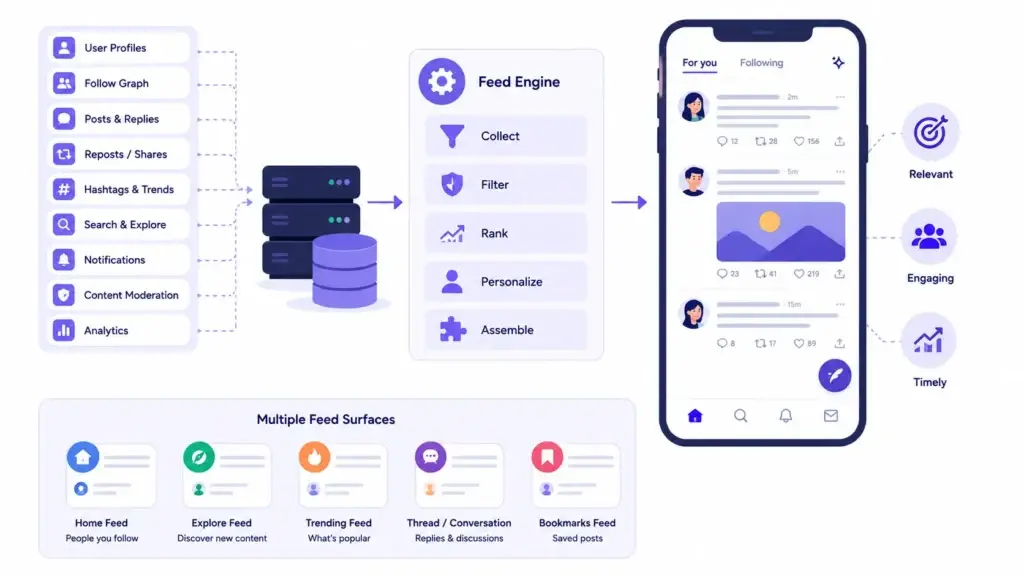
Microblogging feed architecture is the backend and product logic that decides how posts are collected, filtered, ranked, arranged, and delivered to users.
It includes more than storing posts in a database. A real feed system connects user profiles, follow relationships, posts, replies, reposts, hashtags, trends, search, notifications, content moderation, analytics, and personalization.
In a small app, the feed may begin as a simple reverse-chronological stream. The system fetches posts from people a user follows and displays the newest ones first. That works in the early stage, but it becomes limiting as the platform grows.
Users eventually need more than recency. They need relevance. They want to see active discussions, trusted creators, trending topics, useful replies, and content that matches their interests.
That is why modern microblogging platforms usually separate the feed into different surfaces instead of forcing every post into one timeline.
Why One Feed Is Not Enough for a Microblogging Platform
A single feed creates a product problem.
New users may not follow anyone yet, so their feed feels empty. Active users may follow hundreds of accounts, so their feed becomes noisy. Creators may post good content, but it may not reach people outside their current audience. Founders may want to promote trends or communities, but a basic following-only feed gives them limited control.
A stronger microblogging product usually needs three major feed surfaces.
This is especially important for a content creation platform for creators and brands, where the feed must support audience discovery, creator visibility, brand interactions, and repeat engagement instead of only displaying recent posts.
| Feed Surface | What It Does | Why It Matters |
|---|---|---|
| Public discovery feed | Shows popular, recent, topic-based, or editorially relevant public content | Helps new users explore the platform before building a follow graph |
| Following feed | Shows posts from accounts the user follows | Protects user control, trust, and direct relationship-based consumption |
| Personalized feed | Mixes followed and recommended content based on signals | Improves relevance, retention, and content discovery |
The key decision is not which one is better. The stronger decision is how these feeds work together without confusing users.
Founders planning a text-first creator platform should also review the core text-first creator platform features that connect profiles, posts, replies, hashtags, discovery feeds, notifications, moderation, and admin controls into one usable product experience.
A founder building a microblogging app should treat feed architecture as a product strategy layer, not only a backend feature.
Public Discovery Feed: Helping New Users Find Active Conversations
The public discovery feed is the entry point for users who do not yet know whom to follow.
This feed may include trending posts, popular hashtags, fresh discussions, recommended creators, topic-based content, public conversations, and region-specific activity. Its purpose is simple: show that the platform is alive.
For a new microblogging platform, this matters because the first session decides whether users understand the value of the app. If they open the platform and see silence, they may leave before posting or following anyone.
A good public discovery feed should answer three questions quickly:
- What is happening here?
- Who is active?
- Why should I join the conversation?
The public discovery layer can be powered by signals such as post recency, engagement velocity, hashtag activity, creator reputation, reply activity, report history, topic relevance, and editorial boosting.
The mistake is to show only the most viral posts. That can make the feed repetitive and discourage niche communities. A healthier discovery feed should balance popular posts with fresh content, emerging conversations, and category diversity.
Following Feed: Keeping User Choice and Trust Intact
The following feed is the trust layer of a microblogging platform.
When users follow an account, they expect to see that account’s posts. This is the clearest signal of user choice. Even if the platform has a strong personalized feed, the following feed should remain easy to access because it gives users control.
A following feed can be chronological, lightly ranked, or grouped by freshness and engagement. For early-stage platforms, a reverse-chronological following feed is often easier to understand. Users know exactly why a post appeared: they followed the author.
As the platform grows, light ranking may help reduce noise. For example, the system can prioritize posts from accounts the user regularly replies to, posts with active conversations, or posts the user has not already seen.
The key is transparency. If the following feed becomes too algorithmic, users may feel the platform is hiding content from accounts they intentionally follow.
A founder should decide early whether the following feed is:
- Pure chronological
- Chronological with quality filters
- Lightly ranked by user interaction
- A mix of fresh and missed posts
This decision affects database design, cache strategy, notification logic, and user trust.
Personalized Content Feed: Turning Signals Into Relevance
The personalized feed is where a microblogging platform becomes more adaptive.
Instead of showing only followed accounts, the platform can recommend posts from nearby interests, similar creators, followed topics, reposted content, liked posts, trending conversations, and accounts followed by similar users.
The goal is not to replace the user’s choices. The goal is to help users discover content they would probably care about but have not found yet.
A personalized feed usually works through three stages.
First, the system gathers candidate posts. These may come from followed accounts, hashtags, trending topics, similar users, popular posts, search behavior, or content engagement history.
Second, the system filters candidates. It removes deleted posts, blocked accounts, muted topics, reported content, spam, hidden posts, private content, and anything restricted by platform rules.
Third, the system ranks the remaining candidates. Ranking may consider recency, author relationship, engagement quality, reply depth, content type, topic match, language preference, user interests, and negative signals such as skips or “not interested” actions.
The personalized feed should feel useful, not random. Users should feel that recommendations belong near their interests, not that the app is forcing unrelated content into their timeline.
Core Feed Architecture Layers Founders Should Plan
A scalable microblogging feed needs clear layers. Each layer does a different job.
| Architecture Layer | Role in the Feed | Founder Impact |
|---|---|---|
| Post service | Stores posts, media references, replies, reposts, edits, and visibility status | Keeps publishing reliable and organized |
| Social graph service | Tracks follows, blocks, mutes, close connections, and account relationships | Decides who is connected to whom |
| Feed generation service | Builds public, following, and personalized feed candidates | Controls what content is eligible to appear |
| Ranking service | Scores posts based on relevance, freshness, behavior, and quality | Improves retention and session depth |
| Cache layer | Stores precomputed or recent feed results for fast loading | Reduces latency and backend pressure |
| Search and hashtag service | Powers topic discovery, hashtags, trends, and keyword search | Helps content travel beyond followers |
| Moderation service | Applies safety rules, reports, blocks, content filters, and downranking | Protects community quality |
| Analytics layer | Tracks impressions, clicks, replies, follows, hides, reports, and retention | Helps founders improve the product with data |
| Admin dashboard | Gives operators control over trends, reports, users, content, and visibility rules | Keeps the platform manageable after launch |
This layered structure matters because every feed decision creates operational consequences. A founder who ignores moderation, caching, or analytics early may later struggle to understand why users are leaving, why spam is spreading, or why the feed feels slow.
Before finalizing the first product scope, founders can use a practical microblogging app feature checklist to compare feed modules, moderation tools, admin controls, monetization options, and pricing factors.
Feed Ranking Signals That Matter in Microblogging Apps
A microblogging feed should not rank posts only by likes.
Likes are useful, but they can be shallow. A post may receive many likes and still create poor conversation quality. Another post may have fewer likes but stronger replies, saves, or follows generated from it.
Better ranking uses a mix of signals.
Recency shows whether the post is fresh.
Follow relationship shows whether the user intentionally connected with the author.
Reply activity shows whether the post is creating conversation.
Repost activity shows whether users believe the content is worth spreading.
Topic match shows whether the post belongs to the user’s interests.
Author quality shows whether the creator has a good history of useful posts.
Negative feedback shows whether users hide, report, mute, or skip similar content.
Conversation health shows whether replies are constructive, spam-heavy, or abusive.
The founder’s job is not to build the most complex ranking system on day one. The better approach is to start with clear rules, track useful behavior, and improve ranking as real data grows.
Cold Start Strategy for New Users and New Platforms
Cold start is one of the biggest feed problems in microblogging apps.
A new user has no follow graph, no interaction history, and no strong preference signals. A new platform may also have limited content supply. Without a plan, the first feed experience can feel empty or random.
A strong cold start strategy can include:
- Interest selection during onboarding
- Suggested accounts by category
- Seeded public topics
- Trending hashtags
- Location or language-based feeds
- Editorially selected starter conversations
- Creator invite programs
- Welcome prompts that encourage posting
- Follow recommendations after the first few actions
The goal is to collect enough early signals without making onboarding feel heavy.
For founders, this is a business issue as much as a technical one. Paid acquisition will not fix an empty or irrelevant feed. Before scaling traffic, the platform should have enough public content, active creators, visible conversations, and moderation rules to make the first session meaningful.
Once the first feed experience is stable, founders can connect it with a creator platform growth strategy that improves onboarding, content seeding, first follows, creator activation, and repeat sessions.
Moderation, Safety, and Visibility Controls
A microblogging feed can grow quickly, but so can spam, abuse, misinformation, impersonation, and low-quality posting.
That is why moderation should not be treated as an afterthought. It should sit inside the feed architecture.
Useful moderation and visibility controls include content reporting, user blocking, keyword filters, spam detection, account suspension, post removal, reply control, muted words, audit logs, role-based admin access, and manual review queues.
The platform should also support visibility states. A post may be public, limited, hidden, reported, removed, downranked, or restricted from discovery while still visible to the author in some cases.
This gives the operator more control than a simple delete button.
For public discovery and personalized feeds, moderation is especially important because the platform is actively distributing content beyond direct followers. The more reach the system gives a post, the more responsibility the platform has to check quality, safety, and policy signals.
Monetization and Business Value of Feed Architecture
Feed architecture directly affects monetization.
A platform with weak feed logic may struggle to sell ads, subscriptions, boosts, or creator features because users do not spend enough time discovering content. A better feed creates more sessions, more impressions, more follows, more conversations, and more creator visibility.
Common monetization models connected to feed architecture include promoted posts, sponsored trends, creator subscriptions, verified account plans, post boosts, premium analytics, brand communities, and topic-based advertising. Before adding these revenue layers, founders should map the creator platform monetization model carefully so monetization supports user experience instead of making the feed feel overly promotional.
But monetization should be planned carefully. If too many promoted posts appear in the public or personalized feed, users may lose trust. If boosts override quality signals, creators may feel the platform rewards payment more than value.
The better model is controlled monetization. Admins should be able to define where promoted content appears, how often it appears, which users see it, and what quality checks apply before distribution.
Founder Decision Signals
Speed
If the goal is to launch quickly, start with public discovery, following, and basic personalization instead of building a complex ranking engine from day one.
Cost
Feed complexity increases cost when ranking, caching, moderation, analytics, and recommendation systems are treated as custom work from zero.
Scalability
A scalable feed separates post storage, social graph, ranking, cache, moderation, and analytics so the platform can grow without rewriting the core system.
Market Fit
The right feed depends on the audience. News communities need freshness, creator communities need visibility, and professional networks need relevance and trust.
How Miracuves Supports Microblogging Platform Development
Miracuves helps founders build ready-made and white-label social networking platforms with source-code ownership, branded design, admin control, monetization-ready workflows, and faster launch support.
For founders planning a microblogging product, the advantage is not simply getting a posting interface. The real value is starting with a product foundation that already understands profiles, posts, follows, feeds, discovery, moderation, messaging, notifications, and operator control.
A launch-ready microblogging foundation can help teams avoid spending months rebuilding standard social app mechanics before testing the audience. Instead, founders can focus on niche positioning, creator onboarding, community rules, monetization strategy, and user acquisition.
Relevant Miracuves resources for this topic include the social network app solutions page, the social media app development service page, the Threads clone platform page, and related text-first social app guides.
If you are comparing build partners, Miracuves also explains what to look for in a feed-ready social platform development company, including source-code ownership, moderation tooling, deployment support, scalable backend planning, and admin control.
Mistakes Founders Should Avoid
Treating the Feed as a Simple Post List
A microblogging app may start with chronological posts, but the feed eventually needs relevance, filtering, caching, discovery, and moderation. Building it as a simple query can create technical debt later.
Launching Without Public Discovery
New users need something useful before they follow accounts. Without a public discovery layer, the platform may feel inactive during the most important first session.
Over-Personalizing Too Early
Personalization needs data. If the system starts recommending content before it understands the user, the feed may feel random. Early personalization should be simple, explainable, and easy to tune.
Ignoring Admin Visibility Controls
Founders need to manage spam, reports, trends, promoted posts, and visibility rules. Without admin control, every feed issue becomes a developer task.
Forgetting Negative Signals
Likes and replies matter, but hides, mutes, reports, skips, and blocks are equally important. Negative signals help the platform avoid repeating bad recommendations.
Related reading: Short Posts vs Long-Form Articles.
Final Thoughts
The feed is the core product engine of a microblogging platform.
Public discovery helps users find active conversations. The following feed protects user choice. Personalized content improves relevance and retention. Moderation keeps distribution safe. Analytics helps the founder understand what is working.
The strongest microblogging products do not rely on one timeline. They design multiple feed surfaces that serve different user moments.
For founders still comparing build paths, choosing a ready-made social app foundation over full custom development can reduce avoidable build time while keeping room for market-specific branding, feed logic, and monetization strategy.
For founders, the practical decision is whether to build every layer from zero or start with a ready-made foundation that can be customized for the market. Miracuves helps founders launch faster with white-label, source-code-owned social app solutions designed for branding, admin control, monetization, and scalable product growth.
FAQs
What is microblogging platform feed architecture?
Microblogging platform feed architecture is the system that collects, filters, ranks, and delivers posts across different feeds such as public discovery, following, and personalized timelines.
Why does a microblogging app need multiple feeds?
Multiple feeds solve different user needs. A public feed helps users discover conversations, a following feed shows chosen accounts, and a personalized feed improves relevance through user signals.
What is the difference between a following feed and a personalized feed?
A following feed is based mainly on accounts the user follows. A personalized feed can include followed content plus recommended posts, topics, creators, and conversations based on behavior and relevance.
How does a public discovery feed help new users?
A public discovery feed prevents the app from feeling empty. It shows trending posts, active topics, suggested creators, and useful conversations before the user has followed many accounts.
What signals are useful for personalized microblogging feeds?
Useful signals include follows, replies, reposts, likes, topic interest, recency, author relationship, content quality, hides, mutes, reports, and previous engagement behavior.
Should a microblogging feed be chronological or ranked?
Early platforms can begin with chronological feeds for simplicity and trust. As content volume grows, ranking can improve relevance, but users should still have access to a clear following-based feed.
How does moderation connect to feed architecture?
Moderation decides which content should be distributed, limited, reviewed, downranked, or removed. This is especially important for public discovery and personalized feeds because those surfaces expand content reach.
Can Miracuves help build a microblogging platform with feed logic?
Yes. Miracuves helps founders build white-label, source-code-owned social platforms with feeds, discovery, moderation, admin control, monetization workflows, and faster deployment options.
Miracuves is an independent software development company. We are not affiliated with, connected to, sponsored by, or endorsed by any company or product named in this article.
Terms such as “X Clone” are used descriptively. It is how the software industry refers to building a platform with functionality comparable to a known service, and how clients search for it.
The entire design and codebase of our products is built by our own team. Our products contain no code, design, graphics, or content originating from any third-party website or applications.
All third-party names and marks referenced in this article are the property of their respective owners, referenced solely to identify the services discussed.