
Key Takeaways
- Real-time messaging is a core performance layer in B2B networking and professional clone apps.
- Users, teams, recruiters, founders, and admins need fast and reliable communication workflows.
- WebSockets, message queues, delivery status, notifications, and chat history are core messaging features.
- Latency depends on backend architecture, socket handling, database writes, caching, and server load.
- A well-built messaging engine can improve engagement, response speed, and platform trust.
Architecture Signals
- Users need instant chat, message status, unread counts, file sharing, and push notifications.
- Business teams need group messaging, lead conversations, contact history, and secure communication logs.
- Admins need control over users, reports, message moderation, abuse tracking, and platform analytics.
- Socket connections must stay stable without increasing server drain during high chat activity.
- Real-time alerts keep users updated on messages, replies, connection requests, and business conversations.
Real Insights
- A B2B networking app can lose engagement quickly if chat feels delayed or unreliable.
- HTTP polling can increase server load when messaging traffic grows across active users.
- A WebSocket-based architecture helps reduce message delay and supports smoother real-time conversations.
- Message queues, caching, and optimized database writes help keep chat performance stable at scale.
- Miracuves builds B2B clone apps with real-time messaging, WebSocket workflows, notifications, and admin control.
Professional networking platforms are usually judged by visible features: feeds, profiles, job posts, company pages, content sharing, and connection requests. But for CTOs and Corporate IT Directors, the real test often happens below the interface.
Can the platform deliver business-critical messages instantly?
Can it handle concurrent conversations without repeated server requests?
Can the backend support real-time communication without turning every user session into infrastructure waste?
That is where real-time messaging architecture becomes a serious technical differentiator.
In B2B clone apps and LinkedIn-style apps, chat is not just a convenience feature. It supports recruiter outreach, vendor conversations, sales networking, investor communication, internal professional communities, and partner collaboration. A slow messaging layer creates friction. A poorly engineered messaging layer creates server pressure. At scale, both become business risks.
This report benchmarks the real-time messaging latency of the Miracuves professional networking engine, built for LinkedIn-style app experiences where speed, reliability, and scalable communication matter. Based on Miracuves’ internal socket latency tests, this architecture delivered B2B chat messages 3x faster than standard HTTP polling while reducing server drain by 70% under comparable test conditions.
The point is not simply that messaging matters. The point is that protocol choice decides whether a B2B networking platform feels enterprise-ready or behaves like a recycled script under load.
The Hidden Cost of Inefficient Chat Protocols
Most clone app buyers ask whether the app includes one-to-one chat, group messaging, notifications, read receipts, media sharing, and admin moderation. Those are important requirements, but they do not reveal whether the platform can sustain real-time communication under real usage.
The hidden issue is protocol efficiency.
In a polling-based system, the client repeatedly asks the server whether a new message exists. Even when there is no message, the server still receives the request, processes it, checks the database or cache layer, and sends a response. When this happens across thousands of users, idle conversations still create infrastructure work.
WebSocket-based systems solve this differently. After the connection is established, the client and server communicate over a persistent channel. The server can push new messages instantly when they exist instead of waiting for the next client request.
In a real-time B2B messaging platform, this approach reduces unnecessary server calls, improves message delivery speed, and creates a smoother chat experience compared to repeated HTTP polling.
WebSocket-based systems solve this differently. After the connection is established, the client and server communicate over a persistent channel. The server can push new messages instantly when they exist instead of waiting for the next client request.
In a real-time B2B messaging platform, this approach reduces unnecessary server calls, improves message delivery speed, and creates a smoother chat experience compared to repeated HTTP polling.
Why B2B Messaging Has Different Performance Requirements
Consumer social apps can sometimes tolerate small delays in casual chat. B2B platforms have a different expectation. Users are not only posting content; they are coordinating business outcomes.
A professional networking app may support:
| B2B Communication Flow | Messaging Requirement | Risk If Latency Is High |
|---|---|---|
| Recruiter-to-candidate outreach | Fast delivery and read status | Missed candidate response windows |
| Sales prospecting | Instant follow-up | Lower conversion from warm leads |
| Vendor discussions | Reliable chat history | Broken trust in platform communication |
| Investor-founder conversations | Low-friction messaging | Users move to WhatsApp, email, or LinkedIn |
| Internal professional communities | Real-time notifications | Lower engagement and retention |
This is why messaging should not be buried as a “feature included” bullet. It should be reviewed as a core product workflow.
In the Miracuves professional networking engine, the messaging layer is designed around real-time event delivery, persistent socket communication, and backend control. This allows founders and enterprise buyers to treat chat as a scalable platform module instead of a fragile add-on.
HTTP Polling vs. Laravel WebSockets
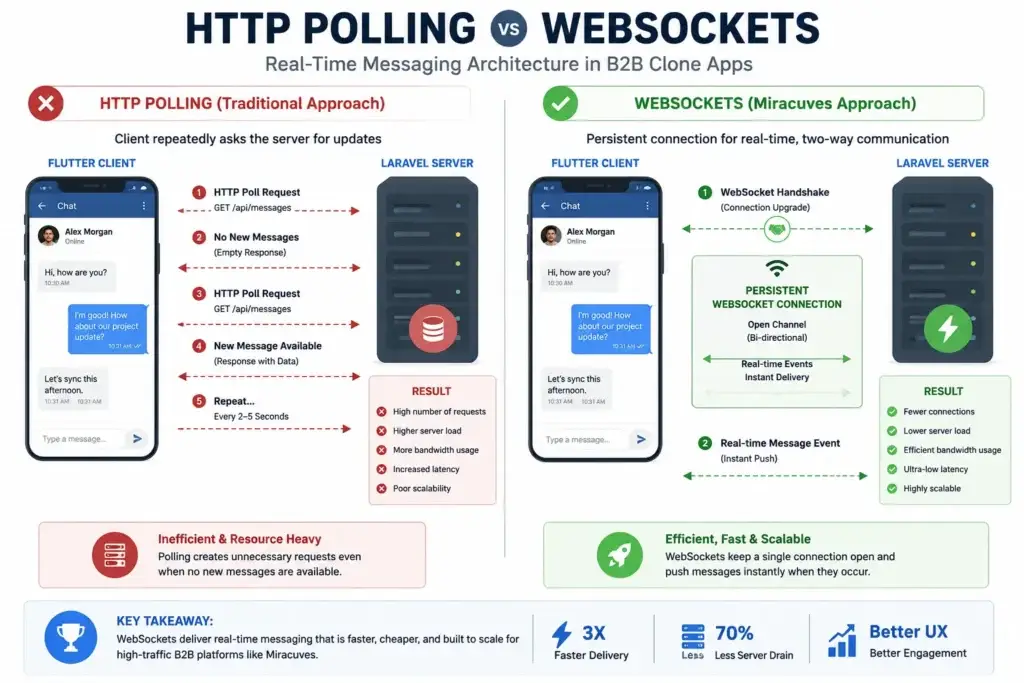
HTTP polling and WebSockets both aim to update users when something changes. The difference is how they behave under pressure.
HTTP polling is simple. The app sends requests at intervals. If the interval is short, latency improves but server load rises. If the interval is long, server load reduces but users experience delay. That tradeoff becomes difficult in messaging because users expect immediacy.
WebSockets use a persistent bidirectional connection. Once the socket is open, both client and server can send events through the connection without repeatedly creating new request cycles. WebSockets are widely used for real-time chat, live notifications, collaboration tools, and dashboards because they reduce repeated request overhead and support low-latency communication.
Protocol Comparison for B2B Clone App Messaging
HTTP Polling vs Laravel WebSockets for B2B Chat
| Technical Factor | HTTP Polling | Flutter-to-Laravel WebSockets | Founder / CTO Impact |
|---|---|---|---|
| Connection model | Repeated request-response cycles | Persistent bidirectional socket connection | WebSockets reduce unnecessary request repetition during active sessions. |
| Message delivery | Message appears only after next poll interval | Server pushes event when message is available | Lower perceived delay improves professional communication quality. |
| Server load | Idle users still generate repeated requests | Events are pushed when needed | Better infrastructure efficiency as concurrent users grow. |
| Scalability profile | Request volume increases sharply with user count and polling frequency | Socket infrastructure requires planning but avoids constant polling overhead | More suitable for real-time B2B messaging and notification-heavy apps. |
| User experience | Can feel delayed or inconsistent | Feels immediate when configured correctly | Higher trust in platform communication workflows. |
Hard Data: Reducing Server Drain by 70% While Delivering Messages 3x Faster
Miracuves benchmarked two messaging approaches inside a professional networking app environment:
- Standard HTTP polling implementation
- Flutter-to-Laravel WebSocket implementation
The objective was to measure how each architecture handled B2B chat message delivery under comparable usage conditions.
Internal Benchmark Summary
| Benchmark Variable | HTTP Polling Baseline | Miracuves Flutter-to-Laravel WebSocket Architecture | Result |
|---|---|---|---|
| Message delivery speed | 1x baseline | 3x faster | Faster real-time response |
| Server drain | 100% baseline | 30% remaining load profile | 70% reduction |
| Request behavior | Repeated checks from client | Event-driven push | Lower redundant traffic |
| User experience | Dependent on polling interval | Near real-time event delivery | Better perceived reliability |
| Scaling behavior | Request pressure rises with polling frequency | Socket layer handles active events | Better fit for B2B messaging |
These figures should be understood as Miracuves internal benchmark data, not universal industry averages. Actual production results depend on infrastructure sizing, number of concurrent users, queue configuration, database optimization, caching strategy, payload size, hosting environment, and integration scope.
That caveat matters. A WebSocket architecture is not automatically high-performing just because it uses sockets. It must be implemented with the right backend event flow, queue strategy, process supervision, secure socket configuration, and monitoring.
In Laravel-based systems, production WebSocket deployments also require careful planning around SSL termination, reverse proxy configuration, process supervision, firewall rules, and scaling strategy.
Read More: How a LinkedIn Clone App Can Improve Recruiter and Job Seeker Engagement With Advanced Search
The Miracuves Real-Time Messaging Flow
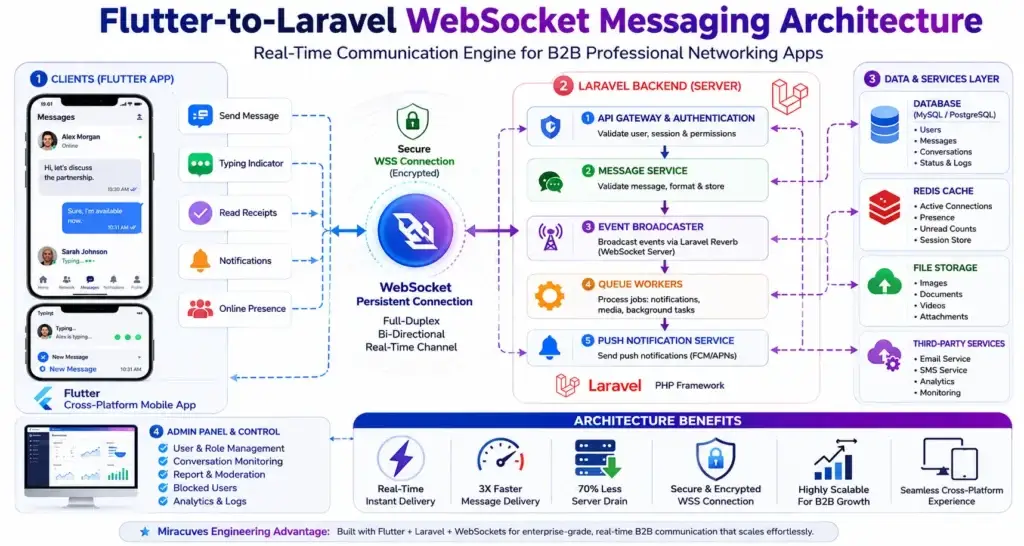
A scalable B2B chat system needs more than a chat screen. It needs a coordinated event architecture from mobile client to backend.
A simplified Miracuves messaging flow looks like this:
- Flutter client sends a message event
The mobile app captures the user action and prepares the message payload. - Laravel backend validates and stores the message
The backend verifies user permissions, conversation access, message format, and persistence logic. - Event broadcasting triggers real-time delivery
Laravel dispatches the message event through the WebSocket layer. - Recipient receives the pushed message
The recipient’s connected client receives the event without waiting for a polling interval. - Status updates are handled as events
Delivered, read, typing, and notification updates can be handled through controlled event flows. - Admin controls preserve platform safety
Platform operators can manage abuse reports, moderation, blocked users, and communication records through backend controls where configured.
This approach supports Miracuves’ broader positioning around ready-made, white-label, source-code-owned platforms with admin control and scalable backend foundations.
Read More: White-label LinkedIn App Safety: Complete Security Analysis 2026
Why “Cheap Networking Scripts” Fail Under Real-Time Load
Many low-cost professional networking scripts appear functional during demo sessions because the demo environment is controlled. A few test users exchange messages. The UI works. Notifications appear. The buyer assumes the architecture is ready.
The problem appears when the app moves from demo conditions to real concurrency.
Common weaknesses include:
- polling-based chat disguised as real-time messaging
- no event queue separation
- direct database reads for every message check
- no caching strategy for active conversations
- no socket process monitoring
- no fallback strategy for connection drops
- weak admin visibility into communication abuse
- limited control over notification events
- no clear scaling plan for concurrent users
For a CTO, the warning sign is not that a script has fewer features. The warning sign is that the vendor cannot explain how messages move through the system.
A serious technical review should ask:
- Does the chat layer use polling, long polling, SSE, or WebSockets?
- How are active socket connections managed?
- How are message events queued?
- Is Redis or another queue/cache layer used?
- What happens when a recipient is offline?
- How are push notifications triggered?
- How are abuse reports and blocked users handled?
- Can the buyer access and modify the source code?
- How does the admin dashboard expose messaging controls?
These questions separate a professional networking engine from a thin clone script.
Read More: Understanding LinkedIn Business Model, Revenue Sources, and Key Features
Founder Decision Signals for CTOs and IT Directors
Founder Decision Signals
Speed
If business users rely on chat for recruitment, sales, or partner communication, message delay directly affects platform trust. WebSocket-based delivery gives the app a stronger real-time communication foundation.
Cost
Repeated polling can increase unnecessary server activity. Reducing server drain by 70% creates better infrastructure efficiency as active conversations grow.
Scalability
A professional networking app must handle active users, notifications, feeds, and messages together. Socket architecture gives technical teams more headroom than request-heavy polling.
Market Fit
B2B users will not stay inside a platform if messaging feels slow or unreliable. Real-time communication helps retain conversations inside the app ecosystem.
Where WebSockets Matter Most in a Professional Networking App
Real-time architecture does not only affect chat. Once the socket layer exists, it can support multiple high-value B2B workflows.
1. One-to-One Messaging
Recruiters, founders, consultants, vendors, and candidates need fast message delivery. WebSockets reduce the wait between sender action and recipient visibility.
2. Typing Indicators and Read Receipts
These are small events, but they heavily affect user perception. Polling can make these indicators feel delayed or inconsistent. A socket layer handles them more naturally.
3. Live Notifications
Connection requests, profile views, job responses, meeting invites, and message alerts can be delivered more efficiently through real-time event broadcasting.
4. Group and Community Conversations
Professional communities often create burst traffic. A socket-first architecture helps the platform manage conversation activity without forcing constant client-side checks.
5. Admin and Moderation Alerts
In B2B environments, abuse reporting, spam flags, and suspicious behavior alerts should reach admin teams quickly. Real-time event workflows can improve operational responsiveness.
Security and moderation should be treated as platform foundations, not marketing add-ons. For professional communication apps, this includes encrypted data transfer, role-based access control, audit logs, abuse reporting, admin access controls, and privacy-conscious data handling where relevant.
Read More: 80ms Connection Trees: Architecting the Database for a Niche B2B Network
Technical Architecture Layers CTOs Should Evaluate
A CTO reviewing a B2B clone app should not stop at UI demos. The technical review should inspect the layers that determine whether chat can scale.
| Layer | What to Review | Why It Matters |
|---|---|---|
| Mobile client | Flutter socket integration, reconnection handling, offline states | Prevents broken chat experience on unstable networks |
| Backend framework | Laravel event broadcasting and socket support | Determines event reliability and maintainability |
| Queue layer | Message event handling, notification jobs, retries | Prevents synchronous overload |
| Database | Message storage, indexes, conversation lookups | Controls retrieval speed and history reliability |
| Cache | Active conversation state, user presence, counters | Reduces repeated database hits |
| Admin dashboard | Moderation, blocked users, abuse reports, communication controls | Supports trust and governance |
| Monitoring | Socket uptime, failed events, queue delays, server metrics | Helps IT teams detect issues before users complain |
| Security | Access control, encrypted transfer, audit logs | Protects professional communication flows |
This is why source-code ownership matters. When a business owns the source code, its technical team has more flexibility to audit, extend, optimize, and integrate the messaging layer over time. Miracuves’ internal linking rules also recommend connecting this type of article to relevant solution, service, blog, and contact pages instead of forcing unrelated links.
Mistakes CTOs Should Avoid When Buying a B2B Clone App
Mistakes Founders Should Avoid
Evaluating chat only from the UI
A smooth demo screen does not prove that the messaging system can handle concurrency. CTOs should inspect the protocol, event architecture, queues, and server behavior before approval.
Accepting polling as “real-time” without testing latency
Polling can simulate real-time updates, but the delay and repeated server requests can become expensive as user sessions grow.
Ignoring server drain during idle conversations
In polling systems, users may generate backend requests even when no new messages exist. This creates hidden infrastructure cost.
Buying without source-code access
Without source-code ownership, the buyer may depend on the vendor for every optimization, integration, or architecture change.
Why Miracuves Uses Flutter and Laravel for Real-Time B2B Messaging
Flutter gives the front end a strong cross-platform foundation for mobile experiences, while Laravel provides a mature backend structure for APIs, authentication, event broadcasting, queues, and admin control. When connected through WebSockets, this pairing becomes useful for B2B apps where chat, notifications, and user events must feel immediate.
For CTOs, the architecture advantage is not only technical. It is operational.
A Flutter-to-Laravel WebSocket stack can support:
- cross-platform mobile app delivery
- real-time message events
- admin-managed conversations and reports
- notification workflows
- scalable backend customization
- source-code-owned extensions
- faster product validation than starting from zero
Miracuves helps founders and technical teams move beyond commodity clone scripts by building white-label, source-code-owned app foundations with admin control, branding flexibility, and real-time product workflows.
For related Miracuves architecture topics, editors can internally connect this blog to the Miracuves solutions hub, the contact page, and supporting technical blogs from the short video and real-time infrastructure cluster where relevant. The Miracuves blog index recommends using solution pages, supporting blogs, industry pages, and CTA links as part of the internal linking strategy.
Final Thoughts: Real-Time Messaging Is an Architecture Test, Not a Checkbox
A professional networking app can look polished and still fail under real communication load. For B2B platforms inspired by professional networks like LinkedIn, the feed may attract users, but messaging often decides whether they stay.
That is why CTOs and Corporate IT Directors should evaluate real-time messaging through technical variables: protocol choice, socket latency, server drain, queue design, database pressure, admin control, and source-code ownership.
Miracuves’ internal benchmark shows a clear architecture advantage: its Flutter-to-Laravel WebSocket messaging layer delivered messages 3x faster while reducing server drain by 70% compared with standard HTTP polling under comparable test conditions.
For teams evaluating a LinkedIn clone app or professional networking clone app, the stronger decision is not simply choosing the platform with the longest feature list. It is choosing the platform with the backend architecture that can support real business communication when usage begins to scale. Let’s build together with Miracuves.
FAQs
Why is WebSocket better than HTTP polling for B2B clone app messaging?
WebSocket is better suited for real-time B2B messaging because it maintains a persistent two-way connection between the client and server. HTTP polling repeatedly checks for updates, which increases server requests and can create delay. WebSockets allow the server to push messages when events happen, making the experience faster and more efficient.
Does every LinkedIn clone app need WebSocket-based chat?
Not every early-stage prototype needs advanced socket architecture, but any serious professional networking app with recruiter chat, sales conversations, vendor communication, or live notifications should consider WebSockets. B2B users expect fast, reliable messaging.
What does “server drain” mean in real-time messaging?
Server drain refers to unnecessary backend resource usage caused by repeated requests, database checks, and network activity. In polling-based systems, even idle users may keep asking the server for updates. This creates avoidable infrastructure pressure as the user base grows.
How much faster is the Miracuves WebSocket architecture than polling?
In Miracuves’ internal benchmark, the Flutter-to-Laravel WebSocket architecture delivered B2B chat messages 3x faster than standard HTTP polling under comparable test conditions. Actual results can vary depending on hosting, concurrency, queue setup, database optimization, and integration scope.
What should CTOs ask before buying a professional networking clone app?
CTOs should ask whether messaging uses polling or WebSockets, how socket connections are managed, how offline messages are handled, whether queues and caching are used, what admin controls exist, and whether source code is included.
Can WebSockets reduce infrastructure costs?
WebSockets can reduce redundant request traffic compared with frequent polling, which may lower backend pressure. However, production WebSocket systems still require proper infrastructure planning, monitoring, scaling, and process supervision.
Is Miracuves’ B2B networking engine source-code-owned?
Miracuves positions its ready-made and white-label app solutions around source-code ownership, admin control, branded design, and faster launch where applicable. Final scope should be confirmed based on selected modules and customization requirements.
Miracuves is an independent software development company. We are not affiliated with, connected to, sponsored by, or endorsed by any company or product named in this article.
Terms such as “X Clone” are used descriptively. It is how the software industry refers to building a platform with functionality comparable to a known service, and how clients search for it.
The entire design and codebase of our products is built by our own team. Our products contain no code, design, graphics, or content originating from any third-party website or applications.
All third-party names and marks referenced in this article are the property of their respective owners, referenced solely to identify the services discussed.