


A professional networking platform is easy to misunderstand as a social network with job listings attached. From a business-model perspective, however, that description misses the most important part of the system.
The real product is the connection between several participant groups that want different outcomes from the same professional identity layer. Members want credibility, relationships, knowledge and career opportunities. Recruiters want access to relevant professionals. Companies want visibility, talent and an authoritative organizational presence. Sales teams want to discover and engage potential business relationships without working from disconnected databases.
When these groups reinforce one another, the platform can develop a valuable professional ecosystem. When they do not, even a technically impressive product can become an empty directory, an inactive feed, a noisy job board or an outreach channel people learn to ignore.
This is why understanding the professional networking platform business model requires more than studying subscriptions or advertising. Founders need to understand who creates value, who consumes value, what causes participants to return, where commercial demand develops, and what level of trust is required for those interactions to remain useful.
Key Takeaways
- A professional networking platform is a multi-sided ecosystem, not simply a profile database or social feed.
- Members create the identity and relationship layer that makes recruiter, company and sales workflows useful.
- Recruiters and companies add opportunities and organizational context that give members practical reasons to return.
- Sales teams create another commercial use case when the network contains sufficiently relevant professional and company relationships.
- Network density matters more than registration volume because value comes from relevant interactions, not raw account numbers.
- Trust, privacy, messaging boundaries and governance directly affect the economic usefulness of the network.
- Monetization should usually follow demonstrated participant value rather than being switched on before the network has become useful.
What a Professional Networking Platform Business Model Really Means
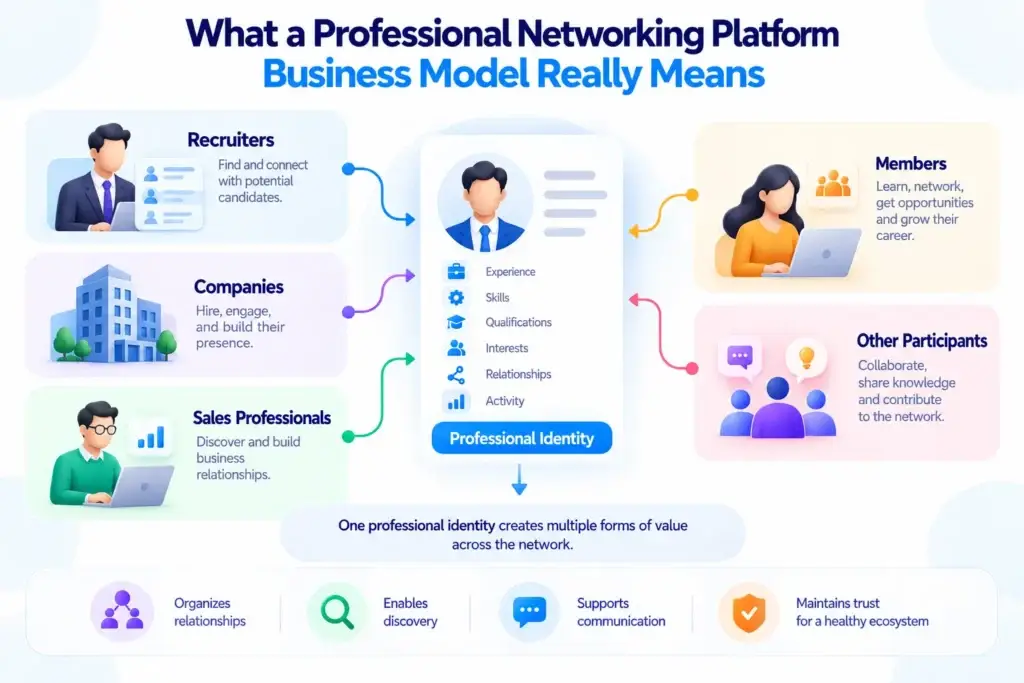
A business model answers a broader question than “How does the platform make money?” Revenue matters, but revenue is the result of a functioning value system.
For a professional network, that system begins with professional identity. A member creates a profile containing experience, skills, qualifications, interests, relationships and activity. That information becomes more useful when it can be discovered by the right people and connected to meaningful workflows.
A recruiter may interpret the same professional identity as a possible candidate. A company may see the member as an employee, follower, applicant, customer, partner or advocate. A sales professional may see the member as a decision-maker or potential business relationship. Other members may see a peer, mentor, collaborator or source of expertise.
That is the core economic mechanism: one professional identity can create different forms of value for multiple participant groups.
The platform’s responsibility is to organize those relationships without allowing one participant type to destroy the experience for another. If recruiters cannot discover relevant professionals, the hiring side becomes weak. If members are overwhelmed with low-quality outreach, participation declines. If companies cannot manage an authoritative presence, business participation becomes fragmented. If sales tools ignore consent, relevance and messaging boundaries, the network can deteriorate into spam.
A successful business model therefore coordinates access, discovery, communication, professional context and trust across the ecosystem.
The Four Participant Groups That Create the Professional Network
Different professional platforms may serve associations, alumni groups, industry communities, talent networks, enterprise ecosystems or broader public audiences. But many of them still depend on four recurring participant groups: members, recruiters, companies and sales teams.
1. Members Supply Professional Identity and Network Activity
Members are more than the audience. They create much of the platform’s underlying asset base.
Every structured profile can add experience, skills, qualifications, professional interests and organizational relationships to the network. Connections create a social graph. Posts and discussions create context. Recommendations, endorsements and credentials can create additional trust signals. Search behavior and engagement can reveal what information or opportunities members consider relevant.
Members participate because they expect something in return: stronger professional visibility, access to people, useful knowledge, career opportunities, business relationships, recognition or participation in a professional community.
If the platform asks members to complete detailed profiles but provides no meaningful discovery or opportunities, profile creation becomes work without a reward. That is usually an early warning that the network’s value loop is incomplete.
2. Recruiters Convert Professional Data Into Hiring Activity
Recruiters approach the network differently. They are not primarily joining to publish a professional identity. They need to discover, evaluate, contact and progress relevant people toward employment opportunities.
That changes what makes the network valuable to them. Profile completeness matters because incomplete experience data weakens candidate discovery. Structured skills matter because they improve filtering. Location and work preferences matter because suitability is contextual. Messaging matters because discovery without communication does not create a hiring workflow.
The recruiter-member relationship is therefore mutually reinforcing. More credible professional profiles create better candidate discovery. Better recruiter participation creates more opportunities for members. More successful interactions give both sides a reason to continue using the network.
Founders exploring this interaction in greater depth can review Miracuves’ guide to advanced job search and candidate matching, which examines how structured professional data improves discovery beyond simple keyword search.
3. Companies Provide Organizational Context
Professional relationships rarely exist independently of organizations. Members work for companies, follow organizations, apply to them, sell to them, learn from them and discuss them.
A company presence therefore does more than create another profile type. It connects individual professional identities to an organizational entity.
That connection can support employer branding, employee affiliation, job publishing, organizational content, company discovery, administrative ownership and analytics. It also helps users distinguish an authorized company presence from an unofficial reference to an organization.
This becomes especially important in industry-specific networks. A healthcare network may organize professionals around hospitals and clinics. A construction network may organize members around contractors, engineering firms and certification bodies. An alumni platform may connect members to institutions, programs and employers.
The company’s role is therefore not simply promotional. It gives structure to the professional graph.
4. Sales Teams Turn the Professional Graph Into B2B Discovery
Sales teams create another layer of platform demand once the network contains sufficient professional and organizational context.
A generic contact list may contain names, companies and email addresses. A professional network can potentially provide richer context: role, company relationship, professional activity, mutual connections, interests, organizational changes and other signals that help a salesperson decide whether outreach is relevant.
The important phrase is once the network contains sufficient context. Sales functionality introduced before there is enough professional density has little value. Worse, unrestricted prospecting can reduce member trust before the network has established a reason for people to remain active.
Sales teams should therefore be treated as participants in a governed professional ecosystem rather than as users who receive unlimited access to everyone else.
How Value Moves Between Members, Recruiters, Companies, and Sales Teams
| Participant | What They Contribute | What They Want Back | Important Platform Connection |
|---|---|---|---|
| Members | Professional identity, skills, experience, relationships, content and activity | Visibility, knowledge, opportunities, relationships and professional credibility | Profiles, connections, search, feeds, messaging and opportunity discovery |
| Recruiters | Jobs, hiring demand, candidate engagement and career opportunities | Relevant candidate discovery and efficient hiring workflows | Professional search, candidate matching, messaging and hiring pipelines |
| Companies | Organizational identity, jobs, content, employees and business context | Employer presence, talent access, audience visibility and analytics | Company pages, employee relationships, job publishing and administration |
| Sales Teams | Commercial demand, relationship activity and B2B participation | Relevant prospects, professional context and managed outreach | Lead discovery, saved searches, lists, messaging boundaries and CRM workflows |
No single row creates the complete platform. The business becomes more defensible when activity in one row strengthens another.
A member improves a profile, which helps a recruiter discover that person. The recruiter creates an opportunity, which gives members another reason to keep their profile current. A company establishes a managed presence, adding context to employee experience and giving potential applicants a place to understand the organization. As professional and company data becomes richer, relevant B2B discovery can become more useful to sales teams.
This interconnectedness is why professional networking products should not be designed as unrelated modules bolted together. The member record, organization record, professional relationships, jobs, messages, permissions and activity should belong to a coherent data model.
For teams planning that foundation, the guide to professional networking database design and the professional social graph explains how profiles, companies, skills, jobs and relationships can be structured without collapsing them into generic social-media records.
Why Network Density Matters More Than Registration Numbers
Network businesses are often judged too early by total registrations. For a professional platform, that number can be misleading.
Ten thousand disconnected users across hundreds of professions may provide less practical value than two thousand relevant professionals concentrated in one industry. The second network may support stronger search results, more relevant discussions, better referrals, more useful hiring activity and clearer commercial demand.
This is the difference between audience size and network density.
A recruiter does not need millions of profiles. The recruiter needs enough suitable candidates in the relevant geography, role, experience level and skill category. A member does not need every company in the economy. The member needs enough relevant employers, peers and professional opportunities. A sales team does not need unlimited contacts. It needs a sufficiently useful concentration of organizations and decision-makers inside the target market.
For founders, this changes launch strategy. The first goal should rarely be “acquire everyone.” A more practical question is: which professional community can become meaningfully connected first?
This is why niche networks can have a credible starting advantage. A focused industry, association, certification community, alumni group, regional business network or specialist talent pool already provides context that broad networks have to infer later.
Miracuves explores this strategy further in its guide to building focused professional networking communities.
Trust and Safety Are Business-Model Infrastructure
Trust is sometimes treated as a technical or legal concern that sits outside the business model. In professional networking, that separation does not work.
The commercial value of the network depends on whether participants believe the identities, opportunities, organizations and communication inside it are credible enough to act on.
Consider a recruiter searching for a specialist. Search quality is not determined only by matching algorithms. The recruiter also needs reasonable confidence that qualifications, experience and organizational relationships are genuine enough to evaluate. Similarly, a member receiving an opportunity needs to know whether the recruiter or company behind it is legitimate.
The same logic applies to sales activity. Professional prospecting may be valuable when it is relevant, bounded and controllable. It becomes destructive when users receive unlimited unsolicited messages, misleading identities or automated outreach without effective controls.
Identity Quality Protects Multiple Sides of the Network
Verification should match the risk and purpose of the community rather than collecting unnecessary information from every user.
A public professional community may rely mainly on email verification and abuse controls. An alumni platform may need institutional verification. A credential-focused community may require membership or qualification validation. A network connecting sensitive industries may need stronger organization approval and privileged-role verification.
The principle is proportional trust: establish enough confidence to protect the intended professional interaction without creating unnecessary data exposure.
Messaging Boundaries Protect Member Attention
Messaging is economically important because recruiters, sales teams, companies and members all need communication. It is also one of the easiest ways to damage a network.
Connection-based messaging, message requests, controlled outreach, blocking, reporting, rate limits and communication preferences can help the platform distinguish useful contact from unwanted volume.
This is not merely a safety decision. Member attention is part of the product. If high-value professionals stop reading messages because the inbox becomes noisy, the commercial value of recruiter and sales access also declines.
Privacy Controls Influence Participation
Professional profiles can contain employment history, location, skills, career preferences, qualifications, relationships and other information members may not want exposed equally to everyone.
Useful privacy design lets the platform establish different boundaries for public identity, connection visibility, contact information, opportunity preferences, messaging permissions and other sensitive professional signals.
When members understand what is visible and why, they can participate more confidently. When information feels uncontrollable, users may deliberately provide less data, weakening search, matching and professional discovery throughout the ecosystem.
Governance Protects the Platform Operator
The platform operator also needs structured controls for reports, moderation, company ownership, account states, privileged administrators and high-impact actions.
Clear administrative roles and audit trails matter because professional-network disputes can involve careers, organizational reputation, commercial outreach and access to sensitive data. Governance should therefore evolve with the business rather than being treated as a generic admin screen.
The Most Valuable Features Are Bridges Between Participant Groups
Founders often create a long feature checklist before deciding how the network should create value. Reversing that order usually produces a stronger product.
A feature is strategically important when it improves a valuable interaction between participant groups.
| Capability | Who It Connects | Why It Matters to the Business Model |
|---|---|---|
| Structured professional profiles | Members ↔ recruiters ↔ companies ↔ sales teams | Creates a common professional identity layer for discovery and relationships. |
| Connections and follows | Members ↔ members / companies | Builds the relationship graph and creates recurring professional context. |
| Professional search | Recruiters / sales teams ↔ members | Turns accumulated network data into actionable discovery. |
| Company pages | Companies ↔ employees ↔ followers ↔ candidates | Creates managed organizational identity and employer context. |
| Jobs and candidate workflows | Companies / recruiters ↔ members | Transforms professional identity into measurable opportunity activity. |
| Messaging | All participant groups | Moves discovery into relationships while requiring trust and outreach controls. |
| Content and professional activity | Members / companies ↔ network | Creates reasons to return between hiring, prospecting or job-search events. |
| Moderation and permissions | Operator ↔ everyone | Protects trust, role boundaries and the quality of the ecosystem. |
Readers evaluating the individual modules behind these interactions can explore the professional networking feature architecture by user role. Keeping that feature-level detail on its dedicated page allows this article to remain focused on the business logic connecting those capabilities.
Monetization Should Follow Value Creation, Not Lead It
A professional networking platform can eventually create several monetizable forms of value, but founders should resist treating monetization as the first proof that the network works.
Members usually need a useful free reason to participate before premium access becomes meaningful. Recruiters need sufficient candidate density before professional search is worth paying for. Companies need an audience or talent pool before enhanced organizational presence becomes valuable. Sales teams need reliable business context before advanced prospecting becomes useful.
This creates a useful principle:
Charge participants for amplified value after the underlying value exists.
That may eventually translate into premium memberships, recruiter access, company plans, professional search, sales tools, controlled outreach or other commercial mechanisms. The correct combination depends on the audience and what participants are demonstrably using the network to accomplish.
Because detailed tier mechanics belong to a different search intent, founders who need that next layer can use Miracuves’ dedicated guide to professional-network monetization and tier design.
A Strong Launch Starts With One Valuable Professional Wedge
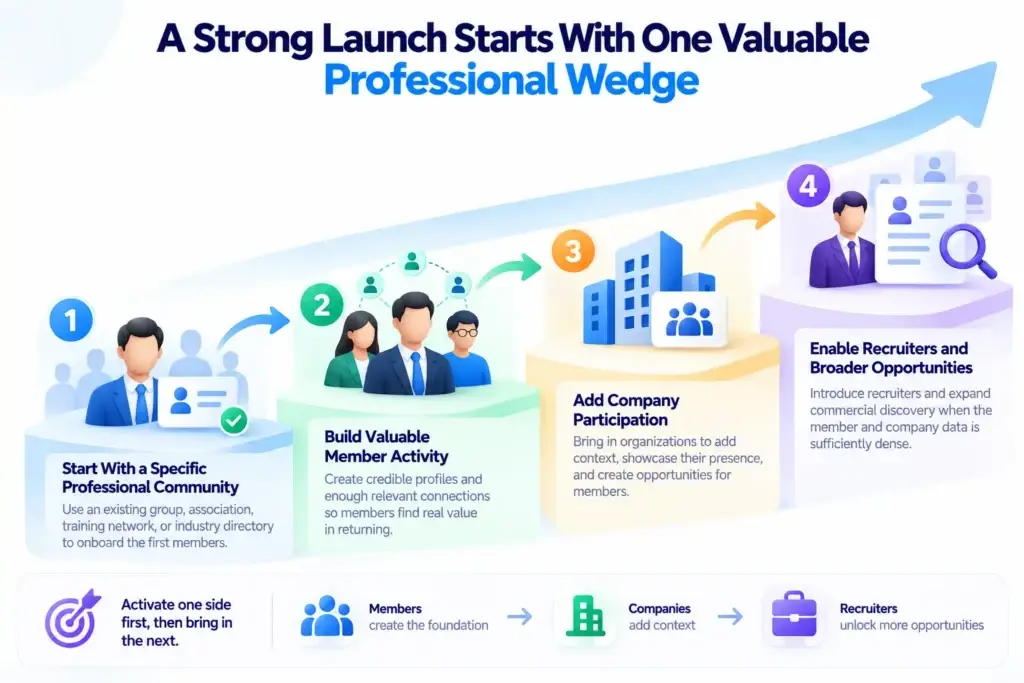
Trying to activate every participant group equally on day one creates a classic marketplace problem: everyone arrives, sees insufficient activity from the other sides, and leaves.
A stronger launch begins with a specific professional wedge.
Imagine a network designed for a specialist industry. The founder may already have access to a professional association, training organization, recruitment pool, conference audience, alumni community or industry directory. That existing concentration becomes the seed.
The first objective is to establish credible professional identities and enough useful relationships that returning to the platform makes sense. Company participation can then add organizational context and opportunities. Recruiters become valuable when the member pool is sufficiently relevant. Broader commercial discovery can follow when member and company data is dense enough to make prospecting more useful than a generic contact database.
The exact sequence will differ by market, but the logic remains the same: activate the side of the network that creates the strongest reason for the next side to join.
How to Think About the Professional Network Flywheel
A useful professional-network flywheel can be described without relying on vanity metrics.
Members create credible professional identities. Those identities make search and discovery more useful. Better discovery attracts organizations and recruiters with genuine opportunities. Those opportunities give members another reason to update profiles and return. Company activity adds professional context and content. Increased professional context improves discovery for recruiters, members and eventually business-development teams. Useful interactions create more relationship data, which can make future discovery more relevant.
The flywheel breaks when any layer extracts too much value without returning enough.
If recruiters send high volumes of irrelevant messages, members disengage. If members create unreliable profiles, recruiter confidence falls. If company pages are abandoned, organizational context becomes stale. If the content feed becomes disconnected from professional purpose, engagement may increase without improving the network’s core utility.
Healthy network effects are therefore not simply “more users create more users.” They are better expressed as:
More relevant participation creates better outcomes, and better outcomes attract more relevant participation.
What Founders Should Measure Before Expanding the Business Model
Founders do not need dozens of dashboards to understand whether the model is beginning to work. The most informative signals are usually tied to repeated value creation.
For members, look at whether completed profiles lead to connections, useful discovery, conversations, applications or repeat visits. For recruiters, look at whether searches return candidates worth saving or contacting and whether those interactions progress. For companies, look at whether organizational presence creates followers, applications, employee associations or useful engagement. For sales participants, look at whether prospecting produces relevant relationship activity without creating disproportionate blocking or reporting.
These indicators are stronger than registration numbers because they reveal whether one side of the platform is successfully creating value for another.
Network Density
Can a member, recruiter or company consistently find relevant people and opportunities inside the target professional segment?
Repeat Value
Do participants return after their first profile, search, message, application or company interaction?
Trust Quality
Are identity disputes, spam, irrelevant outreach and privacy concerns controlled well enough to protect participation?
Commercial Readiness
Is a participant asking for more search, outreach, hiring, visibility or workflow capability because the free experience already delivers value?
Common Business-Model Mistakes in Professional Networking Platforms
Treating the Product as a Social Feed
Content can improve retention, but a professional network needs a deeper reason to exist. Profiles, professional discovery, opportunities, credible organizations and useful relationships should remain connected to the feed rather than becoming secondary to generic engagement.
Charging Before the Network Creates Enough Value
Premium search is not valuable when the database is thin. Recruiter access is not valuable when the right candidates are absent. Company visibility is difficult to sell when the relevant audience is not active. Monetization cannot compensate for missing network density.
Building Every Role at Equal Depth Before Validation
A founder serving an association may need member identity and company affiliation before sophisticated sales workflows. A recruitment-focused community may need candidate search and hiring flows earlier. Product depth should follow the network’s initial value proposition.
Allowing Commercial Outreach to Overrun Member Experience
The existence of B2B demand does not justify unrestricted messaging. When commercial participants consume member attention faster than the platform replenishes value, the network can become less useful for everyone—including the businesses paying to reach it.
Ignoring Professional Identity Quality
Duplicate profiles, unverifiable organizations, fabricated experience or poorly structured professional data reduce the usefulness of search, recommendations, hiring and prospecting simultaneously. Identity quality is an ecosystem issue, not merely a moderation issue.
Measuring Audience Size Instead of Interaction Quality
A network with fewer but highly relevant professionals may create more recruiter, company and member value than a much larger but fragmented audience. Growth targets should reflect useful professional interactions, not just registrations.
From Business-Model Logic to a Launch-Ready Platform Foundation
Once founders understand which participant creates value for whom, product decisions become clearer. Profiles are no longer “a standard social feature”; they are the shared identity layer. Search becomes the discovery engine connecting professional supply with hiring or business demand. Company pages become organizational nodes. Messaging becomes both a value mechanism and a trust boundary. Administrative control becomes the system that keeps all of those relationships governable.
That clarity also helps founders decide what should be built first, what can be configured later, and where differentiation actually matters.
For businesses that do not want to rebuild every foundational professional-network workflow from zero, Miracuves provides a ready-made professional networking platform that can be white-labeled and adapted around the target community and operating model.
Where the ready-made scope fits the project, Miracuves offers a 6-day solution delivery path with source-code ownership, branding and administrative control. More specialized workflows can then be scoped according to the network’s actual differentiation rather than spending the initial build recreating the basic professional identity and interaction layer.
Final Thoughts: The Business Model Is the Relationship System
The strongest professional networking platforms do not succeed because they contain the longest feature list. They succeed when different participant groups repeatedly create value for one another.
Members contribute professional identity, expertise and relationships. Recruiters introduce career demand. Companies add organizational context and opportunities. Sales teams create another form of commercial participation when the network becomes sufficiently relevant. The platform operator connects those activities while protecting identity, communication quality, privacy and governance.
For founders, the practical lesson is to design the value exchange before designing the monetization stack. Identify the first community. Determine what makes participation useful. Understand which side creates the next side’s reason to join. Protect member trust. Measure meaningful interaction rather than raw registrations. Then expand features and monetization when user behavior shows that the underlying network is ready for them.
A professional network becomes commercially interesting only after it becomes professionally useful. Build that usefulness first, and the business model has something real to grow around.
FAQs
What is a professional networking platform business model?
A professional networking platform business model explains how members, recruiters, companies, sales teams and the platform operator create and exchange value. It includes the participant relationships, network effects, trust mechanisms and eventually the monetization methods that sustain the ecosystem.
How do members and recruiters create value for each other?
Members create structured professional identities containing skills, experience and career context. Recruiters bring hiring demand and opportunities. Better professional data improves candidate discovery, while genuine recruiter participation gives members another reason to keep profiles current and return to the platform.
What role do companies play in a professional networking platform?
Companies add organizational context to the network. They can connect employees to verified organizational identities, publish opportunities, maintain company information, communicate with followers and support employer branding. This makes the professional graph more useful to members and recruiters.
How can sales teams use a professional networking platform?
Sales teams can use professional and company context to discover relevant business relationships, organize prospects and conduct controlled outreach. Sales functionality becomes more valuable once the network contains enough accurate professional and organizational data to make discovery genuinely useful.
Why is trust important to a professional networking business model?
Professional interactions can affect careers, hiring and business relationships. Identity quality, messaging controls, privacy settings, organization verification, moderation and role-based administration help participants decide whether the people, information and opportunities inside the network are credible enough to act on.
Should a professional network monetize immediately after launch?
Not necessarily. Paid search, recruiter access, company visibility or sales tools are easier to justify after the underlying network already creates useful outcomes. Founders should first establish sufficient participant relevance, professional data and repeat activity before relying heavily on monetization.
Can a niche professional network work with a smaller audience?
Yes. A smaller but concentrated professional community can create more useful interactions than a large fragmented audience. Relevant member density can improve professional search, hiring, referrals, discussions and company participation even before the network reaches broad scale.
What should founders validate before building a professional networking platform?
Founders should validate the initial professional community, the problem members repeatedly need solved, how the first participant group will be acquired, what encourages repeat use, which side has a reason to pay, what level of identity trust is necessary and which workflows genuinely differentiate the network.
Miracuves is an independent software development company. We are not affiliated with, connected to, sponsored by, or endorsed by any company or product named in this article.
Terms such as “X Clone” are used descriptively. It is how the software industry refers to building a platform with functionality comparable to a known service, and how clients search for it.
The entire design and codebase of our products is built by our own team. Our products contain no code, design, graphics, or content originating from any third-party website or applications.
All third-party names and marks referenced in this article are the property of their respective owners, referenced solely to identify the services discussed.



