
Key Takeaways
- A white-label Fansly app needs strong security to protect creators, subscribers, payments, content, and private interactions.
- Core safety layers include age verification, secure login, content access control, payment protection, and moderation workflows.
- Security risk depends on user privacy, media protection, role permissions, payout handling, and platform compliance rules.
- A secure creator platform foundation helps founders build trust, reduce abuse, and protect long-term subscription revenue.
Security Signals
- Creators need protected profiles, private content controls, payout visibility, subscriber management, and reporting tools.
- Subscribers need secure signup, payment safety, private access, account protection, notifications, and support options.
- Admins need control over verification, users, content reports, payments, subscriptions, moderation, and platform analytics.
- Backend systems should support encrypted data, protected media access, role-based permissions, audit logs, and suspicious activity monitoring.
Real Insights
- A creator subscription app can lose trust quickly if private content, payments, or user data are not protected properly.
- Security should be built into subscriptions, messaging, payouts, media delivery, and admin workflows from the start.
- Moderation, verification, privacy controls, and payment safety help reduce platform abuse and compliance risk.
- Miracuves builds Fansly-like creator platforms with secure subscriptions, protected content access, payment workflows, creator tools, moderation, analytics, and admin control.
Security is one of the first questions serious founders ask before launching a white-label Fansly app.
That is the right concern.
A Fansly-style platform is not a simple social app. It handles creator identities, subscriber accounts, private media, wallet transactions, subscription payments, paid messages, reports, content permissions, and sensitive admin controls. If any of these layers are poorly built, the platform can face data leaks, creator trust issues, payment disputes, takedown pressure, and long-term reputation damage.
The good news is that a white-label Fansly app can be secure when it is built with the right product foundation. The risk is not “white-label” itself. The real risk is choosing a weak provider, launching without security checks, ignoring compliance workflows, or treating creator trust as an afterthought.
This guide explains how safe a white-label Fansly app can be, what risks founders should evaluate, which security standards matter in 2026, and how Miracuves helps businesses launch secure, white-label creator platforms with source code, branded design, admin control, and faster deployment.
What White-Label Fansly App Security Really Means
White-label security is not just about adding SSL to a website or placing a privacy policy in the footer.
For a Fansly-style creator monetization platform, security means every important workflow is protected from the beginning. That includes account creation, creator verification, login, subscription access, media uploads, payment processing, paid messaging, wallet activity, creator payouts, moderation actions, admin access, API communication, and data retention.
A secure white-label app should give the platform operator control without exposing sensitive data unnecessarily. Admins should be able to manage users, creators, payments, reports, and policy workflows, but they should not have uncontrolled access to every private action or creator asset.
Security also has a shared-responsibility layer.
The development partner is responsible for delivering a secure app foundation, protected APIs, deployment support, update practices, and technical hardening. The business owner is responsible for platform policies, legal review, content rules, support workflows, access discipline, and choosing compliant third-party providers.
This distinction matters because many founders assume security is “included” automatically. In reality, security must be designed, verified, configured, monitored, and maintained.
Read More: Top Fansly App Features Creators & Startups Love
Why Fansly-Style Platforms Need Higher Security Than Normal Social Apps
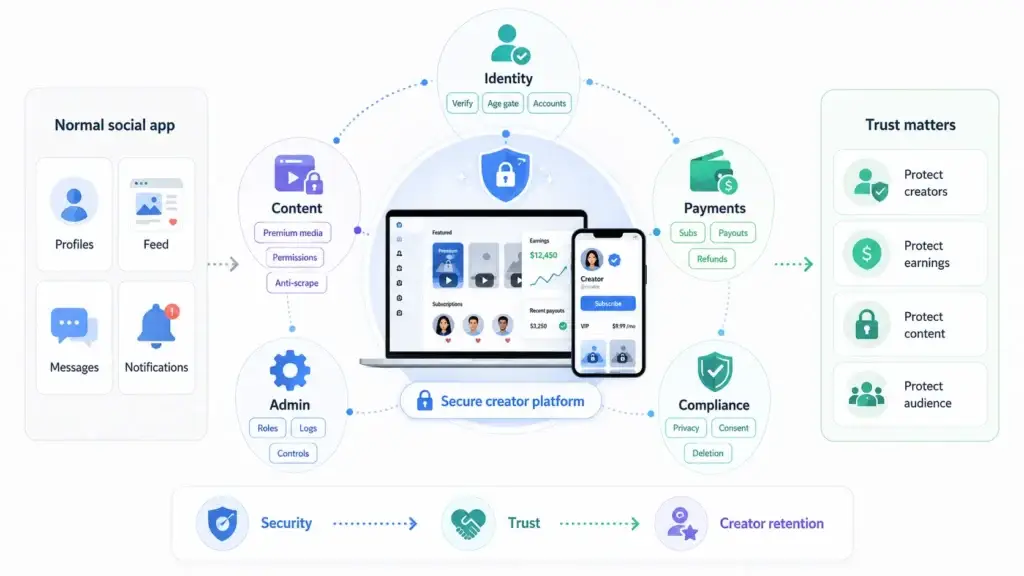
A normal social app may handle profiles, feeds, messages, and notifications. A Fansly-style app or OnlyFans clone app goes further because it connects personal identity, paid content access, sensitive media, fan relationships, and monetization.
That creates five high-risk zones:
- Identity risk: Creator verification records, age-gating workflows, and account information must be protected.
- Content risk: Premium media must not be exposed through public URLs, weak permissions, or scraping tools.
- Payment risk: Subscriptions, wallet activity, refunds, chargebacks, payout records, and payment gateway callbacks must be controlled.
- Admin risk: Internal misuse, over-permissioned dashboards, and missing audit logs can create serious exposure.
- Compliance risk: Privacy, consent, data deletion, takedown, and user rights workflows vary by region.
For founders, the biggest risk is not only a technical breach. It is trust collapse. If creators do not believe the platform protects their content, earnings, identity, and audience, they will not build their business on it.
The Real Security Threat Map for a White-Label Fansly App
A founder should not evaluate security in vague terms. The better question is: what can actually go wrong?
White-Label Fansly App Security Threat Map
| Risk Area | What Can Go Wrong | Security Control Needed |
|---|---|---|
| User Accounts | Credential theft, account takeover, fake accounts, weak passwords | MFA, login throttling, password policy, suspicious login alerts |
| Creator Verification | Fake creators, underage users, identity misuse, consent gaps | Age/identity verification, creator approval workflows, document handling rules |
| Premium Content | Unauthorized downloads, leaked URLs, scraping, piracy | Signed URLs, access tokens, watermarking, CDN controls, entitlement checks |
| Payments | Card data exposure, chargeback abuse, fake subscriptions, webhook tampering | PCI-aligned gateways, tokenized payments, webhook signatures, transaction logs |
| Wallet & Payouts | Incorrect balances, payout fraud, manual payout manipulation | Ledger logic, approval workflows, payout holds, reconciliation records |
| Admin Dashboard | Over-permissioned staff, insider access, untracked actions | Role-based access control, audit logs, approval layers, least privilege |
| APIs | Broken access control, exposed endpoints, scraping, unauthorized data access | Token-based auth, object-level authorization, rate limits, API inventory |
| Infrastructure | Misconfigured storage, unpatched servers, weak backups | Cloud hardening, private buckets, encrypted backups, monitoring |
Data Privacy and Consent Architecture Should Come Before Launch
A secure Fansly-style app must handle personal data carefully. That includes usernames, email addresses, phone numbers, IP signals, creator verification records, payment references, chat history, content metadata, and support tickets.
The founder’s goal should be simple: collect only what is needed, protect what is collected, and give users clear controls where required.
A privacy-conscious app should include:
- Clear consent notices during signup and creator onboarding
- Purpose-specific data collection
- Secure storage for sensitive profile and verification data
- User data export and deletion workflows where applicable
- Access restrictions for support and admin teams
- Logs for sensitive profile, content, payment, and moderation actions
- Privacy policy pages connected to the actual data flows of the app
- Data retention rules for inactive accounts, deleted accounts, and verification records
For businesses operating across multiple regions, privacy expectations may differ. GDPR, CCPA/CPRA, DPDP Act, and other regional frameworks should be mapped before launch. A white-label app can support compliance workflows, but final compliance depends on the target market, legal review, payment providers, identity verification partners, content policies, and operational processes.
Creator Verification, Age-Gating, and Consent Workflows
Creator verification is one of the most important new sections for any Fansly-style platform security guide.
A creator platform cannot rely only on email signup. It needs a structured trust layer to reduce fake profiles, impersonation, underage access, and unauthorized content uploads.
A safer creator onboarding workflow should include:
- Identity verification for creators
- Age verification where required
- Creator approval before monetization is enabled
- Manual or provider-assisted review flows
- Consent confirmation for content involving more than one person
- Business or agency verification where relevant
- Secure document handling and limited admin access
- Logs showing who approved, rejected, or modified verification status
This is not only a legal concern. It is a marketplace trust concern.
Subscribers want confidence that profiles are authentic. Creators want protection from impersonation. Platform operators need clear review records if complaints, takedown requests, or disputes occur.
For founders, the decision is not whether verification adds friction. The decision is whether the business can afford a trust failure after launch.
Content Vault Protection and Anti-Piracy Controls
Premium media is the core asset of a Fansly-style platform. If content access is weak, the business model becomes fragile.
A secure content vault should not expose media through predictable or permanent public URLs. It should connect every media request to subscription status, PPV purchase history, access tier, user session, and content permissions.
Important content protection features include:
- Private media storage
- Signed URLs with expiry
- Token-based access control
- Subscription and PPV entitlement checks
- Watermarking for traceability
- CDN rules that prevent public indexing
- Anti-scraping rate limits
- Download restrictions where technically possible
- Report and takedown workflows
- Admin-side content review and moderation queues
Founders should also be realistic. No platform can guarantee that content will never be screen-recorded or redistributed. The goal is to reduce exposure, detect abuse faster, discourage theft, and create a response workflow that protects creators.
A strong platform makes piracy harder. A weak platform makes piracy easy.
Read More: Fansly vs OnlyFans Business Model Comparison
Payment, Wallet, Subscription, and Payout Security
Creator monetization apps live or die by financial trust.
A secure white-label Fansly app should not store raw card information inside the application. Payment processing should be handled through secure payment gateways, with tokenized payment references and controlled webhook logic.
Founders comparing product scope, creator modules, tipping, payouts, and admin backend features can also review this guide on Fansly clone script features and pricing before finalizing their launch approach.
Key payment security layers include:
- Secure payment gateway integration
- Tokenized payment handling
- Subscription lifecycle tracking
- Payment webhook validation
- Wallet ledger accuracy
- Refund and chargeback records
- Creator payout review workflows
- Withdrawal limits and suspicious payout flags
- Admin approval for high-risk payout events
- Reconciliation reports for finance teams
Wallet and payout logic needs special attention because financial errors can become business disputes. If a creator’s balance is wrong, if a payout is approved incorrectly, or if a fraudulent account extracts funds, the platform operator carries the operational risk.
A serious creator platform should treat wallet and payout security as product infrastructure, not an optional finance feature.
API, Authentication, and Admin Access Security
Modern creator apps depend on APIs. Mobile apps, web apps, admin dashboards, payment gateways, notification services, live streaming tools, and analytics systems all communicate through backend endpoints.
That makes API security one of the most important layers.
A secure white-label Fansly app should include:
- Token-based API authentication
- Object-level authorization checks
- Rate limiting
- Secure session management
- Refresh token controls
- Protected admin endpoints
- No public debug routes
- No exposed secrets in frontend code
- API logging for sensitive events
- Separate staging, demo, and production environments
Admin security is equally important.
The admin dashboard should support role-based access control so team members only access what they need. A support agent may need to view a user’s ticket status but should not be able to modify payout settings. A moderation reviewer may need content review access but should not be able to export payment reports.
Recommended admin roles include:
- Super admin
- Operations manager
- Moderator
- Support agent
- Finance reviewer
- Verification reviewer
- Content policy manager
- Read-only auditor
Every sensitive admin action should create an audit log. That includes login attempts, password resets, payout approvals, account restrictions, content removals, creator verification changes, payment setting changes, and data export requests.
Infrastructure Security for Media-Heavy Creator Platforms
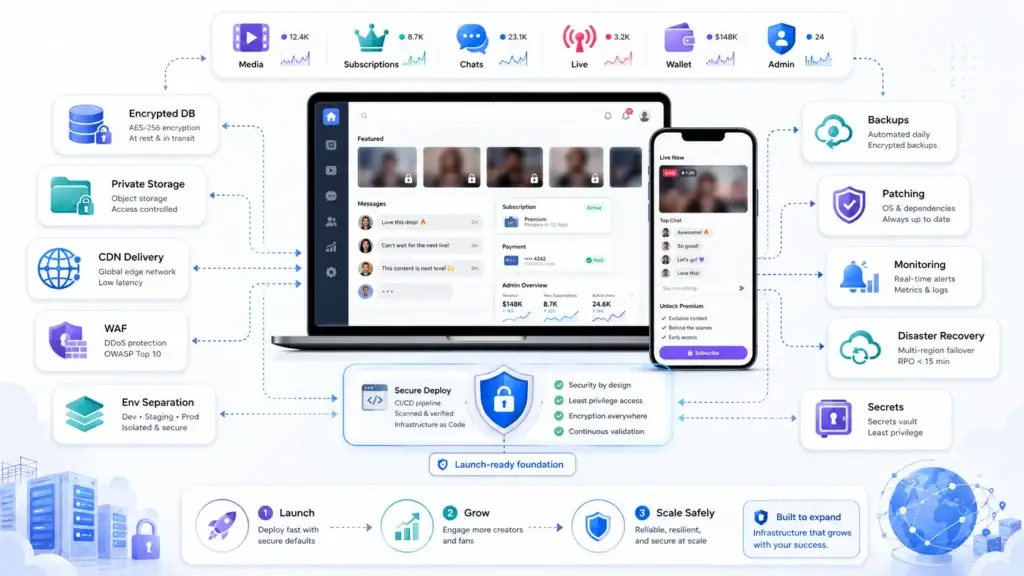
A Fansly-style platform must handle high media volume, private content delivery, subscriptions, notifications, wallet events, chats, live sessions, and admin reporting. For a deeper technical view, founders can also read Miracuves’ guide on how to build an app like Fansly. Security cannot be separated from infrastructure.
The infrastructure should be designed to protect availability, privacy, and operational continuity.
A secure infrastructure setup should include:
- Encrypted databases
- Private object storage
- CDN-ready media delivery
- Environment separation
- Web application firewall
- Server hardening
- Secure backup strategy
- Vulnerability patching
- Monitoring and alerting
- Disaster recovery planning
- Secrets management
- Secure deployment pipelines
The main founder mistake is launching on a setup that works for a demo but fails under real activity. A creator platform may start small, but as creators upload more media and subscribers interact more frequently, weak infrastructure becomes expensive to fix.
Miracuves’ white-label approach helps founders start with a launch-ready foundation and then expand infrastructure, payment providers, media storage, moderation rules, and engagement modules as the business grows.
Read More: Steps by Step Guide to Build a App Like Fansly – Full Detailed Overview
Security Standards a White-Label Fansly App Should Align With
A secure creator platform does not need to overclaim compliance. It should clearly define which standards influence the architecture and which workflows still need legal or provider-specific configuration. Readers exploring broader security topics can also browse Miracuves’ app security guides for related launch-risk and compliance resources.
| Standard / Framework | Why It Matters for Fansly-Style Apps | Founder Action |
|---|---|---|
| OWASP API Security | Helps identify API risks such as broken object-level authorization, broken authentication, and improper authorization checks. | Ask whether APIs are tested for authorization, rate limiting, and sensitive data exposure. |
| OWASP MASVS | Provides a mobile app security baseline for Android and iOS security testing. | Use MASVS-inspired checks before publishing mobile apps. |
| NIST CSF 2.0 | Helps structure cybersecurity governance, risk management, detection, response, and recovery. | Use it as a management framework for ongoing security maturity. |
| PCI DSS | Relevant when payment card data and payment processing workflows are involved. | Use secure payment providers and avoid storing raw card data inside the app. |
| GDPR | Important for EU user privacy rights, consent, data access, deletion, and processing controls. | Map consent, deletion, export, retention, and breach notification workflows. |
| CCPA / CPRA | Important for California user privacy rights and consumer request handling. | Prepare privacy notices and user request workflows where applicable. |
| DPDP Act | Important for businesses processing digital personal data in India or serving Indian users. | Review notice, consent, erasure, grievance, and data fiduciary obligations. |
Founder Decision Signals Before Choosing a White-Label Fansly App Provider
Security Transparency
If the provider cannot explain data storage, API security, admin access, payment handling, and update practices clearly, treat that as a warning sign.
Source Code Control
Source-code ownership gives founders more flexibility for future audits, custom security changes, integrations, and long-term product independence.
Operational Control
The admin dashboard should support users, creators, content, payments, reports, verification, moderation, and policy actions without developer dependency for every small change.
Launch Readiness
A faster launch only helps if the app is security-tested, privacy-aware, payment-ready, and configured for your target market before going live.
Due-Diligence Checklist for Evaluating a Fansly Clone Security Provider
Before signing with any provider, ask practical security questions instead of relying on broad claims.
| Area | Question to Ask | Why It Matters |
|---|---|---|
| Codebase | Who owns the source code after delivery? | Prevents future lock-in and supports independent audits. |
| Hosting | Where will the app, database, and media files be hosted? | Affects privacy, performance, data residency, and control. |
| API Security | Are all APIs protected with authentication and object-level authorization? | Prevents unauthorized access to accounts, content, and payments. |
| Admin Access | Does the dashboard support role-based permissions? | Reduces insider risk and operational mistakes. |
| Content Storage | Are media files private by default? | Prevents public access to premium creator content. |
| Payment Flow | Does the app use tokenized payment gateway integration? | Reduces payment data exposure. |
| Wallet Logic | Are wallet movements and payouts logged? | Supports reconciliation and fraud review. |
| Verification | Does the platform support creator verification and age-gating workflows? | Protects platform trust and reduces policy risk. |
| Monitoring | Are failed logins, unusual activity, and admin actions logged? | Helps detect abuse earlier. |
| Updates | What is the patch and maintenance process after launch? | Prevents security decay after deployment. |
| Legal Setup | Are privacy, terms, consent, and takedown workflows configurable? | Helps align the platform with regional obligations. |
Best Practices for Secure White-Label Fansly App Implementation
A secure app is not created in one step. It needs a launch process.
1. Pre-Launch Security Planning
Before deployment, founders should map the platform’s security needs by workflow.
This includes:
- User signup and login
- Creator onboarding
- Identity and age verification
- Subscription access
- PPV unlocks
- Media uploads
- Paid messaging
- Wallet transactions
- Creator payouts
- Support tickets
- Moderation actions
- Admin permissions
- Data export and deletion
- Complaint and takedown workflows
This planning stage prevents a common problem: launching with strong features but weak governance.
2. Code Review and Vulnerability Testing
A white-label Fansly app should be reviewed before launch for:
- Insecure file uploads
- Broken access controls
- Missing authorization checks
- Exposed environment variables
- Weak password reset flows
- Unprotected media URLs
- API rate-limit gaps
- Poor session handling
- Admin privilege escalation
- Payment webhook manipulation
Testing should include mobile app, web app, admin panel, backend APIs, media storage, and payment callbacks.
3. Infrastructure Hardening
The deployment environment should be hardened before production use.
Recommended controls include:
- HTTPS everywhere
- Private database access
- Firewall rules
- Restricted admin access
- Secure SSH policy
- Encrypted backups
- Separate production and staging environments
- Locked-down object storage
- WAF protection
- Monitoring alerts
- Error logging without sensitive data exposure
4. Admin and Team Training
Many breaches begin with people, not code.
The platform operator should define who can access what. Admins should use MFA. Support teams should avoid sharing user data in unsecured channels. Moderators should have clear content review workflows. Finance teams should have payout approval rules.
Security should become an operating habit.
5. Post-Launch Monitoring
After launch, security work continues.
A secure post-launch plan should include:
- Regular patching
- Access log review
- Failed login monitoring
- Payout anomaly checks
- Content abuse monitoring
- Data export request tracking
- Incident response testing
- Backup restore tests
- Periodic vulnerability scans
- Compliance workflow reviews
Common Security Mistakes Founders Should Avoid
Choosing a Provider Only Because It Is Low Cost
A low-cost product can become expensive if it lacks secure APIs, private media storage, source-code clarity, payment safeguards, and maintenance support.
Launching Without Creator Verification Rules
Creator verification, age-gating, consent review, and policy workflows should be ready before monetization begins.
Giving Every Admin Full Access
Admin convenience can become insider risk. Role-based access, approval layers, and audit logs protect the business.
Using Public Media Links
Premium media should not be accessible through predictable URLs. Signed URLs, entitlement checks, and private storage are essential.
Ignoring Post-Launch Updates
Security weakens when frameworks, packages, servers, and integrations are not updated. Maintenance is part of the product lifecycle.
Is a White-Label Fansly App Safer Than Custom Development?
It can be.
Custom development gives flexibility, but it also starts from zero. If the team does not have deep experience in creator monetization, media protection, subscriptions, wallet logic, verification, moderation, and admin governance, the custom build may introduce security gaps.
A mature white-label app can be safer when it already includes tested workflows for:
- Creator profiles
- Subscription plans
- PPV access
- Wallets
- Creator payouts
- Media uploads
- Messaging
- Admin dashboards
- Moderation queues
- User reports
- Payment integrations
- Verification workflows
- Role-based access
The real question is not white-label vs custom. The better question is whether the product foundation is secure, documented, maintainable, and adaptable. If your business needs deeper custom architecture, Miracuves’ software development services can support more specialized product requirements.
For founders who want faster validation, a white-label Fansly-style platform can reduce development risk and launch time. For businesses with unusual requirements, custom modules can be added on top of the ready-made foundation.
How Miracuves Helps Build a Secure White-Label Fansly App
Miracuves helps founders launch a Fansly clone app with a ready-made, white-label foundation that can be customized for branding, monetization, admin control, and market-specific workflows.
A Miracuves Fansly-style platform can support:
- Creator and subscriber profiles
- Subscription plans
- PPV content unlocks
- Tips and wallet-based spending
- Paid messaging
- Creator earnings visibility
- Admin dashboard control
- Creator verification workflows
- Content moderation queues
- Payment gateway configuration
- Wallet and payout records
- Platform branding
- App publishing support
- Source-code ownership
- Faster deployment for ready-made solutions
For security-focused founders, the value is not only speed. The stronger value is launching with a product foundation that already understands the operational layers of a creator platform.
Miracuves can help founders align security features, payment workflows, admin roles, content policies, verification needs, and deployment planning before launch.
Final Thoughts: Security Is the Product Foundation
A white-label Fansly app can be safe, scalable, and founder-friendly when security is treated as a core product layer.
The unsafe version is a generic content app with weak admin access, public media links, poor payment handling, no verification workflows, and no post-launch maintenance. The safer version is a platform with secure APIs, private media storage, user verification, content protection, tokenized payments, audit logs, role-based admin control, compliance-ready workflows, and clear operating policies.
For founders, the smart move is not to copy another platform blindly. It is to launch with a proven creator monetization foundation, customize it for your market, and protect the users and creators who will build value on top of it.
Miracuves helps founders move faster with white-label, source-code-owned creator platform solutions designed for branding, admin control, monetization, and secure launch planning.
FAQs
How can Miracuves help with secure Fansly app launch?
Miracuves helps founders launch white-label Fansly-style platforms with source code, branded design, admin dashboard, creator workflows, monetization features, payment integrations, and faster deployment. Security planning can be aligned during the launch process based on the selected modules, target region, and operating model.
How often should a creator platform run security checks?
Security checks should happen before launch and continue after launch. Founders should plan regular vulnerability scans, patch reviews, access reviews, payment reconciliation checks, backup tests, and periodic third-party audits where appropriate.
Is white-label safer than custom development?
White-label can be safer when the product foundation is mature, tested, maintained, and built for creator monetization workflows. Custom development gives flexibility but can introduce risk if the team builds security, payments, media access, and admin logic from zero without enough domain experience.
What compliance rules apply to a Fansly-style platform?
Compliance depends on where users are located and how the platform operates. GDPR, CCPA/CPRA, DPDP Act, payment regulations, age-verification rules, privacy laws, and content policies may apply. A white-label app can support compliance workflows, but legal review is still required.
Does a white-label Fansly app need creator verification?
Yes. Creator verification helps reduce impersonation, underage misuse, fake accounts, and policy risk. Verification workflows should be configured based on the platform’s target market, content policy, and legal requirements.
What admin controls are important for security?
Important admin controls include role-based access, MFA, audit logs, payout approval workflows, moderation queues, account restriction tools, verification review, payment setting controls, and sensitive action logs.
Should a Fansly clone app store card details?
No. A secure creator platform should use payment gateways that tokenize payment data. The app should store only necessary payment references, transaction records, and subscription status, not raw card details.
Related Articles:
Miracuves is an independent software development company. We are not affiliated with, connected to, sponsored by, or endorsed by any company or product named in this article.
Terms such as “X Clone” are used descriptively. It is how the software industry refers to building a platform with functionality comparable to a known service, and how clients search for it.
The entire design and codebase of our products is built by our own team. Our products contain no code, design, graphics, or content originating from any third-party website or applications.
All third-party names and marks referenced in this article are the property of their respective owners, referenced solely to identify the services discussed.