

Key Takeaways
- A subscription-based platform primarily sells recurring access to content, services, or premium experiences.
- A creator membership platform combines recurring access with community, interaction, exclusivity, and tier-based benefits.
- Creator-focused platforms can generate revenue through memberships, pay-per-view content, tips, paid messaging, and digital bundles.
- The selected model influences platform features, payment complexity, moderation needs, creator retention, and operating costs.
- Founders should define the intended creator–fan relationship before choosing features or beginning development.
Business Model Signals
- Use a subscription-led model when the primary customer value comes from continuous access.
- Consider creator memberships when engagement, exclusivity, loyalty, and direct interaction drive retention.
- Define membership tiers, content permissions, renewal rules, commissions, refunds, and creator payout schedules.
- Give creators tools for content publishing, fan communication, earnings tracking, audience insights, and membership management.
- Track recurring revenue, churn, creator earnings, paid-content purchases, fan engagement, and payout performance.
Real Insights
- Subscriptions can produce predictable revenue, but repetitive content may lead to rapid cancellations.
- Adding more monetization options increases revenue potential as well as payment, reporting, and moderation complexity.
- Fan loyalty depends on consistent value and creator interaction rather than access restrictions alone.
- A creator economy product needs connected membership, media access, messaging, payment, payout, and safety workflows.
- Miracuves develops creator membership platforms with tiered access, paid content, fan engagement, creator payouts, moderation, and admin controls.
Creator monetization has moved far beyond simple monthly subscriptions. Founders entering this space now have to think about memberships, paid communities, exclusive content, creator tiers, pay-per-view access, tips, messaging, livestreams, platform commissions, payout workflows, and content safety.
That is why comparing a creator membership platform vs a subscription-based platform is no longer just a terminology issue. It is a business model decision.
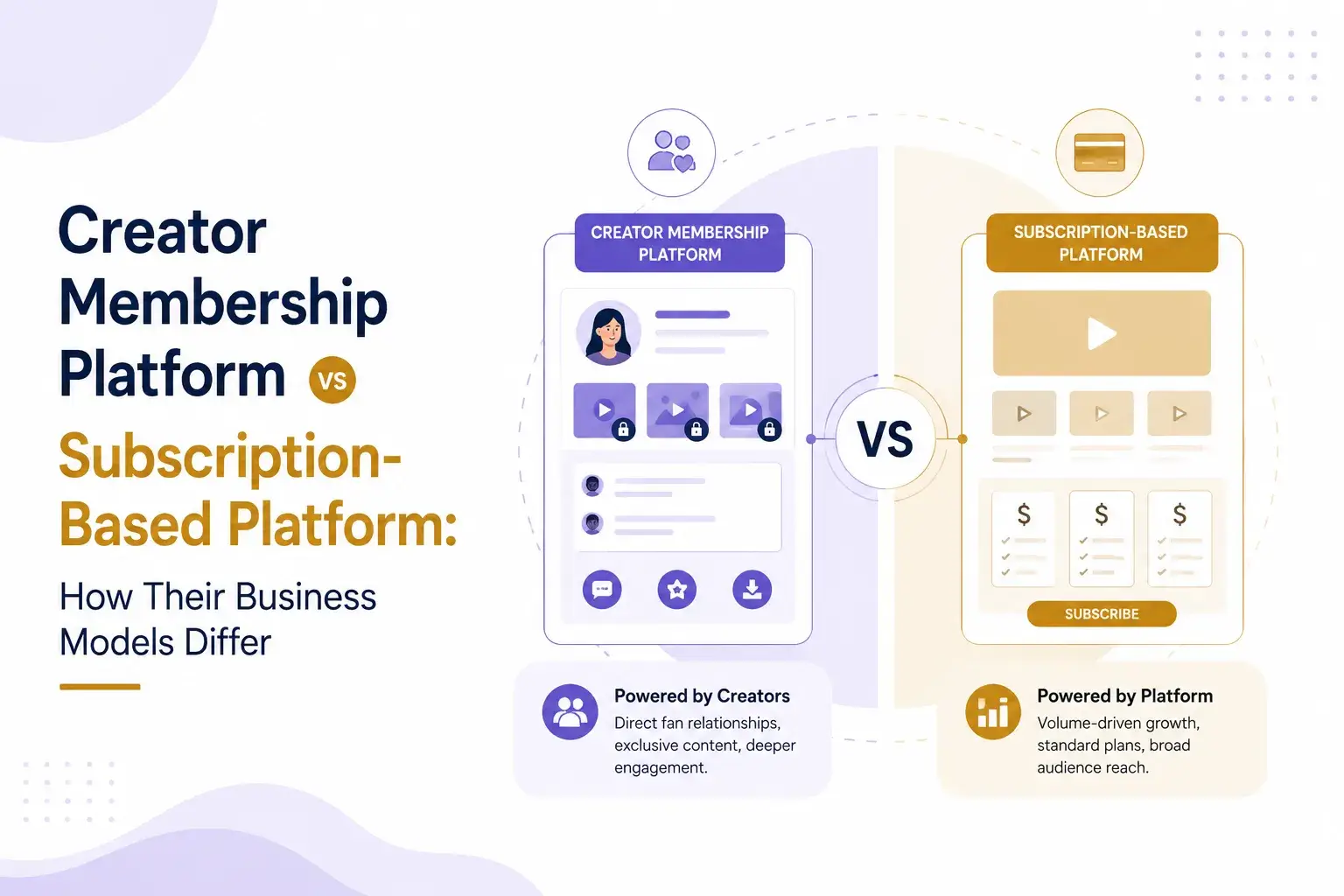
A subscription-based platform usually focuses on recurring access. A user pays every month to unlock content, services, or a product experience. A creator membership platform goes deeper. It combines recurring payments with community access, fan engagement, tiered benefits, creator identity, exclusive drops, direct interaction, and loyalty-building features.
For founders, this difference matters because the model you choose affects revenue predictability, creator acquisition, retention, product architecture, moderation needs, payment complexity, and long-term scalability.
Miracuves helps founders evaluate these decisions before building, so the platform is not just feature-rich but business-model-ready from the beginning.
What Is a Subscription-Based Platform?
A subscription-based platform gives users access to content, services, software, or community features in exchange for recurring payment. The model is simple: users pay weekly, monthly, quarterly, or annually, and the platform earns recurring revenue.
In creator economy products, this usually means fans pay to access private content, premium feeds, locked media, exclusive updates, or creator posts. The platform may earn through a commission on creator earnings, payment processing margins, platform fees, or premium add-ons.
Examples of subscription-based platform mechanics include:
- Monthly fan subscriptions
- Locked content access
- Premium creator pages
- Recurring billing
- Auto-renewals
- Trial offers
- Subscription discounts
- Cancellation and renewal flows
- Platform commission on payments
The advantage of this model is predictability. Founders can track recurring revenue, churn, lifetime value, active subscribers, and creator earnings. The risk is that users may cancel quickly if the value feels repetitive or too transactional.
A pure subscription platform works well when the core value is access. A creator membership platform works better when the value depends on belonging, interaction, exclusivity, and loyalty.
Read More: How Does a Creator Membership Platform Combine Discovery, Memberships, and Paid Content?
What Is a Creator Membership Platform?
A creator membership platform is built around ongoing fan relationships. Subscriptions may still be part of the model, but they are not the entire business. Members do not simply pay to unlock content. They pay to feel closer to a creator, community, niche, or exclusive experience.
This model usually includes multiple monetization layers:
- Membership tiers
- Exclusive posts and media
- Fan communities
- Direct creator messaging
- Pay-per-view content
- Tips and donations
- Creator storefronts
- Livestream access
- Custom requests
- Priority replies
- Private groups
- Loyalty rewards
- Limited drops or premium bundles
The platform operator earns by enabling creators to monetize deeper fan relationships. That means the product must support not only payments and content access, but also engagement, discovery, moderation, creator analytics, and payout transparency.
This is where many founders underestimate the build. A creator membership product is not just a paywall. It is a monetization ecosystem with creator tools, fan journeys, admin workflows, and trust controls working together.
Creator Membership Platform vs Subscription-Based Platform: Core Difference
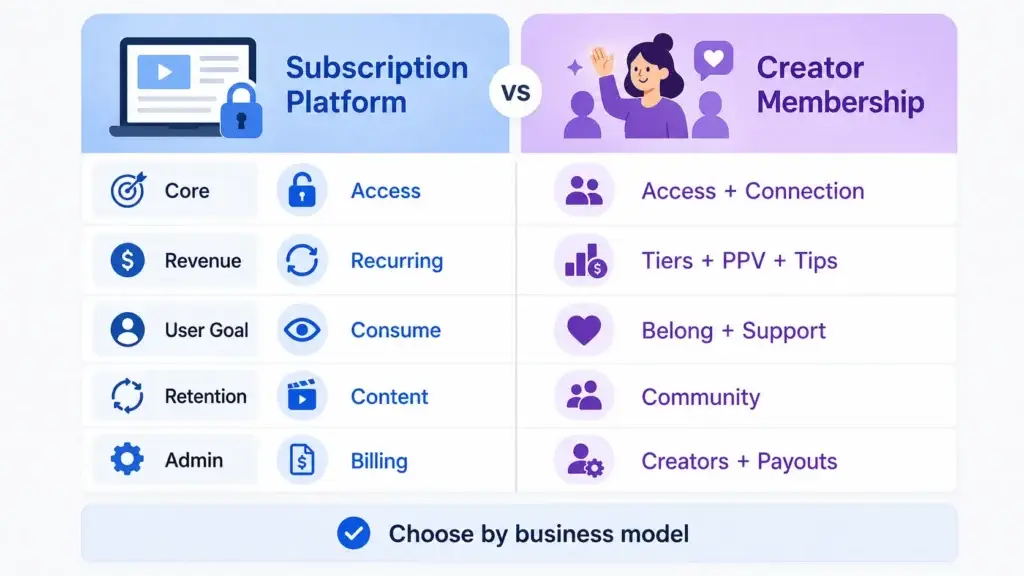
The simplest way to understand the difference is this:
A subscription-based platform sells access.
A creator membership platform sells access plus relationship value.
That one difference changes almost everything about the product.
| Comparison Area | Subscription-Based Platform | Creator Membership Platform |
|---|---|---|
| Core value | Recurring access to content or services | Ongoing creator-fan relationship and exclusive benefits |
| Revenue logic | Monthly or annual recurring billing | Membership tiers, subscriptions, PPV, tips, bundles, paid messaging |
| User motivation | Access content regularly | Support, interact, belong, unlock deeper creator experiences |
| Retention driver | Content volume and renewal value | Community, exclusivity, creator connection, tier benefits |
| Product complexity | Moderate | Higher due to interaction, moderation, payouts, tiers, and analytics |
| Best fit | Content libraries, SaaS, newsletters, courses, streaming | Fan communities, creator networks, premium content ecosystems |
| Admin needs | Subscription, users, billing, access control | Creator verification, content moderation, payouts, abuse reports, tier controls |
| Growth strategy | Reduce churn and increase renewals | Increase fan loyalty, creator earnings, and engagement frequency |
For founders, this means the decision should not be based only on what competitors offer. It should be based on the type of creator economy business you want to operate.
Why This Difference Matters for Founders
Many founders enter the creator economy thinking the platform only needs profiles, subscriptions, payments, and content uploads. That is a starting point, not a complete business model.
If you build a basic subscription platform, your biggest challenge is churn. Users may subscribe for one month, consume the content they wanted, and leave.
If you build a creator membership platform, your biggest challenge is operational depth. You need tier management, creator tools, engagement loops, moderation, payout visibility, content protection, and admin control.
Both models can work, but they require different product decisions.
A founder building a niche education community may only need subscription access, course content, and member discussions. A founder building a fan monetization network may need creator verification, PPV unlocks, tips, direct messaging, creator dashboards, media protection, and payout management.
That is why business model clarity should come before development.
Founder Decision Signals
Speed
If your goal is fast market validation, start with the core monetization flows first: creator profiles, subscriptions, locked content, payments, and admin control.
Revenue Depth
If you want higher earnings per fan, consider membership tiers, PPV unlocks, paid messages, tips, bundles, and creator-led premium experiences.
Scalability
If your platform may handle high media uploads, viral content drops, or many creator payouts, infrastructure and admin workflows must be planned early.
Market Fit
If creators in your niche already have loyal audiences, a membership model may create stronger retention than a simple content subscription model.
Revenue Model Comparison: Where the Money Actually Comes From
A subscription-based platform usually starts with one dominant revenue stream: recurring subscriptions. That is useful, but it can limit revenue expansion if the platform does not add upsell layers.
Creator membership platforms usually perform better when they give creators more than one way to earn. This matters because creators are the supply side of the marketplace. If creators earn more, they are more likely to stay, promote the platform, and bring fans with them.
| Revenue Stream | Subscription-Based Platform | Creator Membership Platform | Founder Impact |
| Monthly subscriptions | Core revenue stream | Core revenue stream | Creates predictable recurring revenue |
| Tiered memberships | Optional | Often central | Supports different fan spending levels |
| Pay-per-view content | Sometimes available | Strong monetization layer | Helps creators monetize premium drops |
| Tips | Optional | Common | Increases fan-to-creator transaction volume |
| Paid messaging | Limited or unavailable | Strong fit | Enables direct creator-fan monetization |
| Creator commission | Common | Common | Platform earns from creator revenue |
| Featured creator placements | Possible | Strong fit | Adds promotional monetization |
| Platform subscriptions for creators | Possible | Possible | Useful for SaaS-style creator tools |
| Bundles and discounts | Useful | Very useful | Helps reduce churn and increase upgrades |
The key lesson is simple: subscription revenue gives stability, but membership-led monetization creates more pricing flexibility.
Access vs Engagement: The Real Business Model Split
A subscription platform succeeds when the user believes continued access is worth the recurring payment. That is why streaming platforms, newsletters, SaaS products, paid communities, and online learning portals often use subscription models.
A creator membership platform succeeds when users feel emotionally or professionally connected to the creator. The member is not just buying content. They may be buying recognition, direct access, identity, exclusivity, or community status.
That emotional layer affects product design.
A simple subscription product may ask:
“Did the user renew?”
A creator membership platform must ask:
“Did the member interact, upgrade, tip, message, return, and feel valued?”
That requires deeper analytics and engagement tracking. Founders need to measure not only subscriber count, but also:
- Active paying members
- Repeat PPV unlocks
- Tier upgrades
- Message purchases
- Tip frequency
- Creator response time
- Churn by creator
- Revenue per fan
- Creator retention
- Content performance by format
These metrics help the platform operator understand whether the business is growing because of genuine fan loyalty or only because of short-term subscription spikes.
Read More: Pre-Launch vs Post-Launch Marketing for a Creator Membership Platform: What Changes After Go-Live?
Why Tiered Access Is More Powerful Than One Flat Subscription
One flat subscription is easier to build, but it may leave money on the table. Fans do not all have the same intent or spending capacity. Some want casual access. Others want premium content, direct interaction, early access, or exclusive perks.
Tiered access gives creators a pricing ladder.
For example:
- Free follower tier for discovery
- Entry-level paid tier for regular posts
- Premium tier for exclusive videos or private community access
- VIP tier for direct messaging, custom drops, or priority engagement
This structure helps creators serve different fan segments without forcing every user into the same price point.
For founders, tiered access also improves platform economics. It creates upgrade paths, improves creator earnings potential, and gives the admin panel more pricing data to analyze.
A platform that supports flexible creator tiers is usually stronger than one that only supports a basic monthly paywall.
Payment and Payout Logic Can Make or Break the Platform
Creator platforms depend heavily on payment reliability. Failed recurring payments, delayed payouts, unclear transaction records, refund disputes, chargebacks, or unsupported payment methods can quickly damage creator trust.
A basic subscription product needs billing and access control. A creator membership platform needs a more complete payment layer:
- Recurring subscription billing
- PPV unlock payments
- Tips
- Paid messaging payments
- Creator wallet or earnings dashboard
- Platform commission tracking
- Refund and dispute workflows
- Payout approval rules
- Payment gateway fallback planning
- Transaction logs
- Admin revenue reports
Miracuves has also published guidance on smart payment routing for creator platforms, including gateway redundancy, retry logic, payout visibility, and admin risk controls as ways to reduce revenue loss and creator churn. For founders, this means payment architecture should be treated as a growth system, not just a checkout feature.
Content Safety and Moderation Are Bigger in Membership Platforms
The more user-generated content and direct interaction a platform supports, the more important safety becomes. A subscription content platform may need content access control and copyright reporting. A creator membership platform usually needs deeper moderation because it includes creator uploads, comments, private messages, paid requests, community interaction, and subscriber behavior.
Important safety workflows include:
- Creator verification
- User verification where relevant
- Content moderation queues
- Abuse reporting
- Comment moderation
- Spam detection
- Age-gating where relevant
- Copyright/reporting workflows
- Admin review tools
- Audit logs
- Payout monitoring
- Dispute management
Security should not be added later as a patch. For creator platforms, trust affects creator retention, user confidence, payment reliability, and brand reputation.
Miracuves’ creator platform security guidance highlights role-based access, subscription and PPV access checks, secure payment integration, moderation workflows, audit logs, and scalable backend planning as important parts of a creator platform foundation.
Admin Control: The Hidden Difference Most Founders Miss
Most users see the frontend. Founders live in the backend.
A subscription-based platform may need basic admin features such as user management, subscription plans, payment status, content access, and reports.
A creator membership platform needs a stronger operating layer:
- Creator approval
- Creator profile management
- Fan and subscriber management
- Membership tier controls
- Commission settings
- PPV content monitoring
- Reported content review
- Payment and payout tracking
- Refund and dispute handling
- Platform analytics
- Creator performance dashboards
- Role-based team access
- Admin activity logs
This admin layer decides how easily the platform operator can manage growth. Without it, every small policy change, pricing adjustment, payout issue, or moderation decision becomes a manual operational burden.
For a founder, backend control is not a technical luxury. It is what makes the business manageable after launch.
Technology Requirements: Subscription Platform vs Creator Membership Platform
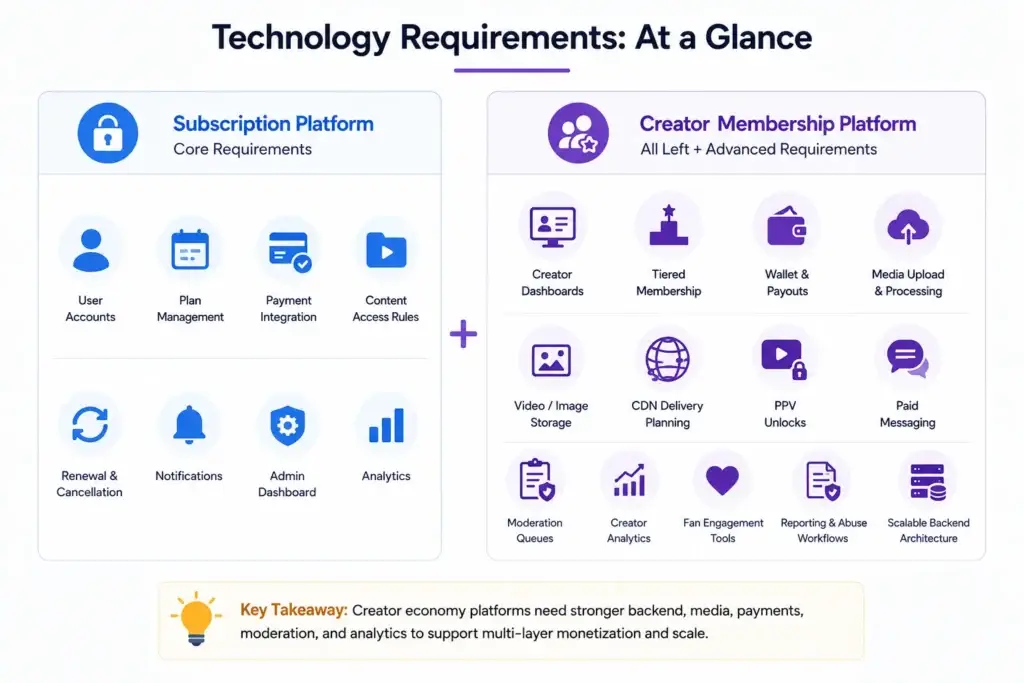
Image Source: AI-generated visual by Miracuves
The technical foundation depends on how complex the business model is.
A subscription platform may require:
- User accounts
- Plan management
- Payment gateway integration
- Content access rules
- Renewal and cancellation logic
- Notifications
- Basic admin dashboard
- Analytics
A creator membership platform may require all of the above plus:
- Creator dashboards
- Tiered membership logic
- Wallet and payout workflows
- Media upload and processing
- Video/image storage
- CDN delivery planning
- PPV unlocks
- Paid messaging
- Moderation queues
- Creator analytics
- Fan engagement tools
- Reporting and abuse workflows
- Scalable backend architecture
This is why founders should avoid choosing technology based only on frontend appearance. A creator economy product depends heavily on backend workflows, media handling, payments, moderation, and analytics.
If your product roadmap includes multiple monetization layers, it is better to plan for that early rather than rebuilding the platform later.
Read More: What Mistakes Should Founders Avoid When Launching a Creator Membership Platform?
Which Model Is Better for a New Creator Economy Startup?
There is no universal answer. The stronger model depends on your niche, creator profile, fan behavior, and monetization plan.
Choose a subscription-based model if:
- Your product is primarily content access
- You want simpler recurring revenue
- You are building a course, newsletter, media library, or community
- Creator-fan interaction is not the main value
- You want a simpler first release
Choose a creator membership model if:
- Your platform depends on creator identity
- Fans want closer access to creators
- You need multiple pricing tiers
- PPV content, tips, and paid messages matter
- Creator earnings are central to growth
- Community and exclusivity drive retention
- You want stronger monetization depth per creator
Many successful creator platforms combine both. They use subscriptions as the foundation and memberships as the retention engine.
For founders, the better question is not “Which model is popular?” The better question is “Which model matches the behavior my creators and fans already want?”
Build From Scratch or Use a Ready-Made Platform Foundation?
Custom development gives maximum flexibility, but it can also increase cost, timeline, and technical risk if the founder has not validated demand yet.
A ready-made platform foundation can be more practical when the core workflows are already known: creator profiles, fan subscriptions, paid content, messaging, payouts, admin dashboard, moderation, and analytics.
Miracuves helps founders launch creator monetization platforms with white-label branding, source-code ownership, admin control, and monetization-ready workflows. For founders evaluating a business model similar to premium fan-subscription platforms, this creator subscription platform foundation can provide a faster starting point without forcing the blog to compete directly with the commercial solution page.
The value is not in copying a platform blindly. The value is in starting with proven creator economy workflows, then customizing the product for your audience, niche, payment needs, content policy, and growth strategy.
Common Mistakes Founders Should Avoid
Building Only a Paywall
A paywall may create access control, but it does not automatically create retention. Creator platforms need engagement loops, creator tools, and fan reasons to return.
Ignoring Payout Operations
Creators care about earnings clarity. If payout tracking, commission logic, or transaction reporting is weak, creator trust can fall quickly.
Adding Moderation Too Late
User-generated content platforms need moderation workflows from the beginning. Waiting until abuse, spam, or disputes appear can damage reputation.
Choosing Features Without a Revenue Strategy
Every feature should connect to acquisition, retention, monetization, safety, or operations. A long feature list without business logic creates complexity without clarity.
How Miracuves Helps Founders Choose the Right Platform Model
Miracuves helps founders look at creator platform development as a complete business system, not just a list of features. The goal is to choose a model that matches the platform’s revenue plan, creator needs, fan behavior, and launch strategy.
Key areas Miracuves helps founders evaluate include:
- Revenue model clarity: Should the platform depend mainly on monthly subscriptions, or should it also include membership tiers, PPV content, tips, paid messaging, and creator commissions?
- Creator experience: Does the platform need simple content publishing, or does it require creator dashboards, earnings reports, fan management, and performance analytics?
- Fan engagement strategy: Will users pay only for access, or will they expect direct interaction, exclusive communities, premium drops, and loyalty-based benefits?
- Admin control: What level of backend control is needed for users, creators, payments, content moderation, payouts, reports, disputes, and commission settings?
- Launch approach: Should the founder start with a subscription-led first version and expand later, or launch directly with a deeper creator membership model?
- Customization scope: Which workflows, branding elements, monetization rules, and platform policies need to be adapted for the target niche?
With a ready-made, white-label, source-code-owned foundation, Miracuves helps founders move faster while keeping the platform flexible enough to match the selected creator economy model.
Final Thoughts: Choose the Model Before Choosing the Features
A subscription-based platform is useful when the business depends on recurring access. A creator membership platform is stronger when the business depends on creator loyalty, fan engagement, exclusive benefits, and monetization depth.
For founders, the real decision is not whether to copy an existing platform. The real decision is how to design a creator economy product that can attract creators, retain fans, process payments reliably, protect content, manage payouts, and scale without operational chaos.
Start with the business model. Then choose the features. Then build the platform foundation around the revenue, retention, and control layers that matter most.
FAQs
What is the difference between a creator membership platform and a subscription-based platform?
A subscription-based platform mainly gives users recurring access to content, services, or tools. A creator membership platform adds deeper creator-fan relationships through tiers, exclusive benefits, direct interaction, PPV content, tips, paid messaging, and community features.
Is a creator membership platform better than a simple subscription platform?
It depends on the business model. A simple subscription platform is better for straightforward access-based products. A creator membership platform is better when retention depends on fan loyalty, creator interaction, exclusivity, and multiple monetization layers.
What monetization features should a creator platform include?
A strong creator platform may include monthly subscriptions, membership tiers, PPV content, tips, paid messaging, creator commissions, promotional placements, bundles, discounts, and creator analytics. The right mix depends on the target niche and creator behavior.
Why do creator membership platforms need stronger admin controls?
Creator membership platforms involve creators, fans, content, payments, payouts, reports, moderation, and disputes. Strong admin controls help the platform operator manage users, creator verification, commissions, content safety, transaction records, and platform growth.
Can a platform use both subscription and membership models?
Yes. Many creator economy platforms combine both. Subscriptions can provide recurring access, while memberships add tiered benefits, loyalty perks, creator interaction, and premium fan experiences.
What should founders build first in a creator monetization platform?
Founders should prioritize creator profiles, fan accounts, subscription access, payment integration, locked content, admin control, creator dashboards, payout tracking, and basic moderation. More advanced features such as PPV, paid messaging, livestreams, and creator analytics can be added based on the business model.
How does a ready-made platform foundation help founders launch faster?
A ready-made foundation can reduce development effort because core workflows such as user accounts, creator profiles, subscriptions, payments, content access, dashboards, and admin controls are already structured. Founders can then focus on branding, niche positioning, monetization rules, and market validation.
What is the biggest risk in building a creator membership platform?
The biggest risk is treating it like a simple content paywall. Creator membership platforms need payment reliability, creator retention tools, content moderation, payout transparency, scalable media handling, and admin control. Without these layers, the product may struggle after launch.
Miracuves is an independent software development company. We are not affiliated with, connected to, sponsored by, or endorsed by any company or product named in this article.
Terms such as “X Clone” are used descriptively. It is how the software industry refers to building a platform with functionality comparable to a known service, and how clients search for it.
The entire design and codebase of our products is built by our own team. Our products contain no code, design, graphics, or content originating from any third-party website or applications.
All third-party names and marks referenced in this article are the property of their respective owners, referenced solely to identify the services discussed.