Key Takeaways
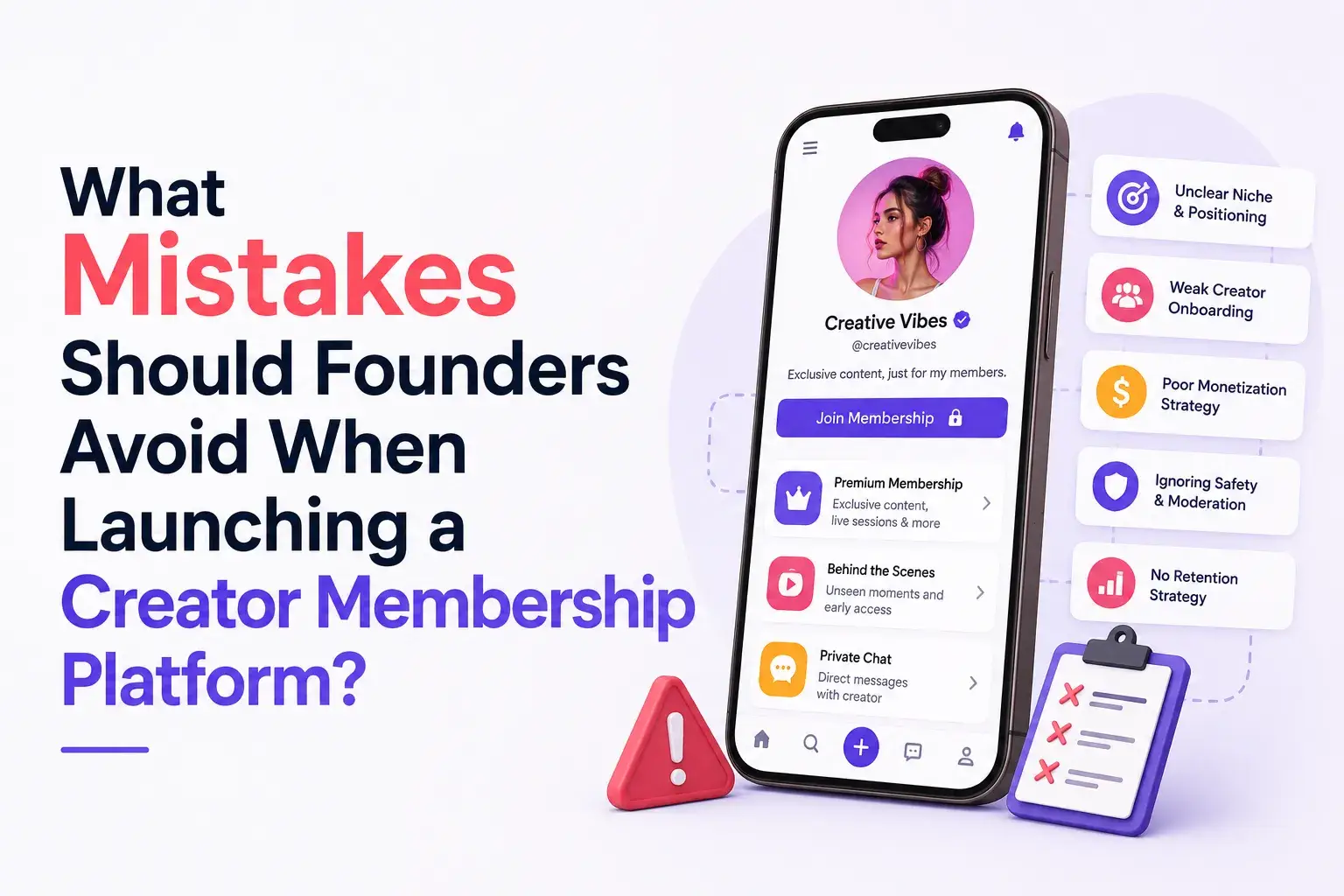
- Creator Membership Platform Launch Mistakes to Avoid include unclear niche positioning, weak membership value, poor creator onboarding, unreliable payouts, late moderation planning, and limited admin control.
- Founders should define one clear creator category before launch instead of trying to serve every type of creator with the same product experience.
- Memberships should provide ongoing value through tiers, community, interaction, perks, loyalty, and exclusivity rather than only unlocking content.
- Creator onboarding should focus on activation: creators should publish, set pricing, connect payouts, promote their profile, and earn their first revenue.
- Payments, payouts, moderation, messaging, access rules, and admin workflows should be planned before real creator-fan transactions begin.
Launch Signals
- Membership tiers should clearly explain what fans receive, why higher tiers cost more, and whether creators can consistently deliver the promised value.
- Paid messaging needs pricing rules, unlock logic, reporting, blocking, refund handling, transaction history, and admin dispute visibility.
- Creator payout dashboards should show total earnings, pending balance, available balance, commissions, refunds, withdrawals, and payout history.
- Moderation should include verification, abuse reporting, content review, takedowns, message reporting, activity logs, and role-based admin access.
- The first release should prove the core loop: creators join → creators publish → fans pay → fans stay engaged → creators earn → admins manage the system.
Real Insights
- A subscription gives access, but a membership creates belonging; founders should design for retention rather than only content unlocking.
- A creator is not truly onboarded when they register; activation happens when they publish, price, promote, and begin earning.
- Overbuilding livestreaming, AI, gamification, wallets, agencies, and advanced analytics before validation can increase cost and delay learning.
- A strong admin dashboard reduces dependence on developers by giving operators control over creators, fans, payments, payouts, reports, disputes, tiers, and settings.
- The strongest launch path is: choose a niche → design clear membership value → activate creators → secure payments and payouts → add moderation and admin control → validate → expand.
Launching a Creator Membership Platform sounds simple from the outside. Creators publish exclusive content, fans pay for access, and the platform earns through subscriptions, tips, paid messages, or commissions.
But most founder mistakes happen before launch, not after.
The problem is usually not the idea. The problem is weak positioning, unclear membership value, poor creator onboarding, unreliable payout logic, missing moderation workflows, and backend systems that cannot support real creator-fan transactions.
ACreator Membership Platform Launch Mistakes to Avoid is not just a content feed with a payment button. It is a relationship-driven platform where fans expect access, creators expect earnings, and the operator needs control over subscriptions, content rules, messaging, payments, disputes, and growth.
For founders planning a broader creator platform, the real challenge is not only building creator profiles. It is designing paid access, fan engagement, creator earnings, moderation, and admin workflows that can support long-term growth.
Miracuves helps founders launch ready-made and white-label creator economy platforms with source-code ownership, admin control, branded design, and monetization-ready workflows. But before choosing any development route, founders should understand the mistakes that can make a creator platform expensive, slow, or difficult to scale.
Mistake 1: Launching Without a Clear Creator Niche
The first mistake founders make is trying to build a creator platform for everyone.
A general platform may sound bigger, but it is harder to market. Fitness creators, musicians, coaches, adult creators, educators, artists, podcasters, and influencers all need different content tools, payment rules, community experiences, and trust signals.
A fitness membership platform may need workout libraries, live classes, progress content, and recurring programs. A fan community platform may need private updates, paid messages, exclusive media, and VIP tiers. An education-led creator platform may need courses, downloads, webinars, and student progress workflows.
When the niche is unclear, everything becomes vague:
- The landing page speaks to no one
- Creator acquisition becomes difficult
- Fan value is unclear
- Feature priorities become scattered
- Pricing becomes harder to justify
- Marketing campaigns become too broad
A stronger approach is to define the creator category first, then build the platform experience around that audience.
Founder Decision Question
Before development starts, ask:
Which creator category will trust this platform enough to bring their audience here?
If that answer is not clear, the platform may need sharper positioning before more features are added.
Mistake 2: Treating Memberships Like Basic Subscriptions
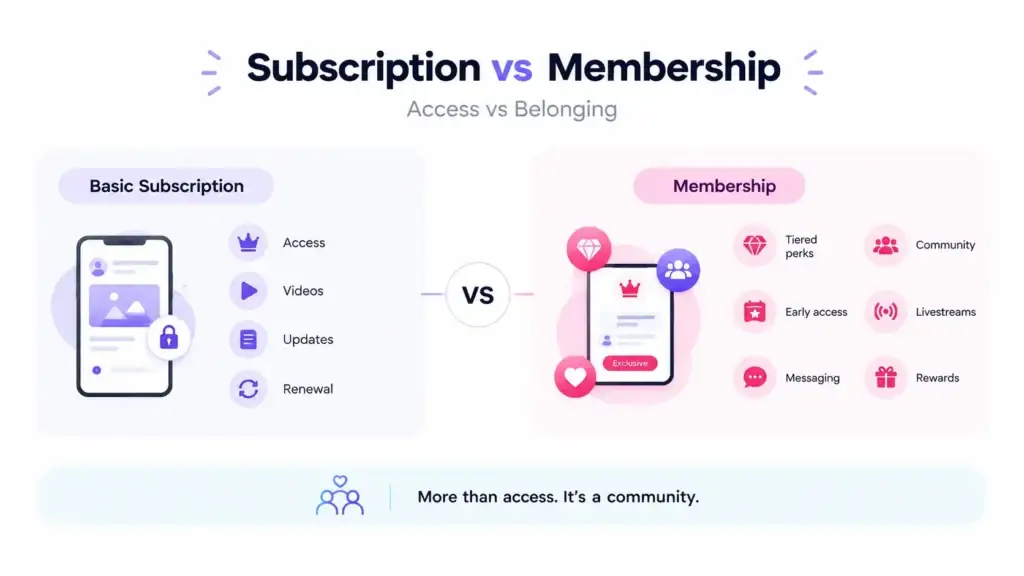
A subscription gives access. A membership creates belonging.
This difference matters because a Creator Membership Platform should not only unlock content. It should give fans a reason to stay connected month after month.
A basic subscription model may include:
- Monthly access
- Locked posts
- Premium videos
- Subscriber-only updates
- Simple renewals
A stronger membership model may include:
- Tiered perks
- Fan badges
- Member-only communities
- Early access
- Private livestreams
- Polls and voting
- Custom creator requests
- Paid messaging
- Exclusive digital downloads
- Loyalty rewards
If the product only says “pay to view content,” fans may cancel quickly after consuming what they came for. If the product creates identity, access, interaction, and ongoing value, retention becomes stronger.
Subscription Access vs Membership Value
| Model | What Fans Pay For | Founder Risk |
|---|---|---|
| Basic Subscription | Access to locked content | Fans may cancel after consuming content |
| Creator Membership | Content, community, interaction, status, and exclusivity | Requires better tier design and creator engagement planning |
| Premium Fan Community | Ongoing relationship with creators and other members | Needs moderation, member experience, and retention workflows |
A subscription based creator platform is useful when founders want to combine recurring fan payments, premium creator content, PPV unlocks, direct messaging, and creator earnings inside one monetization-focused product.
Mistake 3: Designing Membership Tiers Without Clear Value
Many founders add bronze, silver, gold, and VIP tiers because it feels standard. But tier names alone do not create monetization.
Each tier must clearly answer:
- What does the fan get?
- Why is it worth paying more?
- What is exclusive at this level?
- What changes when the fan upgrades?
- How often will the creator deliver value?
- Can the creator manage the workload?
Weak tier design creates confusion. Fans do not upgrade because the difference between tiers feels unclear. Creators also struggle because they may promise too much and fail to deliver consistently.
A practical tier structure may look like this:
| Tier Type | Fan Value | Creator Workload |
|---|---|---|
| Entry Membership | Basic premium content and updates | Low |
| Core Membership | More frequent content, comments, polls, and limited interaction | Medium |
| VIP Membership | Priority replies, exclusive drops, livestream access, or custom requests | High |
| One-Time Unlocks | PPV posts, locked videos, private content, or digital products | Flexible |
The founder’s job is not to add more tiers. The job is to make each tier easier to understand, easier to buy, and realistic for creators to maintain.
Mistake 4: Ignoring Creator Onboarding and Activation
A Creator Membership Platform cannot survive with empty profiles and inactive creators.
Many founders spend heavily on app development but do not plan how creators will join, publish, price their tiers, invite fans, and earn their first payments.
Creator onboarding should help creators:
- Set up profiles quickly
- Add profile images and bios
- Create membership tiers
- Upload first premium content
- Set pricing
- Connect payout details
- Understand platform rules
- Invite fans from existing channels
- Track earnings and performance
The first creator experience matters because creators judge the platform quickly. If setup feels confusing, payout rules are unclear, or content tools feel incomplete, they may leave before bringing their audience.
Better Founder Approach
Build onboarding around creator activation, not just account creation.
A creator is not truly onboarded when they sign up. They are onboarded when they publish, price, promote, and earn.
Mistake 5: Underestimating Paid Messaging and Fan Interaction Rules
Paid messaging can become a major revenue stream, but it also creates operational complexity.
A creator membership app may support:
- Paid first messages
- Paid replies
- Locked media in chat
- Private content requests
- VIP inbox access
- Creator-controlled message pricing
- Fan tipping inside messages
- Priority response options
The mistake is treating messaging as a simple chat feature.
Paid messaging needs rules. The platform should define who can message whom, what happens when a creator does not respond, how locked media is delivered, how refunds are handled, how abuse is reported, and what admins can review when disputes happen.
Without these controls, paid messaging can create:
- Creator spam
- Fan complaints
- Refund disputes
- Abuse reports
- Unclear transaction records
- Moderation workload
- Trust issues
Messaging should be designed as a monetization and safety workflow, not just a conversation box.
If your business model depends heavily on fan access, paid messages, locked content, and creator-led monetization, reviewing a Fan Monetization Platform can help you understand how these workflows connect inside a complete product ecosystem.
Mistake 6: Building Payments Without Payout Trust
Payments bring fans in. Payouts keep creators loyal.
Creators need to trust that their earnings are visible, accurate, and withdrawable according to clear rules. If payout logic is confusing, delayed without explanation, or missing transaction details, creators may lose confidence in the platform.
A strong payout system should show:
- Total earnings
- Pending balance
- Available balance
- Platform commission
- Subscription revenue
- PPV revenue
- Tips
- Paid message revenue
- Refunds or chargebacks
- Withdrawal requests
- Payout history
Before launch, founders should define the creator membership business model, including subscription revenue, platform commission, creator payouts, PPV earnings, refunds, and withdrawal rules.
The admin side should also support commission settings, payout approvals, transaction logs, refund visibility, and financial reporting.
This is where many creator platform launches become fragile. The app may look good, but the business breaks when creators start asking detailed payout questions.
Mistake 7: Adding Content Safety and Moderation Too Late
Content safety should be part of the foundation, especially when the platform includes user-generated content, paid media, private messaging, livestreams, or premium fan communities.
A creator membership business should consider:
- Creator verification
- User verification where relevant
- Age-gating where applicable
- Content moderation
- Abuse reporting
- Copyright or takedown workflows
- Manual review queues
- Spam detection
- Comment moderation
- Message reporting
- Role-based admin access
- Activity logs
- Secure media delivery
- Dispute management
If your platform includes premium videos, locked media, creator feeds, or paid visual content, video content platform solutions can help you plan media workflows, secure access, and moderation requirements more clearly.
No platform should claim that moderation or compliance is automatically guaranteed. Final requirements depend on jurisdiction, business model, content categories, payment providers, and legal review.
But founders should avoid delaying safety planning until after launch. By then, users may already be uploading content, sending messages, requesting refunds, and reporting issues.
A privacy-conscious and compliance-ready foundation helps platform operators build stronger trust from the beginning.
Mistake 8: Launching Without Strong Admin Control
Admin control is often ignored because founders focus on the fan and creator apps. But the admin dashboard decides whether the business can actually operate.
A strong admin dashboard should help operators manage:
- Creators
- Fans
- Subscriptions
- Payments
- Payouts
- Commissions
- Content reports
- Message disputes
- Refund requests
- Membership tiers
- Categories and tags
- Featured creators
- Notifications
- Platform analytics
- Staff permissions
Without admin control, every issue becomes manual. The founder has to ask developers to change pricing rules, manage reports, adjust creators, check payment disputes, or update platform settings.
This slows down operations and makes the platform harder to scale.
Founder Decision Signals
Creator Trust
If creators cannot understand earnings, payouts, content rules, and audience tools, they may not bring their fans to the platform.
Fan Retention
If membership tiers do not create ongoing value, fans may cancel after consuming the first batch of premium content.
Operational Control
If admins cannot manage users, payments, reports, disputes, and content from one dashboard, scaling becomes difficult.
Market Fit
If the platform tries to serve every creator category, marketing becomes broad and creator acquisition becomes weaker.
Mistake 9: Overbuilding Before Market Validation
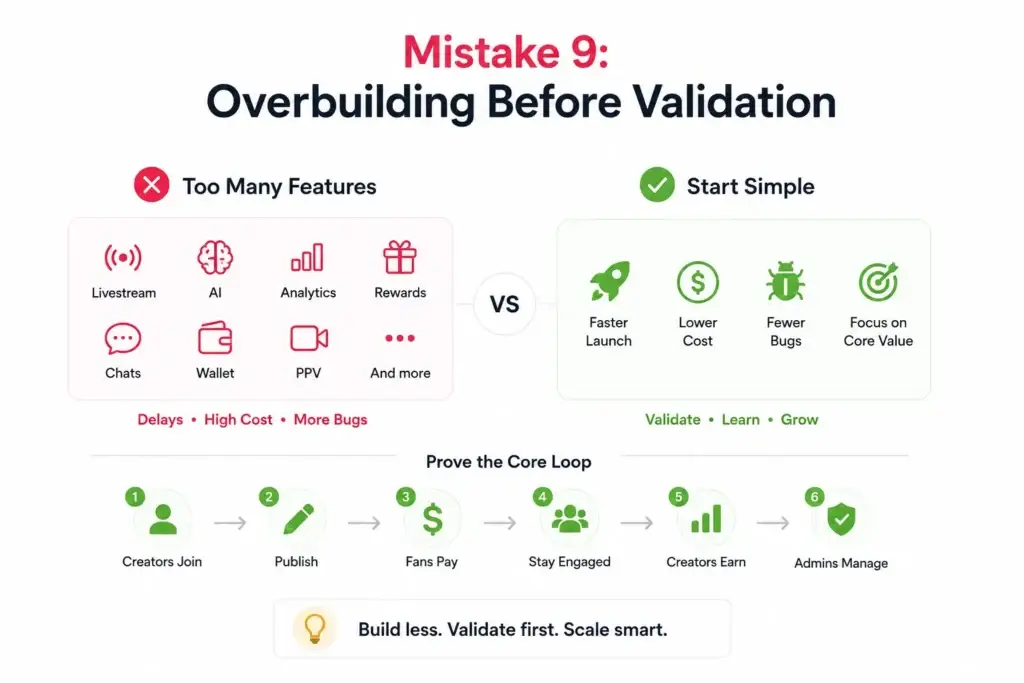
Many founders want everything in the first release:
- Livestreaming
- AI recommendations
- Advanced analytics
- Referral programs
- Gamification
- Creator stores
- Group chats
- Agencies
- Wallets
- PPV
- Paid calls
- Loyalty programs
- Multiple currencies
- Complex moderation automation
Some of these features may be useful later. But adding too much too early can delay launch, increase cost, create bugs, and distract from the core value exchange.
The first version should prove the main business loop:
- Creators join.
- Creators publish value.
- Fans pay.
- Fans stay engaged.
- Creators earn.
- Admins can manage the system.
Once that loop works, advanced features can be prioritized based on real platform behavior.
The better question is not “How many features can we launch with?”
The better question is “Which features are required to prove creator demand and fan willingness to pay?”
Mistake 10: Choosing the Wrong Development Route
Founders usually compare three routes when launching a Creator Membership Platform.
| Development Route | Best For | Risk |
| Build from scratch | Highly unique models with custom workflows | Longer timeline, higher cost exposure, more testing complexity |
| Ready-made foundation | Founders who need faster launch with core creator monetization modules | Needs thoughtful customization around niche, brand, and policy |
| Hybrid approach | Founders who want a working base plus custom modules | Requires clear prioritization to avoid over-customization |
Starting from scratch can make sense for deeply unique products. But if the core model includes creator profiles, fan subscriptions, paid content, messaging, payouts, moderation, and admin control, a ready-made foundation can reduce avoidable development effort.
For founders who want to launch faster, Miracuves offers a <a href=”https://miracuves.com/Fansly-clone/”>launch-ready creator subscription solution</a> that can be customized around premium content access, discovery, creator dashboards, paid interactions, wallet workflows, moderation, and branded platform operations.
What a Launch-Ready Creator Membership Platform Should Include
A founder does not need every advanced feature at launch, but the core foundation should be strong enough to support the business model.
Creator Membership Platform Launch Checklist
| Platform Area | What to Check Before Launch | Why It Matters |
|---|---|---|
| Creator Profiles | Bio, media, categories, links, membership tiers, and verification | Helps creators present value clearly |
| Membership Tiers | Pricing, benefits, upgrade logic, and recurring access rules | Supports predictable revenue and fan segmentation |
| Paid Content | Locked posts, PPV media, access checks, and purchase history | Protects monetization and reduces disputes |
| Messaging | Paid DMs, locked media, reporting, blocking, and transaction records | Turns interaction into revenue while protecting users |
| Payouts | Creator balance, commissions, withdrawals, refunds, and payout status | Builds creator trust |
| Moderation | Content review, abuse reports, user verification, and admin actions | Protects platform reputation and operational safety |
| Admin Dashboard | User control, revenue reports, creator approval, disputes, and settings | Gives operators control after launch |
Founders who need a deeper product checklist can review the essential creator membership platform features required for subscriptions, paid content, messaging, payouts, creator profiles, and admin control.
How Miracuves Helps Founders Avoid These Launch Mistakes
Miracuves helps founders build ready-made and white-label solutions platforms with source-code ownership, custom branding, admin dashboards, creator monetization workflows, secure payment gateway integration, premium content access, and faster deployment.
Instead of building every module from zero, founders can start with a working product foundation and customize the platform around their creator category, pricing logic, moderation policy, payment requirements, and brand experience.
This approach is especially useful when the founder already knows the core model: creators need membership tiers, fans need paid access, and the platform operator needs control over users, content, revenue, reports, and growth.
For related planning, founders can also explore Miracuves’ creator platform development services and broader influencer platform solutions when comparing creator-led business models.
Final Thoughts: Avoid the Mistakes Before You Build the Platform
A Creator Membership Platform succeeds when creators trust the product, fans understand the value, and admins can manage the business without chaos.
The biggest mistakes are predictable: unclear niche, weak membership tiers, poor onboarding, messy payouts, late moderation, missing admin controls, and overbuilding before validation.
Founders do not need to copy another platform feature by feature. They need a focused product foundation that supports their creator category, monetization model, content policy, and launch strategy.
Miracuves helps founders move from idea to execution with white-label flexibility, source-code ownership, admin control, and monetization-ready creator platform workflows.
FAQs
What is a Creator Membership Platform?
A Creator Membership Platform is a digital product where creators offer paid access to exclusive content, communities, messages, events, or premium experiences. Fans become members by paying recurring fees, unlocking content, or purchasing creator interactions.
What is the biggest mistake founders make when launching a creator membership platform?
The biggest mistake is launching without a clear creator niche. A platform built for every creator category is harder to market, harder to onboard, and harder to differentiate.
How is a creator membership platform different from a subscription platform?
A subscription platform mainly gives fans access to paid content. A membership platform adds community, perks, interaction, loyalty, identity, and creator-fan relationship depth.
Why do creator payouts matter so much?
Creators need transparent earnings, commission details, withdrawal status, and payout history. If payout trust is weak, creators may not stay active or invite fans to the platform.
Should paid messaging be included in the first launch?
Paid messaging can be valuable, but it should include reporting, blocking, transaction history, refund logic, creator pricing controls, and admin visibility. It should not be launched as a basic chat tool.
What features should a Creator Membership Platform include at launch?
A practical launch should include creator profiles, fan accounts, membership tiers, paid content access, payment workflows, creator payouts, admin control, moderation tools, and analytics.
Is moderation necessary for creator membership platforms?
Yes. Any platform with user-generated content, paid media, messaging, or fan communities should plan moderation, reporting, verification, and admin review workflows early.
Can Miracuves help build a creator membership platform?
Yes. Miracuves helps founders build ready-made and white-label creator platforms with source-code ownership, branded design, admin dashboards, creator monetization workflows, premium content access, and faster deployment.
Miracuves is an independent software development company. We are not affiliated with, connected to, sponsored by, or endorsed by any company or product named in this article.
Terms such as “X Clone” are used descriptively. It is how the software industry refers to building a platform with functionality comparable to a known service, and how clients search for it.
The entire design and codebase of our products is built by our own team. Our products contain no code, design, graphics, or content originating from any third-party website or applications.
All third-party names and marks referenced in this article are the property of their respective owners, referenced solely to identify the services discussed.