

Key Takeaways
- A short-form video feed architecture should combine ranking signals, real-time user behavior, content freshness, creator relevance, and diversity controls to decide what appears next.
- Useful ranking signals include watch time, completion rate, skips, rewatches, likes, comments, shares, saves, follows, searches, and negative feedback.
- Strong feed performance requires more than relevance alone; the system should continuously balance personalization with novelty, creator variety, topic diversity, and exploration.
Feed Ranking Signals
- Candidate generation can pull videos from followed creators, related interests, trending content, similar users, recent uploads, and discovery pools before ranking begins.
- Ranking models can score each video using predicted watch time, completion probability, engagement likelihood, recency, content quality, and the viewer’s current session behavior.
- Real-time signals such as rapid skips, repeated rewatches, new follows, fresh searches, and changing topic interest should update recommendations during the same viewing session.
Diversity & Personalization Insights
- Creator caps, duplicate suppression, topic limits, freshness weighting, exploration slots, and similarity controls can prevent repetitive feeds and filter-bubble effects.
- Operators should monitor completion rate, skip rate, session depth, creator concentration, content diversity, recommendation freshness, repeat impressions, and return viewing to evaluate feed quality.
- Miracuves develops customizable short-form video platforms with feed ranking, real-time personalization, recommendation logic, discovery controls, creator diversity, engagement analytics, moderation, and admin management.
A short-form video platform succeeds when users keep discovering videos that feel relevant, fresh, safe, and worth watching. That experience does not happen only because of a good-looking video player or an upload button. It depends on the feed architecture behind the product.
Feed architecture is the system that decides which videos appear, in what order, for which users, and under what conditions. It connects user behavior, video metadata, creator quality, moderation rules, freshness, engagement signals, and real-time personalization into one discovery engine.
For founders, this matters because the feed becomes the center of retention. If the feed feels repetitive, unsafe, random, or too slow to adapt, users leave. If it balances relevance with variety, it can help creators get discovered, improve session time, support monetization, and make the platform feel alive from the first few sessions.
If you are planning a branded creator platform or short-video product, Miracuves’ branded short-video platform foundation gives founders a faster path to launch with video creation, engagement tools, admin control, monetization modules, source-code ownership, and a 6-day delivery option where the project scope fits the ready-made solution.
What Is Feed Architecture in a Short-Form Video Platform?
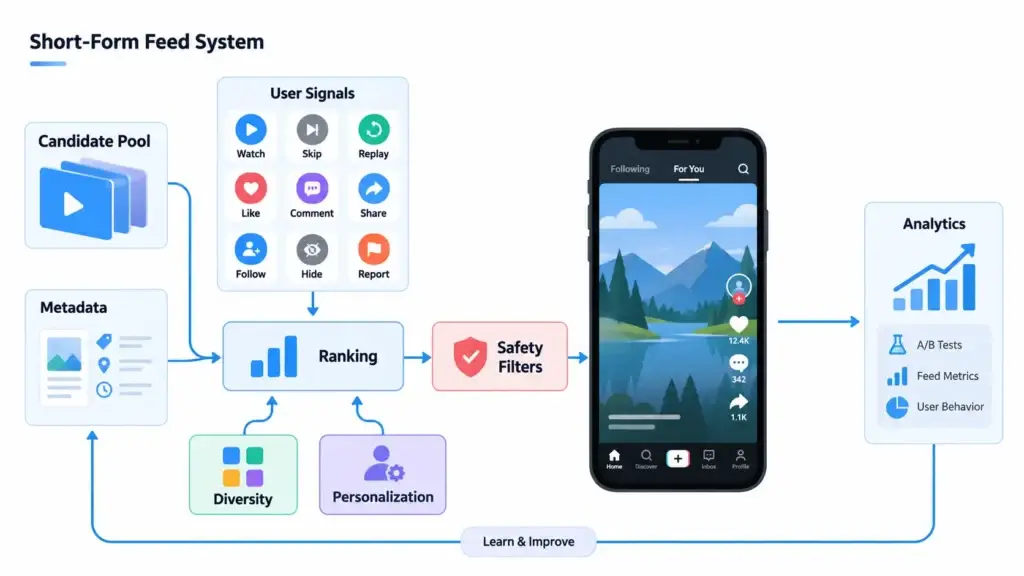
Feed architecture is the backend and decision system that powers content discovery. It is not just one algorithm. It is a connected flow of services that collect content, evaluate user behavior, score videos, apply safety rules, control diversity, and deliver the next set of videos to the app.
A basic feed can show the latest videos or most-liked videos. A scalable short-form video feed needs much more than that. It should understand what a user watches, skips, rewatches, shares, comments on, follows, hides, reports, or ignores.
For founders comparing product foundations, a video-sharing platform infrastructure should support uploads, playback, discovery, engagement events, moderation, analytics, and admin visibility from the beginning.
A strong feed architecture usually includes:
- Candidate generation
- User signal tracking
- Content metadata processing
- Ranking model or scoring logic
- Re-ranking and diversity controls
- Safety and moderation filters
- Real-time personalization
- Feed caching and delivery
- Analytics and experimentation
These layers work best when the core short-video platform features are connected properly, including creator profiles, video uploads, engagement actions, reporting tools, analytics, monetization controls, and admin workflows.
The goal is not to copy another platform’s feed. The goal is to build a discovery system that fits your audience, niche, region, creator strategy, moderation policy, and business model.
Why Feed Architecture Matters More Than Algorithm Hype
Many founders think the feed is only about artificial intelligence. In reality, the first challenge is product architecture.
A feed must answer practical business questions:
Which videos should new users see before the platform knows their preferences?
How should new creators get visibility?
How should the system avoid showing too much similar content?
When should a trending video be promoted or slowed down?
How should unsafe, low-quality, or misleading content be filtered?
How should the admin team control categories, languages, regions, and monetized content?
These questions are not solved by a single recommendation model. They require a structured feed pipeline with clear rules, data flows, ranking signals, and operational controls.
That is why feed architecture should be treated as a product foundation, not as a feature added later.
The Core Layers of a Short-Form Video Feed System
A modern short-form video feed usually works through five major layers. Each layer has a different job, and together they decide what the user sees next.
1. Candidate Generation
Candidate generation creates the first pool of videos that could be shown to a user. The platform may pull candidates from several sources, such as recent uploads, trending videos, followed creators, similar-user behavior, topic categories, language preferences, location relevance, or videos with early engagement momentum.
This stage is broad. Its job is not to find the final order. Its job is to collect enough possible videos so the ranking layer has useful options.
For example, a user interested in fitness may receive candidates from workout creators, nutrition videos, sports challenges, trending wellness posts, and creators followed by similar users. The ranking system then decides which of those videos deserve priority.
2. Feature Collection
Feature collection gathers the data needed to score each video for each user. These features can include user behavior, video performance, creator reputation, content category, device context, session behavior, freshness, language, moderation status, and engagement velocity.
Without good feature collection, the ranking layer becomes weak. The platform may know that a video has many likes, but it may not know whether the current user is likely to watch it, skip it, save it, or report it.
Feature quality directly affects personalization quality.
3. Ranking and Scoring
The ranking layer scores videos based on how relevant, engaging, fresh, safe, and useful they may be for the user.
A simple ranking system may use weighted rules. A more advanced system may use machine learning models that predict watch probability, completion rate, rewatch chance, sharing likelihood, follow intent, or session continuation.
For early-stage platforms, a hybrid approach is often practical. Founders can begin with structured ranking rules and gradually add advanced personalization as user data grows.
4. Re-Ranking, Diversity, and Safety Filtering
After videos are scored, the system should not simply show the highest-scoring videos in order. That can create a repetitive feed.
Re-ranking adds balance. It can limit too many videos from the same creator, category, language, format, topic, or trend. It can also apply safety filters, moderation status, age-sensitive controls, blocked content rules, and user-level restrictions.
This layer protects the user experience and helps the platform avoid becoming too narrow too quickly.
5. Feed Delivery and Feedback Loop
The final feed is delivered to the user through the mobile or web app. As the user watches, swipes, pauses, likes, shares, comments, or reports content, the system collects fresh signals.
Feed quality also depends on playback speed and first-frame experience. Measuring video performance benchmarks helps founders understand whether slow loading, buffering, or delayed video starts are hurting retention before the ranking system even has a chance to work.
That feedback updates the next feed request. This is where real-time personalization begins.
A strong platform should not wait for the next day to learn. It should adapt during the same session.
Core Ranking Signals That Shape a Short-Form Video Feed
Ranking signals help the platform understand what content is likely to create a better user experience. The most useful signals are not always the loudest signals. A like is useful, but a full watch, repeat view, or quick swipe can often reveal stronger intent.
| Ranking Signal Category | What It Measures | Why It Matters for Founders |
|---|---|---|
| Watch behavior | Completion rate, rewatch rate, pause behavior, swipe speed, average watch time | Shows whether users are actually paying attention, not just reacting casually |
| Engagement actions | Likes, comments, shares, saves, follows, profile visits | Helps identify content that creates active interest or community interaction |
| Negative feedback | Skips, hides, reports, “not interested” actions, fast exits | Prevents the feed from repeatedly showing content users dislike |
| Content metadata | Caption, hashtags, category, language, audio, topic, upload time | Helps classify videos and match them with relevant users |
| Creator signals | Creator consistency, audience overlap, publishing frequency, trust history | Helps balance creator discovery with content quality |
| Freshness signals | New uploads, trend momentum, early engagement velocity | Keeps the feed current and prevents stale recommendations |
| Session context | Recent swipes, current viewing pattern, time of day, device behavior | Allows the feed to adapt while the user is still active |
| Safety signals | Moderation status, report history, restricted topics, review queues | Protects platform trust and reduces operational risk |
A strong feed does not depend on only one signal. If watch time is overvalued, the platform may promote addictive but low-quality content. If likes are overvalued, the feed may miss videos that users enjoy but do not publicly engage with. If freshness is overvalued, quality can drop.
The better approach is to combine signals based on the platform’s business model, audience, and content policy.
Why Watch Time Alone Is Not Enough
Watch time is important, but it should not become the only success metric.
A user may watch a video fully because it is valuable, surprising, entertaining, or emotionally engaging. But a user may also watch something because it is controversial, confusing, or misleading. If the platform only optimizes for watch time, the feed may become intense but not healthy for long-term retention.
That is why content safety and moderation controls should sit close to the feed system. Reports, restricted content rules, creator verification, abuse handling, and admin review queues help the platform protect user trust while still giving relevant content room to perform.
Founders should look at watch behavior together with other signals:
Did the user rewatch the video?
Did they follow the creator?
Did they share it?
Did they watch similar videos afterward?
Did they report or hide similar content later?
Did the session continue or end quickly?
The best feed architecture looks beyond one number and evaluates the quality of engagement.
Feed Diversity: Why Personalization Needs Balance
A feed that is too random feels irrelevant. A feed that is too personalized becomes repetitive. Diversity is the layer that keeps discovery fresh.
For a short-form video platform, diversity can include:
- Category diversity
- Creator diversity
- Language diversity
- Format diversity
- New vs familiar content balance
- Trending vs niche content balance
- Local vs global content balance
- Entertainment vs educational content balance
Diversity is especially important for new platforms because creator supply is still developing. If only a few creators receive most of the feed exposure, other creators may stop posting. That weakens the content ecosystem.
A healthier feed gives strong content a chance while still making space for new creators, new categories, and fresh formats.
How Diversity Controls Work in Feed Architecture
Diversity controls usually sit after the first ranking stage. The system may already know which videos are most likely to perform, but the re-ranking layer adjusts the final order.
For example, the system may prevent:
- Five videos from the same creator appearing too close together
- Too many videos from the same category in one session
- Repeated exposure to content the user recently skipped
- Over-promotion of one trend across all users
- New creators being buried too quickly
- Sensitive content appearing without proper review
These controls help create a feed that feels personalized but not trapped.
For founders, this is a product decision as much as a technical decision. A fitness-focused app, a learning app, a creator-commerce app, and a regional entertainment platform may all need different diversity rules.
Real-Time Personalization: How the Feed Learns During a Session
Real-time personalization means the feed changes based on what the user is doing right now.
Long-term history tells the platform what a user usually likes. Session behavior tells the platform what the user wants today.
For example, a user may usually watch comedy videos, but during one session they start watching cooking videos fully. A real-time feed should notice that behavior and test more cooking-related content without permanently changing the user’s entire profile too aggressively.
Real-time personalization can use signals such as:
- Last few videos watched fully
- Recent fast swipes
- Recent rewatches
- Current category interest
- Current language preference
- Videos watched after a search
- New follows during the session
- Recent comments or shares
This allows the feed to feel responsive. The user does not need to manually search or adjust settings. The product learns through behavior.
Handling Cold Start for New Users, New Videos, and New Creators
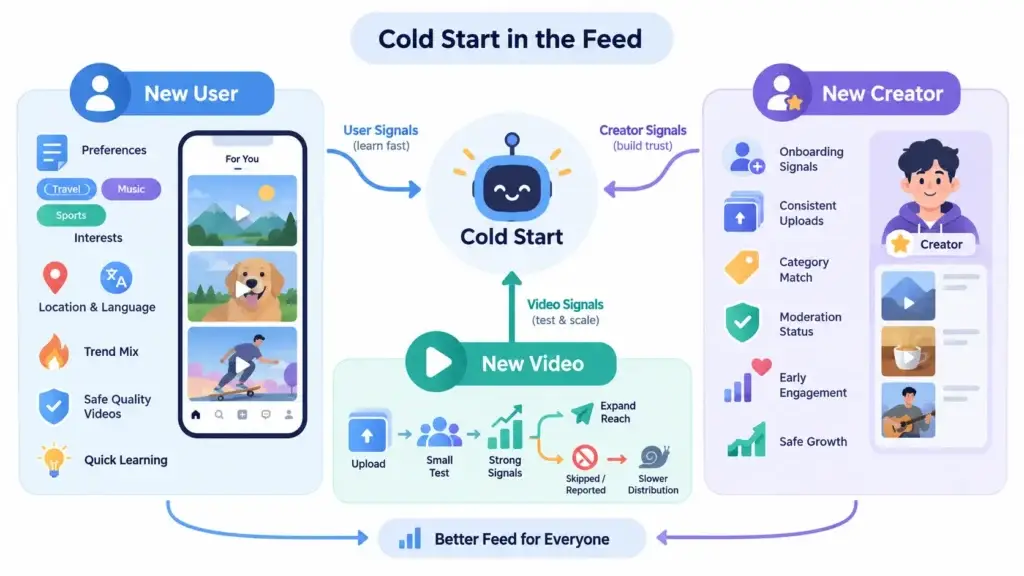
Cold start happens when the platform does not yet have enough data. This is common in three situations: new users, new videos, and new creators.
New User Cold Start
When a user joins for the first time, the platform has limited behavioral history. The feed can begin with onboarding preferences, location, language, selected interests, trending content, safe high-quality videos, and category exploration.
The goal is to learn quickly without making the first feed feel empty or generic.
New Video Cold Start
A newly uploaded video has no performance history. The platform needs to test it with a small relevant audience. If early signals are strong, the video can reach more users. If users skip or report it quickly, distribution can slow down.
This protects feed quality while still giving new content a fair chance.
New Creator Cold Start
New creators need visibility, but the platform also needs quality control. A feed architecture can solve this by using creator onboarding signals, content consistency, category match, upload quality, moderation status, and early audience response.
This helps the platform support creator growth without reducing user trust.
The Data Infrastructure Behind a Scalable Video Feed
A short-form video feed needs more than a recommendation model. It also needs strong infrastructure.
The backend should collect events from the app, process them quickly, update user and content features, serve ranked feeds, cache responses, and send analytics to admin dashboards.
A practical feed infrastructure may include:
- Event tracking for watches, swipes, likes, comments, shares, follows, hides, and reports
- User profile service for preferences and behavior history
- Content metadata service for captions, categories, tags, language, and creator details
- Ranking service for scoring videos
- Re-ranking service for diversity and safety rules
- Moderation service for content review and policy enforcement
- Feed cache for fast response times
- Analytics dashboard for product and creator performance
- Experimentation system for testing ranking changes
For founders, this infrastructure matters because feed performance affects the entire product. Slow feed loading, poor video matching, weak analytics, or missing moderation workflows can damage retention even when the app design looks good. A deeper understanding of backend architecture for short-video apps can also help teams plan event tracking, feed caching, video delivery, creator workflows, and scalable user activity before launch.
Admin Controls Founders Should Plan From the Beginning
Feed control should not live only inside code. Founders and platform operators need admin-level visibility and control.
Useful admin controls include:
- Category-level feed priority
- Region and language rules
- Manual content review queues
- Creator verification status
- Report and abuse management
- Featured creator controls
- Trending topic management
- Sensitive content restrictions
- Video takedown workflows
- Feed analytics by category, creator, and region
- Experiment controls for testing ranking changes
Admin control is important because real platforms face real operating decisions. A founder may need to promote a campaign, slow down unsafe content, support a new creator category, or adjust regional content exposure without waiting for developers for every small change.
Build From Zero or Start With a Launch-Ready Foundation?
A feed system can be built from scratch, but that route requires more planning, more engineering time, more testing, and more operational risk. Founders evaluating scope should also review the short-video app development cost so feed customization, infrastructure, monetization, admin controls, and launch requirements are planned before development begins.
| Decision Area | Building From Zero | Launch-Ready Foundation |
|---|---|---|
| Speed to market | Slower because core app flows, feed logic, uploads, profiles, and admin systems must be built first | Faster because the core platform foundation is already available |
| Feed customization | Fully flexible but requires deeper engineering effort | Customizable around business logic, ranking rules, content categories, and admin needs |
| Cost control | Higher uncertainty because scope often expands during development | More predictable starting point when the required modules already exist |
| Technical risk | Higher early risk if video delivery, feed performance, and moderation are not tested properly | Lower early risk when core workflows are already structured |
| Founder focus | More time spent managing basic development | More time available for positioning, creator onboarding, monetization, and growth |
| Ownership | Depends on vendor contract and architecture | Miracuves offers source-code ownership for stronger long-term control |
Working with a short-form video development company can help founders decide which feed logic, creator workflows, admin controls, and personalization layers should be customized first instead of overbuilding every advanced system before launch.
Mistakes to Avoid When Designing a Short-Form Video Feed
Optimizing Only for Watch Time
Watch time is useful, but it should not be the only ranking priority. A healthy feed also considers user satisfaction, creator quality, negative feedback, safety, and long-term retention.
Ignoring Negative Signals
Fast swipes, hides, reports, and repeated skips are valuable signals. If the system ignores them, users may keep seeing content they already rejected.
Letting the Feed Become Too Repetitive
Personalization should not trap users in one topic. Diversity rules help maintain freshness and support broader creator discovery.
Separating Moderation Too Late
Moderation should be part of feed architecture from the start. Unsafe or restricted content should not reach broad distribution before review.
Not Giving Admins Enough Control
Founders need operational control over categories, creators, reports, featured content, and regional rules. Without admin tools, every feed adjustment becomes a development request.
Launching Without Analytics
A feed cannot improve without measurement. Founders should track completion rate, skip rate, rewatch rate, engagement rate, report rate, creator distribution, and session depth.
How Feed Architecture Supports Monetization
A better feed does more than improve engagement. It also supports monetization because a strong creator platform business model depends on how the feed balances organic discovery, sponsored visibility, creator rewards, ads, subscriptions, gifting, and paid content.
For ad-supported platforms, the feed decides where sponsored content appears and how often users see it. For creator monetization, the feed affects creator visibility, follower growth, gifting, paid content, and fan engagement. For commerce-led short-video platforms, feed ranking can influence product discovery, creator-led sales, and campaign performance.
Monetization becomes stronger when the feed can balance three goals:
- Keep users watching
- Give creators fair visibility
- Protect the platform from low-quality or unsafe content
If the feed only pushes monetized content, users may lose trust. If it ignores monetization completely, the business model may suffer. The best architecture gives founders room to manage both product quality and revenue strategy.
Miracuves Perspective: The Feed Is the Product Engine
A short-form video app is not just a collection of videos. The feed is the product engine that connects users, creators, content, moderation, analytics, and monetization.
Miracuves helps founders build branded short-video platforms with source-code ownership, white-label flexibility, admin dashboards, creator tools, engagement features, and scalable backend workflows. For founders who want to move quickly, a launch-ready solution can reduce the time spent building basic modules and create more room for market validation, creator acquisition, and monetization planning.
The stronger strategy is not to copy a popular app feature by feature. It is to build a short-video product with the right feed architecture, business rules, content controls, and growth path for your market.
Related reading: Why Event-Driven Architecture Helps Short Video Apps Handle Millions of User Actions and Database Architecture for Video Platforms Handling Millions of Users and Engagement Events.
FAQs
What is feed architecture in a short-form video platform?
Feed architecture is the system that selects, ranks, filters, diversifies, and delivers videos to users. It includes candidate generation, ranking signals, personalization, safety rules, feed caching, analytics, and admin controls.
Which ranking signals matter most for a video discovery feed?
Important signals include completion rate, rewatch rate, swipe speed, likes, comments, shares, follows, saves, reports, content category, language, creator quality, freshness, and session behavior.
Why is real-time personalization important?
Real-time personalization helps the feed adapt during the same user session. If a user suddenly shows interest in a new category or skips a type of content repeatedly, the feed can respond quickly instead of waiting for long-term history.
Why does feed diversity matter?
Feed diversity prevents the platform from showing the same type of content repeatedly. It helps users discover new creators, categories, formats, and topics while reducing the risk of over-personalization.
How can new creators get visibility in a short-video platform?
New creators can get visibility through controlled content testing, category matching, early engagement signals, creator verification, freshness rules, and fair distribution logic inside the feed architecture.
Should founders build a feed system from scratch?
A custom feed system can be useful for complex long-term needs, but building everything from zero can delay launch. Many founders start with a launch-ready foundation and customize feed rules, ranking logic, admin controls, and analytics over time.
Can Miracuves customize feed workflows for a branded short-video platform?
Yes. Miracuves can support branded short-video platforms with feed customization, admin controls, creator features, monetization tools, source-code ownership, and ready-made delivery when the project scope fits the existing solution.
Miracuves is an independent software development company. We are not affiliated with, connected to, sponsored by, or endorsed by any company or product named in this article.
Terms such as “X Clone” are used descriptively. It is how the software industry refers to building a platform with functionality comparable to a known service, and how clients search for it.
The entire design and codebase of our products is built by our own team. Our products contain no code, design, graphics, or content originating from any third-party website or applications.
All third-party names and marks referenced in this article are the property of their respective owners, referenced solely to identify the services discussed.