

Key Takeaways
- AI recommendations can hurt a short-form video platform when users repeatedly see similar creators, topics, formats, sounds, or content patterns.
- Filter bubbles can narrow content discovery by over-prioritizing past behavior while reducing exposure to fresh categories, emerging creators, and different interests.
- Feed fatigue grows when recommendation accuracy is optimized without enough diversity, freshness, exploration, user control, and repetition limits.
Recommendation Risk Signals
- Repeated impressions, frequent skips, lower completion rates, shorter sessions, fewer follows, and declining shares can indicate that personalized feeds are becoming too repetitive.
- Recommendation systems should use diversity rules, creator caps, freshness weighting, duplicate suppression, exploration slots, and topic variation to widen content exposure.
- Negative feedback such as “not interested,” hides, blocks, muted topics, skips, and reduced watch time should help the ranking system adjust recommendations quickly.
Feed Quality Insights
- A healthy feed should balance relevance with novelty by mixing familiar interests, new creators, trending content, adjacent topics, and exploratory recommendations.
- Operators should monitor content diversity, repeated impressions, skip rate, completion rate, session depth, creator concentration, discovery rate, and return viewing to measure feed quality.
- Miracuves develops customizable short-form video platforms with AI recommendations, feed ranking, discovery controls, creator diversity, engagement analytics, moderation, and admin management.
AI recommendations can make a short-form video platform feel addictive, personal, and alive.
But they can also damage the product when they are introduced without enough content diversity, user signals, creator balance, moderation control, and feed strategy.
That is the part many founders miss.
A recommendation engine is not automatically a growth engine. It is a decision system. Every time it chooses what to show next, it affects user retention, creator motivation, content discovery, and the overall health of the platform. When that decision system becomes too narrow, too repetitive, or too aggressive, the feed can start working against the business.
Users may feel like they are seeing the same content again and again. Creators may feel invisible. New categories may never get discovered. Admin teams may lose control over what the platform is becoming.
This is where AI recommendations can hurt a short-form video platform instead of helping it.
For founders planning to launch a short-form video platform foundation, the smarter question is not “Should we use AI?” The better question is “How do we use AI without damaging feed diversity, user trust, and long-term retention?”
Why AI Recommendation Problems Matter in Short-Form Video Apps
Short-form video platforms depend on fast emotional feedback.
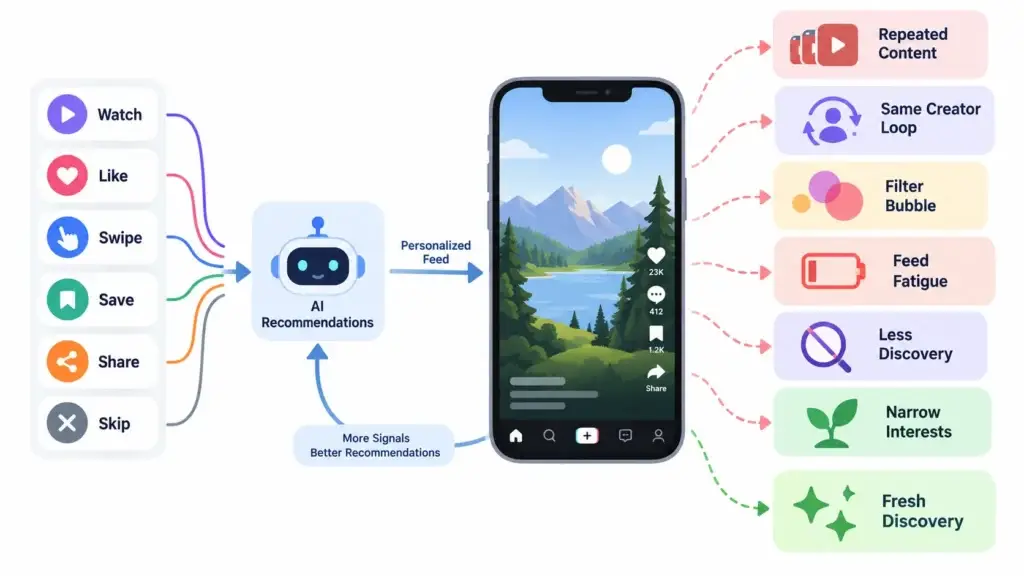
A user opens the app, watches a few seconds, swipes, reacts, skips, saves, shares, or exits. Every interaction becomes a signal. The recommendation system then uses those signals to decide what should appear next.
That sounds powerful, but it also creates risk.
If the system reads early behavior too aggressively, it may assume a user wants only one type of video. If a viewer watches three cooking clips, the feed may overfill with food content. If someone pauses on a dramatic video, the system may keep pushing similar emotional content. If users engage with one creator style, the feed may reduce exposure to new voices.
At first, this can increase watch time. Over time, it can make the app feel predictable.
For a short-video business, predictability is dangerous. Users return because the feed feels fresh, relevant, and slightly surprising. When the feed becomes narrow, it loses the discovery effect that makes vertical video platforms engaging.
The best recommendation systems do not only ask, “What did this user engage with before?” They also ask, “What should we test next without breaking the experience?”
The Difference Between Personalization and Over-Personalization
Personalization is useful when it helps users find content they are likely to enjoy.
Over-personalization happens when the platform becomes too confident too early.
A healthy short-video feed should balance relevance with exploration. It should show familiar content, but not only familiar content. It should reward strong creators, but not hide new creators. It should learn from watch behavior, but not treat every pause, replay, or like as permanent intent.
For founders, this distinction matters because early product teams often confuse “more AI” with “better feed quality.”
That is not always true.
A feed can be technically advanced and still feel bad. A simple feed with smart category rotation, creator freshness, manual curation, and admin rules can sometimes create a better early experience than a complex model trained on weak data.
The goal is not to build the most complicated recommendation layer. The goal is to build a feed that keeps users curious and gives creators enough visibility to keep posting.
How Repetition Starts Inside an AI-Powered Video Feed
Repetition usually begins when the system overweights a small set of signals.
In short-form video, signals can include watch time, likes, shares, comments, rewatches, skips, follows, hashtags, sounds, captions, creator categories, location, language, and device context.
These signals are useful. The problem appears when the recommendation engine keeps doubling down on the same pattern.
For example, a user may watch one motivational video until the end because it had a strong hook. The system may then show more motivational clips. The user watches a few more because they are easy to consume. The feed becomes full of the same voiceovers, similar editing styles, repeated captions, and familiar emotional triggers.
The user has not necessarily asked for that narrow experience. The system has simply taken a short behavior pattern and turned it into a feed identity.
That is how repetition builds.
It can show up as:
- Similar videos appearing too often
- The same creators dominating the feed
- Hashtag clusters becoming too narrow
- Trending sounds overpowering original content
- One content category crowding out other categories
- New creators struggling to get exposure
- Users seeing fewer unexpected recommendations
Repetition is not only a user experience issue. It is often connected to weak custom video feed architecture, where the system keeps rewarding the same formats, creators, hashtags, or engagement patterns without enough freshness logic.
A short-form video platform needs creators to believe the platform can distribute their content. If the algorithm repeatedly favors a small group of videos, formats, or creators, new supply weakens. When creator supply weakens, feed freshness declines. When feed freshness declines, users leave faster.
Filter Bubbles Make the Platform Feel Smaller Than It Is
A filter bubble happens when users are repeatedly exposed to a narrow range of content while other relevant or valuable content remains invisible.
For short-form video platforms, this can happen very quickly because each session creates many signals. A user can swipe through dozens of videos in a few minutes. If the system reacts too strongly, the feed may narrow before the platform understands the user properly.
This creates a strange problem.
The platform may have a wide range of creators, categories, and communities, but the user only sees a small slice of it. From the user’s perspective, the app feels limited. From the creator’s perspective, distribution feels unfair. From the founder’s perspective, the data becomes misleading.
The platform may assume that users only want one type of content because that is all the system keeps showing them.
This feedback loop can hurt discovery.
A founder may invest in creators across fitness, comedy, education, local news, food, beauty, gaming, finance, and entertainment. But if the recommendation system narrows too fast, users may never experience that variety. The product becomes smaller than the content library behind it.
That is bad for retention and monetization.
Advertisers want diverse audience segments. Creators want discovery. Users want freshness. A narrow recommendation loop can also weaken the platform’s creator monetization strategy, because fewer categories, creators, and content formats receive meaningful visibility.
Feed Fatigue: The Silent Retention Killer
Feed fatigue is what happens when users still understand the app, but stop feeling excited by it.
They may not delete it immediately. They may still open it occasionally. But their sessions become shorter. They swipe faster. They engage less. They stop following creators. They stop sharing videos. Eventually, the app loses its place in their daily routine.
This can happen even when the feed is technically personalized.
The issue is not always irrelevant content. Sometimes the issue is too much familiar content.
A user may think:
“I have already seen this type of video.”
“This feed feels the same every day.”
“Why am I only seeing this category now?”
“Nothing new is happening here.”
That emotional response is dangerous because it is hard to diagnose from surface-level analytics.
A founder may still see impressions and video starts, but deeper signals may decline. Completion rates may soften. Shares may drop. Comments may become repetitive. Creator follow rates may slow. Returning users may spend less time in the app.
Feed fatigue is not a single metric. It is a pattern across engagement quality.
Recommendation Diversity Should Be a Product Feature
Many founders treat recommendation diversity as an algorithm detail.
It should be treated as a product feature.
A short-form video platform needs a deliberate system for deciding how much familiar, trending, new, local, niche, creator-led, category-led, and experimental content appears in the feed.
This does not always require heavy AI from day one.
A practical recommendation strategy can include:
- Category rotation to avoid one-topic feeds
- New creator exposure rules
- Freshness limits for repeated formats
- Maximum frequency controls for the same creator
- Trending content caps
- Manual curation for early communities
- Interest reset or feed preference controls
- “Not interested” feedback
- Watch-time and skip-rate analysis
- Admin dashboards for feed performance
Founders should treat feed controls, creator visibility, reporting, category logic, and user feedback as core short video app features that support discovery, not optional add-ons. These controls help the platform avoid repetitive feeds and give the admin team more visibility into how content is being distributed.
This gives the founder more control over the platform’s direction.
The question is not whether personalization should exist. It should. The question is whether personalization is balanced with discovery.
A founder-friendly feed should help users find what they like while still giving them enough variety to stay curious.
Why Early Platforms Are More Vulnerable to Bad AI Recommendations
Large platforms have massive content libraries, mature user behavior data, moderation systems, and years of feed optimization.
New short-form video platforms do not.
That makes early-stage recommendation design more sensitive.
A new platform may only have a few hundred creators or a few thousand uploaded videos. Some categories may be stronger than others. Some creators may post consistently while others disappear. Some users may behave unpredictably because they are still exploring the product.
If AI recommendations are too aggressive at this stage, they may optimize around weak or incomplete signals.
This can create false confidence.
The system may think one niche is the strongest because it has more content, not because it has stronger demand. It may push one creator because they posted more often, not because users genuinely prefer that creator. It may bury useful categories because they do not yet have enough videos to compete.
For founders, this is a product risk.
Early data should be used carefully. It should help the team learn, not lock the platform into a narrow direction too soon.
For many founders, starting with a ready-made video sharing platform is more practical than building every feed, creator, moderation, and analytics layer from zero before the market is validated.
A Better Feed Strategy: Relevance, Freshness, and Control
A healthier short-form video feed usually needs three layers: relevance, freshness, and control.
Relevance makes the feed feel personal.
Freshness makes the feed feel alive.
Control helps the founder, admin team, creators, and users shape the experience when the algorithm gets it wrong.
Without relevance, the feed feels random. Without freshness, the feed feels repetitive. Without control, the platform becomes difficult to manage.
A balanced feed strategy may look like this:
| Feed Layer | What It Does | Why It Matters |
|---|---|---|
| Relevance | Uses user behavior, interests, engagement, and content metadata to show suitable videos | Helps users find content they are likely to enjoy |
| Freshness | Adds new creators, new categories, trending videos, and exploratory content | Prevents repetition and keeps the experience interesting |
| Control | Gives admins and users ways to adjust, report, hide, boost, or limit content patterns | Reduces platform risk and improves trust |
| Creator Fairness | Ensures new and smaller creators still receive exposure opportunities | Keeps creator supply active and motivated |
| Moderation | Filters harmful, spammy, unsafe, or low-quality content from distribution | Protects user experience and platform reputation |
This is the difference between a feed that simply reacts and a feed that supports the business. It also shows why founders should review the backend architecture for scalable video feeds before adding heavier AI recommendation layers.
Founder Decision Signals
Speed
Start with practical feed logic that can launch quickly, then improve recommendations as real watch behavior and creator data develop.
Cost
Avoid spending heavily on advanced personalization before proving content supply, retention, and category demand.
Scalability
Design the backend so ranking rules, content categories, moderation, and recommendation layers can evolve without rebuilding the product.
Market Fit
Use feed analytics to learn which categories create repeat viewing, not just which videos create short-term clicks.
What Founders Should Track Before Blaming the Algorithm
When feed performance drops, founders often blame the recommendation engine.
Sometimes that is fair. But many feed problems are actually content, creator, or product problems.
Before changing the algorithm, founders should review:
- Is there enough fresh content being uploaded daily?
- Are creators posting across different categories?
- Are users skipping because videos are irrelevant or because video quality is weak?
- Are a few creators dominating the feed?
- Are trending sounds making the platform feel repetitive?
- Are new users seeing enough category variety?
- Are returning users seeing enough fresh content?
- Are users able to give feedback when recommendations feel wrong?
- Are admins able to adjust content ranking and visibility?
- Are moderation rules removing low-quality or spammy content?
Feed performance should also be reviewed alongside creator acquisition, retention loops, content seeding, and the broader short-form video platform growth strategy. A recommendation system performs better when the platform has enough fresh content and active creator supply.
These questions help separate algorithm problems from supply problems.
A recommendation system cannot create a healthy feed if the platform does not have enough content quality, category depth, creator consistency, and moderation control.
The Role of Admin Control in Feed Health
Admin control is one of the most underrated parts of a short-form video platform.
Founders often focus on the user app and creator tools, but the admin panel decides how manageable the platform becomes after launch.
For recommendation quality, admins should be able to monitor:
- Top-performing videos
- Overexposed creators
- Underperforming categories
- Reported content
- Repeated hashtags or sounds
- Watch-time trends
- Skip-rate patterns
- Creator upload consistency
- Content approval queues
- Boosted or restricted content
- User complaints around feed relevance
This matters because AI recommendations should not operate like a black box for the business owner.
The platform operator needs visibility and control. If the feed becomes repetitive, unsafe, too narrow, or commercially weak, the admin team should be able to respond quickly.
That is why Miracuves builds short-video platforms with a founder-focused control layer, not just a viewer-facing feed. The goal is to help businesses launch faster while still keeping enough operational flexibility to adjust content, creators, categories, and engagement logic over time.
Where AI Still Adds Real Value

This article is not an argument against AI recommendations.
AI can be extremely valuable when it is used at the right stage and with the right controls.
AI can help a short-form video platform:
- Personalize feeds based on watch behavior
- Improve content discovery
- Detect user interest patterns
- Recommend creators and categories
- Support moderation workflows
- Identify trending topics
- Improve search and content tagging
- Assist with spam detection
- Support creator analytics
- Help admins understand engagement clusters
The problem is not AI itself.
The problem is using AI as a shortcut for product strategy.
A strong short-video platform still needs creator supply, reliable upload workflows, fast video playback, smart moderation, category design, analytics, monetization planning, and admin control. AI works best when those foundations are already in place.
Even the best recommendation engine will struggle if users experience slow loading, delayed playback, or weak scroll performance and first-frame speed. Feed quality depends on both recommendation logic and playback experience.
How Miracuves Helps Founders Launch Without Overbuilding the Feed
Founders do not need to start with a blank codebase just to test a short-form video idea.
A ready-made short-video platform foundation can help teams move faster by starting with the core flows already in place: video upload, user profiles, creator profiles, engagement features, admin controls, moderation workflows, analytics, monetization options, and feed logic.
For founders who want a faster path to market, Miracuves offers a white-label short-video app foundation with source-code ownership and 6-day solution delivery for ready-made launches.
That does not mean every business should launch with the same feed strategy.
A regional entertainment platform may need language-based discovery. A learning-focused video app may need category and playlist logic. A creator commerce platform may need product-led recommendations. A community-first video platform may need stronger manual curation in the early stage.
The foundation should be launch-ready, but the feed strategy should match the market.
That is where the business decision matters.
Mistakes Founders Should Avoid
Mistake 1: Treating Watch Time as the Only Feed Signal
Watch time matters, but it should not be the only decision point. A video can hold attention for the wrong reasons. Founders should also look at skips, shares, comments, follows, reports, rewatches, and return behavior.
Mistake 2: Letting One Category Take Over the Feed
If one category dominates too early, the platform may become harder to reposition later. Category diversity helps users discover more reasons to return.
Mistake 3: Ignoring Creator Visibility
Creators need confidence that posting is worth their time. If the feed repeatedly favors only a few accounts, smaller creators may stop contributing.
Mistake 4: Launching Without Feed Controls
A feed without admin control is risky. Founders need tools to review, boost, restrict, categorize, moderate, and analyze content distribution.
Mistake 5: Confusing AI Complexity With Product Quality
A complex recommendation system cannot fix weak content, poor playback, unclear creator incentives, or bad onboarding. Feed quality depends on the full platform experience.
A Practical Feed Roadmap for Short-Form Video Startups
A smarter launch path is staged.
In the first stage, the platform should validate content supply and viewer behavior. The feed can use category logic, freshness, trending rules, manual curation, and basic personalization.
In the second stage, the platform can introduce stronger recommendation rules based on watch time, skips, likes, comments, shares, follows, and category interest.
In the third stage, once enough data exists, the platform can improve AI ranking, creator discovery, similarity matching, content clustering, and personalized exploration.
This staged approach reduces risk.
It helps founders avoid spending too much on advanced AI before the platform has enough real behavior to learn from. It also protects the early community from repetition, filter bubbles, and feed fatigue.
Final Thoughts: AI Should Improve Discovery, Not Shrink the Platform
AI recommendations should make a short-form video platform feel more relevant, not smaller.
When the feed becomes repetitive, users lose curiosity. When filter bubbles become too strong, content discovery weakens. When feed fatigue appears, retention drops quietly before the founder fully understands why.
The strongest short-video products do not rely on AI alone. They combine personalization with freshness, creator visibility, moderation, category balance, analytics, and admin control.
For founders, that is the real lesson.
Do not build a feed that only chases the next swipe. Build a feed that keeps the platform healthy enough to grow.
FAQs
What causes feed fatigue in a short-form video platform?
Feed fatigue happens when users feel that the video feed is too repetitive, predictable, or narrow. It can be caused by over-personalization, weak content variety, repeated creators, limited categories, or poor recommendation diversity.
Can AI recommendations create filter bubbles?
Yes. AI recommendations can create filter bubbles when the system repeatedly shows users similar content based on past behavior and fails to introduce enough variety, new creators, or exploratory content.
How can founders reduce repetition in a video feed?
Founders can reduce repetition by using category rotation, creator exposure limits, freshness rules, trending content caps, user feedback controls, admin review tools, and recommendation diversity logic.
Should a new short-video app launch with advanced AI recommendations?
Not always. A new platform should first validate creator supply, content categories, video quality, user behavior, and retention patterns. Advanced personalization becomes more useful when the platform has enough reliable data.
What metrics show that a feed is becoming unhealthy?
Warning signs include shorter sessions, rising skip rates, fewer shares, lower creator follows, declining comments, repeated content complaints, reduced returning users, and weak engagement across new categories.
Why is creator visibility important for feed health?
Creator visibility keeps the supply side active. If smaller or newer creators never get exposure, they may stop posting. That reduces content freshness and makes the feed feel stale over time.
How does admin control improve AI recommendation quality?
Admin control helps platform operators monitor content performance, manage moderation, adjust ranking rules, limit repetitive content, boost important categories, and respond when the feed starts moving in the wrong direction.
How can Miracuves help with short-video platform feed strategy?
Miracuves helps founders launch short-video platforms with ready-made app modules, feed logic, creator workflows, moderation controls, monetization features, admin dashboards, source-code ownership, and 6-day solution delivery for faster validation.
Miracuves is an independent software development company. We are not affiliated with, connected to, sponsored by, or endorsed by any company or product named in this article.
Terms such as “X Clone” are used descriptively. It is how the software industry refers to building a platform with functionality comparable to a known service, and how clients search for it.
The entire design and codebase of our products is built by our own team. Our products contain no code, design, graphics, or content originating from any third-party website or applications.
All third-party names and marks referenced in this article are the property of their respective owners, referenced solely to identify the services discussed.