

Key Takeaways
- A freight marketplace vs traditional load board comparison comes down to how deeply the platform supports matching, transactions, workflows, automation, payments, and long-term network growth.
- Traditional load boards mainly help shippers, brokers, and carriers discover available loads or capacity, while freight marketplaces can extend into booking, pricing, communication, tracking, documents, payments, and settlement.
- Founders should choose a model based on target users, market liquidity, operational complexity, monetization strategy, automation goals, and how much of the freight transaction they want the platform to manage.
Marketplace vs Load Board Signals
- A traditional load board can focus on load posting, truck availability, search filters, lane matching, contact details, alerts, and subscription access with relatively simple transaction involvement.
- A freight marketplace can add digital booking, rate negotiation, carrier verification, shipment tracking, document exchange, automated matching, payments, commissions, and performance ratings.
- The marketplace model creates more opportunities to automate freight workflows, but it also requires stronger operational systems, integrations, trust controls, payment handling, and dispute management.
Founder Growth Insights
- Growth can come from expanding freight lanes, carrier participation, shipper demand, broker activity, premium subscriptions, transaction fees, logistics services, and data-driven tools.
- Founders should track active loads, carrier response rates, match rate, booking conversion, repeat shippers, active carriers, transaction volume, lane liquidity, and revenue per account.
- Miracuves develops customizable freight marketplace platforms with load posting, carrier matching, booking workflows, tracking, payments, subscriptions, analytics, verification, and admin controls.
For logistics founders, the decision is no longer just about building a place where loads are posted. The bigger question is whether the platform should remain a simple load discovery tool or evolve into a full freight marketplace with booking, matching, carrier management, pricing logic, tracking, payments, and operational control.
A traditional load board solves one important problem: it helps freight demand meet available truck capacity. Brokers and shippers post available loads, while carriers search for work that fits their lanes, equipment, and schedule. This model is familiar, easy to understand, and useful for spot freight activity.
A freight marketplace goes further. It does not only show available loads. It creates a managed environment where shippers, brokers, carriers, dispatchers, and platform operators can complete more of the freight workflow in one place. That can include verified profiles, automated matching, bid management, digital documentation, shipment visibility, payment workflows, ratings, subscriptions, analytics, and admin controls.
This difference matters because founders are not only choosing software features. They are choosing a growth model. A simple board may help a startup enter the market quickly, but a marketplace can create more options for monetization, retention, operational control, and long-term platform value.
For founders who want to launch faster with a ready-made freight platform foundation, Miracuves offers a white-label approach that can support load posting, carrier workflows, marketplace operations, admin visibility, and source-code ownership without starting from zero.
Founders who want to move from comparison to execution can explore Miracuves’ ready-made freight platform foundation for a closer look at the launch-ready product direction.
What Founders Are Really Comparing
On the surface, the comparison looks simple.
A traditional load board lets users post, search, filter, contact, negotiate, and move freight opportunities. A freight marketplace adds more structure around how users are matched, booked, verified, tracked, paid, and retained.
But for a founder, the real comparison is deeper:
| Decision Area | Traditional Load Board | Freight Marketplace |
|---|---|---|
| Core function | Load and truck listings | End-to-end freight coordination |
| User behavior | Manual search and negotiation | Guided matching and workflow automation |
| Growth focus | More postings and more users | Better transactions, retention, and data |
| Monetization | Subscriptions, featured listings, ads | Subscriptions, transaction fees, SaaS tools, premium workflows |
| Operational control | Lighter admin control | Stronger admin, verification, reporting, and workflow control |
| Scalability path | Network volume first | Network quality, automation, and repeat usage |
A traditional board can be a practical starting point when the goal is to launch quickly and test whether brokers and carriers will join. A marketplace becomes more powerful when the founder wants to own more of the transaction journey and create repeatable workflows around trust, speed, and fulfilment.
What Is a Traditional Load Board?
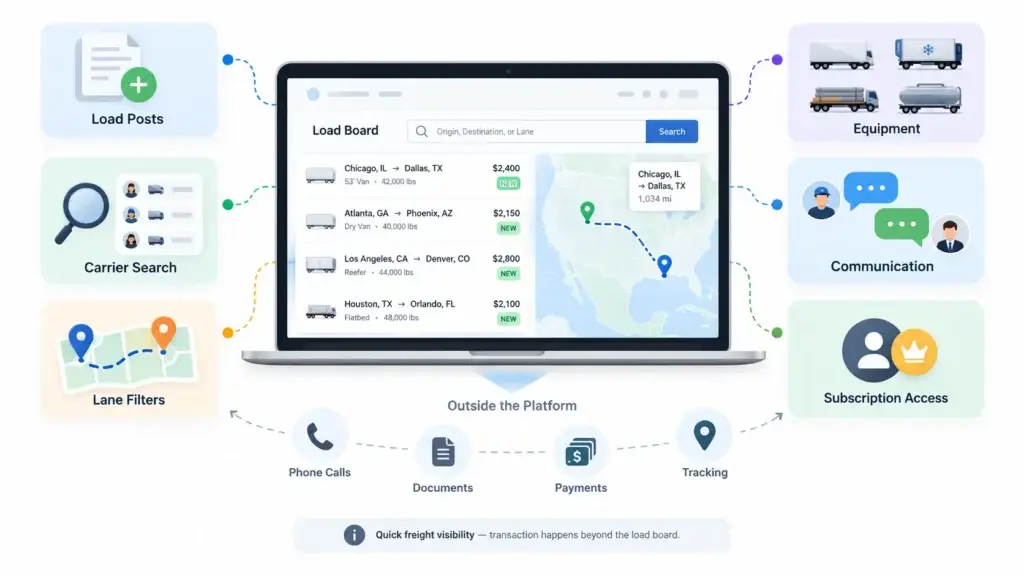
A traditional load board is a digital listing system for freight. Brokers, shippers, or dispatchers post available loads. Carriers search for suitable loads based on lane, pickup location, delivery location, equipment type, date, weight, rate, and other filters.
This model is useful because it gives users immediate visibility into available freight. Carriers can search for backhauls, spot loads, urgent shipments, or equipment-specific opportunities. Brokers can expose loads to a wider carrier base without relying only on direct contacts.
The main advantage is simplicity. Users already understand the workflow. The platform does not need to control every part of the shipment lifecycle from day one.
A traditional board usually works well when the founder wants to prioritize:
- Fast load posting
- Carrier search
- Lane-based discovery
- Broker-carrier communication
- Equipment-specific filtering
- Basic subscription monetization
- Quick market validation
However, the limitation is that much of the work still happens outside the platform. Negotiation may happen through calls or messages. Documents may move through separate tools. Payment may be handled manually. Trust may depend on external relationships. Tracking may require another system.
This means the platform can generate activity, but it may not fully control the transaction.
If readers need a simpler breakdown first, this guide explains how online load boards connect shippers, brokers, and carriers before moving into marketplace-level workflows.
What Is a Freight Marketplace?
A freight marketplace is a more complete digital freight environment. It still connects freight demand with truck capacity, but it usually adds workflow layers that help users move from discovery to booking, execution, tracking, settlement, and repeat transactions.
Instead of simply listing freight, a marketplace can help decide which carrier is a stronger fit for a load. It can support carrier verification, lane preferences, bid comparison, digital acceptance, document upload, proof of delivery, shipment status, rating systems, and admin-level performance tracking.
A freight marketplace usually works well when the founder wants to build a platform with:
- Managed shipper, broker, carrier, and dispatcher workflows
- Digital freight matching
- Booking and bid management
- Carrier verification and compliance-ready records
- Shipment tracking and status updates
- Payment and settlement workflows
- Performance scores and analytics
- Revenue models beyond basic subscriptions
The marketplace model gives founders more growth options because it captures more data and creates more reasons for users to return. When users do more inside the platform, the founder can improve matching quality, reduce manual work, launch premium tools, and build stronger monetization layers.
Load Board vs Freight Marketplace: The Growth Difference
The biggest growth difference is not whether one model is “better” than the other. The difference is how much of the freight workflow the platform owns.
A traditional board grows by increasing listings, users, and lane coverage. If more brokers post loads and more carriers search them, the platform becomes more useful.
A marketplace grows by improving transaction quality. It does not only need more users. It needs better matches, faster booking, stronger verification, smoother payments, fewer disputes, better visibility, and higher repeat usage.
That creates different growth paths.
| Growth Lever | Traditional Load Board | Freight Marketplace |
|---|---|---|
| User acquisition | Bring in brokers and carriers | Bring in users and improve transaction success |
| Retention | More relevant postings | Better workflows, automation, and outcomes |
| Revenue expansion | Paid access and listing upgrades | SaaS tools, transaction fees, premium data, workflow automation |
| Data value | Search and posting activity | Matching, booking, performance, lane, and payment data |
| Brand defensibility | Depends on network size | Depends on workflow depth and operational value |
For founders, this matters because early traffic is not enough. A logistics platform must turn users into repeat operators. Carriers should come back because the platform helps them find relevant work faster. Brokers should return because the platform helps them move loads with less operational friction. Shippers should trust the platform because fulfilment becomes more predictable.
Why Traditional Load Boards Still Matter
It would be a mistake to dismiss the traditional load board model. Many logistics businesses still need open freight discovery, spot capacity, and fast access to available trucks.
For early-stage founders, a board-style experience can be useful because it keeps the product simple. Users can understand the platform quickly. The onboarding journey is shorter. The first version can focus on supply, demand, filters, user profiles, postings, and communication.
This can help founders test important questions:
- Are brokers willing to post loads?
- Are carriers actively searching in the target region?
- Which lanes show repeat activity?
- Which equipment categories attract the most demand?
- Which user segment should be prioritized first?
- What monetization model feels acceptable to the market?
This is why a board-style foundation can still be a smart starting point. It helps the founder validate freight liquidity before adding advanced workflows.
The risk appears when the platform stays too basic for too long. If users can find a load but must complete everything else outside the platform, the business may struggle to build deeper retention or premium revenue streams.
Why Freight Marketplaces Create More Expansion Paths
A freight marketplace gives founders more ways to expand because it can support more than listings. It can become the operating layer for freight coordination.
This matters because logistics users do not only need visibility. They need reliability.
A broker wants to know whether the carrier is verified, responsive, suitable for the load, and likely to complete the shipment correctly. A carrier wants faster access to relevant freight, clear terms, document clarity, and fewer payment issues. A shipper wants visibility, predictable service, and fewer manual follow-ups. A platform operator needs admin control, dispute handling, pricing visibility, and performance reporting.
A marketplace can support these needs through deeper product layers:
- Carrier onboarding and verification
- Broker and shipper profiles
- Load posting and bid management
- Smart lane and equipment filters
- Counter-offer workflows
- Digital confirmation
- Shipment status updates
- Document and invoice handling
- Ratings and performance records
- Admin dashboards and analytics
This creates more growth options because the platform can later introduce premium plans, managed dispatch tools, carrier performance insights, payment services, API integrations, regional expansion, white-label network licensing, or industry-specific freight workflows.
That is where the marketplace model becomes more valuable for founders who are thinking beyond the first launch.
The Hybrid Model: The Practical Growth Path for Many Founders
The strongest option for many logistics startups is not a pure traditional board or a heavy marketplace from day one. It is a hybrid model.
A hybrid freight platform keeps the user experience simple enough for quick adoption but adds marketplace-level controls where they matter most.
For example, the front-end experience may still look familiar:
- Post a load
- Search available freight
- Filter by lane and equipment
- Contact or bid
- Save preferred partners
But behind that simple interface, the platform can support:
- Verified accounts
- Role-based dashboards
- Carrier records
- Bid and counter-offer history
- Document upload
- Admin approval flows
- Subscription plans
- Featured listings
- Analytics
- Payment or invoice workflows
- Dispatch and tracking integrations
This model gives founders flexibility. They can launch with the familiar behavior users already know, then expand into automation and marketplace workflows as activity increases.
Miracuves supports this kind of approach through a ready-made freight platform foundation that can help founders move faster while still leaving room for branding, workflows, monetization, and operational customization.
Founder Decision Signals
Speed
Choose a board-first model when you need to validate lanes, user demand, and posting activity quickly. Choose a marketplace path when you already know the workflow needs more control.
Revenue Depth
A traditional board can support subscriptions and featured listings. A marketplace can add transaction fees, premium tools, analytics, dispatch workflows, and SaaS-style add-ons.
Operational Control
If disputes, verification, payments, documents, and tracking are important from the beginning, a marketplace structure gives the founder more control than a listing-only platform.
Market Fit
Start with the model your users already understand, then expand based on real usage. Growth should come from actual broker, carrier, and shipper behavior, not assumptions.
<style> .miracuves-signal-box { background: #ffffff; border: 1px solid #f1d5dc; border-radius: 18px; padding: 26px; margin: 30px 0; } .signal-grid { display: grid; grid-template-columns: repeat(2, minmax(0, 1fr)); gap: 18px; } .signal-grid div { background: #fff7f9; padding: 18px; border-radius: 14px; } .signal-grid h4 { margin: 0 0 8px; color: #a70d2a; } .signal-grid p { margin: 0; line-height: 1.6; } @media(max-width: 768px) { .signal-grid { grid-template-columns: 1fr; } } </style>
Monetization Options: Which Model Gives More Room?
A traditional load board can make money, but its monetization is usually more limited. The common revenue streams include monthly subscriptions, featured load postings, featured truck postings, banner placements, access tiers, and premium search filters.
These are practical, but they mostly depend on visibility and access.
A freight marketplace creates more monetization room because it can sit closer to the transaction. It can support revenue streams such as:
- Broker subscriptions
- Carrier subscriptions
- Featured listings
- Transaction fees on accepted bookings
- Premium analytics
- Managed dispatch tools
- Document and invoice tools
- Verification or compliance workflow fees
- API access for larger operators
- White-label licensing for regional freight networks
- Premium account support
This does not mean every founder should add every revenue stream immediately. Too many monetization layers too early can slow adoption. The smarter approach is to start with the pricing model that fits the market and add premium layers after users are active.
For a deeper view of subscriptions, transaction fees, premium visibility, carrier access, and platform revenue logic, explore the freight platform business model before finalizing your monetization structure.
For example, a regional freight startup may begin with broker subscriptions and featured listings. Later, it can add carrier verification, automated invoices, analytics, or managed dispatch tools. A niche logistics platform focused on refrigerated freight, flatbed freight, or local delivery may create industry-specific premium workflows.
If you are still deciding how to price access, premium tools, transaction-based workflows, or paid visibility, this guide on freight marketplace pricing strategy explains how founders can structure pricing without creating friction for early users.
The marketplace model gives founders more room to grow because the platform can move from “access to listings” toward “software that helps users complete freight work.”
Feature Depth: What a Growth-Ready Freight Platform Should Include
A founder does not need every advanced feature on day one. But the product foundation should not block future expansion.
A growth-ready freight platform should include the core modules that make both load board and marketplace models possible:
| Feature Layer | Why It Matters |
|---|---|
| User roles | Supports brokers, shippers, carriers, dispatchers, fleet operators, and admins |
| Load posting | Lets freight demand enter the platform clearly |
| Truck posting | Helps carriers show available capacity |
| Search and filters | Improves discovery by lane, date, equipment, rate, and load type |
| Bid and counter-offer workflows | Gives users flexibility during negotiation |
| Verification controls | Builds trust across carriers, brokers, and shippers |
| Messaging or inquiry flow | Reduces friction between parties |
| Document upload | Supports rate confirmations, proof of delivery, invoices, and records |
| Admin dashboard | Gives the operator control over users, listings, disputes, plans, and activity |
| Analytics | Helps founders understand lanes, active users, revenue, and platform liquidity |
If your platform will support dry van, reefer, flatbed, box truck, or specialty freight categories, this guide to building a multi-equipment freight marketplace explains how equipment-specific workflows affect posting, matching, compliance records, pricing, and documentation.
This is where a ready-made platform foundation can reduce avoidable development risk. Instead of rebuilding standard freight workflows from scratch, founders can focus on their operating model, market positioning, user acquisition, and network growth. You can also review Miracuves’ freight marketplace feature set to understand how load posting, carrier bidding, dispatch, tracking, POD, invoicing, and admin control work together.
For a closer look at the available product direction, explore Miracuves’ <a href=”https://miracuves.com/dat-load-board-clone/features/”>freight marketplace feature set</a>.
When a Traditional Load Board Model Makes Sense
A traditional board model may be the right starting point when the founder wants simplicity, speed, and fast validation.
It makes sense when:
- The target users already understand load posting and search behavior
- The platform is focused on spot freight activity
- The first goal is to build liquidity, not automate every workflow
- The founder wants to test a niche region, lane, or equipment category
- The business model starts with subscriptions or featured listings
- The team wants a lighter operational model at launch
This model is especially useful when the startup needs to prove that there is enough supply and demand before investing in deeper automation.
The founder should still build with future expansion in mind. Even if the first release behaves like a board, the platform should be structured so that booking workflows, tracking, payments, analytics, and verification layers can be added later.
When a Freight Marketplace Model Makes Sense
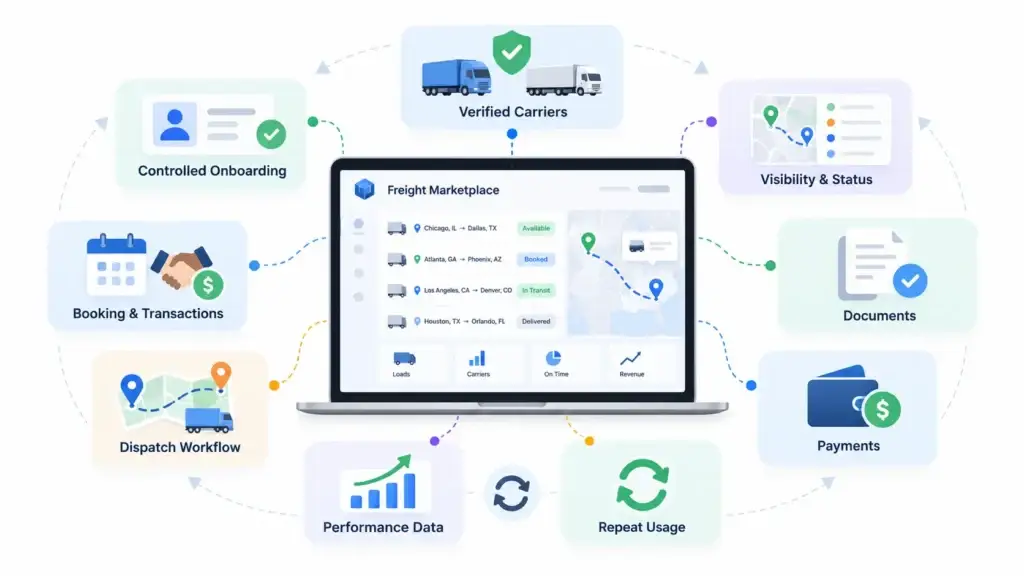
A freight marketplace model makes more sense when the founder wants to control more of the freight workflow from the beginning.
It is better suited when:
- The platform needs verified carriers and controlled onboarding
- The business wants to support booking and transaction workflows
- Shippers or brokers expect visibility and status updates
- The founder wants to monetize beyond access fees
- The platform needs performance data and repeat usage
- The business wants to support dispatch, document, or payment workflows
- The long-term goal is to become an operating system for a freight niche
This model requires stronger planning, but it also creates more growth options. The founder can build a platform that becomes harder to replace because users rely on it for daily operations, not just lead discovery.
Common Mistakes Founders Should Avoid
Building Too Broad Too Early
Trying to serve every lane, equipment type, shipment category, and region from day one can weaken marketplace liquidity. A focused launch usually performs better because the founder can build density in a specific market before expanding.
Treating Listings as the Whole Product
A freight platform is not valuable only because loads exist. It becomes valuable when users can find relevant opportunities, trust the other side, complete workflows, and return repeatedly.
Ignoring Carrier Trust
Carrier verification, profile quality, performance history, dispute handling, and communication workflows matter. Without trust, a platform can attract listings but still fail to create repeat transactions.
Adding Automation Before Understanding Real Behavior
Automation should solve real workflow pain. Founders should avoid building complex matching logic before understanding how users search, negotiate, reject, accept, and repeat transactions.
Choosing a Development Path That Delays Market Learning
Long development cycles can delay real feedback. A ready-made foundation can help founders test the market faster, then customize based on actual usage rather than assumptions.
Choosing a Team Without Freight Workflow Experience
A freight platform is not just a generic marketplace with listings. It needs broker, shipper, carrier, dispatcher, admin, pricing, document, and tracking workflows to work together. If you are evaluating build partners, this guide on choosing a freight marketplace development partner explains what founders should check before moving ahead.
How Miracuves Helps Founders Build Faster
Miracuves helps logistics founders launch white-label freight platforms with the core workflows needed to connect brokers, shippers, carriers, dispatchers, and platform operators.
Instead of starting with a blank technical build, founders can begin with a ready-made foundation and shape it around their business model. That can include branding, role-based dashboards, load posting, truck posting, bid workflows, admin controls, monetization logic, and operational visibility.
For founders who need speed, Miracuves’ ready-made freight solution can be delivered in 6 days where the selected package scope applies. If you are comparing build routes, review the freight platform development cost page to understand what affects scope, pricing, delivery, and customization. This helps teams focus less on rebuilding standard modules and more on route liquidity, user acquisition, broker relationships, carrier trust, and revenue strategy.
Explore the ready-made freight platform foundation if you want a launch-ready base that can support both board-style discovery and marketplace-style growth.
Final Thoughts: Choose the Model That Gives You Room to Grow
A traditional load board is useful when the founder wants fast market entry, simple freight discovery, and early liquidity validation. It can help a startup test whether brokers, shippers, and carriers are willing to participate in a specific region or freight category.
A freight marketplace creates more growth options because it can support deeper workflows. It gives founders room to add matching logic, booking flows, verification, tracking, analytics, payments, subscriptions, premium tools, and stronger admin control.
For many logistics startups, the practical path is a hybrid model. Start with the simplicity users understand, but build on a foundation that can expand into marketplace workflows as the business grows.
Miracuves helps founders take that path with a ready-made freight software foundation designed for faster launch, white-label branding, admin control, monetization, and future customization.
FAQs
What is the difference between a freight marketplace and a traditional load board?
A traditional load board mainly helps users post and search freight opportunities. A freight marketplace usually adds deeper workflows such as matching, booking, verification, tracking, documents, payments, analytics, and admin control.
Which model gives logistics founders more growth options?
A freight marketplace usually gives founders more growth options because it can support more revenue streams, better user retention, workflow automation, carrier verification, and operational data. A traditional board is still useful for fast discovery and early market validation.
Should a startup begin with a load board or freight marketplace?
Many startups should begin with a focused board-style experience if they need fast validation. However, the platform should be built on a foundation that can later support marketplace features such as bid workflows, verification, tracking, and payments.
How does a freight marketplace make money?
A freight marketplace can make money through subscriptions, featured listings, transaction fees, premium analytics, dispatch tools, document workflows, verification services, API access, and white-label licensing depending on the business model.
Why do freight platforms need admin control?
Admin control helps the platform operator manage users, postings, plans, disputes, verification, documents, revenue settings, and activity reports. Without strong admin visibility, the founder may struggle to manage quality as the network grows.
Can a traditional load board become a freight marketplace later?
Yes. A board-style platform can evolve into a freight marketplace if the technical foundation supports user roles, structured data, booking workflows, verification, analytics, and modular feature expansion.
How fast can Miracuves deliver a freight platform?
Miracuves can deliver the ready-made freight platform solution in 6 days where the selected solution scope applies. Final delivery scope depends on branding, integrations, customization, and business requirements.
Does this article discuss any third-party freight platform affiliation?
No. This article discusses general freight software models for educational purposes. Miracuves is an independent software development company and is not affiliated with, connected to, sponsored by, or endorsed by any third-party freight platform.
Miracuves is an independent software development company. We are not affiliated with, connected to, sponsored by, or endorsed by any company or product named in this article.
Terms such as “X Clone” are used descriptively. It is how the software industry refers to building a platform with functionality comparable to a known service, and how clients search for it.
The entire design and codebase of our products is built by our own team. Our products contain no code, design, graphics, or content originating from any third-party website or applications.
All third-party names and marks referenced in this article are the property of their respective owners, referenced solely to identify the services discussed.