


Key Takeaways
- A freight marketplace pricing strategy can combine free access, paid subscriptions, transaction fees, premium tools, and enterprise plans for different shipper, broker, and carrier segments.
- Subscription tiers should reflect practical value such as load visibility, advanced search, alerts, contact access, analytics, team seats, integrations, and workflow automation.
- Founders should connect pricing with platform usage, customer value, operational costs, conversion behavior, and retention instead of adding premium features without a clear monetization structure.
Pricing & Subscription Signals
- Free or entry-level plans can support basic load search and posting, while paid tiers can unlock advanced filters, unlimited searches, real-time alerts, saved lanes, and deeper market insights.
- Premium freight tools may include rate intelligence, lane analytics, carrier verification, route insights, bulk posting, API access, team accounts, reporting, and priority support.
- Monthly, annual, usage-based, per-seat, and hybrid pricing models can be structured around customer size, feature access, load volume, data consumption, and operational needs.
Founder Monetization Insights
- Founders should track free-to-paid conversion, subscription renewals, feature adoption, active users, average revenue per account, churn, and premium-tool usage to evaluate pricing performance.
- The strongest pricing structure gives users a clear reason to upgrade while keeping core load discovery useful enough to support marketplace liquidity and repeated engagement.
- Miracuves develops customizable freight marketplace platforms with subscriptions, premium tools, load matching, rate management, carrier workflows, analytics, payments, API integrations, and admin controls.
Pricing a freight marketplace is not just about deciding what carriers or brokers should pay every month. It is about deciding where the platform creates measurable value, which side of the marketplace should be charged first, and which tools should stay free long enough to create liquidity.
For founders, this decision matters because freight marketplaces depend on trust, density, and repeat usage. If the platform charges too early, carriers may leave before the board has enough useful loads. If it gives everything away for free, the business may grow activity without building predictable revenue. The strongest pricing model usually sits between both extremes: free access where liquidity matters, paid tiers where operational value is clear, and premium tools where users save time, reduce risk, or make better freight decisions.
This guide explains how founders can plan pricing, subscriptions, transaction fees, and premium tools for a freight marketplace without damaging adoption.
Why Pricing Is Harder in Freight Marketplaces Than Normal SaaS
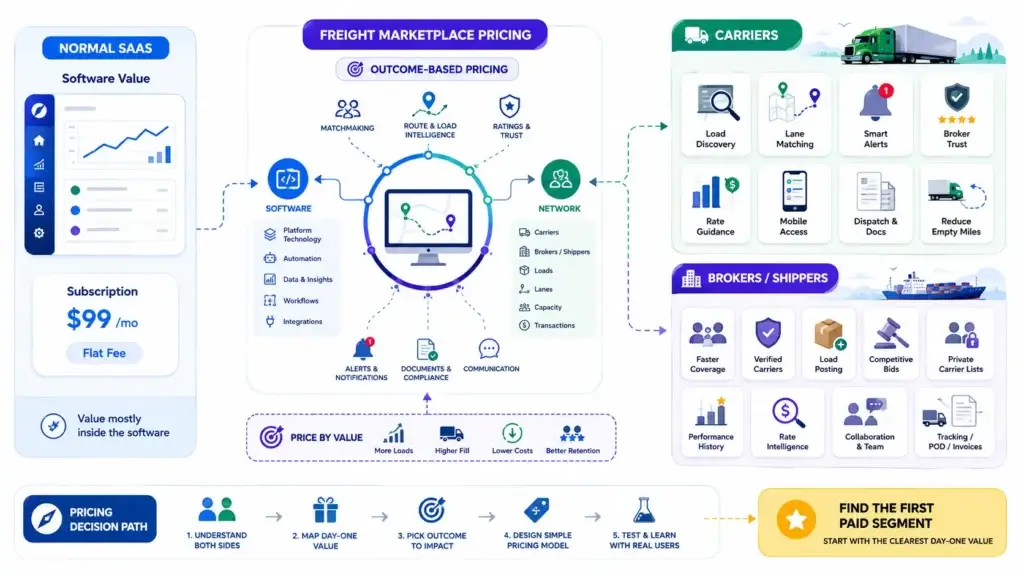
A normal SaaS product can charge users because the value is mostly inside the software. A freight marketplace is different because the value depends on both software and network participation.
Before finalizing pricing, founders should first understand how digital freight marketplaces work because monetization depends on how freight posting, carrier search, broker discovery, matching, verification, documents, and payments connect inside the platform.
A carrier does not pay only for filters. They pay because the platform helps them find relevant loads, avoid wasted miles, evaluate brokers, respond faster, and keep their truck moving. A broker does not pay only to post freight. They pay because the platform helps them reach available capacity, reduce phone work, compare bids, verify carriers, and protect margin.
That means a freight marketplace should not be priced like a simple directory. It should be priced around the business outcomes each user segment cares about.
For carriers, the value often comes from:
- Better load discovery
- Lane and equipment matching
- Saved searches and alerts
- Broker trust signals
- Rate guidance
- Fast communication
- Mobile access
- Dispatch and document workflows
For brokers and shippers, the value often comes from:
- Faster freight coverage
- Access to verified carriers
- Load posting tools
- Bid collection
- Private carrier lists
- Carrier performance history
- Rate intelligence
- Team collaboration
- Tracking, POD, and invoice workflows
A founder planning a freight marketplace should first define which side receives the clearest value on day one. That side may become the first paid segment.
Start With the Marketplace Maturity Stage
Pricing should change as the marketplace grows. A platform with 200 early users should not price itself the same way as a mature network with thousands of active carriers, brokers, and shippers.
Stage 1: Liquidity Building
At the beginning, the goal is participation. The founder needs enough posted freight and enough carrier activity to make the marketplace feel alive.
At this stage, pricing should reduce friction. Free access, discounted founding-member plans, limited-time trials, or free posting can help the platform create movement. Charging too aggressively before users see value may slow the network before it forms.
The better question is not “How much can we charge immediately?” It is “Which pricing structure helps us create enough marketplace activity to prove demand?”
Stage 2: Revenue Validation
Once the marketplace has recurring activity, pricing should test willingness to pay. This is where subscription tiers, posting plans, transaction fees, and premium add-ons become useful.
Founders can start identifying which features users actually value. For example, carriers may pay for unlimited saved searches, instant alerts, broker payment insights, or mobile booking tools. Brokers may pay for bulk posting, private load access, carrier intelligence, and team accounts.
At this stage, founders should avoid adding too many paid features at once. A simple pricing structure is easier to test and explain.
Stage 3: Expansion and Premium Monetization
When the platform has stronger density, data becomes more valuable. The platform can introduce premium analytics, rate intelligence, workflow automation, API access, managed dispatch support, financial tools, and enterprise plans.
This is where the marketplace begins to move beyond basic load posting. The platform is no longer only helping users find freight. It is helping them make better decisions, reduce risk, and run operations inside the same ecosystem.
Choose the Right Base Pricing Model
There is no single correct pricing model for every freight marketplace. The right model depends on who the platform serves, what workflows it owns, and whether it is trying to monetize access, transactions, tools, or enterprise control.
Common Freight Marketplace Pricing Models
| Pricing Model | How It Works | Best For | Founder Consideration |
|---|---|---|---|
| Free access model | Users can browse, post, or search for free | Early liquidity and adoption | Useful at launch, but needs a later monetization path |
| Carrier subscription | Carriers pay monthly for search, alerts, broker data, or booking tools | Carrier-heavy marketplaces | Works only if load quality and frequency are strong |
| Broker posting plan | Brokers pay to post loads, search trucks, or manage carrier responses | Broker-led marketplaces | Best when the platform attracts meaningful carrier supply |
| Shipper pay-per-booking | Shippers post free and pay when a carrier is accepted | Outcome-based marketplaces | Reduces upfront friction but revenue depends on completed transactions |
| Transaction fee | Platform takes a fee on booked or completed loads | Managed marketplaces | Aligns revenue with usage, but may face resistance from high-volume users |
| Premium tools | Users pay extra for rate data, carrier intelligence, automation, API access, or analytics | Mature platforms | Works when tools clearly save time or reduce risk |
| Enterprise plan | Larger teams pay for seats, permissions, reporting, private networks, or integrations | Brokerages, 3PLs, fleets | Requires stronger onboarding and support |
The best freight marketplace pricing strategy often combines two or three models instead of relying on one. For example, a founder may use free browsing to attract users, subscriptions for recurring revenue, and premium rate tools for high-intent users.
For founders who want to compare different monetization paths in more depth, this guide on the freight marketplace revenue model explains how subscriptions, posting fees, transaction charges, premium tools, and licensing can work together inside a load board-style platform.
Should Carriers Pay a Subscription?
Carrier subscriptions can work well, but only when the carrier sees consistent value.
A carrier is not paying because the marketplace exists. They are paying because it helps them earn, save time, avoid bad loads, or reduce uncertainty. If the platform has thin load volume, irrelevant lanes, outdated listings, or poor broker data, subscription pricing may feel unfair.
Carrier subscription tiers usually make more sense when the platform offers:
- Unlimited load search
- Lane-specific alerts
- Saved searches
- Broker profile insights
- Payment or credit indicators
- Deadhead and route filters
- Mobile bidding or booking
- Document upload
- Dispatch workflow
- Premium rate tools
- Team access for dispatchers
A simple structure could look like this:
| Carrier Tier | Included Value | Best For |
|---|---|---|
| Free | Limited search, profile creation, basic load viewing | New users testing the marketplace |
| Starter | Full search, saved lanes, alerts, mobile access | Owner-operators and small carriers |
| Pro | Broker insights, rate tools, priority alerts, document workflow | Active carriers using the platform weekly |
| Fleet | Multiple users, dispatcher tools, fleet visibility, reporting | Small and mid-sized fleets |
The mistake is charging carriers before the platform gives them enough confidence. Founders should make sure the paid tier unlocks genuine operating value, not just basic access that competitors may offer elsewhere.
Should Brokers and Shippers Pay to Post Loads?
Broker and shipper pricing depends on how much demand-side value the platform provides.
If the goal is to build supply from carriers, allowing free or low-cost load posting can help attract freight volume. More posted loads make the board more useful for carriers. That can support carrier subscriptions later.
However, if the platform already has strong carrier access, brokers may be willing to pay for tools that help them cover freight faster. The platform can charge for posting volume, team access, carrier discovery, automation, or private network workflows.
Broker and shipper pricing may include:
- Free limited posting
- Monthly posting plans
- Bulk upload access
- Private load boards
- Carrier search and outreach
- Bid comparison tools
- Book-now workflows
- Team seats
- Rate intelligence
- API or TMS integrations
- Premium visibility for urgent loads
A founder should avoid forcing every broker into the same plan. A small broker posting 20 loads a month and a large 3PL posting hundreds of loads have different value expectations. Pricing should scale with volume, team size, automation needs, or booking activity.
When Transaction Fees Make Sense
Transaction fees are attractive because revenue grows with marketplace activity. Instead of charging only for access, the platform earns when a load is booked, accepted, completed, or paid.
This model works especially well when the platform controls more than discovery. If the marketplace supports booking, rate confirmation, tracking, proof of delivery, invoicing, and payment workflows, then a transaction fee feels more justified.
Transaction fees are harder to defend when the platform only introduces two parties and then loses visibility. Users may avoid the platform after the first contact if they feel the fee does not match the value.
Transaction fees make more sense when the platform provides:
- Booking workflow
- Document trail
- Tracking visibility
- Dispute records
- Payment facilitation
- Carrier verification
- Load status history
- Compliance checks
- Invoice or settlement support
For founders, the decision is simple: charge transaction fees when the platform meaningfully reduces risk or handles execution. Do not charge transaction fees for a thin listing board unless users clearly accept that model.
What Premium Tools Can Founders Monetize?
Premium tools are often where freight marketplaces become more defensible. Basic posting and searching can be copied. Data, workflow depth, trust signals, and automation are harder to replace.
Premium pricing becomes easier when the platform is built with the right freight marketplace feature modules, such as saved searches, smart alerts, broker insights, carrier verification, private networks, dispatch workflows, document handling, and admin controls.
1. Rate Intelligence
Rate intelligence helps users understand lane pricing, market movement, and pricing confidence. Carriers can use it to avoid underpriced loads. Brokers and shippers can use it to post more realistic rates and protect margin.
This can be sold as:
- A premium subscription tier
- A per-lookup feature
- A broker-only intelligence package
- An enterprise analytics module
The founder should be careful with claims. Rate tools should be positioned as decision support, not guaranteed pricing accuracy.
2. Carrier and Broker Verification
Trust is a major monetization layer in freight marketplaces. Users want to know whether the other party is legitimate, responsive, insured, compliant, and reliable.
Premium verification tools may include:
- Carrier profile checks
- Broker profile insights
- Document verification
- Authority and operating-status indicators
- Insurance document records
- Review and dispute history
- Admin approval workflows
- Risk flags
This type of tool can support premium plans because it helps users avoid bad transactions, wasted time, and operational risk.
3. Priority Load Visibility
Featured loads, urgent posting boosts, and premium placement can create additional revenue without changing the core marketplace model.
This works best when there is enough activity for visibility to matter. If the marketplace is still small, charging for featured placement may not create much value. Once load volume increases, brokers may pay to make urgent freight more visible to the right carriers.
4. Saved Searches and Smart Alerts
Saved searches and real-time alerts can be powerful for carriers because timing matters. A carrier looking for a backhaul load wants to know quickly when a matching load appears.
These tools can sit in a paid carrier tier. The free plan may allow limited search, while the paid plan unlocks unlimited saved lanes, SMS alerts, app notifications, and route-based recommendations.
5. Private Networks
Private networks help brokers, shippers, and 3PLs work with preferred carriers. This can become a strong premium feature because it moves the platform from public marketplace to controlled freight network.
Private network tools may include:
- Invite-only carrier groups
- Preferred carrier lists
- Private load visibility
- Direct offers
- Carrier performance records
- Approval workflows
- Team permissions
For larger brokers and logistics teams, private network control may be more valuable than public posting.
6. Team Accounts and Role-Based Access
Freight teams rarely operate with one user forever. Dispatchers, broker reps, compliance staff, finance users, and admins may all need different access.
Team pricing can be based on:
- Number of users
- Role permissions
- Branches or locations
- Load volume
- Reporting access
- Admin controls
This is especially useful for enterprise plans because larger accounts care about governance, visibility, and process control.
7. API Access and Integrations
Once a freight marketplace becomes part of a company’s workflow, integrations become valuable. Brokers may want TMS connections. Shippers may want load posting automation. Carriers may want dispatch or ELD-related workflows.
API access can be priced as:
- A premium add-on
- An enterprise tier
- A usage-based plan
- A setup + monthly support package
API pricing should be handled carefully because high-volume customers may need predictable costs.
A Practical Pricing Structure Founders Can Start With
Founders do not need a complicated pricing page on day one. They need a structure that supports adoption, validates revenue, and leaves room for premium tools later.
Example Pricing Architecture
| User Segment | Free Layer | Paid Layer | Premium Layer |
|---|---|---|---|
| Carriers | Create profile, limited search, basic load viewing | Full search, alerts, saved lanes, mobile bidding | Rate tools, broker insights, dispatch tools, team access |
| Brokers | Limited posting, basic carrier responses | Bulk posting, carrier search, bid management | Private network, rate intelligence, automation, team seats |
| Shippers | Post limited loads, receive bids | Pay-per-booking or monthly posting plan | Private carrier list, tracking, reporting, integrations |
| Fleets | Profile and basic search | Multi-user access and lane alerts | Dispatch workflow, analytics, API access |
| Platform partners | Not applicable | Branded access package | White-label licensing or regional operator model |
This structure keeps the entry path simple while creating upgrade logic around real business value.
For a broader educational breakdown, founders can also read this guide on how freight marketplace platforms make money, especially if they want to compare subscriptions, promoted listings, commissions, posting fees, and premium data services before choosing a pricing model.
Founder Decision Signals Before Finalizing Pricing
Liquidity
If the marketplace does not yet have enough loads or carriers, keep access friction low. Monetize later through premium workflows.
User Value
Charge for features that help users earn, save time, reduce empty miles, verify partners, or move freight with less manual effort.
Operational Depth
If the platform controls booking, tracking, documents, and settlement, transaction fees become easier to justify.
Retention
Premium tools should make users return weekly, not simply pay once. Alerts, saved lanes, private networks, and workflow history improve stickiness.
Mistakes Founders Should Avoid While Pricing a Freight Marketplace
Mistake 1: Charging Before Liquidity Exists
A paid plan only works when the user believes the platform has enough value. If carriers search and find too few relevant loads, they will not upgrade. If brokers post and receive no meaningful responses, they will not renew.
Early pricing should support marketplace activity before maximizing revenue.
Mistake 2: Making the Free Plan Too Powerful
Free access can help adoption, but a free plan that includes every useful workflow leaves no reason to upgrade. Founders should decide which features create activation and which features create monetization.
Basic discovery can be free. Time-saving, trust-building, and workflow-heavy tools can be paid.
Mistake 3: Using One Plan for Every User Type
Carriers, brokers, shippers, fleets, and dispatch teams do not value the same features. A carrier may care about lane alerts and broker reliability. A broker may care about carrier sourcing and rate intelligence. A shipper may care about visibility and trusted capacity.
Pricing should reflect role-specific value.
Mistake 4: Treating Premium Tools as Random Add-Ons
Premium tools should not feel like a collection of locked buttons. They should form a logical upgrade path. For example, a carrier upgrades because they want better load discovery and broker insight. A broker upgrades because they want faster coverage and better carrier selection.
The paid plan should tell a clear value story.
Mistake 5: Ignoring Admin Control
Pricing is not only a marketing decision. It is also a product-operations decision. The platform owner needs control over plans, modules, user access, promotions, billing status, refunds, disputes, and feature availability.
Without admin-side control, every pricing change becomes a developer request. That slows testing and makes it harder to respond to market feedback.
How Pricing Should Connect to Product Features
A freight marketplace should be built so pricing plans are connected to actual product modules. This allows the platform operator to test offers without rebuilding the system every time.
Important pricing-connected modules include:
- Plan management
- Subscription billing
- User role permissions
- Feature access controls
- Load posting limits
- Saved search limits
- Alert limits
- Team seat limits
- Premium data access
- Transaction fee rules
- Invoice and payment records
- Admin reporting
- Promo codes or trial periods
This is where founders should think beyond the pricing page. The pricing page is only what users see. The real pricing engine lives inside the admin dashboard, billing logic, permission system, and analytics layer.
This is also why founders should review freight marketplace development cost factors before finalizing subscription tiers, because billing rules, access permissions, premium modules, integrations, and admin reporting can directly affect the final product scope.
Why Premium Freight Tools Can Increase Retention
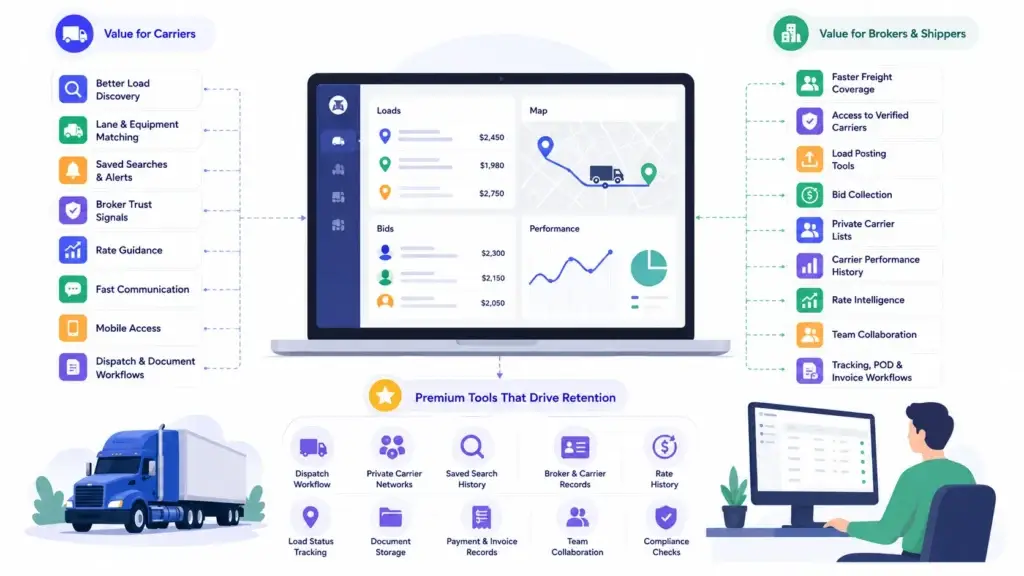
Basic marketplace access is easy to replace. A carrier can search another board. A broker can post somewhere else. A shipper can return to phone calls and email.
Premium tools improve retention because they create workflow dependency. When users save lanes, build trusted carrier lists, collect history, track documents, manage bids, and review performance inside the platform, leaving becomes harder.
The strongest retention tools are usually those connected to daily operations:
- Dispatch workflow
- Private carrier networks
- Saved search history
- Broker and carrier records
- Rate history
- Load status tracking
- Document storage
- Payment and invoice records
- Team collaboration
- Compliance-related checks
Founders should ask: “Which tools make the platform part of the user’s operating rhythm?” Those tools are better candidates for premium pricing.
Where Miracuves Fits Into Freight Marketplace Pricing Planning
Founders often start pricing discussions too late. They think about subscriptions after the platform is built. That creates problems because billing, permissions, plan limits, role access, and premium tools need to be designed into the product architecture.
Miracuves helps founders plan this earlier by building freight marketplace platforms with admin control, monetization workflows, role-based access, and scalable marketplace logic. For founders who want to launch with a ready-made foundation instead of building every module from zero, a white-label freight marketplace platform can help connect pricing strategy with the actual product workflows.
The goal is not to copy another marketplace’s pricing. The goal is to create a model that fits your users, your region, your freight category, your operational depth, and your growth stage.
Recommended Pricing Roadmap for Founders
Phase 1: Validate Activity
Start with simple pricing. Allow enough free or low-friction access to attract both sides of the marketplace. Focus on load volume, carrier response, search behavior, repeat logins, and completed interactions.
Track:
- Active carriers
- Active brokers or shippers
- Loads posted
- Searches performed
- Bids or responses
- Repeat usage
- Most-used filters
- Abandoned actions
Phase 2: Identify Upgrade Triggers
Once activity exists, look for behaviors that suggest willingness to pay. A carrier saving multiple lanes may value alerts. A broker posting regularly may value bulk posting. A shipper receiving bids may value booking, tracking, and trusted carrier lists.
Upgrade triggers may include:
- Frequent search usage
- High posting volume
- Need for faster responses
- Need for more team members
- Repeated lane activity
- Need for broker or carrier insights
- Need for automation
Phase 3: Package Paid Plans
Create plans around business outcomes instead of feature clutter.
For example:
- “Find better loads faster”
- “Cover freight with verified carriers”
- “Manage dispatch and documents in one place”
- “Run private carrier networks”
- “Automate high-volume freight workflows”
This makes pricing easier to understand and easier to sell.
Phase 4: Add Premium Intelligence
Once enough platform data exists, introduce rate insights, market analytics, carrier performance, broker reliability, and lane-level reporting. Data products work better when the marketplace has enough usage history to make insights meaningful.
Phase 5: Expand Into Enterprise and Licensing
At scale, enterprise accounts may need private networks, integrations, API access, custom workflows, compliance controls, and white-label regional expansion. This is where the platform can move beyond subscription revenue into larger account value.
At this stage, choosing the right freight marketplace development partner matters because enterprise pricing often depends on how well the platform handles team permissions, billing logic, reporting, private networks, integrations, and long-term customization.
Founders who are still comparing platform scope can also review this guide on freight platform features and pricing to understand how feature depth, pricing logic, and launch planning connect before development begins.
Final Thoughts
A freight marketplace does not become profitable just because it charges users. It becomes profitable when pricing is connected to real marketplace value.
Founders should begin with liquidity, then validate willingness to pay, then build premium tools around trust, speed, intelligence, and workflow control. Subscriptions can create predictable revenue. Transaction fees can scale with activity. Premium tools can improve retention and help the platform become more than a searchable board.
The strongest pricing strategy is not copied from another company. It is built from how your carriers, brokers, shippers, and logistics teams actually use the platform. For founders planning this kind of pricing-led product architecture, Miracuves can help turn the strategy into a launch-ready freight marketplace platform with admin control, subscription workflows, premium feature access, and room for future monetization experiments.
FAQs
What is the best pricing model for a freight marketplace?
The best pricing model depends on marketplace maturity, user mix, and workflow depth. Early platforms often need free or low-friction access to build liquidity. Mature platforms can monetize through subscriptions, transaction fees, premium tools, enterprise accounts, and private network features.
Should a freight marketplace charge carriers or brokers first?
It depends on which side receives clearer value first. If the platform has strong load volume, carriers may pay for search, alerts, and broker insights. If the platform has strong carrier supply, brokers may pay for posting tools, bid management, carrier discovery, and premium visibility.
Are transaction fees better than subscriptions for freight platforms?
Transaction fees work well when the platform controls booking, tracking, documents, payment, or settlement workflows. Subscriptions work better when users pay for recurring access, data, alerts, or operating tools. Many freight marketplaces can combine both models.
What premium tools can a load board or freight marketplace sell?
Premium tools can include rate intelligence, broker or carrier verification, saved searches, smart alerts, private networks, team accounts, API access, reporting dashboards, dispatch tools, and payment or document workflows.
How can founders avoid pricing too early?
Founders can start with a free or limited-access model, monitor user activity, identify repeat behavior, and then introduce paid tiers around the features users already rely on. This reduces the risk of charging before users see enough value.
Why is admin control important for freight marketplace pricing?
Admin control allows the platform operator to manage plans, subscriptions, feature access, posting limits, premium modules, billing status, disputes, and analytics without rebuilding the product every time pricing changes.
Can a freight marketplace offer both free and paid plans?
Yes. A free layer can help attract users and build marketplace activity, while paid plans can unlock advanced tools such as alerts, rate insights, private networks, team seats, automation, and premium reporting.
How should founders price premium freight tools?
Premium freight tools should be priced based on the value they create. If a tool saves time, improves trust, reduces operational risk, or helps users make better pricing decisions, it can justify a higher tier, add-on fee, or enterprise package.
Miracuves is an independent software development company. We are not affiliated with, connected to, sponsored by, or endorsed by any company or product named in this article.
Terms such as “X Clone” are used descriptively. It is how the software industry refers to building a platform with functionality comparable to a known service, and how clients search for it.
The entire design and codebase of our products is built by our own team. Our products contain no code, design, graphics, or content originating from any third-party website or applications.
All third-party names and marks referenced in this article are the property of their respective owners, referenced solely to identify the services discussed.