
Key Takeaways
- Yacht marketplace pricing intelligence combines sold comparables, active listings, price history, vessel specifications, and market trends.
- Sold records provide stronger valuation evidence because they reflect completed transactions instead of seller expectations.
- Vessel condition, engine hours, refits, equipment, location, tax status, and survey findings can significantly affect value.
- A realistic valuation range with confidence notes is more trustworthy than an unsupported single-price estimate.
- Pricing intelligence helps buyers evaluate value, sellers set expectations, and brokers support recommendations with market evidence.
Pricing Intelligence Signals
- Capture structured vessel details, including builder, model, year, dimensions, engine data, condition, equipment, and refit history.
- Match comparables using model similarity, age, size, location, condition, transaction date, and data completeness.
- Separate completed sale prices from active asking prices when generating valuation reports.
- Display low, median, and high value bands alongside comparable quality and market-data limitations.
- Connect valuation results with broker CRM, seller leads, listing updates, comparisons, reports, and administrative analytics.
Real Insights
- Asking prices show current competition but do not necessarily represent the amount buyers will ultimately pay.
- Rare vessels and thin market segments require confidence scoring because exact comparables may not exist.
- Valuation tools create greater value when brokers can add professional adjustments and explain the supporting evidence.
- Pricing intelligence can support broker subscriptions, valuation leads, premium reports, dealer analytics, and listing tools.
- Miracuves develops yacht marketplace platforms with structured listings, broker workflows, pricing intelligence, lead management, reports, and admin controls.
In many marketplaces, pricing can be estimated through simple supply and demand. If ten similar products are listed at a similar price, the market range becomes fairly obvious.
Yachts are different.
A yacht is a high-value, specification-heavy asset. Buyers do not evaluate only the brand and model. They look at layout, build quality, engine hours, hull material, maintenance record, electronics, refit history, VAT status, cruising region, survey findings, berth availability, and broker reputation.
This makes valuation less about a single number and more about a defensible range.
A yacht marketplace that simply displays asking prices leaves users with limited context. A platform that shows pricing intelligence helps users understand why a vessel may be above, below, or within the market range.
That difference matters because yacht transactions are high-consideration decisions. The buyer journey is longer. The negotiation is more personal. The broker’s explanation carries weight. The seller expects evidence. A marketplace that supports this process becomes more than a listing directory.
It becomes a decision-support platform.
What Is Pricing Intelligence in a Yacht Marketplace?
Pricing intelligence is the process of collecting, structuring, comparing, and interpreting market data to support valuation decisions.
In a yacht marketplace, this usually includes:
- Sold comparables
- Active listing comparisons
- Historical asking price changes
- Days on market
- Vessel specifications
- Location and regional demand
- Brand and model trends
- Refit and upgrade records
- Broker notes and inspection context
- Market liquidity by segment
The goal is not to replace a professional broker, surveyor, or appraiser. The goal is to give them better data to support pricing conversations.
A strong yacht valuation system should answer questions such as:
- What have similar vessels recently sold for?
- How many comparable vessels are currently available?
- Is the asking price above or below the observed market range?
- How long do similar vessels usually remain listed?
- Has this yacht had multiple price reductions?
- Are certain brands or size categories holding value better?
- Is the market thin, active, rising, or softening?
When these answers are visible inside the platform, users can make better decisions with less friction.
Sold Comparables: The Strongest Foundation for Yacht Valuation
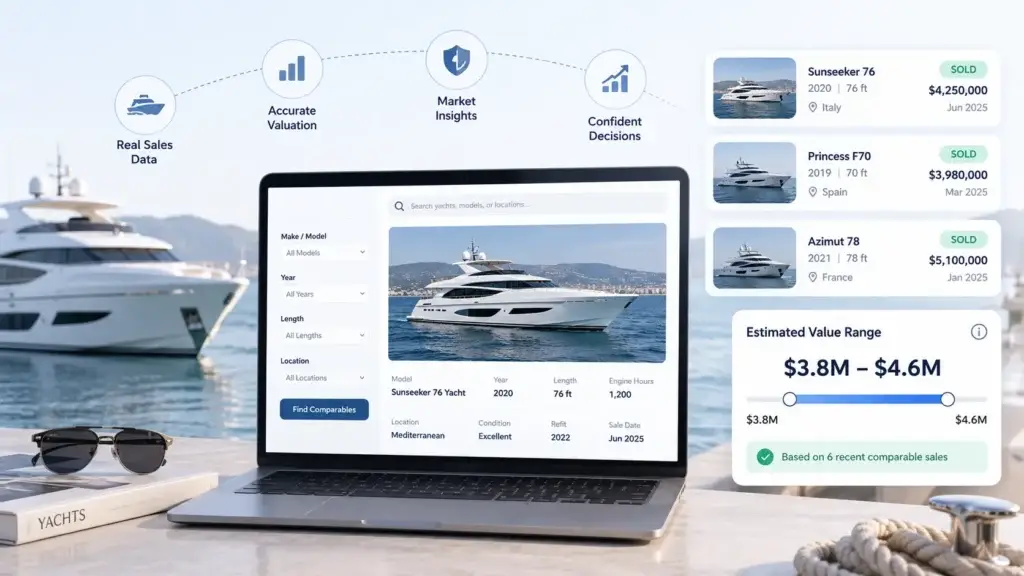
Image Source: AI-generated visual by Miracuves
Sold comparables are completed transactions involving similar vessels. They are powerful because they show what buyers actually paid, not just what sellers hoped to receive.
In yacht valuation, asking prices can be aspirational. Sellers may price emotionally, brokers may test the market, and premium inventory may sit for months before adjusting. Sold data brings the valuation conversation closer to reality.
A useful sold comparable should match the subject vessel across important factors, including:
| Comparable Factor | Why It Matters for Yacht Valuation |
|---|---|
| Builder and model | Establishes the closest product match |
| Year of build | Helps adjust for age and depreciation |
| Length and class | Compares vessels within the right segment |
| Engine hours | Impacts perceived wear, maintenance needs, and value |
| Refit history | Major upgrades can justify valuation differences |
| Location | Demand and transfer costs vary by region |
| Condition | Survey outcomes and maintenance history affect pricing |
| Sale date | Recent transactions are more relevant than old ones |
| Equipment and options | Stabilizers, generators, navigation systems, and tenders can change value |
| Asking-to-sale difference | Shows negotiation behavior in that segment |
The challenge is that yacht markets can be thin. For some models, there may be only a handful of recent sales. For rare vessels, there may be no perfect match.
That is why a pricing intelligence system should not pretend every valuation is exact. It should show confidence levels, comparable quality, and data limitations.
For founders, this is an important product design point. A transparent valuation range builds more trust than an overconfident estimate.
Read More: How Does a Yacht Marketplace Platform Turn Buyer Inquiries Into Qualified Broker Leads?
Active Listings Still Matter, But They Should Not Be Treated as Final Value
Sold data shows market-clearing behavior. Active listings show current competition.
Both are useful, but they answer different questions.
Sold comparables tell the user what similar yachts achieved in completed transactions. Active listings show what buyers are seeing today when they compare options.
A yacht marketplace should use active listing data to understand:
- Current supply in the same category
- Similar asking prices
- Competing vessels in the same geography
- Price positioning by brand, length, and model year
- Whether the market is crowded or limited
- How long comparable listings have been active
- Whether sellers are reducing prices
Active listing data becomes especially useful when sold data is limited. However, it should be clearly labeled as asking-price evidence, not transaction evidence.
A smart valuation interface can separate these two layers:
| Data Type | What It Shows | How to Use It |
|---|---|---|
| Sold comparables | Real transaction behavior | Strongest valuation anchor |
| Active listings | Current market competition | Useful for positioning and negotiation |
| Price history | Seller flexibility and market response | Helps identify overpricing or demand shifts |
| Days on market | Liquidity and buyer interest | Helps sellers adjust expectations |
| Regional data | Local demand and availability | Helps compare Mediterranean, US, Caribbean, Gulf, and APAC demand patterns |
This distinction helps the platform feel credible. It also helps brokers explain pricing without confusing buyers or sellers.
Core Data Sources a Yacht Marketplace Pricing Engine Should Track
A yacht pricing engine is only as useful as the quality and structure of its data.
For a yacht marketplace, the valuation layer should not rely on one signal. It should combine multiple structured inputs and make the logic explainable.
1. Vessel Listing Data
The listing database should capture more than headline fields. A yacht’s value depends on technical details.
Important fields include:
- Make, model, and builder
- Model year and build year
- Length overall
- Beam, draft, displacement, and gross tonnage where relevant
- Hull material
- Engine type, engine count, horsepower, and engine hours
- Fuel type and cruising range
- Cabins, berths, heads, and layout
- Equipment, electronics, stabilizers, generators, tender, and toys
- Refit year and upgrade details
- Flag, tax/VAT status, and location
- Asking price and currency
- Listing status: active, under offer, sold, withdrawn
When these fields are structured properly, the platform can compare vessels more intelligently.
2. Sold Transaction Records
Sold records should include final sale price, sale date, location, vessel condition where known, original asking price, time on market, and broker/dealer context.
Even when some fields are private, the platform can still support internal broker reports or anonymized valuation ranges.
3. Price History
Price history helps users understand seller behavior.
A vessel listed at $2.4 million and reduced to $2.05 million after six months tells a different story than a newly listed vessel priced at $2.05 million from day one.
Price history supports:
- Buyer negotiation strategy
- Seller pricing reviews
- Broker recommendations
- Market trend analysis
- Automated price alerts
4. Days on Market
Days on market is a useful liquidity signal. If similar vessels sell quickly, a seller may have more confidence. If comparable yachts sit for months, the market may require sharper pricing or stronger presentation.
For a marketplace operator, days-on-market data also helps identify stale inventory and trigger broker nudges.
5. Inquiry and Lead Signals
Not every valuation signal comes from public listing data.
A marketplace can also learn from buyer behavior:
- Listing views
- Saved searches
- Compare actions
- Inquiry rates
- Repeat views
- Watchlist additions
- Broker response times
- Shortlist behavior
These signals do not replace sold comparables, but they help operators understand demand intensity.
A yacht with high views but few inquiries may be overpriced, poorly photographed, missing technical details, or positioned against stronger alternatives.
How Sold Comparables Can Be Matched Inside a Yacht Marketplace
The most important part of pricing intelligence is not collecting data. It is matching the right comparables.
A weak valuation system compares any vessel with the same brand name. A stronger system scores comparable quality.
A practical comparable-matching model may use:
| Matching Layer | Example Logic |
|---|---|
| Exact model match | Same builder, model, and length class |
| Near model match | Same builder and similar vessel category |
| Age band | Built within a relevant year range |
| Size band | Similar length, beam, and tonnage |
| Location band | Same region or similar buyer market |
| Condition adjustment | Refit, survey condition, or equipment difference |
| Time relevance | Recent sales weighted higher than older sales |
| Currency normalization | Converted into a consistent reporting currency |
| Data confidence | Higher score for complete, recent, close-match records |
The output should not only say “estimated value.” It should explain why.
For example:
- “Based on five recent comparables from the same model range.”
- “Limited sold data available; active listings used as supporting evidence.”
- “Subject vessel is priced above the median range due to recent refit and low engine hours.”
- “Market evidence is thin; broker review recommended before final pricing.”
This kind of transparency is important in marine marketplaces because buyers and sellers are not making impulse decisions. They want confidence before they engage.
Pricing Intelligence Features That Improve Marketplace Trust
A yacht marketplace does not need to show all valuation data publicly. Some intelligence can be reserved for brokers, sellers, administrators, or premium users.
The key is to design the data layer around trust and workflow.
| Feature | Business Value | Founder Impact |
|---|---|---|
| Sold comparable reports | Helps brokers justify valuation recommendations with evidence. | Creates premium broker tooling and stronger seller trust. |
| Active listing comparison | Shows how a yacht is positioned against current competition. | Improves listing quality and pricing discipline. |
| Price history tracking | Reveals reductions, relisting patterns, and seller flexibility. | Supports negotiation workflows and buyer confidence. |
| Low-mid-high value bands | Gives users a realistic valuation range instead of a single fragile number. | Reduces overpromising and improves trust in the platform. |
| Days-on-market analytics | Shows how quickly similar yachts move in a segment. | Helps sellers adjust expectations and brokers prioritize leads. |
| Broker-branded valuation PDF | Allows brokers to share professional pricing evidence with clients. | Can become a premium subscription or lead-conversion feature. |
| Admin pricing dashboard | Helps operators monitor inventory quality, overpriced listings, and demand patterns. | Turns the marketplace into a managed intelligence platform, not only a listing portal. |
Why Valuation Data Improves Broker Productivity
In a yacht marketplace, brokers are not just listing managers. They are advisors.
They need to explain pricing to sellers, qualify buyers, respond to objections, compare alternatives, and manage long deal cycles. Without structured pricing intelligence, much of that work depends on manual research, screenshots, spreadsheets, and personal experience.
A pricing intelligence layer can help brokers:
- Prepare seller pricing recommendations faster
- Show comparable vessels during client discussions
- Explain why a price reduction may be necessary
- Identify overpriced inventory before it goes stale
- Build buyer shortlists with fair-market context
- Export valuation summaries for client conversations
- Reduce repetitive manual market research
This is where a marketplace becomes more valuable to professionals. Brokers do not only need exposure. They need tools that help them win listings, manage client expectations, and close deals with confidence.
For a founder, this creates a stronger commercial model. If the marketplace provides workflow value, brokers may be more willing to pay for subscriptions, featured listings, analytics access, valuation reports, or branded seller tools.
Founder Decision Signals: When Should a Yacht Platform Add Pricing Intelligence?
Not every first version of a yacht marketplace needs advanced pricing intelligence from day one. But founders should understand when it becomes important.
High-Value Inventory
If the platform lists expensive vessels where every lead matters, pricing intelligence can improve buyer trust and seller confidence.
Broker-Led Sales
If brokers manage inquiries, client shortlists, and negotiations, comparable reports can support their advisory role.
Thin Market Segments
If certain yacht categories have limited comparable supply, the platform should show confidence levels rather than forcing exact estimates.
Premium Monetization
If the business model includes broker subscriptions, analytics, or seller tools, valuation data can become a paid feature layer.
Public vs Private Valuation Data: What Should the Marketplace Show?
One strategic decision is whether valuation data should be public, broker-only, seller-only, or admin-only.
There is no single correct answer. The right choice depends on the marketplace model.
Public Valuation Signals
Public signals can help buyers trust the platform. Examples include:
- Price history
- Similar active listings
- “Priced within market range” indicators
- Days-on-market labels
- Basic market trend summaries
These features improve transparency, but they must be designed carefully. Too much public pricing pressure may upset sellers or brokers if the data is incomplete.
Broker-Only Valuation Tools
Broker-only valuation tools are often safer for high-value transactions. They allow professionals to interpret data before presenting it to clients.
Examples include:
- Sold comparable dashboards
- Broker-branded valuation reports
- Active-vs-sold comparison tables
- Adjustment notes
- Internal confidence scores
This approach keeps the platform professional and helps brokers use the data as part of their advisory workflow.
Seller Valuation Reports
Seller-facing valuation reports can become a strong lead-generation tool.
A yacht owner may enter vessel details and receive a guided valuation request or estimated market band. The platform can then route that lead to a broker, dealer, or marketplace operator.
This creates a valuable acquisition path because sellers searching for “what is my yacht worth” are often closer to listing intent.
Admin Market Intelligence
Operators need visibility across the whole marketplace.
Admin dashboards can track:
- Overpriced listings
- Stale inventory
- High-demand categories
- Undersupplied vessel types
- Broker response times
- Price reductions by segment
- Inquiry-to-listing conversion
- Active inventory by region
This helps the platform operator manage quality, not just traffic.
How Pricing Intelligence Supports Marketplace Monetization
Pricing intelligence can directly support revenue. It gives a yacht marketplace more ways to monetize beyond listing fees.
Possible monetization models include:
| Monetization Model | How Pricing Intelligence Supports It |
|---|---|
| Broker subscriptions | Advanced comparables, market reports, and lead analytics can sit behind broker plans. |
| Featured listings | Sellers can pay to promote vessels that are competitively priced or recently adjusted. |
| Seller valuation leads | Owners requesting valuation reports can become high-intent seller leads. |
| Market intelligence reports | Operators can sell segment-level insights to brokers, dealers, or marine businesses. |
| Premium listing tools | Brokers can unlock price recommendations, report exports, and branded client PDFs. |
| Finance and insurance leads | Valuation data can support adjacent marine finance, insurance, and survey workflows. |
| Dealer analytics | Dealer networks can monitor inventory competitiveness and pricing movement. |
This matters because a yacht marketplace may not have high transaction frequency. The asset value is high, but deal volume can be lower than consumer marketplaces. A founder needs monetization that fits the category.
Pricing intelligence creates value even before a transaction closes.
Common Mistakes Founders Make With Yacht Valuation Features
Treating Asking Prices as True Market Value
Asking prices show seller expectations, not completed transaction behavior. A strong valuation workflow should separate active listing evidence from sold comparable evidence.
Showing a Single Estimate Without Confidence Context
Yacht markets can be thin, especially for rare models. A range with confidence notes is usually more trustworthy than one overconfident number.
Ignoring Vessel Condition and Equipment
Two yachts with the same model year can have very different value if one has recent refits, better electronics, lower engine hours, or stronger maintenance records.
Building Valuation as a Standalone Tool
Pricing intelligence should connect to listings, inquiries, broker CRM, seller reports, admin dashboards, and monetization workflows.
What a Strong Yacht Marketplace Valuation Workflow Looks Like
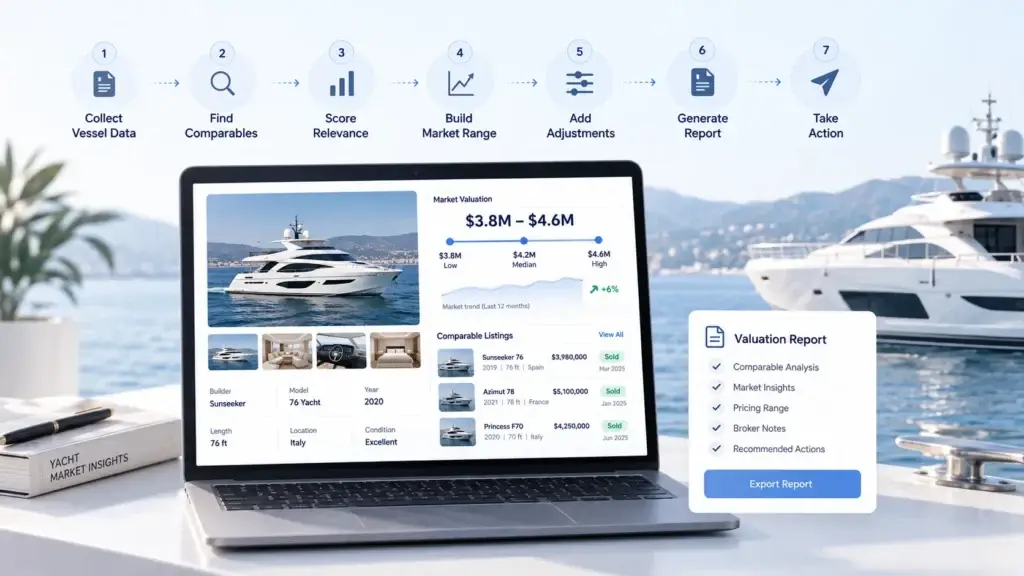
Image Source: AI-generated visual by Miracuves
A practical pricing intelligence workflow should support both human expertise and structured data.
Here is how it may work inside a yacht marketplace:
Step 1: Capture Rich Vessel Data
The platform collects detailed vessel specifications, media, documents, pricing history, and seller notes. The stronger the listing structure, the better the valuation output.
Step 2: Match Comparable Vessels
The system identifies sold and active comparables based on builder, model, year, length, condition, location, and other relevant attributes.
Step 3: Score Comparable Quality
Each comparable receives a relevance score. Exact matches carry more weight than loose matches. Recent sold records carry more weight than old ones.
Step 4: Build a Market Range
The platform presents a valuation range rather than a fixed number. This can include low, median, and high bands.
Step 5: Add Contextual Adjustments
The system allows broker notes for refits, equipment, location, survey findings, or seller urgency.
Step 6: Generate a Report
The broker or operator can export a report showing comparable evidence, pricing range, market movement, and suggested positioning.
Step 7: Connect to Marketplace Action
The valuation output should lead to action: list the vessel, adjust price, contact broker, save comparison, create seller lead, or request a consultation.
This workflow helps turn pricing intelligence into business value.
Read More: Yacht Marketplace Platform Lead Qualification: Identifying Serious Buyers Before Broker Follow-Up
Why Pricing Intelligence Should Connect With Broker CRM
Valuation data becomes more useful when connected to the broker workflow.
A broker may use pricing intelligence at multiple points:
- When pitching a seller to win the listing
- When advising on asking price
- When responding to buyer objections
- When building a shortlist of alternatives
- When recommending a price reduction
- When preparing a valuation report
- When reviewing stale inventory
- When qualifying buyer budgets
If the data stays isolated in a dashboard, it creates limited value. If it connects to CRM, inquiry management, listing edits, saved searches, and client records, it becomes part of daily operations.
That is why founders should think of valuation intelligence as a platform layer, not a separate calculator.
A yacht sales platform should connect listing data, buyer behavior, broker activity, and admin reporting into one workflow.
How Miracuves Helps Founders Build Smarter Yacht Marketplace Platforms
Miracuves helps founders and marketplace operators build launch-ready, white-label app platforms with source-code ownership, branded design, admin control, and scalable marketplace workflows.
For yacht and marine brokerage platforms, the bigger opportunity is not simply publishing vessel listings. It is building a system that supports the full pre-transaction journey: search, comparison, saved alerts, broker inquiry handling, CRM, price history, market evaluation, and reporting.
If your roadmap includes valuation intelligence, broker dashboards, premium seller tools, or marketplace analytics, the platform architecture should be planned early. Retrofitting these workflows later can become expensive if the listing schema, inquiry pipeline, and admin controls are too basic.
A ready-made marine marketplace foundation from Miracuves can help founders move faster while still leaving room for custom valuation logic, broker workflows, data migration, and branded monetization features.
You can explore the launch-ready marine brokerage marketplace platform
Final Thoughts: Pricing Intelligence Turns a Yacht Marketplace Into a Trust Platform
A yacht marketplace becomes more valuable when it helps users make better decisions.
Listings create visibility. Search creates discovery. Broker CRM creates workflow. But pricing intelligence creates confidence.
Sold comparables, active listings, price history, days-on-market data, and valuation reports help buyers understand the market, sellers price more realistically, and brokers advise with evidence. For marketplace founders, this can improve trust, lead quality, broker adoption, and premium monetization.
The strongest yacht marketplaces of the future will not only show what is for sale. They will help users understand what it is worth, why it is priced that way, and what action to take next.
FAQs
What is yacht marketplace pricing intelligence?
Yacht marketplace pricing intelligence is the use of sold comparables, active listing data, price history, vessel specifications, and market trends to support valuation decisions. It helps buyers, sellers, brokers, and platform operators understand whether a yacht is priced fairly.
Why are sold comparables important for yacht valuation?
Sold comparables are important because they reflect completed transactions. Asking prices show seller expectations, while sold data shows what buyers actually agreed to pay. This makes sold comparables one of the strongest valuation signals in yacht brokerage.
Should a yacht marketplace use active listings for valuation?
Yes, but active listings should be used carefully. They help show current competition, supply, and asking-price positioning. However, they should not be treated the same as sold transaction data because listed prices may not represent final sale value.
What data should a yacht valuation platform collect?
A yacht valuation platform should collect builder, model, year, length, engine hours, refit history, condition, equipment, location, asking price, sold price, listing status, price history, and days-on-market data. The richer the structured data, the stronger the valuation output.
Can pricing intelligence help yacht brokers win more listings?
Yes. Brokers can use comparable reports, pricing bands, market summaries, and price-history data to support seller conversations. This makes pricing advice more evidence-based and can improve client confidence.
How can yacht marketplace founders monetize valuation features?
Founders can monetize pricing intelligence through broker subscriptions, premium analytics, seller valuation leads, branded valuation reports, featured listings, market intelligence reports, and dealer dashboards.
Should valuation estimates be shown publicly?
It depends on the marketplace strategy. Public price signals can improve transparency, but broker-only or seller-only valuation reports may be better for high-value vessels where professional interpretation is important.
How does pricing intelligence support a marine brokerage marketplace?
Pricing intelligence supports a marine brokerage marketplace by improving trust, reducing pricing uncertainty, strengthening broker workflows, supporting negotiation, and creating premium data-led features for sellers and professionals.
Miracuves is an independent software development company. We are not affiliated with, connected to, sponsored by, or endorsed by any company or product named in this article.
Terms such as “X Clone” are used descriptively. It is how the software industry refers to building a platform with functionality comparable to a known service, and how clients search for it.
The entire design and codebase of our products is built by our own team. Our products contain no code, design, graphics, or content originating from any third-party website or applications.
All third-party names and marks referenced in this article are the property of their respective owners, referenced solely to identify the services discussed.