




























Groww Clone App - White-Label Multi-Asset Investing Platform for India and US Markets

A launch-ready retail investing platform where one identity, one KYC record, one wallet and one portfolio span fifteen asset classes. Indian equities, US equities, mutual funds, ETFs, index funds, IPOs, derivatives, commodities, currency, bonds, fixed deposits, digital gold, SGBs, REITs and P2P all resolve into the same holdings view rather than into separate products a user has to reconcile themselves.

Three surfaces on one PostgreSQL core. A Next.js web application, a 119 screen React Native app and a ten page operator console read the same 82 entity schema through 55 backend modules, so a capability shipped once appears everywhere it belongs.

Go Live in 6 Days with EquitiesMutual FundsUS StocksSIP & GoalsF&OWhite-Label

⚡ Platform at a Glance

6

Revenue Streams
brokerage, subscriptions, AUM, fees, float, licensing

15

Asset Classes
equities, funds, US stocks, F&O, bonds, gold and REITs

0

Revenue Share
you own the source outright, with no per-seat fee

100%

Auditable
every operator action logged before and after

Wealth, Not Just Brokerage

SIP, STP and SWP, goals and tax tools ship on day one, so the recurring book forms before brokerage turns cyclical.

Breadth Without Twelve Stacks

One order model reaches every asset class, so widening the catalog is configuration rather than a parallel build.

🚀 Ready to launch your own multi-asset investing platform?

More than 6,000+ Companies Trust us Worldwide

Live in Action

Groww Clone Demo - Investor, Trader, Operator Console & Android

Open the platform yourself. Six working logins are seeded and every one of them is live: a long-term investor, a professional trader, a small trader, a beginner, a general demo user and an operator. The demo worth running is the breadth one. Search an instrument, add it to a watchlist, place an order, then open the portfolio and watch the same position appear in the allocation view. Extra logins beyond the panels below: small@mxstocko.com | Small@123, beginner@mxstocko.com | Beginner@123, and demo@mxstocko.com | Demo@123.

INVESTOR EXPERIENCE

Groww Clone - Portfolio, Funds & Systematic Plans

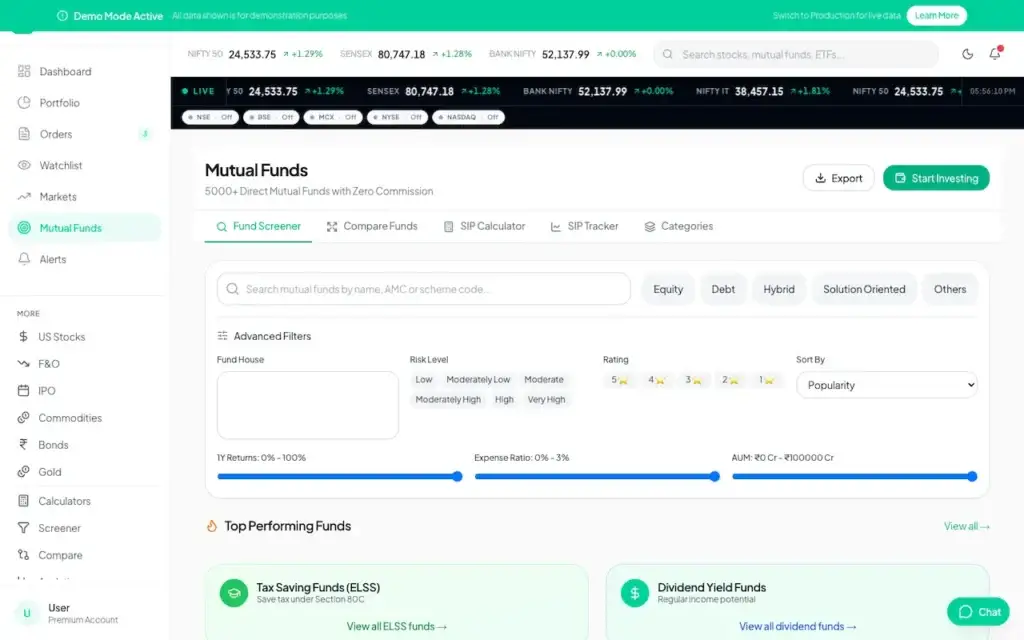
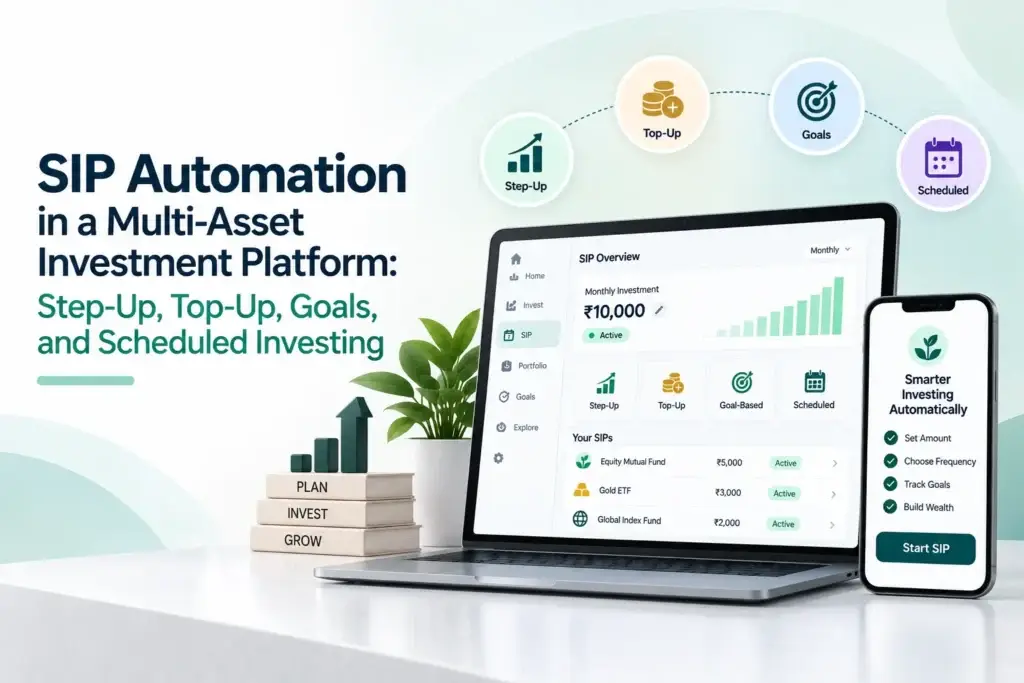
The long-term surface. Mutual fund discovery by category, NAV and AMC detail, SIP creation with step-up and top-up, goal tracking, dividend history and a portfolio view carrying CAGR, XIRR, risk score and sector allocation.

  • Open the web app in your browser
  • Login with the investor credentials below
  • Explore: Portfolio, Mutual Funds, SIP, Goals
  • Try: investor@mxstocko.com | Investor@123
ACTIVE TRADER

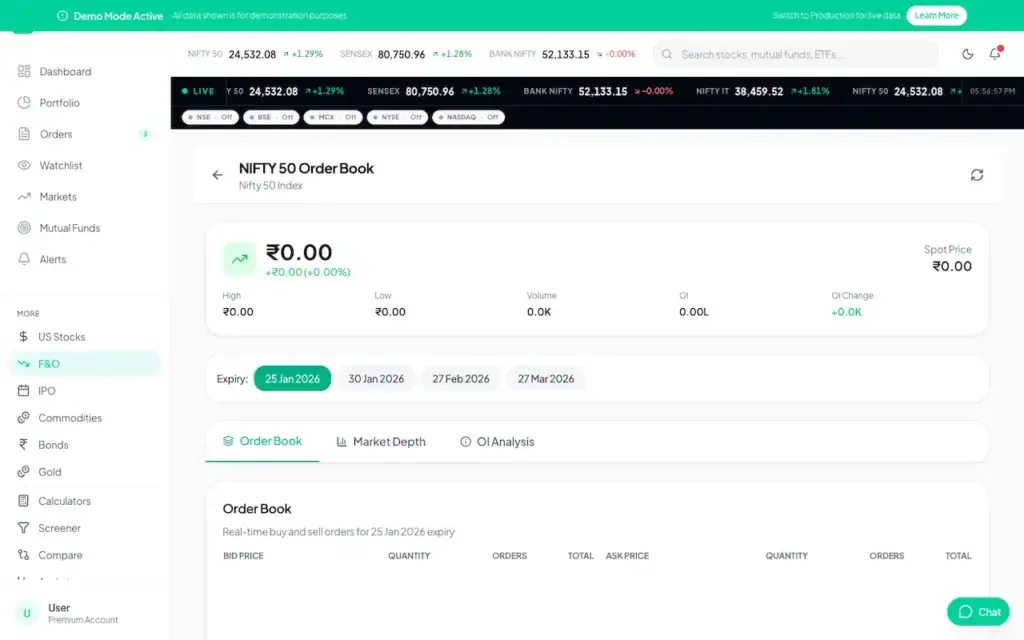
Orders, Derivatives, Screener & Market Data

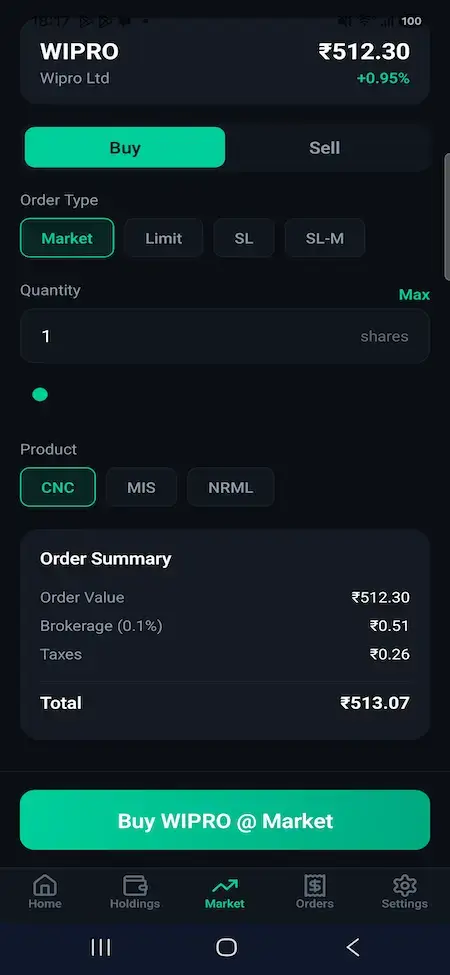
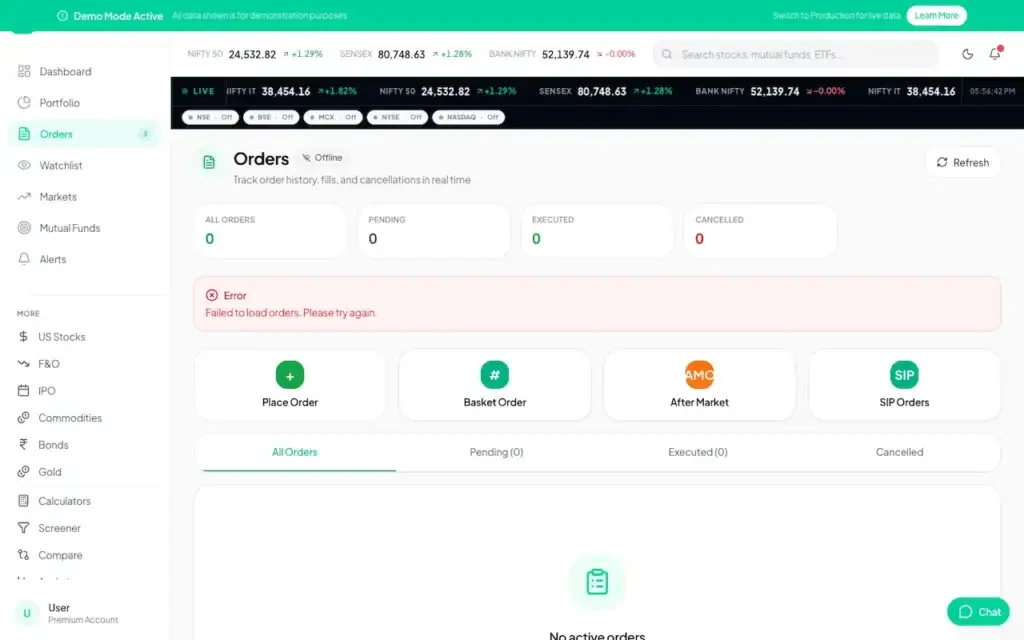
The execution surface. Four order types crossed with five product types and four validity modes across five exchanges, plus the options chain, intraday tools, the margin facility, the screener and technical indicators, with the full charge breakdown shown before confirmation.

  • Open the web app in your browser
  • Login with the trader credentials below
  • Explore: Orders, F&O, Screener, Holdings
  • Try: trader@mxstocko.com | Trader@123

OPERATOR CONSOLE

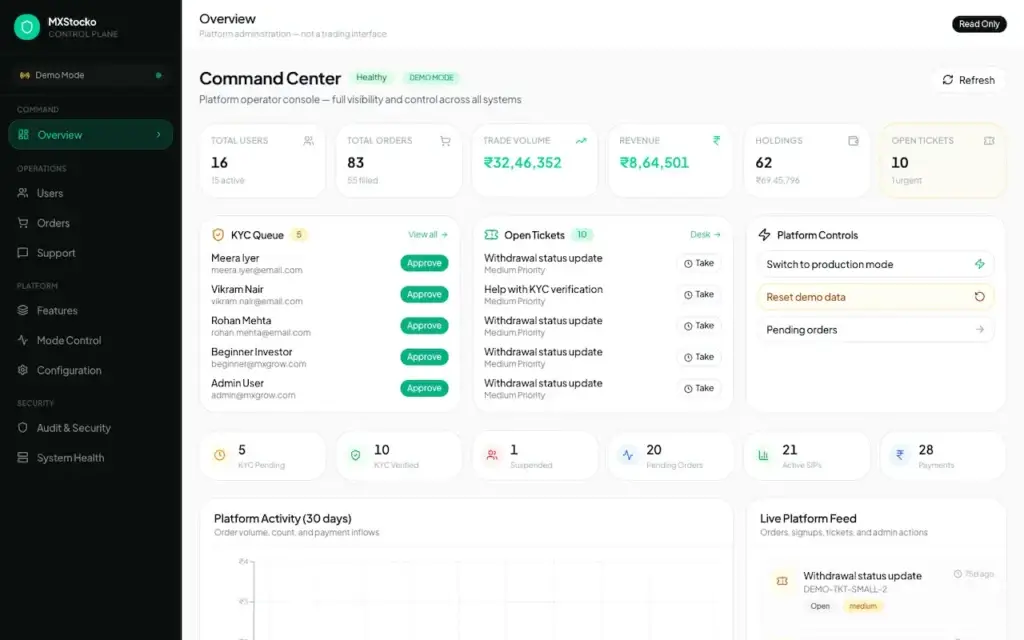
Users, KYC Desk, Orders, Audit & Mode

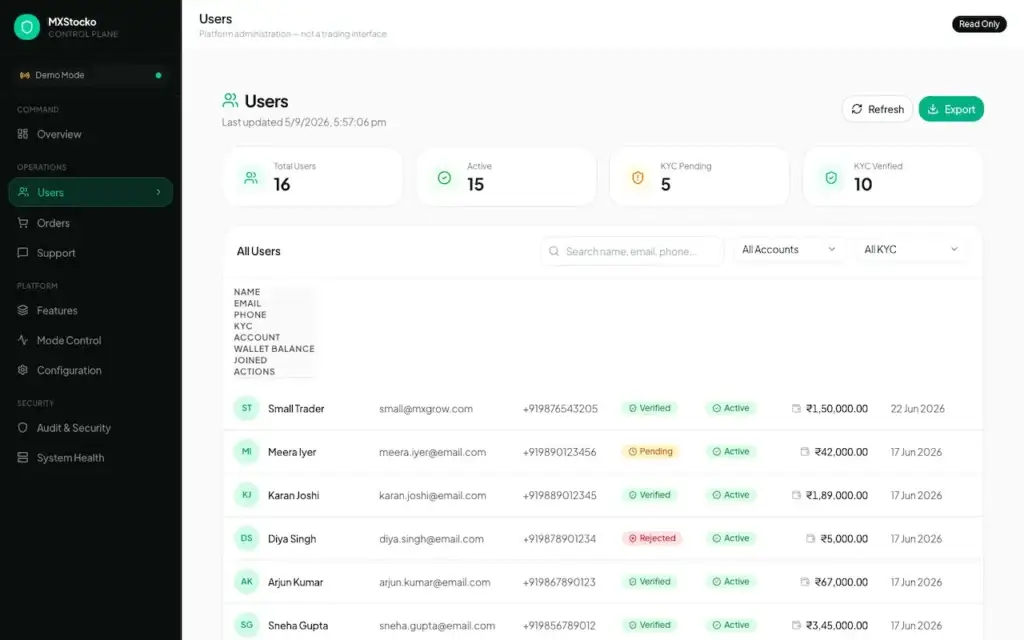
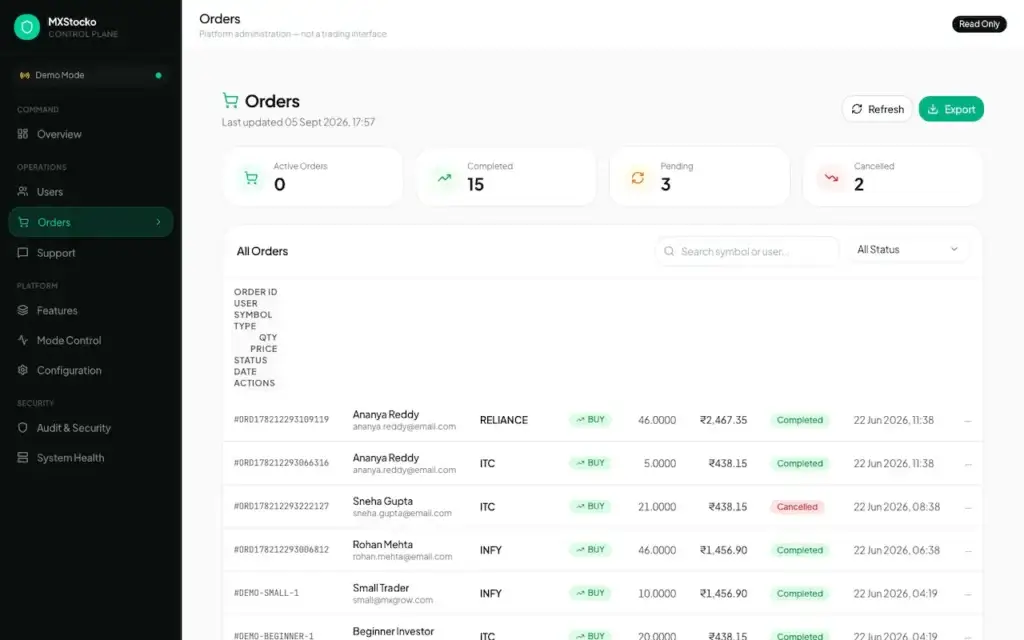
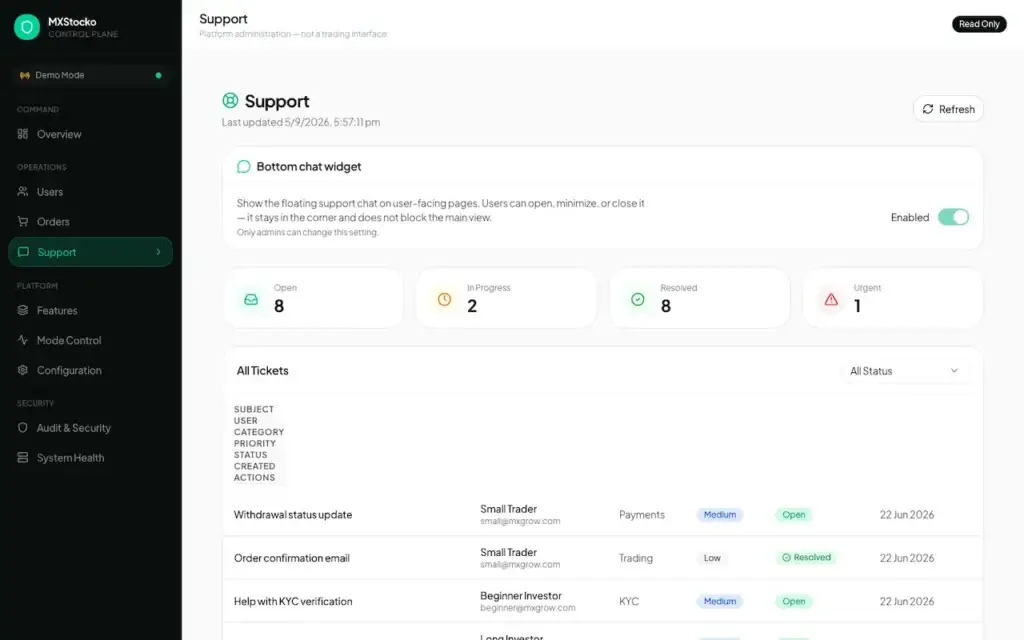
Operator governance across ten pages. User management with status changes, the KYC review desk, order inspection and override, the support ticket queue, platform analytics, the audit log viewer, feature flags, security policies and the demo to production mode switch.

  • Open the admin console in your browser
  • Login with the operator credentials below
  • Explore: Users, KYC, Orders, Audit, Mode
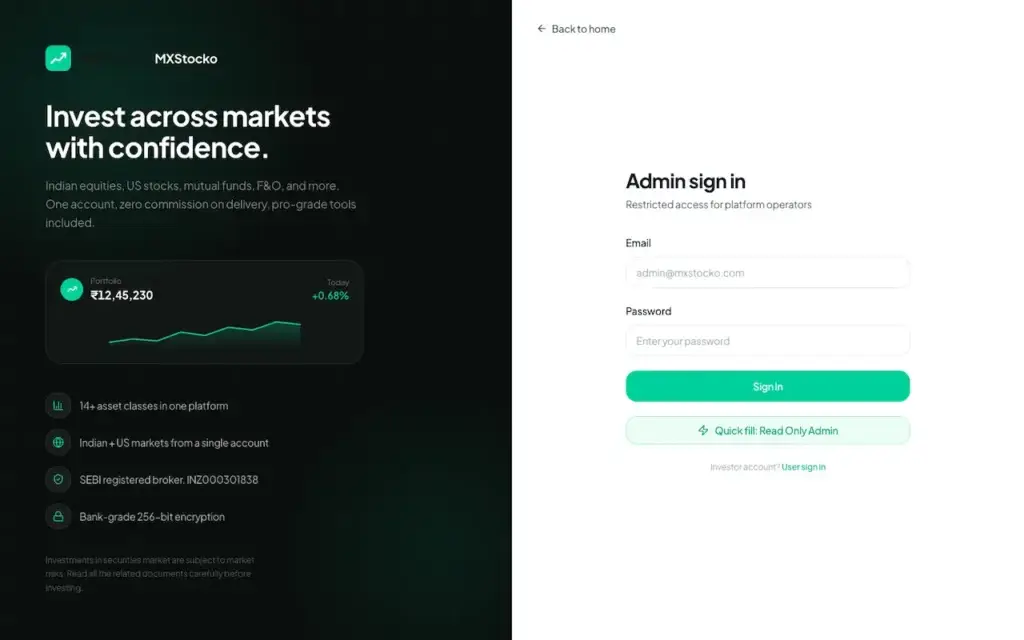
  • Try: admin@mxstocko.com | Admin@123

ANDROID APP

Groww Clone - Android App

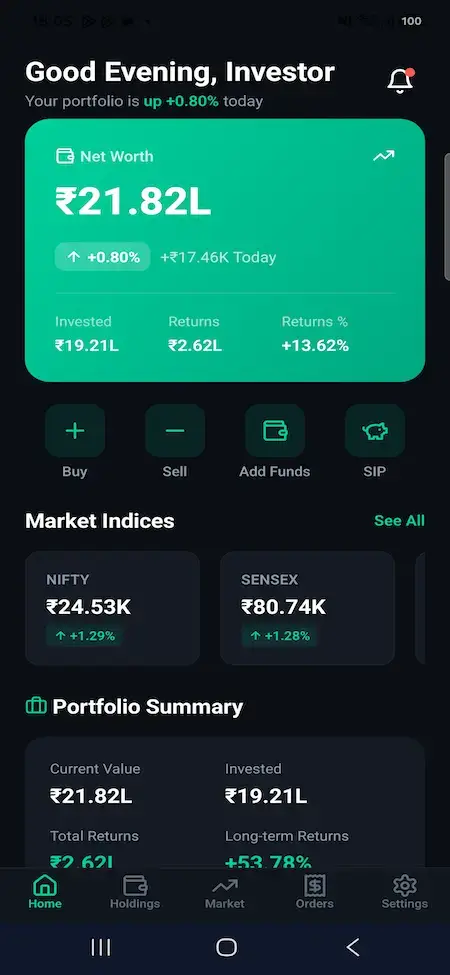
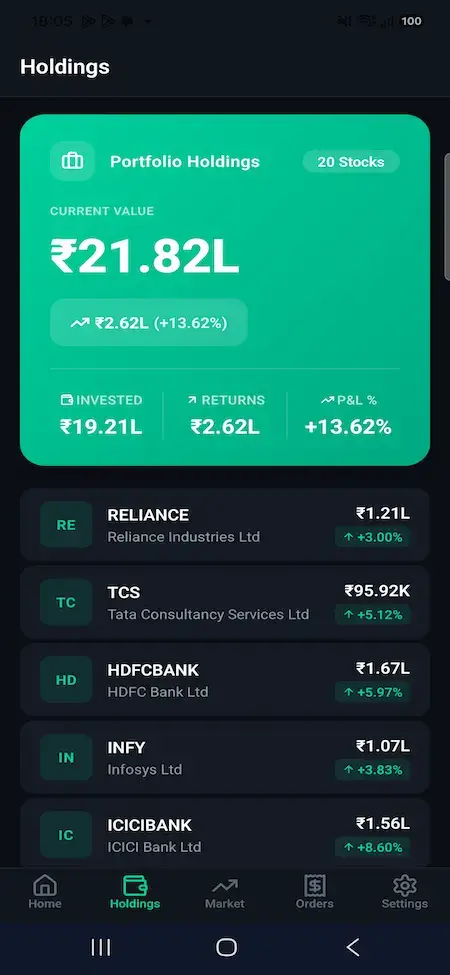
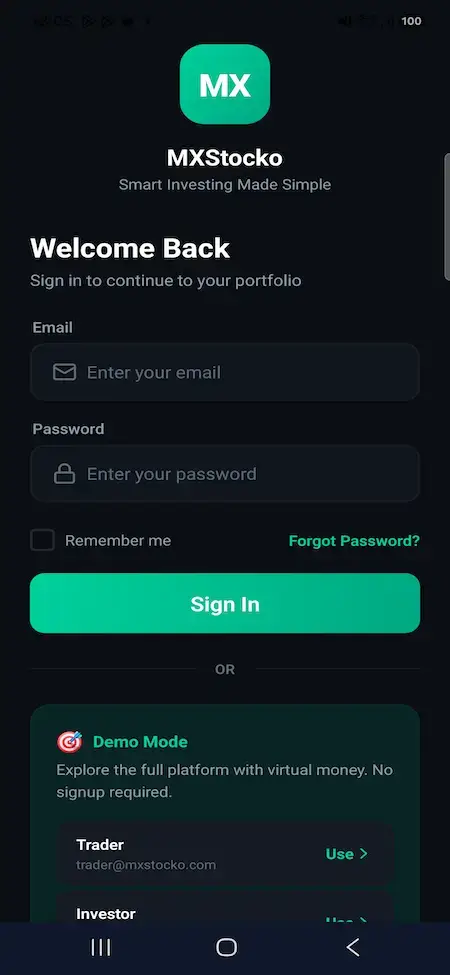
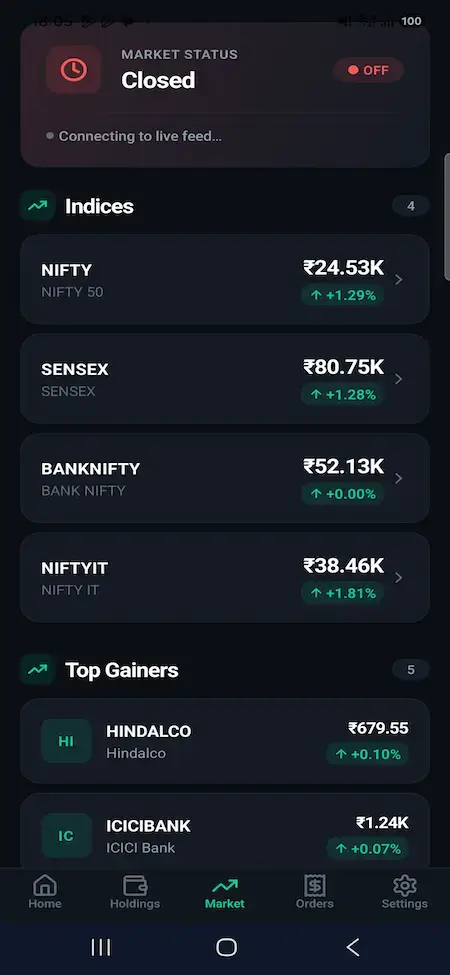
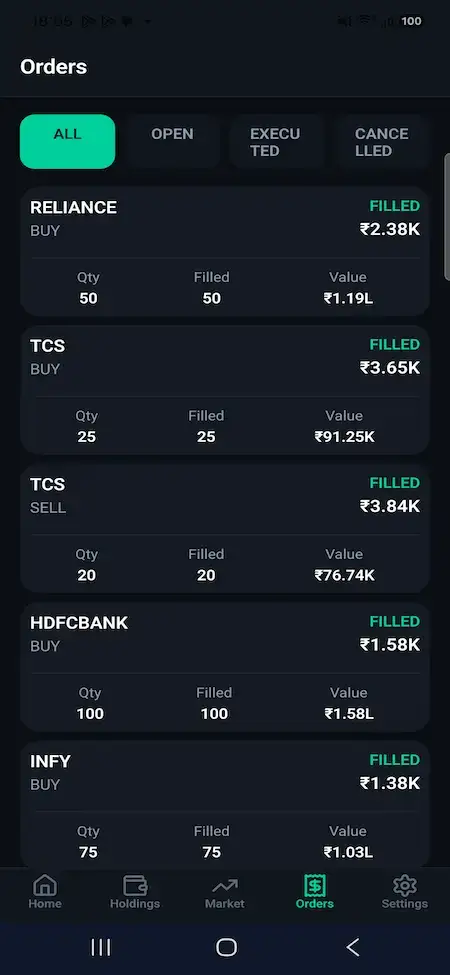
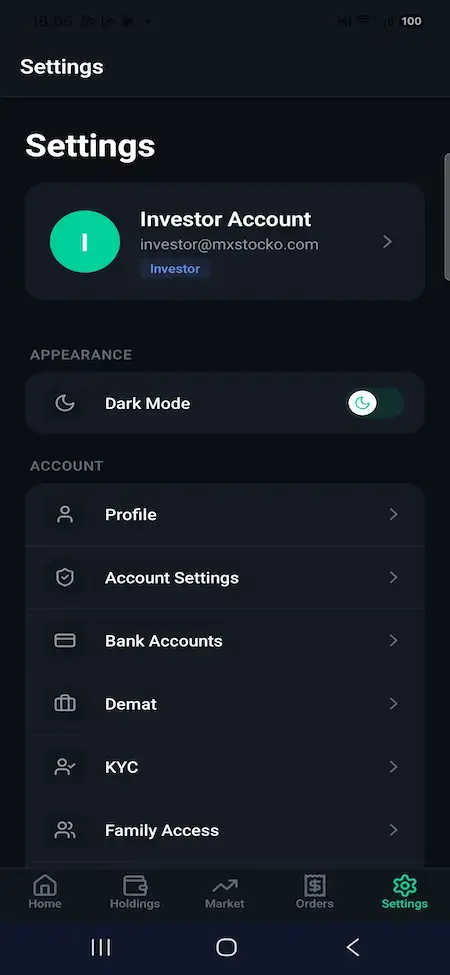
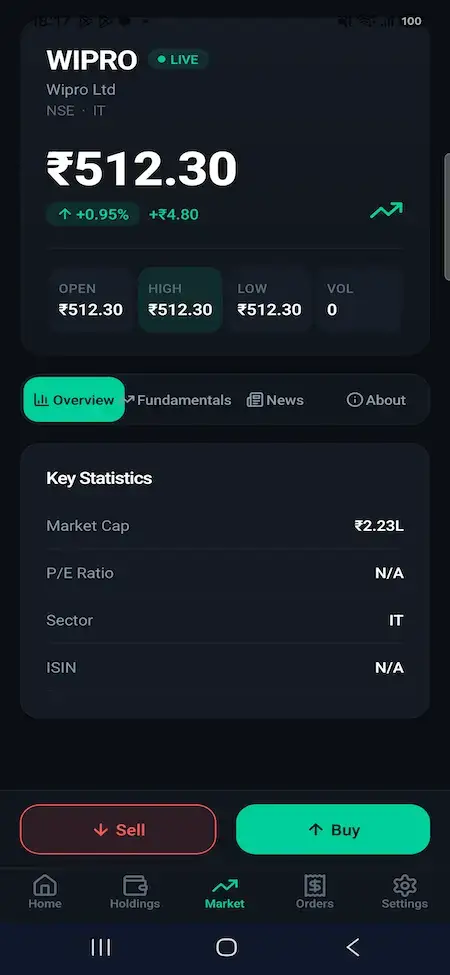
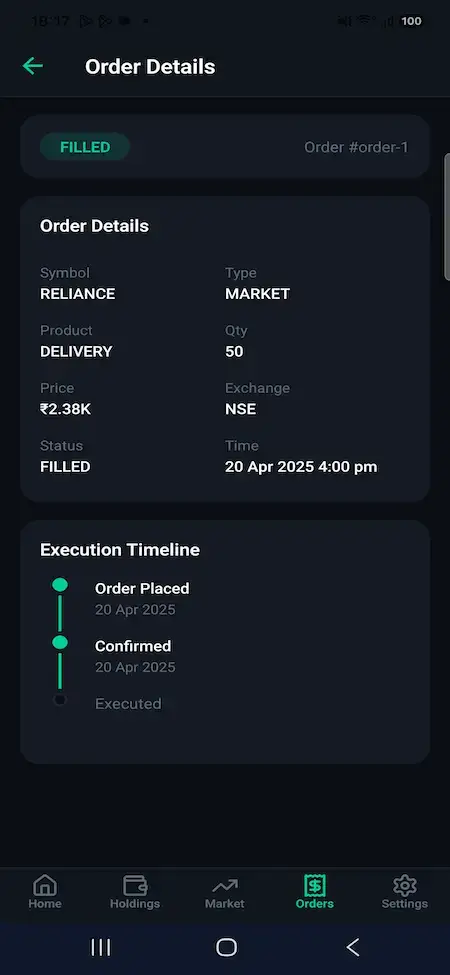
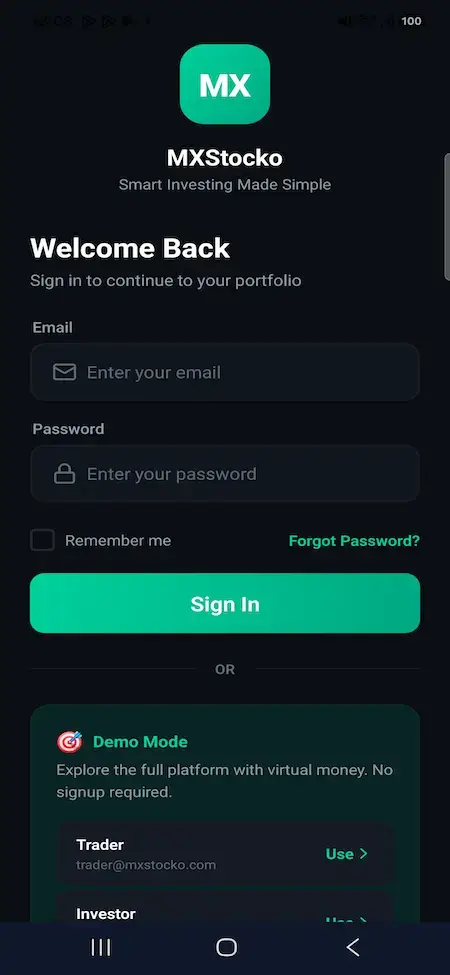
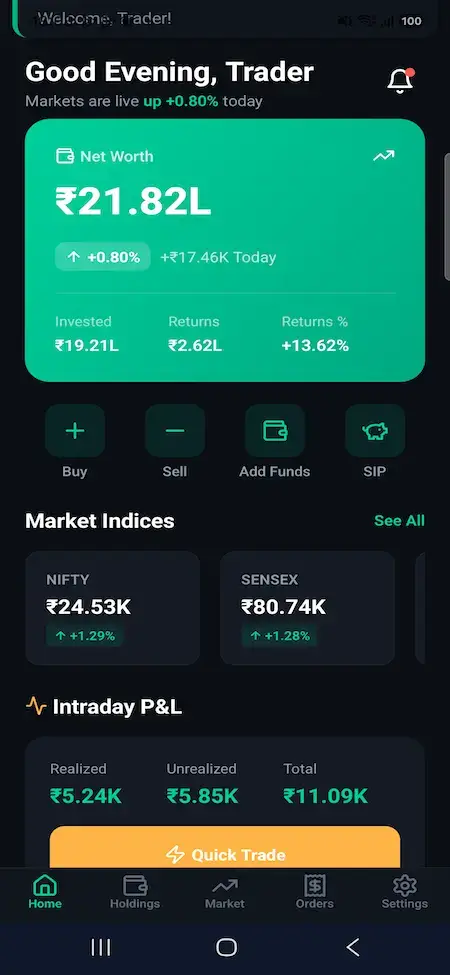
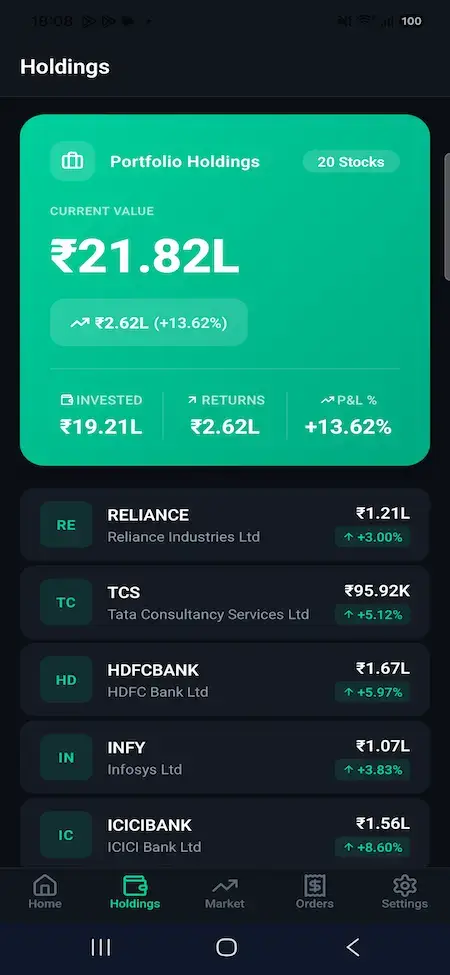
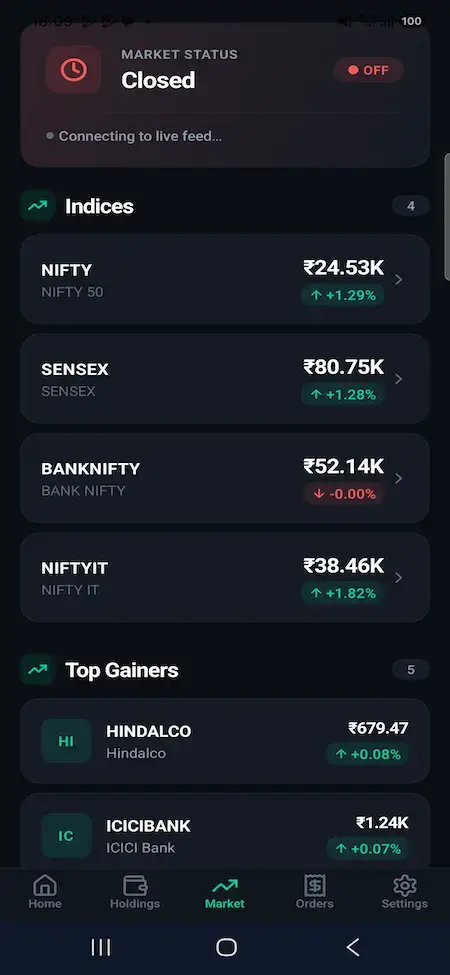
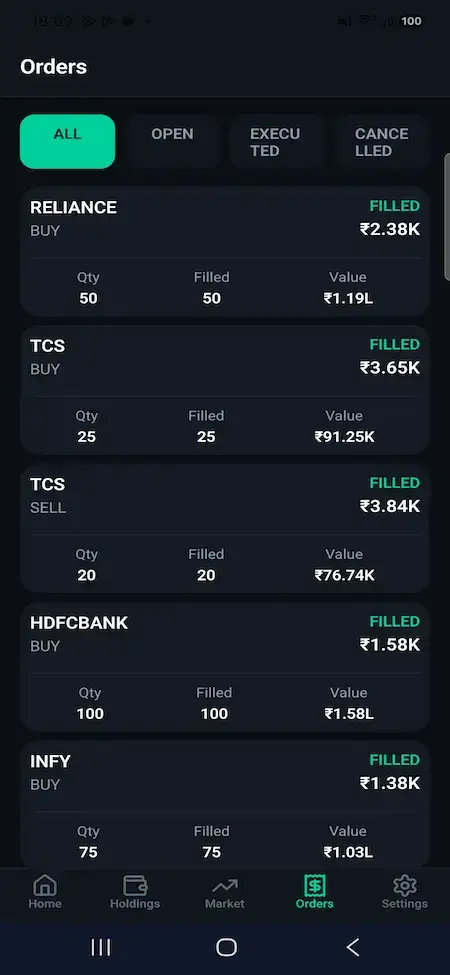
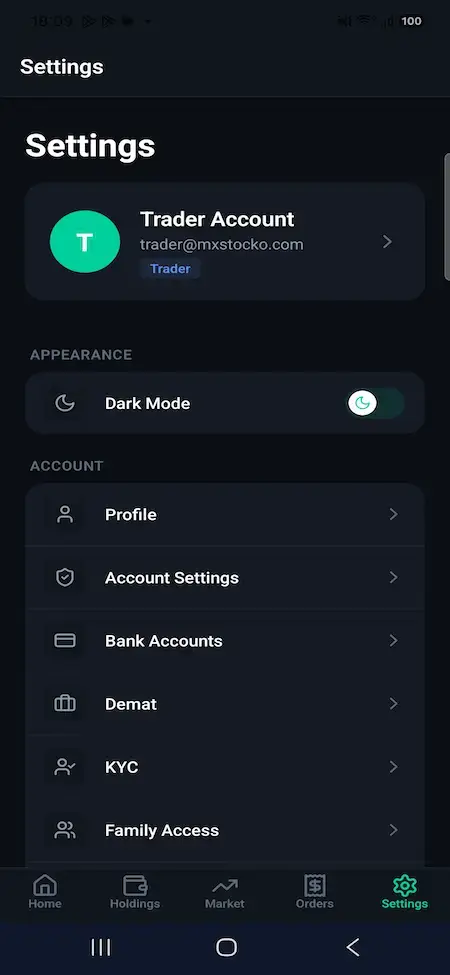
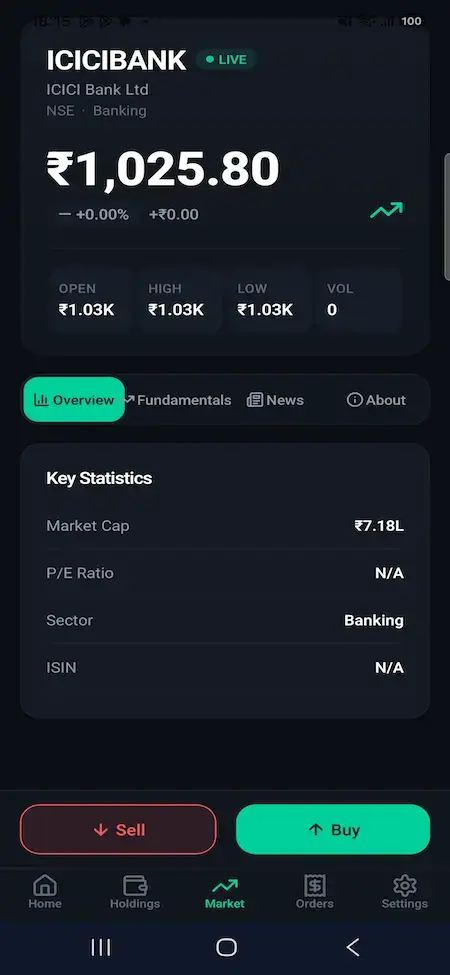
A branded Android build of the React Native application, covering 119 screens across investing, trading, holdings, wallet, KYC, alerts, research and all thirteen calculators, with biometric unlock, Firebase messaging and home-screen widgets, running against the same API as the web app.

  • Download the app to your Android device
  • Login with any of the demo credentials
  • Explore: Dashboard, Portfolio, Orders, Calculators
  • Try: demo@mxstocko.com | Demo@123

Watch It Work

Groww Clone Video Demo: Onboarding, First Order, SIP & Operator Walkthrough

A walkthrough of the platform as an operator sees it rather than a feature reel. It opens on registration and a KYC submission with documents attached, then follows the same record into the operator console where it is reviewed and approved, and the audit row is written. A wallet is funded, an order is placed with the charge breakdown visible before confirmation, and the resulting position appears in holdings and in the allocation chart. A SIP is created with a step-up, a goal is linked to it, and the tax P&L view is opened at the other end. If a specific flow matters more than the tour, ask and we will open it live with data in it.

Every Screen Mapped

Groww Clone App Flows - Investor, Trader, Operator & Compliance Screens

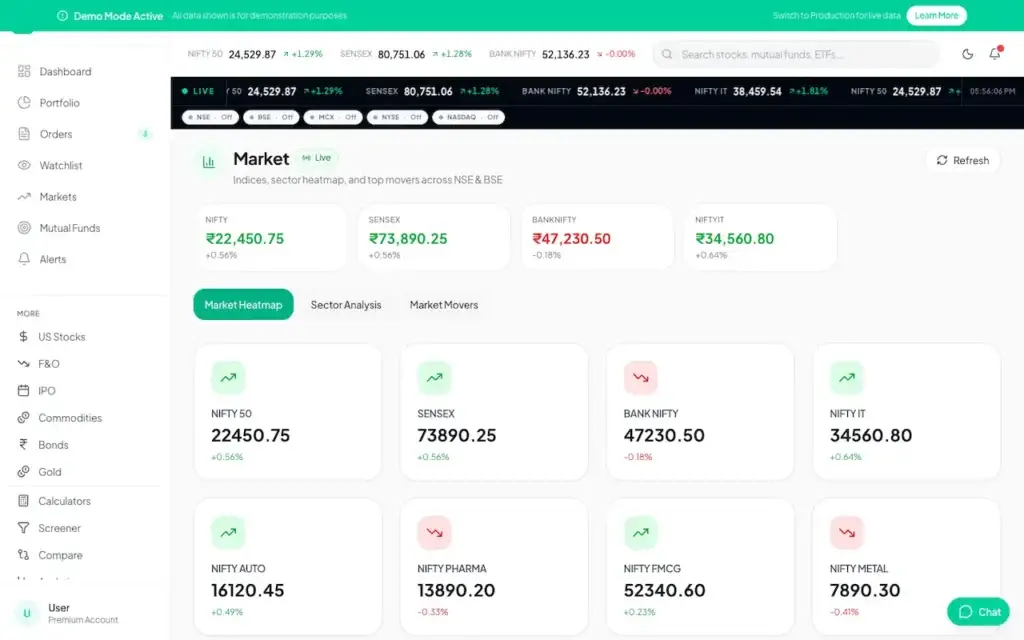
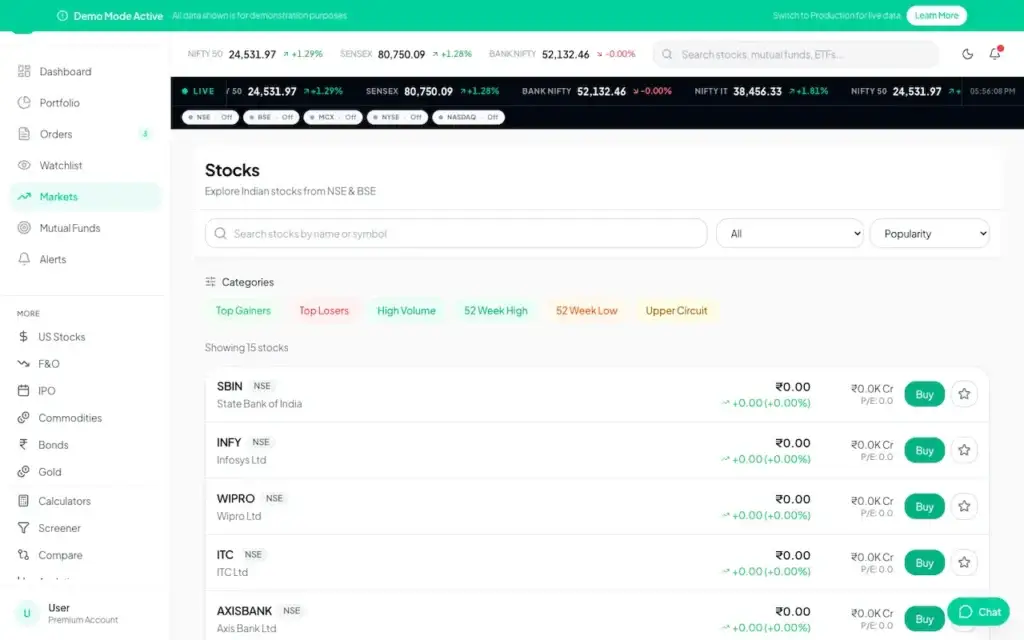
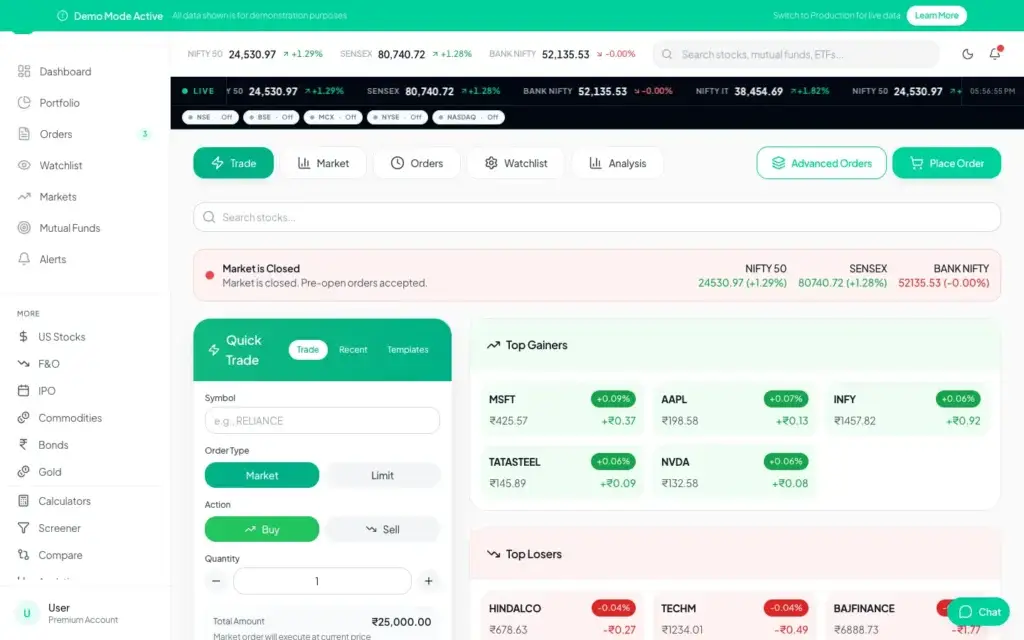
The interface across the surfaces that matter: the dashboard with its allocation and performance charts, instrument search spanning equities and funds and US symbols, the stock and fund detail pages, the order ticket with its charge breakdown, holdings and the portfolio analytics view, the SIP and goal flows, the KYC wizard with document upload, the wallet, the alerts list, and the operator console with its user, KYC, order, ticket and audit queues.

Plus custom device
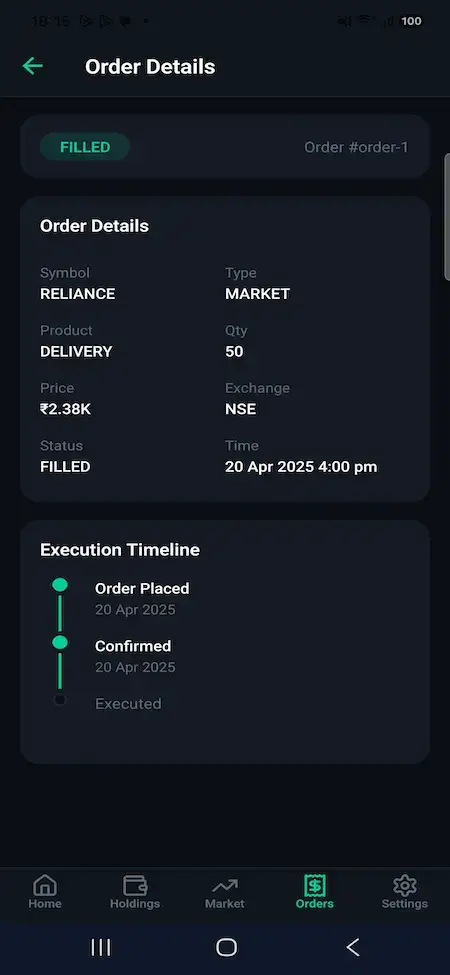
09 order detail
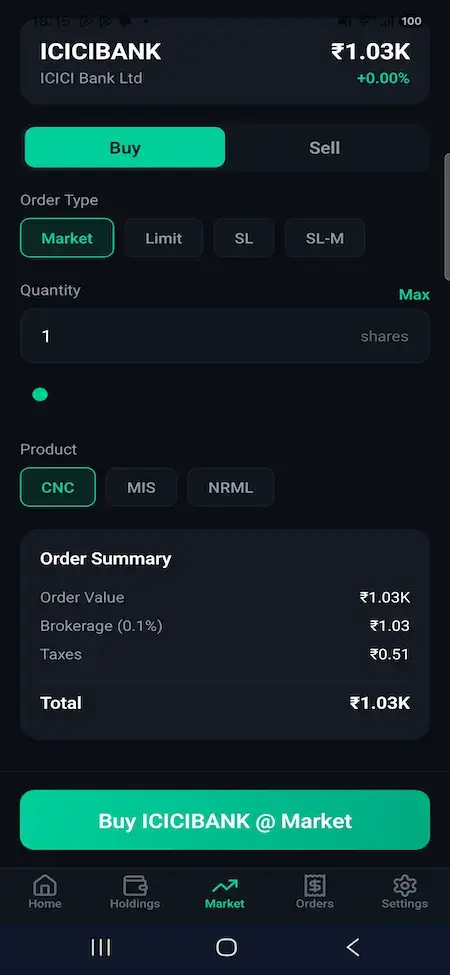
08 buy order
07 stock detail
06 settings
05 orders
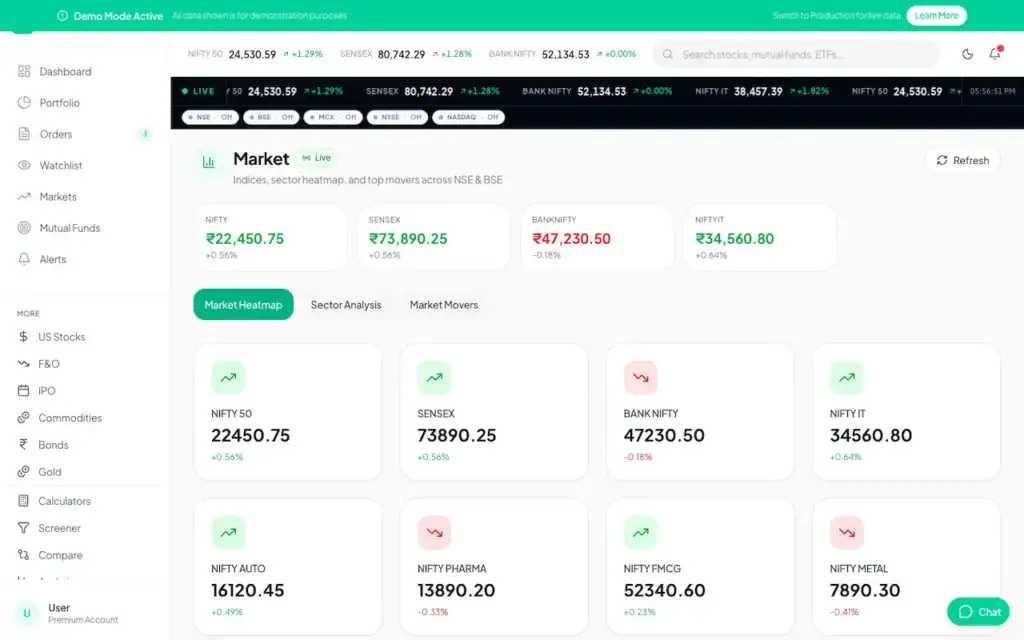
04 market
03 holdings
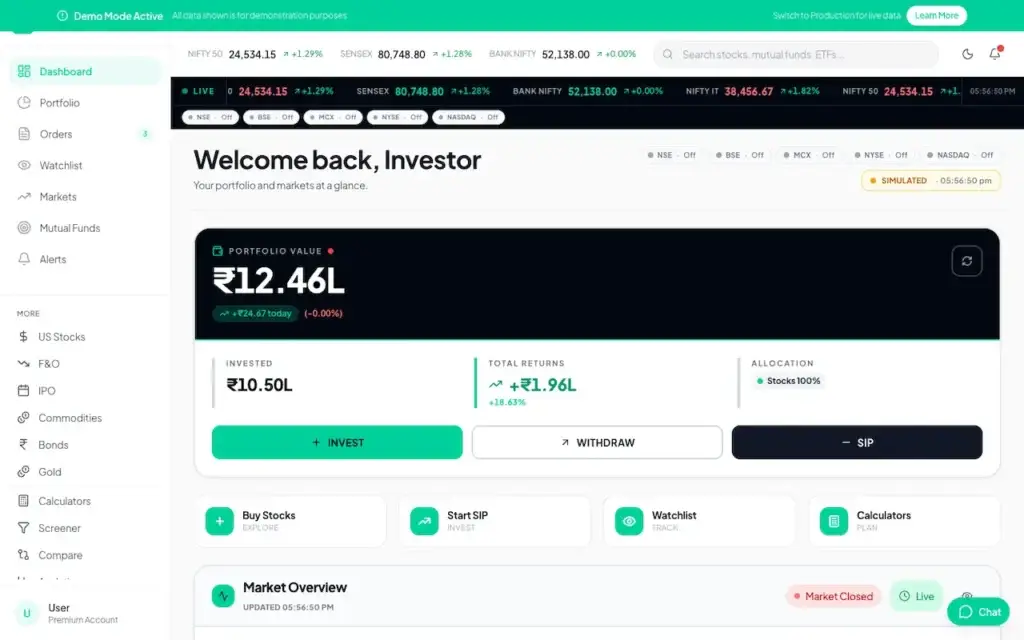
02 dashboard 1
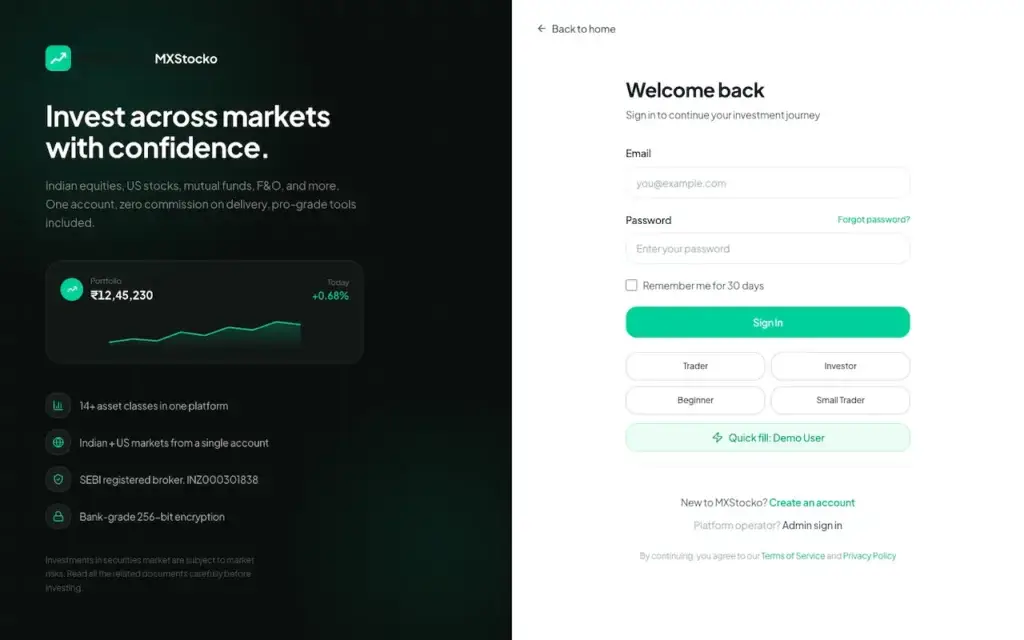
01 login 2
Plus custom device
01 login 3
09 order detail 1
08 buy order 1
07 stock detail 1
06 settings 1
05 orders 1
04 market 1
03 holdings 1
02 dashboard 2
06-admin-system
05-admin-support
04-admin-orders
03-admin-users
02-admin-dashboard
01-admin-login
06-investor-orders
05-investor-mutual-funds
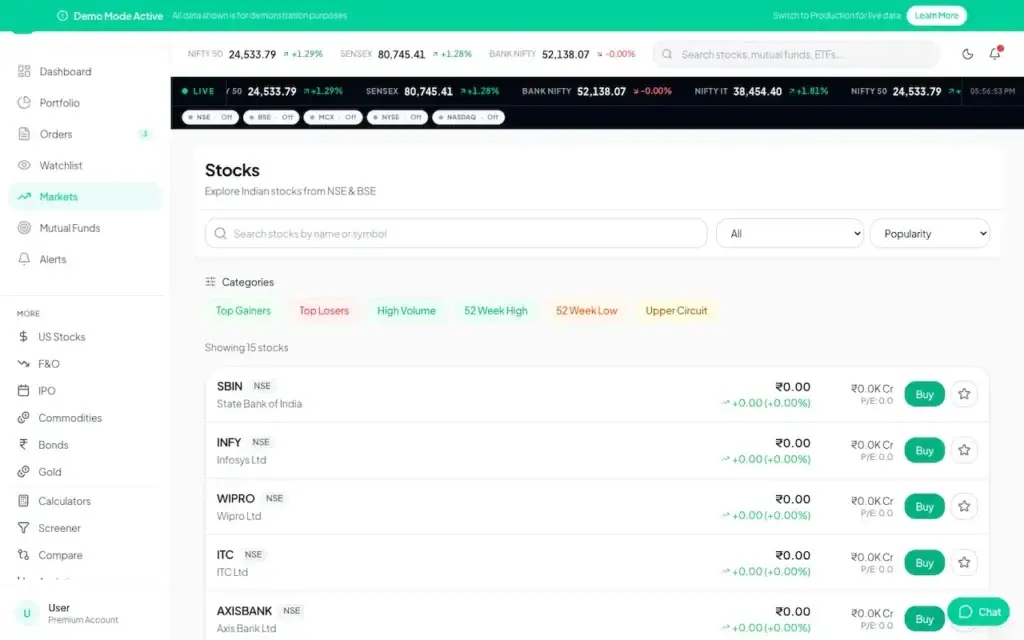
04-investor-stocks-explore
03-investor-market
02-investor-dashboard
01-investor-login
06-trader-fno-orderbook
05-trader-trading
04-trader-stocks-explore
03-trader-market
02-trader-dashboard
01-trader-login

Follow an investor from signup through KYC approval to a funded wallet, a first order and a portfolio that reflects it. Follow a trader from the screener into the options chain and out through an order. Follow an operator from a submitted KYC record to an approval that writes an audit row the compliance officer can read back. Web carries the full experience, the React Native app covers 119 screens of it, and the F&O terminal and the admin console are web-first by design. Want a guided walkthrough of a specific flow? Book a call and we will open the surface you care about with live data in it.

Client Voices

Groww Clone Client Reviews - Real Platforms, Real Results

Feedback from operators who launched investment and trading platforms with Miracuves. Client identities withheld at their request.

How It Is Configured

Groww Clone Reference Deployment - Multi-Asset Retail Investing Launch

A modelled reference deployment showing how the shipped platform is configured for an operator launching equities and mutual funds first, then widening. It is an illustrative scenario rather than a client engagement, and every figure in it is a property of the platform rather than a reported outcome.

Modelled Reference Deployment

India
Multi-Asset Retail Investing Launch

How the shipped platform is configured for an operator launching equities and mutual funds first, then switching on US equities, alternatives and the systematic plan stack as licensing allows.

Illustrative scenario Not a client engagement
India Region
Retail Investing, Multi-Asset Industry
82
Database entities
119
Mobile screens
6 days
Deployment window
Challenges
  • Running equities, mutual funds and US stocks as three separate stacks nobody can reconcile
  • A KYC desk improvised in scripts, with no reviewable trail of who approved what
  • Systematic plans treated as a later phase, so the highest-value segment never activates
🎯 Goal
  • Put every asset class into one portfolio, one wallet and one KYC record
  • Give operations a review desk rather than a database client
  • Ship the wealth layer at launch instead of quoting it as phase two
🛠 Solution by Miracuves
  • One order model covering twelve instrument types through polymorphic keys
  • SIP, STP and SWP as first-class entities with step-up and top-up
  • Seven-state KYC lifecycle with checksummed documents and an audit trail
  • Ten-page operator console with demo and production mode switching
  • Portfolio analytics carrying CAGR, XIRR, risk score and sector allocation

This is a modelled reference deployment, not a client engagement. It shows how the shipped platform would be configured for this market, using platform properties rather than reported outcomes.

OY
Named client deployments are published separately See the Miracuves portfolio for real engagements with their own reported figures.
Model this against your own launch plan See how the multi-asset portfolio and the wealth layer are configured end to end.
Book a consultation

The Basics

What Is a Groww Clone App?

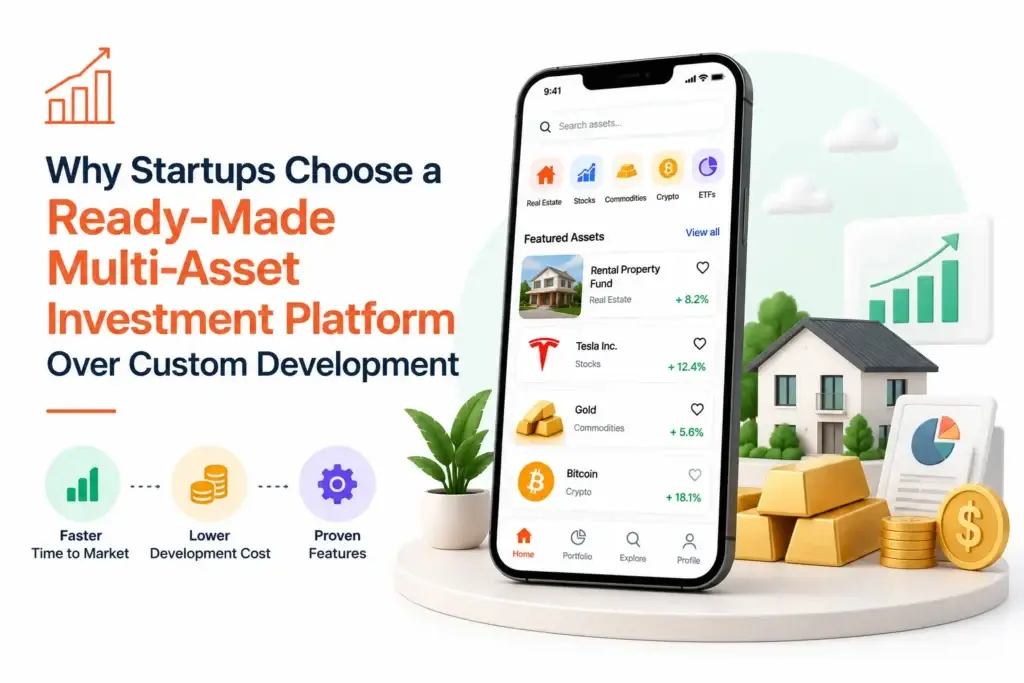
A Groww Clone is a ready-made retail investing platform that treats breadth as the product. One user record carries one KYC submission, one set of wallets and one portfolio, and that portfolio holds Indian equities, US equities, mutual funds, ETFs, index funds, IPO allotments, derivatives, commodities, currency, bonds, fixed deposits, digital gold, SGBs, REITs and P2P positions without the user ever leaving the app to reach any of them.

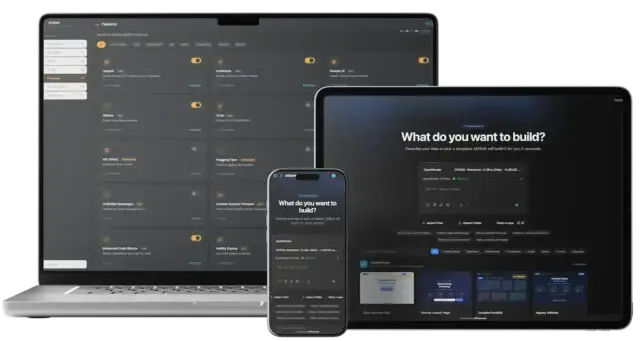
White-label trading platform dashboard displayed across laptop, tablet, and mobile devices with admin controls, market analytics, portfolio data, and trading features

Not a Licensed Broker

This is platform software. Broker registration, exchange membership and KYC/AML licensing remain the operator's responsibility. What ships is the control fabric those licences are examined against: the KYC lifecycle, the audit log, RBAC and retention guidance.

Not a Rental Platform

You receive the source, the 82 entity schema, the migration runner and the seeders. No per-seat fee, no vendor roadmap dependency, and a standard PostgreSQL underneath that any team can hire for.

Honest About Readiness

Live broker execution is an integration per venue, production payment keys are yours to supply, price alerts fire on above and below only, and the 2FA enable endpoint is not implemented. All stated here rather than discovered later.

Built for Web, Mobile & API

What Is a Groww Clone Script?

A Groww Clone Script is the source code behind that: a Next.js 16 web application with 167 backend-for-frontend route handlers, a NestJS 11 core API across 55 modules, an 82 entity PostgreSQL schema under TypeORM, a React Native application of 119 screens, and a deployment kit carrying Docker, nginx, PM2, four CI pipelines and four Grafana dashboards. You own it outright and deploy it under your own brand.

  • One portfolio spanning fifteen asset classes
  • SIP, STP and SWP as first-class entities
  • Seven state KYC lifecycle with an operator review desk
  • Ten page admin console with audit and mode switching
  • Five subscription tiers gated by features and limits JSON
02 trader dashboard

In simple words, it is the shortcut to launching an investing product that does not fragment as it grows. The polymorphic instrument pattern is what makes that possible: orders, holdings and watchlists each carry nullable per-asset foreign keys plus a type discriminator, so adding an asset class is a new entity and a seeder rather than a new stack. Underneath sit 15 database seeders, 11 queue producers, 5 scheduled jobs and an audit fabric that records the before and after of every operator action.

Everything Included

Groww Clone Features - Multi-Asset Orders, Portfolio, Systematic Plans & Operator Desk

Every capability below is built and demonstrable. Where a feature needs a third-party account or a licence, or ships as a schema capability rather than an evaluated one, that is stated against the feature rather than implied away.

One Order Model, Twelve Instrument Types

A single orders table carries nullable keys for stock, US stock, mutual fund, ETF, index fund, future, option, commodity, currency, bond, gold and REIT, plus a type discriminator. Adding an asset class does not fork the execution path.

  • Indian equities across NSE and BSE
  • Search, quote, chart and detail per symbol
  • Top gainers, losers, most active
  • 52 week high and low screens

Charges Computed Server-Side

Brokerage, STT, GST, transaction charges, total and net amount are calculated on the server and shown before confirmation. Client-supplied charge values are never trusted, which closes the most common revenue leak in retail trading.

  • US equities on NYSE and NASDAQ
  • Own catalog, quotes, charts and CIK identifiers
  • Dedicated us_stocks portfolio type
  • Live US execution is an integration

Portfolio Mathematics Done Properly

CAGR, XIRR, risk score, day change, invested against current value, and allocation stored as structured JSON for both asset class and sector. This is the hardest part of an investing product to get right and it is already correct here.

  • Mutual funds by category and AMC
  • NAV, expense ratio, exit load and benchmark
  • Minimum investment and minimum SIP amounts
  • ETFs and index funds with tracking index

Systematic Plans as Three Entities

SIP, STP and SWP each have their own model rather than being variants of one. Step-up percentage, top-up amount, auto-invest on dividend, and a scheduled and active through paused to completed lifecycle.

  • Four order types and five product types
  • Seven state lifecycle with partial fills
  • Brokerage, STT, GST and transaction charges
  • Charges computed server-side, never from the client

Cross-Market Portfolio

US equities carry their own catalog and a dedicated portfolio type, so Indian and US positions aggregate into one allocation view. Live US execution is a broker integration; everything up to the order is built.

  • Multiple portfolios per user
  • CAGR, XIRR and risk score
  • Asset and sector allocation as structured JSON
  • Day change and holdings count

KYC as a First-Class Domain

Typed submissions across individual, corporate and NRI, six document kinds, checksums on every upload, PEP and risk fields, expiry handling, and a dedicated KYC audit entity recording previous and new status per decision.

  • SIP with daily, weekly, monthly and quarterly cadence
  • Step-up percentage and top-up amount
  • Auto-invest on dividend
  • STP and SWP as separate entities

Verify Before Credit

Wallet balance changes only inside the payment verification path. Gateway callbacks cannot mint balance, the payment identifier is unique for idempotency, and the raw gateway response is stored for reconciliation.

  • IPO list, detail and grey market premium
  • Application and bidding flows
  • Allotment status tracking
  • Listing day position creation

Five Tiers Gated by JSON

Basic through enterprise across four billing cycles, with per-plan features and limits held as JSON. Repositioning a tier or gating a module is a configuration change rather than a release.

  • Bonds with ISIN, coupon and yield to maturity
  • Fixed deposits with bank list and booking
  • Digital gold, SGB and REIT surfaces
  • Commodities on MCX and FX pairs

Audit Fabric on Every Mutation

Operator actions write an audit row carrying actor, action, resource and the before and after state. The KYC domain keeps its own audit entity on top of that, which is what a compliance review actually asks to see.

  • Four wallet types with blocked and available balances
  • Margin used and margin available
  • Server-side verification before any wallet credit
  • Refunds with a stored gateway response

Demo and Production as a Switch

A platform mode subsystem with mode history, production readiness checks and a demo data reset, plus an isDemo flag on records. One deployment serves sales demos and production without a forked branch.

  • Seven state KYC across individual, corporate and NRI
  • Six document types with SHA-256 checksums
  • PEP flag, risk category and verification level
  • Operator approve and reject with reason

Thirteen Calculators, Both Surfaces

SIP, SIP top-up, STP, SWP, lumpsum, goal SIP, EMI, FD, inflation, margin, NPS, PPF and brokerage, present on web and on mobile. These are the top-of-funnel acquisition asset most investing platforms build late.

  • Price alerts on above and below conditions
  • Nine notification types with priority levels
  • In-app feed plus WebSocket fan-out
  • Push delivery needs Firebase configured

Mobile at 119 Screens

Not a wrapper. Calculators, alternatives, ESG and comparison research, market intelligence, biometric unlock, MMKV storage, offline detection and home-screen widgets for portfolio, watchlist and indices.

  • Thirteen calculators on web and mobile
  • Academy courses with progress tracking
  • Tax P&L and harvesting suggestions
  • Dividend tracker and corporate actions

Note for buyers: The platform ships complete as software. Live broker execution is an integration per venue, and production payment keys, market-data vendor licensing, SMTP, Firebase push and the queue workers all need your own accounts or configuration. Two things deserve emphasis because the words usually carry more than they should. Price alerts evaluate above and below conditions only; the richer condition set in the schema, covering volume spikes, RSI, moving-average crossovers and news keywords, is scoped work rather than a shipped evaluator. And the 2FA enable endpoint is not implemented, though the TOTP libraries are present. Broker registration and KYC/AML licensing remain yours.

How Operators Earn

Groww Clone Revenue Models - Brokerage, Subscriptions, Float & Licensing

A broad platform earns from more places than a trading app does, and that is the commercial argument for breadth rather than depth. Brokerage is transactional and cyclical. Subscriptions are recurring. Systematic plans compound into an AUM book that does not churn with the market.

Brokerage and Charges

The order engine records brokerage, STT, GST and transaction charges with a net amount, computed server-side. Transaction revenue is present from the first order rather than retrofitted into the schema later.

Five Subscription Tiers

Basic, silver, gold, platinum and enterprise across monthly, quarterly, yearly and lifetime cycles, with trials, auto-renew and cancellation reasons captured for churn analysis. Recurring revenue exists at launch.

Per-Plan Gating as Configuration

Features and limits are JSON per plan, so US market access, F&O, tax harvesting or API access can be moved between tiers without a release. Pricing experiments stop being engineering work.

Systematic Plan AUM

SIP, STP and SWP produce a recurring book. This is the annuity that separates a wealth platform from a trading app, and it is the reason breadth pays back over a longer horizon than execution depth does.

Payment Economics

Payments carry fee and tax fields with adapters for Razorpay and Stripe. Float sits in four wallet types with blocked and available balances tracked separately. Live keys are yours to supply.

White-Label Licensing

Theme tokens, app naming, feature flags, plan JSON and metadata columns mean the same deployment can be licensed to another operator under their own identity without forking the codebase.

The asymmetry worth understanding is that the wealth layer costs nothing extra to run once it is shipped. A SIP created in month one keeps settling for years without further acquisition spend, which is why the highest-LTV segment in Indian retail investing is the one most platforms reach last.

Run It Without a Dev Team

Groww Clone Admin Console - Users, KYC Desk, Orders, Audit & Mode

The operator console exists so that operations does not queue behind engineering. KYC approvals, order investigations, feature toggles and support tickets are all screens rather than database queries, and every mutation leaves an audit row behind it.

Admin Console Sections

Dashboard & Activity

Platform statistics and an activity feed, which is the screen most operators open first each morning to see what moved overnight before anything else gets attention.

User Management

Search and open a user, read their profile and KYC state, and change status across active, inactive, suspended and deleted. Suspension is enforced at the service layer, so a valid token does not survive it.

KYC Review Desk

The revenue gate. Typed submissions with their documents, PEP and risk fields visible, approve or reject with a reason, and a dedicated KYC audit entity recording previous and new status per decision.

Order Oversight

Inspect any order across its seven state lifecycle with the rejection reason preserved, and override status where operations genuinely needs to. Every override writes an audit entry with the before and after.

Audit Log Viewer

Actor, actor type, action, resource and the before and after JSON for every operator mutation. This is the artifact a compliance review asks for first, and it is a screen rather than an export script.

Feature Flags

Runtime toggles per module, giving a single view of what is enabled for whom. Combined with the per-plan JSON, packaging changes stop requiring a deployment.

Support Ticket Desk

User tickets with status, priority and assignment, inside the same console as the user record, so a support agent has context without a second system to log into.

Platform Mode Switch

Demo and production modes with mode history, production readiness checks and a demo data reset. This is what lets one deployment serve enterprise sales demos and live customers without a forked branch.

Security Console

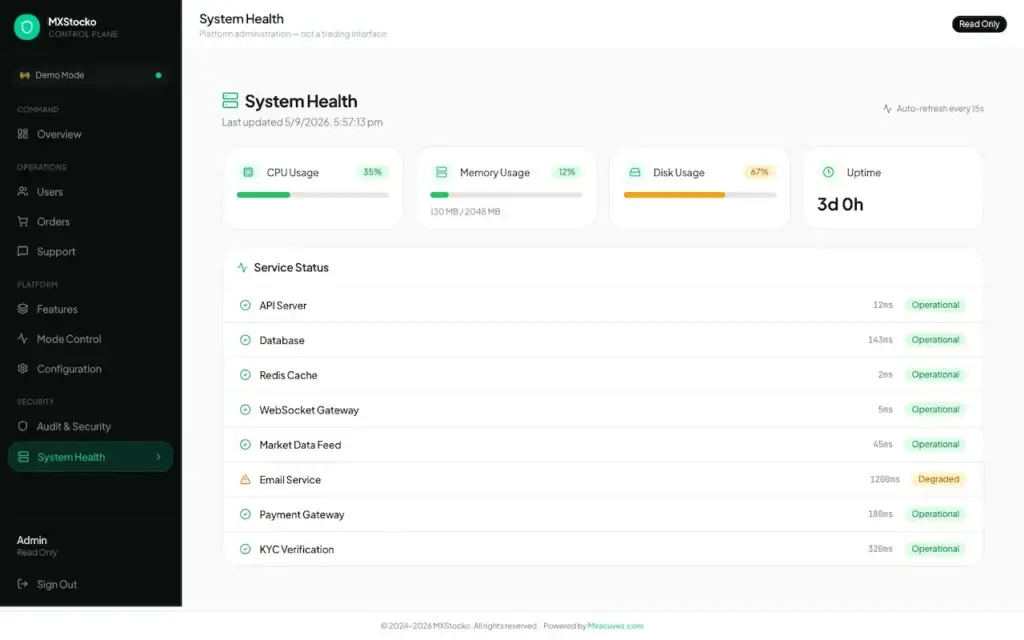
Security policy endpoints surfaced as an admin page, alongside system health. Certification and penetration testing remain operator pursuits; the controls they examine are here.

  • User list, detail and status changes
  • KYC review with approve and reject reasons
  • Order inspection and status override
  • Support ticket desk with assignment

Analytics

Platform metrics for operators alongside the investor-facing portfolio analytics, computed in services rather than in controllers so the heavy aggregates can move behind a queue or a replica later.

  • Platform stats and analytics
  • Activity feed and audit log viewer
  • Feature flags toggled at runtime
  • Security policies and system health

Need deeper governance? Admin authentication is separate from the retail JWT, so a compromised customer credential grants no operator access, and every operator mutation is audit logged with before and after values. Role definitions live in the RBAC tables and are operator-configurable. What is scoped rather than shipped: enforced multi-factor authentication for admin roles, SIEM integration and hard row-level multi-tenancy. Tell us which of those your review process asks for.

Transparent Pricing

How Much Does It Cost to Build an Investment App Like Groww in 2026?

The platform itself is a fixed $7,299. Beyond that, the variable is how much of the surface you switch on for day one. Running live broker execution means a venue connector per broker. Market data carries vendor licensing that is yours rather than ours. Payment gateways need merchant accounts. Enabling the queue workers and Firebase push so systematic plans settle and notifications deliver on launch day is real configuration effort. Store publishing is quoted separately again.

Most Popular
Professional
ReadyMade Turnkey Solution
$7,299/- one-time
⚡ Go-live: 6 days
Best for: Neo-broker founders, wealth platforms & distribution-led fintechs
You get the solution as you see our demo with your own branding and self-hosted on your end.
Get Started →
Enterprise
Custom, Compliance & High-Scale
Custom quote
⚡ Go-live: Based on final scope
Best for: Established brokerages, banks, AMCs & regulated wealth managers
Get it built as you situation demand and business need , as per custom needs.
Request a Quote →
Still deciding?

Not sure which option
is right for you?

Talk to us - we'll understand your goals, timeline, and budget, and point you to exactly what you need. No upselling, just honest advice.

Free 30-min call
Reply within 24 hrs
No pressure, no commitment

The Full Package

What's Included - Groww Clone Source Code, Apps & Deployment

Ownership transfers in full. That matters more here than on a narrower product, because breadth is exactly the thing operators extend: a new asset class, a new venue connector, a new plan tier.

Full Source Code

Web application, core API, mobile app and operator console, all yours to change, rebrand and redeploy with no licence conditions attached and nothing counted per seat.

  • Next.js 16 web application
  • 100+ pages across 41 dashboard route domains
  • 53 component domains
  • 167 backend-for-frontend route handlers

82 Entity Schema

The full PostgreSQL model on TypeORM with polymorphic instrument keys, jsonb extension columns, indexed hot paths, a migration runner and 15 seeders for catalogs and demo data.

  • NestJS 11 core API
  • 55 modules across 52 domains
  • Swagger and OpenAPI decorators
  • Guards, filters, interceptors and pipes

Multi-Asset Order Engine

Four order types, five product types, four validity modes, five exchanges, a seven state lifecycle with partial fills, and server-side charge computation across brokerage, STT and GST.

  • PostgreSQL schema on TypeORM
  • 82 entities with jsonb extension columns
  • Migration runner and CLI config
  • 15 database seeders for catalogs and demo data

Wealth Layer Modules

SIP, STP and SWP with step-up and top-up, goals with progress tracking, tax P&L with harvesting suggestions, dividends, corporate actions and thirteen calculators.

  • React Native 0.73 application
  • 119 screens plus 15 Expo Router routes
  • EAS build profiles for iOS and Android
  • Biometrics, MMKV, Firebase and widgets

KYC & Compliance Stack

Seven state lifecycle across three account types, six document kinds with SHA-256 checksums, PEP and risk fields, an operator review desk and a dedicated KYC audit entity.

  • Ten page operator console
  • Separate admin authentication path
  • Audit log, feature flags and mode management
  • Support ticket desk

React Native App

119 screens plus 15 Expo Router routes, biometric unlock, MMKV storage, Firebase analytics and messaging, offline detection, home-screen widgets and EAS build profiles.

  • Docker Compose for dev and production
  • nginx reverse proxy configuration
  • PM2 process configuration
  • Four GitHub Actions CI/CD workflows

Operator Console

Ten pages covering users, KYC, orders, tickets, analytics, audit, feature flags, security and system health, with separate admin authentication and demo to production mode switching.

  • Prometheus scrape configuration
  • Four Grafana dashboards
  • Health endpoints and a synthetic monitor
  • Deploy, rollback, backup and validation scripts

Deployment & Docs

Docker Compose, nginx, PM2, four CI/CD workflows, Prometheus and four Grafana dashboards, deploy and rollback scripts, plus the eleven document evaluation suite.

  • Eleven documentation files
  • Schema, ERD and API collection
  • VAPT reference mapped to the OWASP Top 10
  • Developer and security handbook

Want to see it running first? Use any of the six demo logins above, or book a walkthrough and we will register an account, push it through the KYC desk, fund a wallet, place an order with the charges visible, and open the portfolio it lands in, against the asset classes you are actually planning to launch with.

Know Your Buyer

Who Is Our Groww Clone App Built For?

The platform suits operators whose product thesis is breadth rather than execution speed. If your differentiator is routing latency or an algo engine, our Zerodha Clone is the better starting point and we would rather say so than sell you the wrong one.

Where this one earns its place is when the roadmap already contains a second and a third asset class, or a wealth layer, or a compliance review. Those are the three things that are expensive to retrofit and cheap to have from the start, because all of them are decisions the schema either made or did not.

Where It Fits

Groww Clone Use Cases - Investing, Wealth, Cross-Market & Operator Control

Launch equities and mutual funds first, with alternatives, derivatives and the US catalog switched off behind feature flags until licensing allows them. The schema already carries every one, so widening later is configuration rather than a migration.

Staged Asset Rollout

Lead with the wealth layer instead. SIP, STP and SWP with step-up and top-up, goals linked to the plans funding them, tax P&L with harvesting suggestions at year end, and dividend and corporate-action tracking underneath.

Wealth-Led Platforms

Sell cross-market access. US equities carry their own catalog, quotes, charts and portfolio type, so an investor holds Indian and US positions in one allocation view. Execution is a venue integration; everything up to it is built.

Cross-Market Access

Pass a compliance review. Typed KYC across individual, corporate and NRI, checksummed documents, an operator review desk, an audit row on every mutation, RBAC with separate admin authentication, and retention guidance per data class.

Compliance-First Deployments

Monetize with tiers rather than with brokerage alone. Five plans across four billing cycles with trials and auto-renew, gated by features and limits JSON so packaging changes are configuration and not releases.

Subscription Monetization

Run several brands from one codebase. Theme tokens, app naming, feature flags, plan JSON and metadata jsonb columns absorb tenant-specific fields, with demo and production modes keeping sales environments away from live data.

Multi-Brand Operators

Every one of these is the same deployment with different switches thrown. That is the point of feature flags and per-plan JSON: the configurations above are settings rather than forks, so an operator can move between them without a migration or a second codebase to maintain.

Multi-asset investing is no longer a differentiator, it is the baseline a retail platform is judged against. What still separates operators is how much of a customer they can hold in one place, and how quickly they can widen when a licence or a market opens up.

Market Timing

Why Launch a Multi-Asset Investing Platform in 2026?

Indian retail investing has widened faster than the software behind most new entrants. Demat accounts, SIP books and derivatives participation have all expanded, but the typical new platform still ships equities first and quotes everything else as a later phase, which is precisely when the highest-value users go elsewhere.

Consolidation Beats Conversion

Every asset class a customer holds elsewhere is an invitation to move. Breadth is the retention mechanic in retail investing, and it is a property of the catalog rather than of the interface.

The Wealth Layer Is the Annuity

Brokerage is cyclical and follows the market. A systematic plan book settles on its own schedule for years, which is why it is the segment worth reaching first rather than last.

Compliance Is Now the First Question

Identity proofing, audit trails and retention are asked about before features are. They are also the most expensive things to retrofit into a schema that was not designed to carry them.

Cross-Market Is Table Stakes

US equities stopped being a premium add-on. A platform without them cedes its most engaged segment, and adding a second market later usually means a second stack nobody wants to reconcile.

Packaging Should Not Need a Release

Five tiers gated by JSON mean pricing is an experiment rather than a deployment. Most platforms discover they need this only after the first pricing change costs them a sprint.

Buy Versus Build Is Settled

A from-scratch equivalent is 18 to 24 months across the order engine, KYC, portfolio mathematics, the mutual fund stack, admin and mobile. A white-label deployment is live on your server in under six days.

Platform by the Numbers

82
Database Entities
55
Backend Modules
119
Mobile Screens
167
API Route Handlers

The second pressure is regulatory. Identity proofing, audit trails and record retention are the questions that get asked first now, not last, and they are expensive to retrofit into a schema that was not designed for them.

Under the Hood

Groww Clone Tech Stack - Next.js, NestJS, PostgreSQL & React Native

One language end to end. TypeScript across the web application, the core API and the mobile app, on conventional frameworks that any team can hire for, with PostgreSQL underneath and no proprietary format to unwind.

Web Application

Next.js 16 · React 19 · Tailwind · Radix

  • 41 dashboard route domains across 100+ pages
  • 53 component domains including a motion library
  • TanStack Query for server state, Zustand for client state
  • PWA with an offline page, i18n locales and dark and light themes

API Layer

NestJS 11 core · Next.js BFF · Passport JWT

  • 55 core modules, 52 of them domain modules
  • 167 backend-for-frontend handlers with Zod validation
  • Guards for JWT, roles and API keys
  • Admin cookie session held apart from the retail JWT

Database

PostgreSQL · TypeORM 0.3

  • 82 entities with jsonb metadata extension columns
  • Polymorphic instrument keys on orders, holdings and watchlists
  • Indexed hot paths on user and status, symbol and status, created date
  • Migration runner plus 15 seeders for catalogs and demo data

Mobile Application

React Native 0.73 · Expo Router

  • 119 screens plus 15 Expo Router routes
  • Biometric unlock and MMKV secure storage
  • Firebase analytics and messaging, NetInfo offline detection
  • EAS build profiles and home-screen widgets

Real-Time & Async

Socket.io · Bull · Redis

  • WebSocket gateway for market ticks, orders and notifications
  • 11 queue producer services, gated by QUEUE_ENABLED
  • 5 scheduled jobs including the NSE provider refresh
  • Systematic plan installments settle through the queue path

Deployment & Observability

Docker · nginx · PM2 · Grafana

  • Compose files for development and production
  • Four GitHub Actions workflows and a validation script
  • Prometheus scrape config with four Grafana dashboards
  • Health endpoints plus a synthetic monitor

Why this stack: Every integration sits behind a service interface rather than inside the domain modules, so payments, market data and push are adapters. Razorpay and Stripe gateways, NSE and Yahoo Finance data providers and an FCM push provider all ship against those interfaces, which is what makes adding a broker venue or a new data vendor an adapter implementation instead of a rewrite. Nothing here is proprietary and nothing is hard to hire for.

End to End

How the Groww Clone Works - Onboard, Fund, Invest & Compound

The path below is the one the platform is built around, and every step of it is enforced in the service layer rather than in the client, which is what makes the sequence auditable after the fact.

Investor Journey, From Signup to a Compounding Portfolio

01-login
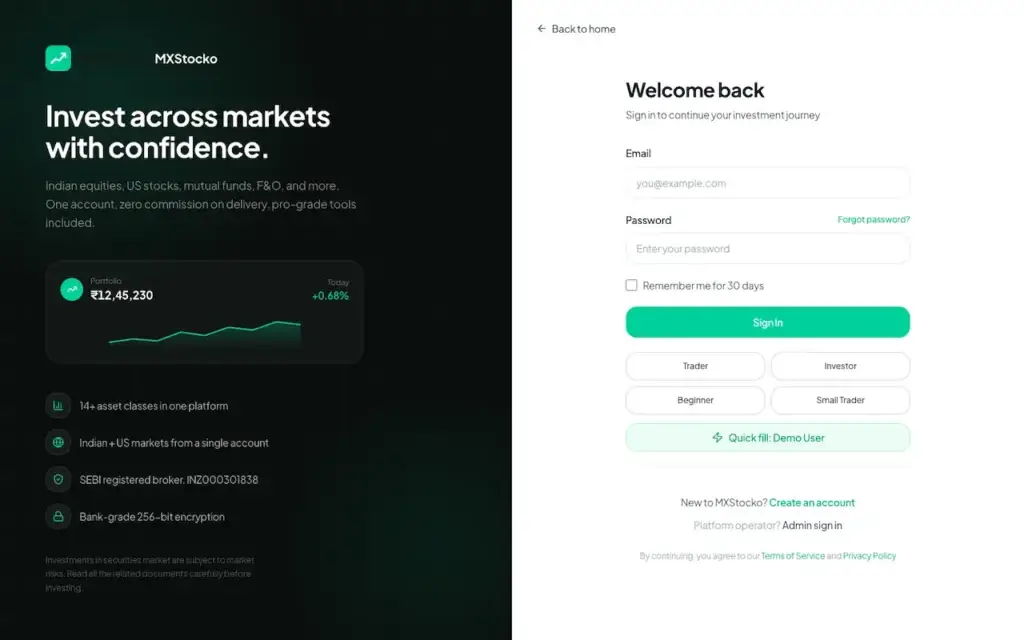
Register and Verify

A new investor signs up and verifies their identity contact before anything financial is possible. Registration is DTO-validated and the password is stored as a bcrypt hash the API will not return.

  • Email and password registration with validation
  • Email verification and mobile OTP flows
  • JWT access token plus a rotating refresh token
  • Individual, corporate and NRI account types
1
01-login
06-settings
Complete KYC

The revenue gate. Documents are uploaded with checksums, the record enters the review queue, and an operator approves or rejects it with a reason that is preserved.

  • Six document types with SHA-256 checksums
  • PAN and Aadhaar verification endpoints
  • PEP flag, risk category and verification level
  • Seven states from pending through to approved or expired
2
06-settings
02-dashboard
Fund the Wallet

Money moves only after server-side verification. A gateway callback on its own never credits a balance, which is the single most important control on the money path.

  • UPI, card and netbanking through gateway adapters
  • Wallet credit occurs only inside the verify path
  • Unique payment identifier gives idempotency on retries
  • Raw gateway response stored for reconciliation
3
02-dashboard
08-buy-order
Place the First Order

Eligibility is checked at order time rather than cached in the client: active user, approved KYC, funded wallet and plan limits. Charges are computed on the server and shown before confirmation.

  • Four order types across five product types
  • Brokerage, STT, GST and transaction charges itemized
  • Seven state lifecycle with partial fill tracking
  • Rejection reasons preserved for support and compliance
4
08-buy-order
03-holdings
Watch the Portfolio Form

The position lands in holdings and the portfolio aggregates recompute. This is the screen investors open most often, and the mathematics behind it is the part most platforms get wrong.

  • Invested against current value with day change
  • CAGR, XIRR and a risk score per portfolio
  • Asset and sector allocation as structured JSON
  • Indian and US positions in one allocation view
5
03-holdings
04-market
Compound With Systematic Plans

The step that turns a customer into an AUM book. A SIP settles on its schedule through the queue path, funded from the wallet, and can be linked to a goal that tracks its own progress.

  • Daily, weekly, monthly and quarterly cadence
  • Step-up percentage and top-up amount
  • Goals with target amount, date and progress
  • Tax P&L and harvesting suggestions at year end
6
04-market

Visual Flow Diagram

Register & Verify KYC Approved Wallet Funded First Order Portfolio Forms SIP Compounds

How It's Built

Groww Clone Platform Architecture & Backend Flow

One Order Model, Many Instruments

Nullable per-asset foreign keys plus an instrumentType discriminator let one orders table, one holdings table and one watchlists table serve twelve instrument entities. This single decision is why the platform is broad without being twelve stacks.

Modular Monolith, Not Microservices

Cross-domain invariants like wallet balance against order settlement, and KYC status against trading eligibility, stay inside one transaction boundary. The hot modules, market data and websocket, are structured for later extraction.

Dual API by Design

The NestJS core at /api/v1 is canonical for mobile and integrators. The Next.js BFF at /api aggregates for browsers, holds the admin cookie session away from the retail JWT, and carries the demo-mode shortcuts.

Verify Before Credit

Wallet balance changes in exactly one place: the payment verification path. A replayed or forged gateway callback cannot mint money, and the unique payment identifier makes retries idempotent.

State Machines in the Service Layer

Order, KYC, payment, subscription and wallet lifecycles are enforced in services rather than in triggers or in the client, and every operator-initiated transition writes an audit row carrying the before and after.

Extensible Without Migrations

jsonb metadata columns sit on most entities, and subscription features and limits are JSON. Tenant fields and packaging changes land as data rather than as schema churn.

Performance Targets

Built to Scale - Indexed Hot Paths, Stateless API & Queue Smoothing

The workload is read-heavy and bursty. Quotes, dashboards and watchlists dominate traffic, and the bursts land on market open and close, which is what the topology is shaped around.

Reads Dominate, So Indexes Decide

Retail investing traffic runs roughly nine reads to every write, and almost all of it is the same handful of queries scoped by user and status.

What the schema indexes:

  • Orders by user and status
  • Orders by symbol and status
  • Orders by creation date
  • KYC by user, status and PAN number

Bursts Land on the Bell

Market open and close produce read spikes on quotes and portfolios rather than write spikes, so the mitigation is caching and fan-out rather than more database capacity.

What absorbs the burst:

  • WebSocket fan-out instead of client polling
  • TanStack Query cache on the client
  • Redis caching path for hot reads
  • Response compression on every route

Writes Get Smoothed by Queues

Systematic plan settlement windows and news ingestion are the write bursts, and both run through Bull producers so they never contend with interactive traffic.

What the queue path carries:

  • 11 producer services across the domains
  • SIP installment settlement
  • External news ingestion
  • Indicators, research and social processing

Storage Grows Where Compliance Requires It

The tables that grow without bound are the ones a regulator will later ask you to produce, which makes retention a design decision rather than a cleanup task.

What the retention model separates:

  • Orders, transactions and payments held seven years
  • Audit logs archived then purged on the same horizon
  • Sessions hard deleted after 30 idle days
  • Notifications archived at 90 days

Stateless API Instances

No server-side session state on the core API, so capacity is added by putting more instances behind a load balancer rather than by rearchitecting anything.

Indexed Where It Reads

Orders by user and status, orders by symbol and status, orders by creation date, and KYC by user, status and PAN number. The queue and reporting scans stay flat as volume climbs.

Queue Smoothing on Writes

Eleven producer services push settlement, news ingestion, indicators and research onto Bull queues, so scheduled write bursts never contend with interactive traffic.

Fan-Out Instead of Polling

A Socket.io gateway pushes market ticks, order updates and notifications, which removes the polling load that otherwise lands hardest exactly at market open.

Money in Decimal, Never Float

Every monetary column is a fixed-scale decimal. It is a small decision that prevents the class of rounding defect that is almost impossible to unwind once it has been in production.

Additions With Names

Redis caching, a WebSocket Redis adapter, read replicas, pgBouncer and CDN fronting are each documented as scoped additions rather than quietly implied as present.

Room to Extend It Later

A modular monolith is the right shape at launch because the invariants that matter, wallet balance against settlement and KYC status against eligibility, stay inside one transaction boundary.

The hot modules are structured for extraction when metrics justify it. Market data and the websocket gateway are the two that would go first, and neither move requires the API contract to change.

Scaling path: Vertical first through the connection pool and the indexes, which are already configured. Then Redis for hot reads, then stateless API instances behind a load balancer, then a Redis adapter for multi-node WebSocket fan-out, then read replicas for analytics. Extraction of market data and websocket out of the monolith comes when the numbers justify it rather than before.

Built to Be Audited

Groww Clone Security - OWASP-Mapped and Candidly Documented

A dedicated VAPT reference maps this platform against the OWASP Top 10. What is present is listed as present, and what needs configuring before a high-assurance go-live is written down as a labelled requirement rather than quietly omitted.

No Card Data on the Server

Payments run through hosted checkout and tokenization at Razorpay or Stripe, so no card number is written to the database. This is the single strongest control in the stack and it also reduces PCI scope.

Wallet Credit Has One Door

Balance changes only inside the server-side verification path. A gateway callback cannot credit money on its own, and the unique payment identifier makes a replayed callback idempotent rather than profitable.

Passwords Never Leave the Database

bcrypt hashing with select:false on the column, so the hash is not returned even by a careless query. Access and refresh tokens are signed with separate secrets and the refresh token rotates.

Admin Blast Radius Contained

Operator authentication is a separate path with its own session surface, so a compromised retail credential grants no console access, and every operator mutation is audit logged with before and after values.

Documents Are Tamper-Evident

Every KYC upload carries a SHA-256 checksum and a UUID key, with no personally identifying information in filenames, so tampering is detectable and paths are not guessable.

Input Rejected by Default

The validation pipe runs whitelist and forbidNonWhitelisted, so unknown properties are rejected rather than ignored. TypeORM parameterizes every query and rendered content is sanitized on the web surface.

The money path and the identity path carry the strongest controls, which is the right priority for a platform handling both. Where the gaps are, they are operational hardening items rather than architectural absences, and they are named below rather than left for a penetration test to find.

Go Further

Groww Clone Add-Ons - Broker Venues, Market Data, Hardening & Enterprise

The platform is complete and demonstrable as it stands. What follows is what operators actually come back and ask for, either because an outside account or a licence is involved, or because their compliance posture needs controls this does not ship enabled.

Broker Venue Connectors

The order lifecycle carries brokerRef and exchangeOrderId and the state machine is ready for fills and rejections. Connecting an actual venue, and mapping its statuses onto the seven order states, is an integration per broker.

Market Data Licensing

NSE and Yahoo Finance provider services ship behind a provider interface, so adding a vendor is an adapter. The licensing itself is yours, and it is the item most commonly underestimated on a launch plan.

Richer Alert Conditions

Price alerts evaluate above and below today. Volume spikes, RSI thresholds, moving-average crossovers, 52-week triggers and news keywords exist in the schema but not in the evaluator, and building that evaluation is scoped work.

Multi-Factor Authentication

TOTP libraries are present and the enable endpoint is not implemented. Completing it, and enforcing it for operator roles specifically, is the authentication item enterprise reviews raise most often.

Object Storage and Scanning

Uploads land on local storage with checksums today. Moving to S3 with presigned URLs, and adding antivirus scanning to the KYC ingestion path, are the two file-handling integrations regulated buyers ask for.

Row-Level Multi-Tenancy

Tenant separation rests on jsonb metadata conventions. Hardening it into enforced row-level tenancy with a tenant column and scoped queries is a customization, and we would rather scope it than imply it exists.

Observability Beyond Grafana

Prometheus, four Grafana dashboards and health checks ship. Error tracking through Sentry, log shipping into a SIEM and alerting thresholds tuned to your traffic are configuration we complete during deployment.

Compliance Certification Support

The control fabric is built and mapped to the OWASP Top 10. SOC 2, ISO 27001 and a third-party VAPT engagement are operator pursuits, and this documentation suite is the scoping artifact they start from.

Building in Fintech? We Have the Whole Market Covered.

The Groww Clone is one platform in a complete fintech suite. If your roadmap extends beyond multi-asset investing, these connect naturally.

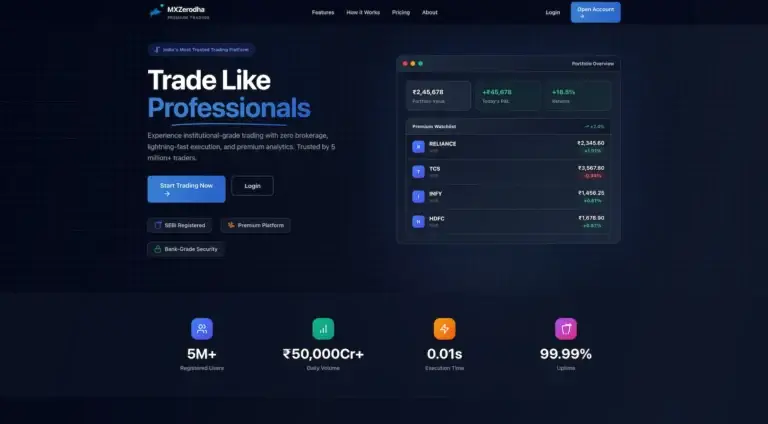
Dark MXZerodha hero page with portfolio watchlist and professional trading statistics
Zerodha Clone

Multi-broker trading platform with order routing, an algo engine and consolidated P&L.

Explore Solution
Trading-platform website section promoting tight spreads, fast execution, and improved cost efficiency for global market traders
Blueberry Markets Clone

Forex and CFD platform with leverage, margin management and multi-account structures.

Explore Solution
Revolut Clone Digital Banking Neobank
Revolut Clone

Neobank platform with multi-currency accounts, transfers, card issuing and spend controls.

Explore Solution
Cred Clone Across Mobile, Web, and Admin Interfaces
Cred Clone

Credit card management platform with bill payments, tracking and a members-only rewards economy.

Explore Solution

The Commercial Case

Marketability, Revenue Potential & Business Prospects

Retail investing is a scale business with a long payback, and the number that decides whether an operator survives is not acquisition cost on its own. It is how much of a customer’s financial life the platform can hold before a competitor offers the part that is missing.

Breadth Is the Retention Mechanic

Every asset class a user holds on your platform is one they are not holding elsewhere. Consolidation is the retention story in retail investing, and it is a function of catalog rather than of interface polish.

Recurring Revenue From Day One

Five subscription tiers across four billing cycles with trials and auto-renew, gated by JSON rather than by code, so pricing is something you experiment with rather than something you ship.

The AUM Annuity

Systematic plans compound without further acquisition spend. A SIP created in month one keeps settling for years, which is why this is the highest-value segment and the one most platforms reach last.

Exit Optionality

The codebase and the schema are yours on standard PostgreSQL, documented across eleven files. There is no proprietary format to unwind and no vendor to renegotiate with at renewal.

What is the realistic path to first revenue?

Most operators launch with equities and mutual funds, the alternatives and derivatives behind feature flags, and a single payment gateway wired. Revenue starts as brokerage on the first orders, which arrives as soon as KYC approvals clear and wallets are funded. Subscription tiers usually switch on once there is a base worth segmenting, because the gating is JSON rather than code and needs no release. The systematic plan book is the slower and more valuable line, and it compounds from whenever you turn it on. The sequencing constraint is almost never the software, since all of it is in the schema already. It is broker execution, market-data licensing and payment credentials, which is why those three sit at the top of the deployment plan rather than at the end.

Defensibility comes from consolidation rather than from features. A user whose equities, funds, US positions, SIPs and goals all live in one portfolio faces a real switching cost, and that cost grows with every asset class you add rather than with every interface improvement you ship. The platform contribution is making breadth cheap to extend: the polymorphic instrument pattern means a new asset class is a new entity and a seeder rather than a parallel stack, and the per-plan JSON means packaging it is configuration. Owning the deployment also means the KYC record, the wallet ledger and the audit trail are yours, which matters most at exactly the moment the business becomes worth acquiring or worth regulating.

Example Revenue Scenarios

That is the commercial argument for breadth. A user who trades equities on your platform and buys funds somewhere else has already told you which product they will consolidate onto. Owning the software matters because the packaging, the tier gating and the asset classes you switch on are the levers that decide whether consolidation runs toward you or away from you.

Focused Launch

2

Asset Classes Live

Equities and mutual funds, everything else flagged off.

An operator launching against a single licence, running equities and funds with the alternatives and derivatives hidden behind feature flags, where the wealth layer activates as the SIP book starts to form.

Full Retail Platform

8

Asset Classes Live

Derivatives, IPOs and alternatives switched on, subscriptions monetizing.

A broker running the majority of the catalog, where subscription tiers gate F&O and tax harvesting, and the systematic plan book has become the predictable half of revenue.

Cross-Market Wealth

15

Asset Classes Live

US equities and the full alternatives stack, multi-brand under one codebase.

A wealth platform running the whole surface including US equities and the fixed-income and gold stack, with several brands as configurations of one deployment rather than as forks.

Why Miracuves

Miracuves vs Other Groww Clone Developers

There are many ways to get an investing platform: generic scripts, freelancers, agencies, or owning the infrastructure.

Why Founders Choose Miracuves

Breadth Ships, It Is Not Quoted

Fifteen asset classes are modeled in the schema on day one. Elsewhere the second and third are change requests that land months after launch, priced individually, each one a new stack to reconcile.

The Wealth Layer Is Not Phase Two

SIP, STP and SWP are three separate entities with goals and tax tooling around them. On most builds systematic plans arrive after the trading surface, which means the highest-value segment is served last.

Portfolio Mathematics Already Correct

CAGR, XIRR, risk score, day change and dual allocation views are built and tested. These are deceptively hard to get right, and they are the screen investors check most often.

An Operator Desk, Not a Database Client

Ten admin pages with an audit log, feature flags, a KYC review desk and a mode switch. On a typical young platform the engineering team is the support desk and approvals happen in scripts.

Written Down for the Review

Schema, entity relationships, an API collection, developer and security handbooks and a VAPT posture mapped to the OWASP Top 10. Procurement asks for these long before it asks for a demo, and they already exist.

The Gaps Are Written Down

Broker execution is an integration, alerts evaluate above and below only, 2FA is not enabled and tenancy is convention rather than enforcement. You read that here rather than discovering it during a security review.

Compare & Discover Why Clients Choose Us as
#1 Ready-Made Clone Solution Partner

Criteria Miracuves Groww Clone Generic Clone Script Custom Dev Agency
Time to Launch 6 days (Production) Unknown / DIY 6-9+ months
Source-Code Ownership ✔ Full Often limited / encrypted Usually yes
Feature Depth (Groww-like) High (multi-asset investing, systematic plans & operator control) Basic (onboarding & feed only) Depends on budget
Security & Compliance Strong (ISO mindset, GDPR-ready) Minimal Varies widely
Scalability & Performance Cloud & CDN-optimized Rarely considered Depends on architecture
Monetization Options Multiple (ads, gifts, subs) Limited / needs custom work Custom (more time & cost)
Admin & Analytics Full-fledged dashboard Very basic or missing Custom build (extra cost)
Cost vs Speed vs Quality Balanced Cheap but risky High cost, slow
Ongoing Support & Updates Available with clear plans Usually none Depends on contract

Most routes to an investing platform hold up until the second asset class. Here is where ours differs.

Industries

Industries We Serve

The Groww Clone suits any operator whose product thesis is holding more of a customer’s financial life rather than executing a trade marginally faster. Neo-broker founders launch equities and funds together with the wealth layer live from day one. Wealth managers and RIAs lead with goals, portfolios and tax efficiency, treating the trading surface as one module. Banks adding an investing tab need the KYC lifecycle, the wallet ledger and the audit fabric to clear internal compliance first. Cross-market platforms sell US access inside one portfolio rather than as a second app. Education-first businesses use the academy and the thirteen calculators as the acquisition product. Insurance-linked and employee-wealth platforms reuse the goals and portfolio spine. White-label vendors run several brands as configurations of one deployment. Agencies and builders take the source and extend it under their own delivery model.

Miracuves’ Groww Clone is built as a multi-asset retail investing platform adaptable to any catalog of instruments, monetized through brokerage, subscriptions and systematic plan AUM where your business requires it, and white-labelled entirely under your brand.

Changelog

Groww Clone Release Log - Version History & Updates

Version Date <span style="color: rgb(6, 6, 8); font-family: Montserrat, sans-serif; font-size: 13px; font-style: normal; font-variant-ligatures: normal; font-variant-caps: normal; font-weight: 700; text-align: left; white-space-collapse: collapse; background-color: rgb(255, 255, 255);">What's New</span>
v2026.1 Sep 2026 Initial release. 15 asset classes in one portfolio, SIP/STP/SWP, goals, tax tooling, KYC desk, operator console and a 119 screen mobile app.

Blog & Resources

Groww Clone App - Latest Insights & Guides

Writing on the business of retail investing platforms: how Groww actually makes money, what a multi-asset catalog costs to run, and what separates a trading app from a wealth platform.

FAQ

Groww Clone FAQ - Asset Classes, Wealth Tools, Compliance & Deployment

Everything you need to know about the Miracuves Groww Clone.

What is a Groww Clone App?

It is a retail investing platform where breadth is the product rather than a roadmap item. One identity carries one KYC record, one set of wallets and one portfolio, and that portfolio spans Indian equities, US equities, mutual funds, ETFs, index funds, IPOs, derivatives, commodities, currency, bonds, fixed deposits, digital gold, SGBs, REITs and P2P. Around it sit the tools that make an investing product sticky rather than transactional: SIP, STP and SWP with step-up and top-up, financial goals, tax P&L with harvesting suggestions, dividend and corporate-action tracking, thirteen calculators and an academy. Web, a 119 screen mobile app and a ten page operator console all read the same 82 entity PostgreSQL schema.

It is the codebase rather than a hosted service: the Next.js 16 web application with its 167 backend-for-frontend route handlers, the NestJS 11 core API across 55 modules, the 82 entity TypeORM schema with its migration runner and 15 seeders, the React Native application of 119 screens with EAS build profiles, and the deployment kit carrying Docker, nginx, PM2, four CI pipelines and four Grafana dashboards. Ownership transfers in full. There is no runtime licence and nothing is counted per seat.

They are genuinely different platforms, not two presentations of one codebase, and the honest answer is that they solve different problems. The Zerodha Clone is about execution depth: multi-broker order routing, an algo engine, consolidated P&L across broker connections, built for trading-first businesses and prop desks. This one is about breadth: fifteen asset classes in one portfolio, plus the wealth layer of systematic plans, goals and tax tooling that turns a trading app into a platform someone consolidates their financial life onto. Pick the Zerodha Clone if your differentiator is how a trade gets executed. Pick this one if it is how much of a customer you can hold. Tell us which you are actually solving and we will point you at the right one even when it is the cheaper one.

The Miracuves Groww Clone starts from $7,299 for a launch-ready white-label deployment. Final scope varies with which asset classes you switch on at launch, broker venue integration, market-data vendor licensing, payment gateway setup, push and queue enablement, and store publishing.

Six working days covers our part, which is rebranding the platform and deploying it to your infrastructure. What lengthens the timeline sits on your side, and on an investing platform it is almost always external rather than technical: broker registration and the venue connection, market-data licensing, merchant accounts per gateway, and a Firebase project if push must work on day one. Brand assets and hosting access complete the list. We would rather set that expectation now than discover it in week three.

Modeled in the schema and surfaced in the product: Indian equities on NSE and BSE, US equities on NYSE and NASDAQ, mutual funds, ETFs, index funds, IPOs with grey market premium and allotment, futures and options, intraday and the margin trading facility, commodities on MCX, currency pairs, bonds, fixed deposits, digital gold and SGBs, REITs and P2P. Each has its own entity with its own typed fields, and orders, holdings and watchlists reach all of them through polymorphic keys. You can launch with two and switch the rest on behind feature flags as licensing allows, which is configuration rather than development.

Does it handle SIPs, goals and tax properly?

Yes, and this is the part we would point at first. SIP, STP and SWP are three separate entities rather than variants of one, carrying daily through quarterly frequencies, step-up percentages, top-up amounts and auto-invest on dividend, with a full scheduled through completed lifecycle. Goals track a target amount and date against progress and link to the plans funding them. Tax gives you realized P&L with short and long-term splits plus a harvesting suggestion engine, and dividends and corporate actions are tracked so holdings reconciliation stays correct. Installment settlement runs through the Bull queue path, so enabling the queue workers is part of the deployment rather than optional.

The order engine is complete: four order types across five product types and four validity modes on five exchanges, a seven state lifecycle with partial fills and preserved rejection reasons, and server-side charge computation covering brokerage, STT, GST and transaction charges. What is not included is a connection to a live venue. The lifecycle carries brokerRef and exchangeOrderId and expects fills from a connector, so wiring an actual broker is an integration per venue rather than a rearchitecture. Paper trading works out of the box through the isDemo flag and the platform mode subsystem, which is also what makes the sales demo safe to hand to a prospect.

It is a React Native application of 119 screens plus 15 Expo Router routes, not a web wrapper. It carries auth with biometric unlock, the dashboard, market and instrument screens, orders, holdings with analytics, watchlist, wallet, KYC status, alerts, news, IPO, SIP creation, all thirteen calculators, the alternatives stack covering bonds, FD, gold, SGB, REIT and P2P, research screens for ESG, comparison, corporate actions and dividends, and market intelligence including the intraday screener, pre-open, sector heatmap and sentiment. Home-screen widgets, Firebase messaging, MMKV storage and offline detection ship with it. The F&O terminal and the admin console are deliberately web-first.

Ten console pages cover the daily loop: platform stats and an activity feed, user management with status changes, the KYC review desk with approve and reject reasons, order inspection and status override, the support ticket queue, analytics, the audit log viewer, feature flags, security policies and system health. On top of that sits the platform mode subsystem, which switches the whole deployment between demo and production with mode history, production readiness checks and a demo data reset. Subscription packaging is per-plan JSON, so moving a feature between tiers needs no release either.

It arrives with a VAPT reference mapped to the OWASP Top 10 that is willing to mark its own gaps. Built controls include bcrypt password hashing with the column not selectable, JWT access and refresh tokens on separate secrets with rotation, RBAC with row-level user scoping, an admin authentication path separate from the retail one, server-side payment verification before any wallet credit, SHA-256 checksums on KYC documents, validation that rejects unknown properties outright, parameterized queries throughout, and an audit row on every operator mutation. The items to close during deployment are named just as plainly: 2FA is not enabled although the TOTP libraries ship, secrets belong in a vault rather than environment files, uploads are not virus scanned, Swagger must be disabled and CORS tightened in production, authentication and OTP routes deserve tighter throttling than the 100 per minute default, and multi-tenant separation is convention rather than enforced row-level tenancy.

The source transfers in full: the web application, the core API, the mobile app, the operator console, the schema with its migrations and seeders, the deployment kit and the documentation suite. On licensing, the distinction matters and we state it plainly. Miracuves supplies platform software, not broker registration. Exchange membership, broker licensing and KYC/AML obligations remain yours as the operator. What the platform provides is the control fabric those licences are examined against, which is the KYC lifecycle, the audit trail, RBAC, retention guidance and the security mapping, so the review has something to look at rather than a promise.

Let's build together

Let's turn your idea into
a live platform.

Get a free consultation, a clear timeline, and honest answers. We'd rather earn your trust than rush a sale.

Reply in 24 hrs
Free consultation
No lock-in contracts
Full source code ownership
Disclaimer

Miracuves is an independent software development company. We are not affiliated with, connected to, sponsored by, or endorsed by Groww.

Why this name

Groww Clone” is used descriptively. It is how the software industry refers to building a platform with functionality similar to Groww, and how clients search for it.

Who built this

The entire design and codebase is built by our own team. The product contains no code, design, graphics, or content originating from the Groww website or applications.

Trademarks

Groww and all other third-party names and marks are the property of their respective owners, referenced here solely to describe the category of software offered.